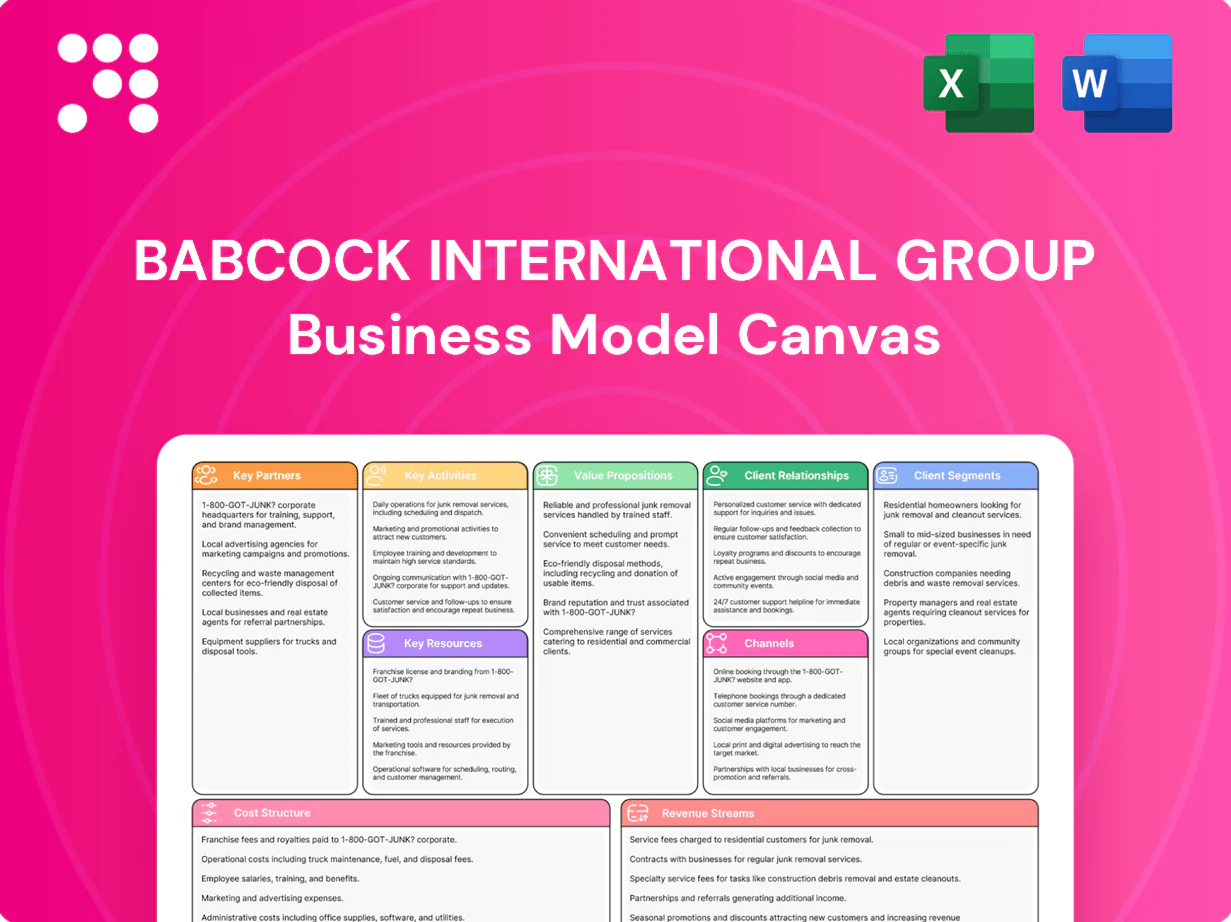
Babcock International Group Business Model Canvas

Business Model Canvas for a defense and engineering services group
Unlock the strategic blueprint of Babcock International Group with our concise Business Model Canvas — uncover value propositions, key partners, and revenue levers that fuel growth. Ideal for investors and consultants seeking actionable insights. Download the full Canvas in Word and Excel to benchmark and strategize immediately.
Partnerships

Defence ministries
Partnerships with the UK MoD, allied navies and air forces underpin long-term fleet and base support contracts, providing secure demand, clearance pathways and formal performance frameworks; Babcock reported c.£3.1bn revenue and an order book near £8.8bn in FY2024 supporting lifecycle services. Co-development on capability upgrades aligns deliveries to mission needs, while strategic alliances boost bid competitiveness and end-to-end lifecycle integration.
Prime contractors & OEMs
Collaboration with OEMs like shipbuilders, vehicle and avionics manufacturers ensures Babcock access to IP, spares and design updates, underpinning through-life support. Tier-1 primes leverage Babcock for sustainment of complex platforms; Babcock reported revenue £4.3bn and c.35,000 staff in 2023. Joint bids blend manufacturing and in-service strengths, while technology transfer accelerates sustainment innovation.

Nuclear regulators & agencies
Working with the ONR (established 2011) and international equivalents is essential for nuclear safety compliance across roughly 36 licensed civil sites in Great Britain; partnerships with site licensees and waste authorities such as the NDA (overseeing around 17 strategic sites) enable operations and decommissioning. Shared protocols reduce regulatory risk and schedule delays, while continuous oversight strengthens safety culture and stakeholder trust.

Technology & training partners
- simulation partners: faster deployment
- digital twin: improved asset life-cycle data
- R&D/academia: expanded test capacity
- curricula co-development: skills currency
Supply chain & logistics
Specialist MRO suppliers, materials providers and logistics firms secure availability of critical spares to uphold Babcock’s safety and airworthiness obligations, with quality-certified partners enforcing regulatory compliance and auditability. Long-term agreements stabilise pricing and lead times, while distributed logistics hubs enable rapid deployment to customer sites worldwide, sustaining mission-critical readiness across defence and civil programmes.
- Specialist MRO suppliers
- Quality-certified materials providers
- Long-term supply agreements
- Distributed global logistics hubs
MoD/OEM partnerships secure £3.1bn revenue, £8.8bn orders
Key partnerships with the UK MoD, OEMs, regulators and digital/R&D allies secure lifecycle contracts, IP/spares access and compliance, underpinning c.£3.1bn FY2024 revenue and an order book near £8.8bn; ~35,000 staff sustain global delivery across ~36 licensed civil sites.
| Metric | Value |
|---|---|
| FY2024 revenue | £3.1bn |
| Order book | £8.8bn |
| Employees | ~35,000 |
| Licensed civil sites | ~36 |
What is included in the product
 Detailed Word Document
A comprehensive Business Model Canvas tailored to Babcock International Group, detailing customer segments, channels, value propositions and revenue streams across the 9 classic BMC blocks and reflecting real-world defence, engineering and support operations. Ideal for presentations and investor due diligence, it includes SWOT-linked insights and competitive advantages to support strategic decisions and funding discussions.

 Customizable Excel Spreadsheet
Condenses Babcock International Group's strategy into a digestible, one-page Business Model Canvas with editable cells to quickly identify core components and relieve strategic planning friction for boards and teams.
Activities

Through-life support
Integrated maintenance, overhaul and upgrades extend fleet and asset lifecycles, supporting readiness across naval and aviation programmes. In 2024 condition-based and predictive maintenance reduced operational downtime by up to 50% and cut maintenance costs by as much as 30%. Rigorous configuration control maintains airworthiness and seaworthiness, while obsolescence management secures long-term parts availability and supply-chain resilience.
Complex program delivery
Planning and executing multi-year defence and nuclear projects is core, with integrated programme teams managing scopes that commonly span 5–15 years and an order book around £4.0bn in 2024. Systems integration, retrofit and refit activities are coordinated across sites to optimize throughput and reduce downtime. Earned value management and rigorous safety systems track performance to specification. Active risk management enforces cost and schedule discipline.

Nuclear operations
Operating, maintaining and decommissioning nuclear facilities demands stringent controls, with radiological safety, waste handling and regulatory compliance embedded in all processes. Specialist procedures minimize environmental impact and continuous monitoring safeguards people and assets. The UK nuclear sector supplied about 14% of electricity in 2023 and Sellafield decommissioning costs are estimated at over £130 billion, underpinning long-term contract demand for Babcock's services.

Training & simulation
Designing and delivering technical, flight and naval training underpins readiness, with simulation and synthetic environments reducing cost and risk by up to 40% and increasing trainee throughput by ~25% (2024 industry estimates). Competency frameworks map to UK MOD and regulator standards, while data-driven feedback has improved pass rates and operational readiness in 2024 deployments.
- Readiness-focused technical, flight, naval training
- Simulation: up to 40% cost/risk reduction
- Throughput +25% via synthetic environments
- Competency frameworks aligned to UK MOD/regulators
- Data-driven feedback improves pass rates
Engineering & digital
Design authority, systems engineering and certification underpin modifications, driving regulated safety and traceable lifecycle decisions. Digital twins, asset analytics and strengthened cybersecurity harden operations and reduce unplanned downtime. Software-enabled diagnostics boost availability while engineering change management ensures full traceability across c.33,000 employees (2024).
- Design authority
- Systems engineering
- Certification & traceability
- Digital twins & analytics
- Cybersecurity
- Software diagnostics
Integrated MRO & nuclear services — order book £4.0bn, c.33,000 staff
Core activities: integrated MRO, long-term defence/nuclear programmes and training sustain readiness; order book ~£4.0bn (2024) and c.33,000 employees. Condition‑based maintenance cut downtime up to 50% and costs ~30% (2024); nuclear services align with UK nuclear output ~14% (2023) and long-term Sellafield decommissioning demand.
| Metric | 2023/24 |
|---|---|
| Order book | £4.0bn (2024) |
| Employees | c.33,000 (2024) |
| UK nuclear share | 14% (2023) |
Full Document Unlocks After Purchase
Business Model Canvas
The document you're previewing is the actual Babcock International Group Business Model Canvas—not a mockup—and it contains the same content, structure and formatting you will receive after purchase. Upon completing your order you’ll get the full editable file, ready to download in Word and Excel formats. What you see is what you’ll own: complete, professional and ready to use.

Business Model Canvas for a defense and engineering services group
Unlock the strategic blueprint of Babcock International Group with our concise Business Model Canvas — uncover value propositions, key partners, and revenue levers that fuel growth. Ideal for investors and consultants seeking actionable insights. Download the full Canvas in Word and Excel to benchmark and strategize immediately.
Partnerships
Defence ministries
Partnerships with the UK MoD, allied navies and air forces underpin long-term fleet and base support contracts, providing secure demand, clearance pathways and formal performance frameworks; Babcock reported c.£3.1bn revenue and an order book near £8.8bn in FY2024 supporting lifecycle services. Co-development on capability upgrades aligns deliveries to mission needs, while strategic alliances boost bid competitiveness and end-to-end lifecycle integration.
Prime contractors & OEMs
Collaboration with OEMs like shipbuilders, vehicle and avionics manufacturers ensures Babcock access to IP, spares and design updates, underpinning through-life support. Tier-1 primes leverage Babcock for sustainment of complex platforms; Babcock reported revenue £4.3bn and c.35,000 staff in 2023. Joint bids blend manufacturing and in-service strengths, while technology transfer accelerates sustainment innovation.
Nuclear regulators & agencies
Working with the ONR (established 2011) and international equivalents is essential for nuclear safety compliance across roughly 36 licensed civil sites in Great Britain; partnerships with site licensees and waste authorities such as the NDA (overseeing around 17 strategic sites) enable operations and decommissioning. Shared protocols reduce regulatory risk and schedule delays, while continuous oversight strengthens safety culture and stakeholder trust.
Technology & training partners
- simulation partners: faster deployment
- digital twin: improved asset life-cycle data
- R&D/academia: expanded test capacity
- curricula co-development: skills currency
Supply chain & logistics
Specialist MRO suppliers, materials providers and logistics firms secure availability of critical spares to uphold Babcock’s safety and airworthiness obligations, with quality-certified partners enforcing regulatory compliance and auditability. Long-term agreements stabilise pricing and lead times, while distributed logistics hubs enable rapid deployment to customer sites worldwide, sustaining mission-critical readiness across defence and civil programmes.
- Specialist MRO suppliers
- Quality-certified materials providers
- Long-term supply agreements
- Distributed global logistics hubs
MoD/OEM partnerships secure £3.1bn revenue, £8.8bn orders
Key partnerships with the UK MoD, OEMs, regulators and digital/R&D allies secure lifecycle contracts, IP/spares access and compliance, underpinning c.£3.1bn FY2024 revenue and an order book near £8.8bn; ~35,000 staff sustain global delivery across ~36 licensed civil sites.
| Metric | Value |
|---|---|
| FY2024 revenue | £3.1bn |
| Order book | £8.8bn |
| Employees | ~35,000 |
| Licensed civil sites | ~36 |
What is included in the product
Detailed Word Document
A comprehensive Business Model Canvas tailored to Babcock International Group, detailing customer segments, channels, value propositions and revenue streams across the 9 classic BMC blocks and reflecting real-world defence, engineering and support operations. Ideal for presentations and investor due diligence, it includes SWOT-linked insights and competitive advantages to support strategic decisions and funding discussions.
Customizable Excel Spreadsheet
Condenses Babcock International Group's strategy into a digestible, one-page Business Model Canvas with editable cells to quickly identify core components and relieve strategic planning friction for boards and teams.
Activities
Through-life support
Integrated maintenance, overhaul and upgrades extend fleet and asset lifecycles, supporting readiness across naval and aviation programmes. In 2024 condition-based and predictive maintenance reduced operational downtime by up to 50% and cut maintenance costs by as much as 30%. Rigorous configuration control maintains airworthiness and seaworthiness, while obsolescence management secures long-term parts availability and supply-chain resilience.
Complex program delivery
Planning and executing multi-year defence and nuclear projects is core, with integrated programme teams managing scopes that commonly span 5–15 years and an order book around £4.0bn in 2024. Systems integration, retrofit and refit activities are coordinated across sites to optimize throughput and reduce downtime. Earned value management and rigorous safety systems track performance to specification. Active risk management enforces cost and schedule discipline.
Nuclear operations
Operating, maintaining and decommissioning nuclear facilities demands stringent controls, with radiological safety, waste handling and regulatory compliance embedded in all processes. Specialist procedures minimize environmental impact and continuous monitoring safeguards people and assets. The UK nuclear sector supplied about 14% of electricity in 2023 and Sellafield decommissioning costs are estimated at over £130 billion, underpinning long-term contract demand for Babcock's services.
Training & simulation
Designing and delivering technical, flight and naval training underpins readiness, with simulation and synthetic environments reducing cost and risk by up to 40% and increasing trainee throughput by ~25% (2024 industry estimates). Competency frameworks map to UK MOD and regulator standards, while data-driven feedback has improved pass rates and operational readiness in 2024 deployments.
- Readiness-focused technical, flight, naval training
- Simulation: up to 40% cost/risk reduction
- Throughput +25% via synthetic environments
- Competency frameworks aligned to UK MOD/regulators
- Data-driven feedback improves pass rates
Engineering & digital
Design authority, systems engineering and certification underpin modifications, driving regulated safety and traceable lifecycle decisions. Digital twins, asset analytics and strengthened cybersecurity harden operations and reduce unplanned downtime. Software-enabled diagnostics boost availability while engineering change management ensures full traceability across c.33,000 employees (2024).
- Design authority
- Systems engineering
- Certification & traceability
- Digital twins & analytics
- Cybersecurity
- Software diagnostics
Integrated MRO & nuclear services — order book £4.0bn, c.33,000 staff
Core activities: integrated MRO, long-term defence/nuclear programmes and training sustain readiness; order book ~£4.0bn (2024) and c.33,000 employees. Condition‑based maintenance cut downtime up to 50% and costs ~30% (2024); nuclear services align with UK nuclear output ~14% (2023) and long-term Sellafield decommissioning demand.
| Metric | 2023/24 |
|---|---|
| Order book | £4.0bn (2024) |
| Employees | c.33,000 (2024) |
| UK nuclear share | 14% (2023) |
Full Document Unlocks After Purchase
Business Model Canvas
The document you're previewing is the actual Babcock International Group Business Model Canvas—not a mockup—and it contains the same content, structure and formatting you will receive after purchase. Upon completing your order you’ll get the full editable file, ready to download in Word and Excel formats. What you see is what you’ll own: complete, professional and ready to use.
Original: $10.00
-65%$10.00
$3.50Description
Business Model Canvas for a defense and engineering services group
Unlock the strategic blueprint of Babcock International Group with our concise Business Model Canvas — uncover value propositions, key partners, and revenue levers that fuel growth. Ideal for investors and consultants seeking actionable insights. Download the full Canvas in Word and Excel to benchmark and strategize immediately.
Partnerships
Defence ministries
Partnerships with the UK MoD, allied navies and air forces underpin long-term fleet and base support contracts, providing secure demand, clearance pathways and formal performance frameworks; Babcock reported c.£3.1bn revenue and an order book near £8.8bn in FY2024 supporting lifecycle services. Co-development on capability upgrades aligns deliveries to mission needs, while strategic alliances boost bid competitiveness and end-to-end lifecycle integration.
Prime contractors & OEMs
Collaboration with OEMs like shipbuilders, vehicle and avionics manufacturers ensures Babcock access to IP, spares and design updates, underpinning through-life support. Tier-1 primes leverage Babcock for sustainment of complex platforms; Babcock reported revenue £4.3bn and c.35,000 staff in 2023. Joint bids blend manufacturing and in-service strengths, while technology transfer accelerates sustainment innovation.
Nuclear regulators & agencies
Working with the ONR (established 2011) and international equivalents is essential for nuclear safety compliance across roughly 36 licensed civil sites in Great Britain; partnerships with site licensees and waste authorities such as the NDA (overseeing around 17 strategic sites) enable operations and decommissioning. Shared protocols reduce regulatory risk and schedule delays, while continuous oversight strengthens safety culture and stakeholder trust.
Technology & training partners
- simulation partners: faster deployment
- digital twin: improved asset life-cycle data
- R&D/academia: expanded test capacity
- curricula co-development: skills currency
Supply chain & logistics
Specialist MRO suppliers, materials providers and logistics firms secure availability of critical spares to uphold Babcock’s safety and airworthiness obligations, with quality-certified partners enforcing regulatory compliance and auditability. Long-term agreements stabilise pricing and lead times, while distributed logistics hubs enable rapid deployment to customer sites worldwide, sustaining mission-critical readiness across defence and civil programmes.
- Specialist MRO suppliers
- Quality-certified materials providers
- Long-term supply agreements
- Distributed global logistics hubs
MoD/OEM partnerships secure £3.1bn revenue, £8.8bn orders
Key partnerships with the UK MoD, OEMs, regulators and digital/R&D allies secure lifecycle contracts, IP/spares access and compliance, underpinning c.£3.1bn FY2024 revenue and an order book near £8.8bn; ~35,000 staff sustain global delivery across ~36 licensed civil sites.
| Metric | Value |
|---|---|
| FY2024 revenue | £3.1bn |
| Order book | £8.8bn |
| Employees | ~35,000 |
| Licensed civil sites | ~36 |
What is included in the product
Detailed Word Document
A comprehensive Business Model Canvas tailored to Babcock International Group, detailing customer segments, channels, value propositions and revenue streams across the 9 classic BMC blocks and reflecting real-world defence, engineering and support operations. Ideal for presentations and investor due diligence, it includes SWOT-linked insights and competitive advantages to support strategic decisions and funding discussions.
Customizable Excel Spreadsheet
Condenses Babcock International Group's strategy into a digestible, one-page Business Model Canvas with editable cells to quickly identify core components and relieve strategic planning friction for boards and teams.
Activities
Through-life support
Integrated maintenance, overhaul and upgrades extend fleet and asset lifecycles, supporting readiness across naval and aviation programmes. In 2024 condition-based and predictive maintenance reduced operational downtime by up to 50% and cut maintenance costs by as much as 30%. Rigorous configuration control maintains airworthiness and seaworthiness, while obsolescence management secures long-term parts availability and supply-chain resilience.
Complex program delivery
Planning and executing multi-year defence and nuclear projects is core, with integrated programme teams managing scopes that commonly span 5–15 years and an order book around £4.0bn in 2024. Systems integration, retrofit and refit activities are coordinated across sites to optimize throughput and reduce downtime. Earned value management and rigorous safety systems track performance to specification. Active risk management enforces cost and schedule discipline.
Nuclear operations
Operating, maintaining and decommissioning nuclear facilities demands stringent controls, with radiological safety, waste handling and regulatory compliance embedded in all processes. Specialist procedures minimize environmental impact and continuous monitoring safeguards people and assets. The UK nuclear sector supplied about 14% of electricity in 2023 and Sellafield decommissioning costs are estimated at over £130 billion, underpinning long-term contract demand for Babcock's services.
Training & simulation
Designing and delivering technical, flight and naval training underpins readiness, with simulation and synthetic environments reducing cost and risk by up to 40% and increasing trainee throughput by ~25% (2024 industry estimates). Competency frameworks map to UK MOD and regulator standards, while data-driven feedback has improved pass rates and operational readiness in 2024 deployments.
- Readiness-focused technical, flight, naval training
- Simulation: up to 40% cost/risk reduction
- Throughput +25% via synthetic environments
- Competency frameworks aligned to UK MOD/regulators
- Data-driven feedback improves pass rates
Engineering & digital
Design authority, systems engineering and certification underpin modifications, driving regulated safety and traceable lifecycle decisions. Digital twins, asset analytics and strengthened cybersecurity harden operations and reduce unplanned downtime. Software-enabled diagnostics boost availability while engineering change management ensures full traceability across c.33,000 employees (2024).
- Design authority
- Systems engineering
- Certification & traceability
- Digital twins & analytics
- Cybersecurity
- Software diagnostics
Integrated MRO & nuclear services — order book £4.0bn, c.33,000 staff
Core activities: integrated MRO, long-term defence/nuclear programmes and training sustain readiness; order book ~£4.0bn (2024) and c.33,000 employees. Condition‑based maintenance cut downtime up to 50% and costs ~30% (2024); nuclear services align with UK nuclear output ~14% (2023) and long-term Sellafield decommissioning demand.
| Metric | 2023/24 |
|---|---|
| Order book | £4.0bn (2024) |
| Employees | c.33,000 (2024) |
| UK nuclear share | 14% (2023) |
Full Document Unlocks After Purchase
Business Model Canvas
The document you're previewing is the actual Babcock International Group Business Model Canvas—not a mockup—and it contains the same content, structure and formatting you will receive after purchase. Upon completing your order you’ll get the full editable file, ready to download in Word and Excel formats. What you see is what you’ll own: complete, professional and ready to use.











