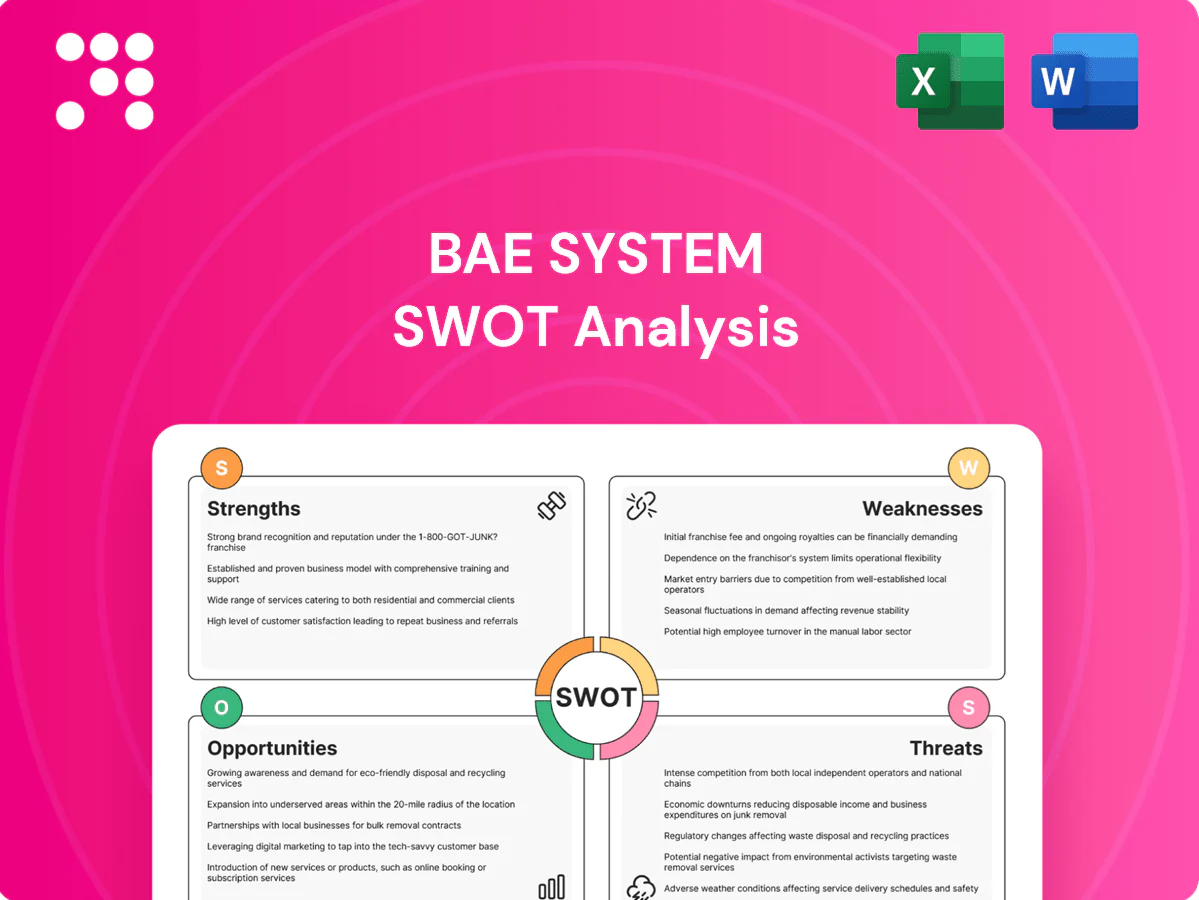
BAE System SWOT Analysis

Go Beyond the Preview—Access the Full Strategic Report
BAE Systems combines scale, diversified defence platforms, and strong government ties—yet faces programme risks, budget sensitivity, and competitive pressure. Our full SWOT unpacks these dynamics, strategic options, and financial implications in a ready-to-use report. Purchase the complete analysis for editable, research-backed insights to guide investment or strategy decisions.
Strengths

Broad defense portfolio
BAE Systems spans air, land, sea, cyber and electronics, reducing reliance on any single platform and supporting integrated multi-domain solutions. This diversification helps stabilize revenue—BAE reported about £25.2bn in FY2024—smoothing cycles across programs. The breadth enables cross-domain integration in complex operations and supports upselling lifecycle services and upgrades.
Deep government relationships
Long-standing ties with the UK, U.S. and allied governments secure multi-year contracts often in the £100sm–£1bn+ range, underpinning BAE Systems’ pipeline and recurring revenue; NATO members spent c. $1.3tn on defence in 2023, supporting demand. Trusted-supplier status and classified programmes raise switching costs and entry barriers, while political alignment with key NATO customers enhances multi-year visibility and entrenches incumbency.

High-value aftermarket & support
Sustainment, training and modernization contracts deliver recurring cash flows for BAE, turning one-off platform sales into long-term service revenue streams. Long program lives—often spanning decades—generate aftermarket income well beyond initial deliveries, enhancing lifetime value. Data-driven maintenance and predictive logistics lift margins and customer stickiness, smoothing earnings versus new-build cyclicality.

Advanced electronics & cyber
Strength in sensors, EW, C4ISR and cyber places BAE in mission-critical niches where electronics content per platform is increasing, boosting value capture; software-defined secure processing and embedded cyber hardening further differentiate offerings and enable networked-warfare solutions.
- Tags: EW
- Tags: C4ISR
- Tags: Cyber
- Tags: Sensors
Global footprint & partnerships
Multi-domain defense leader with recurring aftermarket cashflows and global program visibility
BAE Systems offers multi-domain capabilities across air, land, sea, cyber and electronics, supporting integrated solutions and recurring lifecycle services. FY2024 group revenue was £22.2bn with operations in over 40 countries, underpinning scale and diversification. Long-term government contracts plus strength in C4ISR, EW and cyber create high barriers to entry, sustained aftermarket cashflows and multi-year program visibility.
| Metric | Value |
|---|---|
| FY2024 revenue | £22.2bn |
| Geographic presence | >40 countries |
| Core niches | C4ISR, EW, Cyber, Sensors |
What is included in the product
 Detailed Word Document
Provides a concise SWOT analysis of BAE Systems, highlighting its core strengths and operational capabilities, key weaknesses and internal gaps, strategic growth opportunities in defense and technology markets, and external threats from competition, geopolitics, and regulatory risks.

 Customizable Excel Spreadsheet
Provides a concise, visual SWOT matrix tailored to BAE Systems for fast strategy alignment and clear mitigation of defense-industry risks; ideal for executive briefings and cross-functional decision-making.
Weaknesses

Budget dependence
BAE Systems remains heavily budget-dependent, tying much of its revenue to government defense spending cycles such as the US FY2024 discretionary defense budget of roughly $858 billion. Political shifts and deficit pressures can delay or resize major programs, while continuing resolutions and procurement pauses have repeatedly disrupted cash flow and milestone payments. High customer concentration with governments amplifies revenue volatility risk.
Program execution risk
Complex fixed‑price and incentive contracts expose BAE to delays and cost overruns, particularly on large naval and aerospace programs. Supply‑chain disruptions and component qualification hurdles have inflated unit costs and schedule risk. Milestone slippage compresses margins and undermines credibility with prime customers. High‑profile setbacks can reduce competitiveness for future award opportunities.

Export and compliance constraints
ITAR, export controls and security regulations restrict sales agility and hinder technology transfer to many markets. Licensing delays commonly stretch for months, derailing international opportunities; ITAR violations carry civil/criminal penalties up to $1,000,000 and 20 years imprisonment. Compliance costs are high and rising across the sector, and breaches prompt fines and severe reputational damage that jeopardize contracts.

Legacy product exposure
BAE's legacy product exposure forces costly mid-life upgrades to stay competitive, with sustainment often accounting for up to 50% of platform lifecycle costs.
Technical debt in older platforms slows rapid capability insertion and increases time-to-field versus newer designs.
Backward-compatibility engineering raises program complexity and can compress margins compared with clean-sheet programs; UK defence spending was roughly £50bn in 2024.
- High sustainment share
- Slower capability insertion
- Engineering complexity
- Margin compression vs clean-sheet
Complex supply chain
BAE Systems relies on a multi-tier network of specialized suppliers that creates bottleneck risks and concentrates dependency on limited sources for critical components, increasing lead times and procurement vulnerability. Ensuring quality, cybersecurity and regulatory assurance across tiers is resource-intensive and raises operating costs. When a supplier disruption occurs, delays commonly ripple into program schedules and cost-performance metrics.
- multi-tier supplier concentration
- limited sources → longer lead times
- high QA/cyber assurance cost
- disruptions ripple to schedule & cost
Defense contractor revenues tied to government budgets, sustainment costs and export controls
BAE Systems is highly budget-dependent, tied to government defense budgets such as US FY2024 discretionary defense ~$858bn and UK defence ~£50bn (2024), increasing revenue volatility from political shifts and CRs.
Fixed-price program risk, supply disruptions and legacy platform sustainment (up to 50% of lifecycle costs) compress margins and delay deliveries.
ITAR/export controls limit sales agility; violations carry penalties up to $1,000,000 and 20 years imprisonment.
| Risk | Data |
|---|---|
| US defence budget (FY2024) | $858bn |
| UK defence (2024) | ~£50bn |
| Sustainment share | up to 50% |
| ITAR penalties | $1,000,000 / 20 yrs |
Full Version Awaits
BAE System SWOT Analysis
This is the actual BAE Systems SWOT analysis document you’ll receive upon purchase—no surprises, just professional quality. The preview below is taken directly from the full report you'll get; buy to unlock the complete, editable version. The file shown is the real, structured analysis ready for use in strategy, valuation, or presentation.

Go Beyond the Preview—Access the Full Strategic Report
BAE Systems combines scale, diversified defence platforms, and strong government ties—yet faces programme risks, budget sensitivity, and competitive pressure. Our full SWOT unpacks these dynamics, strategic options, and financial implications in a ready-to-use report. Purchase the complete analysis for editable, research-backed insights to guide investment or strategy decisions.
Strengths
Broad defense portfolio
BAE Systems spans air, land, sea, cyber and electronics, reducing reliance on any single platform and supporting integrated multi-domain solutions. This diversification helps stabilize revenue—BAE reported about £25.2bn in FY2024—smoothing cycles across programs. The breadth enables cross-domain integration in complex operations and supports upselling lifecycle services and upgrades.
Deep government relationships
Long-standing ties with the UK, U.S. and allied governments secure multi-year contracts often in the £100sm–£1bn+ range, underpinning BAE Systems’ pipeline and recurring revenue; NATO members spent c. $1.3tn on defence in 2023, supporting demand. Trusted-supplier status and classified programmes raise switching costs and entry barriers, while political alignment with key NATO customers enhances multi-year visibility and entrenches incumbency.
High-value aftermarket & support
Sustainment, training and modernization contracts deliver recurring cash flows for BAE, turning one-off platform sales into long-term service revenue streams. Long program lives—often spanning decades—generate aftermarket income well beyond initial deliveries, enhancing lifetime value. Data-driven maintenance and predictive logistics lift margins and customer stickiness, smoothing earnings versus new-build cyclicality.
Advanced electronics & cyber
Strength in sensors, EW, C4ISR and cyber places BAE in mission-critical niches where electronics content per platform is increasing, boosting value capture; software-defined secure processing and embedded cyber hardening further differentiate offerings and enable networked-warfare solutions.
- Tags: EW
- Tags: C4ISR
- Tags: Cyber
- Tags: Sensors
Global footprint & partnerships
Multi-domain defense leader with recurring aftermarket cashflows and global program visibility
BAE Systems offers multi-domain capabilities across air, land, sea, cyber and electronics, supporting integrated solutions and recurring lifecycle services. FY2024 group revenue was £22.2bn with operations in over 40 countries, underpinning scale and diversification. Long-term government contracts plus strength in C4ISR, EW and cyber create high barriers to entry, sustained aftermarket cashflows and multi-year program visibility.
| Metric | Value |
|---|---|
| FY2024 revenue | £22.2bn |
| Geographic presence | >40 countries |
| Core niches | C4ISR, EW, Cyber, Sensors |
What is included in the product
Detailed Word Document
Provides a concise SWOT analysis of BAE Systems, highlighting its core strengths and operational capabilities, key weaknesses and internal gaps, strategic growth opportunities in defense and technology markets, and external threats from competition, geopolitics, and regulatory risks.
Customizable Excel Spreadsheet
Provides a concise, visual SWOT matrix tailored to BAE Systems for fast strategy alignment and clear mitigation of defense-industry risks; ideal for executive briefings and cross-functional decision-making.
Weaknesses
Budget dependence
BAE Systems remains heavily budget-dependent, tying much of its revenue to government defense spending cycles such as the US FY2024 discretionary defense budget of roughly $858 billion. Political shifts and deficit pressures can delay or resize major programs, while continuing resolutions and procurement pauses have repeatedly disrupted cash flow and milestone payments. High customer concentration with governments amplifies revenue volatility risk.
Program execution risk
Complex fixed‑price and incentive contracts expose BAE to delays and cost overruns, particularly on large naval and aerospace programs. Supply‑chain disruptions and component qualification hurdles have inflated unit costs and schedule risk. Milestone slippage compresses margins and undermines credibility with prime customers. High‑profile setbacks can reduce competitiveness for future award opportunities.
Export and compliance constraints
ITAR, export controls and security regulations restrict sales agility and hinder technology transfer to many markets. Licensing delays commonly stretch for months, derailing international opportunities; ITAR violations carry civil/criminal penalties up to $1,000,000 and 20 years imprisonment. Compliance costs are high and rising across the sector, and breaches prompt fines and severe reputational damage that jeopardize contracts.
Legacy product exposure
BAE's legacy product exposure forces costly mid-life upgrades to stay competitive, with sustainment often accounting for up to 50% of platform lifecycle costs.
Technical debt in older platforms slows rapid capability insertion and increases time-to-field versus newer designs.
Backward-compatibility engineering raises program complexity and can compress margins compared with clean-sheet programs; UK defence spending was roughly £50bn in 2024.
- High sustainment share
- Slower capability insertion
- Engineering complexity
- Margin compression vs clean-sheet
Complex supply chain
BAE Systems relies on a multi-tier network of specialized suppliers that creates bottleneck risks and concentrates dependency on limited sources for critical components, increasing lead times and procurement vulnerability. Ensuring quality, cybersecurity and regulatory assurance across tiers is resource-intensive and raises operating costs. When a supplier disruption occurs, delays commonly ripple into program schedules and cost-performance metrics.
- multi-tier supplier concentration
- limited sources → longer lead times
- high QA/cyber assurance cost
- disruptions ripple to schedule & cost
Defense contractor revenues tied to government budgets, sustainment costs and export controls
BAE Systems is highly budget-dependent, tied to government defense budgets such as US FY2024 discretionary defense ~$858bn and UK defence ~£50bn (2024), increasing revenue volatility from political shifts and CRs.
Fixed-price program risk, supply disruptions and legacy platform sustainment (up to 50% of lifecycle costs) compress margins and delay deliveries.
ITAR/export controls limit sales agility; violations carry penalties up to $1,000,000 and 20 years imprisonment.
| Risk | Data |
|---|---|
| US defence budget (FY2024) | $858bn |
| UK defence (2024) | ~£50bn |
| Sustainment share | up to 50% |
| ITAR penalties | $1,000,000 / 20 yrs |
Full Version Awaits
BAE System SWOT Analysis
This is the actual BAE Systems SWOT analysis document you’ll receive upon purchase—no surprises, just professional quality. The preview below is taken directly from the full report you'll get; buy to unlock the complete, editable version. The file shown is the real, structured analysis ready for use in strategy, valuation, or presentation.
Original: $10.00
-65%$10.00
$3.50Description
Go Beyond the Preview—Access the Full Strategic Report
BAE Systems combines scale, diversified defence platforms, and strong government ties—yet faces programme risks, budget sensitivity, and competitive pressure. Our full SWOT unpacks these dynamics, strategic options, and financial implications in a ready-to-use report. Purchase the complete analysis for editable, research-backed insights to guide investment or strategy decisions.
Strengths
Broad defense portfolio
BAE Systems spans air, land, sea, cyber and electronics, reducing reliance on any single platform and supporting integrated multi-domain solutions. This diversification helps stabilize revenue—BAE reported about £25.2bn in FY2024—smoothing cycles across programs. The breadth enables cross-domain integration in complex operations and supports upselling lifecycle services and upgrades.
Deep government relationships
Long-standing ties with the UK, U.S. and allied governments secure multi-year contracts often in the £100sm–£1bn+ range, underpinning BAE Systems’ pipeline and recurring revenue; NATO members spent c. $1.3tn on defence in 2023, supporting demand. Trusted-supplier status and classified programmes raise switching costs and entry barriers, while political alignment with key NATO customers enhances multi-year visibility and entrenches incumbency.
High-value aftermarket & support
Sustainment, training and modernization contracts deliver recurring cash flows for BAE, turning one-off platform sales into long-term service revenue streams. Long program lives—often spanning decades—generate aftermarket income well beyond initial deliveries, enhancing lifetime value. Data-driven maintenance and predictive logistics lift margins and customer stickiness, smoothing earnings versus new-build cyclicality.
Advanced electronics & cyber
Strength in sensors, EW, C4ISR and cyber places BAE in mission-critical niches where electronics content per platform is increasing, boosting value capture; software-defined secure processing and embedded cyber hardening further differentiate offerings and enable networked-warfare solutions.
- Tags: EW
- Tags: C4ISR
- Tags: Cyber
- Tags: Sensors
Global footprint & partnerships
Multi-domain defense leader with recurring aftermarket cashflows and global program visibility
BAE Systems offers multi-domain capabilities across air, land, sea, cyber and electronics, supporting integrated solutions and recurring lifecycle services. FY2024 group revenue was £22.2bn with operations in over 40 countries, underpinning scale and diversification. Long-term government contracts plus strength in C4ISR, EW and cyber create high barriers to entry, sustained aftermarket cashflows and multi-year program visibility.
| Metric | Value |
|---|---|
| FY2024 revenue | £22.2bn |
| Geographic presence | >40 countries |
| Core niches | C4ISR, EW, Cyber, Sensors |
What is included in the product
Detailed Word Document
Provides a concise SWOT analysis of BAE Systems, highlighting its core strengths and operational capabilities, key weaknesses and internal gaps, strategic growth opportunities in defense and technology markets, and external threats from competition, geopolitics, and regulatory risks.
Customizable Excel Spreadsheet
Provides a concise, visual SWOT matrix tailored to BAE Systems for fast strategy alignment and clear mitigation of defense-industry risks; ideal for executive briefings and cross-functional decision-making.
Weaknesses
Budget dependence
BAE Systems remains heavily budget-dependent, tying much of its revenue to government defense spending cycles such as the US FY2024 discretionary defense budget of roughly $858 billion. Political shifts and deficit pressures can delay or resize major programs, while continuing resolutions and procurement pauses have repeatedly disrupted cash flow and milestone payments. High customer concentration with governments amplifies revenue volatility risk.
Program execution risk
Complex fixed‑price and incentive contracts expose BAE to delays and cost overruns, particularly on large naval and aerospace programs. Supply‑chain disruptions and component qualification hurdles have inflated unit costs and schedule risk. Milestone slippage compresses margins and undermines credibility with prime customers. High‑profile setbacks can reduce competitiveness for future award opportunities.
Export and compliance constraints
ITAR, export controls and security regulations restrict sales agility and hinder technology transfer to many markets. Licensing delays commonly stretch for months, derailing international opportunities; ITAR violations carry civil/criminal penalties up to $1,000,000 and 20 years imprisonment. Compliance costs are high and rising across the sector, and breaches prompt fines and severe reputational damage that jeopardize contracts.
Legacy product exposure
BAE's legacy product exposure forces costly mid-life upgrades to stay competitive, with sustainment often accounting for up to 50% of platform lifecycle costs.
Technical debt in older platforms slows rapid capability insertion and increases time-to-field versus newer designs.
Backward-compatibility engineering raises program complexity and can compress margins compared with clean-sheet programs; UK defence spending was roughly £50bn in 2024.
- High sustainment share
- Slower capability insertion
- Engineering complexity
- Margin compression vs clean-sheet
Complex supply chain
BAE Systems relies on a multi-tier network of specialized suppliers that creates bottleneck risks and concentrates dependency on limited sources for critical components, increasing lead times and procurement vulnerability. Ensuring quality, cybersecurity and regulatory assurance across tiers is resource-intensive and raises operating costs. When a supplier disruption occurs, delays commonly ripple into program schedules and cost-performance metrics.
- multi-tier supplier concentration
- limited sources → longer lead times
- high QA/cyber assurance cost
- disruptions ripple to schedule & cost
Defense contractor revenues tied to government budgets, sustainment costs and export controls
BAE Systems is highly budget-dependent, tied to government defense budgets such as US FY2024 discretionary defense ~$858bn and UK defence ~£50bn (2024), increasing revenue volatility from political shifts and CRs.
Fixed-price program risk, supply disruptions and legacy platform sustainment (up to 50% of lifecycle costs) compress margins and delay deliveries.
ITAR/export controls limit sales agility; violations carry penalties up to $1,000,000 and 20 years imprisonment.
| Risk | Data |
|---|---|
| US defence budget (FY2024) | $858bn |
| UK defence (2024) | ~£50bn |
| Sustainment share | up to 50% |
| ITAR penalties | $1,000,000 / 20 yrs |
Full Version Awaits
BAE System SWOT Analysis
This is the actual BAE Systems SWOT analysis document you’ll receive upon purchase—no surprises, just professional quality. The preview below is taken directly from the full report you'll get; buy to unlock the complete, editable version. The file shown is the real, structured analysis ready for use in strategy, valuation, or presentation.











