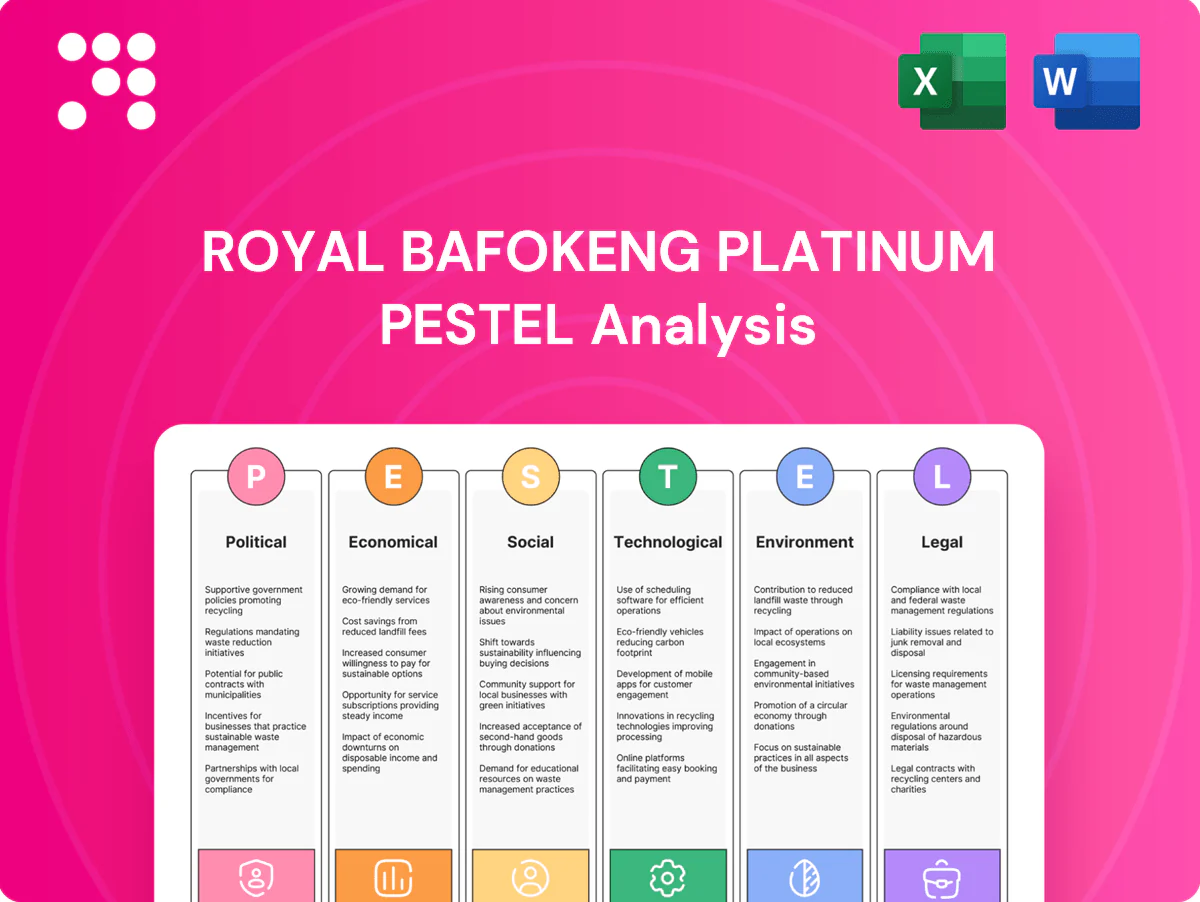
Royal Bafokeng Platinum PESTLE Analysis

Your Competitive Advantage Starts with This Report
Our PESTLE Analysis of Royal Bafokeng Platinum reveals how political regulation, commodity cycles, social license and environmental pressures shape strategic risk and opportunity. We map economic and technological drivers affecting profitability and operations. Ideal for investors and strategists, it's research-ready. Purchase the full report to access detailed, actionable insights.
Political factors

Mining Charter and BEE
Compliance with South Africa’s Mining Charter and BEE ownership remains pivotal to permitting and community legitimacy for Royal Bafokeng Platinum, especially post-Implats acquisition where maintaining qualifying BEE levels and procurement targets is a licensing condition. Any Charter revisions or stricter enforcement can affect capital access and project timelines, while stable stakeholder relations with government reduce regulatory friction and operational risk.
Government policy stability
Policy uncertainty around resource nationalism, royalties (current statutory rates up to 5%) and export rules shapes RBPlat investment plans and can compress project NPV. Clear, predictable frameworks support long-life PGM mines and capital allocation, especially as RBPlat completes 2023–24 capital programmes. Cabinet reshuffles and coalition dynamics have delayed permitting; consistent engagement mitigates policy-driven delays.

Community and traditional authority dynamics
Relations with the Royal Bafokeng Nation determine the social licence for BRPM and Styldrift in the North West, where SLP delivery and transparent benefit-sharing are legally required under the MPRDA to align community expectations; political disputes or leadership changes have previously led to protests and temporary access disruptions, making robust SLP performance critical to sustaining operations.

Labour union influence
Strong unions such as AMCU and NUM materially shape wage settlements and elevate strike risk at Royal Bafokeng Platinum, affecting labour cost and operational continuity. Political backing of labour can harden bargaining positions and increase the likelihood of protracted negotiations. Proactive engagement, demonstrable safety performance and multi-year agreements reduce industrial action and improve planning visibility.
- AMCU/NUM influence on wages
- Political support strengthens bargaining
- Safety + engagement lower strike probability
- Multi-year deals = better visibility
State capacity, SOEs, and security
State-owned Eskom and Transnet reliability directly affect RBPlat uptime and export flows, with recurrent load-shedding and rail/port constraints disrupting operations and sales. Crime, illegal mining and infrastructure sabotage elevate political-security risk around southern platinum operations. Close collaboration with police, Transnet and local authorities, plus contingency power and stepped-up security investments, are essential mitigation.
- Eskom/Transnet: SOE reliability impacts production and exports
- Security risks: crime, illegal mining, sabotage
- Mitigation: law enforcement collaboration
- Buffering: contingency power and security capex
Mining Charter, BEE & 5% royalties raise permit risk; unions and SOEs threaten output
Compliance with the Mining Charter and BEE ownership remains decisive for RBPlat’s permits and licence conditions; royalties remain statutory up to 5% and any Charter tightening raises capital/access risk. Union influence (AMCU, NUM) sustains strike risk and wage pressure; SOE failures (Eskom/Transnet) threaten uptime and exports, requiring contingency power and security spend.
| Factor | Key metric/impact |
|---|---|
| Royalties | Statutory up to 5% |
| Unions | AMCU/NUM drive wage risk |
| SOEs | Eskom/Transnet reliability → production/export risk |
What is included in the product
 Detailed Word Document
Explores how macro-environmental factors uniquely affect Royal Bafokeng Platinum across Political, Economic, Social, Technological, Environmental, and Legal dimensions, with data-driven insights and forward-looking implications. Designed to help executives, investors, and strategists identify risks, opportunities, and actionable scenarios for the South African PGM sector.

 Customizable Excel Spreadsheet
A concise, visually segmented PESTLE summary for Royal Bafokeng Platinum that eases meeting prep and slide creation, while allowing quick annotations for regional or business-line context. Ideal for aligning teams, supporting risk discussions, and sharing across devices during planning sessions.
Economic factors

PGM price volatility
Revenue at Royal Bafokeng Platinum is highly sensitive to platinum (~$1,100/oz H1 2025), palladium (~$1,300/oz) and rhodium (~$4,500/oz) cycles; autocatalyst demand, substitution toward platinum-group metals and recycling drive sharp pricing swings. Hedging programs and exposure to a mixed PGM basket help manage downside, while capital discipline and flexible investment plans must explicitly reflect this cyclical risk.
Rand exchange rate
ZAR weakness lifts USD revenue translation but raises imported input costs—USD/ZAR averaged c.18.5 in 2024–H1 2025, boosting rand EBITDA but compressing margins on dollar-priced consumables. Currency volatility complicates budgeting and debt service, increasing FX risk on rand liabilities. Natural hedges from USD sales offset local inflation, so treasury should align tenor of cash flows and liabilities to reduce mismatch.

Cost inflation and productivity
Energy, explosives, steel and wage inflation have tightened RBPlat margins, increasing focus on mechanization and throughput gains to control unit costs. Supplier localization programs aim to shorten supply chains and can shift cost curves by reducing import exposure. Continuous improvement initiatives remain central to sustaining cash cost competitiveness through operational efficiencies and higher productivity.

Demand transition in autos
Industry consolidation and capital access
Implats’ proposed acquisition targets processing and marketing synergies with RBPlat to drive scale, lower per-unit costs and secure improved offtake terms; successful integration determines how quickly those benefits offset acquisition capex. Execution risk around plant harmonisation and labour relations will shape capex pacing and timing of free cash flow. Investor appetite will depend on clearly visible free cash flow and IRR metrics post-integration.
- Scale: processing and marketing synergies
- Cost: lower unit costs, better offtake
- Execution: integration risk affects value and capex timing
- Investor focus: visible free cash flow and returns
Mining Charter, BEE & 5% royalties raise permit risk; unions and SOEs threaten output
PGM price volatility (Pt ~$1,100/oz; Pd ~$1,300/oz; Rh ~$4,500/oz H1 2025) drives RBPlat revenue swings; hedging and mixed-basket exposure mitigate downside. USD/ZAR ~18.5 (2024–H1 2025) boosts rand EBITDA but raises imported input costs and FX risk. EVs ~14% global sales (IEA 2023) imply gradual autocatalyst demand erosion; Implats bid adds scale but execution risk.
| Metric | Value |
|---|---|
| Pt/Pd/Rh | 1,100/1,300/4,500 $/oz |
| USD/ZAR | ~18.5 |
| EV share | 14% (IEA 2023) |
What You See Is What You Get
Royal Bafokeng Platinum PESTLE Analysis
This PESTLE analysis examines Political, Economic, Social, Technological, Legal and Environmental factors impacting Royal Bafokeng Platinum, offering concise risks, opportunities and strategic implications for investors and managers. The preview shown here is the exact document you’ll receive after purchase—fully formatted and ready to use.

Your Competitive Advantage Starts with This Report
Our PESTLE Analysis of Royal Bafokeng Platinum reveals how political regulation, commodity cycles, social license and environmental pressures shape strategic risk and opportunity. We map economic and technological drivers affecting profitability and operations. Ideal for investors and strategists, it's research-ready. Purchase the full report to access detailed, actionable insights.
Political factors
Mining Charter and BEE
Compliance with South Africa’s Mining Charter and BEE ownership remains pivotal to permitting and community legitimacy for Royal Bafokeng Platinum, especially post-Implats acquisition where maintaining qualifying BEE levels and procurement targets is a licensing condition. Any Charter revisions or stricter enforcement can affect capital access and project timelines, while stable stakeholder relations with government reduce regulatory friction and operational risk.
Government policy stability
Policy uncertainty around resource nationalism, royalties (current statutory rates up to 5%) and export rules shapes RBPlat investment plans and can compress project NPV. Clear, predictable frameworks support long-life PGM mines and capital allocation, especially as RBPlat completes 2023–24 capital programmes. Cabinet reshuffles and coalition dynamics have delayed permitting; consistent engagement mitigates policy-driven delays.
Community and traditional authority dynamics
Relations with the Royal Bafokeng Nation determine the social licence for BRPM and Styldrift in the North West, where SLP delivery and transparent benefit-sharing are legally required under the MPRDA to align community expectations; political disputes or leadership changes have previously led to protests and temporary access disruptions, making robust SLP performance critical to sustaining operations.
Labour union influence
Strong unions such as AMCU and NUM materially shape wage settlements and elevate strike risk at Royal Bafokeng Platinum, affecting labour cost and operational continuity. Political backing of labour can harden bargaining positions and increase the likelihood of protracted negotiations. Proactive engagement, demonstrable safety performance and multi-year agreements reduce industrial action and improve planning visibility.
- AMCU/NUM influence on wages
- Political support strengthens bargaining
- Safety + engagement lower strike probability
- Multi-year deals = better visibility
State capacity, SOEs, and security
State-owned Eskom and Transnet reliability directly affect RBPlat uptime and export flows, with recurrent load-shedding and rail/port constraints disrupting operations and sales. Crime, illegal mining and infrastructure sabotage elevate political-security risk around southern platinum operations. Close collaboration with police, Transnet and local authorities, plus contingency power and stepped-up security investments, are essential mitigation.
- Eskom/Transnet: SOE reliability impacts production and exports
- Security risks: crime, illegal mining, sabotage
- Mitigation: law enforcement collaboration
- Buffering: contingency power and security capex
Mining Charter, BEE & 5% royalties raise permit risk; unions and SOEs threaten output
Compliance with the Mining Charter and BEE ownership remains decisive for RBPlat’s permits and licence conditions; royalties remain statutory up to 5% and any Charter tightening raises capital/access risk. Union influence (AMCU, NUM) sustains strike risk and wage pressure; SOE failures (Eskom/Transnet) threaten uptime and exports, requiring contingency power and security spend.
| Factor | Key metric/impact |
|---|---|
| Royalties | Statutory up to 5% |
| Unions | AMCU/NUM drive wage risk |
| SOEs | Eskom/Transnet reliability → production/export risk |
What is included in the product
Detailed Word Document
Explores how macro-environmental factors uniquely affect Royal Bafokeng Platinum across Political, Economic, Social, Technological, Environmental, and Legal dimensions, with data-driven insights and forward-looking implications. Designed to help executives, investors, and strategists identify risks, opportunities, and actionable scenarios for the South African PGM sector.
Customizable Excel Spreadsheet
A concise, visually segmented PESTLE summary for Royal Bafokeng Platinum that eases meeting prep and slide creation, while allowing quick annotations for regional or business-line context. Ideal for aligning teams, supporting risk discussions, and sharing across devices during planning sessions.
Economic factors
PGM price volatility
Revenue at Royal Bafokeng Platinum is highly sensitive to platinum (~$1,100/oz H1 2025), palladium (~$1,300/oz) and rhodium (~$4,500/oz) cycles; autocatalyst demand, substitution toward platinum-group metals and recycling drive sharp pricing swings. Hedging programs and exposure to a mixed PGM basket help manage downside, while capital discipline and flexible investment plans must explicitly reflect this cyclical risk.
Rand exchange rate
ZAR weakness lifts USD revenue translation but raises imported input costs—USD/ZAR averaged c.18.5 in 2024–H1 2025, boosting rand EBITDA but compressing margins on dollar-priced consumables. Currency volatility complicates budgeting and debt service, increasing FX risk on rand liabilities. Natural hedges from USD sales offset local inflation, so treasury should align tenor of cash flows and liabilities to reduce mismatch.
Cost inflation and productivity
Energy, explosives, steel and wage inflation have tightened RBPlat margins, increasing focus on mechanization and throughput gains to control unit costs. Supplier localization programs aim to shorten supply chains and can shift cost curves by reducing import exposure. Continuous improvement initiatives remain central to sustaining cash cost competitiveness through operational efficiencies and higher productivity.
Demand transition in autos
Industry consolidation and capital access
Implats’ proposed acquisition targets processing and marketing synergies with RBPlat to drive scale, lower per-unit costs and secure improved offtake terms; successful integration determines how quickly those benefits offset acquisition capex. Execution risk around plant harmonisation and labour relations will shape capex pacing and timing of free cash flow. Investor appetite will depend on clearly visible free cash flow and IRR metrics post-integration.
- Scale: processing and marketing synergies
- Cost: lower unit costs, better offtake
- Execution: integration risk affects value and capex timing
- Investor focus: visible free cash flow and returns
Mining Charter, BEE & 5% royalties raise permit risk; unions and SOEs threaten output
PGM price volatility (Pt ~$1,100/oz; Pd ~$1,300/oz; Rh ~$4,500/oz H1 2025) drives RBPlat revenue swings; hedging and mixed-basket exposure mitigate downside. USD/ZAR ~18.5 (2024–H1 2025) boosts rand EBITDA but raises imported input costs and FX risk. EVs ~14% global sales (IEA 2023) imply gradual autocatalyst demand erosion; Implats bid adds scale but execution risk.
| Metric | Value |
|---|---|
| Pt/Pd/Rh | 1,100/1,300/4,500 $/oz |
| USD/ZAR | ~18.5 |
| EV share | 14% (IEA 2023) |
What You See Is What You Get
Royal Bafokeng Platinum PESTLE Analysis
This PESTLE analysis examines Political, Economic, Social, Technological, Legal and Environmental factors impacting Royal Bafokeng Platinum, offering concise risks, opportunities and strategic implications for investors and managers. The preview shown here is the exact document you’ll receive after purchase—fully formatted and ready to use.
Original: $10.00
-65%$10.00
$3.50Description
Your Competitive Advantage Starts with This Report
Our PESTLE Analysis of Royal Bafokeng Platinum reveals how political regulation, commodity cycles, social license and environmental pressures shape strategic risk and opportunity. We map economic and technological drivers affecting profitability and operations. Ideal for investors and strategists, it's research-ready. Purchase the full report to access detailed, actionable insights.
Political factors
Mining Charter and BEE
Compliance with South Africa’s Mining Charter and BEE ownership remains pivotal to permitting and community legitimacy for Royal Bafokeng Platinum, especially post-Implats acquisition where maintaining qualifying BEE levels and procurement targets is a licensing condition. Any Charter revisions or stricter enforcement can affect capital access and project timelines, while stable stakeholder relations with government reduce regulatory friction and operational risk.
Government policy stability
Policy uncertainty around resource nationalism, royalties (current statutory rates up to 5%) and export rules shapes RBPlat investment plans and can compress project NPV. Clear, predictable frameworks support long-life PGM mines and capital allocation, especially as RBPlat completes 2023–24 capital programmes. Cabinet reshuffles and coalition dynamics have delayed permitting; consistent engagement mitigates policy-driven delays.
Community and traditional authority dynamics
Relations with the Royal Bafokeng Nation determine the social licence for BRPM and Styldrift in the North West, where SLP delivery and transparent benefit-sharing are legally required under the MPRDA to align community expectations; political disputes or leadership changes have previously led to protests and temporary access disruptions, making robust SLP performance critical to sustaining operations.
Labour union influence
Strong unions such as AMCU and NUM materially shape wage settlements and elevate strike risk at Royal Bafokeng Platinum, affecting labour cost and operational continuity. Political backing of labour can harden bargaining positions and increase the likelihood of protracted negotiations. Proactive engagement, demonstrable safety performance and multi-year agreements reduce industrial action and improve planning visibility.
- AMCU/NUM influence on wages
- Political support strengthens bargaining
- Safety + engagement lower strike probability
- Multi-year deals = better visibility
State capacity, SOEs, and security
State-owned Eskom and Transnet reliability directly affect RBPlat uptime and export flows, with recurrent load-shedding and rail/port constraints disrupting operations and sales. Crime, illegal mining and infrastructure sabotage elevate political-security risk around southern platinum operations. Close collaboration with police, Transnet and local authorities, plus contingency power and stepped-up security investments, are essential mitigation.
- Eskom/Transnet: SOE reliability impacts production and exports
- Security risks: crime, illegal mining, sabotage
- Mitigation: law enforcement collaboration
- Buffering: contingency power and security capex
Mining Charter, BEE & 5% royalties raise permit risk; unions and SOEs threaten output
Compliance with the Mining Charter and BEE ownership remains decisive for RBPlat’s permits and licence conditions; royalties remain statutory up to 5% and any Charter tightening raises capital/access risk. Union influence (AMCU, NUM) sustains strike risk and wage pressure; SOE failures (Eskom/Transnet) threaten uptime and exports, requiring contingency power and security spend.
| Factor | Key metric/impact |
|---|---|
| Royalties | Statutory up to 5% |
| Unions | AMCU/NUM drive wage risk |
| SOEs | Eskom/Transnet reliability → production/export risk |
What is included in the product
Detailed Word Document
Explores how macro-environmental factors uniquely affect Royal Bafokeng Platinum across Political, Economic, Social, Technological, Environmental, and Legal dimensions, with data-driven insights and forward-looking implications. Designed to help executives, investors, and strategists identify risks, opportunities, and actionable scenarios for the South African PGM sector.
Customizable Excel Spreadsheet
A concise, visually segmented PESTLE summary for Royal Bafokeng Platinum that eases meeting prep and slide creation, while allowing quick annotations for regional or business-line context. Ideal for aligning teams, supporting risk discussions, and sharing across devices during planning sessions.
Economic factors
PGM price volatility
Revenue at Royal Bafokeng Platinum is highly sensitive to platinum (~$1,100/oz H1 2025), palladium (~$1,300/oz) and rhodium (~$4,500/oz) cycles; autocatalyst demand, substitution toward platinum-group metals and recycling drive sharp pricing swings. Hedging programs and exposure to a mixed PGM basket help manage downside, while capital discipline and flexible investment plans must explicitly reflect this cyclical risk.
Rand exchange rate
ZAR weakness lifts USD revenue translation but raises imported input costs—USD/ZAR averaged c.18.5 in 2024–H1 2025, boosting rand EBITDA but compressing margins on dollar-priced consumables. Currency volatility complicates budgeting and debt service, increasing FX risk on rand liabilities. Natural hedges from USD sales offset local inflation, so treasury should align tenor of cash flows and liabilities to reduce mismatch.
Cost inflation and productivity
Energy, explosives, steel and wage inflation have tightened RBPlat margins, increasing focus on mechanization and throughput gains to control unit costs. Supplier localization programs aim to shorten supply chains and can shift cost curves by reducing import exposure. Continuous improvement initiatives remain central to sustaining cash cost competitiveness through operational efficiencies and higher productivity.
Demand transition in autos
Industry consolidation and capital access
Implats’ proposed acquisition targets processing and marketing synergies with RBPlat to drive scale, lower per-unit costs and secure improved offtake terms; successful integration determines how quickly those benefits offset acquisition capex. Execution risk around plant harmonisation and labour relations will shape capex pacing and timing of free cash flow. Investor appetite will depend on clearly visible free cash flow and IRR metrics post-integration.
- Scale: processing and marketing synergies
- Cost: lower unit costs, better offtake
- Execution: integration risk affects value and capex timing
- Investor focus: visible free cash flow and returns
Mining Charter, BEE & 5% royalties raise permit risk; unions and SOEs threaten output
PGM price volatility (Pt ~$1,100/oz; Pd ~$1,300/oz; Rh ~$4,500/oz H1 2025) drives RBPlat revenue swings; hedging and mixed-basket exposure mitigate downside. USD/ZAR ~18.5 (2024–H1 2025) boosts rand EBITDA but raises imported input costs and FX risk. EVs ~14% global sales (IEA 2023) imply gradual autocatalyst demand erosion; Implats bid adds scale but execution risk.
| Metric | Value |
|---|---|
| Pt/Pd/Rh | 1,100/1,300/4,500 $/oz |
| USD/ZAR | ~18.5 |
| EV share | 14% (IEA 2023) |
What You See Is What You Get
Royal Bafokeng Platinum PESTLE Analysis
This PESTLE analysis examines Political, Economic, Social, Technological, Legal and Environmental factors impacting Royal Bafokeng Platinum, offering concise risks, opportunities and strategic implications for investors and managers. The preview shown here is the exact document you’ll receive after purchase—fully formatted and ready to use.











