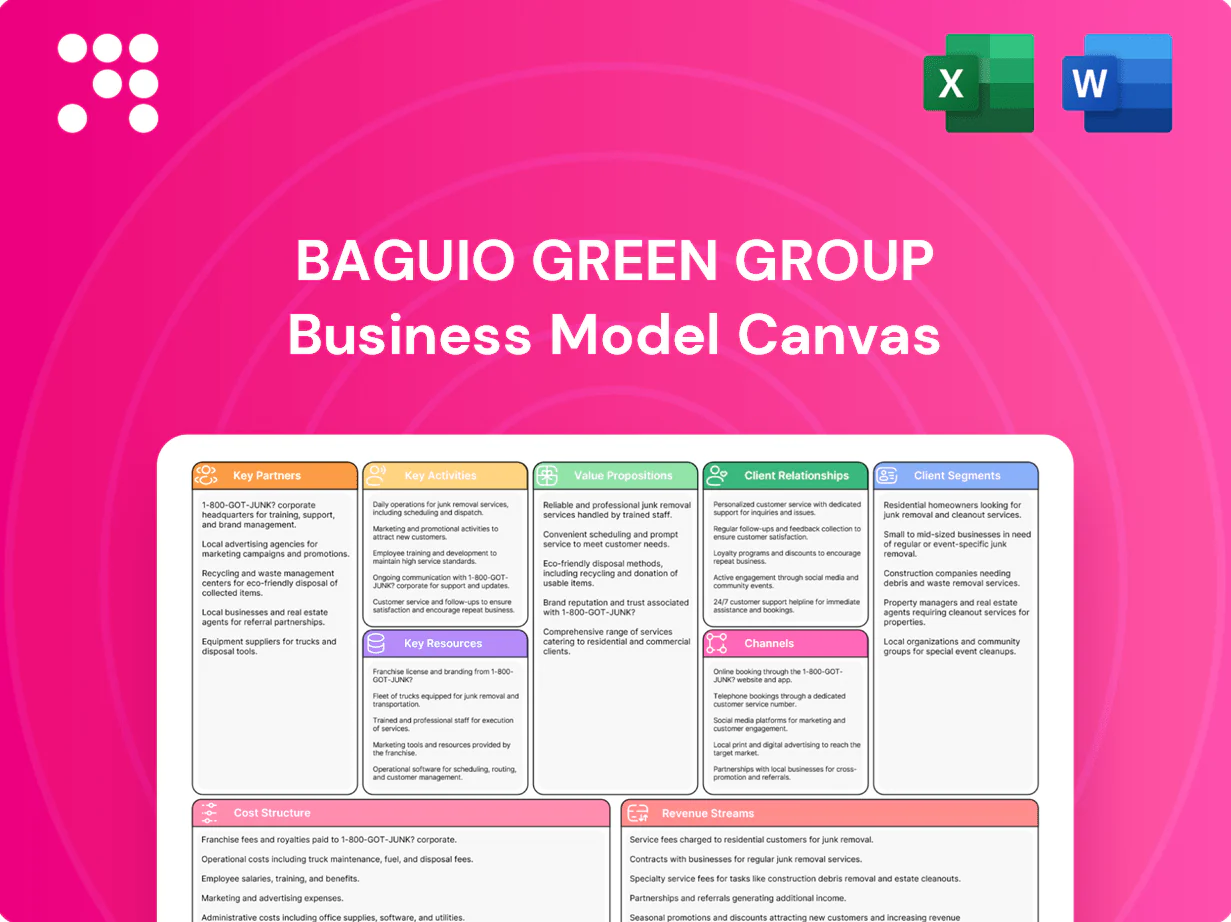
Baguio Green Group Business Model Canvas

Investor-Ready Green Building Business Model Canvas: Strategy, Revenue & Cost Drivers
Discover Baguio Green Group’s Business Model Canvas revealing how it creates value, scales operations, and captures market share across green building segments. This concise, investor-ready canvas maps customer segments, key partners, revenue streams and cost drivers with actionable insights. Download the full editable Word & Excel canvas to benchmark strategy, inform investments, and accelerate decision-making.
Partnerships

Hong Kong government and public agencies
Partnerships with Hong Kong municipal departments secure long-term environmental hygiene and waste contracts through the Government Electronic Tendering System (GETS), supporting service scale to a population of about 7.4 million (2024). They enable access to public tenders, regulatory updates from the Environment and Ecology Bureau and pilot sustainability programs. Collaboration improves service coverage and compliance outcomes citywide. Joint initiatives reinforce cleanliness and circular economy objectives outlined in territory plans.
Property managers and facility operators
Alliances with estates, commercial buildings and housing authorities tap the $1.3 trillion facility management market in 2024, driving predictable recurring volumes; coordinated schedules boost cleaning, waste and landscaping efficiency by 15–25% and improve incident response through shared data feeds; multi-site contract frameworks cut operating friction and churn roughly 20–30%, lowering per-site costs.

Recycling and waste-to-resource technology providers
Partners supply advanced sorting, baling, organics treatment and material-recovery tech that can raise diversion rates to 60–80% and lift recyclables value by 15–25% (2024 industry benchmarks). Co-development with providers unlocks end-to-end traceability and carbon reporting covering >80% of managed streams. Integrated tech differentiates service quality and improves ESG metrics and revenue per tonne. These partnerships are core to Baguio Green Group’s circular offering.

Equipment, fleet, and eco-chemical suppliers
Reliable equipment, fleet, IoT sensor and eco-chemical vendors deliver 99%+ SLA uptime for vehicles and machinery, supporting continuous operations. Bulk procurement in 2024 commonly yields 10–20% unit-cost savings while standardizing quality across sites. Structured preventive maintenance programs extend asset life and reduce replacement CAPEX. Co-testing new equipment with suppliers improves safety and operational efficiency.
- Vendor SLAs: 99%+
- Bulk savings: 10–20%
- Preventive maintenance: lower CAPEX
- Co-testing: faster R&D-to-deployment
Environmental NGOs and academic institutions
Environmental NGOs and academic institutions collaborate with Baguio Green Group to deliver community education, biodiversity projects and field research trials; independent validation enhances ESG credibility and donor confidence. Joint studies guide routing, recycling behavior and urban greening while expanding grant access and public engagement in 2024.
- community education
- ESG validation
- routing & recycling research
- grant access & public engagement
Partnerships win municipal reach 7.4M, access to $1.3T facility market
Key partnerships secure GETS municipal contracts covering ~7.4M residents (2024), access to public tenders and sustainability pilots. Alliances with estates tap the $1.3T facility management market (2024), improving efficiency 15–25% and reducing churn 20–30%. Tech, vendor and NGO ties lift diversion to 60–80%, vendor SLAs 99%+ and bulk savings 10–20%.
| Metric | 2024 |
|---|---|
| Population covered | 7.4M |
| Facility market | $1.3T |
| Diversion rate | 60–80% |
| Vendor SLA | 99%+ |
| Bulk savings | 10–20% |
What is included in the product
 Detailed Word Document
A comprehensive Business Model Canvas for Baguio Green Group detailing customer segments, channels, value propositions, revenue streams and key activities across the 9 BMC blocks, reflecting real-world operations and strategic plans; includes competitive advantages, SWOT-linked insights and a polished format ideal for presentations, funding discussions, and decision-making.

 Customizable Excel Spreadsheet
High-level view of Baguio Green Group’s business model with editable cells to quickly relieve strategy overload and align sustainability initiatives across teams.
Activities

Integrated cleaning and environmental hygiene
Daily cleansing, disinfection, and pest control maintain public health standards for Baguio City, population 366,358 (2020 census). Route planning in 2024 balances responsiveness and cost to cover dense urban zones while minimizing fuel and labor overhead. Regular quality audits with KPIs (coverage, complaint rate, audit score) ensure service consistency. Strict safety protocols protect workers and pedestrians during operations.
Waste collection, sorting, and recycling
Door-to-door, estate, and commercial pickups feed MRF workflows across Baguio (population 345,366 in 2020), converting incoming streams into sorted fractions; Philippines produces roughly 40,000 tonnes of municipal waste daily (DENR baseline). Rigorous sorting and contamination control boost material recovery (targeting >50% diversion), while digital data logging ensures regulatory compliance and client reporting and supports continuous improvement to cut landfill dependence.

Landscape, arboriculture, and urban greening
Horticulture care, tree risk assessments, and seasonal planting strengthen urban resilience by reducing canopy loss and supporting a common municipal green-cover target of 30% (2024 city planning benchmarks). Irrigation and soil programs—backed by industry studies—can improve establishment and survival rates, lowering replacement costs and extending asset life. Biodiversity initiatives align with city sustainability targets and access to green infrastructure funding. Visible greening boosts property values and community satisfaction, increasing local amenity demand.

Operations planning, logistics, and fleet management
Operations planning leverages dynamic routing and telematics—reducing fuel use 10–15% and lifting driver productivity—while predictive maintenance cuts unplanned downtime ~20–30% (2024 industry averages). Shift design smooths peak demand to meet SLAs and improve asset utilization; fuel, charging and parts inventory optimization lowers operating cost and idle time. Incident management protocols maintain continuity and safety across the fleet.
- dynamic-routing: fuel -10–15%
- telematics: +productivity, -idle time
- predictive-maintenance: -unplanned downtime 20–30%
- shift-design: peak SLA management
- inventory-optimization: lower opex
- incident-management: continuity & safety
ESG reporting, compliance, and stakeholder engagement
Monitoring of waste streams, emissions, and service KPIs feeds monthly client and regulatory reports, with monthly KPI dashboards and quarterly feedback cycles that refine programs and outcomes. Certifications and audits (4 audits/year) maintain trust and regulatory compliance. Education campaigns uplift recycling behavior through targeted outreach and measured participation.
- Monthly KPI reporting
- 4 audits/year
- Quarterly feedback loops
- Targeted education campaigns
Route-based ops target 50%+ diversion, 10–15% fuel cut
Daily cleansing, route-based collections, MRF sorting and horticulture/urban greening with predictive maintenance and telematics sustain service levels and target >50% diversion; KPIs: monthly reports, 4 audits/year. Operations aim -10–15% fuel via dynamic routing, -20–30% downtime with predictive maintenance; education campaigns raise recycling participation.
| Metric | 2024 target/value |
|---|---|
| Baguio pop (2020) | 366,358 |
| Material diversion | >50% |
| Fuel saving | 10–15% |
| Unplanned downtime | -20–30% |
| Audits/yr | 4 |
Full Document Unlocks After Purchase
Business Model Canvas
The document previewed here is the actual Baguio Green Group Business Model Canvas, not a mockup—what you see is the file you’ll receive after purchase. Upon completion of your order you’ll get this exact, fully editable document ready for use, presentation, or further customization. No surprises, just the same professional deliverable shown.

Investor-Ready Green Building Business Model Canvas: Strategy, Revenue & Cost Drivers
Discover Baguio Green Group’s Business Model Canvas revealing how it creates value, scales operations, and captures market share across green building segments. This concise, investor-ready canvas maps customer segments, key partners, revenue streams and cost drivers with actionable insights. Download the full editable Word & Excel canvas to benchmark strategy, inform investments, and accelerate decision-making.
Partnerships
Hong Kong government and public agencies
Partnerships with Hong Kong municipal departments secure long-term environmental hygiene and waste contracts through the Government Electronic Tendering System (GETS), supporting service scale to a population of about 7.4 million (2024). They enable access to public tenders, regulatory updates from the Environment and Ecology Bureau and pilot sustainability programs. Collaboration improves service coverage and compliance outcomes citywide. Joint initiatives reinforce cleanliness and circular economy objectives outlined in territory plans.
Property managers and facility operators
Alliances with estates, commercial buildings and housing authorities tap the $1.3 trillion facility management market in 2024, driving predictable recurring volumes; coordinated schedules boost cleaning, waste and landscaping efficiency by 15–25% and improve incident response through shared data feeds; multi-site contract frameworks cut operating friction and churn roughly 20–30%, lowering per-site costs.
Recycling and waste-to-resource technology providers
Partners supply advanced sorting, baling, organics treatment and material-recovery tech that can raise diversion rates to 60–80% and lift recyclables value by 15–25% (2024 industry benchmarks). Co-development with providers unlocks end-to-end traceability and carbon reporting covering >80% of managed streams. Integrated tech differentiates service quality and improves ESG metrics and revenue per tonne. These partnerships are core to Baguio Green Group’s circular offering.
Equipment, fleet, and eco-chemical suppliers
Reliable equipment, fleet, IoT sensor and eco-chemical vendors deliver 99%+ SLA uptime for vehicles and machinery, supporting continuous operations. Bulk procurement in 2024 commonly yields 10–20% unit-cost savings while standardizing quality across sites. Structured preventive maintenance programs extend asset life and reduce replacement CAPEX. Co-testing new equipment with suppliers improves safety and operational efficiency.
- Vendor SLAs: 99%+
- Bulk savings: 10–20%
- Preventive maintenance: lower CAPEX
- Co-testing: faster R&D-to-deployment
Environmental NGOs and academic institutions
Environmental NGOs and academic institutions collaborate with Baguio Green Group to deliver community education, biodiversity projects and field research trials; independent validation enhances ESG credibility and donor confidence. Joint studies guide routing, recycling behavior and urban greening while expanding grant access and public engagement in 2024.
- community education
- ESG validation
- routing & recycling research
- grant access & public engagement
Partnerships win municipal reach 7.4M, access to $1.3T facility market
Key partnerships secure GETS municipal contracts covering ~7.4M residents (2024), access to public tenders and sustainability pilots. Alliances with estates tap the $1.3T facility management market (2024), improving efficiency 15–25% and reducing churn 20–30%. Tech, vendor and NGO ties lift diversion to 60–80%, vendor SLAs 99%+ and bulk savings 10–20%.
| Metric | 2024 |
|---|---|
| Population covered | 7.4M |
| Facility market | $1.3T |
| Diversion rate | 60–80% |
| Vendor SLA | 99%+ |
| Bulk savings | 10–20% |
What is included in the product
Detailed Word Document
A comprehensive Business Model Canvas for Baguio Green Group detailing customer segments, channels, value propositions, revenue streams and key activities across the 9 BMC blocks, reflecting real-world operations and strategic plans; includes competitive advantages, SWOT-linked insights and a polished format ideal for presentations, funding discussions, and decision-making.
Customizable Excel Spreadsheet
High-level view of Baguio Green Group’s business model with editable cells to quickly relieve strategy overload and align sustainability initiatives across teams.
Activities
Integrated cleaning and environmental hygiene
Daily cleansing, disinfection, and pest control maintain public health standards for Baguio City, population 366,358 (2020 census). Route planning in 2024 balances responsiveness and cost to cover dense urban zones while minimizing fuel and labor overhead. Regular quality audits with KPIs (coverage, complaint rate, audit score) ensure service consistency. Strict safety protocols protect workers and pedestrians during operations.
Waste collection, sorting, and recycling
Door-to-door, estate, and commercial pickups feed MRF workflows across Baguio (population 345,366 in 2020), converting incoming streams into sorted fractions; Philippines produces roughly 40,000 tonnes of municipal waste daily (DENR baseline). Rigorous sorting and contamination control boost material recovery (targeting >50% diversion), while digital data logging ensures regulatory compliance and client reporting and supports continuous improvement to cut landfill dependence.
Landscape, arboriculture, and urban greening
Horticulture care, tree risk assessments, and seasonal planting strengthen urban resilience by reducing canopy loss and supporting a common municipal green-cover target of 30% (2024 city planning benchmarks). Irrigation and soil programs—backed by industry studies—can improve establishment and survival rates, lowering replacement costs and extending asset life. Biodiversity initiatives align with city sustainability targets and access to green infrastructure funding. Visible greening boosts property values and community satisfaction, increasing local amenity demand.
Operations planning, logistics, and fleet management
Operations planning leverages dynamic routing and telematics—reducing fuel use 10–15% and lifting driver productivity—while predictive maintenance cuts unplanned downtime ~20–30% (2024 industry averages). Shift design smooths peak demand to meet SLAs and improve asset utilization; fuel, charging and parts inventory optimization lowers operating cost and idle time. Incident management protocols maintain continuity and safety across the fleet.
- dynamic-routing: fuel -10–15%
- telematics: +productivity, -idle time
- predictive-maintenance: -unplanned downtime 20–30%
- shift-design: peak SLA management
- inventory-optimization: lower opex
- incident-management: continuity & safety
ESG reporting, compliance, and stakeholder engagement
Monitoring of waste streams, emissions, and service KPIs feeds monthly client and regulatory reports, with monthly KPI dashboards and quarterly feedback cycles that refine programs and outcomes. Certifications and audits (4 audits/year) maintain trust and regulatory compliance. Education campaigns uplift recycling behavior through targeted outreach and measured participation.
- Monthly KPI reporting
- 4 audits/year
- Quarterly feedback loops
- Targeted education campaigns
Route-based ops target 50%+ diversion, 10–15% fuel cut
Daily cleansing, route-based collections, MRF sorting and horticulture/urban greening with predictive maintenance and telematics sustain service levels and target >50% diversion; KPIs: monthly reports, 4 audits/year. Operations aim -10–15% fuel via dynamic routing, -20–30% downtime with predictive maintenance; education campaigns raise recycling participation.
| Metric | 2024 target/value |
|---|---|
| Baguio pop (2020) | 366,358 |
| Material diversion | >50% |
| Fuel saving | 10–15% |
| Unplanned downtime | -20–30% |
| Audits/yr | 4 |
Full Document Unlocks After Purchase
Business Model Canvas
The document previewed here is the actual Baguio Green Group Business Model Canvas, not a mockup—what you see is the file you’ll receive after purchase. Upon completion of your order you’ll get this exact, fully editable document ready for use, presentation, or further customization. No surprises, just the same professional deliverable shown.
Original: $10.00
-65%$10.00
$3.50Description
Investor-Ready Green Building Business Model Canvas: Strategy, Revenue & Cost Drivers
Discover Baguio Green Group’s Business Model Canvas revealing how it creates value, scales operations, and captures market share across green building segments. This concise, investor-ready canvas maps customer segments, key partners, revenue streams and cost drivers with actionable insights. Download the full editable Word & Excel canvas to benchmark strategy, inform investments, and accelerate decision-making.
Partnerships
Hong Kong government and public agencies
Partnerships with Hong Kong municipal departments secure long-term environmental hygiene and waste contracts through the Government Electronic Tendering System (GETS), supporting service scale to a population of about 7.4 million (2024). They enable access to public tenders, regulatory updates from the Environment and Ecology Bureau and pilot sustainability programs. Collaboration improves service coverage and compliance outcomes citywide. Joint initiatives reinforce cleanliness and circular economy objectives outlined in territory plans.
Property managers and facility operators
Alliances with estates, commercial buildings and housing authorities tap the $1.3 trillion facility management market in 2024, driving predictable recurring volumes; coordinated schedules boost cleaning, waste and landscaping efficiency by 15–25% and improve incident response through shared data feeds; multi-site contract frameworks cut operating friction and churn roughly 20–30%, lowering per-site costs.
Recycling and waste-to-resource technology providers
Partners supply advanced sorting, baling, organics treatment and material-recovery tech that can raise diversion rates to 60–80% and lift recyclables value by 15–25% (2024 industry benchmarks). Co-development with providers unlocks end-to-end traceability and carbon reporting covering >80% of managed streams. Integrated tech differentiates service quality and improves ESG metrics and revenue per tonne. These partnerships are core to Baguio Green Group’s circular offering.
Equipment, fleet, and eco-chemical suppliers
Reliable equipment, fleet, IoT sensor and eco-chemical vendors deliver 99%+ SLA uptime for vehicles and machinery, supporting continuous operations. Bulk procurement in 2024 commonly yields 10–20% unit-cost savings while standardizing quality across sites. Structured preventive maintenance programs extend asset life and reduce replacement CAPEX. Co-testing new equipment with suppliers improves safety and operational efficiency.
- Vendor SLAs: 99%+
- Bulk savings: 10–20%
- Preventive maintenance: lower CAPEX
- Co-testing: faster R&D-to-deployment
Environmental NGOs and academic institutions
Environmental NGOs and academic institutions collaborate with Baguio Green Group to deliver community education, biodiversity projects and field research trials; independent validation enhances ESG credibility and donor confidence. Joint studies guide routing, recycling behavior and urban greening while expanding grant access and public engagement in 2024.
- community education
- ESG validation
- routing & recycling research
- grant access & public engagement
Partnerships win municipal reach 7.4M, access to $1.3T facility market
Key partnerships secure GETS municipal contracts covering ~7.4M residents (2024), access to public tenders and sustainability pilots. Alliances with estates tap the $1.3T facility management market (2024), improving efficiency 15–25% and reducing churn 20–30%. Tech, vendor and NGO ties lift diversion to 60–80%, vendor SLAs 99%+ and bulk savings 10–20%.
| Metric | 2024 |
|---|---|
| Population covered | 7.4M |
| Facility market | $1.3T |
| Diversion rate | 60–80% |
| Vendor SLA | 99%+ |
| Bulk savings | 10–20% |
What is included in the product
Detailed Word Document
A comprehensive Business Model Canvas for Baguio Green Group detailing customer segments, channels, value propositions, revenue streams and key activities across the 9 BMC blocks, reflecting real-world operations and strategic plans; includes competitive advantages, SWOT-linked insights and a polished format ideal for presentations, funding discussions, and decision-making.
Customizable Excel Spreadsheet
High-level view of Baguio Green Group’s business model with editable cells to quickly relieve strategy overload and align sustainability initiatives across teams.
Activities
Integrated cleaning and environmental hygiene
Daily cleansing, disinfection, and pest control maintain public health standards for Baguio City, population 366,358 (2020 census). Route planning in 2024 balances responsiveness and cost to cover dense urban zones while minimizing fuel and labor overhead. Regular quality audits with KPIs (coverage, complaint rate, audit score) ensure service consistency. Strict safety protocols protect workers and pedestrians during operations.
Waste collection, sorting, and recycling
Door-to-door, estate, and commercial pickups feed MRF workflows across Baguio (population 345,366 in 2020), converting incoming streams into sorted fractions; Philippines produces roughly 40,000 tonnes of municipal waste daily (DENR baseline). Rigorous sorting and contamination control boost material recovery (targeting >50% diversion), while digital data logging ensures regulatory compliance and client reporting and supports continuous improvement to cut landfill dependence.
Landscape, arboriculture, and urban greening
Horticulture care, tree risk assessments, and seasonal planting strengthen urban resilience by reducing canopy loss and supporting a common municipal green-cover target of 30% (2024 city planning benchmarks). Irrigation and soil programs—backed by industry studies—can improve establishment and survival rates, lowering replacement costs and extending asset life. Biodiversity initiatives align with city sustainability targets and access to green infrastructure funding. Visible greening boosts property values and community satisfaction, increasing local amenity demand.
Operations planning, logistics, and fleet management
Operations planning leverages dynamic routing and telematics—reducing fuel use 10–15% and lifting driver productivity—while predictive maintenance cuts unplanned downtime ~20–30% (2024 industry averages). Shift design smooths peak demand to meet SLAs and improve asset utilization; fuel, charging and parts inventory optimization lowers operating cost and idle time. Incident management protocols maintain continuity and safety across the fleet.
- dynamic-routing: fuel -10–15%
- telematics: +productivity, -idle time
- predictive-maintenance: -unplanned downtime 20–30%
- shift-design: peak SLA management
- inventory-optimization: lower opex
- incident-management: continuity & safety
ESG reporting, compliance, and stakeholder engagement
Monitoring of waste streams, emissions, and service KPIs feeds monthly client and regulatory reports, with monthly KPI dashboards and quarterly feedback cycles that refine programs and outcomes. Certifications and audits (4 audits/year) maintain trust and regulatory compliance. Education campaigns uplift recycling behavior through targeted outreach and measured participation.
- Monthly KPI reporting
- 4 audits/year
- Quarterly feedback loops
- Targeted education campaigns
Route-based ops target 50%+ diversion, 10–15% fuel cut
Daily cleansing, route-based collections, MRF sorting and horticulture/urban greening with predictive maintenance and telematics sustain service levels and target >50% diversion; KPIs: monthly reports, 4 audits/year. Operations aim -10–15% fuel via dynamic routing, -20–30% downtime with predictive maintenance; education campaigns raise recycling participation.
| Metric | 2024 target/value |
|---|---|
| Baguio pop (2020) | 366,358 |
| Material diversion | >50% |
| Fuel saving | 10–15% |
| Unplanned downtime | -20–30% |
| Audits/yr | 4 |
Full Document Unlocks After Purchase
Business Model Canvas
The document previewed here is the actual Baguio Green Group Business Model Canvas, not a mockup—what you see is the file you’ll receive after purchase. Upon completion of your order you’ll get this exact, fully editable document ready for use, presentation, or further customization. No surprises, just the same professional deliverable shown.











