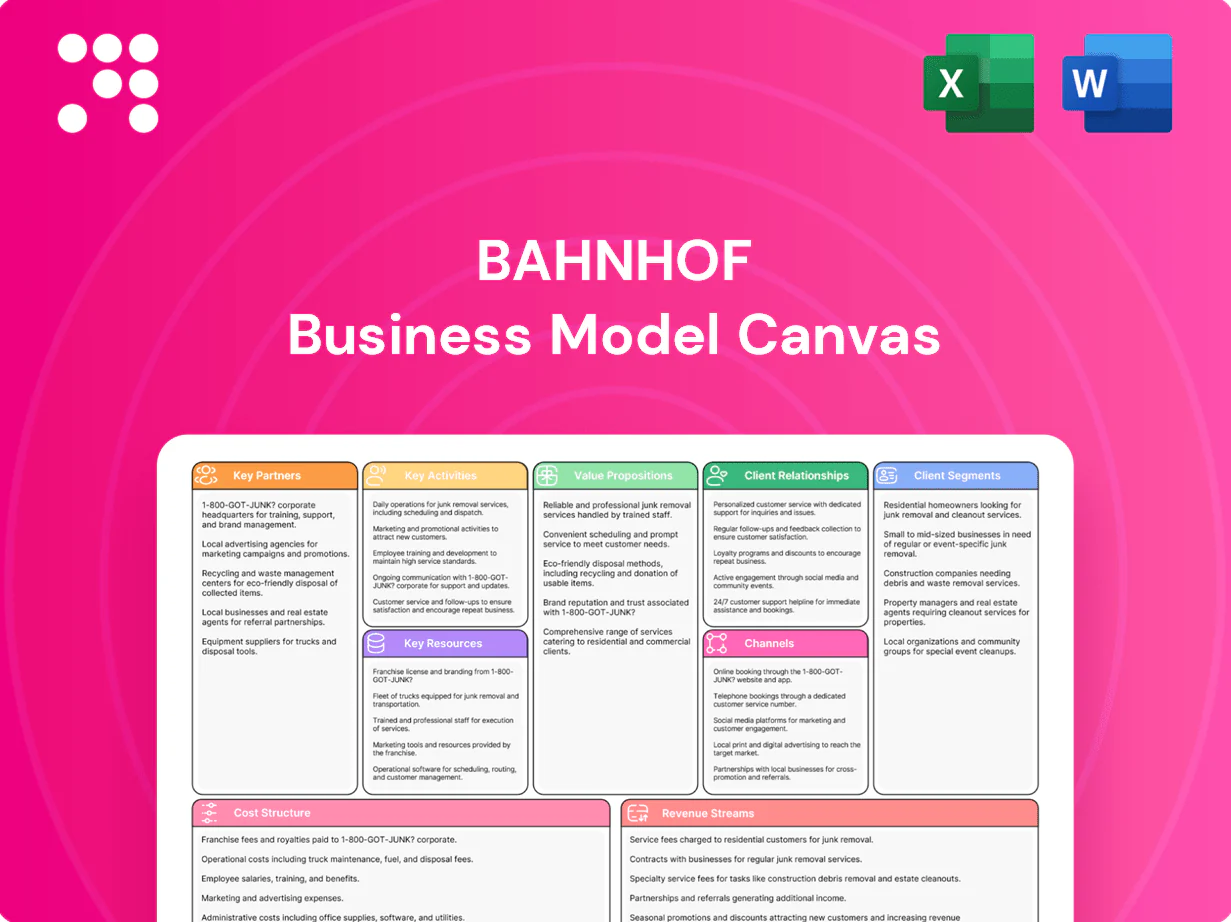
Bahnhof Business Model Canvas

Business Model Canvas for ISPs — benchmark value, growth and revenue streams
Unlock Bahnhof’s strategic blueprint with our Business Model Canvas — a concise, actionable map of value propositions, customer segments, partnerships and revenue streams. Perfect for investors, consultants and founders, this deep-dive reveals how Bahnhof scales and competes. Download the full, editable Word & Excel canvas to benchmark strategies and accelerate decision-making.
Partnerships

Network equipment and software vendors
Partners supplying routers, switches, optical gear and network software ensure Bahnhof can meet performance and scalability targets and maintain common 99.99% SLA levels. Strategic sourcing typically drives procurement savings and faster refresh cycles, accelerating upgrades and lowering TCO. Joint vendor roadmaps enable rapid adoption of new standards like 400G optics announced industrywide in 2024. Support contracts reduce downtime and limit security risk exposure.
Internet exchanges and peering partners
IXPs in Sweden and Europe (Netnod ~1.3 Tbps peak 2024; LINX ~8 Tbps; AMS-IX ~6 Tbps) cut transit needs and latency, lowering operational costs. Direct peering boosts streaming and gaming QoE by reducing hops. Diverse peering increases redundancy and resilience, while cooperative traffic engineering raises throughput and reliability.

Data center facilities and power providers
Colocation sites and Bahnhof’s proprietary facilities demand robust power, cooling and physical security to support dense rack deployments and carrier neutrality; global data centers account for roughly 1% of world electricity use (IEA). Utility partnerships secure competitive tariffs and access to renewables, aligning with Sweden’s largely low‑carbon grid. Facility vendors enable rapid capacity adds through modular builds, while compliance and audit support (ISO, SOC reports) strengthens trust with corporate clients.

Municipalities and property owners
Local access agreements with municipalities and property owners enable last-mile fiber deployment to homes and offices and building access speeds in-house wiring and customer onboarding.
Municipal open-fiber initiatives reached over 200 municipalities in Sweden by 2024, expanding reach cost-effectively; coordinated permits cut rollout delays typically by 3–6 months and lower rollout risk.
- Last-mile access: homes/offices
- Building access: faster onboarding
- 200+ municipalities (2024)
- Permitting delays: −3–6 months
Security and privacy technology partners
Specialized vendors provide encryption, DDoS mitigation and threat intelligence, aligned with global cybersecurity spending of about $210B in 2024. Independent auditors validate privacy controls and certifications to bolster trust. Tooling integrations streamline monitoring and incident response, cutting detection and response times materially. Partnerships reinforce Bahnhof’s privacy-first brand promise.
- Encryption vendors
- DDoS & threat intelligence
- Independent auditors
- Integrated monitoring/IR
Partners power reach, privacy & resilience: IXPs 1.3/8/6T; 200+ towns; $210B cyber spend
Key partners — hardware/software vendors, IXPs, colocation, municipalities and security providers — enable Bahnhof’s performance, reach and privacy stance. Netnod ~1.3 Tbps, LINX ~8 Tbps, AMS-IX ~6 Tbps (2024); municipal open‑fiber in 200+ Swedish municipalities (2024); global cybersecurity spend ~$210B (2024).
| Partner | Role | 2024 metric |
|---|---|---|
| Vendors | Hardware/software | Procurement savings, faster refresh |
| IXPs | Peering/redundancy | Netnod 1.3T, LINX 8T, AMS‑IX 6T |
| Municipalities | Last‑mile access | 200+ municipalities |
What is included in the product
 Detailed Word Document
A comprehensive Business Model Canvas tailored to Bahnhof’s strategy, detailing customer segments, channels, value propositions and revenue streams across the 9 classic BMC blocks. Designed for investor presentations and internal planning, it includes SWOT-linked insights, competitive advantages, and actionable validation using real-company data.

 Customizable Excel Spreadsheet
High-level, editable one-page Business Model Canvas that relieves planning overload by condensing Bahnhof’s strategy into a clean, shareable snapshot for rapid team alignment and decision-making.
Activities

Operate and expand fiber and IP network
Backbone maintenance, capacity upgrades and route optimization keep Bahnhof services fast and reliable, targeting industry-standard latency under 10 ms on core links. Continuous 24/7 monitoring supports an uptime goal of 99.99% and rapid fault isolation. Ongoing fiber builds and densification expand coverage and traffic offload, while planned maintenance windows and automated failover minimize customer impact.
Provision broadband and manage customer CPE
Automated activation accelerates service start for households and offices, cutting provisioning from days to minutes and supporting Sweden’s ~98% household broadband penetration in 2024. CPE configuration and firmware management enforce security and uptime, reducing incident rates. Field service resolves last-mile faults and inventory/logistics keep >95% of installations on schedule.

Run colocation and data center operations
Physical security, N+1 power redundancy and cooling efficiency underpin colocation SLA performance (industry target ~99.99% uptime); global data center PUE averaged 1.59 in 2023 (Uptime Institute). Smart hands services provide on-site equipment support to reduce customer downtime. Continuous environmental monitoring (temperature, humidity, leak detection) prevents incidents. Capacity planning is synchronized with demand spikes as data centers account for about 1% of global electricity use (IEA 2022).

Deliver cloud, VPS, and storage services
Platform orchestration, hypervisor management and automated backups underpin availability for Bahnhof's cloud, VPS and storage services; Gartner forecasts 2024 public cloud spending near 600 billion USD, highlighting demand for resilient platforms. Self-service portals enable rapid provisioning, data residency controls ensure GDPR-aligned compliance, and continuous cost optimization preserves competitive pricing.
- Platform orchestration
- Hypervisor & backups
- Self-service provisioning
- Data residency (GDPR)
- Cost optimization
Ensure privacy, security, and regulatory compliance
Privacy-by-design steers Bahnhof’s product and network choices, embedding data minimization and encryption from design. SOC (Security Operations Center) processes manage incidents and audits to uphold SLAs. Compliance with Swedish law and EU GDPR (effective 25 May 2018) and transparent policies communicated to customers underpin trust.
- Privacy-by-design
- SOC processes for incidents & audits
- Sweden population ~10.5M (2024) — GDPR compliance
Nordic cloud resilience: sub-10 ms core latency, 99.99% uptime, GDPR data-residency
Backbone maintenance, fiber builds and 24/7 monitoring target <10 ms core latency and 99.99% uptime; automated provisioning cuts activation to minutes supporting Sweden’s ~98% household broadband penetration (2024). Colocation resiliency uses N+1 power, PUE ~1.59 (2023) and smart-hands; platform orchestration, GDPR data-residency and SOC processes secure cloud/VPS services amid ~600B USD public cloud spend (2024).
| Metric | Value |
|---|---|
| Core latency | <10 ms |
| Uptime SLA | 99.99% |
| Sweden broadband | ~98% households (2024) |
| Sweden pop | 10.5M (2024) |
| Data center PUE | 1.59 (2023) |
| Public cloud spend | ~600B USD (2024) |
What You See Is What You Get
Business Model Canvas
The Business Model Canvas preview shown here is the actual document you’ll receive—no mockups or samples. After purchase you’ll get this exact, fully editable file (Word and Excel) with all sections and formatting intact. It’s ready to present, customize, and apply immediately—what you see is what you’ll download.

Business Model Canvas for ISPs — benchmark value, growth and revenue streams
Unlock Bahnhof’s strategic blueprint with our Business Model Canvas — a concise, actionable map of value propositions, customer segments, partnerships and revenue streams. Perfect for investors, consultants and founders, this deep-dive reveals how Bahnhof scales and competes. Download the full, editable Word & Excel canvas to benchmark strategies and accelerate decision-making.
Partnerships
Network equipment and software vendors
Partners supplying routers, switches, optical gear and network software ensure Bahnhof can meet performance and scalability targets and maintain common 99.99% SLA levels. Strategic sourcing typically drives procurement savings and faster refresh cycles, accelerating upgrades and lowering TCO. Joint vendor roadmaps enable rapid adoption of new standards like 400G optics announced industrywide in 2024. Support contracts reduce downtime and limit security risk exposure.
Internet exchanges and peering partners
IXPs in Sweden and Europe (Netnod ~1.3 Tbps peak 2024; LINX ~8 Tbps; AMS-IX ~6 Tbps) cut transit needs and latency, lowering operational costs. Direct peering boosts streaming and gaming QoE by reducing hops. Diverse peering increases redundancy and resilience, while cooperative traffic engineering raises throughput and reliability.
Data center facilities and power providers
Colocation sites and Bahnhof’s proprietary facilities demand robust power, cooling and physical security to support dense rack deployments and carrier neutrality; global data centers account for roughly 1% of world electricity use (IEA). Utility partnerships secure competitive tariffs and access to renewables, aligning with Sweden’s largely low‑carbon grid. Facility vendors enable rapid capacity adds through modular builds, while compliance and audit support (ISO, SOC reports) strengthens trust with corporate clients.
Municipalities and property owners
Local access agreements with municipalities and property owners enable last-mile fiber deployment to homes and offices and building access speeds in-house wiring and customer onboarding.
Municipal open-fiber initiatives reached over 200 municipalities in Sweden by 2024, expanding reach cost-effectively; coordinated permits cut rollout delays typically by 3–6 months and lower rollout risk.
- Last-mile access: homes/offices
- Building access: faster onboarding
- 200+ municipalities (2024)
- Permitting delays: −3–6 months
Security and privacy technology partners
Specialized vendors provide encryption, DDoS mitigation and threat intelligence, aligned with global cybersecurity spending of about $210B in 2024. Independent auditors validate privacy controls and certifications to bolster trust. Tooling integrations streamline monitoring and incident response, cutting detection and response times materially. Partnerships reinforce Bahnhof’s privacy-first brand promise.
- Encryption vendors
- DDoS & threat intelligence
- Independent auditors
- Integrated monitoring/IR
Partners power reach, privacy & resilience: IXPs 1.3/8/6T; 200+ towns; $210B cyber spend
Key partners — hardware/software vendors, IXPs, colocation, municipalities and security providers — enable Bahnhof’s performance, reach and privacy stance. Netnod ~1.3 Tbps, LINX ~8 Tbps, AMS-IX ~6 Tbps (2024); municipal open‑fiber in 200+ Swedish municipalities (2024); global cybersecurity spend ~$210B (2024).
| Partner | Role | 2024 metric |
|---|---|---|
| Vendors | Hardware/software | Procurement savings, faster refresh |
| IXPs | Peering/redundancy | Netnod 1.3T, LINX 8T, AMS‑IX 6T |
| Municipalities | Last‑mile access | 200+ municipalities |
What is included in the product
Detailed Word Document
A comprehensive Business Model Canvas tailored to Bahnhof’s strategy, detailing customer segments, channels, value propositions and revenue streams across the 9 classic BMC blocks. Designed for investor presentations and internal planning, it includes SWOT-linked insights, competitive advantages, and actionable validation using real-company data.
Customizable Excel Spreadsheet
High-level, editable one-page Business Model Canvas that relieves planning overload by condensing Bahnhof’s strategy into a clean, shareable snapshot for rapid team alignment and decision-making.
Activities
Operate and expand fiber and IP network
Backbone maintenance, capacity upgrades and route optimization keep Bahnhof services fast and reliable, targeting industry-standard latency under 10 ms on core links. Continuous 24/7 monitoring supports an uptime goal of 99.99% and rapid fault isolation. Ongoing fiber builds and densification expand coverage and traffic offload, while planned maintenance windows and automated failover minimize customer impact.
Provision broadband and manage customer CPE
Automated activation accelerates service start for households and offices, cutting provisioning from days to minutes and supporting Sweden’s ~98% household broadband penetration in 2024. CPE configuration and firmware management enforce security and uptime, reducing incident rates. Field service resolves last-mile faults and inventory/logistics keep >95% of installations on schedule.
Run colocation and data center operations
Physical security, N+1 power redundancy and cooling efficiency underpin colocation SLA performance (industry target ~99.99% uptime); global data center PUE averaged 1.59 in 2023 (Uptime Institute). Smart hands services provide on-site equipment support to reduce customer downtime. Continuous environmental monitoring (temperature, humidity, leak detection) prevents incidents. Capacity planning is synchronized with demand spikes as data centers account for about 1% of global electricity use (IEA 2022).
Deliver cloud, VPS, and storage services
Platform orchestration, hypervisor management and automated backups underpin availability for Bahnhof's cloud, VPS and storage services; Gartner forecasts 2024 public cloud spending near 600 billion USD, highlighting demand for resilient platforms. Self-service portals enable rapid provisioning, data residency controls ensure GDPR-aligned compliance, and continuous cost optimization preserves competitive pricing.
- Platform orchestration
- Hypervisor & backups
- Self-service provisioning
- Data residency (GDPR)
- Cost optimization
Ensure privacy, security, and regulatory compliance
Privacy-by-design steers Bahnhof’s product and network choices, embedding data minimization and encryption from design. SOC (Security Operations Center) processes manage incidents and audits to uphold SLAs. Compliance with Swedish law and EU GDPR (effective 25 May 2018) and transparent policies communicated to customers underpin trust.
- Privacy-by-design
- SOC processes for incidents & audits
- Sweden population ~10.5M (2024) — GDPR compliance
Nordic cloud resilience: sub-10 ms core latency, 99.99% uptime, GDPR data-residency
Backbone maintenance, fiber builds and 24/7 monitoring target <10 ms core latency and 99.99% uptime; automated provisioning cuts activation to minutes supporting Sweden’s ~98% household broadband penetration (2024). Colocation resiliency uses N+1 power, PUE ~1.59 (2023) and smart-hands; platform orchestration, GDPR data-residency and SOC processes secure cloud/VPS services amid ~600B USD public cloud spend (2024).
| Metric | Value |
|---|---|
| Core latency | <10 ms |
| Uptime SLA | 99.99% |
| Sweden broadband | ~98% households (2024) |
| Sweden pop | 10.5M (2024) |
| Data center PUE | 1.59 (2023) |
| Public cloud spend | ~600B USD (2024) |
What You See Is What You Get
Business Model Canvas
The Business Model Canvas preview shown here is the actual document you’ll receive—no mockups or samples. After purchase you’ll get this exact, fully editable file (Word and Excel) with all sections and formatting intact. It’s ready to present, customize, and apply immediately—what you see is what you’ll download.
Original: $10.00
-65%$10.00
$3.50Description
Business Model Canvas for ISPs — benchmark value, growth and revenue streams
Unlock Bahnhof’s strategic blueprint with our Business Model Canvas — a concise, actionable map of value propositions, customer segments, partnerships and revenue streams. Perfect for investors, consultants and founders, this deep-dive reveals how Bahnhof scales and competes. Download the full, editable Word & Excel canvas to benchmark strategies and accelerate decision-making.
Partnerships
Network equipment and software vendors
Partners supplying routers, switches, optical gear and network software ensure Bahnhof can meet performance and scalability targets and maintain common 99.99% SLA levels. Strategic sourcing typically drives procurement savings and faster refresh cycles, accelerating upgrades and lowering TCO. Joint vendor roadmaps enable rapid adoption of new standards like 400G optics announced industrywide in 2024. Support contracts reduce downtime and limit security risk exposure.
Internet exchanges and peering partners
IXPs in Sweden and Europe (Netnod ~1.3 Tbps peak 2024; LINX ~8 Tbps; AMS-IX ~6 Tbps) cut transit needs and latency, lowering operational costs. Direct peering boosts streaming and gaming QoE by reducing hops. Diverse peering increases redundancy and resilience, while cooperative traffic engineering raises throughput and reliability.
Data center facilities and power providers
Colocation sites and Bahnhof’s proprietary facilities demand robust power, cooling and physical security to support dense rack deployments and carrier neutrality; global data centers account for roughly 1% of world electricity use (IEA). Utility partnerships secure competitive tariffs and access to renewables, aligning with Sweden’s largely low‑carbon grid. Facility vendors enable rapid capacity adds through modular builds, while compliance and audit support (ISO, SOC reports) strengthens trust with corporate clients.
Municipalities and property owners
Local access agreements with municipalities and property owners enable last-mile fiber deployment to homes and offices and building access speeds in-house wiring and customer onboarding.
Municipal open-fiber initiatives reached over 200 municipalities in Sweden by 2024, expanding reach cost-effectively; coordinated permits cut rollout delays typically by 3–6 months and lower rollout risk.
- Last-mile access: homes/offices
- Building access: faster onboarding
- 200+ municipalities (2024)
- Permitting delays: −3–6 months
Security and privacy technology partners
Specialized vendors provide encryption, DDoS mitigation and threat intelligence, aligned with global cybersecurity spending of about $210B in 2024. Independent auditors validate privacy controls and certifications to bolster trust. Tooling integrations streamline monitoring and incident response, cutting detection and response times materially. Partnerships reinforce Bahnhof’s privacy-first brand promise.
- Encryption vendors
- DDoS & threat intelligence
- Independent auditors
- Integrated monitoring/IR
Partners power reach, privacy & resilience: IXPs 1.3/8/6T; 200+ towns; $210B cyber spend
Key partners — hardware/software vendors, IXPs, colocation, municipalities and security providers — enable Bahnhof’s performance, reach and privacy stance. Netnod ~1.3 Tbps, LINX ~8 Tbps, AMS-IX ~6 Tbps (2024); municipal open‑fiber in 200+ Swedish municipalities (2024); global cybersecurity spend ~$210B (2024).
| Partner | Role | 2024 metric |
|---|---|---|
| Vendors | Hardware/software | Procurement savings, faster refresh |
| IXPs | Peering/redundancy | Netnod 1.3T, LINX 8T, AMS‑IX 6T |
| Municipalities | Last‑mile access | 200+ municipalities |
What is included in the product
Detailed Word Document
A comprehensive Business Model Canvas tailored to Bahnhof’s strategy, detailing customer segments, channels, value propositions and revenue streams across the 9 classic BMC blocks. Designed for investor presentations and internal planning, it includes SWOT-linked insights, competitive advantages, and actionable validation using real-company data.
Customizable Excel Spreadsheet
High-level, editable one-page Business Model Canvas that relieves planning overload by condensing Bahnhof’s strategy into a clean, shareable snapshot for rapid team alignment and decision-making.
Activities
Operate and expand fiber and IP network
Backbone maintenance, capacity upgrades and route optimization keep Bahnhof services fast and reliable, targeting industry-standard latency under 10 ms on core links. Continuous 24/7 monitoring supports an uptime goal of 99.99% and rapid fault isolation. Ongoing fiber builds and densification expand coverage and traffic offload, while planned maintenance windows and automated failover minimize customer impact.
Provision broadband and manage customer CPE
Automated activation accelerates service start for households and offices, cutting provisioning from days to minutes and supporting Sweden’s ~98% household broadband penetration in 2024. CPE configuration and firmware management enforce security and uptime, reducing incident rates. Field service resolves last-mile faults and inventory/logistics keep >95% of installations on schedule.
Run colocation and data center operations
Physical security, N+1 power redundancy and cooling efficiency underpin colocation SLA performance (industry target ~99.99% uptime); global data center PUE averaged 1.59 in 2023 (Uptime Institute). Smart hands services provide on-site equipment support to reduce customer downtime. Continuous environmental monitoring (temperature, humidity, leak detection) prevents incidents. Capacity planning is synchronized with demand spikes as data centers account for about 1% of global electricity use (IEA 2022).
Deliver cloud, VPS, and storage services
Platform orchestration, hypervisor management and automated backups underpin availability for Bahnhof's cloud, VPS and storage services; Gartner forecasts 2024 public cloud spending near 600 billion USD, highlighting demand for resilient platforms. Self-service portals enable rapid provisioning, data residency controls ensure GDPR-aligned compliance, and continuous cost optimization preserves competitive pricing.
- Platform orchestration
- Hypervisor & backups
- Self-service provisioning
- Data residency (GDPR)
- Cost optimization
Ensure privacy, security, and regulatory compliance
Privacy-by-design steers Bahnhof’s product and network choices, embedding data minimization and encryption from design. SOC (Security Operations Center) processes manage incidents and audits to uphold SLAs. Compliance with Swedish law and EU GDPR (effective 25 May 2018) and transparent policies communicated to customers underpin trust.
- Privacy-by-design
- SOC processes for incidents & audits
- Sweden population ~10.5M (2024) — GDPR compliance
Nordic cloud resilience: sub-10 ms core latency, 99.99% uptime, GDPR data-residency
Backbone maintenance, fiber builds and 24/7 monitoring target <10 ms core latency and 99.99% uptime; automated provisioning cuts activation to minutes supporting Sweden’s ~98% household broadband penetration (2024). Colocation resiliency uses N+1 power, PUE ~1.59 (2023) and smart-hands; platform orchestration, GDPR data-residency and SOC processes secure cloud/VPS services amid ~600B USD public cloud spend (2024).
| Metric | Value |
|---|---|
| Core latency | <10 ms |
| Uptime SLA | 99.99% |
| Sweden broadband | ~98% households (2024) |
| Sweden pop | 10.5M (2024) |
| Data center PUE | 1.59 (2023) |
| Public cloud spend | ~600B USD (2024) |
What You See Is What You Get
Business Model Canvas
The Business Model Canvas preview shown here is the actual document you’ll receive—no mockups or samples. After purchase you’ll get this exact, fully editable file (Word and Excel) with all sections and formatting intact. It’s ready to present, customize, and apply immediately—what you see is what you’ll download.











