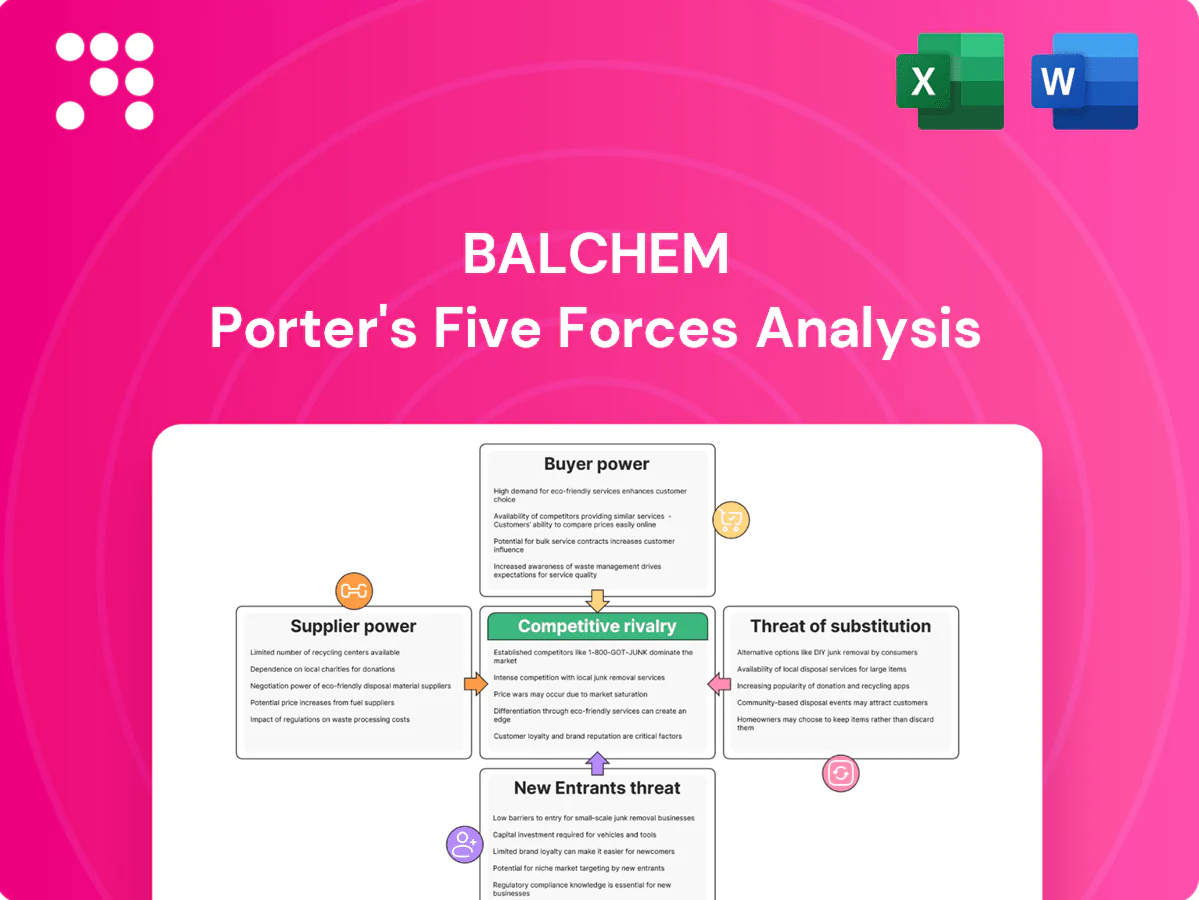
Balchem Porter's Five Forces Analysis

A Must-Have Tool for Decision-Makers
Balchem's Porter's Five Forces highlights moderate supplier power from specialty inputs, differentiated products that limit buyer leverage, high entry barriers tied to regulation and R&D, low substitute threat for niche additives, and rivalry driven by innovation. This brief snapshot only scratches the surface. Unlock the full Porter's Five Forces Analysis to explore Balchem’s competitive dynamics, market pressures, and strategic advantages in detail.
Suppliers Bargaining Power

Specialty raw material concentration
Balchem relies on specialty inputs like choline derivatives, chelated minerals, vitamins and food‑grade gases sourced from a limited set of qualified producers, and with FY2024 sales of about $1.08 billion this concentration increases supplier leverage over lead times and pricing. Qualification and audit demands make switching slower and costlier, raising operational risk. Supplier concentration can amplify commodity and logistics shocks, creating margin and supply volatility.
Regulatory and quality constraints
As of 2024, strict cGMP, FSMA and feed/food safety standards sharply narrow the pool of compliant ingredient suppliers for Balchem, increasing reliance on validated vendors. Suppliers that deliver required validation and documentation routinely secure stronger commercial terms and premium pricing. Any supplier change necessitates costly requalification—often adding weeks of testing and documentation—raising supplier bargaining power.

Commodity volatility pass-through
Inputs like amino acids, vitamins and minerals have experienced cyclical price swings of roughly 20–35% in recent years, and suppliers typically pass increases through faster than downstream buyers accept them. Balchem’s value-added formulations blunt some volatility, but timing mismatches can compress margins by several hundred basis points. Hedging and multi-year contracts mitigate but only partially offset exposure, often covering 40–60% of short-term swings.

Switching costs and co-development
Balchem co-develops encapsulated and chelated systems tailored to specific input specifications, so substituting a supplier typically forces reformulation and revalidation across quality and regulatory processes, extending time-to-replace and raising costs. These technical interdependencies elevate switching costs, making customers and Balchem themselves less elastic to supplier changes. Suppliers recognize this stickiness and can extract price or contractual leverage.
- Co-development ties formulations to supplier specs
- Substitution often requires reformulation and regulatory revalidation
- Higher switching costs increase supplier bargaining power
- Suppliers can leverage sticky relationships for better terms
Limited backward integration
Balchem’s limited backward integration reflects that building regulated feedstock/precursor capacity is capital- and compliance-intensive, so the company remains reliant on external suppliers and lacks broad in‑house precursor production, which weakens its countervailing negotiating power.
Long-term supply agreements mitigate exposure but do not remove asymmetry, leaving suppliers with sustained leverage over price and availability.
Supplier concentration raises leverage, extending requalification and input risk
Balchem relies on limited qualified suppliers for specialty inputs, increasing supplier leverage given FY2024 sales of $1.08 billion. Strict cGMP/FSMA standards and co‑development raise switching costs and extend requalification by weeks, strengthening supplier bargaining. Hedging and multi‑year contracts (covering ~40–60% of short‑term swings) only partially mitigate 20–35% input volatility.
| Metric | Value | Note |
|---|---|---|
| FY2024 sales | $1.08B | scale amplifies supplier impact |
| Input price swings | 20–35% | recent years |
| Hedging/contract coverage | 40–60% | short‑term exposure |
| Requalification time | weeks | validation/testing burden |
What is included in the product
 Detailed Word Document
Concise Porter's Five Forces analysis tailored for Balchem, assessing competitive rivalry, supplier and buyer power, threat of substitutes and new entrants, and identifying key disruptive threats and strategic defenses.

 Customizable Excel Spreadsheet
A concise, one-sheet Porter’s Five Forces for Balchem that pinpoints competitive pressures and actionable relief levers—ready to drop into decks; customize force ratings and scenarios without macros for fast strategic alignment.
Customers Bargaining Power

Large consolidated customers
Large, consolidated global F&B, supplement brands, premix blenders and feed integrators—with the global dietary supplements market at about $170 billion in 2024—use scale to award multi-year tenders and force price compression. Their size enables dual-sourcing leverage and volume rebates, elevating buyer power in Balchem’s core categories where Balchem reported roughly $860 million revenue in 2024.
Switching and reformulation friction
Balchem’s encapsulation and chelation deliver non–plug-and-play benefits that force reformulation, sensory testing and regulatory updates, raising switching costs; qualification timelines commonly span 6–12 months and stability testing can add weeks, creating technical stickiness that supports pricing resilience.

Value-in-use vs price sensitivity
In human nutrition, demonstrated efficacy, higher bioavailability and clean-label benefits support premiums, aligning with a global dietary supplements market of about $206 billion in 2024 and moderating price pushback.
In animal nutrition and industrial uses, intense cost-in-use pressures give buyers stronger price discipline, especially in feed and bulk chemical segments.
Shifts toward higher animal/industrial volumes increase overall buyer power; a rising share of premium human-nutrition sales weakens it.

Custom solutions and service depth
Balchem’s application labs, documentation, and co-innovation programs embed the company in customer workflows, making its offerings harder to compare with commodity alternatives and reducing buyers’ ability to switch. Embedded technical support and tailored formulations lower practical substitutability and shrink the effective bargaining set of customers. This service depth shifts negotiations from price to integrated value, increasing customer dependence on Balchem’s expertise.
- Application labs embed Balchem in client R&D
- Co-innovation reduces comparability to commodities
- Embedded support lowers practical substitutability
- Narrows buyers’ effective bargaining set
Contracting and supply assurance
Long-term supply agreements with clear service-level and quality terms give buyers reliability while providing Balchem volume visibility and production planning benefits; index-linked pricing clauses reduce disputes over short-term raw-material swings. These contract structures temper customer bargaining power but do not eliminate leverage, especially for large food and pharma customers who can switch suppliers.
- Contracts = reliability for buyers, volume visibility for Balchem
- Index-linked pricing reduces volatility disputes
- Moderates but does not remove buyer leverage
Large buyers squeeze prices despite supplier $860M revenue; technical stickiness cushions margins
Large consolidated buyers wield strong price leverage vs Balchem despite Balchem’s $860M revenue in 2024; multi-year tenders and dual-sourcing 압박 compress margins. Technical stickiness—encapsulation/chelation—raises switching costs with 6–12 month qualification timelines, supporting pricing. Premium human-nutrition demand (≈$170B global supplements market, 2024) moderates buyer pressure.
| Metric | Value |
|---|---|
| Balchem revenue (2024) | $860M |
| Global supplements (2024) | $170B |
| Qualification time | 6–12 months |
What You See Is What You Get
Balchem Porter's Five Forces Analysis
This Balchem Porter’s Five Forces analysis is the exact, fully formatted document you’re previewing and the same file you’ll receive instantly after purchase. It presents supplier and buyer power, competitive rivalry, threat of substitutes, and barriers to entry with actionable insights. No placeholders or samples—ready for download and immediate use.

A Must-Have Tool for Decision-Makers
Balchem's Porter's Five Forces highlights moderate supplier power from specialty inputs, differentiated products that limit buyer leverage, high entry barriers tied to regulation and R&D, low substitute threat for niche additives, and rivalry driven by innovation. This brief snapshot only scratches the surface. Unlock the full Porter's Five Forces Analysis to explore Balchem’s competitive dynamics, market pressures, and strategic advantages in detail.
Suppliers Bargaining Power
Specialty raw material concentration
Balchem relies on specialty inputs like choline derivatives, chelated minerals, vitamins and food‑grade gases sourced from a limited set of qualified producers, and with FY2024 sales of about $1.08 billion this concentration increases supplier leverage over lead times and pricing. Qualification and audit demands make switching slower and costlier, raising operational risk. Supplier concentration can amplify commodity and logistics shocks, creating margin and supply volatility.
Regulatory and quality constraints
As of 2024, strict cGMP, FSMA and feed/food safety standards sharply narrow the pool of compliant ingredient suppliers for Balchem, increasing reliance on validated vendors. Suppliers that deliver required validation and documentation routinely secure stronger commercial terms and premium pricing. Any supplier change necessitates costly requalification—often adding weeks of testing and documentation—raising supplier bargaining power.
Commodity volatility pass-through
Inputs like amino acids, vitamins and minerals have experienced cyclical price swings of roughly 20–35% in recent years, and suppliers typically pass increases through faster than downstream buyers accept them. Balchem’s value-added formulations blunt some volatility, but timing mismatches can compress margins by several hundred basis points. Hedging and multi-year contracts mitigate but only partially offset exposure, often covering 40–60% of short-term swings.
Switching costs and co-development
Balchem co-develops encapsulated and chelated systems tailored to specific input specifications, so substituting a supplier typically forces reformulation and revalidation across quality and regulatory processes, extending time-to-replace and raising costs. These technical interdependencies elevate switching costs, making customers and Balchem themselves less elastic to supplier changes. Suppliers recognize this stickiness and can extract price or contractual leverage.
- Co-development ties formulations to supplier specs
- Substitution often requires reformulation and regulatory revalidation
- Higher switching costs increase supplier bargaining power
- Suppliers can leverage sticky relationships for better terms
Limited backward integration
Balchem’s limited backward integration reflects that building regulated feedstock/precursor capacity is capital- and compliance-intensive, so the company remains reliant on external suppliers and lacks broad in‑house precursor production, which weakens its countervailing negotiating power.
Long-term supply agreements mitigate exposure but do not remove asymmetry, leaving suppliers with sustained leverage over price and availability.
Supplier concentration raises leverage, extending requalification and input risk
Balchem relies on limited qualified suppliers for specialty inputs, increasing supplier leverage given FY2024 sales of $1.08 billion. Strict cGMP/FSMA standards and co‑development raise switching costs and extend requalification by weeks, strengthening supplier bargaining. Hedging and multi‑year contracts (covering ~40–60% of short‑term swings) only partially mitigate 20–35% input volatility.
| Metric | Value | Note |
|---|---|---|
| FY2024 sales | $1.08B | scale amplifies supplier impact |
| Input price swings | 20–35% | recent years |
| Hedging/contract coverage | 40–60% | short‑term exposure |
| Requalification time | weeks | validation/testing burden |
What is included in the product
Detailed Word Document
Concise Porter's Five Forces analysis tailored for Balchem, assessing competitive rivalry, supplier and buyer power, threat of substitutes and new entrants, and identifying key disruptive threats and strategic defenses.
Customizable Excel Spreadsheet
A concise, one-sheet Porter’s Five Forces for Balchem that pinpoints competitive pressures and actionable relief levers—ready to drop into decks; customize force ratings and scenarios without macros for fast strategic alignment.
Customers Bargaining Power
Large consolidated customers
Large, consolidated global F&B, supplement brands, premix blenders and feed integrators—with the global dietary supplements market at about $170 billion in 2024—use scale to award multi-year tenders and force price compression. Their size enables dual-sourcing leverage and volume rebates, elevating buyer power in Balchem’s core categories where Balchem reported roughly $860 million revenue in 2024.
Switching and reformulation friction
Balchem’s encapsulation and chelation deliver non–plug-and-play benefits that force reformulation, sensory testing and regulatory updates, raising switching costs; qualification timelines commonly span 6–12 months and stability testing can add weeks, creating technical stickiness that supports pricing resilience.
Value-in-use vs price sensitivity
In human nutrition, demonstrated efficacy, higher bioavailability and clean-label benefits support premiums, aligning with a global dietary supplements market of about $206 billion in 2024 and moderating price pushback.
In animal nutrition and industrial uses, intense cost-in-use pressures give buyers stronger price discipline, especially in feed and bulk chemical segments.
Shifts toward higher animal/industrial volumes increase overall buyer power; a rising share of premium human-nutrition sales weakens it.
Custom solutions and service depth
Balchem’s application labs, documentation, and co-innovation programs embed the company in customer workflows, making its offerings harder to compare with commodity alternatives and reducing buyers’ ability to switch. Embedded technical support and tailored formulations lower practical substitutability and shrink the effective bargaining set of customers. This service depth shifts negotiations from price to integrated value, increasing customer dependence on Balchem’s expertise.
- Application labs embed Balchem in client R&D
- Co-innovation reduces comparability to commodities
- Embedded support lowers practical substitutability
- Narrows buyers’ effective bargaining set
Contracting and supply assurance
Long-term supply agreements with clear service-level and quality terms give buyers reliability while providing Balchem volume visibility and production planning benefits; index-linked pricing clauses reduce disputes over short-term raw-material swings. These contract structures temper customer bargaining power but do not eliminate leverage, especially for large food and pharma customers who can switch suppliers.
- Contracts = reliability for buyers, volume visibility for Balchem
- Index-linked pricing reduces volatility disputes
- Moderates but does not remove buyer leverage
Large buyers squeeze prices despite supplier $860M revenue; technical stickiness cushions margins
Large consolidated buyers wield strong price leverage vs Balchem despite Balchem’s $860M revenue in 2024; multi-year tenders and dual-sourcing 압박 compress margins. Technical stickiness—encapsulation/chelation—raises switching costs with 6–12 month qualification timelines, supporting pricing. Premium human-nutrition demand (≈$170B global supplements market, 2024) moderates buyer pressure.
| Metric | Value |
|---|---|
| Balchem revenue (2024) | $860M |
| Global supplements (2024) | $170B |
| Qualification time | 6–12 months |
What You See Is What You Get
Balchem Porter's Five Forces Analysis
This Balchem Porter’s Five Forces analysis is the exact, fully formatted document you’re previewing and the same file you’ll receive instantly after purchase. It presents supplier and buyer power, competitive rivalry, threat of substitutes, and barriers to entry with actionable insights. No placeholders or samples—ready for download and immediate use.
Description
A Must-Have Tool for Decision-Makers
Balchem's Porter's Five Forces highlights moderate supplier power from specialty inputs, differentiated products that limit buyer leverage, high entry barriers tied to regulation and R&D, low substitute threat for niche additives, and rivalry driven by innovation. This brief snapshot only scratches the surface. Unlock the full Porter's Five Forces Analysis to explore Balchem’s competitive dynamics, market pressures, and strategic advantages in detail.
Suppliers Bargaining Power
Specialty raw material concentration
Balchem relies on specialty inputs like choline derivatives, chelated minerals, vitamins and food‑grade gases sourced from a limited set of qualified producers, and with FY2024 sales of about $1.08 billion this concentration increases supplier leverage over lead times and pricing. Qualification and audit demands make switching slower and costlier, raising operational risk. Supplier concentration can amplify commodity and logistics shocks, creating margin and supply volatility.
Regulatory and quality constraints
As of 2024, strict cGMP, FSMA and feed/food safety standards sharply narrow the pool of compliant ingredient suppliers for Balchem, increasing reliance on validated vendors. Suppliers that deliver required validation and documentation routinely secure stronger commercial terms and premium pricing. Any supplier change necessitates costly requalification—often adding weeks of testing and documentation—raising supplier bargaining power.
Commodity volatility pass-through
Inputs like amino acids, vitamins and minerals have experienced cyclical price swings of roughly 20–35% in recent years, and suppliers typically pass increases through faster than downstream buyers accept them. Balchem’s value-added formulations blunt some volatility, but timing mismatches can compress margins by several hundred basis points. Hedging and multi-year contracts mitigate but only partially offset exposure, often covering 40–60% of short-term swings.
Switching costs and co-development
Balchem co-develops encapsulated and chelated systems tailored to specific input specifications, so substituting a supplier typically forces reformulation and revalidation across quality and regulatory processes, extending time-to-replace and raising costs. These technical interdependencies elevate switching costs, making customers and Balchem themselves less elastic to supplier changes. Suppliers recognize this stickiness and can extract price or contractual leverage.
- Co-development ties formulations to supplier specs
- Substitution often requires reformulation and regulatory revalidation
- Higher switching costs increase supplier bargaining power
- Suppliers can leverage sticky relationships for better terms
Limited backward integration
Balchem’s limited backward integration reflects that building regulated feedstock/precursor capacity is capital- and compliance-intensive, so the company remains reliant on external suppliers and lacks broad in‑house precursor production, which weakens its countervailing negotiating power.
Long-term supply agreements mitigate exposure but do not remove asymmetry, leaving suppliers with sustained leverage over price and availability.
Supplier concentration raises leverage, extending requalification and input risk
Balchem relies on limited qualified suppliers for specialty inputs, increasing supplier leverage given FY2024 sales of $1.08 billion. Strict cGMP/FSMA standards and co‑development raise switching costs and extend requalification by weeks, strengthening supplier bargaining. Hedging and multi‑year contracts (covering ~40–60% of short‑term swings) only partially mitigate 20–35% input volatility.
| Metric | Value | Note |
|---|---|---|
| FY2024 sales | $1.08B | scale amplifies supplier impact |
| Input price swings | 20–35% | recent years |
| Hedging/contract coverage | 40–60% | short‑term exposure |
| Requalification time | weeks | validation/testing burden |
What is included in the product
Detailed Word Document
Concise Porter's Five Forces analysis tailored for Balchem, assessing competitive rivalry, supplier and buyer power, threat of substitutes and new entrants, and identifying key disruptive threats and strategic defenses.
Customizable Excel Spreadsheet
A concise, one-sheet Porter’s Five Forces for Balchem that pinpoints competitive pressures and actionable relief levers—ready to drop into decks; customize force ratings and scenarios without macros for fast strategic alignment.
Customers Bargaining Power
Large consolidated customers
Large, consolidated global F&B, supplement brands, premix blenders and feed integrators—with the global dietary supplements market at about $170 billion in 2024—use scale to award multi-year tenders and force price compression. Their size enables dual-sourcing leverage and volume rebates, elevating buyer power in Balchem’s core categories where Balchem reported roughly $860 million revenue in 2024.
Switching and reformulation friction
Balchem’s encapsulation and chelation deliver non–plug-and-play benefits that force reformulation, sensory testing and regulatory updates, raising switching costs; qualification timelines commonly span 6–12 months and stability testing can add weeks, creating technical stickiness that supports pricing resilience.
Value-in-use vs price sensitivity
In human nutrition, demonstrated efficacy, higher bioavailability and clean-label benefits support premiums, aligning with a global dietary supplements market of about $206 billion in 2024 and moderating price pushback.
In animal nutrition and industrial uses, intense cost-in-use pressures give buyers stronger price discipline, especially in feed and bulk chemical segments.
Shifts toward higher animal/industrial volumes increase overall buyer power; a rising share of premium human-nutrition sales weakens it.
Custom solutions and service depth
Balchem’s application labs, documentation, and co-innovation programs embed the company in customer workflows, making its offerings harder to compare with commodity alternatives and reducing buyers’ ability to switch. Embedded technical support and tailored formulations lower practical substitutability and shrink the effective bargaining set of customers. This service depth shifts negotiations from price to integrated value, increasing customer dependence on Balchem’s expertise.
- Application labs embed Balchem in client R&D
- Co-innovation reduces comparability to commodities
- Embedded support lowers practical substitutability
- Narrows buyers’ effective bargaining set
Contracting and supply assurance
Long-term supply agreements with clear service-level and quality terms give buyers reliability while providing Balchem volume visibility and production planning benefits; index-linked pricing clauses reduce disputes over short-term raw-material swings. These contract structures temper customer bargaining power but do not eliminate leverage, especially for large food and pharma customers who can switch suppliers.
- Contracts = reliability for buyers, volume visibility for Balchem
- Index-linked pricing reduces volatility disputes
- Moderates but does not remove buyer leverage
Large buyers squeeze prices despite supplier $860M revenue; technical stickiness cushions margins
Large consolidated buyers wield strong price leverage vs Balchem despite Balchem’s $860M revenue in 2024; multi-year tenders and dual-sourcing 압박 compress margins. Technical stickiness—encapsulation/chelation—raises switching costs with 6–12 month qualification timelines, supporting pricing. Premium human-nutrition demand (≈$170B global supplements market, 2024) moderates buyer pressure.
| Metric | Value |
|---|---|
| Balchem revenue (2024) | $860M |
| Global supplements (2024) | $170B |
| Qualification time | 6–12 months |
What You See Is What You Get
Balchem Porter's Five Forces Analysis
This Balchem Porter’s Five Forces analysis is the exact, fully formatted document you’re previewing and the same file you’ll receive instantly after purchase. It presents supplier and buyer power, competitive rivalry, threat of substitutes, and barriers to entry with actionable insights. No placeholders or samples—ready for download and immediate use.











