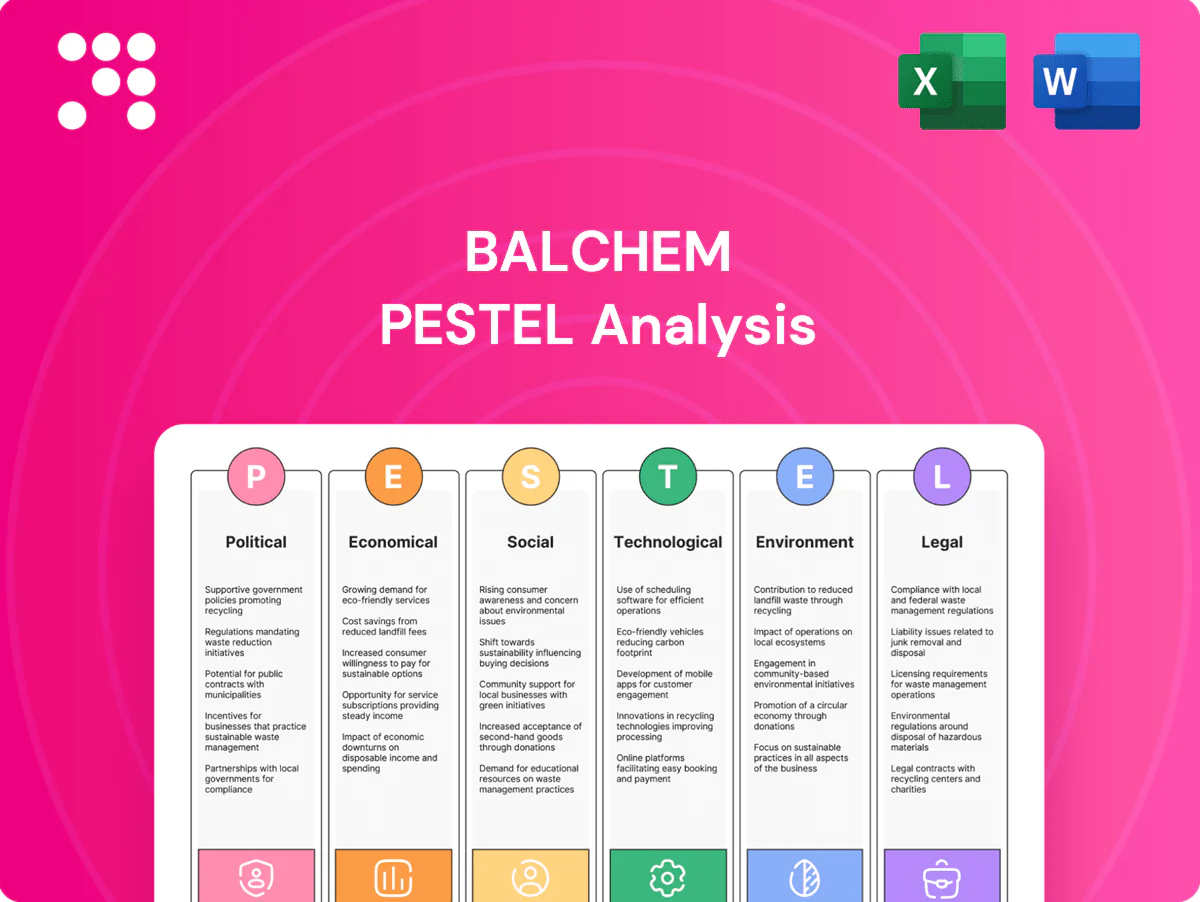
Balchem PESTLE Analysis

Plan Smarter. Present Sharper. Compete Stronger.
Unlock the external landscape shaping Balchem with our concise PESTLE Analysis—highlighting political, economic, social, technological, legal and environmental forces that affect growth. Ideal for investors and strategists, it equips you to anticipate risks and opportunities. Purchase the full report for actionable, ready-to-use insights.
Political factors

Food and ag policy direction
Shifts in national nutrition and food security policies steer fortification priorities and public funding for human health products, critical as WHO estimates about 2 billion people suffer micronutrient deficiencies. Agricultural support schemes determine livestock producers’ purchasing power for feed additives, while alignment with government dietary guidelines and school feeding programs (US NSLP ~29.8M daily) is vital. Policy stability increases demand visibility across segments.
Trade tariffs and geopolitical risk
Tariffs, sanctions and export controls—including US and EU measures imposing duties up to 25% on select chemical imports—can raise Balchem's input costs and constrain market access for specialty ingredients. Geopolitical tensions have disrupted mineral and chemical supply chains, increasing lead times and spot prices by over 8% in 2022–24. Diversifying sourcing and production footprints mitigates concentration risk. Trade agreements can unlock or constrain growth in key regions.

Public health initiatives
Government-backed micronutrient programs drive demand for fortified foods and supplements, with WHO estimating over 2 billion people affected by micronutrient deficiencies and ~29% global anemia prevalence in women of reproductive age. Subsidies and public procurement frameworks accelerate adoption of targeted delivery systems. Balchem can align offerings to maternal, pediatric and elderly nutrition agendas. Consistent engagement with public stakeholders supports long-term program inclusion.

Agri-livestock support and biosecurity
- Policy impact on volumes: + biosecurity-led formulation changes
- Farm payments: alter herd size and nutrition capex
- Regulatory coordination: affects export compliance and market access
Industrial and strategic chemical oversight
Government scrutiny of specialty chemicals tightens approvals, handling rules and plant permits, while energy policy shifts affect input costs—US industrial electricity averaged about 7.3 cents/kWh in 2023 (EIA). Federal incentives like the Inflation Reduction Act (about 369 billion USD) and CHIPS (about 280 billion USD) support reshoring and capex. Active policy engagement helps Balchem anticipate shifts in industrial priorities.
- Regulation: approvals, permits, compliance
- Incentives: IRA 369B, CHIPS 280B
- Energy: industrial power ~7.3¢/kWh (2023)
- Engagement: policy dialogues to foresee priorities
Nutrition programs, tariffs and energy incentives reshape supply chains
National nutrition programs (WHO: ~2B with micronutrient deficiencies) and school feeding (US NSLP ~29.8M/day) drive product demand and public procurement inclusion.
Trade measures (tariffs up to 25%), geopolitical supply shocks (+8% spot prices 2022–24) and feed market size ($21.7B 2024) affect costs and access.
Energy (US industrial power ~7.3¢/kWh 2023) and incentives (IRA 369B, CHIPS 280B) shape reshoring and capex decisions.
| Metric | Value |
|---|---|
| Micronutrient gap | ~2B |
| Feed market (2024) | $21.7B |
| Tariffs | up to 25% |
What is included in the product
 Detailed Word Document
Provides a concise PESTLE review showing how macro forces — Political, Economic, Social, Technological, Environmental, and Legal — specifically affect Balchem’s specialty ingredients and bioscience businesses, with data-driven trends, risk/opportunity highlights, and forward-looking implications for strategy, financing, and regulatory planning.

 Customizable Excel Spreadsheet
A concise, visually segmented PESTLE summary for Balchem that’s easily dropped into presentations, shareable across teams, and editable for regional or business-line notes to streamline external risk discussions and strategic planning.
Economic factors

Commodity and input cost volatility
Fluctuations in minerals, amino alcohols, solvents and energy drive margin variability for Balchem (NASDAQ: BCPC), where active input swings have pressured the company's mid-30s gross margins reported in recent years. Encapsulation materials and packaging cost inflation can compress profitability if not hedged, particularly given industry raw-material price swings. Balchem’s pricing power hinges on product differentiation and contract structure, so active supply and risk management is key to stabilizing gross margins.
FX rates and global demand cycles
Currency swings—the DXY averaged ~103 in 2024—both alter export competitiveness for Balchem and shift translated revenues across geographies. Global dietary supplements, a ~160 billion USD market in 2023 with ~7% CAGR to 2028, mean economic cycles materially affect consumer discretionary spend on supplements and functional foods. Livestock cycles (US cattle inventory ~89 million head Jan 1, 2024) and meat prices drive feed additive volumes, while diverse end-market exposure cushions sector-specific downturns.

Inflation and interest rate environment
Sustained inflation continues to pressure wages, utilities and logistics after US CPI averaged about 3.4% in 2024. Higher policy rates—fed funds roughly 5.25–5.50% into 2025—increase capital costs for expansion and M&A. Customers may elongate purchase cycles or trade down in weaker macro conditions, while disciplined cost pass‑through and productivity gains help protect EBITDA.

Logistics and supply chain resilience
Logistics shocks—freight rates and port congestion—threaten delivery of Balchem’s time-sensitive ingredients; container rates fell roughly 80% from the Sept 2021 Drewry peak of $10,377 per FEU to about $2,000 in 2023, easing but not eliminating disruption risk. Nearshoring and multisourcing shorten lead times and buffer availability, while inventory optimization balances service levels against working capital needs; supply reliability remains a clear B2B competitive advantage.
- Freight volatility: Drewry peak $10,377/FEU (Sep 2021) to ~ $2,000 (2023)
- Nearshoring/multisourcing: reduces lead times & shortage risk
- Inventory optimization: lowers working capital, preserves service
- Supply reliability: differentiator in B2B contracts
M&A and portfolio optimization
Industry consolidation offers Balchem (NASDAQ:BCPC) acquisitive leverage to buy complementary technologies and channels; M&A in specialty ingredients rebounded in 2024–25 with strategic deals driving scale. Synergies in R&D, manufacturing and cross-selling can materially lift ROIC when integration captures 3–6% cost or revenue uplift. Divesting non-core industrial lines sharpens focus on health platforms and recurring margins. Valuation discipline is critical amid competitive bid processes and rising multiples.
- ticker: BCPC
- strategy: buy tech/channels
- synergies: R&D, manufacturing, cross-sell
- focus: divest industrial, prioritize health
- risk: enforce valuation discipline
Nutrition programs, tariffs and energy incentives reshape supply chains
Input-cost swings in minerals, solvents and energy drive mid-30s gross margin variability for Balchem; raw-material and packaging inflation remain key margin risks. Currency (DXY ~103 in 2024) and end‑market cycles (dietary supplements ~$160B in 2023, 7% CAGR to 2028) affect demand and translated revenue. US CPI ~3.4% in 2024 and fed funds ~5.25–5.50% into 2025 raise operating and capital costs; livestock (US cattle ~89M, Jan 1, 2024) impacts feed volumes.
| Metric | Value |
|---|---|
| DXY (2024) | ~103 |
| Supplements (2023) | $160B |
| US CPI (2024) | ~3.4% |
| Fed funds (2025) | 5.25–5.50% |
| US cattle (Jan 1, 2024) | ~89M |
What You See Is What You Get
Balchem PESTLE Analysis
The Balchem PESTLE Analysis preview shown here is the exact document you’ll receive after purchase—fully formatted and ready to use. It contains the final, professionally structured political, economic, social, technological, legal, and environmental review. No placeholders or teasers; download the same file immediately after payment.

Plan Smarter. Present Sharper. Compete Stronger.
Unlock the external landscape shaping Balchem with our concise PESTLE Analysis—highlighting political, economic, social, technological, legal and environmental forces that affect growth. Ideal for investors and strategists, it equips you to anticipate risks and opportunities. Purchase the full report for actionable, ready-to-use insights.
Political factors
Food and ag policy direction
Shifts in national nutrition and food security policies steer fortification priorities and public funding for human health products, critical as WHO estimates about 2 billion people suffer micronutrient deficiencies. Agricultural support schemes determine livestock producers’ purchasing power for feed additives, while alignment with government dietary guidelines and school feeding programs (US NSLP ~29.8M daily) is vital. Policy stability increases demand visibility across segments.
Trade tariffs and geopolitical risk
Tariffs, sanctions and export controls—including US and EU measures imposing duties up to 25% on select chemical imports—can raise Balchem's input costs and constrain market access for specialty ingredients. Geopolitical tensions have disrupted mineral and chemical supply chains, increasing lead times and spot prices by over 8% in 2022–24. Diversifying sourcing and production footprints mitigates concentration risk. Trade agreements can unlock or constrain growth in key regions.
Public health initiatives
Government-backed micronutrient programs drive demand for fortified foods and supplements, with WHO estimating over 2 billion people affected by micronutrient deficiencies and ~29% global anemia prevalence in women of reproductive age. Subsidies and public procurement frameworks accelerate adoption of targeted delivery systems. Balchem can align offerings to maternal, pediatric and elderly nutrition agendas. Consistent engagement with public stakeholders supports long-term program inclusion.
Agri-livestock support and biosecurity
- Policy impact on volumes: + biosecurity-led formulation changes
- Farm payments: alter herd size and nutrition capex
- Regulatory coordination: affects export compliance and market access
Industrial and strategic chemical oversight
Government scrutiny of specialty chemicals tightens approvals, handling rules and plant permits, while energy policy shifts affect input costs—US industrial electricity averaged about 7.3 cents/kWh in 2023 (EIA). Federal incentives like the Inflation Reduction Act (about 369 billion USD) and CHIPS (about 280 billion USD) support reshoring and capex. Active policy engagement helps Balchem anticipate shifts in industrial priorities.
- Regulation: approvals, permits, compliance
- Incentives: IRA 369B, CHIPS 280B
- Energy: industrial power ~7.3¢/kWh (2023)
- Engagement: policy dialogues to foresee priorities
Nutrition programs, tariffs and energy incentives reshape supply chains
National nutrition programs (WHO: ~2B with micronutrient deficiencies) and school feeding (US NSLP ~29.8M/day) drive product demand and public procurement inclusion.
Trade measures (tariffs up to 25%), geopolitical supply shocks (+8% spot prices 2022–24) and feed market size ($21.7B 2024) affect costs and access.
Energy (US industrial power ~7.3¢/kWh 2023) and incentives (IRA 369B, CHIPS 280B) shape reshoring and capex decisions.
| Metric | Value |
|---|---|
| Micronutrient gap | ~2B |
| Feed market (2024) | $21.7B |
| Tariffs | up to 25% |
What is included in the product
Detailed Word Document
Provides a concise PESTLE review showing how macro forces — Political, Economic, Social, Technological, Environmental, and Legal — specifically affect Balchem’s specialty ingredients and bioscience businesses, with data-driven trends, risk/opportunity highlights, and forward-looking implications for strategy, financing, and regulatory planning.
Customizable Excel Spreadsheet
A concise, visually segmented PESTLE summary for Balchem that’s easily dropped into presentations, shareable across teams, and editable for regional or business-line notes to streamline external risk discussions and strategic planning.
Economic factors
Commodity and input cost volatility
Fluctuations in minerals, amino alcohols, solvents and energy drive margin variability for Balchem (NASDAQ: BCPC), where active input swings have pressured the company's mid-30s gross margins reported in recent years. Encapsulation materials and packaging cost inflation can compress profitability if not hedged, particularly given industry raw-material price swings. Balchem’s pricing power hinges on product differentiation and contract structure, so active supply and risk management is key to stabilizing gross margins.
FX rates and global demand cycles
Currency swings—the DXY averaged ~103 in 2024—both alter export competitiveness for Balchem and shift translated revenues across geographies. Global dietary supplements, a ~160 billion USD market in 2023 with ~7% CAGR to 2028, mean economic cycles materially affect consumer discretionary spend on supplements and functional foods. Livestock cycles (US cattle inventory ~89 million head Jan 1, 2024) and meat prices drive feed additive volumes, while diverse end-market exposure cushions sector-specific downturns.
Inflation and interest rate environment
Sustained inflation continues to pressure wages, utilities and logistics after US CPI averaged about 3.4% in 2024. Higher policy rates—fed funds roughly 5.25–5.50% into 2025—increase capital costs for expansion and M&A. Customers may elongate purchase cycles or trade down in weaker macro conditions, while disciplined cost pass‑through and productivity gains help protect EBITDA.
Logistics and supply chain resilience
Logistics shocks—freight rates and port congestion—threaten delivery of Balchem’s time-sensitive ingredients; container rates fell roughly 80% from the Sept 2021 Drewry peak of $10,377 per FEU to about $2,000 in 2023, easing but not eliminating disruption risk. Nearshoring and multisourcing shorten lead times and buffer availability, while inventory optimization balances service levels against working capital needs; supply reliability remains a clear B2B competitive advantage.
- Freight volatility: Drewry peak $10,377/FEU (Sep 2021) to ~ $2,000 (2023)
- Nearshoring/multisourcing: reduces lead times & shortage risk
- Inventory optimization: lowers working capital, preserves service
- Supply reliability: differentiator in B2B contracts
M&A and portfolio optimization
Industry consolidation offers Balchem (NASDAQ:BCPC) acquisitive leverage to buy complementary technologies and channels; M&A in specialty ingredients rebounded in 2024–25 with strategic deals driving scale. Synergies in R&D, manufacturing and cross-selling can materially lift ROIC when integration captures 3–6% cost or revenue uplift. Divesting non-core industrial lines sharpens focus on health platforms and recurring margins. Valuation discipline is critical amid competitive bid processes and rising multiples.
- ticker: BCPC
- strategy: buy tech/channels
- synergies: R&D, manufacturing, cross-sell
- focus: divest industrial, prioritize health
- risk: enforce valuation discipline
Nutrition programs, tariffs and energy incentives reshape supply chains
Input-cost swings in minerals, solvents and energy drive mid-30s gross margin variability for Balchem; raw-material and packaging inflation remain key margin risks. Currency (DXY ~103 in 2024) and end‑market cycles (dietary supplements ~$160B in 2023, 7% CAGR to 2028) affect demand and translated revenue. US CPI ~3.4% in 2024 and fed funds ~5.25–5.50% into 2025 raise operating and capital costs; livestock (US cattle ~89M, Jan 1, 2024) impacts feed volumes.
| Metric | Value |
|---|---|
| DXY (2024) | ~103 |
| Supplements (2023) | $160B |
| US CPI (2024) | ~3.4% |
| Fed funds (2025) | 5.25–5.50% |
| US cattle (Jan 1, 2024) | ~89M |
What You See Is What You Get
Balchem PESTLE Analysis
The Balchem PESTLE Analysis preview shown here is the exact document you’ll receive after purchase—fully formatted and ready to use. It contains the final, professionally structured political, economic, social, technological, legal, and environmental review. No placeholders or teasers; download the same file immediately after payment.
Original: $10.00
-65%$10.00
$3.50Description
Plan Smarter. Present Sharper. Compete Stronger.
Unlock the external landscape shaping Balchem with our concise PESTLE Analysis—highlighting political, economic, social, technological, legal and environmental forces that affect growth. Ideal for investors and strategists, it equips you to anticipate risks and opportunities. Purchase the full report for actionable, ready-to-use insights.
Political factors
Food and ag policy direction
Shifts in national nutrition and food security policies steer fortification priorities and public funding for human health products, critical as WHO estimates about 2 billion people suffer micronutrient deficiencies. Agricultural support schemes determine livestock producers’ purchasing power for feed additives, while alignment with government dietary guidelines and school feeding programs (US NSLP ~29.8M daily) is vital. Policy stability increases demand visibility across segments.
Trade tariffs and geopolitical risk
Tariffs, sanctions and export controls—including US and EU measures imposing duties up to 25% on select chemical imports—can raise Balchem's input costs and constrain market access for specialty ingredients. Geopolitical tensions have disrupted mineral and chemical supply chains, increasing lead times and spot prices by over 8% in 2022–24. Diversifying sourcing and production footprints mitigates concentration risk. Trade agreements can unlock or constrain growth in key regions.
Public health initiatives
Government-backed micronutrient programs drive demand for fortified foods and supplements, with WHO estimating over 2 billion people affected by micronutrient deficiencies and ~29% global anemia prevalence in women of reproductive age. Subsidies and public procurement frameworks accelerate adoption of targeted delivery systems. Balchem can align offerings to maternal, pediatric and elderly nutrition agendas. Consistent engagement with public stakeholders supports long-term program inclusion.
Agri-livestock support and biosecurity
- Policy impact on volumes: + biosecurity-led formulation changes
- Farm payments: alter herd size and nutrition capex
- Regulatory coordination: affects export compliance and market access
Industrial and strategic chemical oversight
Government scrutiny of specialty chemicals tightens approvals, handling rules and plant permits, while energy policy shifts affect input costs—US industrial electricity averaged about 7.3 cents/kWh in 2023 (EIA). Federal incentives like the Inflation Reduction Act (about 369 billion USD) and CHIPS (about 280 billion USD) support reshoring and capex. Active policy engagement helps Balchem anticipate shifts in industrial priorities.
- Regulation: approvals, permits, compliance
- Incentives: IRA 369B, CHIPS 280B
- Energy: industrial power ~7.3¢/kWh (2023)
- Engagement: policy dialogues to foresee priorities
Nutrition programs, tariffs and energy incentives reshape supply chains
National nutrition programs (WHO: ~2B with micronutrient deficiencies) and school feeding (US NSLP ~29.8M/day) drive product demand and public procurement inclusion.
Trade measures (tariffs up to 25%), geopolitical supply shocks (+8% spot prices 2022–24) and feed market size ($21.7B 2024) affect costs and access.
Energy (US industrial power ~7.3¢/kWh 2023) and incentives (IRA 369B, CHIPS 280B) shape reshoring and capex decisions.
| Metric | Value |
|---|---|
| Micronutrient gap | ~2B |
| Feed market (2024) | $21.7B |
| Tariffs | up to 25% |
What is included in the product
Detailed Word Document
Provides a concise PESTLE review showing how macro forces — Political, Economic, Social, Technological, Environmental, and Legal — specifically affect Balchem’s specialty ingredients and bioscience businesses, with data-driven trends, risk/opportunity highlights, and forward-looking implications for strategy, financing, and regulatory planning.
Customizable Excel Spreadsheet
A concise, visually segmented PESTLE summary for Balchem that’s easily dropped into presentations, shareable across teams, and editable for regional or business-line notes to streamline external risk discussions and strategic planning.
Economic factors
Commodity and input cost volatility
Fluctuations in minerals, amino alcohols, solvents and energy drive margin variability for Balchem (NASDAQ: BCPC), where active input swings have pressured the company's mid-30s gross margins reported in recent years. Encapsulation materials and packaging cost inflation can compress profitability if not hedged, particularly given industry raw-material price swings. Balchem’s pricing power hinges on product differentiation and contract structure, so active supply and risk management is key to stabilizing gross margins.
FX rates and global demand cycles
Currency swings—the DXY averaged ~103 in 2024—both alter export competitiveness for Balchem and shift translated revenues across geographies. Global dietary supplements, a ~160 billion USD market in 2023 with ~7% CAGR to 2028, mean economic cycles materially affect consumer discretionary spend on supplements and functional foods. Livestock cycles (US cattle inventory ~89 million head Jan 1, 2024) and meat prices drive feed additive volumes, while diverse end-market exposure cushions sector-specific downturns.
Inflation and interest rate environment
Sustained inflation continues to pressure wages, utilities and logistics after US CPI averaged about 3.4% in 2024. Higher policy rates—fed funds roughly 5.25–5.50% into 2025—increase capital costs for expansion and M&A. Customers may elongate purchase cycles or trade down in weaker macro conditions, while disciplined cost pass‑through and productivity gains help protect EBITDA.
Logistics and supply chain resilience
Logistics shocks—freight rates and port congestion—threaten delivery of Balchem’s time-sensitive ingredients; container rates fell roughly 80% from the Sept 2021 Drewry peak of $10,377 per FEU to about $2,000 in 2023, easing but not eliminating disruption risk. Nearshoring and multisourcing shorten lead times and buffer availability, while inventory optimization balances service levels against working capital needs; supply reliability remains a clear B2B competitive advantage.
- Freight volatility: Drewry peak $10,377/FEU (Sep 2021) to ~ $2,000 (2023)
- Nearshoring/multisourcing: reduces lead times & shortage risk
- Inventory optimization: lowers working capital, preserves service
- Supply reliability: differentiator in B2B contracts
M&A and portfolio optimization
Industry consolidation offers Balchem (NASDAQ:BCPC) acquisitive leverage to buy complementary technologies and channels; M&A in specialty ingredients rebounded in 2024–25 with strategic deals driving scale. Synergies in R&D, manufacturing and cross-selling can materially lift ROIC when integration captures 3–6% cost or revenue uplift. Divesting non-core industrial lines sharpens focus on health platforms and recurring margins. Valuation discipline is critical amid competitive bid processes and rising multiples.
- ticker: BCPC
- strategy: buy tech/channels
- synergies: R&D, manufacturing, cross-sell
- focus: divest industrial, prioritize health
- risk: enforce valuation discipline
Nutrition programs, tariffs and energy incentives reshape supply chains
Input-cost swings in minerals, solvents and energy drive mid-30s gross margin variability for Balchem; raw-material and packaging inflation remain key margin risks. Currency (DXY ~103 in 2024) and end‑market cycles (dietary supplements ~$160B in 2023, 7% CAGR to 2028) affect demand and translated revenue. US CPI ~3.4% in 2024 and fed funds ~5.25–5.50% into 2025 raise operating and capital costs; livestock (US cattle ~89M, Jan 1, 2024) impacts feed volumes.
| Metric | Value |
|---|---|
| DXY (2024) | ~103 |
| Supplements (2023) | $160B |
| US CPI (2024) | ~3.4% |
| Fed funds (2025) | 5.25–5.50% |
| US cattle (Jan 1, 2024) | ~89M |
What You See Is What You Get
Balchem PESTLE Analysis
The Balchem PESTLE Analysis preview shown here is the exact document you’ll receive after purchase—fully formatted and ready to use. It contains the final, professionally structured political, economic, social, technological, legal, and environmental review. No placeholders or teasers; download the same file immediately after payment.











