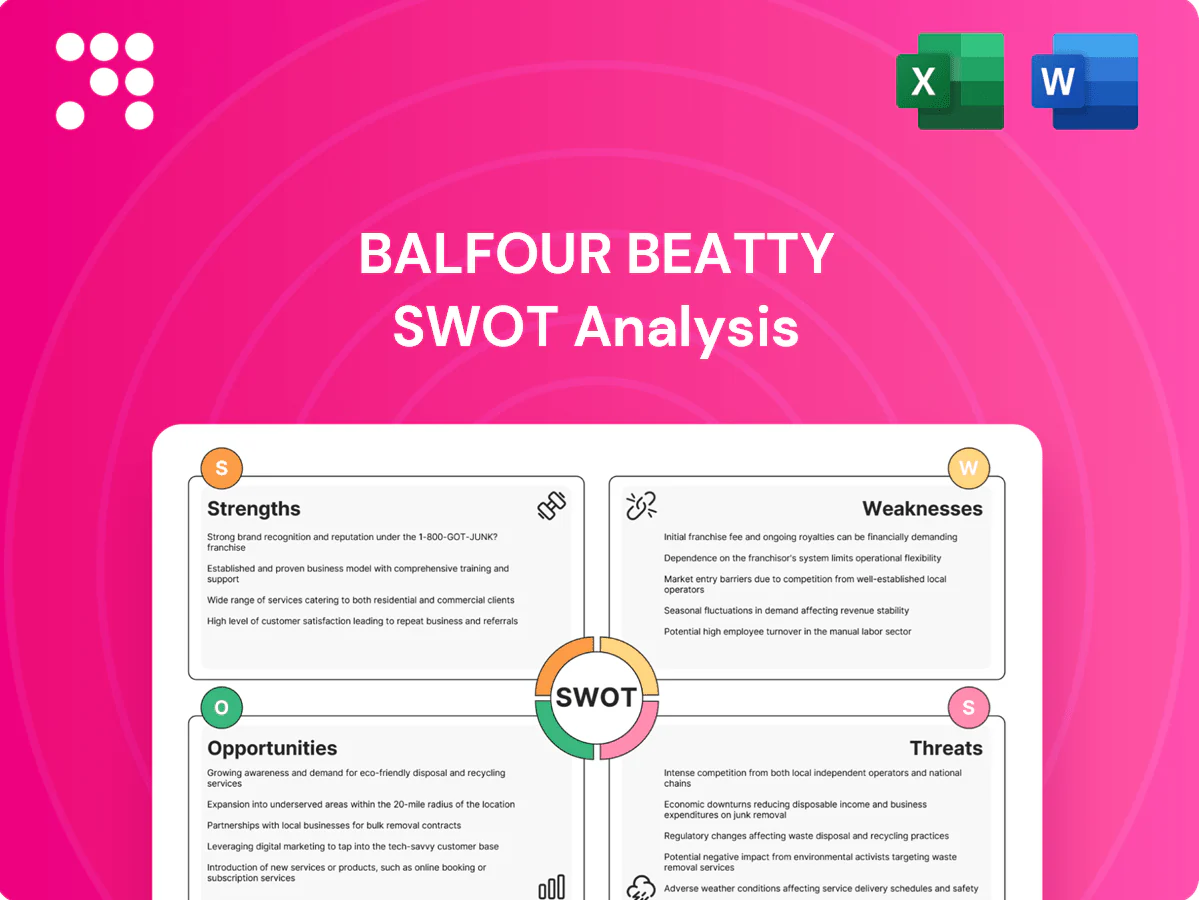
Balfour Beatty SWOT Analysis

Go Beyond the Preview—Access the Full Strategic Report
Balfour Beatty’s SWOT snapshot highlights robust project pipeline and engineering expertise, amid margin pressure from raw material costs and cyclical construction demand. Strategic infrastructure exposure supports growth, while contract risk and regulatory challenges persist. Want the full picture? Purchase the complete SWOT for a research-backed, editable Word and Excel package to plan and invest with confidence.
Strengths

Diversified infrastructure portfolio
Spanning transportation, power, water and social assets, Balfour Beatty reduces dependence on any single end-market, smoothing revenue across cycles and supporting a diversified order book. Cross-sector expertise enables resource sharing and best-practice transfer, boosting efficiency and margins. Its scale—c.25,000 employees (2024) and FTSE 250 status—strengthens bidding credibility on complex, multi-disciplinary programmes.
Strong UK, US, HK footprint
Presence across the UK, US and Hong Kong diversifies political and currency risk and gives access to large public funding pools such as the US IIJA ($1.2tn) and the UK 10-year infrastructure pipeline (c.£650bn), supporting steady bid pipelines. Local delivery track records in each market improve prequalification and drive repeat awards, underpinning Balfour Beatty’s FY 2024 revenue of c.£8.4bn. Cross-border optionality allows workload rebalancing as regional cycles diverge.

End-to-end lifecycle capabilities
End-to-end capabilities from financing and development through build and maintain let Balfour Beatty offer integrated solutions that support whole-life delivery, enabling outcome-based contracts and performance guarantees; this model boosts margins via value-engineering and recurring services revenue and gives clients single-point accountability on complex programmes, backed by an order book of around £19bn (2023).

Robust order book and frameworks
Robust secured order book and multi-year framework agreements give Balfour Beatty strong revenue visibility, with a secured order book of c.£6.4bn reported in FY 2024 that smooths project flow and cash forecasting.
Frameworks reduce bid costs and raise hit rates through repeat work, enable collaborative procurement and early contractor involvement, improving risk allocation and schedule certainty.
- Secured order book: c.£6.4bn (FY 2024)
- Lower bid cost per project
- Higher hit rates via repeat frameworks
- Improved risk allocation & schedule certainty
Operational, safety, and digital know-how
Balfour Beatty’s strong safety culture and program controls materially reduce execution risk, with rigorous site protocols and compliance in regulated projects. Digital design, BIM, and data-driven planning increase productivity and clash avoidance, improving schedule certainty. Standardized processes across sites enhance predictability and differentiate the firm in complex, regulated environments.
- Safety-driven execution
- BIM-enabled clash avoidance
- Data-led planning
- Standardized site processes
Diversified infrastructure: c.£8.4bn revenue, c.£6.4bn order book, c.25,000 staff
Balfour Beatty’s diversified portfolio across transport, power, water and social assets smooths revenue cycles and supports a c.£8.4bn FY2024 top line. Scale (c.25,000 employees, FTSE 250) and global presence (UK, US, HK) strengthen bid credibility and access to large pipelines (US IIJA $1.2tn, UK c.£650bn). Robust secured order book (c.£6.4bn) and integrated end-to-end delivery drive margin resilience.
| Metric | Value |
|---|---|
| FY2024 Revenue | c.£8.4bn |
| Employees | c.25,000 |
| Secured order book | c.£6.4bn |
| Order book (2023) | c.£19bn |
What is included in the product
 Detailed Word Document
Delivers a strategic overview of Balfour Beatty’s internal and external business factors, outlining strengths, weaknesses, opportunities and threats to assess its competitive position, identify key growth drivers and operational gaps, and evaluate the risks shaping the company’s future.

 Customizable Excel Spreadsheet
Provides a concise Balfour Beatty SWOT matrix for fast, visual strategy alignment, easing stakeholder briefings and cross-unit comparisons.
Weaknesses

Structural low margins
Core construction typically runs on thin margins—Balfour Beatty reported an underlying operating margin of around 2.6% in 2024, leaving little buffer for cost overruns. Small variances in cost or schedule can quickly erode profitability and constrain the group’s capacity to absorb shocks despite a robust order book (~£9.6bn). This intensifies focus on disciplined bidding and strict risk pricing to protect returns.
Project and working capital volatility
Large, milestone-driven contracts from an order book of c.£13bn create cashflow timing risk and claim uncertainty; delays, rework or disputes can lock up cash and increase bonding needs. Past cycles have shown working capital swings reaching into the hundreds of millions, pressuring liquidity and covenant headroom. These dynamics heighten dependence on robust commercial management to protect margins and cash.

Complex JV and supply chain reliance
Joint ventures spread project risk for Balfour Beatty but add governance complexity, with partner misalignment slowing decisions and escalating costs on large contracts.
Supply chain fragility—exposed by parts lead-time spikes during 2021–24—undermines quality and schedule on mega-programs (projects >£1bn).
Oversight burdens increase materially on those programmes, requiring layered governance and higher compliance resource allocation.

Fixed-price and legacy risk exposure
Fixed-price and target-cost contracts transfer cost inflation and productivity risk to Balfour Beatty; with an order book around £10bn in 2024 this scale amplifies exposure. Legacy projects have generated warranty and dispute provisions that can tie up cash, prolong recoveries and absorb contingency, distracting management from growth.
- Contract risk: cost inflation shifted to contractor
- Legacy overhang: warranty, defects, litigation
- Financial impact: cash tied in provisions, recovery uncertain
Dependence on public spending cycles
Balfour Beatty relies heavily on public-sector projects, with an order book of c.£9.6bn in 2024, so fiscal tightening, election-related pauses or policy shifts can materially defer awards and revenue recognition. Planning and permitting delays further add timing uncertainty, increasing working capital strains and subcontractor churn. This cyclicality complicates capacity planning and margin visibility across fiscal years.
- Public-dependence: order book c.£9.6bn (2024)
- Risk drivers: fiscal tightening, elections, policy shifts
- Operational impact: planning/permitting delays
- Consequence: capacity planning and margin volatility
Thin margins (~2.6%) and milestone cashflow risk on £9.6bn order book
Balfour Beatty faces thin core margins (underlying operating margin c.2.6% in 2024), large milestone-driven cashflow timing risk from a c.£9.6bn order book, governance complexity from joint ventures, and supply-chain fragility that raised lead times 2021–24, all amplifying working-capital and dispute exposure.
| Metric | 2024 |
|---|---|
| Underlying operating margin | c.2.6% |
| Order book | c.£9.6bn |
| Working-capital swings | hundreds of £m |
| Supply-chain disruption | lead-time spikes 2021–24 |
What You See Is What You Get
Balfour Beatty SWOT Analysis
This is the actual Balfour Beatty SWOT analysis document you’ll receive upon purchase—no surprises, just professional quality. The preview below is taken directly from the full SWOT report you'll get, covering strengths, weaknesses, opportunities, and threats. Once purchased, the complete, editable version is available for download and use in presentations or strategy work.

Go Beyond the Preview—Access the Full Strategic Report
Balfour Beatty’s SWOT snapshot highlights robust project pipeline and engineering expertise, amid margin pressure from raw material costs and cyclical construction demand. Strategic infrastructure exposure supports growth, while contract risk and regulatory challenges persist. Want the full picture? Purchase the complete SWOT for a research-backed, editable Word and Excel package to plan and invest with confidence.
Strengths
Diversified infrastructure portfolio
Spanning transportation, power, water and social assets, Balfour Beatty reduces dependence on any single end-market, smoothing revenue across cycles and supporting a diversified order book. Cross-sector expertise enables resource sharing and best-practice transfer, boosting efficiency and margins. Its scale—c.25,000 employees (2024) and FTSE 250 status—strengthens bidding credibility on complex, multi-disciplinary programmes.
Strong UK, US, HK footprint
Presence across the UK, US and Hong Kong diversifies political and currency risk and gives access to large public funding pools such as the US IIJA ($1.2tn) and the UK 10-year infrastructure pipeline (c.£650bn), supporting steady bid pipelines. Local delivery track records in each market improve prequalification and drive repeat awards, underpinning Balfour Beatty’s FY 2024 revenue of c.£8.4bn. Cross-border optionality allows workload rebalancing as regional cycles diverge.
End-to-end lifecycle capabilities
End-to-end capabilities from financing and development through build and maintain let Balfour Beatty offer integrated solutions that support whole-life delivery, enabling outcome-based contracts and performance guarantees; this model boosts margins via value-engineering and recurring services revenue and gives clients single-point accountability on complex programmes, backed by an order book of around £19bn (2023).
Robust order book and frameworks
Robust secured order book and multi-year framework agreements give Balfour Beatty strong revenue visibility, with a secured order book of c.£6.4bn reported in FY 2024 that smooths project flow and cash forecasting.
Frameworks reduce bid costs and raise hit rates through repeat work, enable collaborative procurement and early contractor involvement, improving risk allocation and schedule certainty.
- Secured order book: c.£6.4bn (FY 2024)
- Lower bid cost per project
- Higher hit rates via repeat frameworks
- Improved risk allocation & schedule certainty
Operational, safety, and digital know-how
Balfour Beatty’s strong safety culture and program controls materially reduce execution risk, with rigorous site protocols and compliance in regulated projects. Digital design, BIM, and data-driven planning increase productivity and clash avoidance, improving schedule certainty. Standardized processes across sites enhance predictability and differentiate the firm in complex, regulated environments.
- Safety-driven execution
- BIM-enabled clash avoidance
- Data-led planning
- Standardized site processes
Diversified infrastructure: c.£8.4bn revenue, c.£6.4bn order book, c.25,000 staff
Balfour Beatty’s diversified portfolio across transport, power, water and social assets smooths revenue cycles and supports a c.£8.4bn FY2024 top line. Scale (c.25,000 employees, FTSE 250) and global presence (UK, US, HK) strengthen bid credibility and access to large pipelines (US IIJA $1.2tn, UK c.£650bn). Robust secured order book (c.£6.4bn) and integrated end-to-end delivery drive margin resilience.
| Metric | Value |
|---|---|
| FY2024 Revenue | c.£8.4bn |
| Employees | c.25,000 |
| Secured order book | c.£6.4bn |
| Order book (2023) | c.£19bn |
What is included in the product
Detailed Word Document
Delivers a strategic overview of Balfour Beatty’s internal and external business factors, outlining strengths, weaknesses, opportunities and threats to assess its competitive position, identify key growth drivers and operational gaps, and evaluate the risks shaping the company’s future.
Customizable Excel Spreadsheet
Provides a concise Balfour Beatty SWOT matrix for fast, visual strategy alignment, easing stakeholder briefings and cross-unit comparisons.
Weaknesses
Structural low margins
Core construction typically runs on thin margins—Balfour Beatty reported an underlying operating margin of around 2.6% in 2024, leaving little buffer for cost overruns. Small variances in cost or schedule can quickly erode profitability and constrain the group’s capacity to absorb shocks despite a robust order book (~£9.6bn). This intensifies focus on disciplined bidding and strict risk pricing to protect returns.
Project and working capital volatility
Large, milestone-driven contracts from an order book of c.£13bn create cashflow timing risk and claim uncertainty; delays, rework or disputes can lock up cash and increase bonding needs. Past cycles have shown working capital swings reaching into the hundreds of millions, pressuring liquidity and covenant headroom. These dynamics heighten dependence on robust commercial management to protect margins and cash.
Complex JV and supply chain reliance
Joint ventures spread project risk for Balfour Beatty but add governance complexity, with partner misalignment slowing decisions and escalating costs on large contracts.
Supply chain fragility—exposed by parts lead-time spikes during 2021–24—undermines quality and schedule on mega-programs (projects >£1bn).
Oversight burdens increase materially on those programmes, requiring layered governance and higher compliance resource allocation.
Fixed-price and legacy risk exposure
Fixed-price and target-cost contracts transfer cost inflation and productivity risk to Balfour Beatty; with an order book around £10bn in 2024 this scale amplifies exposure. Legacy projects have generated warranty and dispute provisions that can tie up cash, prolong recoveries and absorb contingency, distracting management from growth.
- Contract risk: cost inflation shifted to contractor
- Legacy overhang: warranty, defects, litigation
- Financial impact: cash tied in provisions, recovery uncertain
Dependence on public spending cycles
Balfour Beatty relies heavily on public-sector projects, with an order book of c.£9.6bn in 2024, so fiscal tightening, election-related pauses or policy shifts can materially defer awards and revenue recognition. Planning and permitting delays further add timing uncertainty, increasing working capital strains and subcontractor churn. This cyclicality complicates capacity planning and margin visibility across fiscal years.
- Public-dependence: order book c.£9.6bn (2024)
- Risk drivers: fiscal tightening, elections, policy shifts
- Operational impact: planning/permitting delays
- Consequence: capacity planning and margin volatility
Thin margins (~2.6%) and milestone cashflow risk on £9.6bn order book
Balfour Beatty faces thin core margins (underlying operating margin c.2.6% in 2024), large milestone-driven cashflow timing risk from a c.£9.6bn order book, governance complexity from joint ventures, and supply-chain fragility that raised lead times 2021–24, all amplifying working-capital and dispute exposure.
| Metric | 2024 |
|---|---|
| Underlying operating margin | c.2.6% |
| Order book | c.£9.6bn |
| Working-capital swings | hundreds of £m |
| Supply-chain disruption | lead-time spikes 2021–24 |
What You See Is What You Get
Balfour Beatty SWOT Analysis
This is the actual Balfour Beatty SWOT analysis document you’ll receive upon purchase—no surprises, just professional quality. The preview below is taken directly from the full SWOT report you'll get, covering strengths, weaknesses, opportunities, and threats. Once purchased, the complete, editable version is available for download and use in presentations or strategy work.
Original: $10.00
-65%$10.00
$3.50Description
Go Beyond the Preview—Access the Full Strategic Report
Balfour Beatty’s SWOT snapshot highlights robust project pipeline and engineering expertise, amid margin pressure from raw material costs and cyclical construction demand. Strategic infrastructure exposure supports growth, while contract risk and regulatory challenges persist. Want the full picture? Purchase the complete SWOT for a research-backed, editable Word and Excel package to plan and invest with confidence.
Strengths
Diversified infrastructure portfolio
Spanning transportation, power, water and social assets, Balfour Beatty reduces dependence on any single end-market, smoothing revenue across cycles and supporting a diversified order book. Cross-sector expertise enables resource sharing and best-practice transfer, boosting efficiency and margins. Its scale—c.25,000 employees (2024) and FTSE 250 status—strengthens bidding credibility on complex, multi-disciplinary programmes.
Strong UK, US, HK footprint
Presence across the UK, US and Hong Kong diversifies political and currency risk and gives access to large public funding pools such as the US IIJA ($1.2tn) and the UK 10-year infrastructure pipeline (c.£650bn), supporting steady bid pipelines. Local delivery track records in each market improve prequalification and drive repeat awards, underpinning Balfour Beatty’s FY 2024 revenue of c.£8.4bn. Cross-border optionality allows workload rebalancing as regional cycles diverge.
End-to-end lifecycle capabilities
End-to-end capabilities from financing and development through build and maintain let Balfour Beatty offer integrated solutions that support whole-life delivery, enabling outcome-based contracts and performance guarantees; this model boosts margins via value-engineering and recurring services revenue and gives clients single-point accountability on complex programmes, backed by an order book of around £19bn (2023).
Robust order book and frameworks
Robust secured order book and multi-year framework agreements give Balfour Beatty strong revenue visibility, with a secured order book of c.£6.4bn reported in FY 2024 that smooths project flow and cash forecasting.
Frameworks reduce bid costs and raise hit rates through repeat work, enable collaborative procurement and early contractor involvement, improving risk allocation and schedule certainty.
- Secured order book: c.£6.4bn (FY 2024)
- Lower bid cost per project
- Higher hit rates via repeat frameworks
- Improved risk allocation & schedule certainty
Operational, safety, and digital know-how
Balfour Beatty’s strong safety culture and program controls materially reduce execution risk, with rigorous site protocols and compliance in regulated projects. Digital design, BIM, and data-driven planning increase productivity and clash avoidance, improving schedule certainty. Standardized processes across sites enhance predictability and differentiate the firm in complex, regulated environments.
- Safety-driven execution
- BIM-enabled clash avoidance
- Data-led planning
- Standardized site processes
Diversified infrastructure: c.£8.4bn revenue, c.£6.4bn order book, c.25,000 staff
Balfour Beatty’s diversified portfolio across transport, power, water and social assets smooths revenue cycles and supports a c.£8.4bn FY2024 top line. Scale (c.25,000 employees, FTSE 250) and global presence (UK, US, HK) strengthen bid credibility and access to large pipelines (US IIJA $1.2tn, UK c.£650bn). Robust secured order book (c.£6.4bn) and integrated end-to-end delivery drive margin resilience.
| Metric | Value |
|---|---|
| FY2024 Revenue | c.£8.4bn |
| Employees | c.25,000 |
| Secured order book | c.£6.4bn |
| Order book (2023) | c.£19bn |
What is included in the product
Detailed Word Document
Delivers a strategic overview of Balfour Beatty’s internal and external business factors, outlining strengths, weaknesses, opportunities and threats to assess its competitive position, identify key growth drivers and operational gaps, and evaluate the risks shaping the company’s future.
Customizable Excel Spreadsheet
Provides a concise Balfour Beatty SWOT matrix for fast, visual strategy alignment, easing stakeholder briefings and cross-unit comparisons.
Weaknesses
Structural low margins
Core construction typically runs on thin margins—Balfour Beatty reported an underlying operating margin of around 2.6% in 2024, leaving little buffer for cost overruns. Small variances in cost or schedule can quickly erode profitability and constrain the group’s capacity to absorb shocks despite a robust order book (~£9.6bn). This intensifies focus on disciplined bidding and strict risk pricing to protect returns.
Project and working capital volatility
Large, milestone-driven contracts from an order book of c.£13bn create cashflow timing risk and claim uncertainty; delays, rework or disputes can lock up cash and increase bonding needs. Past cycles have shown working capital swings reaching into the hundreds of millions, pressuring liquidity and covenant headroom. These dynamics heighten dependence on robust commercial management to protect margins and cash.
Complex JV and supply chain reliance
Joint ventures spread project risk for Balfour Beatty but add governance complexity, with partner misalignment slowing decisions and escalating costs on large contracts.
Supply chain fragility—exposed by parts lead-time spikes during 2021–24—undermines quality and schedule on mega-programs (projects >£1bn).
Oversight burdens increase materially on those programmes, requiring layered governance and higher compliance resource allocation.
Fixed-price and legacy risk exposure
Fixed-price and target-cost contracts transfer cost inflation and productivity risk to Balfour Beatty; with an order book around £10bn in 2024 this scale amplifies exposure. Legacy projects have generated warranty and dispute provisions that can tie up cash, prolong recoveries and absorb contingency, distracting management from growth.
- Contract risk: cost inflation shifted to contractor
- Legacy overhang: warranty, defects, litigation
- Financial impact: cash tied in provisions, recovery uncertain
Dependence on public spending cycles
Balfour Beatty relies heavily on public-sector projects, with an order book of c.£9.6bn in 2024, so fiscal tightening, election-related pauses or policy shifts can materially defer awards and revenue recognition. Planning and permitting delays further add timing uncertainty, increasing working capital strains and subcontractor churn. This cyclicality complicates capacity planning and margin visibility across fiscal years.
- Public-dependence: order book c.£9.6bn (2024)
- Risk drivers: fiscal tightening, elections, policy shifts
- Operational impact: planning/permitting delays
- Consequence: capacity planning and margin volatility
Thin margins (~2.6%) and milestone cashflow risk on £9.6bn order book
Balfour Beatty faces thin core margins (underlying operating margin c.2.6% in 2024), large milestone-driven cashflow timing risk from a c.£9.6bn order book, governance complexity from joint ventures, and supply-chain fragility that raised lead times 2021–24, all amplifying working-capital and dispute exposure.
| Metric | 2024 |
|---|---|
| Underlying operating margin | c.2.6% |
| Order book | c.£9.6bn |
| Working-capital swings | hundreds of £m |
| Supply-chain disruption | lead-time spikes 2021–24 |
What You See Is What You Get
Balfour Beatty SWOT Analysis
This is the actual Balfour Beatty SWOT analysis document you’ll receive upon purchase—no surprises, just professional quality. The preview below is taken directly from the full SWOT report you'll get, covering strengths, weaknesses, opportunities, and threats. Once purchased, the complete, editable version is available for download and use in presentations or strategy work.











