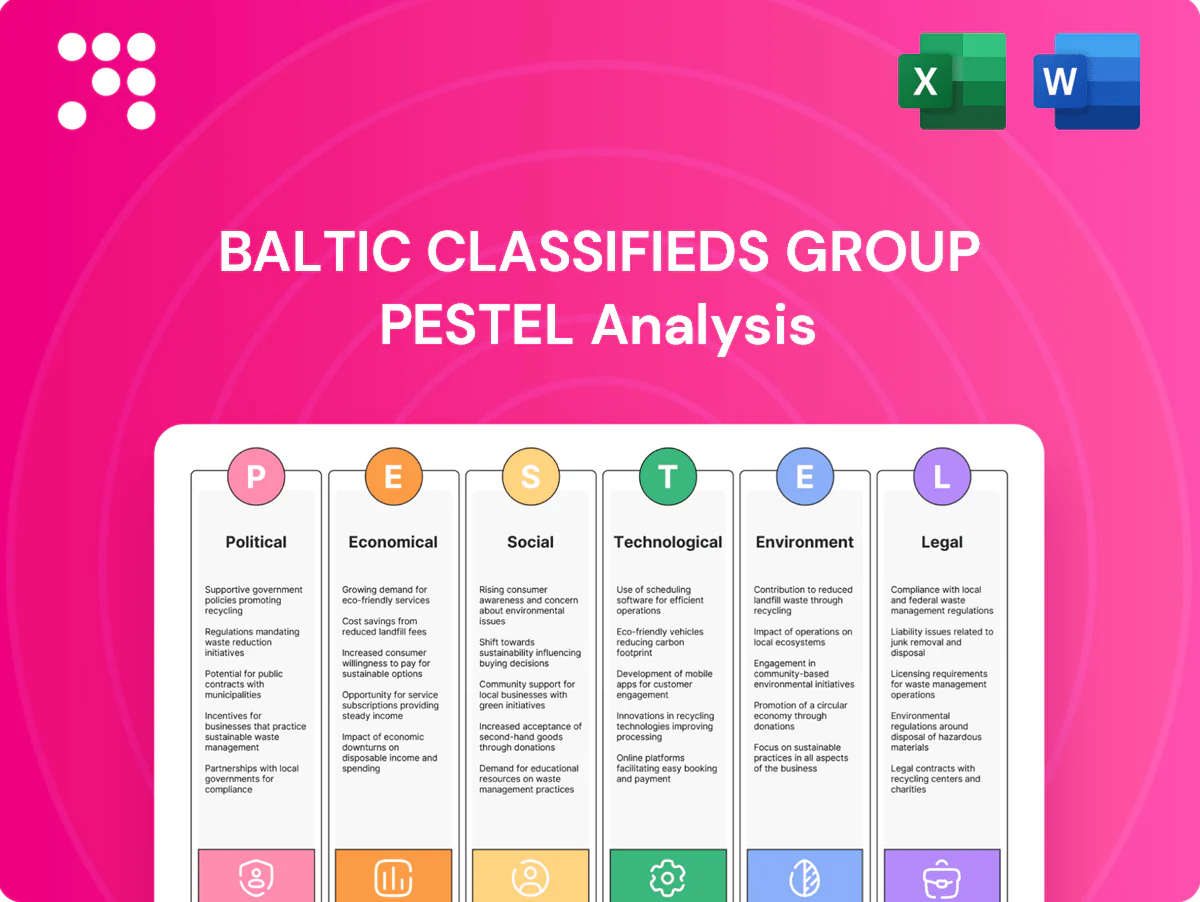
Baltic Classifieds Group PESTLE Analysis

Your Shortcut to Market Insight Starts Here
Unlock how political shifts, economic cycles, and tech disruption are shaping Baltic Classifieds Group with our concise PESTLE snapshot—designed to inform investors and strategists fast. Gain actionable risk and opportunity insights to refine decisions. Purchase the full PESTLE for the complete, exportable analysis and immediate download.
Political factors

EU single market stability
Operating in Estonia, Latvia and Lithuania benefits from EU policy consistency and free movement across 27 member states. Stable EU digital market rules such as the DSA and DMA (adopted 2022) support cross-border classifieds operations. However, shifts in competition or platform regulation could alter operating practices and margins. Monitoring Brussels agendas is essential given the Baltic market population of about 6.1 million.
NATO security backdrop
Baltic proximity to Russia elevates geopolitical risk despite NATO membership and the enhanced forward presence (multinational battlegroups ~1,200 troops per host country). Heightened tensions have previously pushed advertiser spend down 10–25%, weighing on revenue and investor sentiment. Robust business continuity, multi-region data redundancy and tested crisis communication plans preserve operations and user trust.

Public sector digitalization
Baltic governments are leaders in e-government—Estonia launched e-Residency in 2014 and passed 100,000 e-residents by 2021—enabling digital ID and registry integrations that streamline real estate, jobs and auto verification. Such links can materially raise classifieds verification rates and user trust, supporting faster penetration and monetization. Changes in public IT procurement or access rules could materially alter integration roadmaps and timing.

Regional subsidies and EU funds
Tax policy and cross-border VAT
EU VAT and local tax compliance shape pricing of premium listings and add‑ons, with member-state standard VAT rates ranging from 17% (Luxembourg) to 27% (Hungary); OSS/IOSS (introduced 2021) and harmonised reporting cut cross‑border billing complexity. Potential digital services tax adjustments (previously around 3% in some countries) could compress margins if reintroduced or widened. Proactive tax planning lowers administrative friction and audit risk.
- OSS/IOSS: simplifies multi-country VAT reporting
- VAT range: 17%–27%
- DST precedent: ~3% in some jurisdictions
- Proactive planning: reduces penalties and delays
Baltic classifieds: EU rules ease cross-border trade; VAT 17%–27% and geo-risk
EU-wide rules (DSA/DMA 2022) and free movement ease cross-border classifieds across the Baltics (pop ~6.1M), but Brussels policy shifts can affect margins. Proximity to Russia raises geopolitical risk despite NATO battlegroups (~1,200 troops/host), previously dragging ad spend 10–25%. Strong e-gov (Estonian e‑Residency 100,000+ by 2021) and EU funds expand market but VAT/OSS rules (17–27% range; OSS/IOSS 2021) affect pricing.
| Metric | Value |
|---|---|
| Baltic population | ~6.1M |
| NATO battlegroup size | ~1,200/host |
| EU cohesion 2021–27 | €330bn |
| RRF | €672.5bn |
| VAT range | 17%–27% |
What is included in the product
 Detailed Word Document
Explores how external macro-environmental factors uniquely affect Baltic Classifieds Group across Political, Economic, Social, Technological, Environmental and Legal dimensions, with data-backed trends and region-specific examples. Designed for executives and investors to identify threats, opportunities and support scenario planning.

 Customizable Excel Spreadsheet
A concise, visually segmented PESTLE summary of Baltic Classifieds Group that simplifies external risk assessment and market positioning for quick inclusion in presentations or strategy sessions; editable notes allow localization by region or business line, making it easily shareable and accessible to all stakeholders.
Economic factors

GDP growth and ad spend
Classifieds revenue closely follows macro cycles and SME marketing budgets; IMF WEO (Oct 2024) projected Estonia, Latvia and Lithuania GDP growth around 2–3% in 2024–25, boosting demand in auto, real estate and jobs. Recovery phases raise premium listing uptake and CPMs, while downturns compress volumes. Diversifying into subscriptions, lead-gen and services cushions cyclicality.
Interest rates and real estate
ECB rate moves (peaking near 4.00% in 2024 and easing to about 3.75% by mid-2025) directly curb or spur Baltic housing transactions and mortgage demand, with lower rates historically lifting listings and agent ad spend while higher rates suppress churn. Baltic Classifieds must flex pricing models to cycle depth; durable data products for agents can raise ARPU per listing and partially offset volume dips.

Labor market dynamics
Tight labor markets push recruiters to increase spend on job postings and premium visibility, while EU employment rates rose to about 73.1% in 2024 (Eurostat), sustaining demand for talent. Slowdowns cut vacancy counts but heighten demand for better matching tools and AI screening. Cross-border mobility inside the EU expands candidate pools, and performance-based job ads align recruiter spend with measurable hiring outcomes.

Automotive supply and prices
In 2024 eased semiconductor constraints and recovering factory output increased new-car supply, while steady used-car imports from Western Europe and depreciation patterns continue to expand Baltic online listings.
Currency swings and elevated fuel costs in 2024 shifted buyer preference toward smaller efficient and used models, increasing turnover velocity.
Greater consumer financing availability boosted dealer lead volumes, and transparent pricing analytics raised dealer willingness to pay for premium listing services.
- new-supply recovery 2024
- used-imports stable
- fuel/currency influence
- financing up leads
- pricing transparency ↑ dealer spend
SME digitization and ecommerce
SME digitization across the Baltics has driven higher demand for classifieds and adjacent services as more micro and small firms list inventory and leads online; Baltic digital retail volumes grew strongly through 2023–24, supporting platform monetisation. Public digital-voucher schemes and fiscal incentives accelerated onboarding, while bundled ad packages and self-serve tools align with tight SME budgets; training and onboarding reduced churn and lifted lifetime value.
- Tags: SME-onboarding
- Tags: digital-vouchers
- Tags: bundled-pricing
- Tags: churn-reduction
Baltic classifieds: EU rules ease cross-border trade; VAT 17%–27% and geo-risk
Classifieds revenue tracks macro cycles; IMF WEO Oct 2024 projects Estonia/Latvia/Lithuania GDP ~2–3% in 2024–25, lifting auto, real estate and jobs demand.
ECB policy peaked near 4.00% in 2024, easing to ~3.75% by mid‑2025, directly affecting housing transactions and ad spend.
EU employment rose to 73.1% in 2024 (Eurostat), supporting job-post monetisation; vehicle supply recovery and stable used imports expanded listings.
| Indicator | 2024 | 2025e | Source |
|---|---|---|---|
| GDP Baltics | 2–3% | 2–3% | IMF WEO Oct 2024 |
| ECB rate | ~4.00% | ~3.75% | ECB data 2024–25 |
| EU employment | 73.1% | - | Eurostat 2024 |
Full Version Awaits
Baltic Classifieds Group PESTLE Analysis
The Baltic Classifieds Group PESTLE Analysis preview shown here is the exact document you’ll receive after purchase—fully formatted and ready to use. It contains the complete political, economic, social, technological, legal and environmental review with no placeholders or teasers. The layout, content and structure visible here are exactly what you’ll download immediately after checkout.

Your Shortcut to Market Insight Starts Here
Unlock how political shifts, economic cycles, and tech disruption are shaping Baltic Classifieds Group with our concise PESTLE snapshot—designed to inform investors and strategists fast. Gain actionable risk and opportunity insights to refine decisions. Purchase the full PESTLE for the complete, exportable analysis and immediate download.
Political factors
EU single market stability
Operating in Estonia, Latvia and Lithuania benefits from EU policy consistency and free movement across 27 member states. Stable EU digital market rules such as the DSA and DMA (adopted 2022) support cross-border classifieds operations. However, shifts in competition or platform regulation could alter operating practices and margins. Monitoring Brussels agendas is essential given the Baltic market population of about 6.1 million.
NATO security backdrop
Baltic proximity to Russia elevates geopolitical risk despite NATO membership and the enhanced forward presence (multinational battlegroups ~1,200 troops per host country). Heightened tensions have previously pushed advertiser spend down 10–25%, weighing on revenue and investor sentiment. Robust business continuity, multi-region data redundancy and tested crisis communication plans preserve operations and user trust.
Public sector digitalization
Baltic governments are leaders in e-government—Estonia launched e-Residency in 2014 and passed 100,000 e-residents by 2021—enabling digital ID and registry integrations that streamline real estate, jobs and auto verification. Such links can materially raise classifieds verification rates and user trust, supporting faster penetration and monetization. Changes in public IT procurement or access rules could materially alter integration roadmaps and timing.
Regional subsidies and EU funds
Tax policy and cross-border VAT
EU VAT and local tax compliance shape pricing of premium listings and add‑ons, with member-state standard VAT rates ranging from 17% (Luxembourg) to 27% (Hungary); OSS/IOSS (introduced 2021) and harmonised reporting cut cross‑border billing complexity. Potential digital services tax adjustments (previously around 3% in some countries) could compress margins if reintroduced or widened. Proactive tax planning lowers administrative friction and audit risk.
- OSS/IOSS: simplifies multi-country VAT reporting
- VAT range: 17%–27%
- DST precedent: ~3% in some jurisdictions
- Proactive planning: reduces penalties and delays
Baltic classifieds: EU rules ease cross-border trade; VAT 17%–27% and geo-risk
EU-wide rules (DSA/DMA 2022) and free movement ease cross-border classifieds across the Baltics (pop ~6.1M), but Brussels policy shifts can affect margins. Proximity to Russia raises geopolitical risk despite NATO battlegroups (~1,200 troops/host), previously dragging ad spend 10–25%. Strong e-gov (Estonian e‑Residency 100,000+ by 2021) and EU funds expand market but VAT/OSS rules (17–27% range; OSS/IOSS 2021) affect pricing.
| Metric | Value |
|---|---|
| Baltic population | ~6.1M |
| NATO battlegroup size | ~1,200/host |
| EU cohesion 2021–27 | €330bn |
| RRF | €672.5bn |
| VAT range | 17%–27% |
What is included in the product
Detailed Word Document
Explores how external macro-environmental factors uniquely affect Baltic Classifieds Group across Political, Economic, Social, Technological, Environmental and Legal dimensions, with data-backed trends and region-specific examples. Designed for executives and investors to identify threats, opportunities and support scenario planning.
Customizable Excel Spreadsheet
A concise, visually segmented PESTLE summary of Baltic Classifieds Group that simplifies external risk assessment and market positioning for quick inclusion in presentations or strategy sessions; editable notes allow localization by region or business line, making it easily shareable and accessible to all stakeholders.
Economic factors
GDP growth and ad spend
Classifieds revenue closely follows macro cycles and SME marketing budgets; IMF WEO (Oct 2024) projected Estonia, Latvia and Lithuania GDP growth around 2–3% in 2024–25, boosting demand in auto, real estate and jobs. Recovery phases raise premium listing uptake and CPMs, while downturns compress volumes. Diversifying into subscriptions, lead-gen and services cushions cyclicality.
Interest rates and real estate
ECB rate moves (peaking near 4.00% in 2024 and easing to about 3.75% by mid-2025) directly curb or spur Baltic housing transactions and mortgage demand, with lower rates historically lifting listings and agent ad spend while higher rates suppress churn. Baltic Classifieds must flex pricing models to cycle depth; durable data products for agents can raise ARPU per listing and partially offset volume dips.
Labor market dynamics
Tight labor markets push recruiters to increase spend on job postings and premium visibility, while EU employment rates rose to about 73.1% in 2024 (Eurostat), sustaining demand for talent. Slowdowns cut vacancy counts but heighten demand for better matching tools and AI screening. Cross-border mobility inside the EU expands candidate pools, and performance-based job ads align recruiter spend with measurable hiring outcomes.
Automotive supply and prices
In 2024 eased semiconductor constraints and recovering factory output increased new-car supply, while steady used-car imports from Western Europe and depreciation patterns continue to expand Baltic online listings.
Currency swings and elevated fuel costs in 2024 shifted buyer preference toward smaller efficient and used models, increasing turnover velocity.
Greater consumer financing availability boosted dealer lead volumes, and transparent pricing analytics raised dealer willingness to pay for premium listing services.
- new-supply recovery 2024
- used-imports stable
- fuel/currency influence
- financing up leads
- pricing transparency ↑ dealer spend
SME digitization and ecommerce
SME digitization across the Baltics has driven higher demand for classifieds and adjacent services as more micro and small firms list inventory and leads online; Baltic digital retail volumes grew strongly through 2023–24, supporting platform monetisation. Public digital-voucher schemes and fiscal incentives accelerated onboarding, while bundled ad packages and self-serve tools align with tight SME budgets; training and onboarding reduced churn and lifted lifetime value.
- Tags: SME-onboarding
- Tags: digital-vouchers
- Tags: bundled-pricing
- Tags: churn-reduction
Baltic classifieds: EU rules ease cross-border trade; VAT 17%–27% and geo-risk
Classifieds revenue tracks macro cycles; IMF WEO Oct 2024 projects Estonia/Latvia/Lithuania GDP ~2–3% in 2024–25, lifting auto, real estate and jobs demand.
ECB policy peaked near 4.00% in 2024, easing to ~3.75% by mid‑2025, directly affecting housing transactions and ad spend.
EU employment rose to 73.1% in 2024 (Eurostat), supporting job-post monetisation; vehicle supply recovery and stable used imports expanded listings.
| Indicator | 2024 | 2025e | Source |
|---|---|---|---|
| GDP Baltics | 2–3% | 2–3% | IMF WEO Oct 2024 |
| ECB rate | ~4.00% | ~3.75% | ECB data 2024–25 |
| EU employment | 73.1% | - | Eurostat 2024 |
Full Version Awaits
Baltic Classifieds Group PESTLE Analysis
The Baltic Classifieds Group PESTLE Analysis preview shown here is the exact document you’ll receive after purchase—fully formatted and ready to use. It contains the complete political, economic, social, technological, legal and environmental review with no placeholders or teasers. The layout, content and structure visible here are exactly what you’ll download immediately after checkout.
Original: $10.00
-65%$10.00
$3.50Description
Your Shortcut to Market Insight Starts Here
Unlock how political shifts, economic cycles, and tech disruption are shaping Baltic Classifieds Group with our concise PESTLE snapshot—designed to inform investors and strategists fast. Gain actionable risk and opportunity insights to refine decisions. Purchase the full PESTLE for the complete, exportable analysis and immediate download.
Political factors
EU single market stability
Operating in Estonia, Latvia and Lithuania benefits from EU policy consistency and free movement across 27 member states. Stable EU digital market rules such as the DSA and DMA (adopted 2022) support cross-border classifieds operations. However, shifts in competition or platform regulation could alter operating practices and margins. Monitoring Brussels agendas is essential given the Baltic market population of about 6.1 million.
NATO security backdrop
Baltic proximity to Russia elevates geopolitical risk despite NATO membership and the enhanced forward presence (multinational battlegroups ~1,200 troops per host country). Heightened tensions have previously pushed advertiser spend down 10–25%, weighing on revenue and investor sentiment. Robust business continuity, multi-region data redundancy and tested crisis communication plans preserve operations and user trust.
Public sector digitalization
Baltic governments are leaders in e-government—Estonia launched e-Residency in 2014 and passed 100,000 e-residents by 2021—enabling digital ID and registry integrations that streamline real estate, jobs and auto verification. Such links can materially raise classifieds verification rates and user trust, supporting faster penetration and monetization. Changes in public IT procurement or access rules could materially alter integration roadmaps and timing.
Regional subsidies and EU funds
Tax policy and cross-border VAT
EU VAT and local tax compliance shape pricing of premium listings and add‑ons, with member-state standard VAT rates ranging from 17% (Luxembourg) to 27% (Hungary); OSS/IOSS (introduced 2021) and harmonised reporting cut cross‑border billing complexity. Potential digital services tax adjustments (previously around 3% in some countries) could compress margins if reintroduced or widened. Proactive tax planning lowers administrative friction and audit risk.
- OSS/IOSS: simplifies multi-country VAT reporting
- VAT range: 17%–27%
- DST precedent: ~3% in some jurisdictions
- Proactive planning: reduces penalties and delays
Baltic classifieds: EU rules ease cross-border trade; VAT 17%–27% and geo-risk
EU-wide rules (DSA/DMA 2022) and free movement ease cross-border classifieds across the Baltics (pop ~6.1M), but Brussels policy shifts can affect margins. Proximity to Russia raises geopolitical risk despite NATO battlegroups (~1,200 troops/host), previously dragging ad spend 10–25%. Strong e-gov (Estonian e‑Residency 100,000+ by 2021) and EU funds expand market but VAT/OSS rules (17–27% range; OSS/IOSS 2021) affect pricing.
| Metric | Value |
|---|---|
| Baltic population | ~6.1M |
| NATO battlegroup size | ~1,200/host |
| EU cohesion 2021–27 | €330bn |
| RRF | €672.5bn |
| VAT range | 17%–27% |
What is included in the product
Detailed Word Document
Explores how external macro-environmental factors uniquely affect Baltic Classifieds Group across Political, Economic, Social, Technological, Environmental and Legal dimensions, with data-backed trends and region-specific examples. Designed for executives and investors to identify threats, opportunities and support scenario planning.
Customizable Excel Spreadsheet
A concise, visually segmented PESTLE summary of Baltic Classifieds Group that simplifies external risk assessment and market positioning for quick inclusion in presentations or strategy sessions; editable notes allow localization by region or business line, making it easily shareable and accessible to all stakeholders.
Economic factors
GDP growth and ad spend
Classifieds revenue closely follows macro cycles and SME marketing budgets; IMF WEO (Oct 2024) projected Estonia, Latvia and Lithuania GDP growth around 2–3% in 2024–25, boosting demand in auto, real estate and jobs. Recovery phases raise premium listing uptake and CPMs, while downturns compress volumes. Diversifying into subscriptions, lead-gen and services cushions cyclicality.
Interest rates and real estate
ECB rate moves (peaking near 4.00% in 2024 and easing to about 3.75% by mid-2025) directly curb or spur Baltic housing transactions and mortgage demand, with lower rates historically lifting listings and agent ad spend while higher rates suppress churn. Baltic Classifieds must flex pricing models to cycle depth; durable data products for agents can raise ARPU per listing and partially offset volume dips.
Labor market dynamics
Tight labor markets push recruiters to increase spend on job postings and premium visibility, while EU employment rates rose to about 73.1% in 2024 (Eurostat), sustaining demand for talent. Slowdowns cut vacancy counts but heighten demand for better matching tools and AI screening. Cross-border mobility inside the EU expands candidate pools, and performance-based job ads align recruiter spend with measurable hiring outcomes.
Automotive supply and prices
In 2024 eased semiconductor constraints and recovering factory output increased new-car supply, while steady used-car imports from Western Europe and depreciation patterns continue to expand Baltic online listings.
Currency swings and elevated fuel costs in 2024 shifted buyer preference toward smaller efficient and used models, increasing turnover velocity.
Greater consumer financing availability boosted dealer lead volumes, and transparent pricing analytics raised dealer willingness to pay for premium listing services.
- new-supply recovery 2024
- used-imports stable
- fuel/currency influence
- financing up leads
- pricing transparency ↑ dealer spend
SME digitization and ecommerce
SME digitization across the Baltics has driven higher demand for classifieds and adjacent services as more micro and small firms list inventory and leads online; Baltic digital retail volumes grew strongly through 2023–24, supporting platform monetisation. Public digital-voucher schemes and fiscal incentives accelerated onboarding, while bundled ad packages and self-serve tools align with tight SME budgets; training and onboarding reduced churn and lifted lifetime value.
- Tags: SME-onboarding
- Tags: digital-vouchers
- Tags: bundled-pricing
- Tags: churn-reduction
Baltic classifieds: EU rules ease cross-border trade; VAT 17%–27% and geo-risk
Classifieds revenue tracks macro cycles; IMF WEO Oct 2024 projects Estonia/Latvia/Lithuania GDP ~2–3% in 2024–25, lifting auto, real estate and jobs demand.
ECB policy peaked near 4.00% in 2024, easing to ~3.75% by mid‑2025, directly affecting housing transactions and ad spend.
EU employment rose to 73.1% in 2024 (Eurostat), supporting job-post monetisation; vehicle supply recovery and stable used imports expanded listings.
| Indicator | 2024 | 2025e | Source |
|---|---|---|---|
| GDP Baltics | 2–3% | 2–3% | IMF WEO Oct 2024 |
| ECB rate | ~4.00% | ~3.75% | ECB data 2024–25 |
| EU employment | 73.1% | - | Eurostat 2024 |
Full Version Awaits
Baltic Classifieds Group PESTLE Analysis
The Baltic Classifieds Group PESTLE Analysis preview shown here is the exact document you’ll receive after purchase—fully formatted and ready to use. It contains the complete political, economic, social, technological, legal and environmental review with no placeholders or teasers. The layout, content and structure visible here are exactly what you’ll download immediately after checkout.











