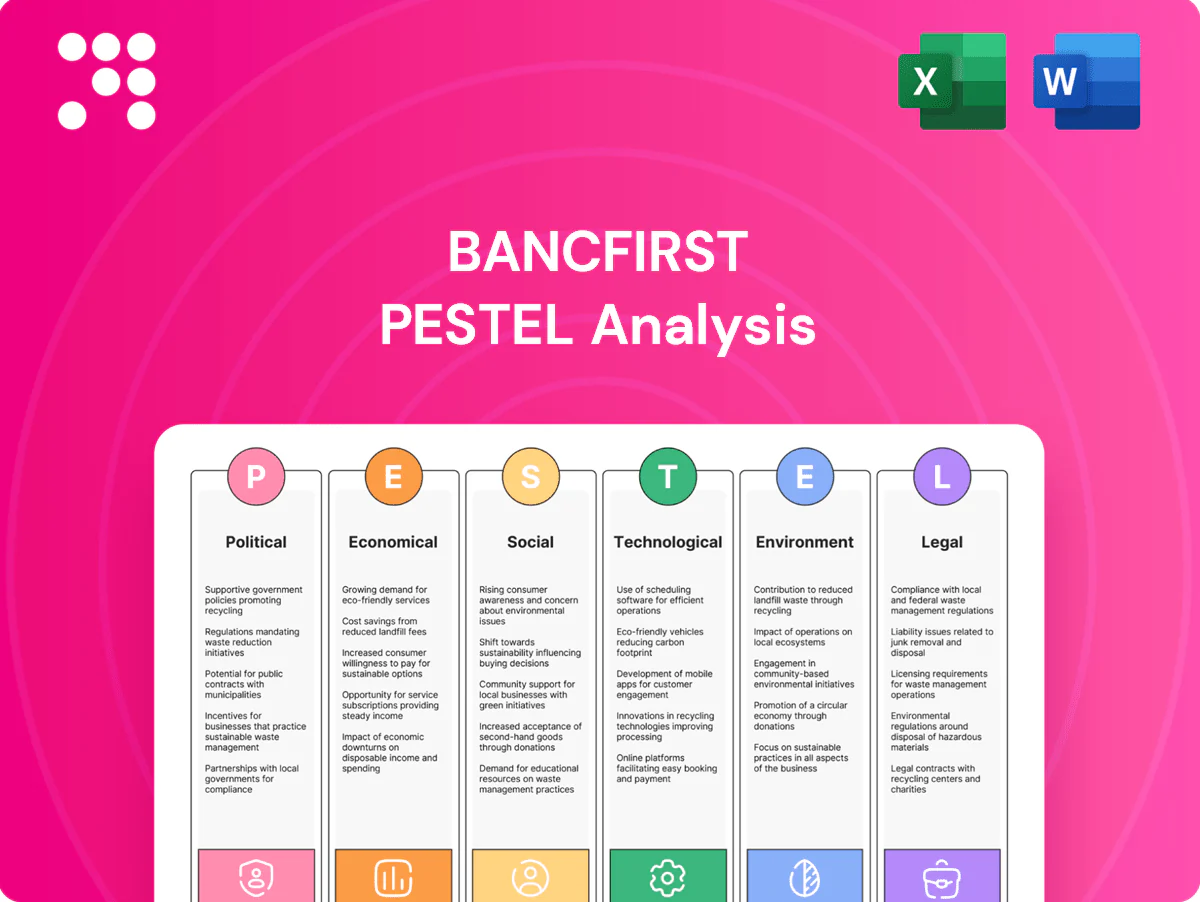
BancFirst PESTLE Analysis

Plan Smarter. Present Sharper. Compete Stronger.
Unlock strategic advantage with our PESTLE Analysis tailored to BancFirst—revealing how political, economic, social, technological, legal, and environmental forces will shape its trajectory. Perfect for investors and strategists, this concise briefing highlights key risks and opportunities. Purchase the full report to access the full deep-dive, data tables, and actionable recommendations.
Political factors

Federal banking oversight
Prudential regulation by the Federal Reserve, FDIC and OCC sets capital, liquidity and risk standards that shape growth and lending across banks.
FDIC insures deposits up to 250,000 while Fed CCAR stress tests apply to bank holding companies with consolidated assets above 100 billion, steering buffers and portfolio mix.
Changes in supervisory tone can tighten compliance and M&A optionality, and political shifts re-prioritize consumer protection versus safety-and-soundness.
State and local policy
As a community bank focused on Oklahoma, state tax policy, incentives and municipal funding directly influence deposit flows and loan demand; Oklahoma's population ~3.96 million (U.S. Census 2023) shapes market scale. State infrastructure programs can catalyze commercial lending, while state regulatory nuances affect branching, fees and mortgage practices. Local economic development priorities shape small-business ecosystems; small firms comprise 99.9% of US businesses (SBA 2024).

CRA and community mandates
CRA, enacted in 1977, drives BancFirsts branch placement, product design and outreach to meet exam standards; the agencies issued a major CRA modernization rule in May 2023 that expands data collection and investment expectations. Strong CRA ratings bolster reputation and growth in BancFirsts Oklahoma-focused markets. Political focus on underserved areas can shift capital toward community development lending and service obligations.

Election-cycle volatility
Elections shift fiscal policy, regulation and stimulus, tightening credit as the 10-year Treasury neared 4.5% in 2024. Policy uncertainty reduces loan pipelines and business sentiment. Debt-ceiling standoffs have stressed municipal cashflows in the ~4T municipal market; post-election agendas may reprioritize housing and small-business support.
- Regulatory risk
- 10y ~4.5%
- Munis ~4T
- Fiscal deficit ~1.7T
Public-sector and tribal relationships
Banking services to governmental entities hinge on procurement rules and local political ties; policy shifts in cash management, depository selection, or collateralization can quickly reallocate municipal and state balances. Collaboration with tribal governments—there are 574 federally recognized tribes nationwide and 39 in Oklahoma—can expand or limit BancFirsts market access. Stability of intergovernmental agreements directly affects fee income predictability.
- Procurement rules drive deposit flows
- Policy shifts reallocate balances
- 574 tribes; 39 in Oklahoma
- Intergovernmental stability = predictable fees
Regulatory, market and tribal forces reshape Oklahoma bank capital and branch strategy
Fed/FDIC/OCC rules (FDIC cap 250,000; CCAR >100B) and CRA reform (May 2023) shape BancFirsts capital, lending and branch strategy in Oklahoma (pop ~3.96M). Rate/policy shifts (10y ~4.5% 2024; fiscal deficit ~$1.7T; muni market ~4T) affect deposits; 574 tribes (39 in OK) influence tribal banking.
| Metric | Value |
|---|---|
| FDIC limit | 250,000 |
| CCAR threshold | >100B |
| OK population (2023) | 3.96M |
| 10y yield (2024) | ~4.5% |
| Munis | ~4T |
| Tribes | 574 total; 39 in OK |
What is included in the product
 Detailed Word Document
Explores how macro-environmental forces—Political, Economic, Social, Technological, Environmental, and Legal—uniquely affect BancFirst, combining data-driven trends and regional regulatory context to identify risks, opportunities, and forward-looking scenarios that support executives, consultants, and investors in strategic planning and stakeholder communications.

 Customizable Excel Spreadsheet
Condensed BancFirst PESTLE summary that’s visually segmented by category for quick interpretation, easily dropped into presentations or shared across teams, and editable so users can add region- or business-specific notes.
Economic factors

Interest rate cycle
Net interest margin for BancFirst is driven by Fed policy, the 2s-10s yield curve shape and deposit betas; with the fed funds rate near 5.25–5.50% in mid-2024, curve dynamics materially affect loan-versus-deposit repricing.
Rapid hikes raise funding costs and squeeze margins when assets reprice slower—regional deposit betas climbed into the mid-20s–30s range, intensifying pressure.
Rate cuts can compress yields but typically revive loan demand and lower credit stress; proactive balance-sheet repositioning (liability mix, duration management) is critical across cycles.
Regional sector exposure
Regional sector exposure ties BancFirst to local SMBs, real estate, agriculture and energy—SMB lending tracks local payrolls while WTI averaged about $85/bbl in 2024, affecting producer cash flow. Commodity volatility compressed farm incomes and collateral values, pressuring ag loans. Commercial real estate repricing, with cap rates near 7–8% in 2024, drives higher charge-offs and reserve builds, while diversification mitigates localized downturns.

Labor market and wages
Tight labor markets in Oklahoma and nationally — 2024 unemployment 3.2% in Oklahoma and 3.7% US annual avg — bolster household deposits and loan performance but raise recruiting and retention costs. Wage growth (average hourly earnings +4.1% year‑over‑year in 2024) supports consumer spending and small‑business revenues. Sudden unemployment spikes typically elevate delinquencies and provisions, while higher staffing costs compress bank efficiency ratios.

Liquidity and funding mix
Shift from noninterest-bearing to interest-bearing deposits has raised BancFirsts funding costs, squeezing net interest margin as deposit beta increases with market rates; competition from money market funds and online banks intensifies disintermediation risk by offering higher yields and digital convenience. Brokered or wholesale funding provides extra liquidity but heightens sensitivity to market conditions and funding flight risk, while a deep, stable core deposit base enhances resilience during stress.
- Funding cost pressure
- Disintermediation risk from MMFs/online banks
- Brokered funding = liquidity vs. market sensitivity
- Stable core deposits support resilience
Inflation and affordability
Inflation (US CPI 2024: 3.4%) squeezes borrower affordability and curbs BancFirst loan demand as higher rates and living costs force households to cut discretionary borrowing; real average earnings fell about 1.2% in 2024, weakening consumer credit appetite. Rising construction/input costs (estimated +5.8% in 2024) pressure CRE project viability, forcing tighter underwriting. Pricing discipline and fee strategies must adapt to these cost dynamics to protect margins.
- Inflation: CPI 2024 3.4%
- Real earnings: -1.2% (2024)
- Construction costs: +5.8% (2024)
- Implication: lower loan demand, tighter CRE underwriting, fee repricing
Regulatory, market and tribal forces reshape Oklahoma bank capital and branch strategy
NIM is driven by Fed policy (fed funds ~5.25–5.50% mid‑2024) and curve dynamics; deposit betas climbed to mid‑20s–30s, squeezing margins. Regional exposure (SMBs, ag, energy, CRE) ties credit risk to WTI ~$85/bbl and CRE cap rates 7–8% (2024). Oklahoma unemployment 3.2% (2024) and CPI 3.4% (2024) support deposits but pressure affordability.
| Metric | 2024/2025 |
|---|---|
| Fed funds | 5.25–5.50% |
| Deposit beta | 25–35% |
| CPI | 3.4% |
| OK unemployment | 3.2% |
| WTI | $85/bbl |
| CRE cap rate | 7–8% |
What You See Is What You Get
BancFirst PESTLE Analysis
This BancFirst PESTLE Analysis preview is the exact document you’ll receive after purchase—fully formatted, professionally structured, and ready to use. The content, layout, and insights shown here match the final downloadable file. No placeholders or surprises; what you see is what you’ll get.

Plan Smarter. Present Sharper. Compete Stronger.
Unlock strategic advantage with our PESTLE Analysis tailored to BancFirst—revealing how political, economic, social, technological, legal, and environmental forces will shape its trajectory. Perfect for investors and strategists, this concise briefing highlights key risks and opportunities. Purchase the full report to access the full deep-dive, data tables, and actionable recommendations.
Political factors
Federal banking oversight
Prudential regulation by the Federal Reserve, FDIC and OCC sets capital, liquidity and risk standards that shape growth and lending across banks.
FDIC insures deposits up to 250,000 while Fed CCAR stress tests apply to bank holding companies with consolidated assets above 100 billion, steering buffers and portfolio mix.
Changes in supervisory tone can tighten compliance and M&A optionality, and political shifts re-prioritize consumer protection versus safety-and-soundness.
State and local policy
As a community bank focused on Oklahoma, state tax policy, incentives and municipal funding directly influence deposit flows and loan demand; Oklahoma's population ~3.96 million (U.S. Census 2023) shapes market scale. State infrastructure programs can catalyze commercial lending, while state regulatory nuances affect branching, fees and mortgage practices. Local economic development priorities shape small-business ecosystems; small firms comprise 99.9% of US businesses (SBA 2024).
CRA and community mandates
CRA, enacted in 1977, drives BancFirsts branch placement, product design and outreach to meet exam standards; the agencies issued a major CRA modernization rule in May 2023 that expands data collection and investment expectations. Strong CRA ratings bolster reputation and growth in BancFirsts Oklahoma-focused markets. Political focus on underserved areas can shift capital toward community development lending and service obligations.
Election-cycle volatility
Elections shift fiscal policy, regulation and stimulus, tightening credit as the 10-year Treasury neared 4.5% in 2024. Policy uncertainty reduces loan pipelines and business sentiment. Debt-ceiling standoffs have stressed municipal cashflows in the ~4T municipal market; post-election agendas may reprioritize housing and small-business support.
- Regulatory risk
- 10y ~4.5%
- Munis ~4T
- Fiscal deficit ~1.7T
Public-sector and tribal relationships
Banking services to governmental entities hinge on procurement rules and local political ties; policy shifts in cash management, depository selection, or collateralization can quickly reallocate municipal and state balances. Collaboration with tribal governments—there are 574 federally recognized tribes nationwide and 39 in Oklahoma—can expand or limit BancFirsts market access. Stability of intergovernmental agreements directly affects fee income predictability.
- Procurement rules drive deposit flows
- Policy shifts reallocate balances
- 574 tribes; 39 in Oklahoma
- Intergovernmental stability = predictable fees
Regulatory, market and tribal forces reshape Oklahoma bank capital and branch strategy
Fed/FDIC/OCC rules (FDIC cap 250,000; CCAR >100B) and CRA reform (May 2023) shape BancFirsts capital, lending and branch strategy in Oklahoma (pop ~3.96M). Rate/policy shifts (10y ~4.5% 2024; fiscal deficit ~$1.7T; muni market ~4T) affect deposits; 574 tribes (39 in OK) influence tribal banking.
| Metric | Value |
|---|---|
| FDIC limit | 250,000 |
| CCAR threshold | >100B |
| OK population (2023) | 3.96M |
| 10y yield (2024) | ~4.5% |
| Munis | ~4T |
| Tribes | 574 total; 39 in OK |
What is included in the product
Detailed Word Document
Explores how macro-environmental forces—Political, Economic, Social, Technological, Environmental, and Legal—uniquely affect BancFirst, combining data-driven trends and regional regulatory context to identify risks, opportunities, and forward-looking scenarios that support executives, consultants, and investors in strategic planning and stakeholder communications.
Customizable Excel Spreadsheet
Condensed BancFirst PESTLE summary that’s visually segmented by category for quick interpretation, easily dropped into presentations or shared across teams, and editable so users can add region- or business-specific notes.
Economic factors
Interest rate cycle
Net interest margin for BancFirst is driven by Fed policy, the 2s-10s yield curve shape and deposit betas; with the fed funds rate near 5.25–5.50% in mid-2024, curve dynamics materially affect loan-versus-deposit repricing.
Rapid hikes raise funding costs and squeeze margins when assets reprice slower—regional deposit betas climbed into the mid-20s–30s range, intensifying pressure.
Rate cuts can compress yields but typically revive loan demand and lower credit stress; proactive balance-sheet repositioning (liability mix, duration management) is critical across cycles.
Regional sector exposure
Regional sector exposure ties BancFirst to local SMBs, real estate, agriculture and energy—SMB lending tracks local payrolls while WTI averaged about $85/bbl in 2024, affecting producer cash flow. Commodity volatility compressed farm incomes and collateral values, pressuring ag loans. Commercial real estate repricing, with cap rates near 7–8% in 2024, drives higher charge-offs and reserve builds, while diversification mitigates localized downturns.
Labor market and wages
Tight labor markets in Oklahoma and nationally — 2024 unemployment 3.2% in Oklahoma and 3.7% US annual avg — bolster household deposits and loan performance but raise recruiting and retention costs. Wage growth (average hourly earnings +4.1% year‑over‑year in 2024) supports consumer spending and small‑business revenues. Sudden unemployment spikes typically elevate delinquencies and provisions, while higher staffing costs compress bank efficiency ratios.
Liquidity and funding mix
Shift from noninterest-bearing to interest-bearing deposits has raised BancFirsts funding costs, squeezing net interest margin as deposit beta increases with market rates; competition from money market funds and online banks intensifies disintermediation risk by offering higher yields and digital convenience. Brokered or wholesale funding provides extra liquidity but heightens sensitivity to market conditions and funding flight risk, while a deep, stable core deposit base enhances resilience during stress.
- Funding cost pressure
- Disintermediation risk from MMFs/online banks
- Brokered funding = liquidity vs. market sensitivity
- Stable core deposits support resilience
Inflation and affordability
Inflation (US CPI 2024: 3.4%) squeezes borrower affordability and curbs BancFirst loan demand as higher rates and living costs force households to cut discretionary borrowing; real average earnings fell about 1.2% in 2024, weakening consumer credit appetite. Rising construction/input costs (estimated +5.8% in 2024) pressure CRE project viability, forcing tighter underwriting. Pricing discipline and fee strategies must adapt to these cost dynamics to protect margins.
- Inflation: CPI 2024 3.4%
- Real earnings: -1.2% (2024)
- Construction costs: +5.8% (2024)
- Implication: lower loan demand, tighter CRE underwriting, fee repricing
Regulatory, market and tribal forces reshape Oklahoma bank capital and branch strategy
NIM is driven by Fed policy (fed funds ~5.25–5.50% mid‑2024) and curve dynamics; deposit betas climbed to mid‑20s–30s, squeezing margins. Regional exposure (SMBs, ag, energy, CRE) ties credit risk to WTI ~$85/bbl and CRE cap rates 7–8% (2024). Oklahoma unemployment 3.2% (2024) and CPI 3.4% (2024) support deposits but pressure affordability.
| Metric | 2024/2025 |
|---|---|
| Fed funds | 5.25–5.50% |
| Deposit beta | 25–35% |
| CPI | 3.4% |
| OK unemployment | 3.2% |
| WTI | $85/bbl |
| CRE cap rate | 7–8% |
What You See Is What You Get
BancFirst PESTLE Analysis
This BancFirst PESTLE Analysis preview is the exact document you’ll receive after purchase—fully formatted, professionally structured, and ready to use. The content, layout, and insights shown here match the final downloadable file. No placeholders or surprises; what you see is what you’ll get.
Original: $10.00
-65%$10.00
$3.50Description
Plan Smarter. Present Sharper. Compete Stronger.
Unlock strategic advantage with our PESTLE Analysis tailored to BancFirst—revealing how political, economic, social, technological, legal, and environmental forces will shape its trajectory. Perfect for investors and strategists, this concise briefing highlights key risks and opportunities. Purchase the full report to access the full deep-dive, data tables, and actionable recommendations.
Political factors
Federal banking oversight
Prudential regulation by the Federal Reserve, FDIC and OCC sets capital, liquidity and risk standards that shape growth and lending across banks.
FDIC insures deposits up to 250,000 while Fed CCAR stress tests apply to bank holding companies with consolidated assets above 100 billion, steering buffers and portfolio mix.
Changes in supervisory tone can tighten compliance and M&A optionality, and political shifts re-prioritize consumer protection versus safety-and-soundness.
State and local policy
As a community bank focused on Oklahoma, state tax policy, incentives and municipal funding directly influence deposit flows and loan demand; Oklahoma's population ~3.96 million (U.S. Census 2023) shapes market scale. State infrastructure programs can catalyze commercial lending, while state regulatory nuances affect branching, fees and mortgage practices. Local economic development priorities shape small-business ecosystems; small firms comprise 99.9% of US businesses (SBA 2024).
CRA and community mandates
CRA, enacted in 1977, drives BancFirsts branch placement, product design and outreach to meet exam standards; the agencies issued a major CRA modernization rule in May 2023 that expands data collection and investment expectations. Strong CRA ratings bolster reputation and growth in BancFirsts Oklahoma-focused markets. Political focus on underserved areas can shift capital toward community development lending and service obligations.
Election-cycle volatility
Elections shift fiscal policy, regulation and stimulus, tightening credit as the 10-year Treasury neared 4.5% in 2024. Policy uncertainty reduces loan pipelines and business sentiment. Debt-ceiling standoffs have stressed municipal cashflows in the ~4T municipal market; post-election agendas may reprioritize housing and small-business support.
- Regulatory risk
- 10y ~4.5%
- Munis ~4T
- Fiscal deficit ~1.7T
Public-sector and tribal relationships
Banking services to governmental entities hinge on procurement rules and local political ties; policy shifts in cash management, depository selection, or collateralization can quickly reallocate municipal and state balances. Collaboration with tribal governments—there are 574 federally recognized tribes nationwide and 39 in Oklahoma—can expand or limit BancFirsts market access. Stability of intergovernmental agreements directly affects fee income predictability.
- Procurement rules drive deposit flows
- Policy shifts reallocate balances
- 574 tribes; 39 in Oklahoma
- Intergovernmental stability = predictable fees
Regulatory, market and tribal forces reshape Oklahoma bank capital and branch strategy
Fed/FDIC/OCC rules (FDIC cap 250,000; CCAR >100B) and CRA reform (May 2023) shape BancFirsts capital, lending and branch strategy in Oklahoma (pop ~3.96M). Rate/policy shifts (10y ~4.5% 2024; fiscal deficit ~$1.7T; muni market ~4T) affect deposits; 574 tribes (39 in OK) influence tribal banking.
| Metric | Value |
|---|---|
| FDIC limit | 250,000 |
| CCAR threshold | >100B |
| OK population (2023) | 3.96M |
| 10y yield (2024) | ~4.5% |
| Munis | ~4T |
| Tribes | 574 total; 39 in OK |
What is included in the product
Detailed Word Document
Explores how macro-environmental forces—Political, Economic, Social, Technological, Environmental, and Legal—uniquely affect BancFirst, combining data-driven trends and regional regulatory context to identify risks, opportunities, and forward-looking scenarios that support executives, consultants, and investors in strategic planning and stakeholder communications.
Customizable Excel Spreadsheet
Condensed BancFirst PESTLE summary that’s visually segmented by category for quick interpretation, easily dropped into presentations or shared across teams, and editable so users can add region- or business-specific notes.
Economic factors
Interest rate cycle
Net interest margin for BancFirst is driven by Fed policy, the 2s-10s yield curve shape and deposit betas; with the fed funds rate near 5.25–5.50% in mid-2024, curve dynamics materially affect loan-versus-deposit repricing.
Rapid hikes raise funding costs and squeeze margins when assets reprice slower—regional deposit betas climbed into the mid-20s–30s range, intensifying pressure.
Rate cuts can compress yields but typically revive loan demand and lower credit stress; proactive balance-sheet repositioning (liability mix, duration management) is critical across cycles.
Regional sector exposure
Regional sector exposure ties BancFirst to local SMBs, real estate, agriculture and energy—SMB lending tracks local payrolls while WTI averaged about $85/bbl in 2024, affecting producer cash flow. Commodity volatility compressed farm incomes and collateral values, pressuring ag loans. Commercial real estate repricing, with cap rates near 7–8% in 2024, drives higher charge-offs and reserve builds, while diversification mitigates localized downturns.
Labor market and wages
Tight labor markets in Oklahoma and nationally — 2024 unemployment 3.2% in Oklahoma and 3.7% US annual avg — bolster household deposits and loan performance but raise recruiting and retention costs. Wage growth (average hourly earnings +4.1% year‑over‑year in 2024) supports consumer spending and small‑business revenues. Sudden unemployment spikes typically elevate delinquencies and provisions, while higher staffing costs compress bank efficiency ratios.
Liquidity and funding mix
Shift from noninterest-bearing to interest-bearing deposits has raised BancFirsts funding costs, squeezing net interest margin as deposit beta increases with market rates; competition from money market funds and online banks intensifies disintermediation risk by offering higher yields and digital convenience. Brokered or wholesale funding provides extra liquidity but heightens sensitivity to market conditions and funding flight risk, while a deep, stable core deposit base enhances resilience during stress.
- Funding cost pressure
- Disintermediation risk from MMFs/online banks
- Brokered funding = liquidity vs. market sensitivity
- Stable core deposits support resilience
Inflation and affordability
Inflation (US CPI 2024: 3.4%) squeezes borrower affordability and curbs BancFirst loan demand as higher rates and living costs force households to cut discretionary borrowing; real average earnings fell about 1.2% in 2024, weakening consumer credit appetite. Rising construction/input costs (estimated +5.8% in 2024) pressure CRE project viability, forcing tighter underwriting. Pricing discipline and fee strategies must adapt to these cost dynamics to protect margins.
- Inflation: CPI 2024 3.4%
- Real earnings: -1.2% (2024)
- Construction costs: +5.8% (2024)
- Implication: lower loan demand, tighter CRE underwriting, fee repricing
Regulatory, market and tribal forces reshape Oklahoma bank capital and branch strategy
NIM is driven by Fed policy (fed funds ~5.25–5.50% mid‑2024) and curve dynamics; deposit betas climbed to mid‑20s–30s, squeezing margins. Regional exposure (SMBs, ag, energy, CRE) ties credit risk to WTI ~$85/bbl and CRE cap rates 7–8% (2024). Oklahoma unemployment 3.2% (2024) and CPI 3.4% (2024) support deposits but pressure affordability.
| Metric | 2024/2025 |
|---|---|
| Fed funds | 5.25–5.50% |
| Deposit beta | 25–35% |
| CPI | 3.4% |
| OK unemployment | 3.2% |
| WTI | $85/bbl |
| CRE cap rate | 7–8% |
What You See Is What You Get
BancFirst PESTLE Analysis
This BancFirst PESTLE Analysis preview is the exact document you’ll receive after purchase—fully formatted, professionally structured, and ready to use. The content, layout, and insights shown here match the final downloadable file. No placeholders or surprises; what you see is what you’ll get.











