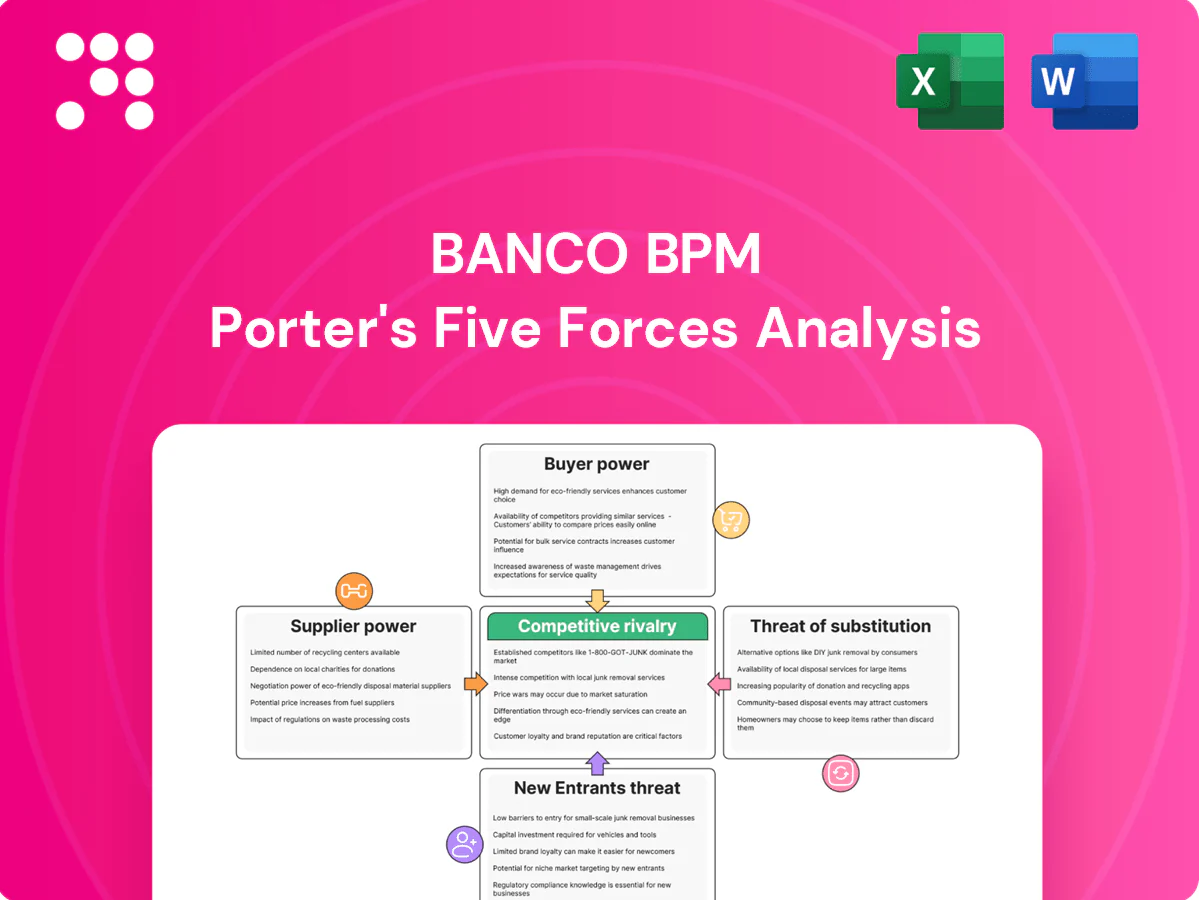
Banco BPM Porter's Five Forces Analysis

From Overview to Strategy Blueprint
Banco BPM faces moderate buyer power and regulatory pressure, with digital entrants raising the threat of substitutes while entrenched banks and scale advantages limit new entrant impact. Competitive rivalry is intense but mitigated by branch network and corporate relationships. This brief snapshot only scratches the surface—unlock the full Porter's Five Forces Analysis for actionable, consultant-grade insights.
Suppliers Bargaining Power

Funding mix and cost
Banco BPM’s core funding suppliers are retail deposits, covered bonds and ECB facilities; a robust retail deposit base reduces wholesale funders’ pricing power, though deposits repriced rapidly during 2022–24 tightening when ECB rates rose to about 4.00% by end‑2024. Reliance on market funding in stress increases supplier leverage via wider spreads; active ALM and liquidity buffers (including precautionary ECB access) mitigate but do not remove this risk.
Technology and core systems vendors
Core banking, cloud, cybersecurity and payments tech are concentrated among a few large providers, raising supplier leverage; global cloud market shares in 2023 were roughly AWS 32%, Microsoft Azure 23% and Google Cloud 11%, amplifying vendor bargaining power. Long-term contracts and high migration complexity further lock Banco BPM into vendors, while rising regulatory and security demands — with the global cybersecurity market near US$220bn in 2024 — increase switching costs. Multi-vendor strategies and selective insourcing can partially mitigate dependence but do not eliminate concentration risk.

Payment networks and infrastructure
Visa and Mastercard operate in 200+ countries while SEPA rails cover 36 European countries with SEPA Instant limits at €100,000, and domestic clearing (Italy’s RTGS/national switches) function as essential utilities; scheme fees, rule changes and compliance mandates (PSD2, AML) give these suppliers bargaining influence. Volume-based pricing and few credible alternatives constrain Banco BPM’s negotiation, so participation in industry consortia and instant-payment ramps diversifies reliance.

Talent and specialized skills
Skilled bankers, risk modellers and IT engineers are scarce for Banco BPM, with LinkedIn 2024 showing ~30% y/y growth in demand for data roles in Italy; wage inflation and competition from fintechs and Big Tech raise supplier power, widening salary gaps. Italian labor rules add rigidity to costs, while systematic upskilling and employer branding can lower exposure over time.
- Scarcity: high demand (~30% y/y)
- Cost pressure: wage inflation + fintech/Big Tech competition
- Mitigant: upskilling & branding
Capital providers and rating agencies
Bond investors, shareholders and rating agencies drove Banco BPMs cost of capital in 2024: reported CET1 ~12.9% and market turbulence pushed Italian bank senior spreads up ~120 bps at times, tightening covenants and lifting supplier power; downgrades triggered higher funding costs and collateral calls, while sustained asset quality and capital buffers preserved negotiating leverage.
- bond spreads ~+120 bps 2024
- CET1 ~12.9% (2024)
- downgrades → higher funding/collateral
- asset quality + buffers = stronger leverage
Supplier power moderate; CET1 12.9%, vendor concentration raises costs
Banco BPM’s supplier power is moderate: strong retail deposits and CET1 ~12.9% (2024) limit market funder leverage though ECB rates rose to ~4.0% by end‑2024 and senior spreads widened ~+120 bps. Tech and card rails are concentrated (AWS 32%, Azure 23%, GCP 11%; Visa/Mastercard dominant) raising switching costs; cybersecurity market ~US$220bn and IT talent demand +30% y/y amplify wage pressure.
| Supplier | 2024 metric | Implication |
|---|---|---|
| Deposits | Core stable | Reduces funding power |
| ECB rate | ~4.0% | ↑ funding costs |
| CET1 | 12.9% | Improves leverage |
| Bond spreads | +120 bps | Higher supplier power |
| Cloud | AWS32/Azure23/GCP11 | Vendor concentration |
| Cyber market | ~US$220bn | Rising compliance cost |
| Labor | Demand +30% y/y | Wage pressure |
What is included in the product
 Detailed Word Document
Tailored exclusively for Banco BPM, this Porter’s Five Forces analysis uncovers key drivers of competition, buyer and supplier power, entry barriers and substitutes, and identifies emerging threats and strategic levers to protect market share.

 Customizable Excel Spreadsheet
Clear, one-sheet Banco BPM Porter's Five Forces summary that simplifies competitive pressures for quick strategic decisions and slide-ready use.
Customers Bargaining Power

Rate sensitivity and price shopping
Italian retail and SME clients increasingly compare loan rates and deposit yields across incumbent banks and digital platforms, using transparent pricing and comparison tools that amplify buyer power. With the ECB deposit rate at 4.00% in 2024, depositors demand higher remuneration or redeploy funds. Banks counter with promotional pricing and segmented offers to limit churn.
Corporate and public-sector bargaining
Larger corporates and public institutions push Banco BPM hard on pricing, covenants and ancillary fees, using formal RFPs and multi-banking to extract better terms. Banco BPM is Italy's third-largest bank by assets (2024), so mandates often require bundled cash-management, trade and treasury services that compress margins. Deep relationships and tailored treasury/credit solutions can offset pure price competition and preserve fee pools.

Digital convenience and switching ease
Mobile onboarding, account switching services and PSD2-driven open banking have cut friction — Banco BPM reported about 3.8 million active mobile users in 2024, speeding acquisition and comparison. As frictions fall, willingness to switch for better UX or price rises, with multi-banking now used by roughly 45% of Italian retail customers in 2024, diluting exclusivity. Superior app features and embedded services (payments, investments, lending) remain key to retain primary status.

Fee transparency and regulation
Fee transparency and tighter EU/Italian consumer protection rules (PSD2, MiFID II enforcement continuing into 2024) empower buyers, forcing Banco BPM to disclose standardized charges and face public scrutiny of hidden fees; fee hikes are harder to sustain as regulators and consumer advocates escalate oversight in 2024. Clients increasingly push back on maintenance and payment fees when digital alternatives reduce switching costs, so Banco BPM defends non-interest income with clearer value propositions and tiered plans.
- Regulation: PSD2/MiFID II enforcement (2024)
- Pressure: higher customer mobility vs fees
- Defense: tiered plans, explicit value
Product substitutability
Clients increasingly replace Banco BPM products with asset managers, insurers and fintech wallets, raising buyer leverage as substitutability grows; commoditized loans and deposits offer thin differentiation, while advisory, ecosystem integration and personalization lower perceived substitutes.
- Substitutability raises negotiation power
- Commoditized products = low differentiation
- Advisory and personalization = reduced substitutes
ECB 4.00% lifts depositor demands; multi-banking raises fee pressure
Retail and SME clients, aided by comparison tools, exert strong price pressure — ECB deposit rate 4.00% (2024) raises depositor demands. Large corporates use RFPs and multi-banking to squeeze fees; Banco BPM is Italy's 3rd-largest bank by assets (2024). Mobile users ~3.8M and 45% multi-banking (2024) increase switching risk; PSD2/MiFID II enforcement tightens fee transparency.
| Metric | 2024 |
|---|---|
| ECB rate | 4.00% |
| Mobile users | 3.8M |
| Multi-banking | 45% |
What You See Is What You Get
Banco BPM Porter's Five Forces Analysis
This Porter's Five Forces analysis for Banco BPM examines competitive rivalry, buyer and supplier power, threats of substitutes and new entrants, and regulatory pressures with actionable insights for strategy and valuation. This preview shows the exact document you'll receive immediately after purchase—no surprises, no placeholders. The file is fully formatted and ready for immediate use.

From Overview to Strategy Blueprint
Banco BPM faces moderate buyer power and regulatory pressure, with digital entrants raising the threat of substitutes while entrenched banks and scale advantages limit new entrant impact. Competitive rivalry is intense but mitigated by branch network and corporate relationships. This brief snapshot only scratches the surface—unlock the full Porter's Five Forces Analysis for actionable, consultant-grade insights.
Suppliers Bargaining Power
Funding mix and cost
Banco BPM’s core funding suppliers are retail deposits, covered bonds and ECB facilities; a robust retail deposit base reduces wholesale funders’ pricing power, though deposits repriced rapidly during 2022–24 tightening when ECB rates rose to about 4.00% by end‑2024. Reliance on market funding in stress increases supplier leverage via wider spreads; active ALM and liquidity buffers (including precautionary ECB access) mitigate but do not remove this risk.
Technology and core systems vendors
Core banking, cloud, cybersecurity and payments tech are concentrated among a few large providers, raising supplier leverage; global cloud market shares in 2023 were roughly AWS 32%, Microsoft Azure 23% and Google Cloud 11%, amplifying vendor bargaining power. Long-term contracts and high migration complexity further lock Banco BPM into vendors, while rising regulatory and security demands — with the global cybersecurity market near US$220bn in 2024 — increase switching costs. Multi-vendor strategies and selective insourcing can partially mitigate dependence but do not eliminate concentration risk.
Payment networks and infrastructure
Visa and Mastercard operate in 200+ countries while SEPA rails cover 36 European countries with SEPA Instant limits at €100,000, and domestic clearing (Italy’s RTGS/national switches) function as essential utilities; scheme fees, rule changes and compliance mandates (PSD2, AML) give these suppliers bargaining influence. Volume-based pricing and few credible alternatives constrain Banco BPM’s negotiation, so participation in industry consortia and instant-payment ramps diversifies reliance.
Talent and specialized skills
Skilled bankers, risk modellers and IT engineers are scarce for Banco BPM, with LinkedIn 2024 showing ~30% y/y growth in demand for data roles in Italy; wage inflation and competition from fintechs and Big Tech raise supplier power, widening salary gaps. Italian labor rules add rigidity to costs, while systematic upskilling and employer branding can lower exposure over time.
- Scarcity: high demand (~30% y/y)
- Cost pressure: wage inflation + fintech/Big Tech competition
- Mitigant: upskilling & branding
Capital providers and rating agencies
Bond investors, shareholders and rating agencies drove Banco BPMs cost of capital in 2024: reported CET1 ~12.9% and market turbulence pushed Italian bank senior spreads up ~120 bps at times, tightening covenants and lifting supplier power; downgrades triggered higher funding costs and collateral calls, while sustained asset quality and capital buffers preserved negotiating leverage.
- bond spreads ~+120 bps 2024
- CET1 ~12.9% (2024)
- downgrades → higher funding/collateral
- asset quality + buffers = stronger leverage
Supplier power moderate; CET1 12.9%, vendor concentration raises costs
Banco BPM’s supplier power is moderate: strong retail deposits and CET1 ~12.9% (2024) limit market funder leverage though ECB rates rose to ~4.0% by end‑2024 and senior spreads widened ~+120 bps. Tech and card rails are concentrated (AWS 32%, Azure 23%, GCP 11%; Visa/Mastercard dominant) raising switching costs; cybersecurity market ~US$220bn and IT talent demand +30% y/y amplify wage pressure.
| Supplier | 2024 metric | Implication |
|---|---|---|
| Deposits | Core stable | Reduces funding power |
| ECB rate | ~4.0% | ↑ funding costs |
| CET1 | 12.9% | Improves leverage |
| Bond spreads | +120 bps | Higher supplier power |
| Cloud | AWS32/Azure23/GCP11 | Vendor concentration |
| Cyber market | ~US$220bn | Rising compliance cost |
| Labor | Demand +30% y/y | Wage pressure |
What is included in the product
Detailed Word Document
Tailored exclusively for Banco BPM, this Porter’s Five Forces analysis uncovers key drivers of competition, buyer and supplier power, entry barriers and substitutes, and identifies emerging threats and strategic levers to protect market share.
Customizable Excel Spreadsheet
Clear, one-sheet Banco BPM Porter's Five Forces summary that simplifies competitive pressures for quick strategic decisions and slide-ready use.
Customers Bargaining Power
Rate sensitivity and price shopping
Italian retail and SME clients increasingly compare loan rates and deposit yields across incumbent banks and digital platforms, using transparent pricing and comparison tools that amplify buyer power. With the ECB deposit rate at 4.00% in 2024, depositors demand higher remuneration or redeploy funds. Banks counter with promotional pricing and segmented offers to limit churn.
Corporate and public-sector bargaining
Larger corporates and public institutions push Banco BPM hard on pricing, covenants and ancillary fees, using formal RFPs and multi-banking to extract better terms. Banco BPM is Italy's third-largest bank by assets (2024), so mandates often require bundled cash-management, trade and treasury services that compress margins. Deep relationships and tailored treasury/credit solutions can offset pure price competition and preserve fee pools.
Digital convenience and switching ease
Mobile onboarding, account switching services and PSD2-driven open banking have cut friction — Banco BPM reported about 3.8 million active mobile users in 2024, speeding acquisition and comparison. As frictions fall, willingness to switch for better UX or price rises, with multi-banking now used by roughly 45% of Italian retail customers in 2024, diluting exclusivity. Superior app features and embedded services (payments, investments, lending) remain key to retain primary status.
Fee transparency and regulation
Fee transparency and tighter EU/Italian consumer protection rules (PSD2, MiFID II enforcement continuing into 2024) empower buyers, forcing Banco BPM to disclose standardized charges and face public scrutiny of hidden fees; fee hikes are harder to sustain as regulators and consumer advocates escalate oversight in 2024. Clients increasingly push back on maintenance and payment fees when digital alternatives reduce switching costs, so Banco BPM defends non-interest income with clearer value propositions and tiered plans.
- Regulation: PSD2/MiFID II enforcement (2024)
- Pressure: higher customer mobility vs fees
- Defense: tiered plans, explicit value
Product substitutability
Clients increasingly replace Banco BPM products with asset managers, insurers and fintech wallets, raising buyer leverage as substitutability grows; commoditized loans and deposits offer thin differentiation, while advisory, ecosystem integration and personalization lower perceived substitutes.
- Substitutability raises negotiation power
- Commoditized products = low differentiation
- Advisory and personalization = reduced substitutes
ECB 4.00% lifts depositor demands; multi-banking raises fee pressure
Retail and SME clients, aided by comparison tools, exert strong price pressure — ECB deposit rate 4.00% (2024) raises depositor demands. Large corporates use RFPs and multi-banking to squeeze fees; Banco BPM is Italy's 3rd-largest bank by assets (2024). Mobile users ~3.8M and 45% multi-banking (2024) increase switching risk; PSD2/MiFID II enforcement tightens fee transparency.
| Metric | 2024 |
|---|---|
| ECB rate | 4.00% |
| Mobile users | 3.8M |
| Multi-banking | 45% |
What You See Is What You Get
Banco BPM Porter's Five Forces Analysis
This Porter's Five Forces analysis for Banco BPM examines competitive rivalry, buyer and supplier power, threats of substitutes and new entrants, and regulatory pressures with actionable insights for strategy and valuation. This preview shows the exact document you'll receive immediately after purchase—no surprises, no placeholders. The file is fully formatted and ready for immediate use.
Original: $10.00
-65%$10.00
$3.50Description
From Overview to Strategy Blueprint
Banco BPM faces moderate buyer power and regulatory pressure, with digital entrants raising the threat of substitutes while entrenched banks and scale advantages limit new entrant impact. Competitive rivalry is intense but mitigated by branch network and corporate relationships. This brief snapshot only scratches the surface—unlock the full Porter's Five Forces Analysis for actionable, consultant-grade insights.
Suppliers Bargaining Power
Funding mix and cost
Banco BPM’s core funding suppliers are retail deposits, covered bonds and ECB facilities; a robust retail deposit base reduces wholesale funders’ pricing power, though deposits repriced rapidly during 2022–24 tightening when ECB rates rose to about 4.00% by end‑2024. Reliance on market funding in stress increases supplier leverage via wider spreads; active ALM and liquidity buffers (including precautionary ECB access) mitigate but do not remove this risk.
Technology and core systems vendors
Core banking, cloud, cybersecurity and payments tech are concentrated among a few large providers, raising supplier leverage; global cloud market shares in 2023 were roughly AWS 32%, Microsoft Azure 23% and Google Cloud 11%, amplifying vendor bargaining power. Long-term contracts and high migration complexity further lock Banco BPM into vendors, while rising regulatory and security demands — with the global cybersecurity market near US$220bn in 2024 — increase switching costs. Multi-vendor strategies and selective insourcing can partially mitigate dependence but do not eliminate concentration risk.
Payment networks and infrastructure
Visa and Mastercard operate in 200+ countries while SEPA rails cover 36 European countries with SEPA Instant limits at €100,000, and domestic clearing (Italy’s RTGS/national switches) function as essential utilities; scheme fees, rule changes and compliance mandates (PSD2, AML) give these suppliers bargaining influence. Volume-based pricing and few credible alternatives constrain Banco BPM’s negotiation, so participation in industry consortia and instant-payment ramps diversifies reliance.
Talent and specialized skills
Skilled bankers, risk modellers and IT engineers are scarce for Banco BPM, with LinkedIn 2024 showing ~30% y/y growth in demand for data roles in Italy; wage inflation and competition from fintechs and Big Tech raise supplier power, widening salary gaps. Italian labor rules add rigidity to costs, while systematic upskilling and employer branding can lower exposure over time.
- Scarcity: high demand (~30% y/y)
- Cost pressure: wage inflation + fintech/Big Tech competition
- Mitigant: upskilling & branding
Capital providers and rating agencies
Bond investors, shareholders and rating agencies drove Banco BPMs cost of capital in 2024: reported CET1 ~12.9% and market turbulence pushed Italian bank senior spreads up ~120 bps at times, tightening covenants and lifting supplier power; downgrades triggered higher funding costs and collateral calls, while sustained asset quality and capital buffers preserved negotiating leverage.
- bond spreads ~+120 bps 2024
- CET1 ~12.9% (2024)
- downgrades → higher funding/collateral
- asset quality + buffers = stronger leverage
Supplier power moderate; CET1 12.9%, vendor concentration raises costs
Banco BPM’s supplier power is moderate: strong retail deposits and CET1 ~12.9% (2024) limit market funder leverage though ECB rates rose to ~4.0% by end‑2024 and senior spreads widened ~+120 bps. Tech and card rails are concentrated (AWS 32%, Azure 23%, GCP 11%; Visa/Mastercard dominant) raising switching costs; cybersecurity market ~US$220bn and IT talent demand +30% y/y amplify wage pressure.
| Supplier | 2024 metric | Implication |
|---|---|---|
| Deposits | Core stable | Reduces funding power |
| ECB rate | ~4.0% | ↑ funding costs |
| CET1 | 12.9% | Improves leverage |
| Bond spreads | +120 bps | Higher supplier power |
| Cloud | AWS32/Azure23/GCP11 | Vendor concentration |
| Cyber market | ~US$220bn | Rising compliance cost |
| Labor | Demand +30% y/y | Wage pressure |
What is included in the product
Detailed Word Document
Tailored exclusively for Banco BPM, this Porter’s Five Forces analysis uncovers key drivers of competition, buyer and supplier power, entry barriers and substitutes, and identifies emerging threats and strategic levers to protect market share.
Customizable Excel Spreadsheet
Clear, one-sheet Banco BPM Porter's Five Forces summary that simplifies competitive pressures for quick strategic decisions and slide-ready use.
Customers Bargaining Power
Rate sensitivity and price shopping
Italian retail and SME clients increasingly compare loan rates and deposit yields across incumbent banks and digital platforms, using transparent pricing and comparison tools that amplify buyer power. With the ECB deposit rate at 4.00% in 2024, depositors demand higher remuneration or redeploy funds. Banks counter with promotional pricing and segmented offers to limit churn.
Corporate and public-sector bargaining
Larger corporates and public institutions push Banco BPM hard on pricing, covenants and ancillary fees, using formal RFPs and multi-banking to extract better terms. Banco BPM is Italy's third-largest bank by assets (2024), so mandates often require bundled cash-management, trade and treasury services that compress margins. Deep relationships and tailored treasury/credit solutions can offset pure price competition and preserve fee pools.
Digital convenience and switching ease
Mobile onboarding, account switching services and PSD2-driven open banking have cut friction — Banco BPM reported about 3.8 million active mobile users in 2024, speeding acquisition and comparison. As frictions fall, willingness to switch for better UX or price rises, with multi-banking now used by roughly 45% of Italian retail customers in 2024, diluting exclusivity. Superior app features and embedded services (payments, investments, lending) remain key to retain primary status.
Fee transparency and regulation
Fee transparency and tighter EU/Italian consumer protection rules (PSD2, MiFID II enforcement continuing into 2024) empower buyers, forcing Banco BPM to disclose standardized charges and face public scrutiny of hidden fees; fee hikes are harder to sustain as regulators and consumer advocates escalate oversight in 2024. Clients increasingly push back on maintenance and payment fees when digital alternatives reduce switching costs, so Banco BPM defends non-interest income with clearer value propositions and tiered plans.
- Regulation: PSD2/MiFID II enforcement (2024)
- Pressure: higher customer mobility vs fees
- Defense: tiered plans, explicit value
Product substitutability
Clients increasingly replace Banco BPM products with asset managers, insurers and fintech wallets, raising buyer leverage as substitutability grows; commoditized loans and deposits offer thin differentiation, while advisory, ecosystem integration and personalization lower perceived substitutes.
- Substitutability raises negotiation power
- Commoditized products = low differentiation
- Advisory and personalization = reduced substitutes
ECB 4.00% lifts depositor demands; multi-banking raises fee pressure
Retail and SME clients, aided by comparison tools, exert strong price pressure — ECB deposit rate 4.00% (2024) raises depositor demands. Large corporates use RFPs and multi-banking to squeeze fees; Banco BPM is Italy's 3rd-largest bank by assets (2024). Mobile users ~3.8M and 45% multi-banking (2024) increase switching risk; PSD2/MiFID II enforcement tightens fee transparency.
| Metric | 2024 |
|---|---|
| ECB rate | 4.00% |
| Mobile users | 3.8M |
| Multi-banking | 45% |
What You See Is What You Get
Banco BPM Porter's Five Forces Analysis
This Porter's Five Forces analysis for Banco BPM examines competitive rivalry, buyer and supplier power, threats of substitutes and new entrants, and regulatory pressures with actionable insights for strategy and valuation. This preview shows the exact document you'll receive immediately after purchase—no surprises, no placeholders. The file is fully formatted and ready for immediate use.











