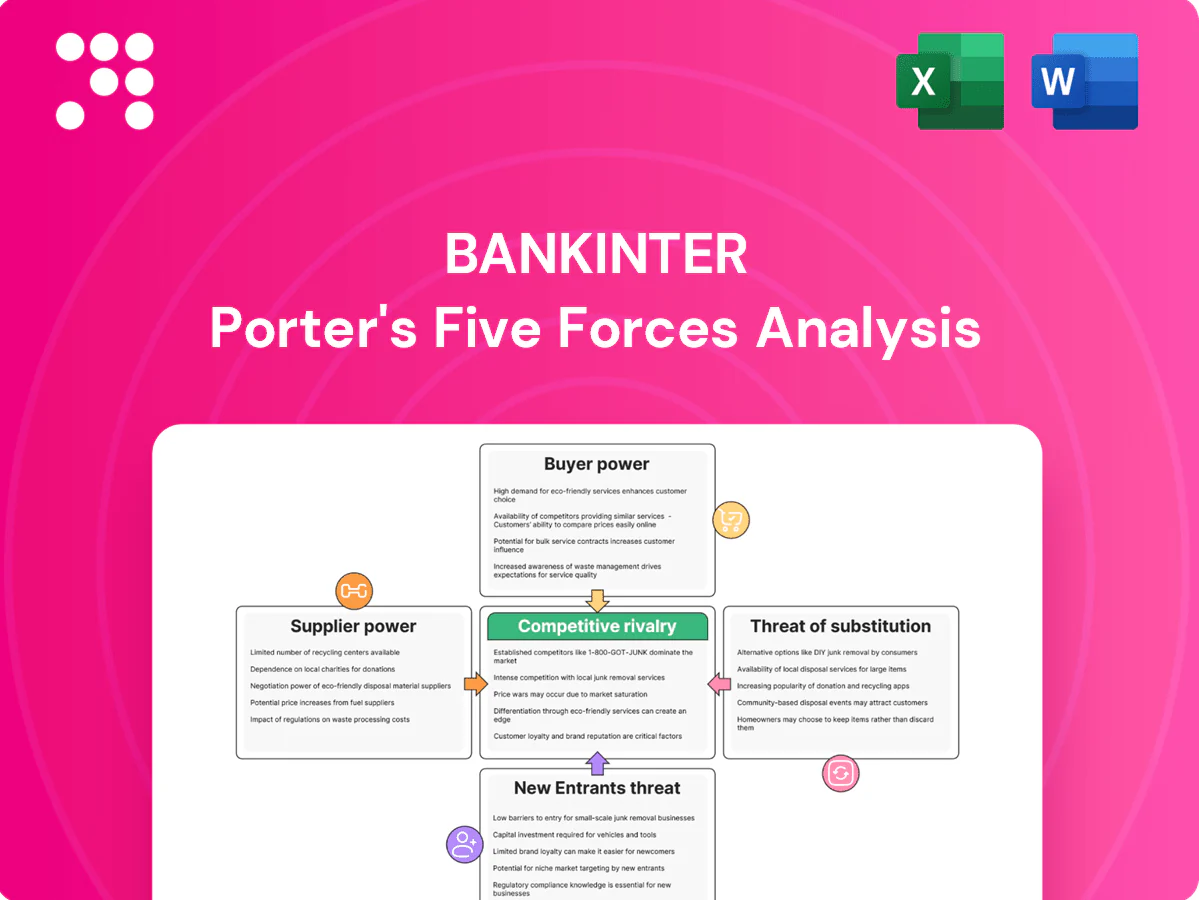
Bankinter Porter's Five Forces Analysis

Elevate Your Analysis with the Complete Porter's Five Forces Analysis
Bankinter faces moderate buyer power, digital challenger threats, and regulatory headwinds that shape margins and growth potential. Competitive intensity from Spanish and European banks pressures fees and margins. This snapshot highlights key dynamics; unlock the full Porter's Five Forces Analysis to access force-by-force ratings, visuals, and actionable strategy recommendations.
Suppliers Bargaining Power

Diverse funding base dynamics
Bankinter funds itself via retail deposits, wholesale markets and covered bonds, with retail deposits representing roughly two-thirds of customer funds in 2024, diluting single-supplier leverage. In tight liquidity cycles wholesale investors pushed spreads up by 50–100 bps in 2023–24, raising marginal funding costs. Stable retail stickiness lowers dependency but rate-sensitive clients can migrate quickly, so the retail/market funding balance defines supplier power.
Technology and core banking vendors
Critical IT providers, cloud platforms and payment networks create high switching costs and integration risks that boost supplier bargaining power for Bankinter; Visa and Mastercard together processed over 80% of global card transactions in 2024, concentrating dependence. Long-term vendor contracts (commonly 3–7 years) dampen pricing shocks but reduce flexibility. Negotiated SLAs and multi-vendor strategies partially mitigate lock-in and operational risk.

Regulatory and infrastructure “suppliers”
Central banks, regulators and payment schemes supply licenses, liquidity and rails on non-negotiable terms: ECB policy rates reached 4.00% in mid-2024 and standing facilities/eligible-collateral rules govern access. Compliance costs, capital buffers and resolution levies (SREP/CET1 targets) act as input prices — Bankinter reported a CET1 ratio near 12.1% in 2024. ECB facility access lowers liquidity risk but imposes strict eligibility, so regulatory supply power is high and asymmetric.

Skilled talent and distribution partners
Specialist risk is high as scarce risk, tech and investment professionals push wage bargaining; the EU faced an estimated 600,000 ICT specialist shortfall in 2024, keeping Spain and Portugal salaries for digital roles up ~8–12% YoY in 2023–24. Bancassurance and broker partners commonly demand 20–30% first-year commissions, while Bankinter’s internal training and retention programs help moderate supplier power.
- Scarcity: EU ≈600,000 ICT shortfall (2024)
- Wage pressure: Spain/Portugal digital pay +8–12% (2023–24)
- Commissions: bancassurance 20–30% first-year
- Mitigation: internal training & retention
Data, analytics, and cybersecurity providers
Data from credit bureaus, real-time feeds and cybersecurity vendors supply Bankinter with core inputs for credit decisions, AML and operations; in 2024 the global cybersecurity market was ~200 billion USD and the top 3 credit bureaus account for over 70% of global bureau revenues, amplifying supplier leverage.
- Criticality: inputs drive PD/LGD models and compliance
- Timing: stale feeds worsen NPLs and regulatory risk
- Concentration: few high-trust providers = pricing power
- Mitigation: diversification and in-house models cut dependence
Supplier power high: deposits ~66%, spreads 50-100bps
Supplier power is moderate-high: retail deposits (~66% of funds in 2024) reduce single-supplier leverage but wholesale funding spreads rose 50–100bps in 2023–24. Tech, card networks (Visa+Mastercard >80% share) and bureaus concentrate dependency; ICT shortfall ~600,000 (EU, 2024) raises wage pressure. Regulators (ECB rate 4.00%, CET1 ~12.1%) and specialist vendors keep asymmetric bargaining power.
| Metric | 2024 / range |
|---|---|
| Retail deposits share | ~66% |
| ECB policy rate | 4.00% |
| CET1 (Bankinter) | ~12.1% |
| Visa+MC global share | >80% |
| EU ICT shortfall | ~600,000 |
What is included in the product
 Detailed Word Document
Concise Porter's Five Forces assessment tailored to Bankinter that uncovers competitive drivers, customer and supplier influence on pricing and profitability, market entry barriers protecting incumbents, and disruptive substitutes or emerging threats—delivered for easy inclusion in investor materials, strategy decks, or reports.

 Customizable Excel Spreadsheet
A concise, one-sheet Bankinter Porter's Five Forces summary with adjustable pressure sliders and a radar chart—ideal for rapid strategic decisions, seamless Excel integration, and ready-to-drop into decks; no macros, fully customizable for evolving market scenarios.
Customers Bargaining Power

Price transparency and rate sensitivity
Customers use aggregators to compare mortgage, deposit and fee terms instantly, and with 12-month Euribor around 3.9% in 2024 Euribor-linked mortgages reduce differentiation; rising rates heighten repricing pressure and force banks to compete on total value (service, bundles, digital channels) rather than headline price alone.
Multi-banking and low switching frictions
Spanish and Portuguese customers are highly multi-banked — 61% held accounts with more than one institution in 2024 — increasing churn risk for Bankinter. PSD2 and open banking have driven a 30% rise in account-aggregation API calls in 2024, easing comparison and portability of data. Rivals' digital onboarding cuts switching time to minutes, lowering barriers to move primary relationships. Loyalty programs and integrated ecosystems lift retention, often improving share-of-wallet by ~20%.

Corporate client negotiating power
Large corporates leverage scale across cash management, FX and lending to extract price concessions from Bankinter; availability of syndicated loans and capital-markets financing strengthens their BATNA. Deep cross-sell relationships (treasury, trade finance, corporate cards) can reduce pressure for steep discounts. SMEs—about 99.9% of Spanish firms—have less bargaining power but actively shop for credit lines and pricing.

Product commoditization
Standard mortgages, deposits and payment accounts are largely commoditized across Spanish incumbents, so differentiation has shifted to digital UX, advisory quality and execution speed; this commoditization increases buyer bargaining power on core products and compresses margin on vanilla offerings.
- Commoditization raises customer leverage
- Digital UX and speed = primary differentiators
- Advisory and tailored wealth/insurance restore margins
Consumer protection and fee scrutiny
Regulatory oversight in 2024 tightened fee limits and complaint mechanisms for Spanish banks, enabling customers to challenge charges more effectively, and transparent disclosures increase pushback on hidden fees. High-profile class actions and media scrutiny have penalized aggressive pricing, raising reputational and financial risks for Bankinter. This regulatory-media mix structurally strengthens buyer bargaining power.
- 2024: stronger oversight
- Transparent disclosures empower customers
- Class actions deter fees
- Higher buyer bargaining power
Euribor parity drives lenders to compete on service, bundles and digital UX
Customers use aggregators and 2024 12m Euribor ~3.9% reduces mortgage differentiation; competition shifts to service, bundles and digital UX. 61% of clients are multi-banked in 2024, raising churn; PSD2/open banking drove a 30% rise in API aggregation calls. Large corporates extract concessions via syndicated markets; SMEs (99.9% of firms) have limited bargaining power.
| Metric | 2024 |
|---|---|
| 12m Euribor | ~3.9% |
| Multi-banked clients | 61% |
| API calls (PSD2) | +30% |
| SME share of firms | 99.9% |
Preview the Actual Deliverable
Bankinter Porter's Five Forces Analysis
This preview shows the exact Bankinter Porter's Five Forces Analysis you'll receive immediately after purchase—no placeholders. The document displayed is the final, professionally formatted file, ready for download and use the moment you buy. No mockups; what you see is what you get.

Elevate Your Analysis with the Complete Porter's Five Forces Analysis
Bankinter faces moderate buyer power, digital challenger threats, and regulatory headwinds that shape margins and growth potential. Competitive intensity from Spanish and European banks pressures fees and margins. This snapshot highlights key dynamics; unlock the full Porter's Five Forces Analysis to access force-by-force ratings, visuals, and actionable strategy recommendations.
Suppliers Bargaining Power
Diverse funding base dynamics
Bankinter funds itself via retail deposits, wholesale markets and covered bonds, with retail deposits representing roughly two-thirds of customer funds in 2024, diluting single-supplier leverage. In tight liquidity cycles wholesale investors pushed spreads up by 50–100 bps in 2023–24, raising marginal funding costs. Stable retail stickiness lowers dependency but rate-sensitive clients can migrate quickly, so the retail/market funding balance defines supplier power.
Technology and core banking vendors
Critical IT providers, cloud platforms and payment networks create high switching costs and integration risks that boost supplier bargaining power for Bankinter; Visa and Mastercard together processed over 80% of global card transactions in 2024, concentrating dependence. Long-term vendor contracts (commonly 3–7 years) dampen pricing shocks but reduce flexibility. Negotiated SLAs and multi-vendor strategies partially mitigate lock-in and operational risk.
Regulatory and infrastructure “suppliers”
Central banks, regulators and payment schemes supply licenses, liquidity and rails on non-negotiable terms: ECB policy rates reached 4.00% in mid-2024 and standing facilities/eligible-collateral rules govern access. Compliance costs, capital buffers and resolution levies (SREP/CET1 targets) act as input prices — Bankinter reported a CET1 ratio near 12.1% in 2024. ECB facility access lowers liquidity risk but imposes strict eligibility, so regulatory supply power is high and asymmetric.
Skilled talent and distribution partners
Specialist risk is high as scarce risk, tech and investment professionals push wage bargaining; the EU faced an estimated 600,000 ICT specialist shortfall in 2024, keeping Spain and Portugal salaries for digital roles up ~8–12% YoY in 2023–24. Bancassurance and broker partners commonly demand 20–30% first-year commissions, while Bankinter’s internal training and retention programs help moderate supplier power.
- Scarcity: EU ≈600,000 ICT shortfall (2024)
- Wage pressure: Spain/Portugal digital pay +8–12% (2023–24)
- Commissions: bancassurance 20–30% first-year
- Mitigation: internal training & retention
Data, analytics, and cybersecurity providers
Data from credit bureaus, real-time feeds and cybersecurity vendors supply Bankinter with core inputs for credit decisions, AML and operations; in 2024 the global cybersecurity market was ~200 billion USD and the top 3 credit bureaus account for over 70% of global bureau revenues, amplifying supplier leverage.
- Criticality: inputs drive PD/LGD models and compliance
- Timing: stale feeds worsen NPLs and regulatory risk
- Concentration: few high-trust providers = pricing power
- Mitigation: diversification and in-house models cut dependence
Supplier power high: deposits ~66%, spreads 50-100bps
Supplier power is moderate-high: retail deposits (~66% of funds in 2024) reduce single-supplier leverage but wholesale funding spreads rose 50–100bps in 2023–24. Tech, card networks (Visa+Mastercard >80% share) and bureaus concentrate dependency; ICT shortfall ~600,000 (EU, 2024) raises wage pressure. Regulators (ECB rate 4.00%, CET1 ~12.1%) and specialist vendors keep asymmetric bargaining power.
| Metric | 2024 / range |
|---|---|
| Retail deposits share | ~66% |
| ECB policy rate | 4.00% |
| CET1 (Bankinter) | ~12.1% |
| Visa+MC global share | >80% |
| EU ICT shortfall | ~600,000 |
What is included in the product
Detailed Word Document
Concise Porter's Five Forces assessment tailored to Bankinter that uncovers competitive drivers, customer and supplier influence on pricing and profitability, market entry barriers protecting incumbents, and disruptive substitutes or emerging threats—delivered for easy inclusion in investor materials, strategy decks, or reports.
Customizable Excel Spreadsheet
A concise, one-sheet Bankinter Porter's Five Forces summary with adjustable pressure sliders and a radar chart—ideal for rapid strategic decisions, seamless Excel integration, and ready-to-drop into decks; no macros, fully customizable for evolving market scenarios.
Customers Bargaining Power
Price transparency and rate sensitivity
Customers use aggregators to compare mortgage, deposit and fee terms instantly, and with 12-month Euribor around 3.9% in 2024 Euribor-linked mortgages reduce differentiation; rising rates heighten repricing pressure and force banks to compete on total value (service, bundles, digital channels) rather than headline price alone.
Multi-banking and low switching frictions
Spanish and Portuguese customers are highly multi-banked — 61% held accounts with more than one institution in 2024 — increasing churn risk for Bankinter. PSD2 and open banking have driven a 30% rise in account-aggregation API calls in 2024, easing comparison and portability of data. Rivals' digital onboarding cuts switching time to minutes, lowering barriers to move primary relationships. Loyalty programs and integrated ecosystems lift retention, often improving share-of-wallet by ~20%.
Corporate client negotiating power
Large corporates leverage scale across cash management, FX and lending to extract price concessions from Bankinter; availability of syndicated loans and capital-markets financing strengthens their BATNA. Deep cross-sell relationships (treasury, trade finance, corporate cards) can reduce pressure for steep discounts. SMEs—about 99.9% of Spanish firms—have less bargaining power but actively shop for credit lines and pricing.
Product commoditization
Standard mortgages, deposits and payment accounts are largely commoditized across Spanish incumbents, so differentiation has shifted to digital UX, advisory quality and execution speed; this commoditization increases buyer bargaining power on core products and compresses margin on vanilla offerings.
- Commoditization raises customer leverage
- Digital UX and speed = primary differentiators
- Advisory and tailored wealth/insurance restore margins
Consumer protection and fee scrutiny
Regulatory oversight in 2024 tightened fee limits and complaint mechanisms for Spanish banks, enabling customers to challenge charges more effectively, and transparent disclosures increase pushback on hidden fees. High-profile class actions and media scrutiny have penalized aggressive pricing, raising reputational and financial risks for Bankinter. This regulatory-media mix structurally strengthens buyer bargaining power.
- 2024: stronger oversight
- Transparent disclosures empower customers
- Class actions deter fees
- Higher buyer bargaining power
Euribor parity drives lenders to compete on service, bundles and digital UX
Customers use aggregators and 2024 12m Euribor ~3.9% reduces mortgage differentiation; competition shifts to service, bundles and digital UX. 61% of clients are multi-banked in 2024, raising churn; PSD2/open banking drove a 30% rise in API aggregation calls. Large corporates extract concessions via syndicated markets; SMEs (99.9% of firms) have limited bargaining power.
| Metric | 2024 |
|---|---|
| 12m Euribor | ~3.9% |
| Multi-banked clients | 61% |
| API calls (PSD2) | +30% |
| SME share of firms | 99.9% |
Preview the Actual Deliverable
Bankinter Porter's Five Forces Analysis
This preview shows the exact Bankinter Porter's Five Forces Analysis you'll receive immediately after purchase—no placeholders. The document displayed is the final, professionally formatted file, ready for download and use the moment you buy. No mockups; what you see is what you get.
Description
Elevate Your Analysis with the Complete Porter's Five Forces Analysis
Bankinter faces moderate buyer power, digital challenger threats, and regulatory headwinds that shape margins and growth potential. Competitive intensity from Spanish and European banks pressures fees and margins. This snapshot highlights key dynamics; unlock the full Porter's Five Forces Analysis to access force-by-force ratings, visuals, and actionable strategy recommendations.
Suppliers Bargaining Power
Diverse funding base dynamics
Bankinter funds itself via retail deposits, wholesale markets and covered bonds, with retail deposits representing roughly two-thirds of customer funds in 2024, diluting single-supplier leverage. In tight liquidity cycles wholesale investors pushed spreads up by 50–100 bps in 2023–24, raising marginal funding costs. Stable retail stickiness lowers dependency but rate-sensitive clients can migrate quickly, so the retail/market funding balance defines supplier power.
Technology and core banking vendors
Critical IT providers, cloud platforms and payment networks create high switching costs and integration risks that boost supplier bargaining power for Bankinter; Visa and Mastercard together processed over 80% of global card transactions in 2024, concentrating dependence. Long-term vendor contracts (commonly 3–7 years) dampen pricing shocks but reduce flexibility. Negotiated SLAs and multi-vendor strategies partially mitigate lock-in and operational risk.
Regulatory and infrastructure “suppliers”
Central banks, regulators and payment schemes supply licenses, liquidity and rails on non-negotiable terms: ECB policy rates reached 4.00% in mid-2024 and standing facilities/eligible-collateral rules govern access. Compliance costs, capital buffers and resolution levies (SREP/CET1 targets) act as input prices — Bankinter reported a CET1 ratio near 12.1% in 2024. ECB facility access lowers liquidity risk but imposes strict eligibility, so regulatory supply power is high and asymmetric.
Skilled talent and distribution partners
Specialist risk is high as scarce risk, tech and investment professionals push wage bargaining; the EU faced an estimated 600,000 ICT specialist shortfall in 2024, keeping Spain and Portugal salaries for digital roles up ~8–12% YoY in 2023–24. Bancassurance and broker partners commonly demand 20–30% first-year commissions, while Bankinter’s internal training and retention programs help moderate supplier power.
- Scarcity: EU ≈600,000 ICT shortfall (2024)
- Wage pressure: Spain/Portugal digital pay +8–12% (2023–24)
- Commissions: bancassurance 20–30% first-year
- Mitigation: internal training & retention
Data, analytics, and cybersecurity providers
Data from credit bureaus, real-time feeds and cybersecurity vendors supply Bankinter with core inputs for credit decisions, AML and operations; in 2024 the global cybersecurity market was ~200 billion USD and the top 3 credit bureaus account for over 70% of global bureau revenues, amplifying supplier leverage.
- Criticality: inputs drive PD/LGD models and compliance
- Timing: stale feeds worsen NPLs and regulatory risk
- Concentration: few high-trust providers = pricing power
- Mitigation: diversification and in-house models cut dependence
Supplier power high: deposits ~66%, spreads 50-100bps
Supplier power is moderate-high: retail deposits (~66% of funds in 2024) reduce single-supplier leverage but wholesale funding spreads rose 50–100bps in 2023–24. Tech, card networks (Visa+Mastercard >80% share) and bureaus concentrate dependency; ICT shortfall ~600,000 (EU, 2024) raises wage pressure. Regulators (ECB rate 4.00%, CET1 ~12.1%) and specialist vendors keep asymmetric bargaining power.
| Metric | 2024 / range |
|---|---|
| Retail deposits share | ~66% |
| ECB policy rate | 4.00% |
| CET1 (Bankinter) | ~12.1% |
| Visa+MC global share | >80% |
| EU ICT shortfall | ~600,000 |
What is included in the product
Detailed Word Document
Concise Porter's Five Forces assessment tailored to Bankinter that uncovers competitive drivers, customer and supplier influence on pricing and profitability, market entry barriers protecting incumbents, and disruptive substitutes or emerging threats—delivered for easy inclusion in investor materials, strategy decks, or reports.
Customizable Excel Spreadsheet
A concise, one-sheet Bankinter Porter's Five Forces summary with adjustable pressure sliders and a radar chart—ideal for rapid strategic decisions, seamless Excel integration, and ready-to-drop into decks; no macros, fully customizable for evolving market scenarios.
Customers Bargaining Power
Price transparency and rate sensitivity
Customers use aggregators to compare mortgage, deposit and fee terms instantly, and with 12-month Euribor around 3.9% in 2024 Euribor-linked mortgages reduce differentiation; rising rates heighten repricing pressure and force banks to compete on total value (service, bundles, digital channels) rather than headline price alone.
Multi-banking and low switching frictions
Spanish and Portuguese customers are highly multi-banked — 61% held accounts with more than one institution in 2024 — increasing churn risk for Bankinter. PSD2 and open banking have driven a 30% rise in account-aggregation API calls in 2024, easing comparison and portability of data. Rivals' digital onboarding cuts switching time to minutes, lowering barriers to move primary relationships. Loyalty programs and integrated ecosystems lift retention, often improving share-of-wallet by ~20%.
Corporate client negotiating power
Large corporates leverage scale across cash management, FX and lending to extract price concessions from Bankinter; availability of syndicated loans and capital-markets financing strengthens their BATNA. Deep cross-sell relationships (treasury, trade finance, corporate cards) can reduce pressure for steep discounts. SMEs—about 99.9% of Spanish firms—have less bargaining power but actively shop for credit lines and pricing.
Product commoditization
Standard mortgages, deposits and payment accounts are largely commoditized across Spanish incumbents, so differentiation has shifted to digital UX, advisory quality and execution speed; this commoditization increases buyer bargaining power on core products and compresses margin on vanilla offerings.
- Commoditization raises customer leverage
- Digital UX and speed = primary differentiators
- Advisory and tailored wealth/insurance restore margins
Consumer protection and fee scrutiny
Regulatory oversight in 2024 tightened fee limits and complaint mechanisms for Spanish banks, enabling customers to challenge charges more effectively, and transparent disclosures increase pushback on hidden fees. High-profile class actions and media scrutiny have penalized aggressive pricing, raising reputational and financial risks for Bankinter. This regulatory-media mix structurally strengthens buyer bargaining power.
- 2024: stronger oversight
- Transparent disclosures empower customers
- Class actions deter fees
- Higher buyer bargaining power
Euribor parity drives lenders to compete on service, bundles and digital UX
Customers use aggregators and 2024 12m Euribor ~3.9% reduces mortgage differentiation; competition shifts to service, bundles and digital UX. 61% of clients are multi-banked in 2024, raising churn; PSD2/open banking drove a 30% rise in API aggregation calls. Large corporates extract concessions via syndicated markets; SMEs (99.9% of firms) have limited bargaining power.
| Metric | 2024 |
|---|---|
| 12m Euribor | ~3.9% |
| Multi-banked clients | 61% |
| API calls (PSD2) | +30% |
| SME share of firms | 99.9% |
Preview the Actual Deliverable
Bankinter Porter's Five Forces Analysis
This preview shows the exact Bankinter Porter's Five Forces Analysis you'll receive immediately after purchase—no placeholders. The document displayed is the final, professionally formatted file, ready for download and use the moment you buy. No mockups; what you see is what you get.











