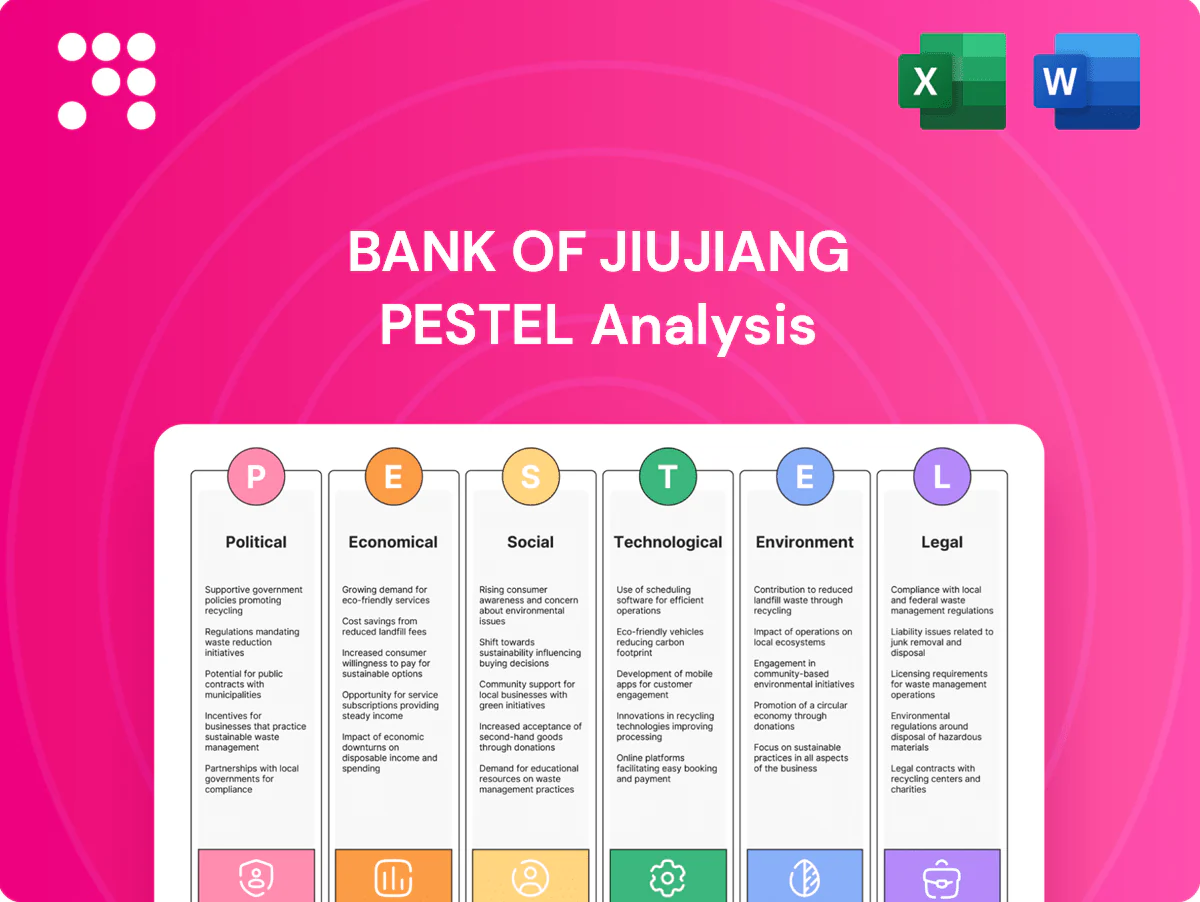
Bank of Jiujiang PESTLE Analysis

Your Shortcut to Market Insight Starts Here
Unlock how political shifts, economic trends, and regulatory pressures are shaping Bank of Jiujiang’s strategic outlook in our concise PESTLE snapshot. This analysis highlights tech risks, social drivers, and environmental factors that could affect performance. Buy the full PESTLE to access the complete, actionable intelligence for investment or strategy decisions.
Political factors

Alignment with central policy
China’s central directives, tied to the 2024 GDP growth target of about 5%, push credit toward MSMEs, advanced manufacturing and rural revitalization; Bank of Jiujiang must tilt loan books to these windows to access re-lending and guarantee schemes. Alignment reduces administrative friction and inspection risk, while deviations can invite supervisory scrutiny or curtailed support. Policy congruence unlocks refinancing and government guarantee programs.
Regulatory oversight intensity
NAFR (established March 2023) and the PBoC maintain strict prudential and conduct supervision over regional banks, with oversight intensifying after 2023 sector stresses. Heightened scrutiny has raised reporting and compliance burdens, including more frequent examinations and data submissions. Periodic campaigns in 2024 tightened standards for shadow credit and wealth products. Proactive compliance materially reduces sanction risk for Bank of Jiujiang.

Local government influence
Provincial and municipal authorities direct development priorities and funding requests that shape Bank of Jiujiang lending and treasury strategies, especially as China recorded GDP growth of about 5.2% in 2024. Exposure to LGFVs requires active management as local budgets tighten and default risk rises. Close cooperation can win deposits, project pipelines and brand visibility. Strong governance safeguards reduce political-lending pressure.

Financial stability measures
Financial-stability tools (PBOC relending, CBIRC bond programs, and state-facilitated M&A) steer liquidity, NPL resolution, and risk pooling among smaller banks; participation often requires stricter performance targets and higher provisioning. As of 2024 China’s headline NPL ratio was about 1.4% with provision coverage near 165%, prompting conservative lending and stronger reserves at regional banks like Bank of Jiujiang.
- Policy tools: relending, bond programs, M&A
- Targets: stricter ROA/ROE and compliance
- NPL: ~1.4% (2024)
- Provision coverage: ~165% (2024)
Cross-regional expansion controls
Regulators pace branching and product approvals to limit systemic spillovers, so Bank of Jiujiang faces staged approvals for cross‑regional expansion and must pass capability tests to receive quotas beyond Jiangxi, making strategic partnerships often preferable to new licenses while political expectations keep the bank geographically focused on local development.
2024 GDP ~5.2% boosts MSME and advanced manufacturing credit as PBoC tightens oversight
Central directives tied to 2024 GDP growth ~5.2% push credit to MSMEs, advanced manufacturing and rural revitalization, requiring Bank of Jiujiang to align lending to access relending/guarantee schemes. NAFR (Mar 2023) and PBoC supervision tightened after 2023 stresses, raising compliance and reporting burdens. Provincial authorities and LGFV exposure shape lending and deposit strategies; PBoC/CBr programs steer liquidity and NPL resolution.
| Indicator | 2024 value |
|---|---|
| China GDP growth | ~5.2% |
| Headline NPL ratio | ~1.4% |
| Provision coverage | ~165% |
| NAFR | Established Mar 2023 |
What is included in the product
 Detailed Word Document
Explores how Political, Economic, Social, Technological, Environmental and Legal forces uniquely impact the Bank of Jiujiang, with data-backed insights, forward-looking scenarios and actionable implications to support executives, investors and strategists.

 Customizable Excel Spreadsheet
Condenses the Bank of Jiujiang PESTLE into a clean, shareable summary—visually segmented by PESTLE categories and written in plain language—so teams can quickly align on external risks, regulatory impacts, and market positioning during meetings or client reports.
Economic factors

Regional growth dependency
Loan demand at Bank of Jiujiang closely follows Jiangxi’s industrial and consumer cycles, with provincial fixed-asset investment growth slowing to about 3–4% in 2024, pressuring credit uptake; property investment contraction of roughly 6–8% and uneven exports (single-digit decline in 2024) can damp credit growth. Diversification into manufacturing, logistics and consumer finance—sectors showing mid-single-digit resilience—stabilizes revenue, while localized underwriting and branch-level risk scoring lifted NPL coverage and sharpened risk-adjusted returns.
Property market headwinds
Developer stress has pressured collateral values and mortgage performance, with China property-sector defaults accelerating since 2021 and estimated developer offshore/onshore defaults exceeding CNY 300bn across 2023–24, weighing on local collateral quality. Construction-linked SMEs report acute cash-flow strains as project stoppages rose, shrinking supplier liquidity. Bank of Jiujiang’s conservative LTVs and segment caps (sub-60% LTV on many new mortgages) have limited loss severity. Active restructuring and targeted workout programs have contained NPL spillover, keeping reported NPLs near a national average of about 1.2%.

MSME credit dynamics
As of 2024 SMEs contribute over 60% of China’s GDP and about 80% of urban employment, so inclusive-finance policy remains a priority while MSMEs exhibit higher default risk. Risk-based pricing and government-backed guarantee schemes are essential to contain losses. Data-driven underwriting improves borrower selection, and cross-selling payments and cash-management services deepens relationships and boosts fee income.

Interest rate and margin pressure
Persistent LPR softness (1-year LPR at 3.65% since Aug 2022) and fierce deposit competition have compressed Chinese commercial NIMs, squeezing Bank of Jiujiang's margins.
Optimizing low-cost liability mix and growing fee income—noninterest income rose ~12% industry-wide in 2023—are vital to offset margin loss.
Faster asset repricing improves earnings resilience; hedging and duration management limit volatility and support capital stability.
- tags: LPR 3.65%
- tags: NIM pressure
- tags: liability mix
- tags: fee income +12%
- tags: hedging & duration
Wealth and savings behavior
Household risk appetite swings between deposits and wealth-management products with market volatility, while transparent, compliant offerings help Bank of Jiujiang retain clients after regulatory rectification cycles. Advisory services increase client stickiness and fee income, and disciplined liquidity management is vital to prevent redemption strains during stress.
- shift: deposits vs WM
- compliance = retention
- advisory = fees + stickiness
- liquidity buffers prevent runs
2024 GDP ~5.2% boosts MSME and advanced manufacturing credit as PBoC tightens oversight
Jiangxi GDP/FAI growth slowed to ~3–4% in 2024, while property investment fell ~6–8% and exports dipped low single-digits, pressuring loan demand and collateral values. LPR 1y at 3.65% and NIM compression force focus on liability mix; noninterest income rose ~12% industry-wide in 2023 aiding offset. Reported NPLs near 1.2% with conservative LTVs and active workouts containing losses.
| Metric | Value |
|---|---|
| Provincial FAI (2024) | 3–4% |
| Property investment | -6–8% |
| 1y LPR | 3.65% |
| NIM impact | Compressed |
| Noninterest income (2023) | +12% |
| Reported NPLs | ~1.2% |
What You See Is What You Get
Bank of Jiujiang PESTLE Analysis
The preview shown here is the exact Bank of Jiujiang PESTLE Analysis document you’ll receive after purchase—fully formatted and ready to use. This screenshot reflects the real file with complete content, structure, and professional layout. No placeholders or teasers—what you see is what you’ll download immediately after payment.

Your Shortcut to Market Insight Starts Here
Unlock how political shifts, economic trends, and regulatory pressures are shaping Bank of Jiujiang’s strategic outlook in our concise PESTLE snapshot. This analysis highlights tech risks, social drivers, and environmental factors that could affect performance. Buy the full PESTLE to access the complete, actionable intelligence for investment or strategy decisions.
Political factors
Alignment with central policy
China’s central directives, tied to the 2024 GDP growth target of about 5%, push credit toward MSMEs, advanced manufacturing and rural revitalization; Bank of Jiujiang must tilt loan books to these windows to access re-lending and guarantee schemes. Alignment reduces administrative friction and inspection risk, while deviations can invite supervisory scrutiny or curtailed support. Policy congruence unlocks refinancing and government guarantee programs.
Regulatory oversight intensity
NAFR (established March 2023) and the PBoC maintain strict prudential and conduct supervision over regional banks, with oversight intensifying after 2023 sector stresses. Heightened scrutiny has raised reporting and compliance burdens, including more frequent examinations and data submissions. Periodic campaigns in 2024 tightened standards for shadow credit and wealth products. Proactive compliance materially reduces sanction risk for Bank of Jiujiang.
Local government influence
Provincial and municipal authorities direct development priorities and funding requests that shape Bank of Jiujiang lending and treasury strategies, especially as China recorded GDP growth of about 5.2% in 2024. Exposure to LGFVs requires active management as local budgets tighten and default risk rises. Close cooperation can win deposits, project pipelines and brand visibility. Strong governance safeguards reduce political-lending pressure.
Financial stability measures
Financial-stability tools (PBOC relending, CBIRC bond programs, and state-facilitated M&A) steer liquidity, NPL resolution, and risk pooling among smaller banks; participation often requires stricter performance targets and higher provisioning. As of 2024 China’s headline NPL ratio was about 1.4% with provision coverage near 165%, prompting conservative lending and stronger reserves at regional banks like Bank of Jiujiang.
- Policy tools: relending, bond programs, M&A
- Targets: stricter ROA/ROE and compliance
- NPL: ~1.4% (2024)
- Provision coverage: ~165% (2024)
Cross-regional expansion controls
Regulators pace branching and product approvals to limit systemic spillovers, so Bank of Jiujiang faces staged approvals for cross‑regional expansion and must pass capability tests to receive quotas beyond Jiangxi, making strategic partnerships often preferable to new licenses while political expectations keep the bank geographically focused on local development.
2024 GDP ~5.2% boosts MSME and advanced manufacturing credit as PBoC tightens oversight
Central directives tied to 2024 GDP growth ~5.2% push credit to MSMEs, advanced manufacturing and rural revitalization, requiring Bank of Jiujiang to align lending to access relending/guarantee schemes. NAFR (Mar 2023) and PBoC supervision tightened after 2023 stresses, raising compliance and reporting burdens. Provincial authorities and LGFV exposure shape lending and deposit strategies; PBoC/CBr programs steer liquidity and NPL resolution.
| Indicator | 2024 value |
|---|---|
| China GDP growth | ~5.2% |
| Headline NPL ratio | ~1.4% |
| Provision coverage | ~165% |
| NAFR | Established Mar 2023 |
What is included in the product
Detailed Word Document
Explores how Political, Economic, Social, Technological, Environmental and Legal forces uniquely impact the Bank of Jiujiang, with data-backed insights, forward-looking scenarios and actionable implications to support executives, investors and strategists.
Customizable Excel Spreadsheet
Condenses the Bank of Jiujiang PESTLE into a clean, shareable summary—visually segmented by PESTLE categories and written in plain language—so teams can quickly align on external risks, regulatory impacts, and market positioning during meetings or client reports.
Economic factors
Regional growth dependency
Loan demand at Bank of Jiujiang closely follows Jiangxi’s industrial and consumer cycles, with provincial fixed-asset investment growth slowing to about 3–4% in 2024, pressuring credit uptake; property investment contraction of roughly 6–8% and uneven exports (single-digit decline in 2024) can damp credit growth. Diversification into manufacturing, logistics and consumer finance—sectors showing mid-single-digit resilience—stabilizes revenue, while localized underwriting and branch-level risk scoring lifted NPL coverage and sharpened risk-adjusted returns.
Property market headwinds
Developer stress has pressured collateral values and mortgage performance, with China property-sector defaults accelerating since 2021 and estimated developer offshore/onshore defaults exceeding CNY 300bn across 2023–24, weighing on local collateral quality. Construction-linked SMEs report acute cash-flow strains as project stoppages rose, shrinking supplier liquidity. Bank of Jiujiang’s conservative LTVs and segment caps (sub-60% LTV on many new mortgages) have limited loss severity. Active restructuring and targeted workout programs have contained NPL spillover, keeping reported NPLs near a national average of about 1.2%.
MSME credit dynamics
As of 2024 SMEs contribute over 60% of China’s GDP and about 80% of urban employment, so inclusive-finance policy remains a priority while MSMEs exhibit higher default risk. Risk-based pricing and government-backed guarantee schemes are essential to contain losses. Data-driven underwriting improves borrower selection, and cross-selling payments and cash-management services deepens relationships and boosts fee income.
Interest rate and margin pressure
Persistent LPR softness (1-year LPR at 3.65% since Aug 2022) and fierce deposit competition have compressed Chinese commercial NIMs, squeezing Bank of Jiujiang's margins.
Optimizing low-cost liability mix and growing fee income—noninterest income rose ~12% industry-wide in 2023—are vital to offset margin loss.
Faster asset repricing improves earnings resilience; hedging and duration management limit volatility and support capital stability.
- tags: LPR 3.65%
- tags: NIM pressure
- tags: liability mix
- tags: fee income +12%
- tags: hedging & duration
Wealth and savings behavior
Household risk appetite swings between deposits and wealth-management products with market volatility, while transparent, compliant offerings help Bank of Jiujiang retain clients after regulatory rectification cycles. Advisory services increase client stickiness and fee income, and disciplined liquidity management is vital to prevent redemption strains during stress.
- shift: deposits vs WM
- compliance = retention
- advisory = fees + stickiness
- liquidity buffers prevent runs
2024 GDP ~5.2% boosts MSME and advanced manufacturing credit as PBoC tightens oversight
Jiangxi GDP/FAI growth slowed to ~3–4% in 2024, while property investment fell ~6–8% and exports dipped low single-digits, pressuring loan demand and collateral values. LPR 1y at 3.65% and NIM compression force focus on liability mix; noninterest income rose ~12% industry-wide in 2023 aiding offset. Reported NPLs near 1.2% with conservative LTVs and active workouts containing losses.
| Metric | Value |
|---|---|
| Provincial FAI (2024) | 3–4% |
| Property investment | -6–8% |
| 1y LPR | 3.65% |
| NIM impact | Compressed |
| Noninterest income (2023) | +12% |
| Reported NPLs | ~1.2% |
What You See Is What You Get
Bank of Jiujiang PESTLE Analysis
The preview shown here is the exact Bank of Jiujiang PESTLE Analysis document you’ll receive after purchase—fully formatted and ready to use. This screenshot reflects the real file with complete content, structure, and professional layout. No placeholders or teasers—what you see is what you’ll download immediately after payment.
Description
Your Shortcut to Market Insight Starts Here
Unlock how political shifts, economic trends, and regulatory pressures are shaping Bank of Jiujiang’s strategic outlook in our concise PESTLE snapshot. This analysis highlights tech risks, social drivers, and environmental factors that could affect performance. Buy the full PESTLE to access the complete, actionable intelligence for investment or strategy decisions.
Political factors
Alignment with central policy
China’s central directives, tied to the 2024 GDP growth target of about 5%, push credit toward MSMEs, advanced manufacturing and rural revitalization; Bank of Jiujiang must tilt loan books to these windows to access re-lending and guarantee schemes. Alignment reduces administrative friction and inspection risk, while deviations can invite supervisory scrutiny or curtailed support. Policy congruence unlocks refinancing and government guarantee programs.
Regulatory oversight intensity
NAFR (established March 2023) and the PBoC maintain strict prudential and conduct supervision over regional banks, with oversight intensifying after 2023 sector stresses. Heightened scrutiny has raised reporting and compliance burdens, including more frequent examinations and data submissions. Periodic campaigns in 2024 tightened standards for shadow credit and wealth products. Proactive compliance materially reduces sanction risk for Bank of Jiujiang.
Local government influence
Provincial and municipal authorities direct development priorities and funding requests that shape Bank of Jiujiang lending and treasury strategies, especially as China recorded GDP growth of about 5.2% in 2024. Exposure to LGFVs requires active management as local budgets tighten and default risk rises. Close cooperation can win deposits, project pipelines and brand visibility. Strong governance safeguards reduce political-lending pressure.
Financial stability measures
Financial-stability tools (PBOC relending, CBIRC bond programs, and state-facilitated M&A) steer liquidity, NPL resolution, and risk pooling among smaller banks; participation often requires stricter performance targets and higher provisioning. As of 2024 China’s headline NPL ratio was about 1.4% with provision coverage near 165%, prompting conservative lending and stronger reserves at regional banks like Bank of Jiujiang.
- Policy tools: relending, bond programs, M&A
- Targets: stricter ROA/ROE and compliance
- NPL: ~1.4% (2024)
- Provision coverage: ~165% (2024)
Cross-regional expansion controls
Regulators pace branching and product approvals to limit systemic spillovers, so Bank of Jiujiang faces staged approvals for cross‑regional expansion and must pass capability tests to receive quotas beyond Jiangxi, making strategic partnerships often preferable to new licenses while political expectations keep the bank geographically focused on local development.
2024 GDP ~5.2% boosts MSME and advanced manufacturing credit as PBoC tightens oversight
Central directives tied to 2024 GDP growth ~5.2% push credit to MSMEs, advanced manufacturing and rural revitalization, requiring Bank of Jiujiang to align lending to access relending/guarantee schemes. NAFR (Mar 2023) and PBoC supervision tightened after 2023 stresses, raising compliance and reporting burdens. Provincial authorities and LGFV exposure shape lending and deposit strategies; PBoC/CBr programs steer liquidity and NPL resolution.
| Indicator | 2024 value |
|---|---|
| China GDP growth | ~5.2% |
| Headline NPL ratio | ~1.4% |
| Provision coverage | ~165% |
| NAFR | Established Mar 2023 |
What is included in the product
Detailed Word Document
Explores how Political, Economic, Social, Technological, Environmental and Legal forces uniquely impact the Bank of Jiujiang, with data-backed insights, forward-looking scenarios and actionable implications to support executives, investors and strategists.
Customizable Excel Spreadsheet
Condenses the Bank of Jiujiang PESTLE into a clean, shareable summary—visually segmented by PESTLE categories and written in plain language—so teams can quickly align on external risks, regulatory impacts, and market positioning during meetings or client reports.
Economic factors
Regional growth dependency
Loan demand at Bank of Jiujiang closely follows Jiangxi’s industrial and consumer cycles, with provincial fixed-asset investment growth slowing to about 3–4% in 2024, pressuring credit uptake; property investment contraction of roughly 6–8% and uneven exports (single-digit decline in 2024) can damp credit growth. Diversification into manufacturing, logistics and consumer finance—sectors showing mid-single-digit resilience—stabilizes revenue, while localized underwriting and branch-level risk scoring lifted NPL coverage and sharpened risk-adjusted returns.
Property market headwinds
Developer stress has pressured collateral values and mortgage performance, with China property-sector defaults accelerating since 2021 and estimated developer offshore/onshore defaults exceeding CNY 300bn across 2023–24, weighing on local collateral quality. Construction-linked SMEs report acute cash-flow strains as project stoppages rose, shrinking supplier liquidity. Bank of Jiujiang’s conservative LTVs and segment caps (sub-60% LTV on many new mortgages) have limited loss severity. Active restructuring and targeted workout programs have contained NPL spillover, keeping reported NPLs near a national average of about 1.2%.
MSME credit dynamics
As of 2024 SMEs contribute over 60% of China’s GDP and about 80% of urban employment, so inclusive-finance policy remains a priority while MSMEs exhibit higher default risk. Risk-based pricing and government-backed guarantee schemes are essential to contain losses. Data-driven underwriting improves borrower selection, and cross-selling payments and cash-management services deepens relationships and boosts fee income.
Interest rate and margin pressure
Persistent LPR softness (1-year LPR at 3.65% since Aug 2022) and fierce deposit competition have compressed Chinese commercial NIMs, squeezing Bank of Jiujiang's margins.
Optimizing low-cost liability mix and growing fee income—noninterest income rose ~12% industry-wide in 2023—are vital to offset margin loss.
Faster asset repricing improves earnings resilience; hedging and duration management limit volatility and support capital stability.
- tags: LPR 3.65%
- tags: NIM pressure
- tags: liability mix
- tags: fee income +12%
- tags: hedging & duration
Wealth and savings behavior
Household risk appetite swings between deposits and wealth-management products with market volatility, while transparent, compliant offerings help Bank of Jiujiang retain clients after regulatory rectification cycles. Advisory services increase client stickiness and fee income, and disciplined liquidity management is vital to prevent redemption strains during stress.
- shift: deposits vs WM
- compliance = retention
- advisory = fees + stickiness
- liquidity buffers prevent runs
2024 GDP ~5.2% boosts MSME and advanced manufacturing credit as PBoC tightens oversight
Jiangxi GDP/FAI growth slowed to ~3–4% in 2024, while property investment fell ~6–8% and exports dipped low single-digits, pressuring loan demand and collateral values. LPR 1y at 3.65% and NIM compression force focus on liability mix; noninterest income rose ~12% industry-wide in 2023 aiding offset. Reported NPLs near 1.2% with conservative LTVs and active workouts containing losses.
| Metric | Value |
|---|---|
| Provincial FAI (2024) | 3–4% |
| Property investment | -6–8% |
| 1y LPR | 3.65% |
| NIM impact | Compressed |
| Noninterest income (2023) | +12% |
| Reported NPLs | ~1.2% |
What You See Is What You Get
Bank of Jiujiang PESTLE Analysis
The preview shown here is the exact Bank of Jiujiang PESTLE Analysis document you’ll receive after purchase—fully formatted and ready to use. This screenshot reflects the real file with complete content, structure, and professional layout. No placeholders or teasers—what you see is what you’ll download immediately after payment.











