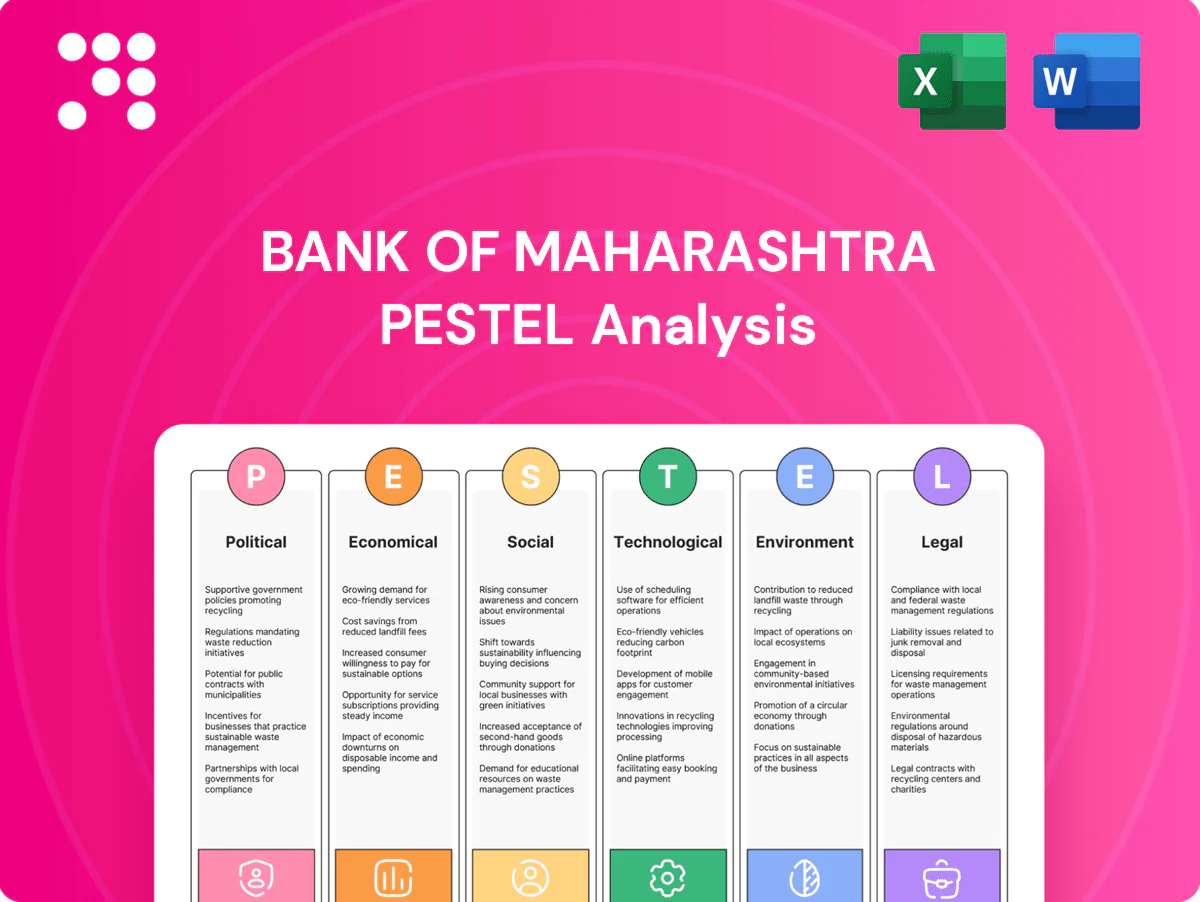
Bank of Maharashtra PESTLE Analysis

Plan Smarter. Present Sharper. Compete Stronger.
Discover how political reforms, macroeconomic shifts, and technological adoption are reshaping Bank of Maharashtra’s competitive outlook in our concise PESTLE snapshot. This quick read highlights regulatory risks, digital opportunities, and social trends that matter to investors and strategists. Purchase the full PESTLE for a complete, actionable external analysis you can deploy immediately.
Political factors

Govt ownership
As a majority government-owned bank, Bank of Maharashtra’s strategic direction is influenced by the Government of India’s priorities; capital infusions, board appointments and merger decisions are often policy-led. This ownership stabilizes funding access and can facilitate recapitalisation but constrains strategic autonomy and commercial flexibility. Alignment with national agendas steers product focus and moderates risk appetite.
Policy mandates
As a public sector bank, Bank of Maharashtra must meet statutory priority sector lending targets — 40% of adjusted net bank credit with an 18% agriculture sub-target — which drive lending to rural and inclusion segments. These mandates expand credit access but often compress yields and raise operational costs through smaller-ticket, higher-service loans. Balancing social objectives with profitability remains an ongoing challenge, and political shifts can quickly recalibrate targets and reporting requirements.

Welfare delivery
Welfare delivery via DBT and schemes like PMJDY (over 480 million accounts), PM SVANidhi and Mudra use PSBs as rails, boosting CASA and transaction volumes for banks like Bank of Maharashtra; BoM reported CASA around 44% in FY24. This expands customer base and fee income but raises execution risks and compliance burdens as volumes scale. Changes in program design or timing around elections can materially affect transaction volumes and fee income.

Geo-political climate
Geo-political tensions (eg Russia–Ukraine war since 2022) disrupt trade flows, elevate FX volatility and complicate Bank of Maharashtra’s overseas operations; Brent averaged about 85 USD/bbl in 2024, pressuring import bills. Sanctions regimes raise correspondent-banking and compliance costs, creating uncertainty for import-export clients and forcing treasury to recalibrate sovereign-risk and oil-price hedges.
- Brent ~85 USD/bbl (2024 avg)
- Sanctions increase correspondent-banking scrutiny
- FX volatility raises hedging demand
- Import-export clients face policy uncertainty
State-center dynamics
Bank of Maharashtra, headquartered in Pune, must navigate state-center dynamics as it operates across states with differing political priorities and subsidies, which in 2024 influenced sectoral credit flows and localized repayment cycles; around 60% of its branch network is concentrated in Maharashtra, amplifying state-policy impact.
State-level programs (farm loan waivers, subsidy disbursements) materially affect credit demand and NPA formation, while coordination with state entities can unlock bulk deposit mobilization but increases compliance layers and processing time.
Regional political risk drives branch expansion and lending mixes, with the bank prioritizing conservative exposure in high-risk states and opportunistic growth where state schemes boost retail and agri loan uptake.
- Branch concentration: ~60% in Maharashtra
- Policy impact: state programs drive short-term loan demand and repayment stress
- Coordination trade-off: deposits gain vs. higher bureaucracy
- Strategy: conservative lending in politically volatile regions
Govt ownership limits strategy; PSL 40% ANBC, 18% agri; CASA ≈44%
Majority government ownership shapes capital, board and merger decisions, limiting strategic autonomy while stabilizing funding.
Mandatory priority-sector targets (40% ANBC; 18% agriculture) drive low-yield, high-cost rural lending and affect profitability.
Welfare schemes boost CASA (≈44% FY24) and volumes; branch concentration (~60% in Maharashtra) amplifies state-policy risk; Brent ≈85 USD/bbl (2024) raises FX/import pressures.
| Factor | Metric | 2024 |
|---|---|---|
| Ownership | Government majority | — |
| CASA | Ratio | ≈44% |
| Branches | Maharashtra share | ≈60% |
| PSL | Targets | 40% ANBC; 18% agri |
| Oil | Brent | ≈85 USD/bbl |
What is included in the product
 Detailed Word Document
Explores how macro-environmental factors uniquely affect Bank of Maharashtra across Political, Economic, Social, Technological, Environmental and Legal dimensions, with data-driven trends and region-specific regulatory context. Designed to aid executives and investors in spotting risks and opportunities.

 Customizable Excel Spreadsheet
A concise, visually segmented PESTLE summary for Bank of Maharashtra that eases strategic discussions by highlighting key political, economic, social, technological, legal and environmental risks at a glance. Easily droppable into presentations or shared across teams to align on external threats and opportunities during planning sessions.
Economic factors

Growth cycle
India’s GDP at roughly 7% in FY2024-25 has driven strong credit demand across retail, MSME and corporate segments, supporting bank credit growth near 16% YoY (RBI Mar 2025). Slowdowns compress fee income and elevate stress—systemic GNPA around 5.6% in FY2024-25 pressured asset quality. Expansion cycles improve loan growth and NIM via operating leverage, while rapid sectoral rotation demands agile portfolio rebalancing.
Inflation & rates
RBI rate moves reshape funding costs and loan pricing; with the repo at 6.50% and 10-year G-sec near 7.4% banks must reprice incremental loans. High CPI inflation around 5.0% compresses real returns and raises borrower stress. ALM gaps demand active management to protect NIMs while treasury gains or losses hinge on yield-curve shifts.

Credit quality
Credit quality at Bank of Maharashtra is highly cyclically linked: NPA upticks track commodity cycles, real estate slowdowns and MSME stress, with MSMEs contributing about 30% of India’s GDP and employing roughly 120 million people. Resolution outcomes under IBC and recoveries influence provisioning and loan-loss buffers. Granular underwriting, analytics and countercyclical capital buffers are vital to control slippages and support resilience.

Competition
Private banks, small finance banks, fintechs and NBFCs intensify pricing pressure on Bank of Maharashtra, compressing margins as competition for retail deposits and lending heats up; UPI and low-cost payment rails processed over 100 billion transactions in 2024, eroding traditional fee pools. Differentiation increasingly rests on service, branch-plus-digital trust and distribution strength. Strategic partnerships and cross-sell can lift ROA by an estimated 20–50 basis points despite pricing headwinds.
- Competition: multi-channel pricing pressure
- Payments: UPI >100B txns (2024)
- Differentiation: service, trust, distribution
- Mitigation: partnerships & cross-sell -> +20–50 bps ROA
FX & trade
- FX volatility: USD/INR ~83 H1 2025
- Oil impact: Brent ~$85/bbl
- Hedging demand → fee income
- Risk controls: OP limits + liquidity (FX reserves ~$560bn)
Govt ownership limits strategy; PSL 40% ANBC, 18% agri; CASA ≈44%
India GDP ~7% (FY2024-25) supported bank credit ~16% YoY; systemic GNPA ~5.6% pressured asset quality and provisioning. Repo 6.50% and 10y G-sec ~7.4% raised funding costs; CPI ~5.0% increased borrower stress. USD/INR ~83 and Brent ~$85/bbl amplified FX/import risk, boosting hedging demand.
| Metric | Value |
|---|---|
| GDP growth | ~7% FY24-25 |
| Bank credit growth | ~16% YoY |
| Systemic GNPA | ~5.6% |
| Repo / 10y G-sec | 6.50% / ~7.4% |
| CPI | ~5.0% |
| USD/INR | ~83 (H1 2025) |
| Brent | ~$85/bbl |
| FX reserves | ~$560bn (mid-2025) |
What You See Is What You Get
Bank of Maharashtra PESTLE Analysis
The Bank of Maharashtra PESTLE Analysis provides a concise assessment of political, economic, social, technological, legal, and environmental factors affecting the bank. The preview shown here is the exact document you’ll receive after purchase—fully formatted and ready to use. Everything displayed is the final, professionally structured file available for immediate download after payment.

Plan Smarter. Present Sharper. Compete Stronger.
Discover how political reforms, macroeconomic shifts, and technological adoption are reshaping Bank of Maharashtra’s competitive outlook in our concise PESTLE snapshot. This quick read highlights regulatory risks, digital opportunities, and social trends that matter to investors and strategists. Purchase the full PESTLE for a complete, actionable external analysis you can deploy immediately.
Political factors
Govt ownership
As a majority government-owned bank, Bank of Maharashtra’s strategic direction is influenced by the Government of India’s priorities; capital infusions, board appointments and merger decisions are often policy-led. This ownership stabilizes funding access and can facilitate recapitalisation but constrains strategic autonomy and commercial flexibility. Alignment with national agendas steers product focus and moderates risk appetite.
Policy mandates
As a public sector bank, Bank of Maharashtra must meet statutory priority sector lending targets — 40% of adjusted net bank credit with an 18% agriculture sub-target — which drive lending to rural and inclusion segments. These mandates expand credit access but often compress yields and raise operational costs through smaller-ticket, higher-service loans. Balancing social objectives with profitability remains an ongoing challenge, and political shifts can quickly recalibrate targets and reporting requirements.
Welfare delivery
Welfare delivery via DBT and schemes like PMJDY (over 480 million accounts), PM SVANidhi and Mudra use PSBs as rails, boosting CASA and transaction volumes for banks like Bank of Maharashtra; BoM reported CASA around 44% in FY24. This expands customer base and fee income but raises execution risks and compliance burdens as volumes scale. Changes in program design or timing around elections can materially affect transaction volumes and fee income.
Geo-political climate
Geo-political tensions (eg Russia–Ukraine war since 2022) disrupt trade flows, elevate FX volatility and complicate Bank of Maharashtra’s overseas operations; Brent averaged about 85 USD/bbl in 2024, pressuring import bills. Sanctions regimes raise correspondent-banking and compliance costs, creating uncertainty for import-export clients and forcing treasury to recalibrate sovereign-risk and oil-price hedges.
- Brent ~85 USD/bbl (2024 avg)
- Sanctions increase correspondent-banking scrutiny
- FX volatility raises hedging demand
- Import-export clients face policy uncertainty
State-center dynamics
Bank of Maharashtra, headquartered in Pune, must navigate state-center dynamics as it operates across states with differing political priorities and subsidies, which in 2024 influenced sectoral credit flows and localized repayment cycles; around 60% of its branch network is concentrated in Maharashtra, amplifying state-policy impact.
State-level programs (farm loan waivers, subsidy disbursements) materially affect credit demand and NPA formation, while coordination with state entities can unlock bulk deposit mobilization but increases compliance layers and processing time.
Regional political risk drives branch expansion and lending mixes, with the bank prioritizing conservative exposure in high-risk states and opportunistic growth where state schemes boost retail and agri loan uptake.
- Branch concentration: ~60% in Maharashtra
- Policy impact: state programs drive short-term loan demand and repayment stress
- Coordination trade-off: deposits gain vs. higher bureaucracy
- Strategy: conservative lending in politically volatile regions
Govt ownership limits strategy; PSL 40% ANBC, 18% agri; CASA ≈44%
Majority government ownership shapes capital, board and merger decisions, limiting strategic autonomy while stabilizing funding.
Mandatory priority-sector targets (40% ANBC; 18% agriculture) drive low-yield, high-cost rural lending and affect profitability.
Welfare schemes boost CASA (≈44% FY24) and volumes; branch concentration (~60% in Maharashtra) amplifies state-policy risk; Brent ≈85 USD/bbl (2024) raises FX/import pressures.
| Factor | Metric | 2024 |
|---|---|---|
| Ownership | Government majority | — |
| CASA | Ratio | ≈44% |
| Branches | Maharashtra share | ≈60% |
| PSL | Targets | 40% ANBC; 18% agri |
| Oil | Brent | ≈85 USD/bbl |
What is included in the product
Detailed Word Document
Explores how macro-environmental factors uniquely affect Bank of Maharashtra across Political, Economic, Social, Technological, Environmental and Legal dimensions, with data-driven trends and region-specific regulatory context. Designed to aid executives and investors in spotting risks and opportunities.
Customizable Excel Spreadsheet
A concise, visually segmented PESTLE summary for Bank of Maharashtra that eases strategic discussions by highlighting key political, economic, social, technological, legal and environmental risks at a glance. Easily droppable into presentations or shared across teams to align on external threats and opportunities during planning sessions.
Economic factors
Growth cycle
India’s GDP at roughly 7% in FY2024-25 has driven strong credit demand across retail, MSME and corporate segments, supporting bank credit growth near 16% YoY (RBI Mar 2025). Slowdowns compress fee income and elevate stress—systemic GNPA around 5.6% in FY2024-25 pressured asset quality. Expansion cycles improve loan growth and NIM via operating leverage, while rapid sectoral rotation demands agile portfolio rebalancing.
Inflation & rates
RBI rate moves reshape funding costs and loan pricing; with the repo at 6.50% and 10-year G-sec near 7.4% banks must reprice incremental loans. High CPI inflation around 5.0% compresses real returns and raises borrower stress. ALM gaps demand active management to protect NIMs while treasury gains or losses hinge on yield-curve shifts.
Credit quality
Credit quality at Bank of Maharashtra is highly cyclically linked: NPA upticks track commodity cycles, real estate slowdowns and MSME stress, with MSMEs contributing about 30% of India’s GDP and employing roughly 120 million people. Resolution outcomes under IBC and recoveries influence provisioning and loan-loss buffers. Granular underwriting, analytics and countercyclical capital buffers are vital to control slippages and support resilience.
Competition
Private banks, small finance banks, fintechs and NBFCs intensify pricing pressure on Bank of Maharashtra, compressing margins as competition for retail deposits and lending heats up; UPI and low-cost payment rails processed over 100 billion transactions in 2024, eroding traditional fee pools. Differentiation increasingly rests on service, branch-plus-digital trust and distribution strength. Strategic partnerships and cross-sell can lift ROA by an estimated 20–50 basis points despite pricing headwinds.
- Competition: multi-channel pricing pressure
- Payments: UPI >100B txns (2024)
- Differentiation: service, trust, distribution
- Mitigation: partnerships & cross-sell -> +20–50 bps ROA
FX & trade
- FX volatility: USD/INR ~83 H1 2025
- Oil impact: Brent ~$85/bbl
- Hedging demand → fee income
- Risk controls: OP limits + liquidity (FX reserves ~$560bn)
Govt ownership limits strategy; PSL 40% ANBC, 18% agri; CASA ≈44%
India GDP ~7% (FY2024-25) supported bank credit ~16% YoY; systemic GNPA ~5.6% pressured asset quality and provisioning. Repo 6.50% and 10y G-sec ~7.4% raised funding costs; CPI ~5.0% increased borrower stress. USD/INR ~83 and Brent ~$85/bbl amplified FX/import risk, boosting hedging demand.
| Metric | Value |
|---|---|
| GDP growth | ~7% FY24-25 |
| Bank credit growth | ~16% YoY |
| Systemic GNPA | ~5.6% |
| Repo / 10y G-sec | 6.50% / ~7.4% |
| CPI | ~5.0% |
| USD/INR | ~83 (H1 2025) |
| Brent | ~$85/bbl |
| FX reserves | ~$560bn (mid-2025) |
What You See Is What You Get
Bank of Maharashtra PESTLE Analysis
The Bank of Maharashtra PESTLE Analysis provides a concise assessment of political, economic, social, technological, legal, and environmental factors affecting the bank. The preview shown here is the exact document you’ll receive after purchase—fully formatted and ready to use. Everything displayed is the final, professionally structured file available for immediate download after payment.
Description
Plan Smarter. Present Sharper. Compete Stronger.
Discover how political reforms, macroeconomic shifts, and technological adoption are reshaping Bank of Maharashtra’s competitive outlook in our concise PESTLE snapshot. This quick read highlights regulatory risks, digital opportunities, and social trends that matter to investors and strategists. Purchase the full PESTLE for a complete, actionable external analysis you can deploy immediately.
Political factors
Govt ownership
As a majority government-owned bank, Bank of Maharashtra’s strategic direction is influenced by the Government of India’s priorities; capital infusions, board appointments and merger decisions are often policy-led. This ownership stabilizes funding access and can facilitate recapitalisation but constrains strategic autonomy and commercial flexibility. Alignment with national agendas steers product focus and moderates risk appetite.
Policy mandates
As a public sector bank, Bank of Maharashtra must meet statutory priority sector lending targets — 40% of adjusted net bank credit with an 18% agriculture sub-target — which drive lending to rural and inclusion segments. These mandates expand credit access but often compress yields and raise operational costs through smaller-ticket, higher-service loans. Balancing social objectives with profitability remains an ongoing challenge, and political shifts can quickly recalibrate targets and reporting requirements.
Welfare delivery
Welfare delivery via DBT and schemes like PMJDY (over 480 million accounts), PM SVANidhi and Mudra use PSBs as rails, boosting CASA and transaction volumes for banks like Bank of Maharashtra; BoM reported CASA around 44% in FY24. This expands customer base and fee income but raises execution risks and compliance burdens as volumes scale. Changes in program design or timing around elections can materially affect transaction volumes and fee income.
Geo-political climate
Geo-political tensions (eg Russia–Ukraine war since 2022) disrupt trade flows, elevate FX volatility and complicate Bank of Maharashtra’s overseas operations; Brent averaged about 85 USD/bbl in 2024, pressuring import bills. Sanctions regimes raise correspondent-banking and compliance costs, creating uncertainty for import-export clients and forcing treasury to recalibrate sovereign-risk and oil-price hedges.
- Brent ~85 USD/bbl (2024 avg)
- Sanctions increase correspondent-banking scrutiny
- FX volatility raises hedging demand
- Import-export clients face policy uncertainty
State-center dynamics
Bank of Maharashtra, headquartered in Pune, must navigate state-center dynamics as it operates across states with differing political priorities and subsidies, which in 2024 influenced sectoral credit flows and localized repayment cycles; around 60% of its branch network is concentrated in Maharashtra, amplifying state-policy impact.
State-level programs (farm loan waivers, subsidy disbursements) materially affect credit demand and NPA formation, while coordination with state entities can unlock bulk deposit mobilization but increases compliance layers and processing time.
Regional political risk drives branch expansion and lending mixes, with the bank prioritizing conservative exposure in high-risk states and opportunistic growth where state schemes boost retail and agri loan uptake.
- Branch concentration: ~60% in Maharashtra
- Policy impact: state programs drive short-term loan demand and repayment stress
- Coordination trade-off: deposits gain vs. higher bureaucracy
- Strategy: conservative lending in politically volatile regions
Govt ownership limits strategy; PSL 40% ANBC, 18% agri; CASA ≈44%
Majority government ownership shapes capital, board and merger decisions, limiting strategic autonomy while stabilizing funding.
Mandatory priority-sector targets (40% ANBC; 18% agriculture) drive low-yield, high-cost rural lending and affect profitability.
Welfare schemes boost CASA (≈44% FY24) and volumes; branch concentration (~60% in Maharashtra) amplifies state-policy risk; Brent ≈85 USD/bbl (2024) raises FX/import pressures.
| Factor | Metric | 2024 |
|---|---|---|
| Ownership | Government majority | — |
| CASA | Ratio | ≈44% |
| Branches | Maharashtra share | ≈60% |
| PSL | Targets | 40% ANBC; 18% agri |
| Oil | Brent | ≈85 USD/bbl |
What is included in the product
Detailed Word Document
Explores how macro-environmental factors uniquely affect Bank of Maharashtra across Political, Economic, Social, Technological, Environmental and Legal dimensions, with data-driven trends and region-specific regulatory context. Designed to aid executives and investors in spotting risks and opportunities.
Customizable Excel Spreadsheet
A concise, visually segmented PESTLE summary for Bank of Maharashtra that eases strategic discussions by highlighting key political, economic, social, technological, legal and environmental risks at a glance. Easily droppable into presentations or shared across teams to align on external threats and opportunities during planning sessions.
Economic factors
Growth cycle
India’s GDP at roughly 7% in FY2024-25 has driven strong credit demand across retail, MSME and corporate segments, supporting bank credit growth near 16% YoY (RBI Mar 2025). Slowdowns compress fee income and elevate stress—systemic GNPA around 5.6% in FY2024-25 pressured asset quality. Expansion cycles improve loan growth and NIM via operating leverage, while rapid sectoral rotation demands agile portfolio rebalancing.
Inflation & rates
RBI rate moves reshape funding costs and loan pricing; with the repo at 6.50% and 10-year G-sec near 7.4% banks must reprice incremental loans. High CPI inflation around 5.0% compresses real returns and raises borrower stress. ALM gaps demand active management to protect NIMs while treasury gains or losses hinge on yield-curve shifts.
Credit quality
Credit quality at Bank of Maharashtra is highly cyclically linked: NPA upticks track commodity cycles, real estate slowdowns and MSME stress, with MSMEs contributing about 30% of India’s GDP and employing roughly 120 million people. Resolution outcomes under IBC and recoveries influence provisioning and loan-loss buffers. Granular underwriting, analytics and countercyclical capital buffers are vital to control slippages and support resilience.
Competition
Private banks, small finance banks, fintechs and NBFCs intensify pricing pressure on Bank of Maharashtra, compressing margins as competition for retail deposits and lending heats up; UPI and low-cost payment rails processed over 100 billion transactions in 2024, eroding traditional fee pools. Differentiation increasingly rests on service, branch-plus-digital trust and distribution strength. Strategic partnerships and cross-sell can lift ROA by an estimated 20–50 basis points despite pricing headwinds.
- Competition: multi-channel pricing pressure
- Payments: UPI >100B txns (2024)
- Differentiation: service, trust, distribution
- Mitigation: partnerships & cross-sell -> +20–50 bps ROA
FX & trade
- FX volatility: USD/INR ~83 H1 2025
- Oil impact: Brent ~$85/bbl
- Hedging demand → fee income
- Risk controls: OP limits + liquidity (FX reserves ~$560bn)
Govt ownership limits strategy; PSL 40% ANBC, 18% agri; CASA ≈44%
India GDP ~7% (FY2024-25) supported bank credit ~16% YoY; systemic GNPA ~5.6% pressured asset quality and provisioning. Repo 6.50% and 10y G-sec ~7.4% raised funding costs; CPI ~5.0% increased borrower stress. USD/INR ~83 and Brent ~$85/bbl amplified FX/import risk, boosting hedging demand.
| Metric | Value |
|---|---|
| GDP growth | ~7% FY24-25 |
| Bank credit growth | ~16% YoY |
| Systemic GNPA | ~5.6% |
| Repo / 10y G-sec | 6.50% / ~7.4% |
| CPI | ~5.0% |
| USD/INR | ~83 (H1 2025) |
| Brent | ~$85/bbl |
| FX reserves | ~$560bn (mid-2025) |
What You See Is What You Get
Bank of Maharashtra PESTLE Analysis
The Bank of Maharashtra PESTLE Analysis provides a concise assessment of political, economic, social, technological, legal, and environmental factors affecting the bank. The preview shown here is the exact document you’ll receive after purchase—fully formatted and ready to use. Everything displayed is the final, professionally structured file available for immediate download after payment.











