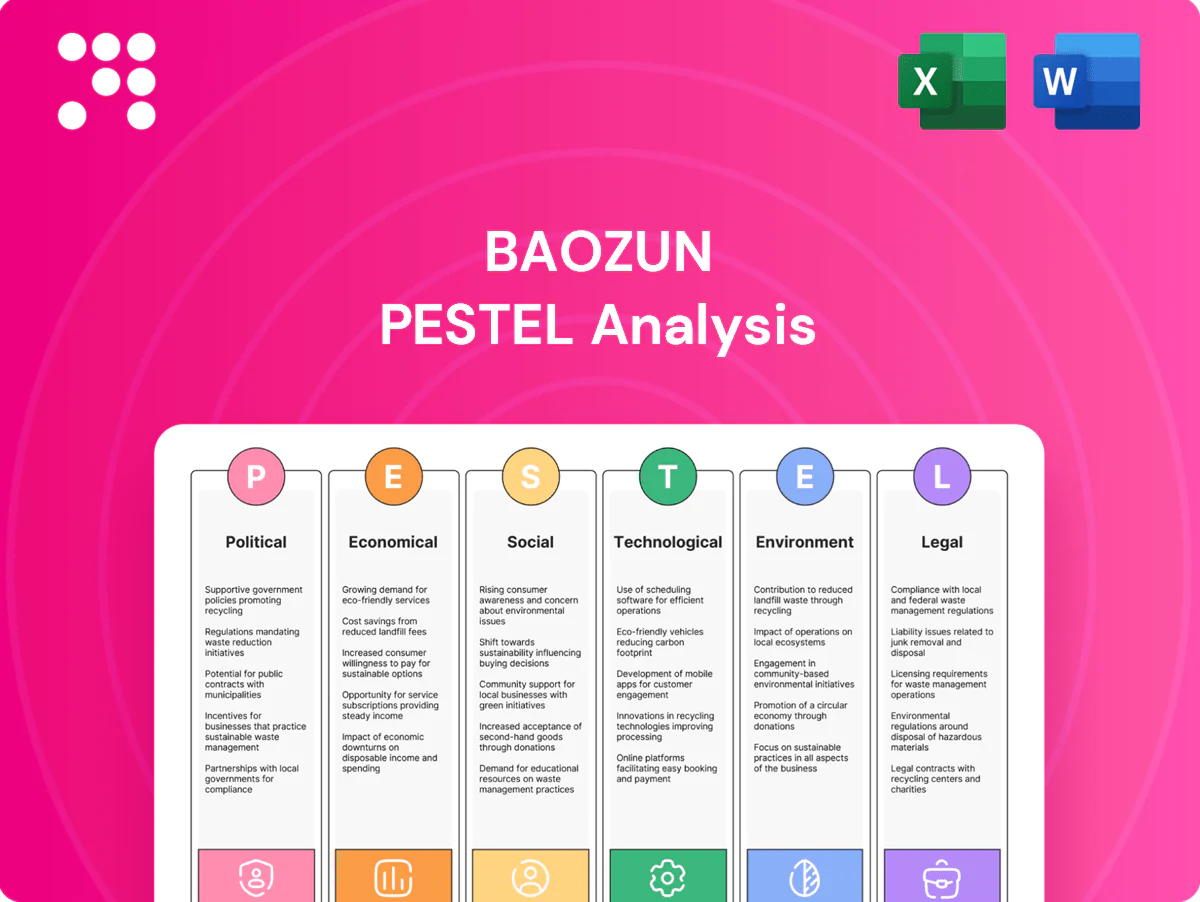
Baozun PESTLE Analysis

Plan Smarter. Present Sharper. Compete Stronger.
Get a clear view of the external forces shaping Baozun—political shifts, economic trends, social behavior, technological advances, legal changes, and environmental risks—and how they affect strategy and valuation. This concise PESTLE highlights critical opportunities and threats for investors and strategists. Purchase the full analysis to access actionable, downloadable insights and detailed recommendations.
Political factors

State influence on e-commerce
China’s government actively shapes the digital economy through industrial policy and strict platform oversight; Baozun must align with national “high-quality development” priorities and compliant platform behavior. Policy shifts—driven by laws like the Data Security Law and PIPL—can rapidly alter traffic allocation, merchant rules and subsidy structures. China’s online retail sales reached RMB 13.81 trillion in 2023 (NBS), making close public–private coordination a strategic necessity for Baozun.
Cross-border and trade policy exposure
Brands Baozun serves often rely on cross-border channels and bonded warehouses, and changes to import tariffs, positive lists or customs procedures directly affect assortment, pricing and fulfillment SLAs. Baozun reported RMB 7.7 billion revenue in FY2023, exposing significant top-line sensitivity to trade frictions. Geopolitical tensions can cause sudden demand swings or increased scrutiny for foreign labels. Scenario-planning for tariff hikes and customs delays is essential to protect margins and service levels.

Data localization and digital sovereignty
Authorities (PIPL effective Nov 2021 and Data Security Law Sept 2021) impose strict localization and security requirements and cross‑border assessment rules; PIPL penalties reach 50 million RMB or up to 5% of annual revenue. Baozun’s IT architecture must meet these local storage and security assessments when processing brand and consumer data to avoid fines and disruption. Building compliant data pipelines enhances platform trust and regulatory resilience.

Platform governance and antitrust
Regulators continue tightening platform governance and antitrust rules—Alibaba received a record 18.2 billion RMB fine in 2021, setting enforcement precedent for 2024–25 scrutiny of exclusivity and discounting. Monitoring of traffic exclusivity affects store operations, so Baozun must diversify across marketplaces and social channels to cut concentration risk and bolster resilience.
- Regulatory precedent: 18.2 billion RMB fine (Alibaba)
- Risk: traffic exclusivity & discount monitoring
- Action: diversify marketplaces & social channels
- Goal: balanced channel portfolio for resilience
Government incentives and regional policies
Local governments in key e-commerce hubs offer logistics, warehousing and tech incentives that Baozun can leverage when siting fulfillment centers. Strategic site selection captures tax breaks and grants but requires strict covenant management to mitigate risks of policy changes or clawbacks. Maintaining a multi-city presence helps spread regional policy risk and preserve operational continuity.
- Leverage local incentives for capex and OPEX relief
- Manage covenants to avoid clawbacks
- Multi-city footprint reduces single-region exposure
China tightens platform rules and data law; e-commerce players must diversify markets
China shapes digital commerce via industrial policy and strict platform oversight; Baozun must align with high-quality development and PIPL/Data Security Law requirements. Online retail sales RMB 13.81 trillion (2023) and Baozun revenue RMB 7.7 billion (FY2023) mean regulatory shifts and trade friction materially affect top line; diversify channels and locations to mitigate risk.
| Metric | Value |
|---|---|
| China online retail sales 2023 | RMB 13.81 trillion |
| Baozun FY2023 revenue | RMB 7.7 billion |
| PIPL max penalty | RMB 50 million or 5% revenue |
| Antitrust precedent | Alibaba fine RMB 18.2 billion (2021) |
What is included in the product
 Detailed Word Document
Explores how macro-environmental factors uniquely affect Baozun across Political, Economic, Social, Technological, Environmental and Legal dimensions, with data-driven trends and region-specific examples to reveal risks and opportunities; designed to support executives, consultants and investors with forward-looking insights, scenario planning and ready-to-use content for business plans, decks and reports.

 Customizable Excel Spreadsheet
Condenses Baozun's PESTLE into a clear, visually segmented summary for quick meeting reference and cross-team alignment, easily dropped into presentations and editable with notes for specific regions or business lines.
Economic factors

China consumption cyclicality
Consumer sentiment in China remains uneven across categories, with discretionary spending in fashion, beauty and electronics driving volatility; these categories represent roughly 30-40% of many brand partners' online sales, making Baozun revenue highly sensitive to cyclical demand. Promotional peaks around 6.18 and 11.11 boost volumes but compress margins through heavy discounts and platform fees. Robust demand forecasting and inventory agility reduce stock-outs and markdown risk, smoothing quarterly swings.
RMB exchange and pricing for global brands
RMB depreciation—about 4% vs USD in 2024—raised landed costs for imported SKUs, squeezing brand margins and forcing Baozun to adjust retail pricing and promotional cadence to protect conversion. The company must coordinate dynamic pricing, FX hedging and targeted promotions to maintain margin-share balance. Currency moves also push brands to shift sourcing and SKU mix toward domestically sourced or lower-cost variants. Clear, transparent FX pass-through policies preserve merchant and consumer trust.

Logistics and last-mile cost inflation
Parcel rate hikes, rising labor and fuel costs — Brent averaged about $86/bbl in 2024 and China urban wages rose ~5.5% in 2023 — squeeze fulfillment economics, with last-mile accounting for up to 53% of delivery cost. Service-level expectations remain high despite these headwinds. Baozun’s network design, carrier mix and automation are primary margin levers. Continuous cost-to-serve measurement is critical.

E-commerce penetration and omni-channel shift
Online penetration remains high with growth migrating to omni and private traffic; China online retail penetration was about 30% in 2024 and social commerce contributed roughly 10%+ of e-commerce GMV in 2024. Brands demand integrated DTC, marketplace and social commerce execution, and Baozun can unlock growth via unified inventory and customer data while channel ROI optimization drives spend allocation.
- Omni-adoption: unified inventory/customer data
- DTC+marketplace+social: integrated execution
- Private traffic: higher LTV, lower acquisition cost
- ROI focus: reallocates marketing spend to high-ROAS channels
Competitive intensity and take-rate pressure
Agencies, third-party partners and in-house brand teams increasingly compete on fees and measurable performance, driving downward pressure on Baozun’s take rates and service margins; differentiation through proprietary tech, analytics and category expertise is critical to defend pricing. Outcome-based contracts that tie fees to sales growth or ROI align incentives and help stabilize margins amid fee competition.
- competitive-fees
- take-rate-erosion
- tech-differentiation
- analytics-capability
- outcome-contracts
China tightens platform rules and data law; e-commerce players must diversify markets
Baozun revenue is highly cyclical as discretionary categories (30–40% of brand online sales) drive volatility; 6.18/11.11 promos raise volume but compress margins. RMB fell ~4% vs USD in 2024, raising landed costs and prompting FX hedging and domestic sourcing. Rising fulfillment costs (Brent ~$86/bbl in 2024; China urban wages +5.5% in 2023) pressure take-rates and automation investment.
| Metric | Value |
|---|---|
| Online penetration (2024) | ~30% |
| Social commerce GMV (2024) | ~10%+ |
| RMB vs USD (2024) | -4% |
What You See Is What You Get
Baozun PESTLE Analysis
The preview shown here is the exact Baozun PESTLE Analysis document you’ll receive after purchase—fully formatted and ready to use. The layout, content, and structure visible in this preview are the final version with no placeholders or teasers. After checkout you’ll instantly download the same professionally structured file, ready for immediate application.

Plan Smarter. Present Sharper. Compete Stronger.
Get a clear view of the external forces shaping Baozun—political shifts, economic trends, social behavior, technological advances, legal changes, and environmental risks—and how they affect strategy and valuation. This concise PESTLE highlights critical opportunities and threats for investors and strategists. Purchase the full analysis to access actionable, downloadable insights and detailed recommendations.
Political factors
State influence on e-commerce
China’s government actively shapes the digital economy through industrial policy and strict platform oversight; Baozun must align with national “high-quality development” priorities and compliant platform behavior. Policy shifts—driven by laws like the Data Security Law and PIPL—can rapidly alter traffic allocation, merchant rules and subsidy structures. China’s online retail sales reached RMB 13.81 trillion in 2023 (NBS), making close public–private coordination a strategic necessity for Baozun.
Cross-border and trade policy exposure
Brands Baozun serves often rely on cross-border channels and bonded warehouses, and changes to import tariffs, positive lists or customs procedures directly affect assortment, pricing and fulfillment SLAs. Baozun reported RMB 7.7 billion revenue in FY2023, exposing significant top-line sensitivity to trade frictions. Geopolitical tensions can cause sudden demand swings or increased scrutiny for foreign labels. Scenario-planning for tariff hikes and customs delays is essential to protect margins and service levels.
Data localization and digital sovereignty
Authorities (PIPL effective Nov 2021 and Data Security Law Sept 2021) impose strict localization and security requirements and cross‑border assessment rules; PIPL penalties reach 50 million RMB or up to 5% of annual revenue. Baozun’s IT architecture must meet these local storage and security assessments when processing brand and consumer data to avoid fines and disruption. Building compliant data pipelines enhances platform trust and regulatory resilience.
Platform governance and antitrust
Regulators continue tightening platform governance and antitrust rules—Alibaba received a record 18.2 billion RMB fine in 2021, setting enforcement precedent for 2024–25 scrutiny of exclusivity and discounting. Monitoring of traffic exclusivity affects store operations, so Baozun must diversify across marketplaces and social channels to cut concentration risk and bolster resilience.
- Regulatory precedent: 18.2 billion RMB fine (Alibaba)
- Risk: traffic exclusivity & discount monitoring
- Action: diversify marketplaces & social channels
- Goal: balanced channel portfolio for resilience
Government incentives and regional policies
Local governments in key e-commerce hubs offer logistics, warehousing and tech incentives that Baozun can leverage when siting fulfillment centers. Strategic site selection captures tax breaks and grants but requires strict covenant management to mitigate risks of policy changes or clawbacks. Maintaining a multi-city presence helps spread regional policy risk and preserve operational continuity.
- Leverage local incentives for capex and OPEX relief
- Manage covenants to avoid clawbacks
- Multi-city footprint reduces single-region exposure
China tightens platform rules and data law; e-commerce players must diversify markets
China shapes digital commerce via industrial policy and strict platform oversight; Baozun must align with high-quality development and PIPL/Data Security Law requirements. Online retail sales RMB 13.81 trillion (2023) and Baozun revenue RMB 7.7 billion (FY2023) mean regulatory shifts and trade friction materially affect top line; diversify channels and locations to mitigate risk.
| Metric | Value |
|---|---|
| China online retail sales 2023 | RMB 13.81 trillion |
| Baozun FY2023 revenue | RMB 7.7 billion |
| PIPL max penalty | RMB 50 million or 5% revenue |
| Antitrust precedent | Alibaba fine RMB 18.2 billion (2021) |
What is included in the product
Detailed Word Document
Explores how macro-environmental factors uniquely affect Baozun across Political, Economic, Social, Technological, Environmental and Legal dimensions, with data-driven trends and region-specific examples to reveal risks and opportunities; designed to support executives, consultants and investors with forward-looking insights, scenario planning and ready-to-use content for business plans, decks and reports.
Customizable Excel Spreadsheet
Condenses Baozun's PESTLE into a clear, visually segmented summary for quick meeting reference and cross-team alignment, easily dropped into presentations and editable with notes for specific regions or business lines.
Economic factors
China consumption cyclicality
Consumer sentiment in China remains uneven across categories, with discretionary spending in fashion, beauty and electronics driving volatility; these categories represent roughly 30-40% of many brand partners' online sales, making Baozun revenue highly sensitive to cyclical demand. Promotional peaks around 6.18 and 11.11 boost volumes but compress margins through heavy discounts and platform fees. Robust demand forecasting and inventory agility reduce stock-outs and markdown risk, smoothing quarterly swings.
RMB exchange and pricing for global brands
RMB depreciation—about 4% vs USD in 2024—raised landed costs for imported SKUs, squeezing brand margins and forcing Baozun to adjust retail pricing and promotional cadence to protect conversion. The company must coordinate dynamic pricing, FX hedging and targeted promotions to maintain margin-share balance. Currency moves also push brands to shift sourcing and SKU mix toward domestically sourced or lower-cost variants. Clear, transparent FX pass-through policies preserve merchant and consumer trust.
Logistics and last-mile cost inflation
Parcel rate hikes, rising labor and fuel costs — Brent averaged about $86/bbl in 2024 and China urban wages rose ~5.5% in 2023 — squeeze fulfillment economics, with last-mile accounting for up to 53% of delivery cost. Service-level expectations remain high despite these headwinds. Baozun’s network design, carrier mix and automation are primary margin levers. Continuous cost-to-serve measurement is critical.
E-commerce penetration and omni-channel shift
Online penetration remains high with growth migrating to omni and private traffic; China online retail penetration was about 30% in 2024 and social commerce contributed roughly 10%+ of e-commerce GMV in 2024. Brands demand integrated DTC, marketplace and social commerce execution, and Baozun can unlock growth via unified inventory and customer data while channel ROI optimization drives spend allocation.
- Omni-adoption: unified inventory/customer data
- DTC+marketplace+social: integrated execution
- Private traffic: higher LTV, lower acquisition cost
- ROI focus: reallocates marketing spend to high-ROAS channels
Competitive intensity and take-rate pressure
Agencies, third-party partners and in-house brand teams increasingly compete on fees and measurable performance, driving downward pressure on Baozun’s take rates and service margins; differentiation through proprietary tech, analytics and category expertise is critical to defend pricing. Outcome-based contracts that tie fees to sales growth or ROI align incentives and help stabilize margins amid fee competition.
- competitive-fees
- take-rate-erosion
- tech-differentiation
- analytics-capability
- outcome-contracts
China tightens platform rules and data law; e-commerce players must diversify markets
Baozun revenue is highly cyclical as discretionary categories (30–40% of brand online sales) drive volatility; 6.18/11.11 promos raise volume but compress margins. RMB fell ~4% vs USD in 2024, raising landed costs and prompting FX hedging and domestic sourcing. Rising fulfillment costs (Brent ~$86/bbl in 2024; China urban wages +5.5% in 2023) pressure take-rates and automation investment.
| Metric | Value |
|---|---|
| Online penetration (2024) | ~30% |
| Social commerce GMV (2024) | ~10%+ |
| RMB vs USD (2024) | -4% |
What You See Is What You Get
Baozun PESTLE Analysis
The preview shown here is the exact Baozun PESTLE Analysis document you’ll receive after purchase—fully formatted and ready to use. The layout, content, and structure visible in this preview are the final version with no placeholders or teasers. After checkout you’ll instantly download the same professionally structured file, ready for immediate application.
Original: $10.00
-65%$10.00
$3.50Description
Plan Smarter. Present Sharper. Compete Stronger.
Get a clear view of the external forces shaping Baozun—political shifts, economic trends, social behavior, technological advances, legal changes, and environmental risks—and how they affect strategy and valuation. This concise PESTLE highlights critical opportunities and threats for investors and strategists. Purchase the full analysis to access actionable, downloadable insights and detailed recommendations.
Political factors
State influence on e-commerce
China’s government actively shapes the digital economy through industrial policy and strict platform oversight; Baozun must align with national “high-quality development” priorities and compliant platform behavior. Policy shifts—driven by laws like the Data Security Law and PIPL—can rapidly alter traffic allocation, merchant rules and subsidy structures. China’s online retail sales reached RMB 13.81 trillion in 2023 (NBS), making close public–private coordination a strategic necessity for Baozun.
Cross-border and trade policy exposure
Brands Baozun serves often rely on cross-border channels and bonded warehouses, and changes to import tariffs, positive lists or customs procedures directly affect assortment, pricing and fulfillment SLAs. Baozun reported RMB 7.7 billion revenue in FY2023, exposing significant top-line sensitivity to trade frictions. Geopolitical tensions can cause sudden demand swings or increased scrutiny for foreign labels. Scenario-planning for tariff hikes and customs delays is essential to protect margins and service levels.
Data localization and digital sovereignty
Authorities (PIPL effective Nov 2021 and Data Security Law Sept 2021) impose strict localization and security requirements and cross‑border assessment rules; PIPL penalties reach 50 million RMB or up to 5% of annual revenue. Baozun’s IT architecture must meet these local storage and security assessments when processing brand and consumer data to avoid fines and disruption. Building compliant data pipelines enhances platform trust and regulatory resilience.
Platform governance and antitrust
Regulators continue tightening platform governance and antitrust rules—Alibaba received a record 18.2 billion RMB fine in 2021, setting enforcement precedent for 2024–25 scrutiny of exclusivity and discounting. Monitoring of traffic exclusivity affects store operations, so Baozun must diversify across marketplaces and social channels to cut concentration risk and bolster resilience.
- Regulatory precedent: 18.2 billion RMB fine (Alibaba)
- Risk: traffic exclusivity & discount monitoring
- Action: diversify marketplaces & social channels
- Goal: balanced channel portfolio for resilience
Government incentives and regional policies
Local governments in key e-commerce hubs offer logistics, warehousing and tech incentives that Baozun can leverage when siting fulfillment centers. Strategic site selection captures tax breaks and grants but requires strict covenant management to mitigate risks of policy changes or clawbacks. Maintaining a multi-city presence helps spread regional policy risk and preserve operational continuity.
- Leverage local incentives for capex and OPEX relief
- Manage covenants to avoid clawbacks
- Multi-city footprint reduces single-region exposure
China tightens platform rules and data law; e-commerce players must diversify markets
China shapes digital commerce via industrial policy and strict platform oversight; Baozun must align with high-quality development and PIPL/Data Security Law requirements. Online retail sales RMB 13.81 trillion (2023) and Baozun revenue RMB 7.7 billion (FY2023) mean regulatory shifts and trade friction materially affect top line; diversify channels and locations to mitigate risk.
| Metric | Value |
|---|---|
| China online retail sales 2023 | RMB 13.81 trillion |
| Baozun FY2023 revenue | RMB 7.7 billion |
| PIPL max penalty | RMB 50 million or 5% revenue |
| Antitrust precedent | Alibaba fine RMB 18.2 billion (2021) |
What is included in the product
Detailed Word Document
Explores how macro-environmental factors uniquely affect Baozun across Political, Economic, Social, Technological, Environmental and Legal dimensions, with data-driven trends and region-specific examples to reveal risks and opportunities; designed to support executives, consultants and investors with forward-looking insights, scenario planning and ready-to-use content for business plans, decks and reports.
Customizable Excel Spreadsheet
Condenses Baozun's PESTLE into a clear, visually segmented summary for quick meeting reference and cross-team alignment, easily dropped into presentations and editable with notes for specific regions or business lines.
Economic factors
China consumption cyclicality
Consumer sentiment in China remains uneven across categories, with discretionary spending in fashion, beauty and electronics driving volatility; these categories represent roughly 30-40% of many brand partners' online sales, making Baozun revenue highly sensitive to cyclical demand. Promotional peaks around 6.18 and 11.11 boost volumes but compress margins through heavy discounts and platform fees. Robust demand forecasting and inventory agility reduce stock-outs and markdown risk, smoothing quarterly swings.
RMB exchange and pricing for global brands
RMB depreciation—about 4% vs USD in 2024—raised landed costs for imported SKUs, squeezing brand margins and forcing Baozun to adjust retail pricing and promotional cadence to protect conversion. The company must coordinate dynamic pricing, FX hedging and targeted promotions to maintain margin-share balance. Currency moves also push brands to shift sourcing and SKU mix toward domestically sourced or lower-cost variants. Clear, transparent FX pass-through policies preserve merchant and consumer trust.
Logistics and last-mile cost inflation
Parcel rate hikes, rising labor and fuel costs — Brent averaged about $86/bbl in 2024 and China urban wages rose ~5.5% in 2023 — squeeze fulfillment economics, with last-mile accounting for up to 53% of delivery cost. Service-level expectations remain high despite these headwinds. Baozun’s network design, carrier mix and automation are primary margin levers. Continuous cost-to-serve measurement is critical.
E-commerce penetration and omni-channel shift
Online penetration remains high with growth migrating to omni and private traffic; China online retail penetration was about 30% in 2024 and social commerce contributed roughly 10%+ of e-commerce GMV in 2024. Brands demand integrated DTC, marketplace and social commerce execution, and Baozun can unlock growth via unified inventory and customer data while channel ROI optimization drives spend allocation.
- Omni-adoption: unified inventory/customer data
- DTC+marketplace+social: integrated execution
- Private traffic: higher LTV, lower acquisition cost
- ROI focus: reallocates marketing spend to high-ROAS channels
Competitive intensity and take-rate pressure
Agencies, third-party partners and in-house brand teams increasingly compete on fees and measurable performance, driving downward pressure on Baozun’s take rates and service margins; differentiation through proprietary tech, analytics and category expertise is critical to defend pricing. Outcome-based contracts that tie fees to sales growth or ROI align incentives and help stabilize margins amid fee competition.
- competitive-fees
- take-rate-erosion
- tech-differentiation
- analytics-capability
- outcome-contracts
China tightens platform rules and data law; e-commerce players must diversify markets
Baozun revenue is highly cyclical as discretionary categories (30–40% of brand online sales) drive volatility; 6.18/11.11 promos raise volume but compress margins. RMB fell ~4% vs USD in 2024, raising landed costs and prompting FX hedging and domestic sourcing. Rising fulfillment costs (Brent ~$86/bbl in 2024; China urban wages +5.5% in 2023) pressure take-rates and automation investment.
| Metric | Value |
|---|---|
| Online penetration (2024) | ~30% |
| Social commerce GMV (2024) | ~10%+ |
| RMB vs USD (2024) | -4% |
What You See Is What You Get
Baozun PESTLE Analysis
The preview shown here is the exact Baozun PESTLE Analysis document you’ll receive after purchase—fully formatted and ready to use. The layout, content, and structure visible in this preview are the final version with no placeholders or teasers. After checkout you’ll instantly download the same professionally structured file, ready for immediate application.











