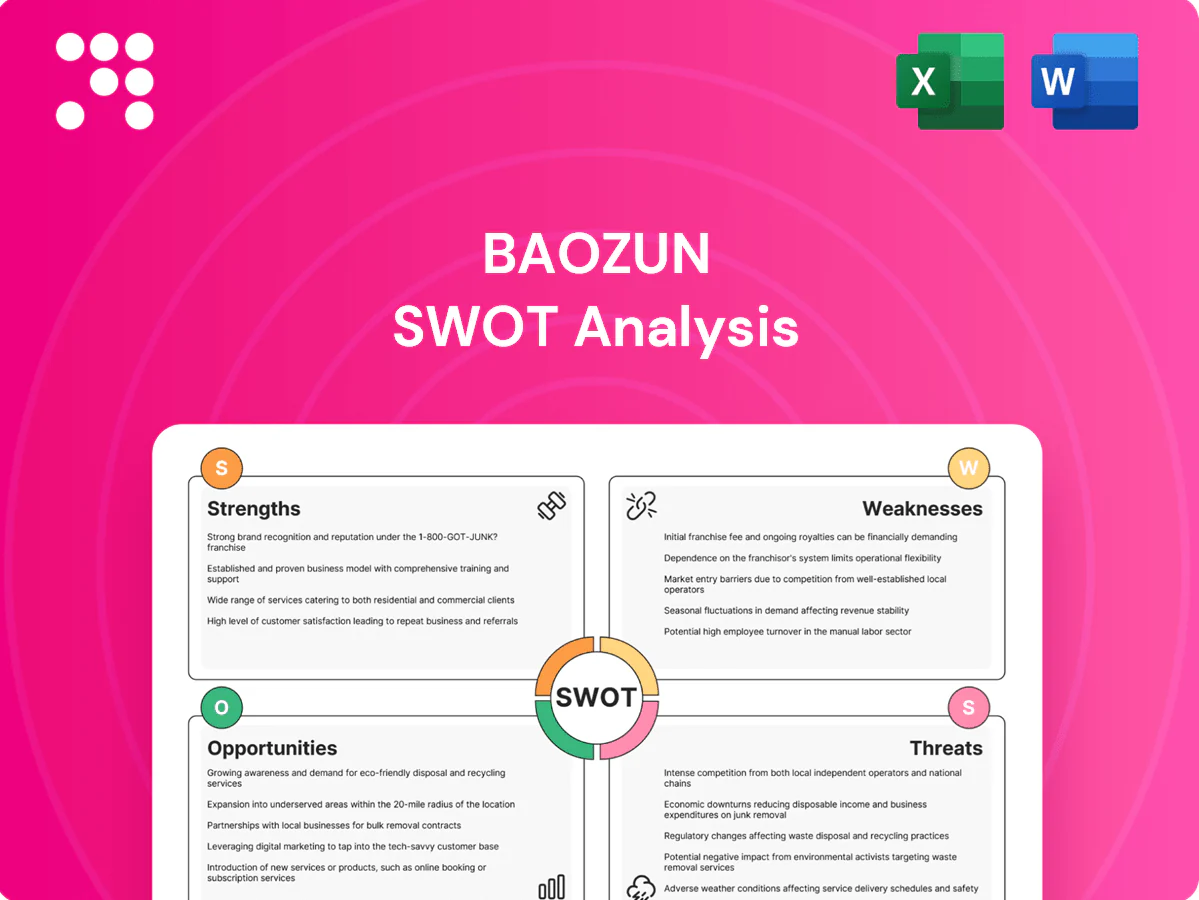
Baozun SWOT Analysis

Dive Deeper Into the Company’s Strategic Blueprint
Baozun’s strengths in e-commerce services and integrated digital solutions position it well against market volatility, while exposure to platform concentration and margin pressure are key risks. Want full strategic clarity? Purchase the complete SWOT analysis for a research-backed, editable report with actionable recommendations and Excel deliverables.
Strengths

End-to-end e-commerce solutions
Baozun's end-to-end e-commerce stack—integrated IT, store ops, marketing, CS and fulfillment—reduces vendor friction and accelerates time-to-market; a single accountable partner lowers coordination costs for global brands entering China. Full-stack capabilities preserve CX consistency and data continuity, a scale advantage underscored by serving 200+ global brands since its 2007 founding.
Deep China market expertise
Baozun’s localized operations, compliance know-how and fluency across Tmall, JD and WeChat drive higher conversion and faster ramp-up for brand partners. Deep understanding of festival cadence and regional nuances sharpens merchandising and campaign timing. Playbooks proven in China’s unique ecosystem shorten learning curves and mitigate market-entry risk. Founded 2007, Baozun is headquartered in Shanghai.

Omnichannel logistics and fulfillment
Owned and managed warehousing plus last-mile integration enable Baozun to meet sub-48-hour delivery SLAs in major Chinese cities, supporting rapid omni-channel fulfillment. Real-time inventory visibility and its OMS cut stockouts and returns, boosting order accuracy—Baozun reported improved fulfillment efficiency in 2024 operational updates. Logistics depth helps execute promotions and absorb peak demand, strengthening brand trust and repeat purchase rates.

Data-driven operations and tech stack
Proprietary IT tools unify traffic, transaction and CRM data to enable real-time decisioning across brand stores; analytics drive dynamic pricing, optimized media spend and targeted lifecycle marketing, while automation raises store efficiency and service consistency. Continuous data feedback loops compound performance across the brand portfolio, improving conversion and retention.
- Unified data: traffic + transactions + CRM
- Analytics: pricing, media ROI, lifecycle
- Automation: ops efficiency, service levels
- Feedback loops: cross-brand performance gains
Strong global brand relationships
Baozun’s multi-year engagements with 300+ global brands (2024) generate high switching costs and provide predictable pipeline visibility; category breadth across apparel, beauty and electronics smooths demand cyclicality and supports cross-category upsells. Case studies repeatedly win new logos and expand scopes, while scale drives media-buying leverage and faster best-practice transfers.
- 300+ brand partners (2024)
- Multi-year contracts => stronger pipeline
- Category diversification + media leverage
Omnichannel commerce: 300+ brands, sub-48h SLA
Baozun’s full-stack e-commerce platform and proprietary IT unify traffic, transactions and CRM to drive higher conversion and lifecycle value. Localized operations and multi-channel fluency (Tmall, JD, WeChat) plus owned logistics enable sub-48-hour SLAs and rapid ramp-up for global brands. Multi-year engagements with 300+ brand partners (2024) create high switching costs and media-buying leverage.
| Metric | Value |
|---|---|
| Brand partners (2024) | 300+ |
| Founded | 2007 |
| Fulfillment SLA | sub-48-hour (major cities) |
| Platform | Full-stack IT, OMS, CRM |
What is included in the product
 Detailed Word Document
Provides a strategic overview of Baozun’s internal capabilities and external market factors, outlining strengths, weaknesses, opportunities, and threats to its e-commerce enablement and digital services business.

 Customizable Excel Spreadsheet
Provides a concise Baozun SWOT matrix for fast, visual strategy alignment, helping teams quickly identify growth levers and mitigate e‑commerce risks.
Weaknesses

China-centric revenue concentration
Over 90% of Baozun’s revenue comes from mainland China (2023 annual report), leaving the company highly exposed to China’s consumer cycle and amplifying macro volatility. Policy or platform shifts on key partners can quickly disrupt sales funnels and margins. Limited geographic diversification — international sales under 10% in 2023 — constrains resilience and requires new capabilities and local partnerships to scale outside China.
Operationally intensive, low-margin model
Baozun’s labor-heavy store ops and fulfillment squeeze gross margins, with third-party e-commerce take rates in China typically capped in the low single digits (around 1–5%), limiting fee expansion. Peak-season staffing needs and volatile returns handling introduce margin variability quarter-to-quarter. Sustained margin improvement depends on automation investment and shifting service mix toward higher-margin offerings.

Client and category concentration risk
Dependence on a handful of anchor brands leaves Baozun exposed — its top five clients generated roughly 40% of revenue in 2023, so churn or insourcing by one client can sharply reduce utilization and margins. Contract losses or client-led insourcing compress fulfillment and service capacity, hurting near-term operating leverage. Volatility in fashion and beauty demand quickly ripples through sales volumes, and meaningful diversification requires multi-quarter investment in sales and channel development.

Platform dependency and policy exposure
Baozun’s heavy reliance on major marketplaces such as Tmall and JD—Alibaba’s ecosystem held roughly 56% of China’s e‑commerce market in 2023—exposes it to sudden rule, algorithm and fee changes that can shift traffic and costs overnight; preferential in‑house programs on these platforms can squeeze third‑party providers while platform owners retain control over key customer‑experience features.
- Marketplace concentration risk
- Algorithm/fee volatility
- Disadvantage versus in‑house services
- Limited control of platform CX
Capital and tech upgrade requirements
Continuous capex and opex for warehousing, OMS/WMS and AI upgrades strain Baozun during high-growth and transformation phases, and lagging improvements risk SLA misses and client attrition.
Customization demands on clients versus maintaining a scalable core increase operational complexity and can tighten cash flow in multi-quarter modernization cycles.
China-centric retail: >90% revenue, ≈40% top-5, platform & margin risk
Revenue concentration: >90% from mainland China in 2023; top 5 clients ≈40% of revenue; international sales <10%. Marketplace dependence: Alibaba/Tmall+JD ≈56% China e‑commerce share (2023) creates platform risk. Margin pressure from labor‑intensive store ops and ongoing capex/opex for warehousing, OMS/WMS and AI compress cash flow during transformation.
| Metric | 2023 |
|---|---|
| China revenue share | >90% |
| Top‑5 client share | ≈40% |
| Intl sales | <10% |
| Alibaba/Tmall+JD share | ≈56% |
Same Document Delivered
Baozun SWOT Analysis
This is the actual Baozun SWOT analysis document you’ll receive upon purchase—no surprises, just professional quality. The preview below is taken directly from the full report and reflects the same structured, actionable insights included in the downloadable file. Buy now to unlock the complete, editable version with in-depth strengths, weaknesses, opportunities, and threats.

Dive Deeper Into the Company’s Strategic Blueprint
Baozun’s strengths in e-commerce services and integrated digital solutions position it well against market volatility, while exposure to platform concentration and margin pressure are key risks. Want full strategic clarity? Purchase the complete SWOT analysis for a research-backed, editable report with actionable recommendations and Excel deliverables.
Strengths
End-to-end e-commerce solutions
Baozun's end-to-end e-commerce stack—integrated IT, store ops, marketing, CS and fulfillment—reduces vendor friction and accelerates time-to-market; a single accountable partner lowers coordination costs for global brands entering China. Full-stack capabilities preserve CX consistency and data continuity, a scale advantage underscored by serving 200+ global brands since its 2007 founding.
Deep China market expertise
Baozun’s localized operations, compliance know-how and fluency across Tmall, JD and WeChat drive higher conversion and faster ramp-up for brand partners. Deep understanding of festival cadence and regional nuances sharpens merchandising and campaign timing. Playbooks proven in China’s unique ecosystem shorten learning curves and mitigate market-entry risk. Founded 2007, Baozun is headquartered in Shanghai.
Omnichannel logistics and fulfillment
Owned and managed warehousing plus last-mile integration enable Baozun to meet sub-48-hour delivery SLAs in major Chinese cities, supporting rapid omni-channel fulfillment. Real-time inventory visibility and its OMS cut stockouts and returns, boosting order accuracy—Baozun reported improved fulfillment efficiency in 2024 operational updates. Logistics depth helps execute promotions and absorb peak demand, strengthening brand trust and repeat purchase rates.
Data-driven operations and tech stack
Proprietary IT tools unify traffic, transaction and CRM data to enable real-time decisioning across brand stores; analytics drive dynamic pricing, optimized media spend and targeted lifecycle marketing, while automation raises store efficiency and service consistency. Continuous data feedback loops compound performance across the brand portfolio, improving conversion and retention.
- Unified data: traffic + transactions + CRM
- Analytics: pricing, media ROI, lifecycle
- Automation: ops efficiency, service levels
- Feedback loops: cross-brand performance gains
Strong global brand relationships
Baozun’s multi-year engagements with 300+ global brands (2024) generate high switching costs and provide predictable pipeline visibility; category breadth across apparel, beauty and electronics smooths demand cyclicality and supports cross-category upsells. Case studies repeatedly win new logos and expand scopes, while scale drives media-buying leverage and faster best-practice transfers.
- 300+ brand partners (2024)
- Multi-year contracts => stronger pipeline
- Category diversification + media leverage
Omnichannel commerce: 300+ brands, sub-48h SLA
Baozun’s full-stack e-commerce platform and proprietary IT unify traffic, transactions and CRM to drive higher conversion and lifecycle value. Localized operations and multi-channel fluency (Tmall, JD, WeChat) plus owned logistics enable sub-48-hour SLAs and rapid ramp-up for global brands. Multi-year engagements with 300+ brand partners (2024) create high switching costs and media-buying leverage.
| Metric | Value |
|---|---|
| Brand partners (2024) | 300+ |
| Founded | 2007 |
| Fulfillment SLA | sub-48-hour (major cities) |
| Platform | Full-stack IT, OMS, CRM |
What is included in the product
Detailed Word Document
Provides a strategic overview of Baozun’s internal capabilities and external market factors, outlining strengths, weaknesses, opportunities, and threats to its e-commerce enablement and digital services business.
Customizable Excel Spreadsheet
Provides a concise Baozun SWOT matrix for fast, visual strategy alignment, helping teams quickly identify growth levers and mitigate e‑commerce risks.
Weaknesses
China-centric revenue concentration
Over 90% of Baozun’s revenue comes from mainland China (2023 annual report), leaving the company highly exposed to China’s consumer cycle and amplifying macro volatility. Policy or platform shifts on key partners can quickly disrupt sales funnels and margins. Limited geographic diversification — international sales under 10% in 2023 — constrains resilience and requires new capabilities and local partnerships to scale outside China.
Operationally intensive, low-margin model
Baozun’s labor-heavy store ops and fulfillment squeeze gross margins, with third-party e-commerce take rates in China typically capped in the low single digits (around 1–5%), limiting fee expansion. Peak-season staffing needs and volatile returns handling introduce margin variability quarter-to-quarter. Sustained margin improvement depends on automation investment and shifting service mix toward higher-margin offerings.
Client and category concentration risk
Dependence on a handful of anchor brands leaves Baozun exposed — its top five clients generated roughly 40% of revenue in 2023, so churn or insourcing by one client can sharply reduce utilization and margins. Contract losses or client-led insourcing compress fulfillment and service capacity, hurting near-term operating leverage. Volatility in fashion and beauty demand quickly ripples through sales volumes, and meaningful diversification requires multi-quarter investment in sales and channel development.
Platform dependency and policy exposure
Baozun’s heavy reliance on major marketplaces such as Tmall and JD—Alibaba’s ecosystem held roughly 56% of China’s e‑commerce market in 2023—exposes it to sudden rule, algorithm and fee changes that can shift traffic and costs overnight; preferential in‑house programs on these platforms can squeeze third‑party providers while platform owners retain control over key customer‑experience features.
- Marketplace concentration risk
- Algorithm/fee volatility
- Disadvantage versus in‑house services
- Limited control of platform CX
Capital and tech upgrade requirements
Continuous capex and opex for warehousing, OMS/WMS and AI upgrades strain Baozun during high-growth and transformation phases, and lagging improvements risk SLA misses and client attrition.
Customization demands on clients versus maintaining a scalable core increase operational complexity and can tighten cash flow in multi-quarter modernization cycles.
China-centric retail: >90% revenue, ≈40% top-5, platform & margin risk
Revenue concentration: >90% from mainland China in 2023; top 5 clients ≈40% of revenue; international sales <10%. Marketplace dependence: Alibaba/Tmall+JD ≈56% China e‑commerce share (2023) creates platform risk. Margin pressure from labor‑intensive store ops and ongoing capex/opex for warehousing, OMS/WMS and AI compress cash flow during transformation.
| Metric | 2023 |
|---|---|
| China revenue share | >90% |
| Top‑5 client share | ≈40% |
| Intl sales | <10% |
| Alibaba/Tmall+JD share | ≈56% |
Same Document Delivered
Baozun SWOT Analysis
This is the actual Baozun SWOT analysis document you’ll receive upon purchase—no surprises, just professional quality. The preview below is taken directly from the full report and reflects the same structured, actionable insights included in the downloadable file. Buy now to unlock the complete, editable version with in-depth strengths, weaknesses, opportunities, and threats.
Original: $10.00
-65%$10.00
$3.50Description
Dive Deeper Into the Company’s Strategic Blueprint
Baozun’s strengths in e-commerce services and integrated digital solutions position it well against market volatility, while exposure to platform concentration and margin pressure are key risks. Want full strategic clarity? Purchase the complete SWOT analysis for a research-backed, editable report with actionable recommendations and Excel deliverables.
Strengths
End-to-end e-commerce solutions
Baozun's end-to-end e-commerce stack—integrated IT, store ops, marketing, CS and fulfillment—reduces vendor friction and accelerates time-to-market; a single accountable partner lowers coordination costs for global brands entering China. Full-stack capabilities preserve CX consistency and data continuity, a scale advantage underscored by serving 200+ global brands since its 2007 founding.
Deep China market expertise
Baozun’s localized operations, compliance know-how and fluency across Tmall, JD and WeChat drive higher conversion and faster ramp-up for brand partners. Deep understanding of festival cadence and regional nuances sharpens merchandising and campaign timing. Playbooks proven in China’s unique ecosystem shorten learning curves and mitigate market-entry risk. Founded 2007, Baozun is headquartered in Shanghai.
Omnichannel logistics and fulfillment
Owned and managed warehousing plus last-mile integration enable Baozun to meet sub-48-hour delivery SLAs in major Chinese cities, supporting rapid omni-channel fulfillment. Real-time inventory visibility and its OMS cut stockouts and returns, boosting order accuracy—Baozun reported improved fulfillment efficiency in 2024 operational updates. Logistics depth helps execute promotions and absorb peak demand, strengthening brand trust and repeat purchase rates.
Data-driven operations and tech stack
Proprietary IT tools unify traffic, transaction and CRM data to enable real-time decisioning across brand stores; analytics drive dynamic pricing, optimized media spend and targeted lifecycle marketing, while automation raises store efficiency and service consistency. Continuous data feedback loops compound performance across the brand portfolio, improving conversion and retention.
- Unified data: traffic + transactions + CRM
- Analytics: pricing, media ROI, lifecycle
- Automation: ops efficiency, service levels
- Feedback loops: cross-brand performance gains
Strong global brand relationships
Baozun’s multi-year engagements with 300+ global brands (2024) generate high switching costs and provide predictable pipeline visibility; category breadth across apparel, beauty and electronics smooths demand cyclicality and supports cross-category upsells. Case studies repeatedly win new logos and expand scopes, while scale drives media-buying leverage and faster best-practice transfers.
- 300+ brand partners (2024)
- Multi-year contracts => stronger pipeline
- Category diversification + media leverage
Omnichannel commerce: 300+ brands, sub-48h SLA
Baozun’s full-stack e-commerce platform and proprietary IT unify traffic, transactions and CRM to drive higher conversion and lifecycle value. Localized operations and multi-channel fluency (Tmall, JD, WeChat) plus owned logistics enable sub-48-hour SLAs and rapid ramp-up for global brands. Multi-year engagements with 300+ brand partners (2024) create high switching costs and media-buying leverage.
| Metric | Value |
|---|---|
| Brand partners (2024) | 300+ |
| Founded | 2007 |
| Fulfillment SLA | sub-48-hour (major cities) |
| Platform | Full-stack IT, OMS, CRM |
What is included in the product
Detailed Word Document
Provides a strategic overview of Baozun’s internal capabilities and external market factors, outlining strengths, weaknesses, opportunities, and threats to its e-commerce enablement and digital services business.
Customizable Excel Spreadsheet
Provides a concise Baozun SWOT matrix for fast, visual strategy alignment, helping teams quickly identify growth levers and mitigate e‑commerce risks.
Weaknesses
China-centric revenue concentration
Over 90% of Baozun’s revenue comes from mainland China (2023 annual report), leaving the company highly exposed to China’s consumer cycle and amplifying macro volatility. Policy or platform shifts on key partners can quickly disrupt sales funnels and margins. Limited geographic diversification — international sales under 10% in 2023 — constrains resilience and requires new capabilities and local partnerships to scale outside China.
Operationally intensive, low-margin model
Baozun’s labor-heavy store ops and fulfillment squeeze gross margins, with third-party e-commerce take rates in China typically capped in the low single digits (around 1–5%), limiting fee expansion. Peak-season staffing needs and volatile returns handling introduce margin variability quarter-to-quarter. Sustained margin improvement depends on automation investment and shifting service mix toward higher-margin offerings.
Client and category concentration risk
Dependence on a handful of anchor brands leaves Baozun exposed — its top five clients generated roughly 40% of revenue in 2023, so churn or insourcing by one client can sharply reduce utilization and margins. Contract losses or client-led insourcing compress fulfillment and service capacity, hurting near-term operating leverage. Volatility in fashion and beauty demand quickly ripples through sales volumes, and meaningful diversification requires multi-quarter investment in sales and channel development.
Platform dependency and policy exposure
Baozun’s heavy reliance on major marketplaces such as Tmall and JD—Alibaba’s ecosystem held roughly 56% of China’s e‑commerce market in 2023—exposes it to sudden rule, algorithm and fee changes that can shift traffic and costs overnight; preferential in‑house programs on these platforms can squeeze third‑party providers while platform owners retain control over key customer‑experience features.
- Marketplace concentration risk
- Algorithm/fee volatility
- Disadvantage versus in‑house services
- Limited control of platform CX
Capital and tech upgrade requirements
Continuous capex and opex for warehousing, OMS/WMS and AI upgrades strain Baozun during high-growth and transformation phases, and lagging improvements risk SLA misses and client attrition.
Customization demands on clients versus maintaining a scalable core increase operational complexity and can tighten cash flow in multi-quarter modernization cycles.
China-centric retail: >90% revenue, ≈40% top-5, platform & margin risk
Revenue concentration: >90% from mainland China in 2023; top 5 clients ≈40% of revenue; international sales <10%. Marketplace dependence: Alibaba/Tmall+JD ≈56% China e‑commerce share (2023) creates platform risk. Margin pressure from labor‑intensive store ops and ongoing capex/opex for warehousing, OMS/WMS and AI compress cash flow during transformation.
| Metric | 2023 |
|---|---|
| China revenue share | >90% |
| Top‑5 client share | ≈40% |
| Intl sales | <10% |
| Alibaba/Tmall+JD share | ≈56% |
Same Document Delivered
Baozun SWOT Analysis
This is the actual Baozun SWOT analysis document you’ll receive upon purchase—no surprises, just professional quality. The preview below is taken directly from the full report and reflects the same structured, actionable insights included in the downloadable file. Buy now to unlock the complete, editable version with in-depth strengths, weaknesses, opportunities, and threats.











