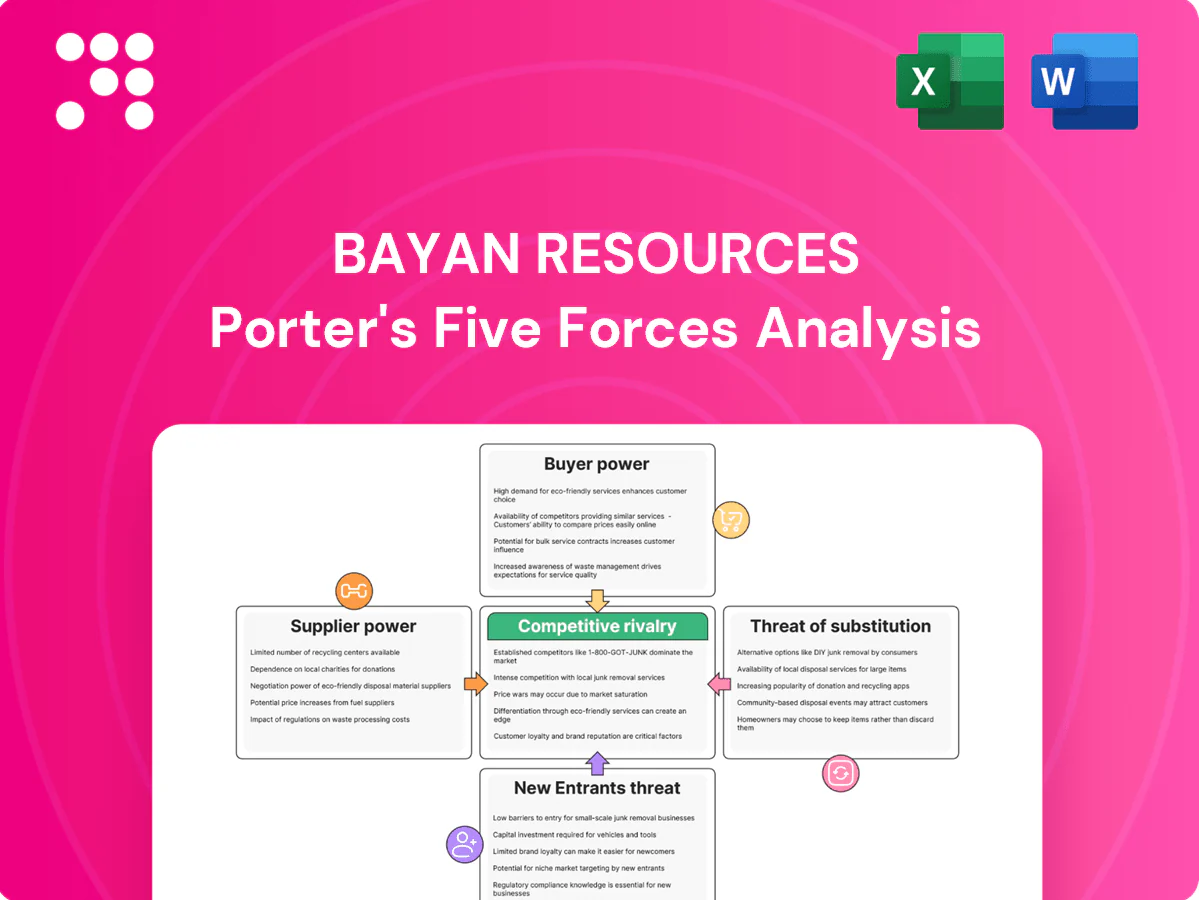
Bayan Resources Porter's Five Forces Analysis

From Overview to Strategy Blueprint
Bayan Resources faces intense commodity price pressure, concentrated buyer segments and regulatory scrutiny that shape margins and growth prospects; supplier and substitute threats vary with fuel-market shifts and ESG momentum. This brief snapshot highlights key tensions but only scratches the surface. Unlock the full Porter’s Five Forces Analysis for force-by-force ratings, visuals and actionable strategy to inform investment or strategic decisions.
Suppliers Bargaining Power

Integrated logistics lowers dependence
Bayan’s ownership of barging, transshipment and port assets lets the company handle the bulk of outbound flows, cutting reliance on third-party logistics and limiting exposure to market freight shocks. This internal control mitigated scheduling bottlenecks and helped contain freight-cost volatility during 2024, when Indonesia coal freight rates showed roughly 20–25% year-on-year swings. Logistics suppliers therefore hold limited leverage, while improved on-time delivery strengthens Bayan’s negotiating stance with buyers.
Critical inputs still concentrated
Explosives, diesel, heavy equipment and spare parts are sourced from a concentrated pool of OEMs and licensed distributors, creating supplier leverage over pricing and availability. Supply-chain disruptions or OEM price hikes in 2024—with long-lead components commonly taking 6–12 months—can compress margins. Proprietary parts and switching frictions raise operating risk, and although vendor diversification and ~3-month inventory buffers mitigate exposure, they do not eliminate it.

Contractor and labor dynamics
Mining contractors and skilled labor are pivotal for Bayan Resources’ overburden removal and daily operations, with contractor availability directly affecting strip ratios and unit costs. Tight regional contractor capacity has historically pushed rates and wages higher, increasing operating expense volatility. Multi-year frameworks and performance-based contracts help moderate cost swings and secure capacity. Community relations and compliance requirements further constrain sourcing and can delay mobilization.

Fuel price volatility passthrough
Diesel remains a sizable cost driver for Bayan Resources, closely tied to Brent crude (Brent averaged about 86 USD/b in 2024); contractual hedges and fuel surcharges can partially offset spikes, but rapid oil moves can outpace adjustments and grant fuel suppliers temporary pricing leverage; efficiency gains and electrification initiatives are expected to reduce exposure over time.
Regulatory and permit gatekeepers
Governmental bodies function as institutional suppliers of licenses, quotas and environmental permits, and their approval timelines directly constrain Bayan Resources’ operational flexibility and project schedules.
Compliance with evolving Indonesian mining and environmental regulations raises the effective supplier power when delays occur, as time costs and deferred revenue amplify regulatory leverage.
Bayan’s strong compliance record and documented ESG adherence reduce permit-related risk, smoothing renewals and lowering the probability of punitive restrictions.
- Regulatory suppliers: licenses, quotas, permits
- Constraint mechanism: approval timelines → time cost
- Mitigant: Bayan ESG/compliance track record
- Risk amplification: delays increase supplier power
Logistics ownership curbs freight power amid 20–25% coal volatility; diesel ~86 USD/b
Bayan’s logistics ownership and on-time delivery limit freight supplier power amid 2024 coal freight volatility of roughly 20–25% y/y. OEMs and long-lead parts (6–12 months) exert high pricing leverage despite ~3-month inventory buffers. Contractors have elevated power; multi-year contracts mitigate. Diesel exposure tied to Brent ~86 USD/b in 2024, hedges partly offsetting spikes.
| Supplier | Power | 2024 metric |
|---|---|---|
| Freight | Low | 20–25% y/y volatility |
| OEMs/parts | High | 6–12m lead, 3m inventory |
| Diesel | Medium | Brent ~86 USD/b |
What is included in the product
 Detailed Word Document
Tailored Porter’s Five Forces analysis for Bayan Resources that uncovers key competitive drivers, supplier and buyer power, threats from substitutes and new entrants, and strategic levers to protect market share and profitability.

 Customizable Excel Spreadsheet
A concise Porter’s Five Forces snapshot for Bayan Resources—clarifying competitive pressures and strategic levers for rapid boardroom decisions; customizable force levels and radar visualization simplify scenario analysis and deck-ready export.
Customers Bargaining Power

Large utilities dominate demand
Power generators in Indonesia, China and India are highly price-sensitive and sophisticated buyers; China and India together account for roughly 60% of global coal consumption in 2024, giving them outsized leverage. Their scale enables tough negotiations on price, specifications and delivery terms, while multi-year offtake contracts—common across ASEAN—lock in benchmarks and reduce spot exposure. Rigorous credit and counterparty risk screening remains pivotal for suppliers.
Benchmark-linked pricing
Benchmark-linked pricing—typically tied to Newcastle or HBA indices (2024 Newcastle ~USD100/t) with quality adjustments—gives buyers transparency that strengthens their bargaining power in downcycles. Bayan’s high-CV coal (≈6,200–6,600 kcal/kg GAR) with low ash (4–6%) and sulfur (<0.7%) earns quality differentials that cushion discounts, while freight parity and IDR/USD FX movements materially shape realized FOB and landed prices.

Moderate switching costs
Buyers can source coal from Indonesia (worlds largest thermal coal exporter in 2023), Australia, Russia and South Africa, keeping bargaining power elevated; however boiler design and tightening emission limits create specification-based stickiness. Consistent quality and on-time delivery from Bayan lower incentive to switch, while multi-year offtake relationships and performance history further dampen churn.

Logistics reliability valued
Bayan’s integrated logistics improves schedule adherence, aligning with buyer priority for timely delivery and lowering demurrage and port-congestion risk, which buyers quantify as material cost exposure. Service reliability supports premium pricing versus fragmented rivals and reduces buyer leverage over timing and penalty negotiation.
- Logistics reliability: higher schedule adherence
- Lower demurrage and congestion risk
- Supports premium pricing
- Reduces buyer timing/penalty leverage
ESG pressures influence procurement
- Net-zero pressure: >130 countries (2024)
- Disclosure demand: traceability & emissions data
- Benefit: access to premium markets/financing
- Risk: exclusion/pricing pressure amplifies buyer power
China+India ~60% demand; Newcastle USD100/t; high-CV cushions; net-zero >130
Large, price-sensitive buyers (China+India ~60% of coal demand in 2024) exert strong leverage; benchmark pricing (Newcastle ~USD100/t in 2024) and diverse origins keep bargaining power high. Bayan’s high-CV coal (≈6,200–6,600 kcal/kg GAR; ash 4–6%; S <0.7%) and reliable logistics mitigate discounts and switching risk. Net-zero pressures (>130 countries by 2024) raise disclosure-driven buyer leverage.
| Metric | 2024/2023 |
|---|---|
| China+India demand | ~60% |
| Newcastle price | ~USD100/t (2024) |
| Bayan CV | 6,200–6,600 kcal/kg GAR |
| Net-zero signatories | >130 countries (2024) |
Preview the Actual Deliverable
Bayan Resources Porter's Five Forces Analysis
This preview shows the exact Bayan Resources Porter's Five Forces Analysis you'll receive upon purchase—no placeholders or summaries. The file is fully formatted and ready to use immediately after payment. It contains the same comprehensive assessment of industry rivalry, supplier and buyer power, threats of entry and substitutes.

From Overview to Strategy Blueprint
Bayan Resources faces intense commodity price pressure, concentrated buyer segments and regulatory scrutiny that shape margins and growth prospects; supplier and substitute threats vary with fuel-market shifts and ESG momentum. This brief snapshot highlights key tensions but only scratches the surface. Unlock the full Porter’s Five Forces Analysis for force-by-force ratings, visuals and actionable strategy to inform investment or strategic decisions.
Suppliers Bargaining Power
Integrated logistics lowers dependence
Bayan’s ownership of barging, transshipment and port assets lets the company handle the bulk of outbound flows, cutting reliance on third-party logistics and limiting exposure to market freight shocks. This internal control mitigated scheduling bottlenecks and helped contain freight-cost volatility during 2024, when Indonesia coal freight rates showed roughly 20–25% year-on-year swings. Logistics suppliers therefore hold limited leverage, while improved on-time delivery strengthens Bayan’s negotiating stance with buyers.
Critical inputs still concentrated
Explosives, diesel, heavy equipment and spare parts are sourced from a concentrated pool of OEMs and licensed distributors, creating supplier leverage over pricing and availability. Supply-chain disruptions or OEM price hikes in 2024—with long-lead components commonly taking 6–12 months—can compress margins. Proprietary parts and switching frictions raise operating risk, and although vendor diversification and ~3-month inventory buffers mitigate exposure, they do not eliminate it.
Contractor and labor dynamics
Mining contractors and skilled labor are pivotal for Bayan Resources’ overburden removal and daily operations, with contractor availability directly affecting strip ratios and unit costs. Tight regional contractor capacity has historically pushed rates and wages higher, increasing operating expense volatility. Multi-year frameworks and performance-based contracts help moderate cost swings and secure capacity. Community relations and compliance requirements further constrain sourcing and can delay mobilization.
Fuel price volatility passthrough
Diesel remains a sizable cost driver for Bayan Resources, closely tied to Brent crude (Brent averaged about 86 USD/b in 2024); contractual hedges and fuel surcharges can partially offset spikes, but rapid oil moves can outpace adjustments and grant fuel suppliers temporary pricing leverage; efficiency gains and electrification initiatives are expected to reduce exposure over time.
Regulatory and permit gatekeepers
Governmental bodies function as institutional suppliers of licenses, quotas and environmental permits, and their approval timelines directly constrain Bayan Resources’ operational flexibility and project schedules.
Compliance with evolving Indonesian mining and environmental regulations raises the effective supplier power when delays occur, as time costs and deferred revenue amplify regulatory leverage.
Bayan’s strong compliance record and documented ESG adherence reduce permit-related risk, smoothing renewals and lowering the probability of punitive restrictions.
- Regulatory suppliers: licenses, quotas, permits
- Constraint mechanism: approval timelines → time cost
- Mitigant: Bayan ESG/compliance track record
- Risk amplification: delays increase supplier power
Logistics ownership curbs freight power amid 20–25% coal volatility; diesel ~86 USD/b
Bayan’s logistics ownership and on-time delivery limit freight supplier power amid 2024 coal freight volatility of roughly 20–25% y/y. OEMs and long-lead parts (6–12 months) exert high pricing leverage despite ~3-month inventory buffers. Contractors have elevated power; multi-year contracts mitigate. Diesel exposure tied to Brent ~86 USD/b in 2024, hedges partly offsetting spikes.
| Supplier | Power | 2024 metric |
|---|---|---|
| Freight | Low | 20–25% y/y volatility |
| OEMs/parts | High | 6–12m lead, 3m inventory |
| Diesel | Medium | Brent ~86 USD/b |
What is included in the product
Detailed Word Document
Tailored Porter’s Five Forces analysis for Bayan Resources that uncovers key competitive drivers, supplier and buyer power, threats from substitutes and new entrants, and strategic levers to protect market share and profitability.
Customizable Excel Spreadsheet
A concise Porter’s Five Forces snapshot for Bayan Resources—clarifying competitive pressures and strategic levers for rapid boardroom decisions; customizable force levels and radar visualization simplify scenario analysis and deck-ready export.
Customers Bargaining Power
Large utilities dominate demand
Power generators in Indonesia, China and India are highly price-sensitive and sophisticated buyers; China and India together account for roughly 60% of global coal consumption in 2024, giving them outsized leverage. Their scale enables tough negotiations on price, specifications and delivery terms, while multi-year offtake contracts—common across ASEAN—lock in benchmarks and reduce spot exposure. Rigorous credit and counterparty risk screening remains pivotal for suppliers.
Benchmark-linked pricing
Benchmark-linked pricing—typically tied to Newcastle or HBA indices (2024 Newcastle ~USD100/t) with quality adjustments—gives buyers transparency that strengthens their bargaining power in downcycles. Bayan’s high-CV coal (≈6,200–6,600 kcal/kg GAR) with low ash (4–6%) and sulfur (<0.7%) earns quality differentials that cushion discounts, while freight parity and IDR/USD FX movements materially shape realized FOB and landed prices.
Moderate switching costs
Buyers can source coal from Indonesia (worlds largest thermal coal exporter in 2023), Australia, Russia and South Africa, keeping bargaining power elevated; however boiler design and tightening emission limits create specification-based stickiness. Consistent quality and on-time delivery from Bayan lower incentive to switch, while multi-year offtake relationships and performance history further dampen churn.
Logistics reliability valued
Bayan’s integrated logistics improves schedule adherence, aligning with buyer priority for timely delivery and lowering demurrage and port-congestion risk, which buyers quantify as material cost exposure. Service reliability supports premium pricing versus fragmented rivals and reduces buyer leverage over timing and penalty negotiation.
- Logistics reliability: higher schedule adherence
- Lower demurrage and congestion risk
- Supports premium pricing
- Reduces buyer timing/penalty leverage
ESG pressures influence procurement
- Net-zero pressure: >130 countries (2024)
- Disclosure demand: traceability & emissions data
- Benefit: access to premium markets/financing
- Risk: exclusion/pricing pressure amplifies buyer power
China+India ~60% demand; Newcastle USD100/t; high-CV cushions; net-zero >130
Large, price-sensitive buyers (China+India ~60% of coal demand in 2024) exert strong leverage; benchmark pricing (Newcastle ~USD100/t in 2024) and diverse origins keep bargaining power high. Bayan’s high-CV coal (≈6,200–6,600 kcal/kg GAR; ash 4–6%; S <0.7%) and reliable logistics mitigate discounts and switching risk. Net-zero pressures (>130 countries by 2024) raise disclosure-driven buyer leverage.
| Metric | 2024/2023 |
|---|---|
| China+India demand | ~60% |
| Newcastle price | ~USD100/t (2024) |
| Bayan CV | 6,200–6,600 kcal/kg GAR |
| Net-zero signatories | >130 countries (2024) |
Preview the Actual Deliverable
Bayan Resources Porter's Five Forces Analysis
This preview shows the exact Bayan Resources Porter's Five Forces Analysis you'll receive upon purchase—no placeholders or summaries. The file is fully formatted and ready to use immediately after payment. It contains the same comprehensive assessment of industry rivalry, supplier and buyer power, threats of entry and substitutes.
Description
From Overview to Strategy Blueprint
Bayan Resources faces intense commodity price pressure, concentrated buyer segments and regulatory scrutiny that shape margins and growth prospects; supplier and substitute threats vary with fuel-market shifts and ESG momentum. This brief snapshot highlights key tensions but only scratches the surface. Unlock the full Porter’s Five Forces Analysis for force-by-force ratings, visuals and actionable strategy to inform investment or strategic decisions.
Suppliers Bargaining Power
Integrated logistics lowers dependence
Bayan’s ownership of barging, transshipment and port assets lets the company handle the bulk of outbound flows, cutting reliance on third-party logistics and limiting exposure to market freight shocks. This internal control mitigated scheduling bottlenecks and helped contain freight-cost volatility during 2024, when Indonesia coal freight rates showed roughly 20–25% year-on-year swings. Logistics suppliers therefore hold limited leverage, while improved on-time delivery strengthens Bayan’s negotiating stance with buyers.
Critical inputs still concentrated
Explosives, diesel, heavy equipment and spare parts are sourced from a concentrated pool of OEMs and licensed distributors, creating supplier leverage over pricing and availability. Supply-chain disruptions or OEM price hikes in 2024—with long-lead components commonly taking 6–12 months—can compress margins. Proprietary parts and switching frictions raise operating risk, and although vendor diversification and ~3-month inventory buffers mitigate exposure, they do not eliminate it.
Contractor and labor dynamics
Mining contractors and skilled labor are pivotal for Bayan Resources’ overburden removal and daily operations, with contractor availability directly affecting strip ratios and unit costs. Tight regional contractor capacity has historically pushed rates and wages higher, increasing operating expense volatility. Multi-year frameworks and performance-based contracts help moderate cost swings and secure capacity. Community relations and compliance requirements further constrain sourcing and can delay mobilization.
Fuel price volatility passthrough
Diesel remains a sizable cost driver for Bayan Resources, closely tied to Brent crude (Brent averaged about 86 USD/b in 2024); contractual hedges and fuel surcharges can partially offset spikes, but rapid oil moves can outpace adjustments and grant fuel suppliers temporary pricing leverage; efficiency gains and electrification initiatives are expected to reduce exposure over time.
Regulatory and permit gatekeepers
Governmental bodies function as institutional suppliers of licenses, quotas and environmental permits, and their approval timelines directly constrain Bayan Resources’ operational flexibility and project schedules.
Compliance with evolving Indonesian mining and environmental regulations raises the effective supplier power when delays occur, as time costs and deferred revenue amplify regulatory leverage.
Bayan’s strong compliance record and documented ESG adherence reduce permit-related risk, smoothing renewals and lowering the probability of punitive restrictions.
- Regulatory suppliers: licenses, quotas, permits
- Constraint mechanism: approval timelines → time cost
- Mitigant: Bayan ESG/compliance track record
- Risk amplification: delays increase supplier power
Logistics ownership curbs freight power amid 20–25% coal volatility; diesel ~86 USD/b
Bayan’s logistics ownership and on-time delivery limit freight supplier power amid 2024 coal freight volatility of roughly 20–25% y/y. OEMs and long-lead parts (6–12 months) exert high pricing leverage despite ~3-month inventory buffers. Contractors have elevated power; multi-year contracts mitigate. Diesel exposure tied to Brent ~86 USD/b in 2024, hedges partly offsetting spikes.
| Supplier | Power | 2024 metric |
|---|---|---|
| Freight | Low | 20–25% y/y volatility |
| OEMs/parts | High | 6–12m lead, 3m inventory |
| Diesel | Medium | Brent ~86 USD/b |
What is included in the product
Detailed Word Document
Tailored Porter’s Five Forces analysis for Bayan Resources that uncovers key competitive drivers, supplier and buyer power, threats from substitutes and new entrants, and strategic levers to protect market share and profitability.
Customizable Excel Spreadsheet
A concise Porter’s Five Forces snapshot for Bayan Resources—clarifying competitive pressures and strategic levers for rapid boardroom decisions; customizable force levels and radar visualization simplify scenario analysis and deck-ready export.
Customers Bargaining Power
Large utilities dominate demand
Power generators in Indonesia, China and India are highly price-sensitive and sophisticated buyers; China and India together account for roughly 60% of global coal consumption in 2024, giving them outsized leverage. Their scale enables tough negotiations on price, specifications and delivery terms, while multi-year offtake contracts—common across ASEAN—lock in benchmarks and reduce spot exposure. Rigorous credit and counterparty risk screening remains pivotal for suppliers.
Benchmark-linked pricing
Benchmark-linked pricing—typically tied to Newcastle or HBA indices (2024 Newcastle ~USD100/t) with quality adjustments—gives buyers transparency that strengthens their bargaining power in downcycles. Bayan’s high-CV coal (≈6,200–6,600 kcal/kg GAR) with low ash (4–6%) and sulfur (<0.7%) earns quality differentials that cushion discounts, while freight parity and IDR/USD FX movements materially shape realized FOB and landed prices.
Moderate switching costs
Buyers can source coal from Indonesia (worlds largest thermal coal exporter in 2023), Australia, Russia and South Africa, keeping bargaining power elevated; however boiler design and tightening emission limits create specification-based stickiness. Consistent quality and on-time delivery from Bayan lower incentive to switch, while multi-year offtake relationships and performance history further dampen churn.
Logistics reliability valued
Bayan’s integrated logistics improves schedule adherence, aligning with buyer priority for timely delivery and lowering demurrage and port-congestion risk, which buyers quantify as material cost exposure. Service reliability supports premium pricing versus fragmented rivals and reduces buyer leverage over timing and penalty negotiation.
- Logistics reliability: higher schedule adherence
- Lower demurrage and congestion risk
- Supports premium pricing
- Reduces buyer timing/penalty leverage
ESG pressures influence procurement
- Net-zero pressure: >130 countries (2024)
- Disclosure demand: traceability & emissions data
- Benefit: access to premium markets/financing
- Risk: exclusion/pricing pressure amplifies buyer power
China+India ~60% demand; Newcastle USD100/t; high-CV cushions; net-zero >130
Large, price-sensitive buyers (China+India ~60% of coal demand in 2024) exert strong leverage; benchmark pricing (Newcastle ~USD100/t in 2024) and diverse origins keep bargaining power high. Bayan’s high-CV coal (≈6,200–6,600 kcal/kg GAR; ash 4–6%; S <0.7%) and reliable logistics mitigate discounts and switching risk. Net-zero pressures (>130 countries by 2024) raise disclosure-driven buyer leverage.
| Metric | 2024/2023 |
|---|---|
| China+India demand | ~60% |
| Newcastle price | ~USD100/t (2024) |
| Bayan CV | 6,200–6,600 kcal/kg GAR |
| Net-zero signatories | >130 countries (2024) |
Preview the Actual Deliverable
Bayan Resources Porter's Five Forces Analysis
This preview shows the exact Bayan Resources Porter's Five Forces Analysis you'll receive upon purchase—no placeholders or summaries. The file is fully formatted and ready to use immediately after payment. It contains the same comprehensive assessment of industry rivalry, supplier and buyer power, threats of entry and substitutes.











