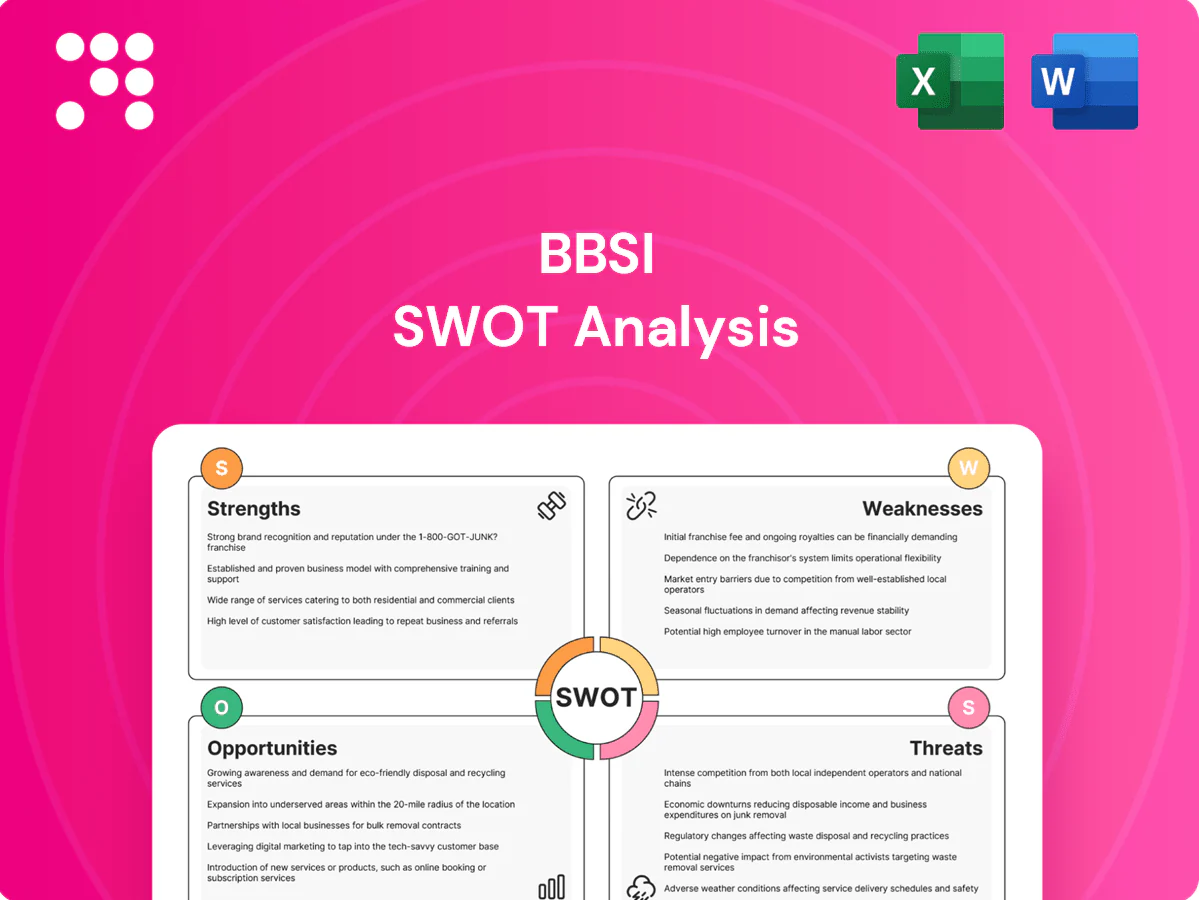
BBSI SWOT Analysis

Your Strategic Toolkit Starts Here
BBSI SWOT Analysis highlights the company’s operational strengths, client-concentration risks, market opportunities in SMB services, and regulatory or competitive threats. This concise preview points to strategic levers and financial implications you need to evaluate. Ideal for investors, advisors, and managers seeking clarity. Purchase the full, editable SWOT (Word + Excel) for in-depth, research-backed recommendations.
Strengths

Comprehensive service suite
BBSI’s end-to-end offerings—payroll, HR, risk mitigation and workers’ comp administration—simplify vendor management for the 99.9% of U.S. firms classified as small businesses (SBA). This breadth increases client stickiness and creates multiple entry points for new relationships. Cross-functional data from integrated services improves advisory quality and measurable outcomes for clients.
SMB-focused operating model
BBSI tailors HR, payroll and compliance processes specifically for small and mid-sized businesses, delivering a consultative model that fills gaps for owners without in-house HR expertise. Pricing and service tiers are calibrated to SMB budgets, improving accessibility and perceived value. This focused go-to-market boosts win rates and supports higher client retention in its core segment.

Risk and workers’ comp expertise
BBSI combines deep safety-program and claims-management expertise that has helped client cohorts reduce loss frequency by as much as 25% and severity materially, translating into potential workers’ comp premium savings commonly in the 8–12% range. This risk-control focus supports margin stability for BBSI, which reported roughly $1.09 billion in revenue in FY2024, by lowering claim volatility and expense. Strong, verifiable credibility in workers’ comp differentiates BBSI from pure-payroll competitors and reinforces client retention.

High-touch local delivery
Branch-based teams provide on-the-ground support and deepen client relationships, with BBSI operating roughly 170 local offices as of 2024, boosting responsiveness on sensitive HR and compliance matters. Proximity shortens issue resolution time and local insight lets teams tailor solutions to industry and regional norms, strengthening referrals and cross-sell.
- Local offices: ~170 (2024)
- Higher responsiveness: faster resolution of HR/compliance
- Tailored solutions: industry/regional fit
- Stronger referrals & cross-sell
Cross-sell and recurring revenue
Payroll anchors recurring relationships at BBSI, with payroll-led client engagement enabling add-on HR, benefits and risk services; BBSI reported roughly $1.13 billion in revenue in fiscal 2024, underscoring scale. Bundled offerings raise ARPU and reduce churn, while integrated data flows across modules increase switching costs. Recurring payroll fees support predictable cash flows and planning.
- Payroll-first customer stickiness
- Higher ARPU via bundling
- Lower churn from integrated services
- Predictable recurring cash flow
Payroll-led HR and risk services raise SMB retention; FY2024 $1.09B
BBSI’s integrated payroll, HR and risk services drive high stickiness for SMBs, with FY2024 revenue ~$1.09B and ~170 local offices (2024). Targeted safety programs cut loss frequency up to 25% and deliver typical workers’ comp premium savings of 8–12%, supporting margin stability. Payroll-led recurring fees raise ARPU, lower churn and enable cross-sell.
| Metric | Value |
|---|---|
| FY2024 revenue | $1.09B |
| Local offices (2024) | ~170 |
| Loss frequency reduction | up to 25% |
| Comp premium savings | 8–12% |
What is included in the product
 Detailed Word Document
Provides a concise SWOT analysis highlighting BBSI’s internal capabilities, operational gaps, market opportunities, and external threats to inform strategic decision-making.

 Customizable Excel Spreadsheet
Provides a focused SWOT overview that quickly identifies BBSI's strengths, weaknesses, opportunities, and threats to speed strategic response and reduce analysis bottlenecks for executives and teams.
Weaknesses

Exposure to claims volatility
Workers’ comp results can swing materially with claim frequency and medical severity, and adverse development has in prior periods pressured margins and increased capital needs for BBSI. Hedging programs and disciplined underwriting reduce exposure but cannot eliminate tail risk from large or late-developing claims. Market participants often apply a risk discount to BBSI’s valuation reflecting this volatility and reserve uncertainty.
Regulatory complexity
Regulatory complexity burdens BBSI (NASDAQ: BBSI) as multi-state labor, tax and insurance rules raise compliance overhead, with the company’s FY2024 revenue near $500 million highlighting scale-sensitive exposure. Rapid policy shifts force swift process or pricing changes that squeeze margins. Maintaining compliance systems and specialized staff is costly. Errors can trigger regulatory fines and reputational damage that harm client retention.

Cyclicality with SMB health
Revenue is directly tied to payroll volumes and headcount, so BBSI typically sees softer top-line performance in downturns as SMB employment contracts. SMBs are especially sensitive to credit and demand shocks—small firms account for roughly 47% of US private-sector employment (SBA), amplifying macro effects. Elevated churn and longer sales cycles commonly emerge during recessions as owners cut costs and delay decisions.

Technology depth vs larger peers
BBSI's technology depth trails larger peers that invest heavily in automation and UX, leaving feature gaps and slower integrations compared with top-tier HR SaaS providers. Reliance on higher-touch service raises unit costs when tech leverage is limited, and perceived lack of tech parity can weaken competitive bids for mid-to-large enterprise contracts. This dynamic pressures margin expansion and client acquisition.
Collateral and capital intensity
Insurance programs can require sizable collateral and reserves, and rising loss costs or tighter carrier terms can further strain liquidity, reducing available cash for operations. Capital tied up in claims or collateral reduces flexibility to fund organic growth or acquisitions, constraining ability to pursue aggressive expansion. This intensity elevates financial risk during adverse underwriting cycles.
- Collateral-heavy insurance programs
- Higher loss costs tighten liquidity
- Capital tied to risk limits growth flexibility
- Constrains aggressive expansion
Workers comp tail risk and state compliance squeeze margins; revenue ~$500M
BBSI faces volatile workers' comp results with tail-risk claims that have pressured margins and increased capital needs. Regulatory complexity across states elevates compliance costs as FY2024 revenue was ~$500M. Revenue tied to payroll/headcount makes BBSI cyclically sensitive; SMBs account for ~47% of US private employment. Limited tech depth raises unit costs versus SaaS leaders, hindering larger deals.
| Metric | Value |
|---|---|
| FY2024 revenue | ~$500M |
| SMB share of US private employment | ~47% (SBA) |
| Key risk | Workers' comp reserve volatility |
Full Version Awaits
BBSI SWOT Analysis
This is the actual BBSI SWOT analysis document you’ll receive upon purchase—no surprises, just professional quality. The preview below is taken directly from the full report; buying unlocks the complete, editable version with in-depth findings and strategic recommendations. Use it as-is or adapt it for presentations.

Your Strategic Toolkit Starts Here
BBSI SWOT Analysis highlights the company’s operational strengths, client-concentration risks, market opportunities in SMB services, and regulatory or competitive threats. This concise preview points to strategic levers and financial implications you need to evaluate. Ideal for investors, advisors, and managers seeking clarity. Purchase the full, editable SWOT (Word + Excel) for in-depth, research-backed recommendations.
Strengths
Comprehensive service suite
BBSI’s end-to-end offerings—payroll, HR, risk mitigation and workers’ comp administration—simplify vendor management for the 99.9% of U.S. firms classified as small businesses (SBA). This breadth increases client stickiness and creates multiple entry points for new relationships. Cross-functional data from integrated services improves advisory quality and measurable outcomes for clients.
SMB-focused operating model
BBSI tailors HR, payroll and compliance processes specifically for small and mid-sized businesses, delivering a consultative model that fills gaps for owners without in-house HR expertise. Pricing and service tiers are calibrated to SMB budgets, improving accessibility and perceived value. This focused go-to-market boosts win rates and supports higher client retention in its core segment.
Risk and workers’ comp expertise
BBSI combines deep safety-program and claims-management expertise that has helped client cohorts reduce loss frequency by as much as 25% and severity materially, translating into potential workers’ comp premium savings commonly in the 8–12% range. This risk-control focus supports margin stability for BBSI, which reported roughly $1.09 billion in revenue in FY2024, by lowering claim volatility and expense. Strong, verifiable credibility in workers’ comp differentiates BBSI from pure-payroll competitors and reinforces client retention.
High-touch local delivery
Branch-based teams provide on-the-ground support and deepen client relationships, with BBSI operating roughly 170 local offices as of 2024, boosting responsiveness on sensitive HR and compliance matters. Proximity shortens issue resolution time and local insight lets teams tailor solutions to industry and regional norms, strengthening referrals and cross-sell.
- Local offices: ~170 (2024)
- Higher responsiveness: faster resolution of HR/compliance
- Tailored solutions: industry/regional fit
- Stronger referrals & cross-sell
Cross-sell and recurring revenue
Payroll anchors recurring relationships at BBSI, with payroll-led client engagement enabling add-on HR, benefits and risk services; BBSI reported roughly $1.13 billion in revenue in fiscal 2024, underscoring scale. Bundled offerings raise ARPU and reduce churn, while integrated data flows across modules increase switching costs. Recurring payroll fees support predictable cash flows and planning.
- Payroll-first customer stickiness
- Higher ARPU via bundling
- Lower churn from integrated services
- Predictable recurring cash flow
Payroll-led HR and risk services raise SMB retention; FY2024 $1.09B
BBSI’s integrated payroll, HR and risk services drive high stickiness for SMBs, with FY2024 revenue ~$1.09B and ~170 local offices (2024). Targeted safety programs cut loss frequency up to 25% and deliver typical workers’ comp premium savings of 8–12%, supporting margin stability. Payroll-led recurring fees raise ARPU, lower churn and enable cross-sell.
| Metric | Value |
|---|---|
| FY2024 revenue | $1.09B |
| Local offices (2024) | ~170 |
| Loss frequency reduction | up to 25% |
| Comp premium savings | 8–12% |
What is included in the product
Detailed Word Document
Provides a concise SWOT analysis highlighting BBSI’s internal capabilities, operational gaps, market opportunities, and external threats to inform strategic decision-making.
Customizable Excel Spreadsheet
Provides a focused SWOT overview that quickly identifies BBSI's strengths, weaknesses, opportunities, and threats to speed strategic response and reduce analysis bottlenecks for executives and teams.
Weaknesses
Exposure to claims volatility
Workers’ comp results can swing materially with claim frequency and medical severity, and adverse development has in prior periods pressured margins and increased capital needs for BBSI. Hedging programs and disciplined underwriting reduce exposure but cannot eliminate tail risk from large or late-developing claims. Market participants often apply a risk discount to BBSI’s valuation reflecting this volatility and reserve uncertainty.
Regulatory complexity
Regulatory complexity burdens BBSI (NASDAQ: BBSI) as multi-state labor, tax and insurance rules raise compliance overhead, with the company’s FY2024 revenue near $500 million highlighting scale-sensitive exposure. Rapid policy shifts force swift process or pricing changes that squeeze margins. Maintaining compliance systems and specialized staff is costly. Errors can trigger regulatory fines and reputational damage that harm client retention.
Cyclicality with SMB health
Revenue is directly tied to payroll volumes and headcount, so BBSI typically sees softer top-line performance in downturns as SMB employment contracts. SMBs are especially sensitive to credit and demand shocks—small firms account for roughly 47% of US private-sector employment (SBA), amplifying macro effects. Elevated churn and longer sales cycles commonly emerge during recessions as owners cut costs and delay decisions.
Technology depth vs larger peers
BBSI's technology depth trails larger peers that invest heavily in automation and UX, leaving feature gaps and slower integrations compared with top-tier HR SaaS providers. Reliance on higher-touch service raises unit costs when tech leverage is limited, and perceived lack of tech parity can weaken competitive bids for mid-to-large enterprise contracts. This dynamic pressures margin expansion and client acquisition.
Collateral and capital intensity
Insurance programs can require sizable collateral and reserves, and rising loss costs or tighter carrier terms can further strain liquidity, reducing available cash for operations. Capital tied up in claims or collateral reduces flexibility to fund organic growth or acquisitions, constraining ability to pursue aggressive expansion. This intensity elevates financial risk during adverse underwriting cycles.
- Collateral-heavy insurance programs
- Higher loss costs tighten liquidity
- Capital tied to risk limits growth flexibility
- Constrains aggressive expansion
Workers comp tail risk and state compliance squeeze margins; revenue ~$500M
BBSI faces volatile workers' comp results with tail-risk claims that have pressured margins and increased capital needs. Regulatory complexity across states elevates compliance costs as FY2024 revenue was ~$500M. Revenue tied to payroll/headcount makes BBSI cyclically sensitive; SMBs account for ~47% of US private employment. Limited tech depth raises unit costs versus SaaS leaders, hindering larger deals.
| Metric | Value |
|---|---|
| FY2024 revenue | ~$500M |
| SMB share of US private employment | ~47% (SBA) |
| Key risk | Workers' comp reserve volatility |
Full Version Awaits
BBSI SWOT Analysis
This is the actual BBSI SWOT analysis document you’ll receive upon purchase—no surprises, just professional quality. The preview below is taken directly from the full report; buying unlocks the complete, editable version with in-depth findings and strategic recommendations. Use it as-is or adapt it for presentations.
Original: $10.00
-65%$10.00
$3.50Description
Your Strategic Toolkit Starts Here
BBSI SWOT Analysis highlights the company’s operational strengths, client-concentration risks, market opportunities in SMB services, and regulatory or competitive threats. This concise preview points to strategic levers and financial implications you need to evaluate. Ideal for investors, advisors, and managers seeking clarity. Purchase the full, editable SWOT (Word + Excel) for in-depth, research-backed recommendations.
Strengths
Comprehensive service suite
BBSI’s end-to-end offerings—payroll, HR, risk mitigation and workers’ comp administration—simplify vendor management for the 99.9% of U.S. firms classified as small businesses (SBA). This breadth increases client stickiness and creates multiple entry points for new relationships. Cross-functional data from integrated services improves advisory quality and measurable outcomes for clients.
SMB-focused operating model
BBSI tailors HR, payroll and compliance processes specifically for small and mid-sized businesses, delivering a consultative model that fills gaps for owners without in-house HR expertise. Pricing and service tiers are calibrated to SMB budgets, improving accessibility and perceived value. This focused go-to-market boosts win rates and supports higher client retention in its core segment.
Risk and workers’ comp expertise
BBSI combines deep safety-program and claims-management expertise that has helped client cohorts reduce loss frequency by as much as 25% and severity materially, translating into potential workers’ comp premium savings commonly in the 8–12% range. This risk-control focus supports margin stability for BBSI, which reported roughly $1.09 billion in revenue in FY2024, by lowering claim volatility and expense. Strong, verifiable credibility in workers’ comp differentiates BBSI from pure-payroll competitors and reinforces client retention.
High-touch local delivery
Branch-based teams provide on-the-ground support and deepen client relationships, with BBSI operating roughly 170 local offices as of 2024, boosting responsiveness on sensitive HR and compliance matters. Proximity shortens issue resolution time and local insight lets teams tailor solutions to industry and regional norms, strengthening referrals and cross-sell.
- Local offices: ~170 (2024)
- Higher responsiveness: faster resolution of HR/compliance
- Tailored solutions: industry/regional fit
- Stronger referrals & cross-sell
Cross-sell and recurring revenue
Payroll anchors recurring relationships at BBSI, with payroll-led client engagement enabling add-on HR, benefits and risk services; BBSI reported roughly $1.13 billion in revenue in fiscal 2024, underscoring scale. Bundled offerings raise ARPU and reduce churn, while integrated data flows across modules increase switching costs. Recurring payroll fees support predictable cash flows and planning.
- Payroll-first customer stickiness
- Higher ARPU via bundling
- Lower churn from integrated services
- Predictable recurring cash flow
Payroll-led HR and risk services raise SMB retention; FY2024 $1.09B
BBSI’s integrated payroll, HR and risk services drive high stickiness for SMBs, with FY2024 revenue ~$1.09B and ~170 local offices (2024). Targeted safety programs cut loss frequency up to 25% and deliver typical workers’ comp premium savings of 8–12%, supporting margin stability. Payroll-led recurring fees raise ARPU, lower churn and enable cross-sell.
| Metric | Value |
|---|---|
| FY2024 revenue | $1.09B |
| Local offices (2024) | ~170 |
| Loss frequency reduction | up to 25% |
| Comp premium savings | 8–12% |
What is included in the product
Detailed Word Document
Provides a concise SWOT analysis highlighting BBSI’s internal capabilities, operational gaps, market opportunities, and external threats to inform strategic decision-making.
Customizable Excel Spreadsheet
Provides a focused SWOT overview that quickly identifies BBSI's strengths, weaknesses, opportunities, and threats to speed strategic response and reduce analysis bottlenecks for executives and teams.
Weaknesses
Exposure to claims volatility
Workers’ comp results can swing materially with claim frequency and medical severity, and adverse development has in prior periods pressured margins and increased capital needs for BBSI. Hedging programs and disciplined underwriting reduce exposure but cannot eliminate tail risk from large or late-developing claims. Market participants often apply a risk discount to BBSI’s valuation reflecting this volatility and reserve uncertainty.
Regulatory complexity
Regulatory complexity burdens BBSI (NASDAQ: BBSI) as multi-state labor, tax and insurance rules raise compliance overhead, with the company’s FY2024 revenue near $500 million highlighting scale-sensitive exposure. Rapid policy shifts force swift process or pricing changes that squeeze margins. Maintaining compliance systems and specialized staff is costly. Errors can trigger regulatory fines and reputational damage that harm client retention.
Cyclicality with SMB health
Revenue is directly tied to payroll volumes and headcount, so BBSI typically sees softer top-line performance in downturns as SMB employment contracts. SMBs are especially sensitive to credit and demand shocks—small firms account for roughly 47% of US private-sector employment (SBA), amplifying macro effects. Elevated churn and longer sales cycles commonly emerge during recessions as owners cut costs and delay decisions.
Technology depth vs larger peers
BBSI's technology depth trails larger peers that invest heavily in automation and UX, leaving feature gaps and slower integrations compared with top-tier HR SaaS providers. Reliance on higher-touch service raises unit costs when tech leverage is limited, and perceived lack of tech parity can weaken competitive bids for mid-to-large enterprise contracts. This dynamic pressures margin expansion and client acquisition.
Collateral and capital intensity
Insurance programs can require sizable collateral and reserves, and rising loss costs or tighter carrier terms can further strain liquidity, reducing available cash for operations. Capital tied up in claims or collateral reduces flexibility to fund organic growth or acquisitions, constraining ability to pursue aggressive expansion. This intensity elevates financial risk during adverse underwriting cycles.
- Collateral-heavy insurance programs
- Higher loss costs tighten liquidity
- Capital tied to risk limits growth flexibility
- Constrains aggressive expansion
Workers comp tail risk and state compliance squeeze margins; revenue ~$500M
BBSI faces volatile workers' comp results with tail-risk claims that have pressured margins and increased capital needs. Regulatory complexity across states elevates compliance costs as FY2024 revenue was ~$500M. Revenue tied to payroll/headcount makes BBSI cyclically sensitive; SMBs account for ~47% of US private employment. Limited tech depth raises unit costs versus SaaS leaders, hindering larger deals.
| Metric | Value |
|---|---|
| FY2024 revenue | ~$500M |
| SMB share of US private employment | ~47% (SBA) |
| Key risk | Workers' comp reserve volatility |
Full Version Awaits
BBSI SWOT Analysis
This is the actual BBSI SWOT analysis document you’ll receive upon purchase—no surprises, just professional quality. The preview below is taken directly from the full report; buying unlocks the complete, editable version with in-depth findings and strategic recommendations. Use it as-is or adapt it for presentations.











