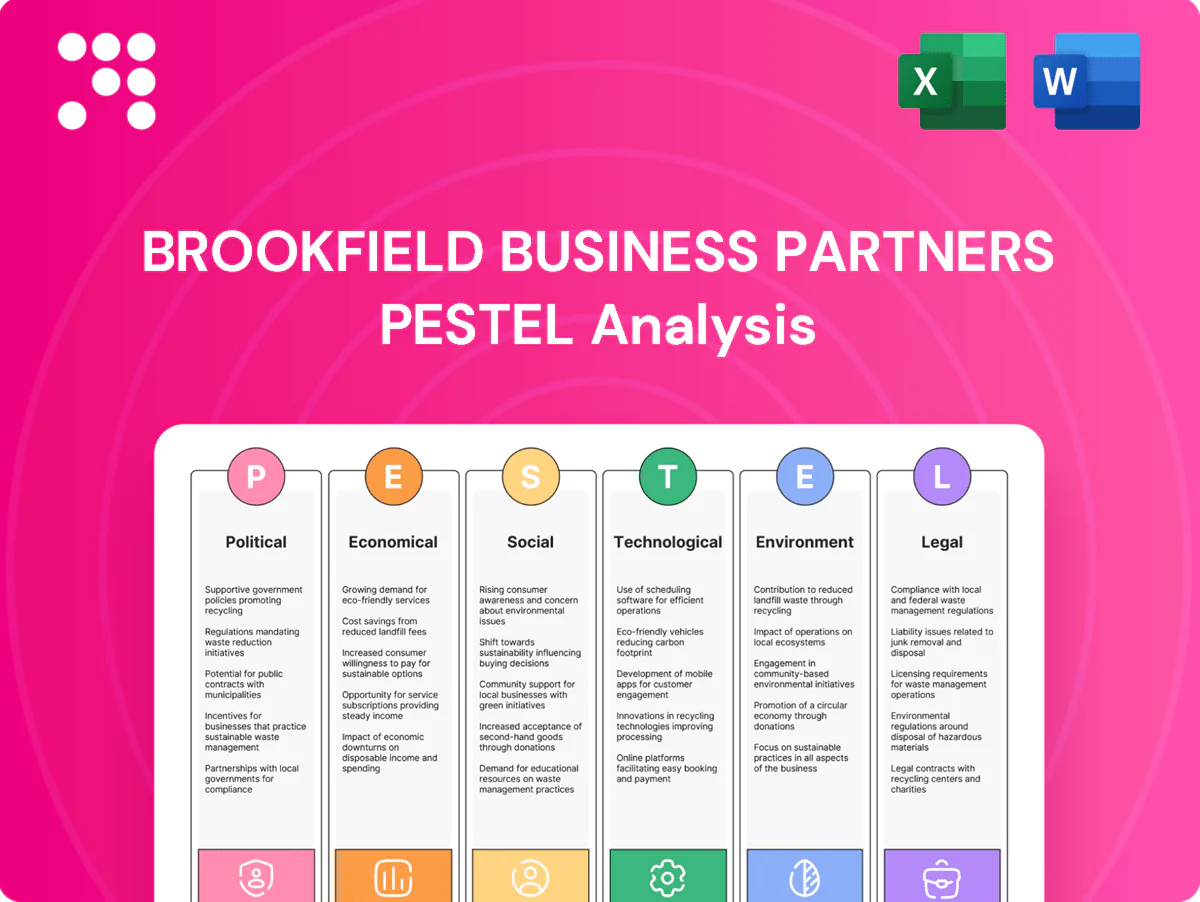
Brookfield Business Partners PESTLE Analysis

Your Competitive Advantage Starts with This Report
Our PESTLE Analysis for Brookfield Business Partners reveals how political regulation, macroeconomic cycles, technological shifts, social expectations, and environmental rules shape its risk and growth profile. Actionable insights highlight strategic levers and regulatory exposures. Ideal for investors and planners—purchase the full report to access detailed findings and recommendations.
Political factors

Geopolitical risk exposure
Operating across multiple regions exposes Brookfield Business Partners to regime shifts, conflict and policy volatility, amplified by Brookfield group’s global scale with parent AUM exceeding US$800 billion (2024). Political instability can disrupt supply chains, permitting and currency convertibility, threatening cash flow in emerging markets. Portfolio diversification and contingency planning mitigate localized shocks, while active stakeholder engagement and scenario analysis are critical for resilience.
Trade policy and tariffs
Tariff changes—notably the US-China measures affecting roughly $360 billion of goods with rates up to 25%—raise input costs and complicate cross-border service delivery for Brookfield Business Partners.
Shifts in export/import rules can force relocation of production footprints and sourcing strategies, increasing capex and working capital needs.
Proactive supply-chain redesign, hedging instruments and dual-sourcing have reduced tariff leakage and dampened volatility in recent portfolio companies.

FDI and ownership restrictions
Foreign investment reviews (eg CFIUS, EU FSR) can delay or condition Brookfield Business Partners deals, especially in sensitive sectors; with Brookfield group AUM roughly US$800bn in 2024 such delays can materially affect timing. Ownership caps or local partner mandates alter governance and returns, so early regulatory mapping streamlines structuring, and transparent value-creation plans improve approval odds.

Public-private concessions
Public-private concession terms and privatization waves determine Brookfield Business Partners' entry points for infrastructure and services; with about 100 operating businesses in 2024, concession length, tariffs and tenure shape valuation and IRR. Political cycles can prompt renegotiations of tariffs, service standards or tenure, while strong contracts with explicit KPIs protect economics and local relationship capital improves concession stability.
- Concessions shape entry and value
- Tariff/tenure renegotiation risk
- Contracts & KPIs preserve cashflows
- Local relationships reduce political risk
Sanctions and export controls
Evolving sanctions regimes from the US, EU, UK, Canada and Australia complicate counterparties and cross-border technology transfers; screening, end-use checks and supply-chain diligence are essential to avoid prohibited exports. Rapid policy shifts can strand assets or contracts, so centralized compliance and a single control framework reduce enforcement and reputational risk.
- jurisdictions: US/EU/UK/CA/AU
- controls: screening, end-use, supply-chain
- mitigation: centralized compliance
Cross-border assets exposed to sanctions, tariff and concession risks; central compliance mitigates
Operating across regions exposes Brookfield Business Partners (Brookfield group AUM ~US$800bn in 2024) to regime shifts, sanctions and tariff volatility that can disrupt cashflows and supply chains. Foreign-investment reviews (CFIUS, EU FSR) and concession renegotiations delay deals and compress IRRs. Centralized compliance, hedging and local partnerships reduce political and execution risk.
| Risk | Metric |
|---|---|
| Tariffs | $360bn US‑China exposure |
| AUM | ~US$800bn (2024) |
| Portfolio | ~100 businesses (2024) |
What is included in the product
 Detailed Word Document
Explores how macro-environmental factors specifically impact Brookfield Business Partners across Political, Economic, Social, Technological, Environmental and Legal dimensions, with data-backed trends and sector-specific examples. Designed to help executives and investors spot risks, opportunities and inform resilient strategy and scenario planning.

 Customizable Excel Spreadsheet
Provides a clean, visually segmented PESTLE summary tailored to Brookfield Business Partners, enabling quick reference in meetings or presentations and supporting risk discussions and strategic alignment across teams.
Economic factors

Interest rates and credit
Leveraged acquisitions at Brookfield Business Partners are highly sensitive to base rates—US Fed funds sat around 5.25–5.50% and the 10-year Treasury near 4.0% in mid‑2025—while leveraged loan spreads have averaged roughly 350–400 bps, raising all‑in funding costs. Higher funding costs compress equity IRRs and push out refinancing windows, particularly for mid‑market platforms. Active liability management and duration hedging have been used to protect cash flows, with the fixed–floating debt mix a primary lever to manage rate risk.
Inflation and input costs
Cost inflation—driven by labor, energy and materials—compressed margins as US CPI eased to about 3.4% in 2024 and Canada to roughly 2.9% in 2024, while sector wage growth remained above CPI in many assets. Index-linked contracts and pass-through clauses across Brookfield Business Partners mitigated input shocks, preserving cash flow. Operational excellence and productivity gains reduced unit costs, offsetting cost creep. Pricing power varies by sector and must be mapped to contract elasticity and competitive position.

FX volatility
Brookfield Business Partners faces translation and transaction risks from multi-currency revenues and costs across more than 15 countries, which can swing reported results even if underlying operations are stable.
Natural hedges in local-cost operations and selective derivatives have historically reduced earnings variability, with treasury reporting focus on matched cashflows.
Acquisition timing and funding currency alignment are critical to avoid FX-induced value erosion, while disciplined treasury management preserves distributable cash for holders.

Commodity cycles
Industrial holdings face pronounced cyclicality across metals, chemicals and energy; 2024 saw Brent average roughly $86/bbl and LME copper near $9,500/ton, driving volatile demand and pricing that pressure margins and utilization. Low-cost assets and secured long-term offtakes supported mid-2024 utilization above peers, while opportunistic, countercyclical acquisitions captured distressed value in late-2023/2024. Scenario-driven capex pacing guided investment timing and preserved liquidity.
- Demand/price swings: energy & metals
- Hedges/offtakes stabilize utilization
- Countercyclical buys capture distressed spreads
- Scenario planning steers capex timing
M&A valuations and exits
M&A deal flow and multiples for Brookfield Business Partners reflect liquidity and risk appetite across its infrastructure and industrial portfolio, with exit returns driven by entry discipline and operational uplift; clear exit routes include IPOs, strategic sales, and recapitalizations that underpin realized returns, while competitive auctions demand differentiated investment theses.
- Deal flow tracks liquidity/risk appetite
- Multiple arbitrage requires disciplined entry + ops uplift
- Exits via IPOs, strategic sales, recaps
- Auctions need differentiated theses
Cross-border assets exposed to sanctions, tariff and concession risks; central compliance mitigates
Higher rates (Fed 5.25–5.50%, 10y ~4.0% mid‑2025) and leveraged loan spreads (~350–400 bps) raise all‑in funding costs, compress IRRs and delay refinancings. Cost inflation (US CPI ~3.4% 2024; Canada ~2.9%) and sector wage growth squeeze margins, offset by index‑links and productivity. Commodity volatility (Brent ~$86/bbl; LME copper ~$9,500/t) drives cyclicality, hedges and offtakes stabilize utilization.
| Metric | Value | Impact |
|---|---|---|
| Fed funds | 5.25–5.50% | Higher debt cost |
| 10‑yr Treasury | ~4.0% | Refi/valuation |
| Loan spreads | 350–400 bps | All‑in funding |
| US CPI 2024 | ~3.4% | Input inflation |
| Brent 2024 | ~$86/bbl | Demand/price risk |
Full Version Awaits
Brookfield Business Partners PESTLE Analysis
The preview shown here is the exact PESTLE analysis of Brookfield Business Partners you’ll receive after purchase. It’s fully formatted and ready to use, covering political, economic, social, technological, legal and environmental factors. No placeholders—this is the final document.

Your Competitive Advantage Starts with This Report
Our PESTLE Analysis for Brookfield Business Partners reveals how political regulation, macroeconomic cycles, technological shifts, social expectations, and environmental rules shape its risk and growth profile. Actionable insights highlight strategic levers and regulatory exposures. Ideal for investors and planners—purchase the full report to access detailed findings and recommendations.
Political factors
Geopolitical risk exposure
Operating across multiple regions exposes Brookfield Business Partners to regime shifts, conflict and policy volatility, amplified by Brookfield group’s global scale with parent AUM exceeding US$800 billion (2024). Political instability can disrupt supply chains, permitting and currency convertibility, threatening cash flow in emerging markets. Portfolio diversification and contingency planning mitigate localized shocks, while active stakeholder engagement and scenario analysis are critical for resilience.
Trade policy and tariffs
Tariff changes—notably the US-China measures affecting roughly $360 billion of goods with rates up to 25%—raise input costs and complicate cross-border service delivery for Brookfield Business Partners.
Shifts in export/import rules can force relocation of production footprints and sourcing strategies, increasing capex and working capital needs.
Proactive supply-chain redesign, hedging instruments and dual-sourcing have reduced tariff leakage and dampened volatility in recent portfolio companies.
FDI and ownership restrictions
Foreign investment reviews (eg CFIUS, EU FSR) can delay or condition Brookfield Business Partners deals, especially in sensitive sectors; with Brookfield group AUM roughly US$800bn in 2024 such delays can materially affect timing. Ownership caps or local partner mandates alter governance and returns, so early regulatory mapping streamlines structuring, and transparent value-creation plans improve approval odds.
Public-private concessions
Public-private concession terms and privatization waves determine Brookfield Business Partners' entry points for infrastructure and services; with about 100 operating businesses in 2024, concession length, tariffs and tenure shape valuation and IRR. Political cycles can prompt renegotiations of tariffs, service standards or tenure, while strong contracts with explicit KPIs protect economics and local relationship capital improves concession stability.
- Concessions shape entry and value
- Tariff/tenure renegotiation risk
- Contracts & KPIs preserve cashflows
- Local relationships reduce political risk
Sanctions and export controls
Evolving sanctions regimes from the US, EU, UK, Canada and Australia complicate counterparties and cross-border technology transfers; screening, end-use checks and supply-chain diligence are essential to avoid prohibited exports. Rapid policy shifts can strand assets or contracts, so centralized compliance and a single control framework reduce enforcement and reputational risk.
- jurisdictions: US/EU/UK/CA/AU
- controls: screening, end-use, supply-chain
- mitigation: centralized compliance
Cross-border assets exposed to sanctions, tariff and concession risks; central compliance mitigates
Operating across regions exposes Brookfield Business Partners (Brookfield group AUM ~US$800bn in 2024) to regime shifts, sanctions and tariff volatility that can disrupt cashflows and supply chains. Foreign-investment reviews (CFIUS, EU FSR) and concession renegotiations delay deals and compress IRRs. Centralized compliance, hedging and local partnerships reduce political and execution risk.
| Risk | Metric |
|---|---|
| Tariffs | $360bn US‑China exposure |
| AUM | ~US$800bn (2024) |
| Portfolio | ~100 businesses (2024) |
What is included in the product
Detailed Word Document
Explores how macro-environmental factors specifically impact Brookfield Business Partners across Political, Economic, Social, Technological, Environmental and Legal dimensions, with data-backed trends and sector-specific examples. Designed to help executives and investors spot risks, opportunities and inform resilient strategy and scenario planning.
Customizable Excel Spreadsheet
Provides a clean, visually segmented PESTLE summary tailored to Brookfield Business Partners, enabling quick reference in meetings or presentations and supporting risk discussions and strategic alignment across teams.
Economic factors
Interest rates and credit
Leveraged acquisitions at Brookfield Business Partners are highly sensitive to base rates—US Fed funds sat around 5.25–5.50% and the 10-year Treasury near 4.0% in mid‑2025—while leveraged loan spreads have averaged roughly 350–400 bps, raising all‑in funding costs. Higher funding costs compress equity IRRs and push out refinancing windows, particularly for mid‑market platforms. Active liability management and duration hedging have been used to protect cash flows, with the fixed–floating debt mix a primary lever to manage rate risk.
Inflation and input costs
Cost inflation—driven by labor, energy and materials—compressed margins as US CPI eased to about 3.4% in 2024 and Canada to roughly 2.9% in 2024, while sector wage growth remained above CPI in many assets. Index-linked contracts and pass-through clauses across Brookfield Business Partners mitigated input shocks, preserving cash flow. Operational excellence and productivity gains reduced unit costs, offsetting cost creep. Pricing power varies by sector and must be mapped to contract elasticity and competitive position.
FX volatility
Brookfield Business Partners faces translation and transaction risks from multi-currency revenues and costs across more than 15 countries, which can swing reported results even if underlying operations are stable.
Natural hedges in local-cost operations and selective derivatives have historically reduced earnings variability, with treasury reporting focus on matched cashflows.
Acquisition timing and funding currency alignment are critical to avoid FX-induced value erosion, while disciplined treasury management preserves distributable cash for holders.
Commodity cycles
Industrial holdings face pronounced cyclicality across metals, chemicals and energy; 2024 saw Brent average roughly $86/bbl and LME copper near $9,500/ton, driving volatile demand and pricing that pressure margins and utilization. Low-cost assets and secured long-term offtakes supported mid-2024 utilization above peers, while opportunistic, countercyclical acquisitions captured distressed value in late-2023/2024. Scenario-driven capex pacing guided investment timing and preserved liquidity.
- Demand/price swings: energy & metals
- Hedges/offtakes stabilize utilization
- Countercyclical buys capture distressed spreads
- Scenario planning steers capex timing
M&A valuations and exits
M&A deal flow and multiples for Brookfield Business Partners reflect liquidity and risk appetite across its infrastructure and industrial portfolio, with exit returns driven by entry discipline and operational uplift; clear exit routes include IPOs, strategic sales, and recapitalizations that underpin realized returns, while competitive auctions demand differentiated investment theses.
- Deal flow tracks liquidity/risk appetite
- Multiple arbitrage requires disciplined entry + ops uplift
- Exits via IPOs, strategic sales, recaps
- Auctions need differentiated theses
Cross-border assets exposed to sanctions, tariff and concession risks; central compliance mitigates
Higher rates (Fed 5.25–5.50%, 10y ~4.0% mid‑2025) and leveraged loan spreads (~350–400 bps) raise all‑in funding costs, compress IRRs and delay refinancings. Cost inflation (US CPI ~3.4% 2024; Canada ~2.9%) and sector wage growth squeeze margins, offset by index‑links and productivity. Commodity volatility (Brent ~$86/bbl; LME copper ~$9,500/t) drives cyclicality, hedges and offtakes stabilize utilization.
| Metric | Value | Impact |
|---|---|---|
| Fed funds | 5.25–5.50% | Higher debt cost |
| 10‑yr Treasury | ~4.0% | Refi/valuation |
| Loan spreads | 350–400 bps | All‑in funding |
| US CPI 2024 | ~3.4% | Input inflation |
| Brent 2024 | ~$86/bbl | Demand/price risk |
Full Version Awaits
Brookfield Business Partners PESTLE Analysis
The preview shown here is the exact PESTLE analysis of Brookfield Business Partners you’ll receive after purchase. It’s fully formatted and ready to use, covering political, economic, social, technological, legal and environmental factors. No placeholders—this is the final document.
Description
Your Competitive Advantage Starts with This Report
Our PESTLE Analysis for Brookfield Business Partners reveals how political regulation, macroeconomic cycles, technological shifts, social expectations, and environmental rules shape its risk and growth profile. Actionable insights highlight strategic levers and regulatory exposures. Ideal for investors and planners—purchase the full report to access detailed findings and recommendations.
Political factors
Geopolitical risk exposure
Operating across multiple regions exposes Brookfield Business Partners to regime shifts, conflict and policy volatility, amplified by Brookfield group’s global scale with parent AUM exceeding US$800 billion (2024). Political instability can disrupt supply chains, permitting and currency convertibility, threatening cash flow in emerging markets. Portfolio diversification and contingency planning mitigate localized shocks, while active stakeholder engagement and scenario analysis are critical for resilience.
Trade policy and tariffs
Tariff changes—notably the US-China measures affecting roughly $360 billion of goods with rates up to 25%—raise input costs and complicate cross-border service delivery for Brookfield Business Partners.
Shifts in export/import rules can force relocation of production footprints and sourcing strategies, increasing capex and working capital needs.
Proactive supply-chain redesign, hedging instruments and dual-sourcing have reduced tariff leakage and dampened volatility in recent portfolio companies.
FDI and ownership restrictions
Foreign investment reviews (eg CFIUS, EU FSR) can delay or condition Brookfield Business Partners deals, especially in sensitive sectors; with Brookfield group AUM roughly US$800bn in 2024 such delays can materially affect timing. Ownership caps or local partner mandates alter governance and returns, so early regulatory mapping streamlines structuring, and transparent value-creation plans improve approval odds.
Public-private concessions
Public-private concession terms and privatization waves determine Brookfield Business Partners' entry points for infrastructure and services; with about 100 operating businesses in 2024, concession length, tariffs and tenure shape valuation and IRR. Political cycles can prompt renegotiations of tariffs, service standards or tenure, while strong contracts with explicit KPIs protect economics and local relationship capital improves concession stability.
- Concessions shape entry and value
- Tariff/tenure renegotiation risk
- Contracts & KPIs preserve cashflows
- Local relationships reduce political risk
Sanctions and export controls
Evolving sanctions regimes from the US, EU, UK, Canada and Australia complicate counterparties and cross-border technology transfers; screening, end-use checks and supply-chain diligence are essential to avoid prohibited exports. Rapid policy shifts can strand assets or contracts, so centralized compliance and a single control framework reduce enforcement and reputational risk.
- jurisdictions: US/EU/UK/CA/AU
- controls: screening, end-use, supply-chain
- mitigation: centralized compliance
Cross-border assets exposed to sanctions, tariff and concession risks; central compliance mitigates
Operating across regions exposes Brookfield Business Partners (Brookfield group AUM ~US$800bn in 2024) to regime shifts, sanctions and tariff volatility that can disrupt cashflows and supply chains. Foreign-investment reviews (CFIUS, EU FSR) and concession renegotiations delay deals and compress IRRs. Centralized compliance, hedging and local partnerships reduce political and execution risk.
| Risk | Metric |
|---|---|
| Tariffs | $360bn US‑China exposure |
| AUM | ~US$800bn (2024) |
| Portfolio | ~100 businesses (2024) |
What is included in the product
Detailed Word Document
Explores how macro-environmental factors specifically impact Brookfield Business Partners across Political, Economic, Social, Technological, Environmental and Legal dimensions, with data-backed trends and sector-specific examples. Designed to help executives and investors spot risks, opportunities and inform resilient strategy and scenario planning.
Customizable Excel Spreadsheet
Provides a clean, visually segmented PESTLE summary tailored to Brookfield Business Partners, enabling quick reference in meetings or presentations and supporting risk discussions and strategic alignment across teams.
Economic factors
Interest rates and credit
Leveraged acquisitions at Brookfield Business Partners are highly sensitive to base rates—US Fed funds sat around 5.25–5.50% and the 10-year Treasury near 4.0% in mid‑2025—while leveraged loan spreads have averaged roughly 350–400 bps, raising all‑in funding costs. Higher funding costs compress equity IRRs and push out refinancing windows, particularly for mid‑market platforms. Active liability management and duration hedging have been used to protect cash flows, with the fixed–floating debt mix a primary lever to manage rate risk.
Inflation and input costs
Cost inflation—driven by labor, energy and materials—compressed margins as US CPI eased to about 3.4% in 2024 and Canada to roughly 2.9% in 2024, while sector wage growth remained above CPI in many assets. Index-linked contracts and pass-through clauses across Brookfield Business Partners mitigated input shocks, preserving cash flow. Operational excellence and productivity gains reduced unit costs, offsetting cost creep. Pricing power varies by sector and must be mapped to contract elasticity and competitive position.
FX volatility
Brookfield Business Partners faces translation and transaction risks from multi-currency revenues and costs across more than 15 countries, which can swing reported results even if underlying operations are stable.
Natural hedges in local-cost operations and selective derivatives have historically reduced earnings variability, with treasury reporting focus on matched cashflows.
Acquisition timing and funding currency alignment are critical to avoid FX-induced value erosion, while disciplined treasury management preserves distributable cash for holders.
Commodity cycles
Industrial holdings face pronounced cyclicality across metals, chemicals and energy; 2024 saw Brent average roughly $86/bbl and LME copper near $9,500/ton, driving volatile demand and pricing that pressure margins and utilization. Low-cost assets and secured long-term offtakes supported mid-2024 utilization above peers, while opportunistic, countercyclical acquisitions captured distressed value in late-2023/2024. Scenario-driven capex pacing guided investment timing and preserved liquidity.
- Demand/price swings: energy & metals
- Hedges/offtakes stabilize utilization
- Countercyclical buys capture distressed spreads
- Scenario planning steers capex timing
M&A valuations and exits
M&A deal flow and multiples for Brookfield Business Partners reflect liquidity and risk appetite across its infrastructure and industrial portfolio, with exit returns driven by entry discipline and operational uplift; clear exit routes include IPOs, strategic sales, and recapitalizations that underpin realized returns, while competitive auctions demand differentiated investment theses.
- Deal flow tracks liquidity/risk appetite
- Multiple arbitrage requires disciplined entry + ops uplift
- Exits via IPOs, strategic sales, recaps
- Auctions need differentiated theses
Cross-border assets exposed to sanctions, tariff and concession risks; central compliance mitigates
Higher rates (Fed 5.25–5.50%, 10y ~4.0% mid‑2025) and leveraged loan spreads (~350–400 bps) raise all‑in funding costs, compress IRRs and delay refinancings. Cost inflation (US CPI ~3.4% 2024; Canada ~2.9%) and sector wage growth squeeze margins, offset by index‑links and productivity. Commodity volatility (Brent ~$86/bbl; LME copper ~$9,500/t) drives cyclicality, hedges and offtakes stabilize utilization.
| Metric | Value | Impact |
|---|---|---|
| Fed funds | 5.25–5.50% | Higher debt cost |
| 10‑yr Treasury | ~4.0% | Refi/valuation |
| Loan spreads | 350–400 bps | All‑in funding |
| US CPI 2024 | ~3.4% | Input inflation |
| Brent 2024 | ~$86/bbl | Demand/price risk |
Full Version Awaits
Brookfield Business Partners PESTLE Analysis
The preview shown here is the exact PESTLE analysis of Brookfield Business Partners you’ll receive after purchase. It’s fully formatted and ready to use, covering political, economic, social, technological, legal and environmental factors. No placeholders—this is the final document.











