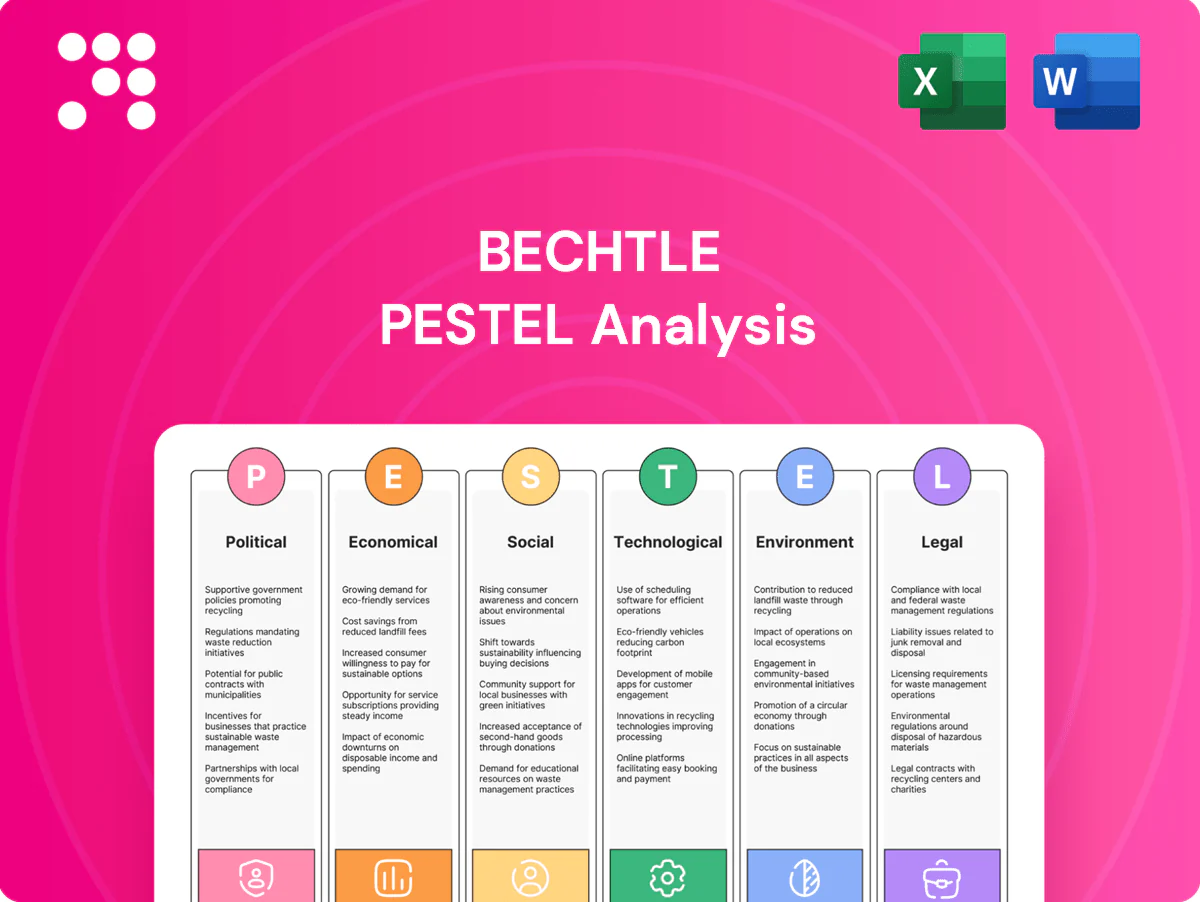
Bechtle PESTLE Analysis

Plan Smarter. Present Sharper. Compete Stronger.
Our Bechtle PESTLE Analysis pinpoints political, economic, social, technological, legal and environmental forces shaping the company's trajectory. It highlights regulatory risks, digital transformation opportunities and macroeconomic sensitivities. Perfect for investors and strategists seeking actionable intelligence. Purchase the full report to access detailed, ready-to-use insights.
Political factors

EU digital sovereignty priorities
EU pushes cloud sovereignty and trusted infrastructure, backing initiatives like GAIA-X which counts 300+ members as of 2024; Bechtle can align offerings to GAIA-X and sovereign cloud requirements. This alignment strengthens public-sector procurement credentials and compliance positioning. It also differentiates Bechtle vs non-EU hyperscalers for sensitive workloads, supporting revenue growth in regulated segments.
Public procurement dynamics
Bechtle relies heavily on public tenders, with bids increasingly tied to framework agreements and e-procurement rules that compress pricing and margins; the EU public procurement market is roughly €2 trillion annually (European Commission). Political budget cycles can accelerate or delay sizeable IT projects, affecting Bechtle’s order timing against its ~€8.3bn 2024 group revenue. Strong local presence across Germany and Europe aids contract qualification and renewals.

Cyber defense and critical infrastructure
Heightened geopolitical tensions are driving demand for cyber defense and infrastructure resilience, with the global cybersecurity market forecast to reach about $345 billion by 2026. Public and regulated sectors increasingly require certified partners under standards like ISO/IEC 27001 and NIS2, favoring vendors with compliance credentials. Bechtle can leverage its security competencies and partner network to capture rising SOC, zero-trust and backup project spend.

EU funding and digitalization programs
EU Recovery and Resilience Facility (€723.8bn) and Digital Europe (€7.5bn) channel funding into cloud, 5G and digital public services, with national RRF plans running through 2021–2026 creating visible multi-year pipelines. Grant-backed projects require co-financing, favoring established integrators like Bechtle; timely bid management secures multi-year revenue streams.
- RRF €723.8bn
- Digital Europe €7.5bn
- National plans 2021–2026
- Co-financing favors large integrators
- Timely bids capture multi-year deals
Trade and vendor relations
Export controls tightened in 2024, raising hardware lead times and prices and forcing Bechtle to adjust procurement and bid pricing.
Heightened scrutiny of vendor country-of-origin drives more selective sourcing and the need to diversify suppliers and maintain buffer stock.
Transparent, auditable supply chains reduce political risk in public tenders and improve bid competitiveness.
- 2024 export-controls impact
- vendor origin scrutiny
- supplier diversification & buffer stock
- transparent supply chains for bids
GAIA-X 300+ and RRF €723.8bn boost cloud; EU €2tn/yr favors NIS2/ISO27001
GAIA-X 300+ (2024) and RRF €723.8bn/Digital Europe €7.5bn boost public-cloud demand; EU public procurement ~€2tn/yr compresses margins versus Bechtle €8.3bn 2024 revenue. 2024 export controls and vendor-origin scrutiny raise lead times, favoring supplier diversification and NIS2/ISO27001-certified partners.
| Metric | Value |
|---|---|
| Bechtle revenue | €8.3bn |
| EU public procurement | €2tn/yr |
| GAIA-X members | 300+ |
What is included in the product
 Detailed Word Document
Explores how external macro-environmental factors uniquely affect Bechtle across six dimensions—Political, Economic, Social, Technological, Environmental and Legal—backed by data and trends, reflecting regional market and regulatory dynamics, and delivering forward-looking insights ready for executive decision-making, strategy and investor communications.

 Customizable Excel Spreadsheet
A concise, visually segmented PESTLE summary for Bechtle that’s easily dropped into presentations, shared across teams, and annotated for regional or business-line specifics—ideal for risk discussions and strategic planning.
Economic factors

IT spend cyclicality
Macro slowdowns typically defer hardware refresh and discretionary projects, pressuring Bechtle’s systems business as global IT spending was about $4.6 trillion in 2024 (Gartner). Mission-critical managed services show resilience, supported by multi-year contracts that stabilize cash flows and represented a growing share of services revenue in recent years. Upselling cloud and security—markets growing ~15–20% annually—helps offset hardware softness.
Inflation and wage pressures
Rising salaries compress Bechtle’s service margins as labor costs grew following elevated inflation — Bechtle reported revenue of €6.73bn in FY2023 with roughly 15,000 employees, increasing payroll exposure. Indexation clauses and standardized rate cards enable partial pass-through of input cost rises to clients. Automation, plus offshore/nearshore delivery, boosts service leverage and productivity. Procurement scale and vendor volume discounts reduce pricing pressure on hardware and licenses.

Currency fluctuations
USD/EUR fluctuations — around 1.08 in 2024–25 — materially change Bechtle's imported hardware costs, squeezing margins on euro-priced contracts. Hedging programs and vendor price-protection clauses mitigate volatility. Quoting discipline and dynamic pricing preserve gross margins. Cross-border e-commerce expands FX exposure, requiring centralized FX risk controls and real-time pricing.

SMB vs enterprise mix
Bechtle’s SMB vs enterprise mix buffers cyclical risk: SMBs drive high-volume e-commerce while enterprise accounts supply higher-margin, complex services; Bechtle reported €7.08bn revenue in 2023, underscoring scale in both segments. Cross-sell from hardware to managed services raises lifetime value, and tightened credit risk management becomes critical in downturns to protect receivables.
- SMB: volume e-commerce focus
- Enterprise: complex, high-margin services
- €7.08bn revenue (2023)
- Cross-sell increases LTV
- Credit risk controls essential
Vendor rebate economics
Bechtle's tier status with major OEMs drives rebate and MDF scale, typically translating into incremental margin uplift of about 1–3% and MDF pools that can reach low-double-digit millions annually; deeper certifications unlock 1–2% better pricing and priority inventory. Joint go-to-market models lower customer acquisition cost roughly 15–25%, while governance limits vendor concentration to under ~20% of supplier spend to avoid single-vendor risk.
- Tier status: 1–3% rebate uplift
- Certification: +1–2% pricing benefit
- Joint GTM: −15–25% CAC
- Governance: vendor exposure ≤20%
GAIA-X 300+ and RRF €723.8bn boost cloud; EU €2tn/yr favors NIS2/ISO27001
Macro slowdown hit hardware; services and cloud/security (15–20% CAGR) stabilize margins. FY2023 revenue €7.08bn; ~15,000 employees raise payroll exposure. USD/EUR ~1.08 (2024–25) affects imported hardware; tier OEM rebates add ~1–3% margin.
| Metric | Value |
|---|---|
| Global IT spend (2024) | €4.6tn (Gartner) |
| Bechtle rev (2023) | €7.08bn |
Same Document Delivered
Bechtle PESTLE Analysis
The Bechtle PESTLE Analysis preview shown here is the exact document you’ll receive after purchase—fully formatted and ready to use. It contains the complete political, economic, social, technological, legal, and environmental assessment as displayed, with no placeholders or teasers. After checkout you’ll instantly download this same professionally structured file.

Plan Smarter. Present Sharper. Compete Stronger.
Our Bechtle PESTLE Analysis pinpoints political, economic, social, technological, legal and environmental forces shaping the company's trajectory. It highlights regulatory risks, digital transformation opportunities and macroeconomic sensitivities. Perfect for investors and strategists seeking actionable intelligence. Purchase the full report to access detailed, ready-to-use insights.
Political factors
EU digital sovereignty priorities
EU pushes cloud sovereignty and trusted infrastructure, backing initiatives like GAIA-X which counts 300+ members as of 2024; Bechtle can align offerings to GAIA-X and sovereign cloud requirements. This alignment strengthens public-sector procurement credentials and compliance positioning. It also differentiates Bechtle vs non-EU hyperscalers for sensitive workloads, supporting revenue growth in regulated segments.
Public procurement dynamics
Bechtle relies heavily on public tenders, with bids increasingly tied to framework agreements and e-procurement rules that compress pricing and margins; the EU public procurement market is roughly €2 trillion annually (European Commission). Political budget cycles can accelerate or delay sizeable IT projects, affecting Bechtle’s order timing against its ~€8.3bn 2024 group revenue. Strong local presence across Germany and Europe aids contract qualification and renewals.
Cyber defense and critical infrastructure
Heightened geopolitical tensions are driving demand for cyber defense and infrastructure resilience, with the global cybersecurity market forecast to reach about $345 billion by 2026. Public and regulated sectors increasingly require certified partners under standards like ISO/IEC 27001 and NIS2, favoring vendors with compliance credentials. Bechtle can leverage its security competencies and partner network to capture rising SOC, zero-trust and backup project spend.
EU funding and digitalization programs
EU Recovery and Resilience Facility (€723.8bn) and Digital Europe (€7.5bn) channel funding into cloud, 5G and digital public services, with national RRF plans running through 2021–2026 creating visible multi-year pipelines. Grant-backed projects require co-financing, favoring established integrators like Bechtle; timely bid management secures multi-year revenue streams.
- RRF €723.8bn
- Digital Europe €7.5bn
- National plans 2021–2026
- Co-financing favors large integrators
- Timely bids capture multi-year deals
Trade and vendor relations
Export controls tightened in 2024, raising hardware lead times and prices and forcing Bechtle to adjust procurement and bid pricing.
Heightened scrutiny of vendor country-of-origin drives more selective sourcing and the need to diversify suppliers and maintain buffer stock.
Transparent, auditable supply chains reduce political risk in public tenders and improve bid competitiveness.
- 2024 export-controls impact
- vendor origin scrutiny
- supplier diversification & buffer stock
- transparent supply chains for bids
GAIA-X 300+ and RRF €723.8bn boost cloud; EU €2tn/yr favors NIS2/ISO27001
GAIA-X 300+ (2024) and RRF €723.8bn/Digital Europe €7.5bn boost public-cloud demand; EU public procurement ~€2tn/yr compresses margins versus Bechtle €8.3bn 2024 revenue. 2024 export controls and vendor-origin scrutiny raise lead times, favoring supplier diversification and NIS2/ISO27001-certified partners.
| Metric | Value |
|---|---|
| Bechtle revenue | €8.3bn |
| EU public procurement | €2tn/yr |
| GAIA-X members | 300+ |
What is included in the product
Detailed Word Document
Explores how external macro-environmental factors uniquely affect Bechtle across six dimensions—Political, Economic, Social, Technological, Environmental and Legal—backed by data and trends, reflecting regional market and regulatory dynamics, and delivering forward-looking insights ready for executive decision-making, strategy and investor communications.
Customizable Excel Spreadsheet
A concise, visually segmented PESTLE summary for Bechtle that’s easily dropped into presentations, shared across teams, and annotated for regional or business-line specifics—ideal for risk discussions and strategic planning.
Economic factors
IT spend cyclicality
Macro slowdowns typically defer hardware refresh and discretionary projects, pressuring Bechtle’s systems business as global IT spending was about $4.6 trillion in 2024 (Gartner). Mission-critical managed services show resilience, supported by multi-year contracts that stabilize cash flows and represented a growing share of services revenue in recent years. Upselling cloud and security—markets growing ~15–20% annually—helps offset hardware softness.
Inflation and wage pressures
Rising salaries compress Bechtle’s service margins as labor costs grew following elevated inflation — Bechtle reported revenue of €6.73bn in FY2023 with roughly 15,000 employees, increasing payroll exposure. Indexation clauses and standardized rate cards enable partial pass-through of input cost rises to clients. Automation, plus offshore/nearshore delivery, boosts service leverage and productivity. Procurement scale and vendor volume discounts reduce pricing pressure on hardware and licenses.
Currency fluctuations
USD/EUR fluctuations — around 1.08 in 2024–25 — materially change Bechtle's imported hardware costs, squeezing margins on euro-priced contracts. Hedging programs and vendor price-protection clauses mitigate volatility. Quoting discipline and dynamic pricing preserve gross margins. Cross-border e-commerce expands FX exposure, requiring centralized FX risk controls and real-time pricing.
SMB vs enterprise mix
Bechtle’s SMB vs enterprise mix buffers cyclical risk: SMBs drive high-volume e-commerce while enterprise accounts supply higher-margin, complex services; Bechtle reported €7.08bn revenue in 2023, underscoring scale in both segments. Cross-sell from hardware to managed services raises lifetime value, and tightened credit risk management becomes critical in downturns to protect receivables.
- SMB: volume e-commerce focus
- Enterprise: complex, high-margin services
- €7.08bn revenue (2023)
- Cross-sell increases LTV
- Credit risk controls essential
Vendor rebate economics
Bechtle's tier status with major OEMs drives rebate and MDF scale, typically translating into incremental margin uplift of about 1–3% and MDF pools that can reach low-double-digit millions annually; deeper certifications unlock 1–2% better pricing and priority inventory. Joint go-to-market models lower customer acquisition cost roughly 15–25%, while governance limits vendor concentration to under ~20% of supplier spend to avoid single-vendor risk.
- Tier status: 1–3% rebate uplift
- Certification: +1–2% pricing benefit
- Joint GTM: −15–25% CAC
- Governance: vendor exposure ≤20%
GAIA-X 300+ and RRF €723.8bn boost cloud; EU €2tn/yr favors NIS2/ISO27001
Macro slowdown hit hardware; services and cloud/security (15–20% CAGR) stabilize margins. FY2023 revenue €7.08bn; ~15,000 employees raise payroll exposure. USD/EUR ~1.08 (2024–25) affects imported hardware; tier OEM rebates add ~1–3% margin.
| Metric | Value |
|---|---|
| Global IT spend (2024) | €4.6tn (Gartner) |
| Bechtle rev (2023) | €7.08bn |
Same Document Delivered
Bechtle PESTLE Analysis
The Bechtle PESTLE Analysis preview shown here is the exact document you’ll receive after purchase—fully formatted and ready to use. It contains the complete political, economic, social, technological, legal, and environmental assessment as displayed, with no placeholders or teasers. After checkout you’ll instantly download this same professionally structured file.
Description
Plan Smarter. Present Sharper. Compete Stronger.
Our Bechtle PESTLE Analysis pinpoints political, economic, social, technological, legal and environmental forces shaping the company's trajectory. It highlights regulatory risks, digital transformation opportunities and macroeconomic sensitivities. Perfect for investors and strategists seeking actionable intelligence. Purchase the full report to access detailed, ready-to-use insights.
Political factors
EU digital sovereignty priorities
EU pushes cloud sovereignty and trusted infrastructure, backing initiatives like GAIA-X which counts 300+ members as of 2024; Bechtle can align offerings to GAIA-X and sovereign cloud requirements. This alignment strengthens public-sector procurement credentials and compliance positioning. It also differentiates Bechtle vs non-EU hyperscalers for sensitive workloads, supporting revenue growth in regulated segments.
Public procurement dynamics
Bechtle relies heavily on public tenders, with bids increasingly tied to framework agreements and e-procurement rules that compress pricing and margins; the EU public procurement market is roughly €2 trillion annually (European Commission). Political budget cycles can accelerate or delay sizeable IT projects, affecting Bechtle’s order timing against its ~€8.3bn 2024 group revenue. Strong local presence across Germany and Europe aids contract qualification and renewals.
Cyber defense and critical infrastructure
Heightened geopolitical tensions are driving demand for cyber defense and infrastructure resilience, with the global cybersecurity market forecast to reach about $345 billion by 2026. Public and regulated sectors increasingly require certified partners under standards like ISO/IEC 27001 and NIS2, favoring vendors with compliance credentials. Bechtle can leverage its security competencies and partner network to capture rising SOC, zero-trust and backup project spend.
EU funding and digitalization programs
EU Recovery and Resilience Facility (€723.8bn) and Digital Europe (€7.5bn) channel funding into cloud, 5G and digital public services, with national RRF plans running through 2021–2026 creating visible multi-year pipelines. Grant-backed projects require co-financing, favoring established integrators like Bechtle; timely bid management secures multi-year revenue streams.
- RRF €723.8bn
- Digital Europe €7.5bn
- National plans 2021–2026
- Co-financing favors large integrators
- Timely bids capture multi-year deals
Trade and vendor relations
Export controls tightened in 2024, raising hardware lead times and prices and forcing Bechtle to adjust procurement and bid pricing.
Heightened scrutiny of vendor country-of-origin drives more selective sourcing and the need to diversify suppliers and maintain buffer stock.
Transparent, auditable supply chains reduce political risk in public tenders and improve bid competitiveness.
- 2024 export-controls impact
- vendor origin scrutiny
- supplier diversification & buffer stock
- transparent supply chains for bids
GAIA-X 300+ and RRF €723.8bn boost cloud; EU €2tn/yr favors NIS2/ISO27001
GAIA-X 300+ (2024) and RRF €723.8bn/Digital Europe €7.5bn boost public-cloud demand; EU public procurement ~€2tn/yr compresses margins versus Bechtle €8.3bn 2024 revenue. 2024 export controls and vendor-origin scrutiny raise lead times, favoring supplier diversification and NIS2/ISO27001-certified partners.
| Metric | Value |
|---|---|
| Bechtle revenue | €8.3bn |
| EU public procurement | €2tn/yr |
| GAIA-X members | 300+ |
What is included in the product
Detailed Word Document
Explores how external macro-environmental factors uniquely affect Bechtle across six dimensions—Political, Economic, Social, Technological, Environmental and Legal—backed by data and trends, reflecting regional market and regulatory dynamics, and delivering forward-looking insights ready for executive decision-making, strategy and investor communications.
Customizable Excel Spreadsheet
A concise, visually segmented PESTLE summary for Bechtle that’s easily dropped into presentations, shared across teams, and annotated for regional or business-line specifics—ideal for risk discussions and strategic planning.
Economic factors
IT spend cyclicality
Macro slowdowns typically defer hardware refresh and discretionary projects, pressuring Bechtle’s systems business as global IT spending was about $4.6 trillion in 2024 (Gartner). Mission-critical managed services show resilience, supported by multi-year contracts that stabilize cash flows and represented a growing share of services revenue in recent years. Upselling cloud and security—markets growing ~15–20% annually—helps offset hardware softness.
Inflation and wage pressures
Rising salaries compress Bechtle’s service margins as labor costs grew following elevated inflation — Bechtle reported revenue of €6.73bn in FY2023 with roughly 15,000 employees, increasing payroll exposure. Indexation clauses and standardized rate cards enable partial pass-through of input cost rises to clients. Automation, plus offshore/nearshore delivery, boosts service leverage and productivity. Procurement scale and vendor volume discounts reduce pricing pressure on hardware and licenses.
Currency fluctuations
USD/EUR fluctuations — around 1.08 in 2024–25 — materially change Bechtle's imported hardware costs, squeezing margins on euro-priced contracts. Hedging programs and vendor price-protection clauses mitigate volatility. Quoting discipline and dynamic pricing preserve gross margins. Cross-border e-commerce expands FX exposure, requiring centralized FX risk controls and real-time pricing.
SMB vs enterprise mix
Bechtle’s SMB vs enterprise mix buffers cyclical risk: SMBs drive high-volume e-commerce while enterprise accounts supply higher-margin, complex services; Bechtle reported €7.08bn revenue in 2023, underscoring scale in both segments. Cross-sell from hardware to managed services raises lifetime value, and tightened credit risk management becomes critical in downturns to protect receivables.
- SMB: volume e-commerce focus
- Enterprise: complex, high-margin services
- €7.08bn revenue (2023)
- Cross-sell increases LTV
- Credit risk controls essential
Vendor rebate economics
Bechtle's tier status with major OEMs drives rebate and MDF scale, typically translating into incremental margin uplift of about 1–3% and MDF pools that can reach low-double-digit millions annually; deeper certifications unlock 1–2% better pricing and priority inventory. Joint go-to-market models lower customer acquisition cost roughly 15–25%, while governance limits vendor concentration to under ~20% of supplier spend to avoid single-vendor risk.
- Tier status: 1–3% rebate uplift
- Certification: +1–2% pricing benefit
- Joint GTM: −15–25% CAC
- Governance: vendor exposure ≤20%
GAIA-X 300+ and RRF €723.8bn boost cloud; EU €2tn/yr favors NIS2/ISO27001
Macro slowdown hit hardware; services and cloud/security (15–20% CAGR) stabilize margins. FY2023 revenue €7.08bn; ~15,000 employees raise payroll exposure. USD/EUR ~1.08 (2024–25) affects imported hardware; tier OEM rebates add ~1–3% margin.
| Metric | Value |
|---|---|
| Global IT spend (2024) | €4.6tn (Gartner) |
| Bechtle rev (2023) | €7.08bn |
Same Document Delivered
Bechtle PESTLE Analysis
The Bechtle PESTLE Analysis preview shown here is the exact document you’ll receive after purchase—fully formatted and ready to use. It contains the complete political, economic, social, technological, legal, and environmental assessment as displayed, with no placeholders or teasers. After checkout you’ll instantly download this same professionally structured file.











