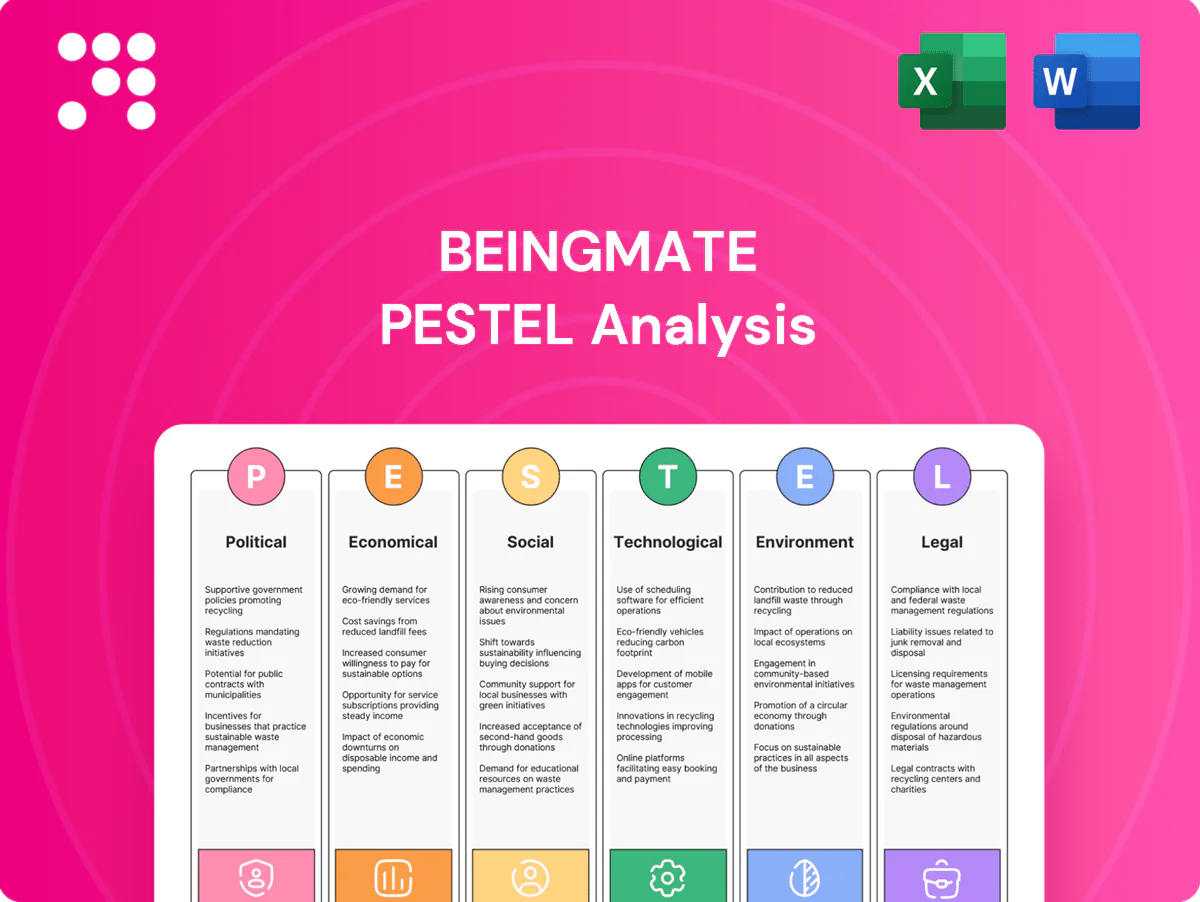
Beingmate PESTLE Analysis

Skip the Research. Get the Strategy.
Unlock strategic clarity with our PESTLE Analysis of Beingmate—pinpoint political, economic, social, technological, legal and environmental forces shaping its trajectory. Ideal for investors and strategists; buy the full report for actionable, editable insights you can use now.
Political factors

Food safety policy
After the 2008 melamine scandal that sickened about 300,000 infants and caused six deaths, China has prioritized infant formula safety with strict oversight and frequent inspections. Central directives require traceability, raw milk source control and factory licensing. Beingmate must align with evolving NMPA and SAMR standards to retain approvals. Noncompliance risks license revocation, shutdowns and severe reputational damage.
Industrial policy support
Beijing's push for domestic dairy self-sufficiency and brand upgrading dovetails with a national milk output near 36 million tonnes in 2023, boosting opportunities for Beingmate. Provincial incentives, especially in major regions like Inner Mongolia (around 20% of output), can fund capacity, R&D and quality upgrades. Policy shifts may unlock grants or procurement advantages, but support is performance-contingent and reversible.

Trade and import rules
Tariffs, quotas and registration requirements directly shape imports of milk powder and ingredients, with dairy tariff lines in some markets reaching up to 30%, raising costs and lead times for Beingmate. Tighter import rules can shield domestic producers but push up input costs when relying on foreign whey or lactoferrin. Cross-border e-commerce reforms matter as overseas brands compete via channels that saw China CBEC imports exceed RMB 2 trillion in 2023. Policy volatility forces frequent adjustments to pricing and sourcing strategies.

Regional enforcement intensity
Regional enforcement intensity in China causes inspection frequency and compliance burden to vary significantly across provinces and cities, forcing Beingmate to adapt site-by-site.
Local governments often add labeling and distribution requirements beyond national rules, increasing administrative complexity for multi-site operations.
As a result, local government relationships and robust, centralized compliance systems are strategic assets for managing costs and operational risk.
- provincial variance raises inspection frequency and costs
- local labeling/distribution rules add administrative burden
- multi-site operations face coordination complexity
- local relationships and compliance systems = strategic assets
Geopolitics and supply security
Sino-West tensions and heightened biosecurity have intermittently disrupted dairy ingredient flows from New Zealand, Australia and the EU, with New Zealand dairy exports at about NZ$19.3bn in 2023 and China a dominant market, increasing exposure for Beingmate.
Sanctions or logistics friction raise lead times and costs; container disruptions in 2021–22 pushed freight rates multiples higher and similar spikes can recur under geopolitical stress.
Beingmate therefore needs diversified sourcing, safety stock and agility as government import priorities can shift rapidly during crises.
- diversify suppliers (NZ, AU, EU + domestic)
- maintain safety stock covering 3–6 months
- monitor trade policy and logistic bottlenecks weekly
- stress-test P&L for freight and tariff shocks
China dairy: strict oversight, domestic boost and supply-chain resilience (3-6 months stock)
Post-2008 reforms mean strict NMPA/SAMR oversight, traceability and licencing; noncompliance risks shutdowns. Beijing promotes domestic dairy (China milk ~36.0m t in 2023) and provincial incentives (Inner Mongolia ≈20% share). Trade frictions (NZ exports NZ$19.3bn in 2023) and tariffs raise input costs; diversify suppliers and hold 3–6 months safety stock.
| Metric | 2023/2024 |
|---|---|
| China milk output | 36.0m t (2023) |
| Inner Mongolia share | ~20% |
| NZ dairy exports | NZ$19.3bn (2023) |
| China CBEC imports | RMB 2.0trn (2023) |
What is included in the product
 Detailed Word Document
Explores how Political, Economic, Social, Technological, Environmental and Legal factors uniquely affect Beingmate, with data-backed trends and region-specific regulatory context; designed for executives, consultants and investors to identify risks, opportunities and forward-looking scenarios that can be inserted directly into business plans, pitch decks or strategic reports.

 Customizable Excel Spreadsheet
A concise, visually segmented Beingmate PESTLE summary that’s easily shareable and editable, streamlining external risk discussions and quick alignment during strategy meetings.
Economic factors

Birth rate headwinds
China’s falling births (9.56m in 2023; TFR ~1.09) compress the infant nutrition market, and 2021–22 policy moves to allow second/third children have not reversed the decline. Volume pressure forces premiumization and aggressive share capture to sustain revenue; forecasts must model sharp regional disparities (urban aging hotspots vs higher birth pockets in western provinces) when sizing addressable market.
Income and premiumization
Rising disposable income—China’s per capita disposable income was about 40,285 yuan in 2023—sustains demand for premium formulations in tier 1–3 cities, supporting premium SKU growth (single‑digit to low‑teens CAGR in premium segments through 2024). Economic slowdowns curb trading‑up and raise price sensitivity, so balancing value and premium SKUs is critical; elasticity differs by channel, with modern trade/e‑commerce showing lower price elasticity than rural/offline outlets.

Input cost volatility
Input cost volatility: global dairy, whey, oils and packaging follow commodity cycles—GDT-style dairy swings ~15–25% annually in 2023–24; RMB moves versus USD/EUR/NZD (~5–8% variation 2023–25) raise imported input costs. Cost pass-through depends on brand strength and channel terms; hedging and multi-year contracts have materially reduced margin swings for peers.

Channel dynamics
Channel dynamics: e-commerce, mother-and-baby specialty stores and pharmacies show distinct economics: online faces platform fees typically 5–20% plus heavy promo discounts that compress margins, while offline builds trust but incurs higher fixed costs (rent, staff) often 20–40% of sales; omni-channel strategies have cut CAC by 20–40% and raised retention in recent retail studies (2024–25).
- e-commerce: platform fees 5–20%
- offline: operating costs 20–40% of sales
- promotions: major margin pressure
- omni-channel: CAC down 20–40%, retention up
Competitive intensity
Domestic leaders and multinationals compete on quality, science and trust, with domestic brands holding roughly 65% value share of China’s infant formula market in 2023 (market ≈RMB160bn). Price wars often erupt in lower tiers during downturns, squeezing margins. Differentiation through functionality and brand equity, combined with scale efficiencies, drives sustainable cost advantage and market position.
- Domestic share ≈65% (2023)
- Market size ≈RMB160bn (2023)
- Price pressure concentrated in lower tiers
- Top players benefit from scale-driven cost edge
China dairy: strict oversight, domestic boost and supply-chain resilience (3-6 months stock)
China’s declining births (9.56m in 2023; TFR ~1.09) compress volumes, forcing premiumization and regionalized market forecasts. Per‑capita disposable income 40,285 yuan (2023) supports premium growth in urban tiers but slows in downturns, raising price sensitivity. Input cost and FX volatility (commodity swings 15–25%; RMB ±5–8% 2023–25) pressure margins, making hedging and scale critical.
| Metric | Value |
|---|---|
| Births (2023) | 9.56m |
| TFR (2023) | ~1.09 |
| Per‑capita disposable (2023) | 40,285 yuan |
| Market size (2023) | RMB160bn |
| Domestic share (2023) | ≈65% |
Same Document Delivered
Beingmate PESTLE Analysis
The preview shown here is the exact Beingmate PESTLE Analysis document you’ll receive after purchase—fully formatted and ready to use. This is a real screenshot of the product you’re buying, with no placeholders or teasers. The layout, content, and structure visible here are exactly what you’ll be able to download immediately after buying.

Skip the Research. Get the Strategy.
Unlock strategic clarity with our PESTLE Analysis of Beingmate—pinpoint political, economic, social, technological, legal and environmental forces shaping its trajectory. Ideal for investors and strategists; buy the full report for actionable, editable insights you can use now.
Political factors
Food safety policy
After the 2008 melamine scandal that sickened about 300,000 infants and caused six deaths, China has prioritized infant formula safety with strict oversight and frequent inspections. Central directives require traceability, raw milk source control and factory licensing. Beingmate must align with evolving NMPA and SAMR standards to retain approvals. Noncompliance risks license revocation, shutdowns and severe reputational damage.
Industrial policy support
Beijing's push for domestic dairy self-sufficiency and brand upgrading dovetails with a national milk output near 36 million tonnes in 2023, boosting opportunities for Beingmate. Provincial incentives, especially in major regions like Inner Mongolia (around 20% of output), can fund capacity, R&D and quality upgrades. Policy shifts may unlock grants or procurement advantages, but support is performance-contingent and reversible.
Trade and import rules
Tariffs, quotas and registration requirements directly shape imports of milk powder and ingredients, with dairy tariff lines in some markets reaching up to 30%, raising costs and lead times for Beingmate. Tighter import rules can shield domestic producers but push up input costs when relying on foreign whey or lactoferrin. Cross-border e-commerce reforms matter as overseas brands compete via channels that saw China CBEC imports exceed RMB 2 trillion in 2023. Policy volatility forces frequent adjustments to pricing and sourcing strategies.
Regional enforcement intensity
Regional enforcement intensity in China causes inspection frequency and compliance burden to vary significantly across provinces and cities, forcing Beingmate to adapt site-by-site.
Local governments often add labeling and distribution requirements beyond national rules, increasing administrative complexity for multi-site operations.
As a result, local government relationships and robust, centralized compliance systems are strategic assets for managing costs and operational risk.
- provincial variance raises inspection frequency and costs
- local labeling/distribution rules add administrative burden
- multi-site operations face coordination complexity
- local relationships and compliance systems = strategic assets
Geopolitics and supply security
Sino-West tensions and heightened biosecurity have intermittently disrupted dairy ingredient flows from New Zealand, Australia and the EU, with New Zealand dairy exports at about NZ$19.3bn in 2023 and China a dominant market, increasing exposure for Beingmate.
Sanctions or logistics friction raise lead times and costs; container disruptions in 2021–22 pushed freight rates multiples higher and similar spikes can recur under geopolitical stress.
Beingmate therefore needs diversified sourcing, safety stock and agility as government import priorities can shift rapidly during crises.
- diversify suppliers (NZ, AU, EU + domestic)
- maintain safety stock covering 3–6 months
- monitor trade policy and logistic bottlenecks weekly
- stress-test P&L for freight and tariff shocks
China dairy: strict oversight, domestic boost and supply-chain resilience (3-6 months stock)
Post-2008 reforms mean strict NMPA/SAMR oversight, traceability and licencing; noncompliance risks shutdowns. Beijing promotes domestic dairy (China milk ~36.0m t in 2023) and provincial incentives (Inner Mongolia ≈20% share). Trade frictions (NZ exports NZ$19.3bn in 2023) and tariffs raise input costs; diversify suppliers and hold 3–6 months safety stock.
| Metric | 2023/2024 |
|---|---|
| China milk output | 36.0m t (2023) |
| Inner Mongolia share | ~20% |
| NZ dairy exports | NZ$19.3bn (2023) |
| China CBEC imports | RMB 2.0trn (2023) |
What is included in the product
Detailed Word Document
Explores how Political, Economic, Social, Technological, Environmental and Legal factors uniquely affect Beingmate, with data-backed trends and region-specific regulatory context; designed for executives, consultants and investors to identify risks, opportunities and forward-looking scenarios that can be inserted directly into business plans, pitch decks or strategic reports.
Customizable Excel Spreadsheet
A concise, visually segmented Beingmate PESTLE summary that’s easily shareable and editable, streamlining external risk discussions and quick alignment during strategy meetings.
Economic factors
Birth rate headwinds
China’s falling births (9.56m in 2023; TFR ~1.09) compress the infant nutrition market, and 2021–22 policy moves to allow second/third children have not reversed the decline. Volume pressure forces premiumization and aggressive share capture to sustain revenue; forecasts must model sharp regional disparities (urban aging hotspots vs higher birth pockets in western provinces) when sizing addressable market.
Income and premiumization
Rising disposable income—China’s per capita disposable income was about 40,285 yuan in 2023—sustains demand for premium formulations in tier 1–3 cities, supporting premium SKU growth (single‑digit to low‑teens CAGR in premium segments through 2024). Economic slowdowns curb trading‑up and raise price sensitivity, so balancing value and premium SKUs is critical; elasticity differs by channel, with modern trade/e‑commerce showing lower price elasticity than rural/offline outlets.
Input cost volatility
Input cost volatility: global dairy, whey, oils and packaging follow commodity cycles—GDT-style dairy swings ~15–25% annually in 2023–24; RMB moves versus USD/EUR/NZD (~5–8% variation 2023–25) raise imported input costs. Cost pass-through depends on brand strength and channel terms; hedging and multi-year contracts have materially reduced margin swings for peers.
Channel dynamics
Channel dynamics: e-commerce, mother-and-baby specialty stores and pharmacies show distinct economics: online faces platform fees typically 5–20% plus heavy promo discounts that compress margins, while offline builds trust but incurs higher fixed costs (rent, staff) often 20–40% of sales; omni-channel strategies have cut CAC by 20–40% and raised retention in recent retail studies (2024–25).
- e-commerce: platform fees 5–20%
- offline: operating costs 20–40% of sales
- promotions: major margin pressure
- omni-channel: CAC down 20–40%, retention up
Competitive intensity
Domestic leaders and multinationals compete on quality, science and trust, with domestic brands holding roughly 65% value share of China’s infant formula market in 2023 (market ≈RMB160bn). Price wars often erupt in lower tiers during downturns, squeezing margins. Differentiation through functionality and brand equity, combined with scale efficiencies, drives sustainable cost advantage and market position.
- Domestic share ≈65% (2023)
- Market size ≈RMB160bn (2023)
- Price pressure concentrated in lower tiers
- Top players benefit from scale-driven cost edge
China dairy: strict oversight, domestic boost and supply-chain resilience (3-6 months stock)
China’s declining births (9.56m in 2023; TFR ~1.09) compress volumes, forcing premiumization and regionalized market forecasts. Per‑capita disposable income 40,285 yuan (2023) supports premium growth in urban tiers but slows in downturns, raising price sensitivity. Input cost and FX volatility (commodity swings 15–25%; RMB ±5–8% 2023–25) pressure margins, making hedging and scale critical.
| Metric | Value |
|---|---|
| Births (2023) | 9.56m |
| TFR (2023) | ~1.09 |
| Per‑capita disposable (2023) | 40,285 yuan |
| Market size (2023) | RMB160bn |
| Domestic share (2023) | ≈65% |
Same Document Delivered
Beingmate PESTLE Analysis
The preview shown here is the exact Beingmate PESTLE Analysis document you’ll receive after purchase—fully formatted and ready to use. This is a real screenshot of the product you’re buying, with no placeholders or teasers. The layout, content, and structure visible here are exactly what you’ll be able to download immediately after buying.
Original: $10.00
-65%$10.00
$3.50Description
Skip the Research. Get the Strategy.
Unlock strategic clarity with our PESTLE Analysis of Beingmate—pinpoint political, economic, social, technological, legal and environmental forces shaping its trajectory. Ideal for investors and strategists; buy the full report for actionable, editable insights you can use now.
Political factors
Food safety policy
After the 2008 melamine scandal that sickened about 300,000 infants and caused six deaths, China has prioritized infant formula safety with strict oversight and frequent inspections. Central directives require traceability, raw milk source control and factory licensing. Beingmate must align with evolving NMPA and SAMR standards to retain approvals. Noncompliance risks license revocation, shutdowns and severe reputational damage.
Industrial policy support
Beijing's push for domestic dairy self-sufficiency and brand upgrading dovetails with a national milk output near 36 million tonnes in 2023, boosting opportunities for Beingmate. Provincial incentives, especially in major regions like Inner Mongolia (around 20% of output), can fund capacity, R&D and quality upgrades. Policy shifts may unlock grants or procurement advantages, but support is performance-contingent and reversible.
Trade and import rules
Tariffs, quotas and registration requirements directly shape imports of milk powder and ingredients, with dairy tariff lines in some markets reaching up to 30%, raising costs and lead times for Beingmate. Tighter import rules can shield domestic producers but push up input costs when relying on foreign whey or lactoferrin. Cross-border e-commerce reforms matter as overseas brands compete via channels that saw China CBEC imports exceed RMB 2 trillion in 2023. Policy volatility forces frequent adjustments to pricing and sourcing strategies.
Regional enforcement intensity
Regional enforcement intensity in China causes inspection frequency and compliance burden to vary significantly across provinces and cities, forcing Beingmate to adapt site-by-site.
Local governments often add labeling and distribution requirements beyond national rules, increasing administrative complexity for multi-site operations.
As a result, local government relationships and robust, centralized compliance systems are strategic assets for managing costs and operational risk.
- provincial variance raises inspection frequency and costs
- local labeling/distribution rules add administrative burden
- multi-site operations face coordination complexity
- local relationships and compliance systems = strategic assets
Geopolitics and supply security
Sino-West tensions and heightened biosecurity have intermittently disrupted dairy ingredient flows from New Zealand, Australia and the EU, with New Zealand dairy exports at about NZ$19.3bn in 2023 and China a dominant market, increasing exposure for Beingmate.
Sanctions or logistics friction raise lead times and costs; container disruptions in 2021–22 pushed freight rates multiples higher and similar spikes can recur under geopolitical stress.
Beingmate therefore needs diversified sourcing, safety stock and agility as government import priorities can shift rapidly during crises.
- diversify suppliers (NZ, AU, EU + domestic)
- maintain safety stock covering 3–6 months
- monitor trade policy and logistic bottlenecks weekly
- stress-test P&L for freight and tariff shocks
China dairy: strict oversight, domestic boost and supply-chain resilience (3-6 months stock)
Post-2008 reforms mean strict NMPA/SAMR oversight, traceability and licencing; noncompliance risks shutdowns. Beijing promotes domestic dairy (China milk ~36.0m t in 2023) and provincial incentives (Inner Mongolia ≈20% share). Trade frictions (NZ exports NZ$19.3bn in 2023) and tariffs raise input costs; diversify suppliers and hold 3–6 months safety stock.
| Metric | 2023/2024 |
|---|---|
| China milk output | 36.0m t (2023) |
| Inner Mongolia share | ~20% |
| NZ dairy exports | NZ$19.3bn (2023) |
| China CBEC imports | RMB 2.0trn (2023) |
What is included in the product
Detailed Word Document
Explores how Political, Economic, Social, Technological, Environmental and Legal factors uniquely affect Beingmate, with data-backed trends and region-specific regulatory context; designed for executives, consultants and investors to identify risks, opportunities and forward-looking scenarios that can be inserted directly into business plans, pitch decks or strategic reports.
Customizable Excel Spreadsheet
A concise, visually segmented Beingmate PESTLE summary that’s easily shareable and editable, streamlining external risk discussions and quick alignment during strategy meetings.
Economic factors
Birth rate headwinds
China’s falling births (9.56m in 2023; TFR ~1.09) compress the infant nutrition market, and 2021–22 policy moves to allow second/third children have not reversed the decline. Volume pressure forces premiumization and aggressive share capture to sustain revenue; forecasts must model sharp regional disparities (urban aging hotspots vs higher birth pockets in western provinces) when sizing addressable market.
Income and premiumization
Rising disposable income—China’s per capita disposable income was about 40,285 yuan in 2023—sustains demand for premium formulations in tier 1–3 cities, supporting premium SKU growth (single‑digit to low‑teens CAGR in premium segments through 2024). Economic slowdowns curb trading‑up and raise price sensitivity, so balancing value and premium SKUs is critical; elasticity differs by channel, with modern trade/e‑commerce showing lower price elasticity than rural/offline outlets.
Input cost volatility
Input cost volatility: global dairy, whey, oils and packaging follow commodity cycles—GDT-style dairy swings ~15–25% annually in 2023–24; RMB moves versus USD/EUR/NZD (~5–8% variation 2023–25) raise imported input costs. Cost pass-through depends on brand strength and channel terms; hedging and multi-year contracts have materially reduced margin swings for peers.
Channel dynamics
Channel dynamics: e-commerce, mother-and-baby specialty stores and pharmacies show distinct economics: online faces platform fees typically 5–20% plus heavy promo discounts that compress margins, while offline builds trust but incurs higher fixed costs (rent, staff) often 20–40% of sales; omni-channel strategies have cut CAC by 20–40% and raised retention in recent retail studies (2024–25).
- e-commerce: platform fees 5–20%
- offline: operating costs 20–40% of sales
- promotions: major margin pressure
- omni-channel: CAC down 20–40%, retention up
Competitive intensity
Domestic leaders and multinationals compete on quality, science and trust, with domestic brands holding roughly 65% value share of China’s infant formula market in 2023 (market ≈RMB160bn). Price wars often erupt in lower tiers during downturns, squeezing margins. Differentiation through functionality and brand equity, combined with scale efficiencies, drives sustainable cost advantage and market position.
- Domestic share ≈65% (2023)
- Market size ≈RMB160bn (2023)
- Price pressure concentrated in lower tiers
- Top players benefit from scale-driven cost edge
China dairy: strict oversight, domestic boost and supply-chain resilience (3-6 months stock)
China’s declining births (9.56m in 2023; TFR ~1.09) compress volumes, forcing premiumization and regionalized market forecasts. Per‑capita disposable income 40,285 yuan (2023) supports premium growth in urban tiers but slows in downturns, raising price sensitivity. Input cost and FX volatility (commodity swings 15–25%; RMB ±5–8% 2023–25) pressure margins, making hedging and scale critical.
| Metric | Value |
|---|---|
| Births (2023) | 9.56m |
| TFR (2023) | ~1.09 |
| Per‑capita disposable (2023) | 40,285 yuan |
| Market size (2023) | RMB160bn |
| Domestic share (2023) | ≈65% |
Same Document Delivered
Beingmate PESTLE Analysis
The preview shown here is the exact Beingmate PESTLE Analysis document you’ll receive after purchase—fully formatted and ready to use. This is a real screenshot of the product you’re buying, with no placeholders or teasers. The layout, content, and structure visible here are exactly what you’ll be able to download immediately after buying.











