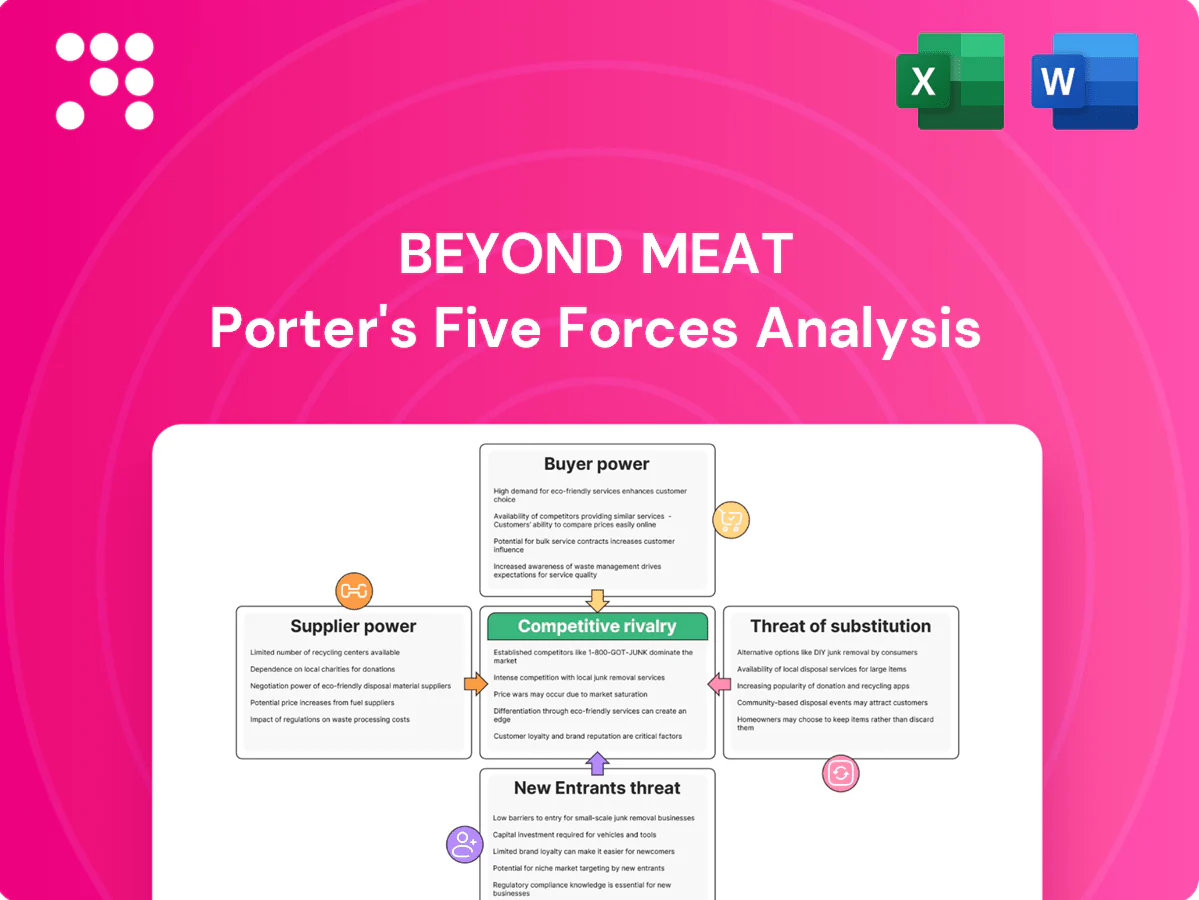
Beyond Meat Porter's Five Forces Analysis

A Must-Have Tool for Decision-Makers
Beyond Meat faces intense rivalry from incumbents and rising plant-based rivals, moderate supplier leverage on novel ingredients, growing buyer power from retailers and foodservice chains, and meaningful substitute threats from conventional meat and hybrid products. This snapshot highlights key tensions and strategic levers. Unlock the full Porter's Five Forces Analysis to access force-by-force ratings, visuals, and actionable recommendations.
Suppliers Bargaining Power

Concentrated pea protein sources
Pea protein isolate suppliers remain relatively concentrated, giving key vendors leverage over pricing and allocations; in 2024 this concentration continued to pressure buyers like Beyond Meat. Any crop shortfall or processing bottleneck can tighten supply and push input costs higher, forcing Beyond Meat to balance multi-sourcing with strict specification consistency. Long-term contracts and geographic diversification help mitigate price spikes and allocation risk but cannot fully eliminate them.
Specialized co-manufacturers
Beyond relies on toll processors for extrusion, blending and packaging in some markets, creating dependency on a limited set of capable partners; switching co-mans typically requires 6–12 months of qualification and multimillion-dollar capex to retool. Tight capacity can give co-mans scheduling power and rush fees often adding a 10–20% premium to unit costs. Bringing capacity in-house reduces supply risk but raises fixed costs by tens of millions for new plants and equipment.

Volatile commodity oils and additives
Coconut, canola and sunflower oils plus functional additives are subject to commodity and geopolitical shocks that drive sudden price swings and can compress Beyond Meat’s margins if not hedged or quickly passed through. Reformulation options are limited by strict texture and taste targets, constraining short-term supplier substitution. Strategic supplier partnerships and hedging programs mitigate exposure but add procurement complexity and cost.

Quality, certification, and traceability demands
Beyond Meat’s non-GMO, allergen-control, and sustainability mandates significantly shrink eligible suppliers, raising switching costs and giving certified vendors greater bargaining leverage; any ingredient quality lapse can force costly recalls and severe brand damage. Rigorous third-party audits and dual-qualification of suppliers are essential to preserve purchasing leverage and operational resilience.
- Non-GMO and sustainability requirements reduce supplier pool
- Higher specs raise switching costs
- Quality lapses risk recalls and brand harm
- Audits and dual-qualification preserve leverage
Packaging and logistics constraints
Specialized packaging like modified-atmosphere and recyclable formats is capacity-constrained and price-inelastic, raising per-unit costs for Beyond Meat; the global plant-based meat retail market reached about $8.1 billion in 2024, increasing demand for such packaging. Cold-chain and international freight in 2024 remained volatile, exposing the firm to surcharges and delays while carriers often prioritize larger customers. Forward contracts and inventory buffers are required to stabilize supply and margins.
- Packaging capacity limited, higher unit cost
- Cold-chain freight volatility in 2024, surcharge risk
- Carriers favor high-volume clients
- Mitigation: forward contracts + inventory buffers
Supply squeeze: 6-12m switching, 10-20% rush-premia
Supplier concentration (pea protein, co-mans, specialty oils/packaging) gave vendors measurable leverage in 2024, creating 6–12 month switching timelines and 10–20% rush-premia; non-GMO/sustainability specs shrink the supplier pool and raise switching costs, while packaging demand (global plant-based retail ~$8.1B in 2024) and cold-chain volatility add price and allocation risk.
| Metric | 2024 Value |
|---|---|
| Pea-protein supplier concentration | High |
| Co-man switch time | 6–12 months |
| Rush premium | 10–20% |
| Packaging market | $8.1B |
What is included in the product
 Detailed Word Document
Tailored Porter’s Five Forces analysis for Beyond Meat that uncovers competitive intensity, buyer and supplier power, threat of new entrants and substitutes, and identifies disruptive forces and strategic implications for pricing, margins, and market share.

 Customizable Excel Spreadsheet
A clear, one-sheet summary of Beyond Meat's five forces—ideal for quick strategic decisions, showing supplier, buyer, and competitive pressures at a glance.
Customers Bargaining Power

Powerful retail chains
Large grocers, led by Walmart and Kroger, together account for roughly one-third of U.S. grocery sales, giving them shelf power to demand pricing, slotting fees and promotional terms from suppliers like Beyond Meat. Retailers can delist SKUs or reallocate facings toward faster-moving or cheaper private labels, whose shelf share has been rising in recent years. Beyond must fund significant trade spend to maintain velocity, pressuring gross margins. Private-label expansion further intensifies retailer leverage.
Consolidated foodservice buyers
Consolidated QSRs, contract caterers and chains leverage scale to demand volume discounts and strict specs from suppliers like Beyond Meat; U.S. foodservice sales exceeded $1 trillion in 2024 per National Restaurant Association, concentrating bargaining power. Menu rotations and frequent limited-time offers drive demand volatility, so failure to hit price or performance targets risks rapid displacement. Successful pilots can scale quickly but typically operate at tight margins.

High price sensitivity
Consumers compare plant-based meat to animal meat and rivals, making elasticity high: Beyond Meat products often carry a 30–50% price premium versus conventional ground beef, so small price gaps drive switching. Inflationary periods amplify trading down, with US grocery inflation peaking consumers' sensitivity in 2022–24. Promotional cadence heavily influences trial and repeat, while value packs and tiered offerings reduce churn by improving perceived value.

Low switching costs for end consumers
Brand loyalty in plant-based meat remains nascent, so taste and price prompt rapid switching; competing products are widely available online and in 90% of US grocery chains. Social media and reviews accelerate preference shifts, and consistent sensory performance is critical to retain buyers; plant-based meat represents about 2% of US retail meat sales (Good Food Institute, 2023–24).
Data-driven category management
Retailers leverage granular POS and loyalty data to optimize assortments, using velocity and margin metrics to grant or retract shelf space; underperforming SKUs are frequently culled within weeks, pressuring Beyond Meat to prove sustained sell-through and differentiated shopper insights. Joint business planning can lock in placement but ties Beyond to strict sales and promotional targets.
- Velocity-driven shelf decisions
- SKU culling risks
- Need for margin and shopper analytics
- Placement traded for targets
Retailer and QSR power squeezes plant-based margins as consumers pay 30–50% premium
Large grocers (≈33% of US grocery sales) and consolidated QSRs (US foodservice >$1T in 2024) exert strong pricing and placement leverage, forcing high trade spend and margins pressure. Consumers face 30–50% price premium vs. meat and plant-based ≈2% of US retail meat sales, raising price elasticity and churn. Private-label growth and omnichannel availability amplify retailer and buyer power.
| Segment | Concentration | Leverage |
|---|---|---|
| Grocers | ≈33% | High |
| Foodservice | >$1T (2024) | High |
| Consumers | Broad | Price-sensitive |
Same Document Delivered
Beyond Meat Porter's Five Forces Analysis
This preview shows the exact Beyond Meat Porter's Five Forces analysis you'll receive immediately after purchase—no placeholders or mockups. The document is fully formatted, professionally written, and ready for download and use the moment you buy. You'll get this same complete file instantly upon payment.

A Must-Have Tool for Decision-Makers
Beyond Meat faces intense rivalry from incumbents and rising plant-based rivals, moderate supplier leverage on novel ingredients, growing buyer power from retailers and foodservice chains, and meaningful substitute threats from conventional meat and hybrid products. This snapshot highlights key tensions and strategic levers. Unlock the full Porter's Five Forces Analysis to access force-by-force ratings, visuals, and actionable recommendations.
Suppliers Bargaining Power
Concentrated pea protein sources
Pea protein isolate suppliers remain relatively concentrated, giving key vendors leverage over pricing and allocations; in 2024 this concentration continued to pressure buyers like Beyond Meat. Any crop shortfall or processing bottleneck can tighten supply and push input costs higher, forcing Beyond Meat to balance multi-sourcing with strict specification consistency. Long-term contracts and geographic diversification help mitigate price spikes and allocation risk but cannot fully eliminate them.
Specialized co-manufacturers
Beyond relies on toll processors for extrusion, blending and packaging in some markets, creating dependency on a limited set of capable partners; switching co-mans typically requires 6–12 months of qualification and multimillion-dollar capex to retool. Tight capacity can give co-mans scheduling power and rush fees often adding a 10–20% premium to unit costs. Bringing capacity in-house reduces supply risk but raises fixed costs by tens of millions for new plants and equipment.
Volatile commodity oils and additives
Coconut, canola and sunflower oils plus functional additives are subject to commodity and geopolitical shocks that drive sudden price swings and can compress Beyond Meat’s margins if not hedged or quickly passed through. Reformulation options are limited by strict texture and taste targets, constraining short-term supplier substitution. Strategic supplier partnerships and hedging programs mitigate exposure but add procurement complexity and cost.
Quality, certification, and traceability demands
Beyond Meat’s non-GMO, allergen-control, and sustainability mandates significantly shrink eligible suppliers, raising switching costs and giving certified vendors greater bargaining leverage; any ingredient quality lapse can force costly recalls and severe brand damage. Rigorous third-party audits and dual-qualification of suppliers are essential to preserve purchasing leverage and operational resilience.
- Non-GMO and sustainability requirements reduce supplier pool
- Higher specs raise switching costs
- Quality lapses risk recalls and brand harm
- Audits and dual-qualification preserve leverage
Packaging and logistics constraints
Specialized packaging like modified-atmosphere and recyclable formats is capacity-constrained and price-inelastic, raising per-unit costs for Beyond Meat; the global plant-based meat retail market reached about $8.1 billion in 2024, increasing demand for such packaging. Cold-chain and international freight in 2024 remained volatile, exposing the firm to surcharges and delays while carriers often prioritize larger customers. Forward contracts and inventory buffers are required to stabilize supply and margins.
- Packaging capacity limited, higher unit cost
- Cold-chain freight volatility in 2024, surcharge risk
- Carriers favor high-volume clients
- Mitigation: forward contracts + inventory buffers
Supply squeeze: 6-12m switching, 10-20% rush-premia
Supplier concentration (pea protein, co-mans, specialty oils/packaging) gave vendors measurable leverage in 2024, creating 6–12 month switching timelines and 10–20% rush-premia; non-GMO/sustainability specs shrink the supplier pool and raise switching costs, while packaging demand (global plant-based retail ~$8.1B in 2024) and cold-chain volatility add price and allocation risk.
| Metric | 2024 Value |
|---|---|
| Pea-protein supplier concentration | High |
| Co-man switch time | 6–12 months |
| Rush premium | 10–20% |
| Packaging market | $8.1B |
What is included in the product
Detailed Word Document
Tailored Porter’s Five Forces analysis for Beyond Meat that uncovers competitive intensity, buyer and supplier power, threat of new entrants and substitutes, and identifies disruptive forces and strategic implications for pricing, margins, and market share.
Customizable Excel Spreadsheet
A clear, one-sheet summary of Beyond Meat's five forces—ideal for quick strategic decisions, showing supplier, buyer, and competitive pressures at a glance.
Customers Bargaining Power
Powerful retail chains
Large grocers, led by Walmart and Kroger, together account for roughly one-third of U.S. grocery sales, giving them shelf power to demand pricing, slotting fees and promotional terms from suppliers like Beyond Meat. Retailers can delist SKUs or reallocate facings toward faster-moving or cheaper private labels, whose shelf share has been rising in recent years. Beyond must fund significant trade spend to maintain velocity, pressuring gross margins. Private-label expansion further intensifies retailer leverage.
Consolidated foodservice buyers
Consolidated QSRs, contract caterers and chains leverage scale to demand volume discounts and strict specs from suppliers like Beyond Meat; U.S. foodservice sales exceeded $1 trillion in 2024 per National Restaurant Association, concentrating bargaining power. Menu rotations and frequent limited-time offers drive demand volatility, so failure to hit price or performance targets risks rapid displacement. Successful pilots can scale quickly but typically operate at tight margins.
High price sensitivity
Consumers compare plant-based meat to animal meat and rivals, making elasticity high: Beyond Meat products often carry a 30–50% price premium versus conventional ground beef, so small price gaps drive switching. Inflationary periods amplify trading down, with US grocery inflation peaking consumers' sensitivity in 2022–24. Promotional cadence heavily influences trial and repeat, while value packs and tiered offerings reduce churn by improving perceived value.
Low switching costs for end consumers
Brand loyalty in plant-based meat remains nascent, so taste and price prompt rapid switching; competing products are widely available online and in 90% of US grocery chains. Social media and reviews accelerate preference shifts, and consistent sensory performance is critical to retain buyers; plant-based meat represents about 2% of US retail meat sales (Good Food Institute, 2023–24).
Data-driven category management
Retailers leverage granular POS and loyalty data to optimize assortments, using velocity and margin metrics to grant or retract shelf space; underperforming SKUs are frequently culled within weeks, pressuring Beyond Meat to prove sustained sell-through and differentiated shopper insights. Joint business planning can lock in placement but ties Beyond to strict sales and promotional targets.
- Velocity-driven shelf decisions
- SKU culling risks
- Need for margin and shopper analytics
- Placement traded for targets
Retailer and QSR power squeezes plant-based margins as consumers pay 30–50% premium
Large grocers (≈33% of US grocery sales) and consolidated QSRs (US foodservice >$1T in 2024) exert strong pricing and placement leverage, forcing high trade spend and margins pressure. Consumers face 30–50% price premium vs. meat and plant-based ≈2% of US retail meat sales, raising price elasticity and churn. Private-label growth and omnichannel availability amplify retailer and buyer power.
| Segment | Concentration | Leverage |
|---|---|---|
| Grocers | ≈33% | High |
| Foodservice | >$1T (2024) | High |
| Consumers | Broad | Price-sensitive |
Same Document Delivered
Beyond Meat Porter's Five Forces Analysis
This preview shows the exact Beyond Meat Porter's Five Forces analysis you'll receive immediately after purchase—no placeholders or mockups. The document is fully formatted, professionally written, and ready for download and use the moment you buy. You'll get this same complete file instantly upon payment.
Description
A Must-Have Tool for Decision-Makers
Beyond Meat faces intense rivalry from incumbents and rising plant-based rivals, moderate supplier leverage on novel ingredients, growing buyer power from retailers and foodservice chains, and meaningful substitute threats from conventional meat and hybrid products. This snapshot highlights key tensions and strategic levers. Unlock the full Porter's Five Forces Analysis to access force-by-force ratings, visuals, and actionable recommendations.
Suppliers Bargaining Power
Concentrated pea protein sources
Pea protein isolate suppliers remain relatively concentrated, giving key vendors leverage over pricing and allocations; in 2024 this concentration continued to pressure buyers like Beyond Meat. Any crop shortfall or processing bottleneck can tighten supply and push input costs higher, forcing Beyond Meat to balance multi-sourcing with strict specification consistency. Long-term contracts and geographic diversification help mitigate price spikes and allocation risk but cannot fully eliminate them.
Specialized co-manufacturers
Beyond relies on toll processors for extrusion, blending and packaging in some markets, creating dependency on a limited set of capable partners; switching co-mans typically requires 6–12 months of qualification and multimillion-dollar capex to retool. Tight capacity can give co-mans scheduling power and rush fees often adding a 10–20% premium to unit costs. Bringing capacity in-house reduces supply risk but raises fixed costs by tens of millions for new plants and equipment.
Volatile commodity oils and additives
Coconut, canola and sunflower oils plus functional additives are subject to commodity and geopolitical shocks that drive sudden price swings and can compress Beyond Meat’s margins if not hedged or quickly passed through. Reformulation options are limited by strict texture and taste targets, constraining short-term supplier substitution. Strategic supplier partnerships and hedging programs mitigate exposure but add procurement complexity and cost.
Quality, certification, and traceability demands
Beyond Meat’s non-GMO, allergen-control, and sustainability mandates significantly shrink eligible suppliers, raising switching costs and giving certified vendors greater bargaining leverage; any ingredient quality lapse can force costly recalls and severe brand damage. Rigorous third-party audits and dual-qualification of suppliers are essential to preserve purchasing leverage and operational resilience.
- Non-GMO and sustainability requirements reduce supplier pool
- Higher specs raise switching costs
- Quality lapses risk recalls and brand harm
- Audits and dual-qualification preserve leverage
Packaging and logistics constraints
Specialized packaging like modified-atmosphere and recyclable formats is capacity-constrained and price-inelastic, raising per-unit costs for Beyond Meat; the global plant-based meat retail market reached about $8.1 billion in 2024, increasing demand for such packaging. Cold-chain and international freight in 2024 remained volatile, exposing the firm to surcharges and delays while carriers often prioritize larger customers. Forward contracts and inventory buffers are required to stabilize supply and margins.
- Packaging capacity limited, higher unit cost
- Cold-chain freight volatility in 2024, surcharge risk
- Carriers favor high-volume clients
- Mitigation: forward contracts + inventory buffers
Supply squeeze: 6-12m switching, 10-20% rush-premia
Supplier concentration (pea protein, co-mans, specialty oils/packaging) gave vendors measurable leverage in 2024, creating 6–12 month switching timelines and 10–20% rush-premia; non-GMO/sustainability specs shrink the supplier pool and raise switching costs, while packaging demand (global plant-based retail ~$8.1B in 2024) and cold-chain volatility add price and allocation risk.
| Metric | 2024 Value |
|---|---|
| Pea-protein supplier concentration | High |
| Co-man switch time | 6–12 months |
| Rush premium | 10–20% |
| Packaging market | $8.1B |
What is included in the product
Detailed Word Document
Tailored Porter’s Five Forces analysis for Beyond Meat that uncovers competitive intensity, buyer and supplier power, threat of new entrants and substitutes, and identifies disruptive forces and strategic implications for pricing, margins, and market share.
Customizable Excel Spreadsheet
A clear, one-sheet summary of Beyond Meat's five forces—ideal for quick strategic decisions, showing supplier, buyer, and competitive pressures at a glance.
Customers Bargaining Power
Powerful retail chains
Large grocers, led by Walmart and Kroger, together account for roughly one-third of U.S. grocery sales, giving them shelf power to demand pricing, slotting fees and promotional terms from suppliers like Beyond Meat. Retailers can delist SKUs or reallocate facings toward faster-moving or cheaper private labels, whose shelf share has been rising in recent years. Beyond must fund significant trade spend to maintain velocity, pressuring gross margins. Private-label expansion further intensifies retailer leverage.
Consolidated foodservice buyers
Consolidated QSRs, contract caterers and chains leverage scale to demand volume discounts and strict specs from suppliers like Beyond Meat; U.S. foodservice sales exceeded $1 trillion in 2024 per National Restaurant Association, concentrating bargaining power. Menu rotations and frequent limited-time offers drive demand volatility, so failure to hit price or performance targets risks rapid displacement. Successful pilots can scale quickly but typically operate at tight margins.
High price sensitivity
Consumers compare plant-based meat to animal meat and rivals, making elasticity high: Beyond Meat products often carry a 30–50% price premium versus conventional ground beef, so small price gaps drive switching. Inflationary periods amplify trading down, with US grocery inflation peaking consumers' sensitivity in 2022–24. Promotional cadence heavily influences trial and repeat, while value packs and tiered offerings reduce churn by improving perceived value.
Low switching costs for end consumers
Brand loyalty in plant-based meat remains nascent, so taste and price prompt rapid switching; competing products are widely available online and in 90% of US grocery chains. Social media and reviews accelerate preference shifts, and consistent sensory performance is critical to retain buyers; plant-based meat represents about 2% of US retail meat sales (Good Food Institute, 2023–24).
Data-driven category management
Retailers leverage granular POS and loyalty data to optimize assortments, using velocity and margin metrics to grant or retract shelf space; underperforming SKUs are frequently culled within weeks, pressuring Beyond Meat to prove sustained sell-through and differentiated shopper insights. Joint business planning can lock in placement but ties Beyond to strict sales and promotional targets.
- Velocity-driven shelf decisions
- SKU culling risks
- Need for margin and shopper analytics
- Placement traded for targets
Retailer and QSR power squeezes plant-based margins as consumers pay 30–50% premium
Large grocers (≈33% of US grocery sales) and consolidated QSRs (US foodservice >$1T in 2024) exert strong pricing and placement leverage, forcing high trade spend and margins pressure. Consumers face 30–50% price premium vs. meat and plant-based ≈2% of US retail meat sales, raising price elasticity and churn. Private-label growth and omnichannel availability amplify retailer and buyer power.
| Segment | Concentration | Leverage |
|---|---|---|
| Grocers | ≈33% | High |
| Foodservice | >$1T (2024) | High |
| Consumers | Broad | Price-sensitive |
Same Document Delivered
Beyond Meat Porter's Five Forces Analysis
This preview shows the exact Beyond Meat Porter's Five Forces analysis you'll receive immediately after purchase—no placeholders or mockups. The document is fully formatted, professionally written, and ready for download and use the moment you buy. You'll get this same complete file instantly upon payment.











