Bharat Forge Porter's Five Forces Analysis

Elevate Your Analysis with the Complete Porter's Five Forces Analysis
Bharat Forge operates in a capital-intensive, cyclical sector where supplier leverage, buyer concentration, and substitution risks shape margins and growth prospects. Our snapshot highlights key competitive pressures and strategic differentiators but omits force-by-force ratings and visuals. Unlock the full Porter's Five Forces Analysis to quantify threats, uncover opportunities, and guide investment or strategy. Get the complete, consultant-grade report for immediate use.
Suppliers Bargaining Power

Specialty steel dependence
Inputs for Bharat Forge include alloy and specialty steels with tight chemistries and cleanliness norms, which limits the pool of qualified mills. Fewer approved suppliers increase suppliers’ leverage on pricing and allocation. Long-term contracts and hedging can moderate raw-material volatility, though surcharge pass-throughs commonly lag market moves. Localization and multi-sourcing strategies reduce single-mill concentration risk.
Capital equipment OEMs
Large forging presses, heat‑treatment furnaces and CNCs are sourced from a handful of global OEMs (SMS, Schuler, Danieli, FATA), concentrating supply and granting pricing power as lead times for new presses often reach 12–18 months. Spare parts, proprietary maintenance and retrofit upgrades create vendor lock‑in and switching costs; preventive maintenance and in‑house refurbishment programs can materially reduce this dependence and recurring capex.

Energy and gas intensity
Forging is highly electricity- and gas-intensive, leaving Bharat Forge exposed to industrial tariffs that vary across India roughly 6–12 INR/kWh and to volatile gas/LNG prices (spot averaged about 12–16 USD/MMBtu in 2024). Limited alternative energy sources near key plants increases supplier leverage and cost pass-through risk. Captive power, waste-heat recovery and PPAs—used by peers to cut 10–30% of energy costs—can blunt volatility, while geographic diversification balances regional utility risks.

Tooling and die makers
- Limited suppliers — concentrated expertise
- Lead times 12–20 weeks — raises supplier power
- In-house tools + digital simulation — lowers dependence
- Standardization — up to 15% tooling cost reduction
Logistics and alloy inputs
Logistics and alloy inputs tighten supplier power for Bharat Forge as international seaborne trade carries roughly 80% of merchandise by volume, making port and freight disruptions highly impactful; concentrated refining of nickel, molybdenum and vanadium in few hubs adds pricing risk while scrap market swings increase input volatility.
- Ports/geopolitics amplify leverage
- Alloy concentration raises price risk
- Scrap market volatility
- Inventory buffers & near‑shoring mitigate
Concentrated alloy suppliers; presses 12–18 months, dies 12–20 weeks, energy exposure high
Suppliers of alloy steels, presses and precision dies are concentrated, giving pricing and lead‑time leverage (presses 12–18 months; dies 12–20 weeks). Energy exposure (6–12 INR/kWh; gas 12–16 USD/MMBtu in 2024) and alloy/refining concentration raise cost risk. In‑house tooling, localization, PPAs and multi‑sourcing materially reduce supplier power.
| Factor | 2024 Data |
|---|---|
| Press lead time | 12–18 months |
| Die lead time | 12–20 weeks |
| Energy | 6–12 INR/kWh; gas 12–16 USD/MMBtu |
| Die simulation adoption | ~40% |
What is included in the product
 Detailed Word Document
Tailored Porter's Five Forces for Bharat Forge that uncovers competitive drivers, supplier and buyer power, entry barriers, substitutes and disruptive threats to its market share. Useable in investor decks, strategy reports, or academic work.

 Customizable Excel Spreadsheet
One-page Porter’s Five Forces for Bharat Forge—clear radar chart and customizable pressure levels make strategic risks and strengths instantly actionable, easy to drop into pitch decks or dashboards with no macros and quick data swaps for evolving market scenarios.
Customers Bargaining Power

OEM concentration
Automotive and industrial OEMs are few and large, exerting strong cost-down pressure—India's top OEMs held roughly 70–80% of vehicle market share in 2024, concentrating buying power. Their scale enables tough contract terms and penalties, but complex qualification cycles and high switching costs limit aggressive shifts. Long-term contracts often trade lower prices for volume stability; automotive sales were about 60% of Bharat Forge consolidated revenue in FY2024.
Dual-sourcing norms
OEMs mandate at least two approved suppliers per part, capping individual share at 50% and constraining pricing latitude while driving continuous improvement. For Bharat Forge, winning incremental share depends on demonstrable performance and cost leadership. Aggressive value-engineering can, however, win sole-source status on selected critical components.

Quality and certification demands
Buyers requiring PPAP, AS9100, IATF 16949 and full traceability raise supplier compliance costs — in 2024 OEMs increased supplier audit intensity, pushing certification and traceability investments that can add up to 5–10% to unit costs.

Cyclical volumes
Bargaining power of customers is cyclical as end-markets—auto, CV, O&G, aerospace—swing with cycles; in 2024 downturn pockets buyers renegotiated prices and shifted volumes aggressively, while 2024 upcycle capacity tightness tightened supplier leverage and reduced buyer power. A diversified sector mix smooths these swings for Bharat Forge.
- Downturn: aggressive renegotiation, volume shifts
- Upcycle 2024: capacity tightness lowers buyer power
- Diversification: reduces revenue volatility
Make-vs-buy decisions
Large OEMs can consider insourcing or shifting to lower-cost regions, but total cost of ownership, capex and specialized forging expertise often make outsourcing to Bharat Forge preferable; Bharat Forge exports to over 40 countries, strengthening its bargaining position. Co-development and design lock-in with OEMs reduce substitutability, while long-term supply agreements with indexation clauses balance commodity and currency risks.
- OEM option: insource or nearshore
- TCO/capex/expertise favor outsourcing
- Co-development → design lock-in
- Long-term indexed contracts share risk
OEMs 70-80% share; dual-sourcing and long qualifications limit switching
Few large OEMs (70–80% market share in 2024) exert strong price pressure, but long qualification cycles, dual-sourcing rules (≤50%) and high switching costs limit abrupt shifts. Automotive was ~60% of Bharat Forge consolidated revenue in FY2024; supplier compliance added ~5–10% to unit costs in 2024. Exports to 40+ countries and co-development raise switching barriers.
| Metric | Value (2024) |
|---|---|
| Top OEM share | 70–80% |
| Auto share of BF revenue | ~60% (FY2024) |
| Compliance cost impact | 5–10% |
| Export footprint | 40+ countries |
| Max per-part share | 50% (dual sourcing) |
Preview Before You Purchase
Bharat Forge Porter's Five Forces Analysis
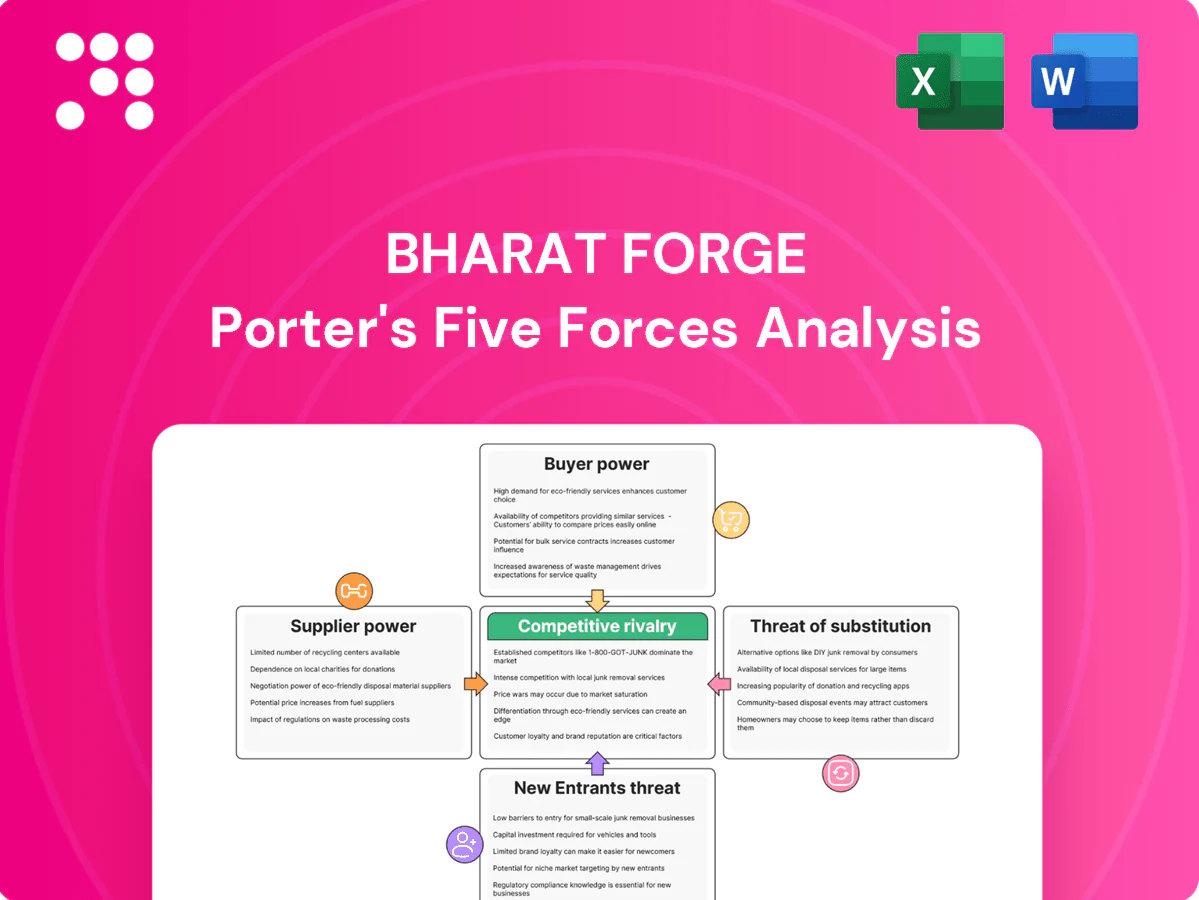
This Bharat Forge Porter's Five Forces Analysis provides a clear assessment of competitive rivalry, supplier and buyer power, threat of substitutes, and barriers to entry, with actionable insights for investors and strategists. This preview is the exact, fully formatted document you will receive immediately after purchase—no samples or placeholders. Use it right away for decision-making or presentation needs.

Elevate Your Analysis with the Complete Porter's Five Forces Analysis
Bharat Forge operates in a capital-intensive, cyclical sector where supplier leverage, buyer concentration, and substitution risks shape margins and growth prospects. Our snapshot highlights key competitive pressures and strategic differentiators but omits force-by-force ratings and visuals. Unlock the full Porter's Five Forces Analysis to quantify threats, uncover opportunities, and guide investment or strategy. Get the complete, consultant-grade report for immediate use.
Suppliers Bargaining Power
Specialty steel dependence
Inputs for Bharat Forge include alloy and specialty steels with tight chemistries and cleanliness norms, which limits the pool of qualified mills. Fewer approved suppliers increase suppliers’ leverage on pricing and allocation. Long-term contracts and hedging can moderate raw-material volatility, though surcharge pass-throughs commonly lag market moves. Localization and multi-sourcing strategies reduce single-mill concentration risk.
Capital equipment OEMs
Large forging presses, heat‑treatment furnaces and CNCs are sourced from a handful of global OEMs (SMS, Schuler, Danieli, FATA), concentrating supply and granting pricing power as lead times for new presses often reach 12–18 months. Spare parts, proprietary maintenance and retrofit upgrades create vendor lock‑in and switching costs; preventive maintenance and in‑house refurbishment programs can materially reduce this dependence and recurring capex.
Energy and gas intensity
Forging is highly electricity- and gas-intensive, leaving Bharat Forge exposed to industrial tariffs that vary across India roughly 6–12 INR/kWh and to volatile gas/LNG prices (spot averaged about 12–16 USD/MMBtu in 2024). Limited alternative energy sources near key plants increases supplier leverage and cost pass-through risk. Captive power, waste-heat recovery and PPAs—used by peers to cut 10–30% of energy costs—can blunt volatility, while geographic diversification balances regional utility risks.
Tooling and die makers
- Limited suppliers — concentrated expertise
- Lead times 12–20 weeks — raises supplier power
- In-house tools + digital simulation — lowers dependence
- Standardization — up to 15% tooling cost reduction
Logistics and alloy inputs
Logistics and alloy inputs tighten supplier power for Bharat Forge as international seaborne trade carries roughly 80% of merchandise by volume, making port and freight disruptions highly impactful; concentrated refining of nickel, molybdenum and vanadium in few hubs adds pricing risk while scrap market swings increase input volatility.
- Ports/geopolitics amplify leverage
- Alloy concentration raises price risk
- Scrap market volatility
- Inventory buffers & near‑shoring mitigate
Concentrated alloy suppliers; presses 12–18 months, dies 12–20 weeks, energy exposure high
Suppliers of alloy steels, presses and precision dies are concentrated, giving pricing and lead‑time leverage (presses 12–18 months; dies 12–20 weeks). Energy exposure (6–12 INR/kWh; gas 12–16 USD/MMBtu in 2024) and alloy/refining concentration raise cost risk. In‑house tooling, localization, PPAs and multi‑sourcing materially reduce supplier power.
| Factor | 2024 Data |
|---|---|
| Press lead time | 12–18 months |
| Die lead time | 12–20 weeks |
| Energy | 6–12 INR/kWh; gas 12–16 USD/MMBtu |
| Die simulation adoption | ~40% |
What is included in the product
Detailed Word Document
Tailored Porter's Five Forces for Bharat Forge that uncovers competitive drivers, supplier and buyer power, entry barriers, substitutes and disruptive threats to its market share. Useable in investor decks, strategy reports, or academic work.
Customizable Excel Spreadsheet
One-page Porter’s Five Forces for Bharat Forge—clear radar chart and customizable pressure levels make strategic risks and strengths instantly actionable, easy to drop into pitch decks or dashboards with no macros and quick data swaps for evolving market scenarios.
Customers Bargaining Power
OEM concentration
Automotive and industrial OEMs are few and large, exerting strong cost-down pressure—India's top OEMs held roughly 70–80% of vehicle market share in 2024, concentrating buying power. Their scale enables tough contract terms and penalties, but complex qualification cycles and high switching costs limit aggressive shifts. Long-term contracts often trade lower prices for volume stability; automotive sales were about 60% of Bharat Forge consolidated revenue in FY2024.
Dual-sourcing norms
OEMs mandate at least two approved suppliers per part, capping individual share at 50% and constraining pricing latitude while driving continuous improvement. For Bharat Forge, winning incremental share depends on demonstrable performance and cost leadership. Aggressive value-engineering can, however, win sole-source status on selected critical components.
Quality and certification demands
Buyers requiring PPAP, AS9100, IATF 16949 and full traceability raise supplier compliance costs — in 2024 OEMs increased supplier audit intensity, pushing certification and traceability investments that can add up to 5–10% to unit costs.
Cyclical volumes
Bargaining power of customers is cyclical as end-markets—auto, CV, O&G, aerospace—swing with cycles; in 2024 downturn pockets buyers renegotiated prices and shifted volumes aggressively, while 2024 upcycle capacity tightness tightened supplier leverage and reduced buyer power. A diversified sector mix smooths these swings for Bharat Forge.
- Downturn: aggressive renegotiation, volume shifts
- Upcycle 2024: capacity tightness lowers buyer power
- Diversification: reduces revenue volatility
Make-vs-buy decisions
Large OEMs can consider insourcing or shifting to lower-cost regions, but total cost of ownership, capex and specialized forging expertise often make outsourcing to Bharat Forge preferable; Bharat Forge exports to over 40 countries, strengthening its bargaining position. Co-development and design lock-in with OEMs reduce substitutability, while long-term supply agreements with indexation clauses balance commodity and currency risks.
- OEM option: insource or nearshore
- TCO/capex/expertise favor outsourcing
- Co-development → design lock-in
- Long-term indexed contracts share risk
OEMs 70-80% share; dual-sourcing and long qualifications limit switching
Few large OEMs (70–80% market share in 2024) exert strong price pressure, but long qualification cycles, dual-sourcing rules (≤50%) and high switching costs limit abrupt shifts. Automotive was ~60% of Bharat Forge consolidated revenue in FY2024; supplier compliance added ~5–10% to unit costs in 2024. Exports to 40+ countries and co-development raise switching barriers.
| Metric | Value (2024) |
|---|---|
| Top OEM share | 70–80% |
| Auto share of BF revenue | ~60% (FY2024) |
| Compliance cost impact | 5–10% |
| Export footprint | 40+ countries |
| Max per-part share | 50% (dual sourcing) |
Preview Before You Purchase
Bharat Forge Porter's Five Forces Analysis
This Bharat Forge Porter's Five Forces Analysis provides a clear assessment of competitive rivalry, supplier and buyer power, threat of substitutes, and barriers to entry, with actionable insights for investors and strategists. This preview is the exact, fully formatted document you will receive immediately after purchase—no samples or placeholders. Use it right away for decision-making or presentation needs.
Original: $10.00
-65%$10.00
$3.50Description
Elevate Your Analysis with the Complete Porter's Five Forces Analysis
Bharat Forge operates in a capital-intensive, cyclical sector where supplier leverage, buyer concentration, and substitution risks shape margins and growth prospects. Our snapshot highlights key competitive pressures and strategic differentiators but omits force-by-force ratings and visuals. Unlock the full Porter's Five Forces Analysis to quantify threats, uncover opportunities, and guide investment or strategy. Get the complete, consultant-grade report for immediate use.
Suppliers Bargaining Power
Specialty steel dependence
Inputs for Bharat Forge include alloy and specialty steels with tight chemistries and cleanliness norms, which limits the pool of qualified mills. Fewer approved suppliers increase suppliers’ leverage on pricing and allocation. Long-term contracts and hedging can moderate raw-material volatility, though surcharge pass-throughs commonly lag market moves. Localization and multi-sourcing strategies reduce single-mill concentration risk.
Capital equipment OEMs
Large forging presses, heat‑treatment furnaces and CNCs are sourced from a handful of global OEMs (SMS, Schuler, Danieli, FATA), concentrating supply and granting pricing power as lead times for new presses often reach 12–18 months. Spare parts, proprietary maintenance and retrofit upgrades create vendor lock‑in and switching costs; preventive maintenance and in‑house refurbishment programs can materially reduce this dependence and recurring capex.
Energy and gas intensity
Forging is highly electricity- and gas-intensive, leaving Bharat Forge exposed to industrial tariffs that vary across India roughly 6–12 INR/kWh and to volatile gas/LNG prices (spot averaged about 12–16 USD/MMBtu in 2024). Limited alternative energy sources near key plants increases supplier leverage and cost pass-through risk. Captive power, waste-heat recovery and PPAs—used by peers to cut 10–30% of energy costs—can blunt volatility, while geographic diversification balances regional utility risks.
Tooling and die makers
- Limited suppliers — concentrated expertise
- Lead times 12–20 weeks — raises supplier power
- In-house tools + digital simulation — lowers dependence
- Standardization — up to 15% tooling cost reduction
Logistics and alloy inputs
Logistics and alloy inputs tighten supplier power for Bharat Forge as international seaborne trade carries roughly 80% of merchandise by volume, making port and freight disruptions highly impactful; concentrated refining of nickel, molybdenum and vanadium in few hubs adds pricing risk while scrap market swings increase input volatility.
- Ports/geopolitics amplify leverage
- Alloy concentration raises price risk
- Scrap market volatility
- Inventory buffers & near‑shoring mitigate
Concentrated alloy suppliers; presses 12–18 months, dies 12–20 weeks, energy exposure high
Suppliers of alloy steels, presses and precision dies are concentrated, giving pricing and lead‑time leverage (presses 12–18 months; dies 12–20 weeks). Energy exposure (6–12 INR/kWh; gas 12–16 USD/MMBtu in 2024) and alloy/refining concentration raise cost risk. In‑house tooling, localization, PPAs and multi‑sourcing materially reduce supplier power.
| Factor | 2024 Data |
|---|---|
| Press lead time | 12–18 months |
| Die lead time | 12–20 weeks |
| Energy | 6–12 INR/kWh; gas 12–16 USD/MMBtu |
| Die simulation adoption | ~40% |
What is included in the product
Detailed Word Document
Tailored Porter's Five Forces for Bharat Forge that uncovers competitive drivers, supplier and buyer power, entry barriers, substitutes and disruptive threats to its market share. Useable in investor decks, strategy reports, or academic work.
Customizable Excel Spreadsheet
One-page Porter’s Five Forces for Bharat Forge—clear radar chart and customizable pressure levels make strategic risks and strengths instantly actionable, easy to drop into pitch decks or dashboards with no macros and quick data swaps for evolving market scenarios.
Customers Bargaining Power
OEM concentration
Automotive and industrial OEMs are few and large, exerting strong cost-down pressure—India's top OEMs held roughly 70–80% of vehicle market share in 2024, concentrating buying power. Their scale enables tough contract terms and penalties, but complex qualification cycles and high switching costs limit aggressive shifts. Long-term contracts often trade lower prices for volume stability; automotive sales were about 60% of Bharat Forge consolidated revenue in FY2024.
Dual-sourcing norms
OEMs mandate at least two approved suppliers per part, capping individual share at 50% and constraining pricing latitude while driving continuous improvement. For Bharat Forge, winning incremental share depends on demonstrable performance and cost leadership. Aggressive value-engineering can, however, win sole-source status on selected critical components.
Quality and certification demands
Buyers requiring PPAP, AS9100, IATF 16949 and full traceability raise supplier compliance costs — in 2024 OEMs increased supplier audit intensity, pushing certification and traceability investments that can add up to 5–10% to unit costs.
Cyclical volumes
Bargaining power of customers is cyclical as end-markets—auto, CV, O&G, aerospace—swing with cycles; in 2024 downturn pockets buyers renegotiated prices and shifted volumes aggressively, while 2024 upcycle capacity tightness tightened supplier leverage and reduced buyer power. A diversified sector mix smooths these swings for Bharat Forge.
- Downturn: aggressive renegotiation, volume shifts
- Upcycle 2024: capacity tightness lowers buyer power
- Diversification: reduces revenue volatility
Make-vs-buy decisions
Large OEMs can consider insourcing or shifting to lower-cost regions, but total cost of ownership, capex and specialized forging expertise often make outsourcing to Bharat Forge preferable; Bharat Forge exports to over 40 countries, strengthening its bargaining position. Co-development and design lock-in with OEMs reduce substitutability, while long-term supply agreements with indexation clauses balance commodity and currency risks.
- OEM option: insource or nearshore
- TCO/capex/expertise favor outsourcing
- Co-development → design lock-in
- Long-term indexed contracts share risk
OEMs 70-80% share; dual-sourcing and long qualifications limit switching
Few large OEMs (70–80% market share in 2024) exert strong price pressure, but long qualification cycles, dual-sourcing rules (≤50%) and high switching costs limit abrupt shifts. Automotive was ~60% of Bharat Forge consolidated revenue in FY2024; supplier compliance added ~5–10% to unit costs in 2024. Exports to 40+ countries and co-development raise switching barriers.
| Metric | Value (2024) |
|---|---|
| Top OEM share | 70–80% |
| Auto share of BF revenue | ~60% (FY2024) |
| Compliance cost impact | 5–10% |
| Export footprint | 40+ countries |
| Max per-part share | 50% (dual sourcing) |
Preview Before You Purchase
Bharat Forge Porter's Five Forces Analysis
This Bharat Forge Porter's Five Forces Analysis provides a clear assessment of competitive rivalry, supplier and buyer power, threat of substitutes, and barriers to entry, with actionable insights for investors and strategists. This preview is the exact, fully formatted document you will receive immediately after purchase—no samples or placeholders. Use it right away for decision-making or presentation needs.











