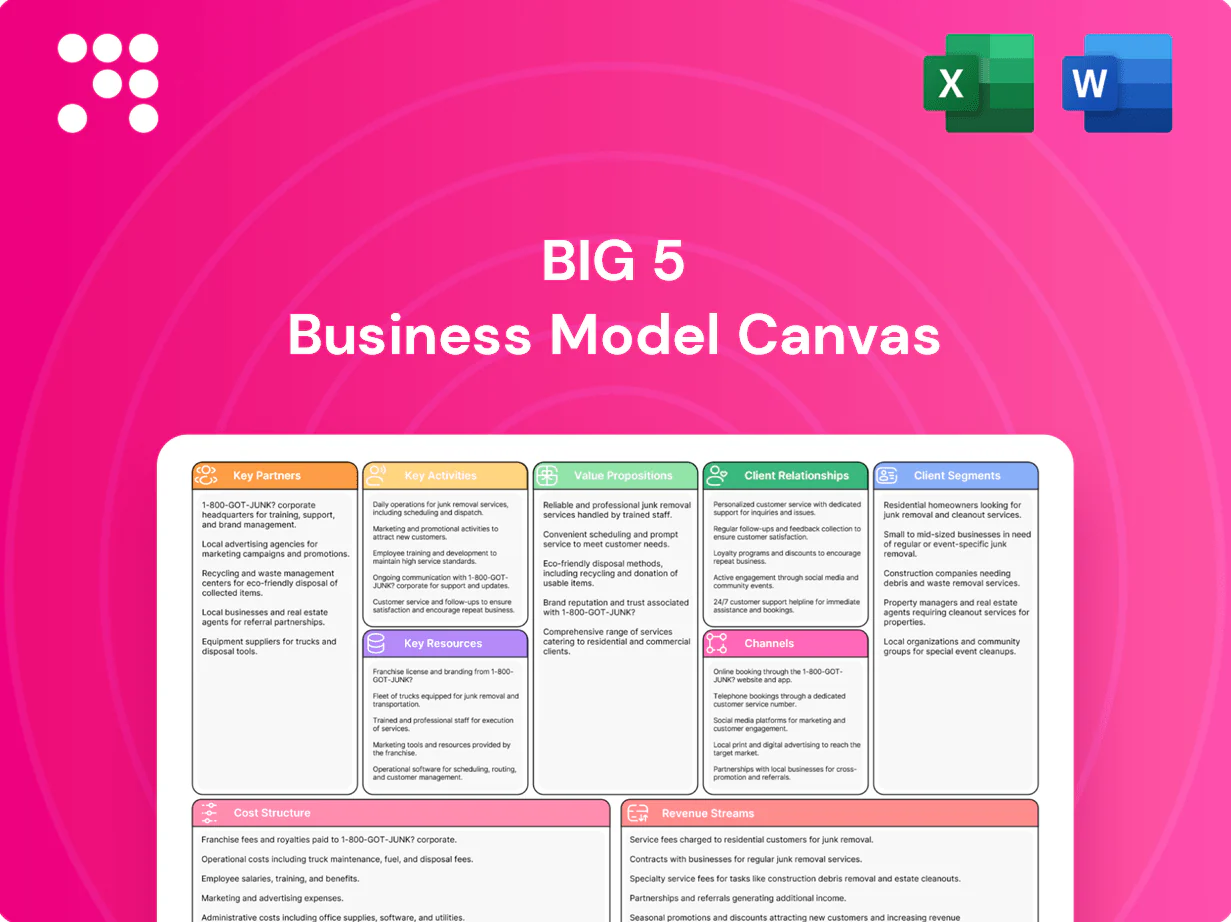
Big 5 Business Model Canvas

Retail business model canvas: concise strategic blueprint for growth
Unlock the full strategic blueprint behind Big 5’s business model with our concise Business Model Canvas—three sentences won't do it justice, but this preview shows how value is created, scaled, and monetized. Ideal for entrepreneurs, consultants, and investors seeking actionable clarity. Purchase the complete, editable Word and Excel canvas to analyze every block and apply proven strategies to your own plans.
Partnerships

National brand suppliers
Partnerships with national footwear, apparel and equipment brands (Nike FY2024 revenue $51.9B) secure breadth and credibility across core categories. Favorable buying terms and co-op funding enable promotions and seasonal assortments that improve margins. Joint marketing campaigns historically lift store traffic and conversion double-digits year-over-year. Reliable supply from brand partners cuts stockouts and supports consistent value pricing.
Outdoor, hunting, and fishing vendors
Specialty suppliers supply camping, hunting, fishing, and tactical gear, supporting a U.S. outdoor gear market estimated at about $56 billion in 2024 and rising demand for performance and technical SKU attributes.
Compliance-ready partners ensure firearms, ammunition, and marine products meet federal and state regulatory standards, reducing liability and time-to-shelf.
Exclusive SKUs and curated bundles increase margin and customer loyalty, while seasonal allocations concentrate inventory for Q2–Q3 peak demand cycles.

Logistics and distribution providers
Freight carriers and 3PLs, in a global 3PL market valued at about $1.14 trillion in 2024, support inbound and outbound flows and scale peak-season capacity. Regional trucking partners shorten lead times and can cut replenishment costs and transit times by roughly 20–25%, improving shelf availability. Parcel carriers enable e-commerce growth (e-commerce ~16.6% of retail sales in 2024) and BOPIS adoption (around 18% of omnichannel orders). Contracted contingency capacity reduces disruption-driven stockouts and expedited spend during shocks.

Landlords and retail centers
Landlords of strip malls and neighborhood centers secure high-visibility, convenience-driven sites that attract value shoppers and support omnichannel pickup. Flexible short- and mid-term leases enable rapid market optimization and SKU testing to match local demand. Co-tenancy with complementary retailers amplifies foot traffic and lowers customer acquisition costs for the Big 5 format.
- High-visibility locations
- Flexible leases
- Co-tenancy benefits
- Localized site selection
Community leagues and licensing authorities
- Youth channel: 7.8M high school athletes (2023–24)
- Bulk sales: higher average order value from teams
- Licensing tie-ins: ~10–12M licensed hunters/fishers
- Outcome: increased repeat visits and community trust
Strategic brand partnerships, specialty suppliers and 3PLs unlock omnichannel growth
Strategic brand partnerships (Nike FY2024 revenue 51.9B) drive assortment, co-op funding and margin lift; specialty suppliers capture a US outdoor gear market ≈56B (2024). Compliance partners reduce regulatory risk for firearms/marine lines. 3PLs and carriers (global 3PL market 1.14T; e-commerce 16.6% of retail 2024) enable omnichannel scale and peak-season resilience.
| Partner | 2024 metric |
|---|---|
| Brand | Nike rev 51.9B |
| Outdoor market | 56B |
| 3PL | 1.14T |
What is included in the product
 Detailed Word Document
A concise, investor-ready Big 5 Business Model Canvas presenting five core strategic pillars—customer, value proposition, channels, revenue, and operations—with clear narratives and linked SWOT insights. Ideal for presentations, funding pitches, and rapid validation of business strategies using real-world data.

 Customizable Excel Spreadsheet
High-level, one-page Big 5 Business Model Canvas that pinpoints and alleviates strategic pain points across customers, value propositions, channels, revenue and resources with editable cells for fast prioritization and action.
Activities

Merchandising and assortment planning
Curate seasonal and regional assortments across sports and outdoors, targeting private label at 20–25% of SKU mix to drive margin while keeping key national brands; data-driven planograms raise sell-through by ~10% vs. manual layouts; align promotions to clear end-of-season inventory with typical markdowns of 30–50%; use weekly sell-through analytics to reallocate stock and adjust buys in near real time.
Inventory and supply chain management
Forecast demand to sustain 95%+ in-stock while driving 8–10 inventory turns to keep working capital lean. Optimize DC-to-store replenishment cadence to daily or multi-drop models, cutting lead-time variability by ~20%. Increase safety stock ~20% ahead of peak seasons to avoid stockouts. Tighten shrink controls and quarterly audits to push shrink below 1% versus ~1.5% industry average.

In-store customer service and selling
In Big 5s ~265 stores (2024) frontline associates provide fit assistance for footwear and gear selection and deliver product education for outdoor and compliance-sensitive categories to reduce returns and liability. Associates execute add-on and attachment selling to raise average transaction value, while streamlined POS and curbside pickup options enable quick checkout and faster fulfillment.

Omnichannel operations
Operate e-commerce, BOPIS and ship-from-store workflows with synchronized fulfillment to reduce lead times and capture demand; 2024 data shows omnichannel shoppers spend ~2.4x more than single-channel shoppers.
Maintain accurate real-time store inventory online via centralized IMS; retailers reporting real-time visibility in 2024 saw materially fewer stockouts.
Coordinate promotions across digital and print circulars and streamline returns across channels to lower return costs and boost retention.
- Run e-commerce, BOPIS, ship-from-store
- Real-time store inventory online
- Coordinated digital+print promotions
- Streamlined cross-channel returns
Local marketing and promotions
- Weekly ads + digital offers: 15% YoY coupon lift (2024)
- Local sponsorships: community visibility
- Seasonal doorbusters: rapid inventory turnover
- Social media: real-time, geotargeted reach
Achieve 95%+ in-stock, 8–10 turns, 2.4x omnichannel spend
Curate 20–25% private‑label assortments, data planograms +10% sell‑through, and 30–50% end‑of‑season markdowns. Target 95%+ in‑stock with 8–10 turns, DC cadence reducing lead variability ~20%. 265 stores (2024) drive fit assistance and omnichannel fulfillment; omnishoppers spend ~2.4x and coupon redemptions +15% (2024).
| Metric | 2024 |
|---|---|
| Stores | 265 |
| In‑stock | 95%+ |
| Inventory turns | 8–10 |
| Omnichannel spend | 2.4x |
Preview Before You Purchase
Business Model Canvas
The preview you see is the actual Big 5 Business Model Canvas document, not a mockup. After purchase you will receive this same complete, editable file ready for use. No hidden pages or altered layouts—what you preview is what you download and own.

Retail business model canvas: concise strategic blueprint for growth
Unlock the full strategic blueprint behind Big 5’s business model with our concise Business Model Canvas—three sentences won't do it justice, but this preview shows how value is created, scaled, and monetized. Ideal for entrepreneurs, consultants, and investors seeking actionable clarity. Purchase the complete, editable Word and Excel canvas to analyze every block and apply proven strategies to your own plans.
Partnerships
National brand suppliers
Partnerships with national footwear, apparel and equipment brands (Nike FY2024 revenue $51.9B) secure breadth and credibility across core categories. Favorable buying terms and co-op funding enable promotions and seasonal assortments that improve margins. Joint marketing campaigns historically lift store traffic and conversion double-digits year-over-year. Reliable supply from brand partners cuts stockouts and supports consistent value pricing.
Outdoor, hunting, and fishing vendors
Specialty suppliers supply camping, hunting, fishing, and tactical gear, supporting a U.S. outdoor gear market estimated at about $56 billion in 2024 and rising demand for performance and technical SKU attributes.
Compliance-ready partners ensure firearms, ammunition, and marine products meet federal and state regulatory standards, reducing liability and time-to-shelf.
Exclusive SKUs and curated bundles increase margin and customer loyalty, while seasonal allocations concentrate inventory for Q2–Q3 peak demand cycles.
Logistics and distribution providers
Freight carriers and 3PLs, in a global 3PL market valued at about $1.14 trillion in 2024, support inbound and outbound flows and scale peak-season capacity. Regional trucking partners shorten lead times and can cut replenishment costs and transit times by roughly 20–25%, improving shelf availability. Parcel carriers enable e-commerce growth (e-commerce ~16.6% of retail sales in 2024) and BOPIS adoption (around 18% of omnichannel orders). Contracted contingency capacity reduces disruption-driven stockouts and expedited spend during shocks.
Landlords and retail centers
Landlords of strip malls and neighborhood centers secure high-visibility, convenience-driven sites that attract value shoppers and support omnichannel pickup. Flexible short- and mid-term leases enable rapid market optimization and SKU testing to match local demand. Co-tenancy with complementary retailers amplifies foot traffic and lowers customer acquisition costs for the Big 5 format.
- High-visibility locations
- Flexible leases
- Co-tenancy benefits
- Localized site selection
Community leagues and licensing authorities
- Youth channel: 7.8M high school athletes (2023–24)
- Bulk sales: higher average order value from teams
- Licensing tie-ins: ~10–12M licensed hunters/fishers
- Outcome: increased repeat visits and community trust
Strategic brand partnerships, specialty suppliers and 3PLs unlock omnichannel growth
Strategic brand partnerships (Nike FY2024 revenue 51.9B) drive assortment, co-op funding and margin lift; specialty suppliers capture a US outdoor gear market ≈56B (2024). Compliance partners reduce regulatory risk for firearms/marine lines. 3PLs and carriers (global 3PL market 1.14T; e-commerce 16.6% of retail 2024) enable omnichannel scale and peak-season resilience.
| Partner | 2024 metric |
|---|---|
| Brand | Nike rev 51.9B |
| Outdoor market | 56B |
| 3PL | 1.14T |
What is included in the product
Detailed Word Document
A concise, investor-ready Big 5 Business Model Canvas presenting five core strategic pillars—customer, value proposition, channels, revenue, and operations—with clear narratives and linked SWOT insights. Ideal for presentations, funding pitches, and rapid validation of business strategies using real-world data.
Customizable Excel Spreadsheet
High-level, one-page Big 5 Business Model Canvas that pinpoints and alleviates strategic pain points across customers, value propositions, channels, revenue and resources with editable cells for fast prioritization and action.
Activities
Merchandising and assortment planning
Curate seasonal and regional assortments across sports and outdoors, targeting private label at 20–25% of SKU mix to drive margin while keeping key national brands; data-driven planograms raise sell-through by ~10% vs. manual layouts; align promotions to clear end-of-season inventory with typical markdowns of 30–50%; use weekly sell-through analytics to reallocate stock and adjust buys in near real time.
Inventory and supply chain management
Forecast demand to sustain 95%+ in-stock while driving 8–10 inventory turns to keep working capital lean. Optimize DC-to-store replenishment cadence to daily or multi-drop models, cutting lead-time variability by ~20%. Increase safety stock ~20% ahead of peak seasons to avoid stockouts. Tighten shrink controls and quarterly audits to push shrink below 1% versus ~1.5% industry average.
In-store customer service and selling
In Big 5s ~265 stores (2024) frontline associates provide fit assistance for footwear and gear selection and deliver product education for outdoor and compliance-sensitive categories to reduce returns and liability. Associates execute add-on and attachment selling to raise average transaction value, while streamlined POS and curbside pickup options enable quick checkout and faster fulfillment.
Omnichannel operations
Operate e-commerce, BOPIS and ship-from-store workflows with synchronized fulfillment to reduce lead times and capture demand; 2024 data shows omnichannel shoppers spend ~2.4x more than single-channel shoppers.
Maintain accurate real-time store inventory online via centralized IMS; retailers reporting real-time visibility in 2024 saw materially fewer stockouts.
Coordinate promotions across digital and print circulars and streamline returns across channels to lower return costs and boost retention.
- Run e-commerce, BOPIS, ship-from-store
- Real-time store inventory online
- Coordinated digital+print promotions
- Streamlined cross-channel returns
Local marketing and promotions
- Weekly ads + digital offers: 15% YoY coupon lift (2024)
- Local sponsorships: community visibility
- Seasonal doorbusters: rapid inventory turnover
- Social media: real-time, geotargeted reach
Achieve 95%+ in-stock, 8–10 turns, 2.4x omnichannel spend
Curate 20–25% private‑label assortments, data planograms +10% sell‑through, and 30–50% end‑of‑season markdowns. Target 95%+ in‑stock with 8–10 turns, DC cadence reducing lead variability ~20%. 265 stores (2024) drive fit assistance and omnichannel fulfillment; omnishoppers spend ~2.4x and coupon redemptions +15% (2024).
| Metric | 2024 |
|---|---|
| Stores | 265 |
| In‑stock | 95%+ |
| Inventory turns | 8–10 |
| Omnichannel spend | 2.4x |
Preview Before You Purchase
Business Model Canvas
The preview you see is the actual Big 5 Business Model Canvas document, not a mockup. After purchase you will receive this same complete, editable file ready for use. No hidden pages or altered layouts—what you preview is what you download and own.
Original: $10.00
-65%$10.00
$3.50Description
Retail business model canvas: concise strategic blueprint for growth
Unlock the full strategic blueprint behind Big 5’s business model with our concise Business Model Canvas—three sentences won't do it justice, but this preview shows how value is created, scaled, and monetized. Ideal for entrepreneurs, consultants, and investors seeking actionable clarity. Purchase the complete, editable Word and Excel canvas to analyze every block and apply proven strategies to your own plans.
Partnerships
National brand suppliers
Partnerships with national footwear, apparel and equipment brands (Nike FY2024 revenue $51.9B) secure breadth and credibility across core categories. Favorable buying terms and co-op funding enable promotions and seasonal assortments that improve margins. Joint marketing campaigns historically lift store traffic and conversion double-digits year-over-year. Reliable supply from brand partners cuts stockouts and supports consistent value pricing.
Outdoor, hunting, and fishing vendors
Specialty suppliers supply camping, hunting, fishing, and tactical gear, supporting a U.S. outdoor gear market estimated at about $56 billion in 2024 and rising demand for performance and technical SKU attributes.
Compliance-ready partners ensure firearms, ammunition, and marine products meet federal and state regulatory standards, reducing liability and time-to-shelf.
Exclusive SKUs and curated bundles increase margin and customer loyalty, while seasonal allocations concentrate inventory for Q2–Q3 peak demand cycles.
Logistics and distribution providers
Freight carriers and 3PLs, in a global 3PL market valued at about $1.14 trillion in 2024, support inbound and outbound flows and scale peak-season capacity. Regional trucking partners shorten lead times and can cut replenishment costs and transit times by roughly 20–25%, improving shelf availability. Parcel carriers enable e-commerce growth (e-commerce ~16.6% of retail sales in 2024) and BOPIS adoption (around 18% of omnichannel orders). Contracted contingency capacity reduces disruption-driven stockouts and expedited spend during shocks.
Landlords and retail centers
Landlords of strip malls and neighborhood centers secure high-visibility, convenience-driven sites that attract value shoppers and support omnichannel pickup. Flexible short- and mid-term leases enable rapid market optimization and SKU testing to match local demand. Co-tenancy with complementary retailers amplifies foot traffic and lowers customer acquisition costs for the Big 5 format.
- High-visibility locations
- Flexible leases
- Co-tenancy benefits
- Localized site selection
Community leagues and licensing authorities
- Youth channel: 7.8M high school athletes (2023–24)
- Bulk sales: higher average order value from teams
- Licensing tie-ins: ~10–12M licensed hunters/fishers
- Outcome: increased repeat visits and community trust
Strategic brand partnerships, specialty suppliers and 3PLs unlock omnichannel growth
Strategic brand partnerships (Nike FY2024 revenue 51.9B) drive assortment, co-op funding and margin lift; specialty suppliers capture a US outdoor gear market ≈56B (2024). Compliance partners reduce regulatory risk for firearms/marine lines. 3PLs and carriers (global 3PL market 1.14T; e-commerce 16.6% of retail 2024) enable omnichannel scale and peak-season resilience.
| Partner | 2024 metric |
|---|---|
| Brand | Nike rev 51.9B |
| Outdoor market | 56B |
| 3PL | 1.14T |
What is included in the product
Detailed Word Document
A concise, investor-ready Big 5 Business Model Canvas presenting five core strategic pillars—customer, value proposition, channels, revenue, and operations—with clear narratives and linked SWOT insights. Ideal for presentations, funding pitches, and rapid validation of business strategies using real-world data.
Customizable Excel Spreadsheet
High-level, one-page Big 5 Business Model Canvas that pinpoints and alleviates strategic pain points across customers, value propositions, channels, revenue and resources with editable cells for fast prioritization and action.
Activities
Merchandising and assortment planning
Curate seasonal and regional assortments across sports and outdoors, targeting private label at 20–25% of SKU mix to drive margin while keeping key national brands; data-driven planograms raise sell-through by ~10% vs. manual layouts; align promotions to clear end-of-season inventory with typical markdowns of 30–50%; use weekly sell-through analytics to reallocate stock and adjust buys in near real time.
Inventory and supply chain management
Forecast demand to sustain 95%+ in-stock while driving 8–10 inventory turns to keep working capital lean. Optimize DC-to-store replenishment cadence to daily or multi-drop models, cutting lead-time variability by ~20%. Increase safety stock ~20% ahead of peak seasons to avoid stockouts. Tighten shrink controls and quarterly audits to push shrink below 1% versus ~1.5% industry average.
In-store customer service and selling
In Big 5s ~265 stores (2024) frontline associates provide fit assistance for footwear and gear selection and deliver product education for outdoor and compliance-sensitive categories to reduce returns and liability. Associates execute add-on and attachment selling to raise average transaction value, while streamlined POS and curbside pickup options enable quick checkout and faster fulfillment.
Omnichannel operations
Operate e-commerce, BOPIS and ship-from-store workflows with synchronized fulfillment to reduce lead times and capture demand; 2024 data shows omnichannel shoppers spend ~2.4x more than single-channel shoppers.
Maintain accurate real-time store inventory online via centralized IMS; retailers reporting real-time visibility in 2024 saw materially fewer stockouts.
Coordinate promotions across digital and print circulars and streamline returns across channels to lower return costs and boost retention.
- Run e-commerce, BOPIS, ship-from-store
- Real-time store inventory online
- Coordinated digital+print promotions
- Streamlined cross-channel returns
Local marketing and promotions
- Weekly ads + digital offers: 15% YoY coupon lift (2024)
- Local sponsorships: community visibility
- Seasonal doorbusters: rapid inventory turnover
- Social media: real-time, geotargeted reach
Achieve 95%+ in-stock, 8–10 turns, 2.4x omnichannel spend
Curate 20–25% private‑label assortments, data planograms +10% sell‑through, and 30–50% end‑of‑season markdowns. Target 95%+ in‑stock with 8–10 turns, DC cadence reducing lead variability ~20%. 265 stores (2024) drive fit assistance and omnichannel fulfillment; omnishoppers spend ~2.4x and coupon redemptions +15% (2024).
| Metric | 2024 |
|---|---|
| Stores | 265 |
| In‑stock | 95%+ |
| Inventory turns | 8–10 |
| Omnichannel spend | 2.4x |
Preview Before You Purchase
Business Model Canvas
The preview you see is the actual Big 5 Business Model Canvas document, not a mockup. After purchase you will receive this same complete, editable file ready for use. No hidden pages or altered layouts—what you preview is what you download and own.











