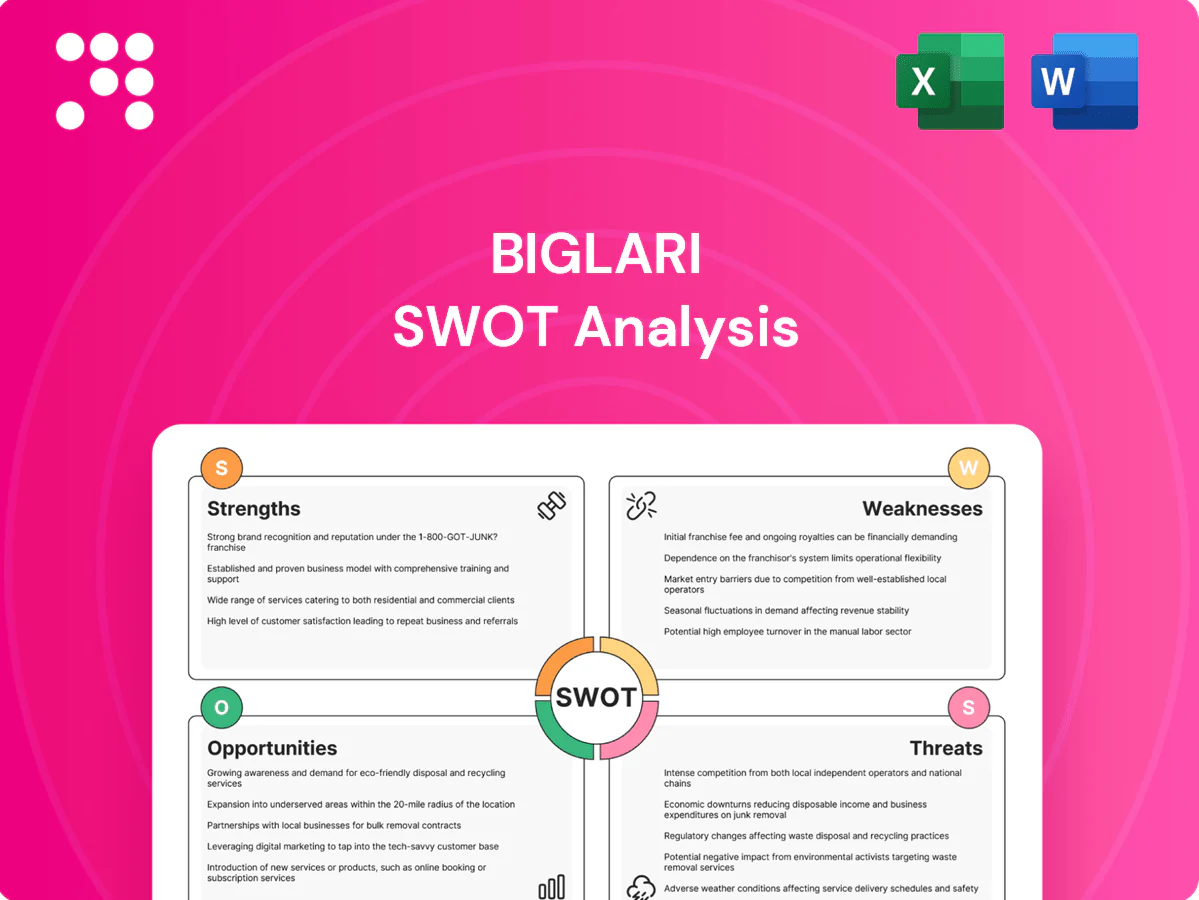
Biglari SWOT Analysis

Elevate Your Analysis with the Complete SWOT Report
Explore Biglari’s strategic landscape with our concise SWOT preview—highlighting its core strengths, competitive threats, market opportunities, and operational weaknesses. Want the full, investor-ready analysis? Purchase the complete SWOT for a research-backed Word report plus an editable Excel matrix to support decisions, presentations, and strategy execution.
Strengths

Diverse holdings
Diverse holdings mean Biglari relies on restaurants and insurance rather than a single cash stream, with the countercyclical nature of dining and underwriting smoothing consolidated earnings across cycles. This mix creates optionality to reallocate capital toward higher-return segments as opportunities arise, and strengthens resilience when one sector faces a downturn.
Owner-operator focus
Owner-operator leadership at Biglari prioritizes long-term value creation over quarterly results, with a centralized capital allocation model that reallocates cash rapidly to higher risk-adjusted opportunities. This discipline compounds intrinsic value over time and permits contrarian investments during market dislocations. The approach aligns management incentives tightly with shareholder outcomes.

Recognized restaurant brand
Steak n Shake, founded in 1934, provides Biglari with strong brand equity and customer awareness that can be leveraged across channels. Its decades-long U.S. footprint supports scale economies in procurement and national marketing. Brand affinity can accelerate turnaround when paired with operational improvements. The recognized name also enables franchising and licensing initiatives.

Insurance cash flows
Insurance operations produce steady underwriting income and investable float that supply low-cost capital for Biglari to fund acquisitions or internal reinvestment, reducing reliance on external financing.
The segment diversifies revenue and enhances liquidity flexibility, helping offset restaurant-cyclicality and smoothing overall cash-flow volatility.
Opportunistic investing
The Biglari Holdings holding company model, led by Sardar Biglari and trading on NYSE under BH as of 2025, enables opportunistic purchases of undervalued assets across sectors. Patient capital deployment increases potential return on invested capital while a flexible mandate permits tactical reallocations as market conditions shift. This approach supports compounding through cycles.
- opportunistic multi-sector acquisitions
- patient deployment → higher ROIC potential
- flexible mandate for tactical shifts
- compounding capital across cycles
Owner-led group merges restaurants and insurance, using underwriting float to compound value
Biglari combines restaurants and insurance, smoothing consolidated earnings via countercyclical dining and underwriting cash flows. Owner-operator leadership under Sardar Biglari emphasizes long-term capital allocation and opportunistic acquisitions, enabling contrarian investments and compounding value. Steak n Shake (founded 1934) supplies brand equity and scale; insurance operations provide investable float to fund growth.
| Metric | Detail |
|---|---|
| Ticker | BH (NYSE, 2025) |
| CEO | Sardar Biglari |
| Key brand | Steak n Shake (est. 1934) |
What is included in the product
 Detailed Word Document
Provides a concise SWOT overview of Biglari, outlining strengths, weaknesses, opportunities and threats while assessing competitive positioning, diversification across restaurant and investment holdings, operational capabilities, governance risks, and key growth levers.

 Customizable Excel Spreadsheet
Provides a focused SWOT snapshot of Biglari to quickly surface core strengths, weaknesses, opportunities and threats, reducing research time for executives and investors and enabling faster strategic decisions.
Weaknesses

Restaurant concentration
Steak n Shake still drives a large share of Biglari's operations and brand identity; with roughly 350 restaurants its performance swings can disproportionately move consolidated results. Turnarounds have proven lengthy and capital-intensive, often requiring store-level investment and marketing that strains cash flow. Concentration raises exposure to food cost, labor and traffic volatility, amplifying earnings sensitivity.
Scale limitations
Compared with mega-conglomerates, Biglari's portfolio remains compact—market capitalization under $1 billion versus Berkshire Hathaway's >$700 billion—reducing bargaining leverage and access to ultra-low-cost capital. Limited scale curtails diversification benefits in severe downturns and concentrates downside risk. Smaller size can constrain transformative deal flow and limit pursuit of large strategic acquisitions.

Execution complexity
Managing restaurants and insurance demands different capabilities and systems, with US restaurants generating roughly $900B in 2023 and operating margins typically 3–5%, while insurance performance is measured by combined ratios often in the 95–105% range; limited cross-segment synergies raise coordination costs, operational missteps in one unit can distract leadership, and divergent metrics can slow decision-making during critical pivots.

Brand refresh needs
Legacy restaurant assets need remodeling and tech upgrades; outdated units can dampen same-store sales and guest experience. Modernization demands capital and disciplined rollouts—typical capex ranges ~$150k–350k per unit (industry 2024). Delays risk losing share to digitally savvy competitors as digital orders reached roughly 25–30% of casual-dining traffic in 2024.
- Legacy assets: remodels + tech upgrades
- Capex: ~$150k–350k per unit (2024)
- Sales risk: weaker same-store sales, poorer guest experience
- Competitive threat: digital orders ~25–30% (2024)
Key-person dependence
Biglari Holdings exhibits key-person dependence as centralized capital allocation intensifies reliance on Sardar Biglari’s judgment; the firm trades under ticker BH on NYSE American, so leadership signals directly affect market perception. Succession planning and governance scrutiny can pressure valuation, and market confidence often wavers during leadership transitions, raising cost of capital in stressed periods.
- Centralized decision risk
- Succession/governance impact
- Market confidence volatility
- Higher cost of capital in stress
Concentrated 350-unit restaurant exposure heightens capital, governance and turnaround risks
Concentration in Steak n Shake (~350 restaurants) makes consolidated results sensitive to restaurant performance; turnarounds are capital-intensive and time-consuming. Limited scale (BH market cap < $1B vs Berkshire Hathaway > $700B) reduces bargaining power and access to cheap capital. Divergent businesses (restaurants vs insurance) add coordination costs and governance/key-person risk.
| Metric | Value |
|---|---|
| Steak n Shake units | ~350 |
| Digital orders (2024) | 25–30% |
| Capex per unit (2024) | $150k–350k |
| BH market cap | <$1B |
| Berkshire market cap | >$700B |
Full Version Awaits
Biglari SWOT Analysis
This is the actual SWOT analysis document you’ll receive upon purchase—no surprises, just professional quality. The preview below is taken directly from the full SWOT report you'll get; purchase unlocks the entire in-depth version. You’re viewing a live preview of the actual SWOT analysis file and the complete, editable report becomes available after checkout.

Elevate Your Analysis with the Complete SWOT Report
Explore Biglari’s strategic landscape with our concise SWOT preview—highlighting its core strengths, competitive threats, market opportunities, and operational weaknesses. Want the full, investor-ready analysis? Purchase the complete SWOT for a research-backed Word report plus an editable Excel matrix to support decisions, presentations, and strategy execution.
Strengths
Diverse holdings
Diverse holdings mean Biglari relies on restaurants and insurance rather than a single cash stream, with the countercyclical nature of dining and underwriting smoothing consolidated earnings across cycles. This mix creates optionality to reallocate capital toward higher-return segments as opportunities arise, and strengthens resilience when one sector faces a downturn.
Owner-operator focus
Owner-operator leadership at Biglari prioritizes long-term value creation over quarterly results, with a centralized capital allocation model that reallocates cash rapidly to higher risk-adjusted opportunities. This discipline compounds intrinsic value over time and permits contrarian investments during market dislocations. The approach aligns management incentives tightly with shareholder outcomes.
Recognized restaurant brand
Steak n Shake, founded in 1934, provides Biglari with strong brand equity and customer awareness that can be leveraged across channels. Its decades-long U.S. footprint supports scale economies in procurement and national marketing. Brand affinity can accelerate turnaround when paired with operational improvements. The recognized name also enables franchising and licensing initiatives.
Insurance cash flows
Insurance operations produce steady underwriting income and investable float that supply low-cost capital for Biglari to fund acquisitions or internal reinvestment, reducing reliance on external financing.
The segment diversifies revenue and enhances liquidity flexibility, helping offset restaurant-cyclicality and smoothing overall cash-flow volatility.
Opportunistic investing
The Biglari Holdings holding company model, led by Sardar Biglari and trading on NYSE under BH as of 2025, enables opportunistic purchases of undervalued assets across sectors. Patient capital deployment increases potential return on invested capital while a flexible mandate permits tactical reallocations as market conditions shift. This approach supports compounding through cycles.
- opportunistic multi-sector acquisitions
- patient deployment → higher ROIC potential
- flexible mandate for tactical shifts
- compounding capital across cycles
Owner-led group merges restaurants and insurance, using underwriting float to compound value
Biglari combines restaurants and insurance, smoothing consolidated earnings via countercyclical dining and underwriting cash flows. Owner-operator leadership under Sardar Biglari emphasizes long-term capital allocation and opportunistic acquisitions, enabling contrarian investments and compounding value. Steak n Shake (founded 1934) supplies brand equity and scale; insurance operations provide investable float to fund growth.
| Metric | Detail |
|---|---|
| Ticker | BH (NYSE, 2025) |
| CEO | Sardar Biglari |
| Key brand | Steak n Shake (est. 1934) |
What is included in the product
Detailed Word Document
Provides a concise SWOT overview of Biglari, outlining strengths, weaknesses, opportunities and threats while assessing competitive positioning, diversification across restaurant and investment holdings, operational capabilities, governance risks, and key growth levers.
Customizable Excel Spreadsheet
Provides a focused SWOT snapshot of Biglari to quickly surface core strengths, weaknesses, opportunities and threats, reducing research time for executives and investors and enabling faster strategic decisions.
Weaknesses
Restaurant concentration
Steak n Shake still drives a large share of Biglari's operations and brand identity; with roughly 350 restaurants its performance swings can disproportionately move consolidated results. Turnarounds have proven lengthy and capital-intensive, often requiring store-level investment and marketing that strains cash flow. Concentration raises exposure to food cost, labor and traffic volatility, amplifying earnings sensitivity.
Scale limitations
Compared with mega-conglomerates, Biglari's portfolio remains compact—market capitalization under $1 billion versus Berkshire Hathaway's >$700 billion—reducing bargaining leverage and access to ultra-low-cost capital. Limited scale curtails diversification benefits in severe downturns and concentrates downside risk. Smaller size can constrain transformative deal flow and limit pursuit of large strategic acquisitions.
Execution complexity
Managing restaurants and insurance demands different capabilities and systems, with US restaurants generating roughly $900B in 2023 and operating margins typically 3–5%, while insurance performance is measured by combined ratios often in the 95–105% range; limited cross-segment synergies raise coordination costs, operational missteps in one unit can distract leadership, and divergent metrics can slow decision-making during critical pivots.
Brand refresh needs
Legacy restaurant assets need remodeling and tech upgrades; outdated units can dampen same-store sales and guest experience. Modernization demands capital and disciplined rollouts—typical capex ranges ~$150k–350k per unit (industry 2024). Delays risk losing share to digitally savvy competitors as digital orders reached roughly 25–30% of casual-dining traffic in 2024.
- Legacy assets: remodels + tech upgrades
- Capex: ~$150k–350k per unit (2024)
- Sales risk: weaker same-store sales, poorer guest experience
- Competitive threat: digital orders ~25–30% (2024)
Key-person dependence
Biglari Holdings exhibits key-person dependence as centralized capital allocation intensifies reliance on Sardar Biglari’s judgment; the firm trades under ticker BH on NYSE American, so leadership signals directly affect market perception. Succession planning and governance scrutiny can pressure valuation, and market confidence often wavers during leadership transitions, raising cost of capital in stressed periods.
- Centralized decision risk
- Succession/governance impact
- Market confidence volatility
- Higher cost of capital in stress
Concentrated 350-unit restaurant exposure heightens capital, governance and turnaround risks
Concentration in Steak n Shake (~350 restaurants) makes consolidated results sensitive to restaurant performance; turnarounds are capital-intensive and time-consuming. Limited scale (BH market cap < $1B vs Berkshire Hathaway > $700B) reduces bargaining power and access to cheap capital. Divergent businesses (restaurants vs insurance) add coordination costs and governance/key-person risk.
| Metric | Value |
|---|---|
| Steak n Shake units | ~350 |
| Digital orders (2024) | 25–30% |
| Capex per unit (2024) | $150k–350k |
| BH market cap | <$1B |
| Berkshire market cap | >$700B |
Full Version Awaits
Biglari SWOT Analysis
This is the actual SWOT analysis document you’ll receive upon purchase—no surprises, just professional quality. The preview below is taken directly from the full SWOT report you'll get; purchase unlocks the entire in-depth version. You’re viewing a live preview of the actual SWOT analysis file and the complete, editable report becomes available after checkout.
Original: $10.00
-65%$10.00
$3.50Description
Elevate Your Analysis with the Complete SWOT Report
Explore Biglari’s strategic landscape with our concise SWOT preview—highlighting its core strengths, competitive threats, market opportunities, and operational weaknesses. Want the full, investor-ready analysis? Purchase the complete SWOT for a research-backed Word report plus an editable Excel matrix to support decisions, presentations, and strategy execution.
Strengths
Diverse holdings
Diverse holdings mean Biglari relies on restaurants and insurance rather than a single cash stream, with the countercyclical nature of dining and underwriting smoothing consolidated earnings across cycles. This mix creates optionality to reallocate capital toward higher-return segments as opportunities arise, and strengthens resilience when one sector faces a downturn.
Owner-operator focus
Owner-operator leadership at Biglari prioritizes long-term value creation over quarterly results, with a centralized capital allocation model that reallocates cash rapidly to higher risk-adjusted opportunities. This discipline compounds intrinsic value over time and permits contrarian investments during market dislocations. The approach aligns management incentives tightly with shareholder outcomes.
Recognized restaurant brand
Steak n Shake, founded in 1934, provides Biglari with strong brand equity and customer awareness that can be leveraged across channels. Its decades-long U.S. footprint supports scale economies in procurement and national marketing. Brand affinity can accelerate turnaround when paired with operational improvements. The recognized name also enables franchising and licensing initiatives.
Insurance cash flows
Insurance operations produce steady underwriting income and investable float that supply low-cost capital for Biglari to fund acquisitions or internal reinvestment, reducing reliance on external financing.
The segment diversifies revenue and enhances liquidity flexibility, helping offset restaurant-cyclicality and smoothing overall cash-flow volatility.
Opportunistic investing
The Biglari Holdings holding company model, led by Sardar Biglari and trading on NYSE under BH as of 2025, enables opportunistic purchases of undervalued assets across sectors. Patient capital deployment increases potential return on invested capital while a flexible mandate permits tactical reallocations as market conditions shift. This approach supports compounding through cycles.
- opportunistic multi-sector acquisitions
- patient deployment → higher ROIC potential
- flexible mandate for tactical shifts
- compounding capital across cycles
Owner-led group merges restaurants and insurance, using underwriting float to compound value
Biglari combines restaurants and insurance, smoothing consolidated earnings via countercyclical dining and underwriting cash flows. Owner-operator leadership under Sardar Biglari emphasizes long-term capital allocation and opportunistic acquisitions, enabling contrarian investments and compounding value. Steak n Shake (founded 1934) supplies brand equity and scale; insurance operations provide investable float to fund growth.
| Metric | Detail |
|---|---|
| Ticker | BH (NYSE, 2025) |
| CEO | Sardar Biglari |
| Key brand | Steak n Shake (est. 1934) |
What is included in the product
Detailed Word Document
Provides a concise SWOT overview of Biglari, outlining strengths, weaknesses, opportunities and threats while assessing competitive positioning, diversification across restaurant and investment holdings, operational capabilities, governance risks, and key growth levers.
Customizable Excel Spreadsheet
Provides a focused SWOT snapshot of Biglari to quickly surface core strengths, weaknesses, opportunities and threats, reducing research time for executives and investors and enabling faster strategic decisions.
Weaknesses
Restaurant concentration
Steak n Shake still drives a large share of Biglari's operations and brand identity; with roughly 350 restaurants its performance swings can disproportionately move consolidated results. Turnarounds have proven lengthy and capital-intensive, often requiring store-level investment and marketing that strains cash flow. Concentration raises exposure to food cost, labor and traffic volatility, amplifying earnings sensitivity.
Scale limitations
Compared with mega-conglomerates, Biglari's portfolio remains compact—market capitalization under $1 billion versus Berkshire Hathaway's >$700 billion—reducing bargaining leverage and access to ultra-low-cost capital. Limited scale curtails diversification benefits in severe downturns and concentrates downside risk. Smaller size can constrain transformative deal flow and limit pursuit of large strategic acquisitions.
Execution complexity
Managing restaurants and insurance demands different capabilities and systems, with US restaurants generating roughly $900B in 2023 and operating margins typically 3–5%, while insurance performance is measured by combined ratios often in the 95–105% range; limited cross-segment synergies raise coordination costs, operational missteps in one unit can distract leadership, and divergent metrics can slow decision-making during critical pivots.
Brand refresh needs
Legacy restaurant assets need remodeling and tech upgrades; outdated units can dampen same-store sales and guest experience. Modernization demands capital and disciplined rollouts—typical capex ranges ~$150k–350k per unit (industry 2024). Delays risk losing share to digitally savvy competitors as digital orders reached roughly 25–30% of casual-dining traffic in 2024.
- Legacy assets: remodels + tech upgrades
- Capex: ~$150k–350k per unit (2024)
- Sales risk: weaker same-store sales, poorer guest experience
- Competitive threat: digital orders ~25–30% (2024)
Key-person dependence
Biglari Holdings exhibits key-person dependence as centralized capital allocation intensifies reliance on Sardar Biglari’s judgment; the firm trades under ticker BH on NYSE American, so leadership signals directly affect market perception. Succession planning and governance scrutiny can pressure valuation, and market confidence often wavers during leadership transitions, raising cost of capital in stressed periods.
- Centralized decision risk
- Succession/governance impact
- Market confidence volatility
- Higher cost of capital in stress
Concentrated 350-unit restaurant exposure heightens capital, governance and turnaround risks
Concentration in Steak n Shake (~350 restaurants) makes consolidated results sensitive to restaurant performance; turnarounds are capital-intensive and time-consuming. Limited scale (BH market cap < $1B vs Berkshire Hathaway > $700B) reduces bargaining power and access to cheap capital. Divergent businesses (restaurants vs insurance) add coordination costs and governance/key-person risk.
| Metric | Value |
|---|---|
| Steak n Shake units | ~350 |
| Digital orders (2024) | 25–30% |
| Capex per unit (2024) | $150k–350k |
| BH market cap | <$1B |
| Berkshire market cap | >$700B |
Full Version Awaits
Biglari SWOT Analysis
This is the actual SWOT analysis document you’ll receive upon purchase—no surprises, just professional quality. The preview below is taken directly from the full SWOT report you'll get; purchase unlocks the entire in-depth version. You’re viewing a live preview of the actual SWOT analysis file and the complete, editable report becomes available after checkout.











