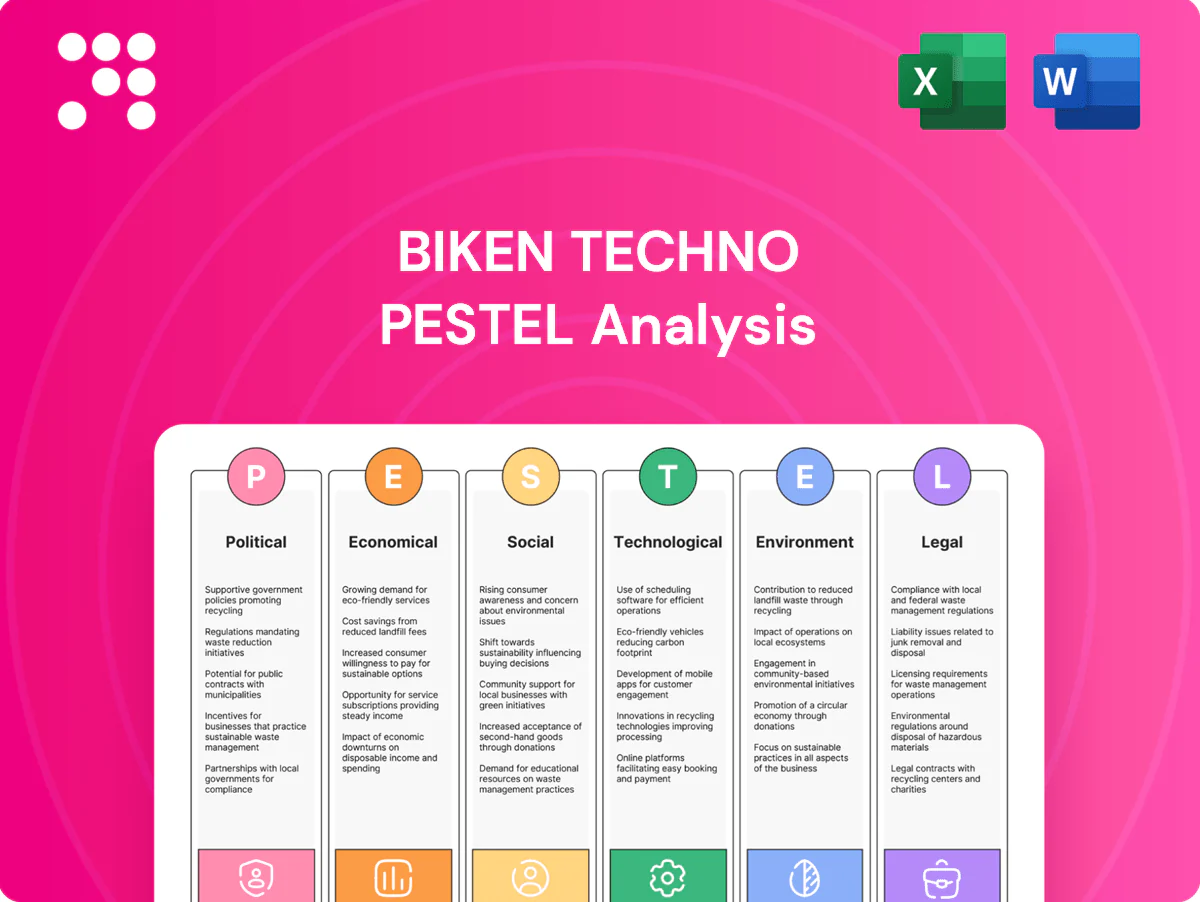
Biken Techno PESTLE Analysis

Your Competitive Advantage Starts with This Report
Unlock how political shifts, market dynamics, and tech trends are reshaping Biken Techno’s prospects with our focused PESTLE snapshot—ideal for investors and strategists. Get actionable insights, ready-to-use charts, and risk forecasts to inform decisions. Purchase the full PESTLE for the complete, editable analysis and immediate download.
Political factors

Public safety policy priorities
Government focus on disaster resilience, crime reduction, and critical infrastructure protection boosts demand for integrated security solutions, with global cybersecurity spending reaching about $210B in 2024 and the physical security market near $150B the same year.
National and local grant programs, including resilience and infrastructure funds totaling tens of billions annually in major markets, can accelerate approvals and enlarge project budgets.
Shifts in ruling coalitions often reallocate funds between physical and cyber domains; close alignment with policy roadmaps positions Biken Techno to capture funded needs.
Defense-civil security overlap
Convergence of defense and civilian security opens partnership and procurement opportunities as global defense spending tops $2.2 trillion (SIPRI 2023) and the US FY2025 budget is about $858 billion, driving civil agency buys. Export controls and security clearances can limit suppliers and delay partnerships. Dual-use scrutiny often slows deployment schedules. Managing compliance while accessing advanced tech will be a key competitive lever.

Urban planning and smart-city agendas
Smart-city initiatives increasingly mandate integrated surveillance, emergency response and unified data platforms, with the global smart-city market exceeding $500 billion in 2023. Municipal procurement cycles (commonly 6–24 months) and PPP structures materially affect project timelines and supplier margins. Strong political backing for urban digitization accelerates pilot-to-scale pathways, while participation in city-level consortiums steers standards adoption and vendor selection.

Geopolitical supply chain risks
Trade tensions and sanctions can choke access to sensors, chips and software stacks, with the global semiconductor market near $600B in 2023 and supply‑chain lead times rising ~40% during 2021–22, forcing country‑of‑origin constraints on sourcing. Political risk insurance and multi‑region suppliers reduce delay exposure, while transparent component provenance strengthens trust for critical security deployments.
- Sanctions risk: constrains suppliers
- Country‑of‑origin: limits sourcing options
- Mitigation: political risk insurance, multi‑region sourcing
- Trust: provenance increases adoption in security projects
Disaster governance and funding
Post-disaster reconstruction budgets often drive rapid procurement of prevention and early-warning systems, exemplified by Türkiye’s post-2023 reconstruction bill estimated at about 100 billion USD; national emergency frameworks increasingly mandate certification and interoperability standards; sustained political commitment to climate adaptation funds multi-year programs; proactive engagement with disaster agencies yields framework agreements and repeat contracts.
- Reconstruction budgets: Türkiye ~100 billion USD (post-2023)
- Standards: national emergency frameworks set certification/interoperability
- Funding horizon: political commitment enables multi-year adaptation programs
- Market access: framework agreements with disaster agencies = repeat work
Governments fund resilience, boosting integrated cyber and physical security projects
Government emphasis on resilience and critical‑infrastructure protection drives demand for integrated security (cybersecurity ~$210B 2024; physical security ~$150B 2024). Grants and reconstruction funds (Türkiye ~100B USD post‑2023) accelerate projects and multi‑year contracts. Trade tensions and export controls constrain sensors/chips (semiconductors ~600B 2023), while smart‑city mandates (>500B market 2023) speed procurement cycles.
| Metric | Value (year) |
|---|---|
| Cybersecurity spend | $210B (2024) |
| Physical security market | $150B (2024) |
| Smart‑city market | $500B+ (2023) |
| Defense spending (global) | $2.2T (SIPRI 2023) |
| Semiconductor market | $600B (2023) |
| Türkiye reconstruction | $100B (post‑2023) |
What is included in the product
 Detailed Word Document
Explores how Political, Economic, Social, Technological, Environmental, and Legal forces uniquely affect Biken Techno, with data-backed trends and region-specific examples to identify threats and opportunities; designed for executives, consultants, and investors seeking actionable, forward-looking insights for strategy, scenario planning, funding, and competitive positioning.

 Customizable Excel Spreadsheet
A concise, visually segmented PESTLE summary for Biken Techno that’s easily dropped into presentations or shared across teams, enabling quick alignment on external risks and market positioning; editable notes let users tailor insights to their region or business line for faster strategic decisions.
Economic factors

Capex cycles and security budgets
Macroeconomic conditions directly steer enterprise and public-sector security capex, with global cybersecurity spending topping $180 billion in 2023; in slowdowns buyers shift to retrofits and managed services over large upfront buys, while outcome-based contracts smooth revenues across cycles and clear ROI cases tied to quantifiable risk reduction help preserve allocated spend.
Insurance and risk pricing
Premium incentives for improved physical and cyber controls shift buyer behavior; insurers reported cyber premium increases of roughly 25–35% in North America by 2024, encouraging clients to adopt stronger controls. Collaboration with insurers enables Biken Techno to bundle validated solutions and access pilot programs that prove efficacy. Rising loss ratios—often exceeding 100% in cyber segments in 2023–24—push firms to invest in prevention. Verified performance data can unlock preferential terms and lower deductibles for clients.

Labor costs and skilled scarcity
Shortages in cybersecurity (ISC2 estimates a 3.4 million global gap in 2024), systems-integration and field technicians push delivery costs higher and extend lead times. Wage inflation—US private-sector average annual wage growth ~4.5% in 2024—squeezes service margins absent pricing discipline. Standardized architectures and remote monitoring can boost technician productivity by up to 20–25% (McKinsey). Expanded training pipelines and certifications cut project bottlenecks and time-to-deploy.

Component inflation and FX volatility
Sensor, semiconductor, and server price swings materially compress Biken Techno project margins as component spot prices and lead-time premiums fluctuate across cycles; FX moves (eg USD strength in 2024–H1 2025) raised import costs and reduced competitiveness on international bids.
Active hedging, multi-sourcing and inventory buffers have cut input-cost volatility and lead times; modular designs enable substitution of components without full redesign, preserving delivery schedules and margin.
- Component price volatility: affects margin per project
- FX moves: raise import costs, impact bid pricing
- Mitigation: hedging, multi-sourcing, inventory
- Design: modularity allows low-cost substitutions
Recurring revenue expansion
Maintenance, monitoring and MSSP-style offerings give Biken Techno predictable recurring revenue and align with a global MSSP CAGR near 10% (2024–2030), improving revenue visibility. SLA-backed services support 10–20% premium pricing and reinforce stickiness. Bundled lifecycle contracts can lift customer lifetime value by double-digit percentages while analytics add-ons create high-margin upsell paths with minimal hardware change; SaaS-like margins typically run 70–80%.
- Maintenance: predictable ARR
- MSSP: ~10% CAGR
- SLA: 10–20% price uplift
- Bundles: double-digit CLTV lift
- Analytics: high-margin upsell, minimal CAPEX
Governments fund resilience, boosting integrated cyber and physical security projects
Global cybersecurity spend reached ~$180B in 2023; buyers favor managed, outcome-based contracts to smooth capex and preserve spend in slowdowns.
North American cyber premiums rose ~25–35% by 2024, driving demand for validated controls and insurer partnerships that lower client deductibles.
Talent gap (~3.4M shortfall in 2024) and component/FX volatility (USD strength in 2024–H1) raise delivery costs, making hedging, multi-sourcing and modular design critical.
| Metric | Value | Impact |
|---|---|---|
| Cyber spend | $180B (2023) | Market size |
| MSSP CAGR | ~10% (2024–30) | ARR growth |
| Workforce gap | 3.4M (2024) | Higher wages/delays |
| Insur. premiums NA | 25–35% (2024) | Controls demand |
Preview Before You Purchase
Biken Techno PESTLE Analysis
The preview shown here is the exact Biken Techno PESTLE document you’ll receive after purchase—fully formatted and ready to use. No placeholders or teasers; the layout, content, and structure are identical to the downloadable file. After checkout you’ll instantly own this finished, professionally structured analysis.

Your Competitive Advantage Starts with This Report
Unlock how political shifts, market dynamics, and tech trends are reshaping Biken Techno’s prospects with our focused PESTLE snapshot—ideal for investors and strategists. Get actionable insights, ready-to-use charts, and risk forecasts to inform decisions. Purchase the full PESTLE for the complete, editable analysis and immediate download.
Political factors
Public safety policy priorities
Government focus on disaster resilience, crime reduction, and critical infrastructure protection boosts demand for integrated security solutions, with global cybersecurity spending reaching about $210B in 2024 and the physical security market near $150B the same year.
National and local grant programs, including resilience and infrastructure funds totaling tens of billions annually in major markets, can accelerate approvals and enlarge project budgets.
Shifts in ruling coalitions often reallocate funds between physical and cyber domains; close alignment with policy roadmaps positions Biken Techno to capture funded needs.
Defense-civil security overlap
Convergence of defense and civilian security opens partnership and procurement opportunities as global defense spending tops $2.2 trillion (SIPRI 2023) and the US FY2025 budget is about $858 billion, driving civil agency buys. Export controls and security clearances can limit suppliers and delay partnerships. Dual-use scrutiny often slows deployment schedules. Managing compliance while accessing advanced tech will be a key competitive lever.
Urban planning and smart-city agendas
Smart-city initiatives increasingly mandate integrated surveillance, emergency response and unified data platforms, with the global smart-city market exceeding $500 billion in 2023. Municipal procurement cycles (commonly 6–24 months) and PPP structures materially affect project timelines and supplier margins. Strong political backing for urban digitization accelerates pilot-to-scale pathways, while participation in city-level consortiums steers standards adoption and vendor selection.
Geopolitical supply chain risks
Trade tensions and sanctions can choke access to sensors, chips and software stacks, with the global semiconductor market near $600B in 2023 and supply‑chain lead times rising ~40% during 2021–22, forcing country‑of‑origin constraints on sourcing. Political risk insurance and multi‑region suppliers reduce delay exposure, while transparent component provenance strengthens trust for critical security deployments.
- Sanctions risk: constrains suppliers
- Country‑of‑origin: limits sourcing options
- Mitigation: political risk insurance, multi‑region sourcing
- Trust: provenance increases adoption in security projects
Disaster governance and funding
Post-disaster reconstruction budgets often drive rapid procurement of prevention and early-warning systems, exemplified by Türkiye’s post-2023 reconstruction bill estimated at about 100 billion USD; national emergency frameworks increasingly mandate certification and interoperability standards; sustained political commitment to climate adaptation funds multi-year programs; proactive engagement with disaster agencies yields framework agreements and repeat contracts.
- Reconstruction budgets: Türkiye ~100 billion USD (post-2023)
- Standards: national emergency frameworks set certification/interoperability
- Funding horizon: political commitment enables multi-year adaptation programs
- Market access: framework agreements with disaster agencies = repeat work
Governments fund resilience, boosting integrated cyber and physical security projects
Government emphasis on resilience and critical‑infrastructure protection drives demand for integrated security (cybersecurity ~$210B 2024; physical security ~$150B 2024). Grants and reconstruction funds (Türkiye ~100B USD post‑2023) accelerate projects and multi‑year contracts. Trade tensions and export controls constrain sensors/chips (semiconductors ~600B 2023), while smart‑city mandates (>500B market 2023) speed procurement cycles.
| Metric | Value (year) |
|---|---|
| Cybersecurity spend | $210B (2024) |
| Physical security market | $150B (2024) |
| Smart‑city market | $500B+ (2023) |
| Defense spending (global) | $2.2T (SIPRI 2023) |
| Semiconductor market | $600B (2023) |
| Türkiye reconstruction | $100B (post‑2023) |
What is included in the product
Detailed Word Document
Explores how Political, Economic, Social, Technological, Environmental, and Legal forces uniquely affect Biken Techno, with data-backed trends and region-specific examples to identify threats and opportunities; designed for executives, consultants, and investors seeking actionable, forward-looking insights for strategy, scenario planning, funding, and competitive positioning.
Customizable Excel Spreadsheet
A concise, visually segmented PESTLE summary for Biken Techno that’s easily dropped into presentations or shared across teams, enabling quick alignment on external risks and market positioning; editable notes let users tailor insights to their region or business line for faster strategic decisions.
Economic factors
Capex cycles and security budgets
Macroeconomic conditions directly steer enterprise and public-sector security capex, with global cybersecurity spending topping $180 billion in 2023; in slowdowns buyers shift to retrofits and managed services over large upfront buys, while outcome-based contracts smooth revenues across cycles and clear ROI cases tied to quantifiable risk reduction help preserve allocated spend.
Insurance and risk pricing
Premium incentives for improved physical and cyber controls shift buyer behavior; insurers reported cyber premium increases of roughly 25–35% in North America by 2024, encouraging clients to adopt stronger controls. Collaboration with insurers enables Biken Techno to bundle validated solutions and access pilot programs that prove efficacy. Rising loss ratios—often exceeding 100% in cyber segments in 2023–24—push firms to invest in prevention. Verified performance data can unlock preferential terms and lower deductibles for clients.
Labor costs and skilled scarcity
Shortages in cybersecurity (ISC2 estimates a 3.4 million global gap in 2024), systems-integration and field technicians push delivery costs higher and extend lead times. Wage inflation—US private-sector average annual wage growth ~4.5% in 2024—squeezes service margins absent pricing discipline. Standardized architectures and remote monitoring can boost technician productivity by up to 20–25% (McKinsey). Expanded training pipelines and certifications cut project bottlenecks and time-to-deploy.
Component inflation and FX volatility
Sensor, semiconductor, and server price swings materially compress Biken Techno project margins as component spot prices and lead-time premiums fluctuate across cycles; FX moves (eg USD strength in 2024–H1 2025) raised import costs and reduced competitiveness on international bids.
Active hedging, multi-sourcing and inventory buffers have cut input-cost volatility and lead times; modular designs enable substitution of components without full redesign, preserving delivery schedules and margin.
- Component price volatility: affects margin per project
- FX moves: raise import costs, impact bid pricing
- Mitigation: hedging, multi-sourcing, inventory
- Design: modularity allows low-cost substitutions
Recurring revenue expansion
Maintenance, monitoring and MSSP-style offerings give Biken Techno predictable recurring revenue and align with a global MSSP CAGR near 10% (2024–2030), improving revenue visibility. SLA-backed services support 10–20% premium pricing and reinforce stickiness. Bundled lifecycle contracts can lift customer lifetime value by double-digit percentages while analytics add-ons create high-margin upsell paths with minimal hardware change; SaaS-like margins typically run 70–80%.
- Maintenance: predictable ARR
- MSSP: ~10% CAGR
- SLA: 10–20% price uplift
- Bundles: double-digit CLTV lift
- Analytics: high-margin upsell, minimal CAPEX
Governments fund resilience, boosting integrated cyber and physical security projects
Global cybersecurity spend reached ~$180B in 2023; buyers favor managed, outcome-based contracts to smooth capex and preserve spend in slowdowns.
North American cyber premiums rose ~25–35% by 2024, driving demand for validated controls and insurer partnerships that lower client deductibles.
Talent gap (~3.4M shortfall in 2024) and component/FX volatility (USD strength in 2024–H1) raise delivery costs, making hedging, multi-sourcing and modular design critical.
| Metric | Value | Impact |
|---|---|---|
| Cyber spend | $180B (2023) | Market size |
| MSSP CAGR | ~10% (2024–30) | ARR growth |
| Workforce gap | 3.4M (2024) | Higher wages/delays |
| Insur. premiums NA | 25–35% (2024) | Controls demand |
Preview Before You Purchase
Biken Techno PESTLE Analysis
The preview shown here is the exact Biken Techno PESTLE document you’ll receive after purchase—fully formatted and ready to use. No placeholders or teasers; the layout, content, and structure are identical to the downloadable file. After checkout you’ll instantly own this finished, professionally structured analysis.
Original: $10.00
-65%$10.00
$3.50Description
Your Competitive Advantage Starts with This Report
Unlock how political shifts, market dynamics, and tech trends are reshaping Biken Techno’s prospects with our focused PESTLE snapshot—ideal for investors and strategists. Get actionable insights, ready-to-use charts, and risk forecasts to inform decisions. Purchase the full PESTLE for the complete, editable analysis and immediate download.
Political factors
Public safety policy priorities
Government focus on disaster resilience, crime reduction, and critical infrastructure protection boosts demand for integrated security solutions, with global cybersecurity spending reaching about $210B in 2024 and the physical security market near $150B the same year.
National and local grant programs, including resilience and infrastructure funds totaling tens of billions annually in major markets, can accelerate approvals and enlarge project budgets.
Shifts in ruling coalitions often reallocate funds between physical and cyber domains; close alignment with policy roadmaps positions Biken Techno to capture funded needs.
Defense-civil security overlap
Convergence of defense and civilian security opens partnership and procurement opportunities as global defense spending tops $2.2 trillion (SIPRI 2023) and the US FY2025 budget is about $858 billion, driving civil agency buys. Export controls and security clearances can limit suppliers and delay partnerships. Dual-use scrutiny often slows deployment schedules. Managing compliance while accessing advanced tech will be a key competitive lever.
Urban planning and smart-city agendas
Smart-city initiatives increasingly mandate integrated surveillance, emergency response and unified data platforms, with the global smart-city market exceeding $500 billion in 2023. Municipal procurement cycles (commonly 6–24 months) and PPP structures materially affect project timelines and supplier margins. Strong political backing for urban digitization accelerates pilot-to-scale pathways, while participation in city-level consortiums steers standards adoption and vendor selection.
Geopolitical supply chain risks
Trade tensions and sanctions can choke access to sensors, chips and software stacks, with the global semiconductor market near $600B in 2023 and supply‑chain lead times rising ~40% during 2021–22, forcing country‑of‑origin constraints on sourcing. Political risk insurance and multi‑region suppliers reduce delay exposure, while transparent component provenance strengthens trust for critical security deployments.
- Sanctions risk: constrains suppliers
- Country‑of‑origin: limits sourcing options
- Mitigation: political risk insurance, multi‑region sourcing
- Trust: provenance increases adoption in security projects
Disaster governance and funding
Post-disaster reconstruction budgets often drive rapid procurement of prevention and early-warning systems, exemplified by Türkiye’s post-2023 reconstruction bill estimated at about 100 billion USD; national emergency frameworks increasingly mandate certification and interoperability standards; sustained political commitment to climate adaptation funds multi-year programs; proactive engagement with disaster agencies yields framework agreements and repeat contracts.
- Reconstruction budgets: Türkiye ~100 billion USD (post-2023)
- Standards: national emergency frameworks set certification/interoperability
- Funding horizon: political commitment enables multi-year adaptation programs
- Market access: framework agreements with disaster agencies = repeat work
Governments fund resilience, boosting integrated cyber and physical security projects
Government emphasis on resilience and critical‑infrastructure protection drives demand for integrated security (cybersecurity ~$210B 2024; physical security ~$150B 2024). Grants and reconstruction funds (Türkiye ~100B USD post‑2023) accelerate projects and multi‑year contracts. Trade tensions and export controls constrain sensors/chips (semiconductors ~600B 2023), while smart‑city mandates (>500B market 2023) speed procurement cycles.
| Metric | Value (year) |
|---|---|
| Cybersecurity spend | $210B (2024) |
| Physical security market | $150B (2024) |
| Smart‑city market | $500B+ (2023) |
| Defense spending (global) | $2.2T (SIPRI 2023) |
| Semiconductor market | $600B (2023) |
| Türkiye reconstruction | $100B (post‑2023) |
What is included in the product
Detailed Word Document
Explores how Political, Economic, Social, Technological, Environmental, and Legal forces uniquely affect Biken Techno, with data-backed trends and region-specific examples to identify threats and opportunities; designed for executives, consultants, and investors seeking actionable, forward-looking insights for strategy, scenario planning, funding, and competitive positioning.
Customizable Excel Spreadsheet
A concise, visually segmented PESTLE summary for Biken Techno that’s easily dropped into presentations or shared across teams, enabling quick alignment on external risks and market positioning; editable notes let users tailor insights to their region or business line for faster strategic decisions.
Economic factors
Capex cycles and security budgets
Macroeconomic conditions directly steer enterprise and public-sector security capex, with global cybersecurity spending topping $180 billion in 2023; in slowdowns buyers shift to retrofits and managed services over large upfront buys, while outcome-based contracts smooth revenues across cycles and clear ROI cases tied to quantifiable risk reduction help preserve allocated spend.
Insurance and risk pricing
Premium incentives for improved physical and cyber controls shift buyer behavior; insurers reported cyber premium increases of roughly 25–35% in North America by 2024, encouraging clients to adopt stronger controls. Collaboration with insurers enables Biken Techno to bundle validated solutions and access pilot programs that prove efficacy. Rising loss ratios—often exceeding 100% in cyber segments in 2023–24—push firms to invest in prevention. Verified performance data can unlock preferential terms and lower deductibles for clients.
Labor costs and skilled scarcity
Shortages in cybersecurity (ISC2 estimates a 3.4 million global gap in 2024), systems-integration and field technicians push delivery costs higher and extend lead times. Wage inflation—US private-sector average annual wage growth ~4.5% in 2024—squeezes service margins absent pricing discipline. Standardized architectures and remote monitoring can boost technician productivity by up to 20–25% (McKinsey). Expanded training pipelines and certifications cut project bottlenecks and time-to-deploy.
Component inflation and FX volatility
Sensor, semiconductor, and server price swings materially compress Biken Techno project margins as component spot prices and lead-time premiums fluctuate across cycles; FX moves (eg USD strength in 2024–H1 2025) raised import costs and reduced competitiveness on international bids.
Active hedging, multi-sourcing and inventory buffers have cut input-cost volatility and lead times; modular designs enable substitution of components without full redesign, preserving delivery schedules and margin.
- Component price volatility: affects margin per project
- FX moves: raise import costs, impact bid pricing
- Mitigation: hedging, multi-sourcing, inventory
- Design: modularity allows low-cost substitutions
Recurring revenue expansion
Maintenance, monitoring and MSSP-style offerings give Biken Techno predictable recurring revenue and align with a global MSSP CAGR near 10% (2024–2030), improving revenue visibility. SLA-backed services support 10–20% premium pricing and reinforce stickiness. Bundled lifecycle contracts can lift customer lifetime value by double-digit percentages while analytics add-ons create high-margin upsell paths with minimal hardware change; SaaS-like margins typically run 70–80%.
- Maintenance: predictable ARR
- MSSP: ~10% CAGR
- SLA: 10–20% price uplift
- Bundles: double-digit CLTV lift
- Analytics: high-margin upsell, minimal CAPEX
Governments fund resilience, boosting integrated cyber and physical security projects
Global cybersecurity spend reached ~$180B in 2023; buyers favor managed, outcome-based contracts to smooth capex and preserve spend in slowdowns.
North American cyber premiums rose ~25–35% by 2024, driving demand for validated controls and insurer partnerships that lower client deductibles.
Talent gap (~3.4M shortfall in 2024) and component/FX volatility (USD strength in 2024–H1) raise delivery costs, making hedging, multi-sourcing and modular design critical.
| Metric | Value | Impact |
|---|---|---|
| Cyber spend | $180B (2023) | Market size |
| MSSP CAGR | ~10% (2024–30) | ARR growth |
| Workforce gap | 3.4M (2024) | Higher wages/delays |
| Insur. premiums NA | 25–35% (2024) | Controls demand |
Preview Before You Purchase
Biken Techno PESTLE Analysis
The preview shown here is the exact Biken Techno PESTLE document you’ll receive after purchase—fully formatted and ready to use. No placeholders or teasers; the layout, content, and structure are identical to the downloadable file. After checkout you’ll instantly own this finished, professionally structured analysis.











