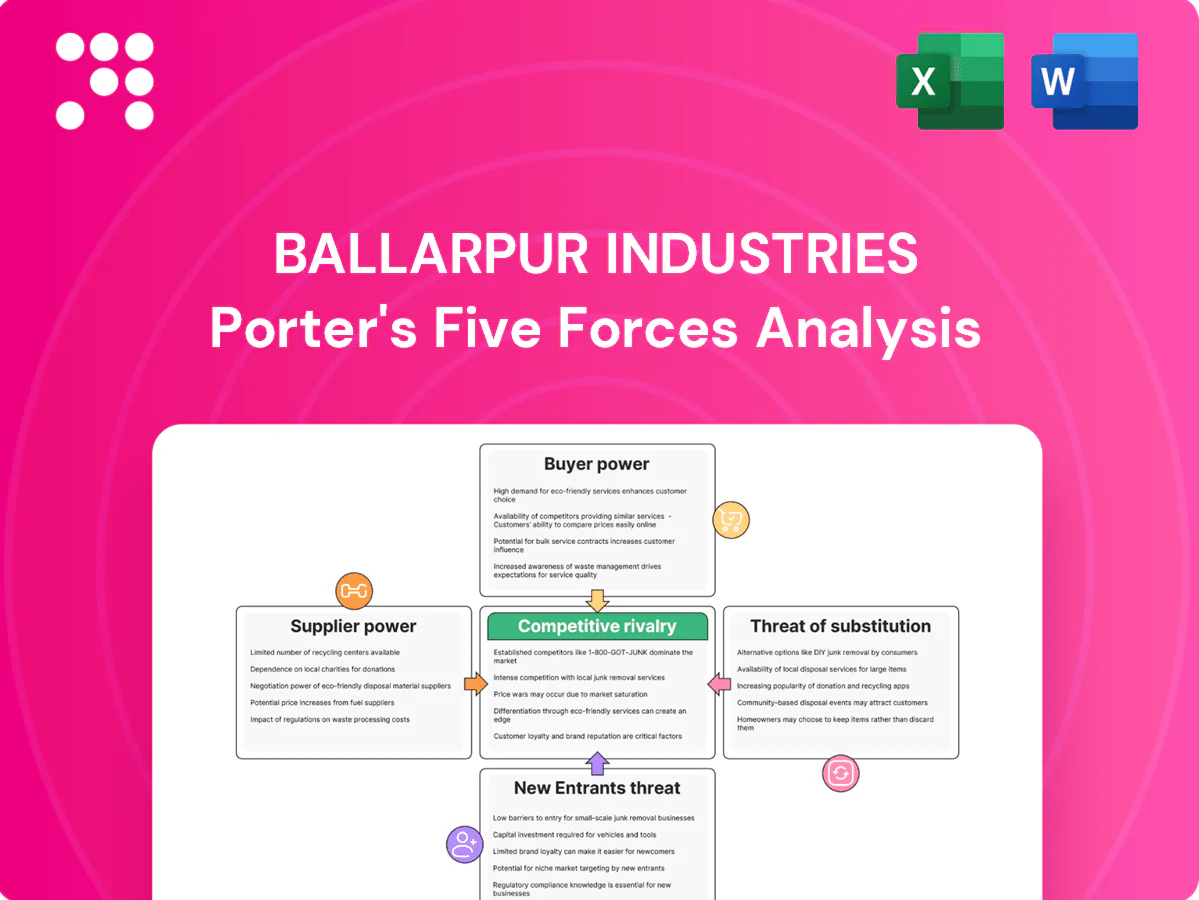
Ballarpur Industries Porter's Five Forces Analysis

From Overview to Strategy Blueprint
Ballarpur Industries faces moderate buyer power and fragmented supplier influence, while capital intensity and scale create barriers to entry; rivalry among paper manufacturers compresses margins and substitutes from digital media and packaging alternatives are rising. This brief snapshot only scratches the surface. Unlock the full Porter's Five Forces Analysis to explore Ballarpur Industries’s competitive dynamics, market pressures, and strategic advantages in detail.
Suppliers Bargaining Power

Concentrated pulp and timber sources
Wood fiber and market pulp supply for Ballarpur is concentrated in a few domestic forestry zones and global exporters, with India importing roughly 35% of its market pulp in 2024, raising reliance on limited domestic sources; certified timber in India remains under 5% of commercially available supply, increasing dependence on contracted farm forestry and imports. This concentration lets key suppliers exert pricing and contract leverage, especially in tight cycles, while rising certification and sustainability requirements further narrow qualified suppliers.
Volatile input costs (pulp, chemicals, energy)
Pulp, caustic soda, fillers and coal/power are highly cyclical and energy-intensive inputs for Ballarpur, allowing suppliers to pass through price spikes quickly and compress paper margins; fuel and freight surcharges add additional short‑term volatility. Long‑term procurement contracts mitigate some risk, but material spot exposure persists, keeping supplier bargaining power elevated.

Import dependence and FX exposure
Imported pulp, chemicals and machinery parts make BILT highly FX-sensitive; INR depreciation of roughly 10–12% versus USD between 2021–24 raised landed costs and amplified supplier leverage, while global wood-pulp prices climbed about 15% in 2023, squeezing margins.

Switching frictions for critical grades
Qualifying new pulp or chemical specs requires trials that can alter paper strength, whiteness and runnability, so technical certification, warranties and process tuning create tangible switching costs for BILT. Suppliers offering on-site application support and proprietary dosing systems increase supplier stickiness and raise the effective cost of switching. This dynamic reduces BILT’s short-term flexibility in renegotiations and price responsiveness.
- Switching friction: trials, certification, process tuning
- Supplier leverage: application support, warranties
- Impact: higher switching costs, lower short-term renegotiation flexibility
Sustainability and compliance pressures
Sustainability and tighter EHS/effluent norms limit eligible pulp and fiber suppliers for Ballarpur Industries, with over 500 million hectares certified under FSC/PEFC globally as of 2024 tightening supply pools.
Compliant vendors command price and contract premiums, raising input costs and securing stricter delivery terms; supply disruption risks mills breaching norms and facing fines or shutdowns.
- Compliant suppliers scarce
- Premiums and tighter terms
- Disruption = regulatory risk
- Over 500M ha FSC/PEFC (2024)
Supplier power: 35% imports; timber <5%
Supplier power is high: 35% of India’s market pulp imported in 2024 and domestic certified timber under 5% concentrate supply; FX sensitivity (INR down ~10–12% vs USD 2021–24) and global pulp +15% in 2023 amplified landed costs. Technical switching costs and EHS certification (500M ha FSC/PEFC global 2024) keep renegotiation leverage with suppliers strong.
| Metric | Value (2024) | Impact |
|---|---|---|
| Import share | 35% | Higher supplier leverage |
| Certified timber (IN) | <5% | Narrow qualified pool |
| FX move | INR −10–12% | Raised costs |
| Global pulp move | +15% (2023) | Compressed margins |
What is included in the product
 Detailed Word Document
Tailored Porter's Five Forces assessment for Ballarpur Industries that uncovers competitive intensity, supplier and buyer bargaining power, threat of substitutes and new entrants, and identifies disruptive forces and strategic levers affecting pricing, margins, and market share.

 Customizable Excel Spreadsheet
Clear one-sheet Porter's Five Forces for Ballarpur Industries—instantly spot supplier, buyer and rivalry pressures with a ready-to-use spider chart and customizable pressure levels for evolving pulp, paper and packaging markets.
Customers Bargaining Power

Diverse but price-sensitive customers
Publishers, printers, converters and packaging buyers are fragmented but highly cost-sensitive, driving intense price negotiation across Ballarpur Industries’ sales channels. Frequent tendering and quarterly price resets amplify buyer bargaining power and force margin compression. Buyers routinely benchmark local offers against imported paper grades, increasing pricing pressure. Volume commitments routinely come with rebate demands and short payment cycles.
Large accounts and channel concentration
Major publishers, FMCG packaging converters and government buyers collectively drive large-volume demand for Ballarpur Industries, enabling them to impose stringent specs, service SLAs and extended payment terms often stretching 60–90 days.
Concentration in a few anchor accounts means losing one can materially dent capacity utilization, commonly reducing throughput by double-digit percentages in the paperboard sector.
This buyer concentration elevates bargaining leverage, pressuring margins and working capital for suppliers like Ballarpur.

Low differentiation in commodity grades
Uncoated W&P and basic industrial papers are highly standardized, enabling easy comparison and driving buyers to switch based on price and logistics; industry reports in 2024 show commodity-grade paper bids tightened with spot prices declining ~10% year-on-year. Private-label growth (around 8–12% share in Indian retail categories in 2024) can further compress mill margins by several hundred basis points. Service and delivery reliability therefore become key tie-breakers for Ballarpur.

Availability of import alternatives
ASEAN/China-origin coated and specialty papers offer credible alternatives to Ballarpur, comprising roughly 20–25% of India’s coated-paper supply in 2024; when domestic prices exceed import parity by 10–15%, buyers switch to imports, with port-proximate purchasers exploiting this most. Trade-policy moves (duties, anti-dumping, quotas) have repeatedly swung this leverage within months in 2024.
- import-share: 20–25% (2024)
- price-gap: import parity premium/discount ~10–15%
- policy-sensitivity: duties/AD actions shift flows rapidly
- highest-risk segment: port-proximate buyers
Growing sustainability and specification demands
Buyers increasingly demand FSC-certified, low-carbon and fully recyclable papers, raising production complexity and qualification time; by 2024 FSC-certified forest area exceeded 220 million hectares, reflecting strengthened procurement standards. Non-compliance can lead to disqualification from large tenders, shifting specification power and price negotiation decisively in buyers’ favor.
- Buyers: FSC, low‑carbon, recyclable
- Impact: higher production complexity & longer qualification
- Risk: tender disqualification, loss of revenue
- Outcome: stronger buyer negotiation leverage
Buyers squeeze margins: 60–90 day terms; imports 20–25%, parity 10–15%, FSC > 220m ha
Buyers are price-sensitive and concentrated, driving margin compression and 60–90 day terms; losing an anchor can cut throughput double-digits. Imports (20–25% share in 2024) and 10–15% parity gaps increase switching. Sustainability specs (FSC >220m ha certified in 2024) raise qualification barriers, strengthening buyer leverage.
| Metric | 2024 | Impact |
|---|---|---|
| Import share | 20–25% | Higher switching |
| Price gap | 10–15% | Import substitution |
| FSC area | >220m ha | Stricter specs |
| Payment terms | 60–90 days | Working capital pressure |
Preview Before You Purchase
Ballarpur Industries Porter's Five Forces Analysis
This preview shows the exact Porter’s Five Forces analysis for Ballarpur Industries you’ll receive—no placeholders or samples. The document is fully formatted, professionally written and ready for immediate download upon purchase. What you see here is precisely what will be available to you instantly after payment.

From Overview to Strategy Blueprint
Ballarpur Industries faces moderate buyer power and fragmented supplier influence, while capital intensity and scale create barriers to entry; rivalry among paper manufacturers compresses margins and substitutes from digital media and packaging alternatives are rising. This brief snapshot only scratches the surface. Unlock the full Porter's Five Forces Analysis to explore Ballarpur Industries’s competitive dynamics, market pressures, and strategic advantages in detail.
Suppliers Bargaining Power
Concentrated pulp and timber sources
Wood fiber and market pulp supply for Ballarpur is concentrated in a few domestic forestry zones and global exporters, with India importing roughly 35% of its market pulp in 2024, raising reliance on limited domestic sources; certified timber in India remains under 5% of commercially available supply, increasing dependence on contracted farm forestry and imports. This concentration lets key suppliers exert pricing and contract leverage, especially in tight cycles, while rising certification and sustainability requirements further narrow qualified suppliers.
Volatile input costs (pulp, chemicals, energy)
Pulp, caustic soda, fillers and coal/power are highly cyclical and energy-intensive inputs for Ballarpur, allowing suppliers to pass through price spikes quickly and compress paper margins; fuel and freight surcharges add additional short‑term volatility. Long‑term procurement contracts mitigate some risk, but material spot exposure persists, keeping supplier bargaining power elevated.
Import dependence and FX exposure
Imported pulp, chemicals and machinery parts make BILT highly FX-sensitive; INR depreciation of roughly 10–12% versus USD between 2021–24 raised landed costs and amplified supplier leverage, while global wood-pulp prices climbed about 15% in 2023, squeezing margins.
Switching frictions for critical grades
Qualifying new pulp or chemical specs requires trials that can alter paper strength, whiteness and runnability, so technical certification, warranties and process tuning create tangible switching costs for BILT. Suppliers offering on-site application support and proprietary dosing systems increase supplier stickiness and raise the effective cost of switching. This dynamic reduces BILT’s short-term flexibility in renegotiations and price responsiveness.
- Switching friction: trials, certification, process tuning
- Supplier leverage: application support, warranties
- Impact: higher switching costs, lower short-term renegotiation flexibility
Sustainability and compliance pressures
Sustainability and tighter EHS/effluent norms limit eligible pulp and fiber suppliers for Ballarpur Industries, with over 500 million hectares certified under FSC/PEFC globally as of 2024 tightening supply pools.
Compliant vendors command price and contract premiums, raising input costs and securing stricter delivery terms; supply disruption risks mills breaching norms and facing fines or shutdowns.
- Compliant suppliers scarce
- Premiums and tighter terms
- Disruption = regulatory risk
- Over 500M ha FSC/PEFC (2024)
Supplier power: 35% imports; timber <5%
Supplier power is high: 35% of India’s market pulp imported in 2024 and domestic certified timber under 5% concentrate supply; FX sensitivity (INR down ~10–12% vs USD 2021–24) and global pulp +15% in 2023 amplified landed costs. Technical switching costs and EHS certification (500M ha FSC/PEFC global 2024) keep renegotiation leverage with suppliers strong.
| Metric | Value (2024) | Impact |
|---|---|---|
| Import share | 35% | Higher supplier leverage |
| Certified timber (IN) | <5% | Narrow qualified pool |
| FX move | INR −10–12% | Raised costs |
| Global pulp move | +15% (2023) | Compressed margins |
What is included in the product
Detailed Word Document
Tailored Porter's Five Forces assessment for Ballarpur Industries that uncovers competitive intensity, supplier and buyer bargaining power, threat of substitutes and new entrants, and identifies disruptive forces and strategic levers affecting pricing, margins, and market share.
Customizable Excel Spreadsheet
Clear one-sheet Porter's Five Forces for Ballarpur Industries—instantly spot supplier, buyer and rivalry pressures with a ready-to-use spider chart and customizable pressure levels for evolving pulp, paper and packaging markets.
Customers Bargaining Power
Diverse but price-sensitive customers
Publishers, printers, converters and packaging buyers are fragmented but highly cost-sensitive, driving intense price negotiation across Ballarpur Industries’ sales channels. Frequent tendering and quarterly price resets amplify buyer bargaining power and force margin compression. Buyers routinely benchmark local offers against imported paper grades, increasing pricing pressure. Volume commitments routinely come with rebate demands and short payment cycles.
Large accounts and channel concentration
Major publishers, FMCG packaging converters and government buyers collectively drive large-volume demand for Ballarpur Industries, enabling them to impose stringent specs, service SLAs and extended payment terms often stretching 60–90 days.
Concentration in a few anchor accounts means losing one can materially dent capacity utilization, commonly reducing throughput by double-digit percentages in the paperboard sector.
This buyer concentration elevates bargaining leverage, pressuring margins and working capital for suppliers like Ballarpur.
Low differentiation in commodity grades
Uncoated W&P and basic industrial papers are highly standardized, enabling easy comparison and driving buyers to switch based on price and logistics; industry reports in 2024 show commodity-grade paper bids tightened with spot prices declining ~10% year-on-year. Private-label growth (around 8–12% share in Indian retail categories in 2024) can further compress mill margins by several hundred basis points. Service and delivery reliability therefore become key tie-breakers for Ballarpur.
Availability of import alternatives
ASEAN/China-origin coated and specialty papers offer credible alternatives to Ballarpur, comprising roughly 20–25% of India’s coated-paper supply in 2024; when domestic prices exceed import parity by 10–15%, buyers switch to imports, with port-proximate purchasers exploiting this most. Trade-policy moves (duties, anti-dumping, quotas) have repeatedly swung this leverage within months in 2024.
- import-share: 20–25% (2024)
- price-gap: import parity premium/discount ~10–15%
- policy-sensitivity: duties/AD actions shift flows rapidly
- highest-risk segment: port-proximate buyers
Growing sustainability and specification demands
Buyers increasingly demand FSC-certified, low-carbon and fully recyclable papers, raising production complexity and qualification time; by 2024 FSC-certified forest area exceeded 220 million hectares, reflecting strengthened procurement standards. Non-compliance can lead to disqualification from large tenders, shifting specification power and price negotiation decisively in buyers’ favor.
- Buyers: FSC, low‑carbon, recyclable
- Impact: higher production complexity & longer qualification
- Risk: tender disqualification, loss of revenue
- Outcome: stronger buyer negotiation leverage
Buyers squeeze margins: 60–90 day terms; imports 20–25%, parity 10–15%, FSC > 220m ha
Buyers are price-sensitive and concentrated, driving margin compression and 60–90 day terms; losing an anchor can cut throughput double-digits. Imports (20–25% share in 2024) and 10–15% parity gaps increase switching. Sustainability specs (FSC >220m ha certified in 2024) raise qualification barriers, strengthening buyer leverage.
| Metric | 2024 | Impact |
|---|---|---|
| Import share | 20–25% | Higher switching |
| Price gap | 10–15% | Import substitution |
| FSC area | >220m ha | Stricter specs |
| Payment terms | 60–90 days | Working capital pressure |
Preview Before You Purchase
Ballarpur Industries Porter's Five Forces Analysis
This preview shows the exact Porter’s Five Forces analysis for Ballarpur Industries you’ll receive—no placeholders or samples. The document is fully formatted, professionally written and ready for immediate download upon purchase. What you see here is precisely what will be available to you instantly after payment.
Original: $10.00
-65%$10.00
$3.50Description
From Overview to Strategy Blueprint
Ballarpur Industries faces moderate buyer power and fragmented supplier influence, while capital intensity and scale create barriers to entry; rivalry among paper manufacturers compresses margins and substitutes from digital media and packaging alternatives are rising. This brief snapshot only scratches the surface. Unlock the full Porter's Five Forces Analysis to explore Ballarpur Industries’s competitive dynamics, market pressures, and strategic advantages in detail.
Suppliers Bargaining Power
Concentrated pulp and timber sources
Wood fiber and market pulp supply for Ballarpur is concentrated in a few domestic forestry zones and global exporters, with India importing roughly 35% of its market pulp in 2024, raising reliance on limited domestic sources; certified timber in India remains under 5% of commercially available supply, increasing dependence on contracted farm forestry and imports. This concentration lets key suppliers exert pricing and contract leverage, especially in tight cycles, while rising certification and sustainability requirements further narrow qualified suppliers.
Volatile input costs (pulp, chemicals, energy)
Pulp, caustic soda, fillers and coal/power are highly cyclical and energy-intensive inputs for Ballarpur, allowing suppliers to pass through price spikes quickly and compress paper margins; fuel and freight surcharges add additional short‑term volatility. Long‑term procurement contracts mitigate some risk, but material spot exposure persists, keeping supplier bargaining power elevated.
Import dependence and FX exposure
Imported pulp, chemicals and machinery parts make BILT highly FX-sensitive; INR depreciation of roughly 10–12% versus USD between 2021–24 raised landed costs and amplified supplier leverage, while global wood-pulp prices climbed about 15% in 2023, squeezing margins.
Switching frictions for critical grades
Qualifying new pulp or chemical specs requires trials that can alter paper strength, whiteness and runnability, so technical certification, warranties and process tuning create tangible switching costs for BILT. Suppliers offering on-site application support and proprietary dosing systems increase supplier stickiness and raise the effective cost of switching. This dynamic reduces BILT’s short-term flexibility in renegotiations and price responsiveness.
- Switching friction: trials, certification, process tuning
- Supplier leverage: application support, warranties
- Impact: higher switching costs, lower short-term renegotiation flexibility
Sustainability and compliance pressures
Sustainability and tighter EHS/effluent norms limit eligible pulp and fiber suppliers for Ballarpur Industries, with over 500 million hectares certified under FSC/PEFC globally as of 2024 tightening supply pools.
Compliant vendors command price and contract premiums, raising input costs and securing stricter delivery terms; supply disruption risks mills breaching norms and facing fines or shutdowns.
- Compliant suppliers scarce
- Premiums and tighter terms
- Disruption = regulatory risk
- Over 500M ha FSC/PEFC (2024)
Supplier power: 35% imports; timber <5%
Supplier power is high: 35% of India’s market pulp imported in 2024 and domestic certified timber under 5% concentrate supply; FX sensitivity (INR down ~10–12% vs USD 2021–24) and global pulp +15% in 2023 amplified landed costs. Technical switching costs and EHS certification (500M ha FSC/PEFC global 2024) keep renegotiation leverage with suppliers strong.
| Metric | Value (2024) | Impact |
|---|---|---|
| Import share | 35% | Higher supplier leverage |
| Certified timber (IN) | <5% | Narrow qualified pool |
| FX move | INR −10–12% | Raised costs |
| Global pulp move | +15% (2023) | Compressed margins |
What is included in the product
Detailed Word Document
Tailored Porter's Five Forces assessment for Ballarpur Industries that uncovers competitive intensity, supplier and buyer bargaining power, threat of substitutes and new entrants, and identifies disruptive forces and strategic levers affecting pricing, margins, and market share.
Customizable Excel Spreadsheet
Clear one-sheet Porter's Five Forces for Ballarpur Industries—instantly spot supplier, buyer and rivalry pressures with a ready-to-use spider chart and customizable pressure levels for evolving pulp, paper and packaging markets.
Customers Bargaining Power
Diverse but price-sensitive customers
Publishers, printers, converters and packaging buyers are fragmented but highly cost-sensitive, driving intense price negotiation across Ballarpur Industries’ sales channels. Frequent tendering and quarterly price resets amplify buyer bargaining power and force margin compression. Buyers routinely benchmark local offers against imported paper grades, increasing pricing pressure. Volume commitments routinely come with rebate demands and short payment cycles.
Large accounts and channel concentration
Major publishers, FMCG packaging converters and government buyers collectively drive large-volume demand for Ballarpur Industries, enabling them to impose stringent specs, service SLAs and extended payment terms often stretching 60–90 days.
Concentration in a few anchor accounts means losing one can materially dent capacity utilization, commonly reducing throughput by double-digit percentages in the paperboard sector.
This buyer concentration elevates bargaining leverage, pressuring margins and working capital for suppliers like Ballarpur.
Low differentiation in commodity grades
Uncoated W&P and basic industrial papers are highly standardized, enabling easy comparison and driving buyers to switch based on price and logistics; industry reports in 2024 show commodity-grade paper bids tightened with spot prices declining ~10% year-on-year. Private-label growth (around 8–12% share in Indian retail categories in 2024) can further compress mill margins by several hundred basis points. Service and delivery reliability therefore become key tie-breakers for Ballarpur.
Availability of import alternatives
ASEAN/China-origin coated and specialty papers offer credible alternatives to Ballarpur, comprising roughly 20–25% of India’s coated-paper supply in 2024; when domestic prices exceed import parity by 10–15%, buyers switch to imports, with port-proximate purchasers exploiting this most. Trade-policy moves (duties, anti-dumping, quotas) have repeatedly swung this leverage within months in 2024.
- import-share: 20–25% (2024)
- price-gap: import parity premium/discount ~10–15%
- policy-sensitivity: duties/AD actions shift flows rapidly
- highest-risk segment: port-proximate buyers
Growing sustainability and specification demands
Buyers increasingly demand FSC-certified, low-carbon and fully recyclable papers, raising production complexity and qualification time; by 2024 FSC-certified forest area exceeded 220 million hectares, reflecting strengthened procurement standards. Non-compliance can lead to disqualification from large tenders, shifting specification power and price negotiation decisively in buyers’ favor.
- Buyers: FSC, low‑carbon, recyclable
- Impact: higher production complexity & longer qualification
- Risk: tender disqualification, loss of revenue
- Outcome: stronger buyer negotiation leverage
Buyers squeeze margins: 60–90 day terms; imports 20–25%, parity 10–15%, FSC > 220m ha
Buyers are price-sensitive and concentrated, driving margin compression and 60–90 day terms; losing an anchor can cut throughput double-digits. Imports (20–25% share in 2024) and 10–15% parity gaps increase switching. Sustainability specs (FSC >220m ha certified in 2024) raise qualification barriers, strengthening buyer leverage.
| Metric | 2024 | Impact |
|---|---|---|
| Import share | 20–25% | Higher switching |
| Price gap | 10–15% | Import substitution |
| FSC area | >220m ha | Stricter specs |
| Payment terms | 60–90 days | Working capital pressure |
Preview Before You Purchase
Ballarpur Industries Porter's Five Forces Analysis
This preview shows the exact Porter’s Five Forces analysis for Ballarpur Industries you’ll receive—no placeholders or samples. The document is fully formatted, professionally written and ready for immediate download upon purchase. What you see here is precisely what will be available to you instantly after payment.











