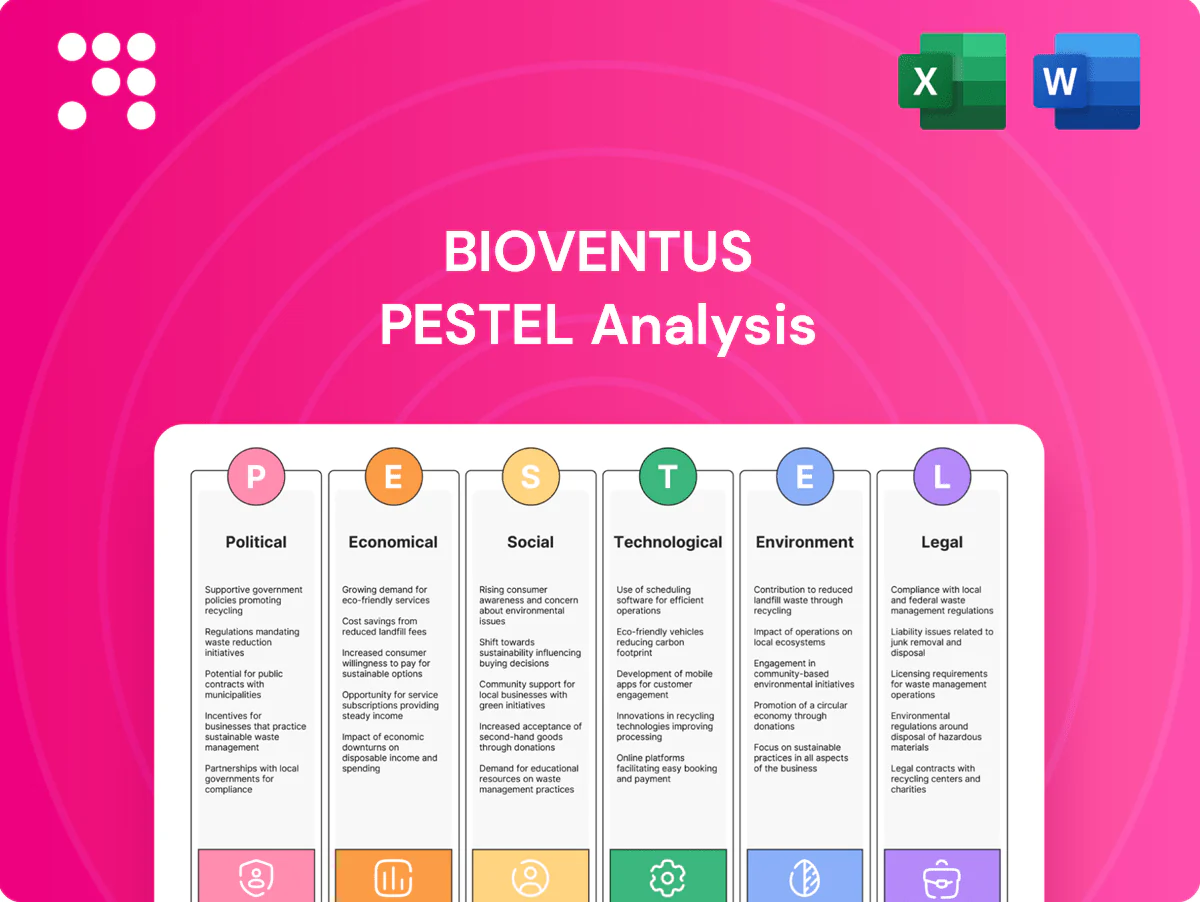
Bioventus PESTLE Analysis

Your Competitive Advantage Starts with This Report
Our PESTLE analysis pinpoints the political, economic, social, technological, legal and environmental forces reshaping Bioventus’s growth trajectory. It reveals regulatory risks, reimbursement dynamics, innovation drivers and sustainability pressures investors must monitor. Ideal for strategy, due diligence, or competitive benchmarking, it translates trends into actionable insight. Purchase the full PESTLE for the complete, ready-to-use breakdown.
Political factors

Healthcare policy and reimbursement
Government funding priorities and reimbursement frameworks, including NIH's roughly $49.6 billion FY2024 budget and the ~64 million US Medicare beneficiaries in 2024, directly shape demand for orthobiologics and OA therapies. Policy shifts toward value-based care favor cost-effective, minimally invasive options and can boost uptake if tied to outcomes-based reimbursement. Changes in Medicare/Medicaid coverage or national health service HTA decisions can accelerate or constrain adoption, so continuous engagement with policymakers and HTA bodies is critical.
Regulatory approval pathways
National regulators set evidence thresholds and review timelines—FDA targets 90 days for 510(k) decisions and 180 days for PMA cycles, while the EU MDR came into full effect on May 26, 2021, tightening pre- and post-market requirements. Streamlined pathways like de novo can accelerate entry, whereas heightened scrutiny and political pressure after safety events often lead to added post-market obligations and reporting. Harmonization efforts via IMDRF, established in 2011, aim to align labeling and surveillance but progress is uneven across jurisdictions.

Trade and tariff exposure
Tariffs on biomaterials, components and finished devices—average applied tariffs for medical devices in major markets around 2–4% per WTO—compress Bioventus margins on low-margin products. Export controls and customs delays (often adding 1–3 weeks) disrupt cross-border supply chains. Favorable trade pacts like USMCA or EU agreements can improve pricing competitiveness, while geopolitical tensions drive dual sourcing strategies.

Public procurement dynamics
Tenders and group purchasing in public systems set access and price benchmarks; OECD estimates public procurement at about 12% of GDP, and US GPOs oversee roughly $200 billion in healthcare contracts annually, shaping hospital purchasing. Political mandates for local sourcing, such as Buy American-style rules, influence manufacturing footprints and supplier selection. Transparency and anti-corruption standards (OECD and national rules) tightly govern bidding behavior, while multi-year framework agreements (commonly 3–5 years) provide volume visibility for capacity planning.
- Tenders/GPOs: set price benchmarks; ~$200bn US healthcare contracts
- Public procurement: ~12% of GDP (OECD)
- Local sourcing mandates: affect manufacturing siting
- Transparency rules: govern bidding and compliance
- Frameworks: 3–5 year deals give volume visibility
Geopolitical stability and supply chains
Conflicts, sanctions, and policy volatility threaten Bioventus supply of key polymers and surgical disposables by disrupting trade lanes and supplier contracts, increasing procurement risk and cost pressure.
Political risks at sterilization and logistics hubs can create sterilization backlogs and transport bottlenecks, delaying product release and revenue recognition.
In crises governments often prioritize essential medtech allocations, shifting distribution and reimbursement dynamics; scenario planning and supplier diversification reduce disruption impact.
- Supply vulnerability: trade and sanctions risk
- Sterilization/logistics: concentration creates bottlenecks
- Policy shifts: government prioritization alters allocations
- Mitigation: scenario planning and supplier diversification
NIH $49.6B, Medicare ~64M and FDA timelines shape market
Government funding and reimbursement (NIH $49.6B FY2024; ~64M Medicare beneficiaries 2024) drive orthobiologics demand and favor value-based, cost-effective therapies. Regulatory timelines (FDA 90d 510(k)/180d PMA; EU MDR effective 26‑May‑2021) and tariffs (~2–4% on devices) affect market access and margins. Public procurement/GPOs (~12% GDP; US GPOs ~$200B) determine pricing and volume via 3–5 year frameworks.
| Factor | Key metric |
|---|---|
| NIH budget | $49.6B FY2024 |
| Medicare | ~64M beneficiaries (2024) |
| FDA timelines | 90d 510(k)/180d PMA |
| Tariffs | ~2–4% |
| GPOs/procurement | ~$200B / ~12% GDP |
What is included in the product
 Detailed Word Document
Explores how external macro-environmental factors uniquely affect Bioventus across six dimensions—Political, Economic, Social, Technological, Environmental, and Legal—using current market and regulatory dynamics relevant to its orthobiologics and medtech operations. Designed for executives and investors, each section is data-backed, forward-looking, and formatted for direct use in strategy, funding pitches, or scenario planning.

 Customizable Excel Spreadsheet
Bioventus PESTLE Analysis distills regulatory, market and technological risks into a clean, visually segmented summary for quick interpretation and team alignment. Its concise, shareable format makes it easy to drop into presentations or strategy sessions to relieve planning and risk-assessment bottlenecks.
Economic factors

Procedure volume sensitivity
Elective and semi‑elective orthopedics fell up to 50% in early 2020, with procedures (hip/knee ~1.2M annually pre‑pandemic in the US) rebounding to near pre‑pandemic levels by 2023; backlogs have triggered 20–40% short‑term surges post‑disruption. Hospital budget constraints frequently defer capital and premium purchases, so predictive demand planning helps align Bioventus inventory to these swings.
Pricing and payer pressure
Payers increasingly demand lower prices and outcomes guarantees for OA and fracture solutions, pressuring manufacturers like Bioventus (2024 revenue ~USD 600M). Robust cost-effectiveness evidence supports formulary inclusion and helps stabilize average selling prices. Expansion of bundled payments shifts financial risk to providers and vendors, while value-based contracts can preserve market share but cap upside.

Inflation and input costs
Rising inflation (US CPI 2024 +3.4%) and higher energy costs have pushed biomaterials, packaging and sterilization expenses up materially, squeezing margins. Wage inflation (average hourly earnings ~+4.1% in 2024) increases manufacturing and field support costs while contract terms mean price pass-throughs often lag by quarters. Bioventus targets productivity gains and product redesigns to offset COGS pressure, aiming for mid-single-digit cost improvements.

Currency fluctuations
Global sales expose Bioventus earnings to foreign exchange volatility, which can materially affect reported USD revenues and margins.
A stronger US dollar tends to compress reported international revenues and margin percentages when translated to USD.
Bioventus uses natural hedges through local cost bases and selective financial hedging, and must set market prices reflecting each market’s FX pass-through ability.
- FX exposure: impacts reported revenue and margins
- Mitigants: local costs + financial hedging
- Pricing: must reflect market-specific FX pass-through
Capital access and interest rates
Higher interest rates raise Bioventus’s borrowing costs and elevate R&D and M&A hurdle rates; US federal funds were about 5.25–5.50% in mid‑2025, tightening capital availability and increasing discount rates used in valuations. Tighter provider financing constrains purchase of higher‑end solutions, while lower investor risk appetite compresses multiples, making disciplined capital allocation a key competitive advantage.
- Higher rates: federal funds ~5.25–5.50% (mid‑2025)
- R&D/M&A: higher hurdle rates, pricier debt
- Provider financing: reduced uptake of premium devices
- Investor risk appetite: lower valuations, less strategic flexibility
- Capital allocation: decisive competitive edge
NIH $49.6B, Medicare ~64M and FDA timelines shape market
Elective ortho rebounded to near pre‑pandemic volumes by 2023, creating 20–40% short‑term surges that challenge inventory and hospital budgets. Payers press for lower prices, outcomes guarantees and bundled payments, pressuring ASPs despite Bioventus’s ~USD 600M 2024 revenue. Inflation (CPI 2024 +3.4%), wage inflation (+4.1%) and higher input costs squeeze margins; fed funds ~5.25–5.50% (mid‑2025) raise financing costs. FX volatility and a stronger USD compress reported international revenue; local cost bases and hedging partially mitigate.
| Metric | Value |
|---|---|
| Bioventus revenue (2024) | ~USD 600M |
| US hip/knee procedures (pre‑pandemic) | ~1.2M annually |
| CPI (2024) | +3.4% |
| Wage inflation (2024) | +4.1% |
| Fed funds (mid‑2025) | 5.25–5.50% |
| FX impact | Stronger USD compresses reported revenues |
Preview Before You Purchase
Bioventus PESTLE Analysis
This Bioventus PESTLE Analysis delivers a concise evaluation of the political, economic, social, technological, legal, and environmental factors shaping the company and its market position. It highlights key risks, regulatory impacts, and strategic opportunities for investors and business leaders. The preview shown here is the exact document you’ll receive after purchase—fully formatted and ready to use.

Your Competitive Advantage Starts with This Report
Our PESTLE analysis pinpoints the political, economic, social, technological, legal and environmental forces reshaping Bioventus’s growth trajectory. It reveals regulatory risks, reimbursement dynamics, innovation drivers and sustainability pressures investors must monitor. Ideal for strategy, due diligence, or competitive benchmarking, it translates trends into actionable insight. Purchase the full PESTLE for the complete, ready-to-use breakdown.
Political factors
Healthcare policy and reimbursement
Government funding priorities and reimbursement frameworks, including NIH's roughly $49.6 billion FY2024 budget and the ~64 million US Medicare beneficiaries in 2024, directly shape demand for orthobiologics and OA therapies. Policy shifts toward value-based care favor cost-effective, minimally invasive options and can boost uptake if tied to outcomes-based reimbursement. Changes in Medicare/Medicaid coverage or national health service HTA decisions can accelerate or constrain adoption, so continuous engagement with policymakers and HTA bodies is critical.
Regulatory approval pathways
National regulators set evidence thresholds and review timelines—FDA targets 90 days for 510(k) decisions and 180 days for PMA cycles, while the EU MDR came into full effect on May 26, 2021, tightening pre- and post-market requirements. Streamlined pathways like de novo can accelerate entry, whereas heightened scrutiny and political pressure after safety events often lead to added post-market obligations and reporting. Harmonization efforts via IMDRF, established in 2011, aim to align labeling and surveillance but progress is uneven across jurisdictions.
Trade and tariff exposure
Tariffs on biomaterials, components and finished devices—average applied tariffs for medical devices in major markets around 2–4% per WTO—compress Bioventus margins on low-margin products. Export controls and customs delays (often adding 1–3 weeks) disrupt cross-border supply chains. Favorable trade pacts like USMCA or EU agreements can improve pricing competitiveness, while geopolitical tensions drive dual sourcing strategies.
Public procurement dynamics
Tenders and group purchasing in public systems set access and price benchmarks; OECD estimates public procurement at about 12% of GDP, and US GPOs oversee roughly $200 billion in healthcare contracts annually, shaping hospital purchasing. Political mandates for local sourcing, such as Buy American-style rules, influence manufacturing footprints and supplier selection. Transparency and anti-corruption standards (OECD and national rules) tightly govern bidding behavior, while multi-year framework agreements (commonly 3–5 years) provide volume visibility for capacity planning.
- Tenders/GPOs: set price benchmarks; ~$200bn US healthcare contracts
- Public procurement: ~12% of GDP (OECD)
- Local sourcing mandates: affect manufacturing siting
- Transparency rules: govern bidding and compliance
- Frameworks: 3–5 year deals give volume visibility
Geopolitical stability and supply chains
Conflicts, sanctions, and policy volatility threaten Bioventus supply of key polymers and surgical disposables by disrupting trade lanes and supplier contracts, increasing procurement risk and cost pressure.
Political risks at sterilization and logistics hubs can create sterilization backlogs and transport bottlenecks, delaying product release and revenue recognition.
In crises governments often prioritize essential medtech allocations, shifting distribution and reimbursement dynamics; scenario planning and supplier diversification reduce disruption impact.
- Supply vulnerability: trade and sanctions risk
- Sterilization/logistics: concentration creates bottlenecks
- Policy shifts: government prioritization alters allocations
- Mitigation: scenario planning and supplier diversification
NIH $49.6B, Medicare ~64M and FDA timelines shape market
Government funding and reimbursement (NIH $49.6B FY2024; ~64M Medicare beneficiaries 2024) drive orthobiologics demand and favor value-based, cost-effective therapies. Regulatory timelines (FDA 90d 510(k)/180d PMA; EU MDR effective 26‑May‑2021) and tariffs (~2–4% on devices) affect market access and margins. Public procurement/GPOs (~12% GDP; US GPOs ~$200B) determine pricing and volume via 3–5 year frameworks.
| Factor | Key metric |
|---|---|
| NIH budget | $49.6B FY2024 |
| Medicare | ~64M beneficiaries (2024) |
| FDA timelines | 90d 510(k)/180d PMA |
| Tariffs | ~2–4% |
| GPOs/procurement | ~$200B / ~12% GDP |
What is included in the product
Detailed Word Document
Explores how external macro-environmental factors uniquely affect Bioventus across six dimensions—Political, Economic, Social, Technological, Environmental, and Legal—using current market and regulatory dynamics relevant to its orthobiologics and medtech operations. Designed for executives and investors, each section is data-backed, forward-looking, and formatted for direct use in strategy, funding pitches, or scenario planning.
Customizable Excel Spreadsheet
Bioventus PESTLE Analysis distills regulatory, market and technological risks into a clean, visually segmented summary for quick interpretation and team alignment. Its concise, shareable format makes it easy to drop into presentations or strategy sessions to relieve planning and risk-assessment bottlenecks.
Economic factors
Procedure volume sensitivity
Elective and semi‑elective orthopedics fell up to 50% in early 2020, with procedures (hip/knee ~1.2M annually pre‑pandemic in the US) rebounding to near pre‑pandemic levels by 2023; backlogs have triggered 20–40% short‑term surges post‑disruption. Hospital budget constraints frequently defer capital and premium purchases, so predictive demand planning helps align Bioventus inventory to these swings.
Pricing and payer pressure
Payers increasingly demand lower prices and outcomes guarantees for OA and fracture solutions, pressuring manufacturers like Bioventus (2024 revenue ~USD 600M). Robust cost-effectiveness evidence supports formulary inclusion and helps stabilize average selling prices. Expansion of bundled payments shifts financial risk to providers and vendors, while value-based contracts can preserve market share but cap upside.
Inflation and input costs
Rising inflation (US CPI 2024 +3.4%) and higher energy costs have pushed biomaterials, packaging and sterilization expenses up materially, squeezing margins. Wage inflation (average hourly earnings ~+4.1% in 2024) increases manufacturing and field support costs while contract terms mean price pass-throughs often lag by quarters. Bioventus targets productivity gains and product redesigns to offset COGS pressure, aiming for mid-single-digit cost improvements.
Currency fluctuations
Global sales expose Bioventus earnings to foreign exchange volatility, which can materially affect reported USD revenues and margins.
A stronger US dollar tends to compress reported international revenues and margin percentages when translated to USD.
Bioventus uses natural hedges through local cost bases and selective financial hedging, and must set market prices reflecting each market’s FX pass-through ability.
- FX exposure: impacts reported revenue and margins
- Mitigants: local costs + financial hedging
- Pricing: must reflect market-specific FX pass-through
Capital access and interest rates
Higher interest rates raise Bioventus’s borrowing costs and elevate R&D and M&A hurdle rates; US federal funds were about 5.25–5.50% in mid‑2025, tightening capital availability and increasing discount rates used in valuations. Tighter provider financing constrains purchase of higher‑end solutions, while lower investor risk appetite compresses multiples, making disciplined capital allocation a key competitive advantage.
- Higher rates: federal funds ~5.25–5.50% (mid‑2025)
- R&D/M&A: higher hurdle rates, pricier debt
- Provider financing: reduced uptake of premium devices
- Investor risk appetite: lower valuations, less strategic flexibility
- Capital allocation: decisive competitive edge
NIH $49.6B, Medicare ~64M and FDA timelines shape market
Elective ortho rebounded to near pre‑pandemic volumes by 2023, creating 20–40% short‑term surges that challenge inventory and hospital budgets. Payers press for lower prices, outcomes guarantees and bundled payments, pressuring ASPs despite Bioventus’s ~USD 600M 2024 revenue. Inflation (CPI 2024 +3.4%), wage inflation (+4.1%) and higher input costs squeeze margins; fed funds ~5.25–5.50% (mid‑2025) raise financing costs. FX volatility and a stronger USD compress reported international revenue; local cost bases and hedging partially mitigate.
| Metric | Value |
|---|---|
| Bioventus revenue (2024) | ~USD 600M |
| US hip/knee procedures (pre‑pandemic) | ~1.2M annually |
| CPI (2024) | +3.4% |
| Wage inflation (2024) | +4.1% |
| Fed funds (mid‑2025) | 5.25–5.50% |
| FX impact | Stronger USD compresses reported revenues |
Preview Before You Purchase
Bioventus PESTLE Analysis
This Bioventus PESTLE Analysis delivers a concise evaluation of the political, economic, social, technological, legal, and environmental factors shaping the company and its market position. It highlights key risks, regulatory impacts, and strategic opportunities for investors and business leaders. The preview shown here is the exact document you’ll receive after purchase—fully formatted and ready to use.
Original: $10.00
-65%$10.00
$3.50Description
Your Competitive Advantage Starts with This Report
Our PESTLE analysis pinpoints the political, economic, social, technological, legal and environmental forces reshaping Bioventus’s growth trajectory. It reveals regulatory risks, reimbursement dynamics, innovation drivers and sustainability pressures investors must monitor. Ideal for strategy, due diligence, or competitive benchmarking, it translates trends into actionable insight. Purchase the full PESTLE for the complete, ready-to-use breakdown.
Political factors
Healthcare policy and reimbursement
Government funding priorities and reimbursement frameworks, including NIH's roughly $49.6 billion FY2024 budget and the ~64 million US Medicare beneficiaries in 2024, directly shape demand for orthobiologics and OA therapies. Policy shifts toward value-based care favor cost-effective, minimally invasive options and can boost uptake if tied to outcomes-based reimbursement. Changes in Medicare/Medicaid coverage or national health service HTA decisions can accelerate or constrain adoption, so continuous engagement with policymakers and HTA bodies is critical.
Regulatory approval pathways
National regulators set evidence thresholds and review timelines—FDA targets 90 days for 510(k) decisions and 180 days for PMA cycles, while the EU MDR came into full effect on May 26, 2021, tightening pre- and post-market requirements. Streamlined pathways like de novo can accelerate entry, whereas heightened scrutiny and political pressure after safety events often lead to added post-market obligations and reporting. Harmonization efforts via IMDRF, established in 2011, aim to align labeling and surveillance but progress is uneven across jurisdictions.
Trade and tariff exposure
Tariffs on biomaterials, components and finished devices—average applied tariffs for medical devices in major markets around 2–4% per WTO—compress Bioventus margins on low-margin products. Export controls and customs delays (often adding 1–3 weeks) disrupt cross-border supply chains. Favorable trade pacts like USMCA or EU agreements can improve pricing competitiveness, while geopolitical tensions drive dual sourcing strategies.
Public procurement dynamics
Tenders and group purchasing in public systems set access and price benchmarks; OECD estimates public procurement at about 12% of GDP, and US GPOs oversee roughly $200 billion in healthcare contracts annually, shaping hospital purchasing. Political mandates for local sourcing, such as Buy American-style rules, influence manufacturing footprints and supplier selection. Transparency and anti-corruption standards (OECD and national rules) tightly govern bidding behavior, while multi-year framework agreements (commonly 3–5 years) provide volume visibility for capacity planning.
- Tenders/GPOs: set price benchmarks; ~$200bn US healthcare contracts
- Public procurement: ~12% of GDP (OECD)
- Local sourcing mandates: affect manufacturing siting
- Transparency rules: govern bidding and compliance
- Frameworks: 3–5 year deals give volume visibility
Geopolitical stability and supply chains
Conflicts, sanctions, and policy volatility threaten Bioventus supply of key polymers and surgical disposables by disrupting trade lanes and supplier contracts, increasing procurement risk and cost pressure.
Political risks at sterilization and logistics hubs can create sterilization backlogs and transport bottlenecks, delaying product release and revenue recognition.
In crises governments often prioritize essential medtech allocations, shifting distribution and reimbursement dynamics; scenario planning and supplier diversification reduce disruption impact.
- Supply vulnerability: trade and sanctions risk
- Sterilization/logistics: concentration creates bottlenecks
- Policy shifts: government prioritization alters allocations
- Mitigation: scenario planning and supplier diversification
NIH $49.6B, Medicare ~64M and FDA timelines shape market
Government funding and reimbursement (NIH $49.6B FY2024; ~64M Medicare beneficiaries 2024) drive orthobiologics demand and favor value-based, cost-effective therapies. Regulatory timelines (FDA 90d 510(k)/180d PMA; EU MDR effective 26‑May‑2021) and tariffs (~2–4% on devices) affect market access and margins. Public procurement/GPOs (~12% GDP; US GPOs ~$200B) determine pricing and volume via 3–5 year frameworks.
| Factor | Key metric |
|---|---|
| NIH budget | $49.6B FY2024 |
| Medicare | ~64M beneficiaries (2024) |
| FDA timelines | 90d 510(k)/180d PMA |
| Tariffs | ~2–4% |
| GPOs/procurement | ~$200B / ~12% GDP |
What is included in the product
Detailed Word Document
Explores how external macro-environmental factors uniquely affect Bioventus across six dimensions—Political, Economic, Social, Technological, Environmental, and Legal—using current market and regulatory dynamics relevant to its orthobiologics and medtech operations. Designed for executives and investors, each section is data-backed, forward-looking, and formatted for direct use in strategy, funding pitches, or scenario planning.
Customizable Excel Spreadsheet
Bioventus PESTLE Analysis distills regulatory, market and technological risks into a clean, visually segmented summary for quick interpretation and team alignment. Its concise, shareable format makes it easy to drop into presentations or strategy sessions to relieve planning and risk-assessment bottlenecks.
Economic factors
Procedure volume sensitivity
Elective and semi‑elective orthopedics fell up to 50% in early 2020, with procedures (hip/knee ~1.2M annually pre‑pandemic in the US) rebounding to near pre‑pandemic levels by 2023; backlogs have triggered 20–40% short‑term surges post‑disruption. Hospital budget constraints frequently defer capital and premium purchases, so predictive demand planning helps align Bioventus inventory to these swings.
Pricing and payer pressure
Payers increasingly demand lower prices and outcomes guarantees for OA and fracture solutions, pressuring manufacturers like Bioventus (2024 revenue ~USD 600M). Robust cost-effectiveness evidence supports formulary inclusion and helps stabilize average selling prices. Expansion of bundled payments shifts financial risk to providers and vendors, while value-based contracts can preserve market share but cap upside.
Inflation and input costs
Rising inflation (US CPI 2024 +3.4%) and higher energy costs have pushed biomaterials, packaging and sterilization expenses up materially, squeezing margins. Wage inflation (average hourly earnings ~+4.1% in 2024) increases manufacturing and field support costs while contract terms mean price pass-throughs often lag by quarters. Bioventus targets productivity gains and product redesigns to offset COGS pressure, aiming for mid-single-digit cost improvements.
Currency fluctuations
Global sales expose Bioventus earnings to foreign exchange volatility, which can materially affect reported USD revenues and margins.
A stronger US dollar tends to compress reported international revenues and margin percentages when translated to USD.
Bioventus uses natural hedges through local cost bases and selective financial hedging, and must set market prices reflecting each market’s FX pass-through ability.
- FX exposure: impacts reported revenue and margins
- Mitigants: local costs + financial hedging
- Pricing: must reflect market-specific FX pass-through
Capital access and interest rates
Higher interest rates raise Bioventus’s borrowing costs and elevate R&D and M&A hurdle rates; US federal funds were about 5.25–5.50% in mid‑2025, tightening capital availability and increasing discount rates used in valuations. Tighter provider financing constrains purchase of higher‑end solutions, while lower investor risk appetite compresses multiples, making disciplined capital allocation a key competitive advantage.
- Higher rates: federal funds ~5.25–5.50% (mid‑2025)
- R&D/M&A: higher hurdle rates, pricier debt
- Provider financing: reduced uptake of premium devices
- Investor risk appetite: lower valuations, less strategic flexibility
- Capital allocation: decisive competitive edge
NIH $49.6B, Medicare ~64M and FDA timelines shape market
Elective ortho rebounded to near pre‑pandemic volumes by 2023, creating 20–40% short‑term surges that challenge inventory and hospital budgets. Payers press for lower prices, outcomes guarantees and bundled payments, pressuring ASPs despite Bioventus’s ~USD 600M 2024 revenue. Inflation (CPI 2024 +3.4%), wage inflation (+4.1%) and higher input costs squeeze margins; fed funds ~5.25–5.50% (mid‑2025) raise financing costs. FX volatility and a stronger USD compress reported international revenue; local cost bases and hedging partially mitigate.
| Metric | Value |
|---|---|
| Bioventus revenue (2024) | ~USD 600M |
| US hip/knee procedures (pre‑pandemic) | ~1.2M annually |
| CPI (2024) | +3.4% |
| Wage inflation (2024) | +4.1% |
| Fed funds (mid‑2025) | 5.25–5.50% |
| FX impact | Stronger USD compresses reported revenues |
Preview Before You Purchase
Bioventus PESTLE Analysis
This Bioventus PESTLE Analysis delivers a concise evaluation of the political, economic, social, technological, legal, and environmental factors shaping the company and its market position. It highlights key risks, regulatory impacts, and strategic opportunities for investors and business leaders. The preview shown here is the exact document you’ll receive after purchase—fully formatted and ready to use.











