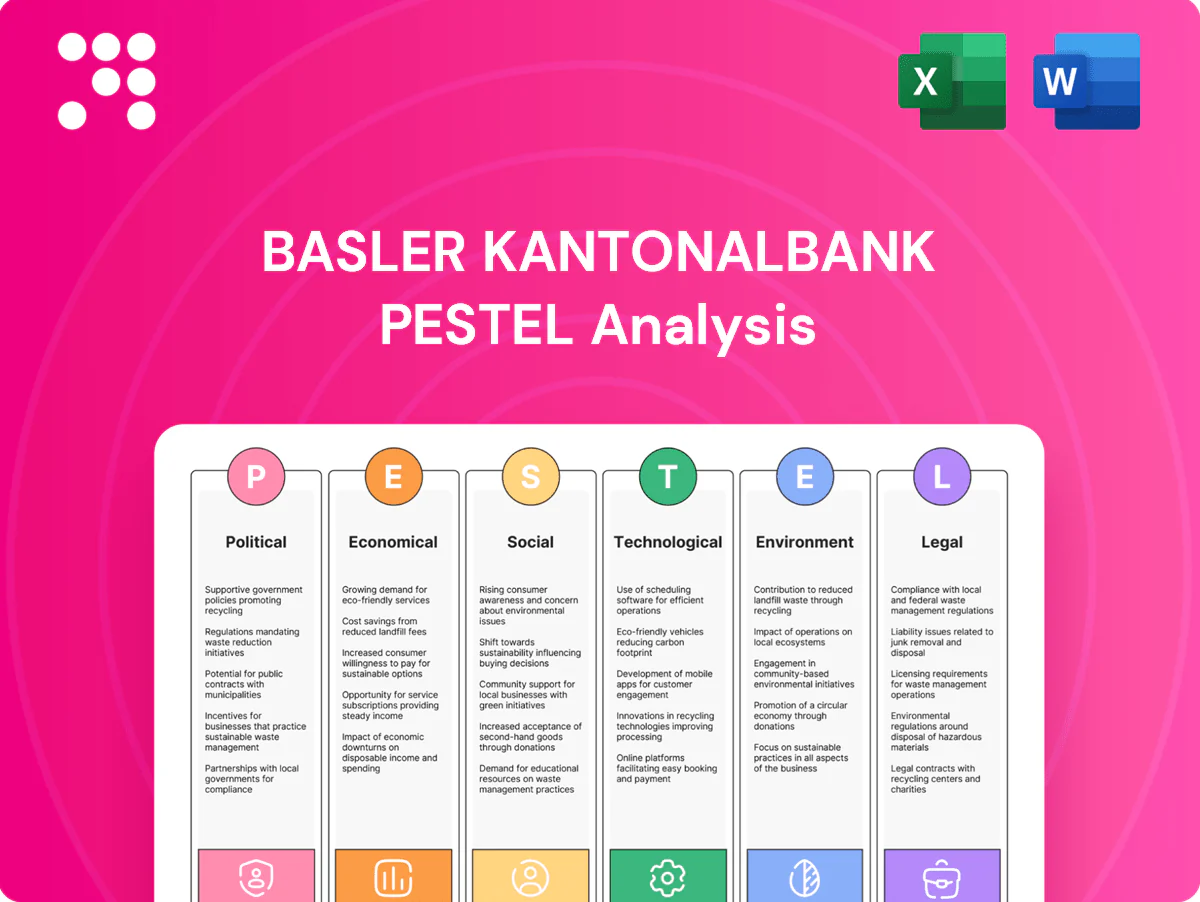
Basler Kantonalbank PESTLE Analysis

Plan Smarter. Present Sharper. Compete Stronger.
Discover how political shifts, economic cycles, and technological trends are reshaping Basler Kantonalbank’s strategic landscape in our concise PESTLE overview. Ideal for investors and strategists, it highlights risks and opportunities you need to know. Purchase the full analysis to access the detailed, ready-to-use insights and forecasts.
Political factors

Cantonal ownership and guarantee
Basler Kantonalbank is wholly owned by the Canton of Basel-Stadt, benefiting from an explicit cantonal guarantee that underpins depositor confidence and supports stable access to liquidity.
This political backing typically lowers funding costs and helps stabilize the franchise in stress periods, while increasing public scrutiny and expectations for conservative risk management.
Any revision to the guarantee framework would materially affect the bank’s risk profile and capital requirements, altering investor and regulator assessments.
Swiss federal stability
Switzerland’s stable federal system and consensus-driven governance, reflected in its AAA sovereign rating (S&P) in 2024, significantly reduce political risk for banks and enable long-term planning.
Strong institutions and predictable policy-making underpin Basel’s role as a financial hub, supporting cross-border activity and regional banking stability.
Swiss geopolitical neutrality since 1815 dampens external shocks, while the national banking sector—reported by SNB at roughly CHF 10 trillion in assets in 2024—adds resilience to Basler Kantonalbank’s operating environment.

Regional development mandate
Basler Kantonalbank is expected to prioritize lending to Basel-Stadt’s economy, supporting SMEs, infrastructure and housing in a canton of about 201,000 residents (2024). Political stakeholders may push local lending through downturns, raising concentration risks in construction and the region’s strong life-sciences cluster. Balancing commercial returns with public-policy objectives remains a core governance challenge for BKB.

Cross-border relations in the tri-border area
Basel’s proximity to Germany and France drives significant cross-border client flows and political sensitivities; Switzerland hosted about 350,000 cross-border workers in 2023 (Swiss Federal Statistical Office), concentrating notable volumes in the tri‑border region and boosting Basler Kantonalbank’s retail and private-banking catchment. Bilateral agreements and EU–Swiss relations directly shape market access, tax coordination and labour mobility; any deterioration would raise compliance costs and restrict near‑border growth, while stable cooperation expands BKB’s regional reach.
Public scrutiny and governance
Basler Kantonalbank is 100% owned by the Canton of Basel-Stadt, so cantonal oversight and Swiss direct-democratic mechanisms drive heightened transparency and accountability. Political expectations shape executive pay, risk appetite and sustainability commitments, and governance lapses rapidly escalate into political issues. Strong, continuous stakeholder engagement is essential to preserve legitimacy and trust.
Cantonal guarantee and Swiss AAA underpin Basel cantonal bank's regional funding advantage
Cantonal ownership and an explicit Basel‑Stadt guarantee underpin depositor confidence and lower funding costs, while raising public scrutiny and conservative risk expectations. Switzerland’s AAA (S&P, 2024) and CHF 10tn banking assets (SNB, 2024) reduce political risk; 201,000 residents in Basel‑Stadt (2024) focus BKB on local lending. 350,000 cross‑border workers (SFSO, 2023) amplify regional market access and regulatory sensitivity.
| Metric | Value (Year) |
|---|---|
| Swiss rating | AAA (S&P, 2024) |
| Banking sector assets | CHF 10tn (SNB, 2024) |
| Basel‑Stadt pop. | 201,000 (2024) |
| Cross‑border workers | 350,000 (SFSO, 2023) |
What is included in the product
 Detailed Word Document
Provides a concise PESTLE assessment of Basler Kantonalbank, examining Political, Economic, Social, Technological, Environmental and Legal drivers with data-backed trends and region-specific examples to identify risks, opportunities and forward-looking scenarios for executives, consultants and investors.

 Customizable Excel Spreadsheet
A concise, visually segmented PESTLE summary of Basler Kantonalbank that’s easily dropped into presentations, editable for local context, and ideal for quick team alignment and risk discussions.
Economic factors

SNB interest-rate cycle
SNB interest-rate policy directly shapes Basler Kantonalbank's net interest margins and Swiss mortgage demand; the SNB policy rate stood at 1.75% in mid-2025, lifting margins but moderating credit growth. Rate cuts would compress spreads yet tend to improve asset quality. Active balance-sheet positioning and hedging are essential to smooth earnings volatility going forward.
Basel’s life sciences cluster
Basel’s life sciences cluster, anchored by Roche (CHF 63.6bn sales in 2023) and Novartis (CHF 50.1bn in 2023), stabilizes household incomes and deposit bases in the region. A dense network of supplier SMEs and high-skilled R&D roles sustains demand for affluent retail and private banking. Sector cyclicality and global pricing pressures can quickly transmit to regional credit quality and working-capital needs. Basler Kantonalbank can capture this base via targeted corporate lending, cash management and bespoke wealth services.

Swiss franc strength
A strong Swiss franc preserves domestic purchasing power but strains exporters and tourism clients by making Swiss goods and overnight stays pricier for foreigners. It shapes cross-border activity and wealth management flows, with Swiss banks overseeing roughly USD 3.5 trillion in cross-border assets in 2024. Currency strength also pressures investment returns in client portfolios, raising demand for hedging; tailored FX hedges and diversified lending lines mitigate FX-related earnings swings.

Real estate and mortgage dynamics
Mortgages are core to Swiss banking with about 1.3 trillion CHF in outstanding residential mortgages (SNB 2024); affordability rules (amortisation + 33% debt-service test) and macroprudential buffers limit rapid growth. Higher rates since 2022 have cooled price gains and refinancing volumes; strict LTV caps and credit standards lower default risk but constrain new business, while Basler Kantonalbank’s regional concentration ties performance to Basel housing cycles.
- Mortgage stock: 1.3tn CHF (SNB 2024)
- Affordability: 33% DST + amortisation rules
- LTV caps ≈80% limit risk but slow originations
- Regional risk: Basel market concentration concentrates cyclicality
SME cycle and credit quality
Swiss SMEs, which account for 99.7% of firms and roughly 67% of employment (FSO), are highly sensitive to global demand and financing costs, which directly affect loan performance; payment behavior and insolvencies closely track the business cycle. Diversification across sectors lowers tail risk, while proactive workout and advisory support improve recoveries and preserve client relationships.
- SME share: 99.7% of firms (FSO)
- Employment: ~67% workforce (FSO)
- Payment behavior: cyclical
- Mitigation: sector diversification + proactive workouts
Cantonal guarantee and Swiss AAA underpin Basel cantonal bank's regional funding advantage
SNB policy (1.75% mid-2025) drives NIMs and mortgage demand, with rate cuts compressing spreads but easing asset quality. Mortgage stock ~1.3tn CHF (SNB 2024) and strict DST/LTV rules cap originations. SMEs (99.7% firms; ~67% employment, FSO) and Basel life-science cluster support deposits but transmit global cyclicality. Strong CHF and ~USD 3.5tn cross-border assets (2024) raise hedging needs.
| Metric | Value |
|---|---|
| SNB policy rate | 1.75% (mid-2025) |
| Mortgage stock | 1.3tn CHF (SNB 2024) |
| Cross-border assets | USD 3.5tn (2024) |
| SME share | 99.7% firms; ~67% employment (FSO) |
Full Version Awaits
Basler Kantonalbank PESTLE Analysis
The Basler Kantonalbank PESTLE Analysis provides a concise review of political, economic, social, technological, legal and environmental factors affecting the bank. The preview shown here is the exact document you’ll receive after purchase—fully formatted and ready to use. No placeholders, no surprises; this is the final file.

Plan Smarter. Present Sharper. Compete Stronger.
Discover how political shifts, economic cycles, and technological trends are reshaping Basler Kantonalbank’s strategic landscape in our concise PESTLE overview. Ideal for investors and strategists, it highlights risks and opportunities you need to know. Purchase the full analysis to access the detailed, ready-to-use insights and forecasts.
Political factors
Cantonal ownership and guarantee
Basler Kantonalbank is wholly owned by the Canton of Basel-Stadt, benefiting from an explicit cantonal guarantee that underpins depositor confidence and supports stable access to liquidity.
This political backing typically lowers funding costs and helps stabilize the franchise in stress periods, while increasing public scrutiny and expectations for conservative risk management.
Any revision to the guarantee framework would materially affect the bank’s risk profile and capital requirements, altering investor and regulator assessments.
Swiss federal stability
Switzerland’s stable federal system and consensus-driven governance, reflected in its AAA sovereign rating (S&P) in 2024, significantly reduce political risk for banks and enable long-term planning.
Strong institutions and predictable policy-making underpin Basel’s role as a financial hub, supporting cross-border activity and regional banking stability.
Swiss geopolitical neutrality since 1815 dampens external shocks, while the national banking sector—reported by SNB at roughly CHF 10 trillion in assets in 2024—adds resilience to Basler Kantonalbank’s operating environment.
Regional development mandate
Basler Kantonalbank is expected to prioritize lending to Basel-Stadt’s economy, supporting SMEs, infrastructure and housing in a canton of about 201,000 residents (2024). Political stakeholders may push local lending through downturns, raising concentration risks in construction and the region’s strong life-sciences cluster. Balancing commercial returns with public-policy objectives remains a core governance challenge for BKB.
Cross-border relations in the tri-border area
Basel’s proximity to Germany and France drives significant cross-border client flows and political sensitivities; Switzerland hosted about 350,000 cross-border workers in 2023 (Swiss Federal Statistical Office), concentrating notable volumes in the tri‑border region and boosting Basler Kantonalbank’s retail and private-banking catchment. Bilateral agreements and EU–Swiss relations directly shape market access, tax coordination and labour mobility; any deterioration would raise compliance costs and restrict near‑border growth, while stable cooperation expands BKB’s regional reach.
Public scrutiny and governance
Basler Kantonalbank is 100% owned by the Canton of Basel-Stadt, so cantonal oversight and Swiss direct-democratic mechanisms drive heightened transparency and accountability. Political expectations shape executive pay, risk appetite and sustainability commitments, and governance lapses rapidly escalate into political issues. Strong, continuous stakeholder engagement is essential to preserve legitimacy and trust.
Cantonal guarantee and Swiss AAA underpin Basel cantonal bank's regional funding advantage
Cantonal ownership and an explicit Basel‑Stadt guarantee underpin depositor confidence and lower funding costs, while raising public scrutiny and conservative risk expectations. Switzerland’s AAA (S&P, 2024) and CHF 10tn banking assets (SNB, 2024) reduce political risk; 201,000 residents in Basel‑Stadt (2024) focus BKB on local lending. 350,000 cross‑border workers (SFSO, 2023) amplify regional market access and regulatory sensitivity.
| Metric | Value (Year) |
|---|---|
| Swiss rating | AAA (S&P, 2024) |
| Banking sector assets | CHF 10tn (SNB, 2024) |
| Basel‑Stadt pop. | 201,000 (2024) |
| Cross‑border workers | 350,000 (SFSO, 2023) |
What is included in the product
Detailed Word Document
Provides a concise PESTLE assessment of Basler Kantonalbank, examining Political, Economic, Social, Technological, Environmental and Legal drivers with data-backed trends and region-specific examples to identify risks, opportunities and forward-looking scenarios for executives, consultants and investors.
Customizable Excel Spreadsheet
A concise, visually segmented PESTLE summary of Basler Kantonalbank that’s easily dropped into presentations, editable for local context, and ideal for quick team alignment and risk discussions.
Economic factors
SNB interest-rate cycle
SNB interest-rate policy directly shapes Basler Kantonalbank's net interest margins and Swiss mortgage demand; the SNB policy rate stood at 1.75% in mid-2025, lifting margins but moderating credit growth. Rate cuts would compress spreads yet tend to improve asset quality. Active balance-sheet positioning and hedging are essential to smooth earnings volatility going forward.
Basel’s life sciences cluster
Basel’s life sciences cluster, anchored by Roche (CHF 63.6bn sales in 2023) and Novartis (CHF 50.1bn in 2023), stabilizes household incomes and deposit bases in the region. A dense network of supplier SMEs and high-skilled R&D roles sustains demand for affluent retail and private banking. Sector cyclicality and global pricing pressures can quickly transmit to regional credit quality and working-capital needs. Basler Kantonalbank can capture this base via targeted corporate lending, cash management and bespoke wealth services.
Swiss franc strength
A strong Swiss franc preserves domestic purchasing power but strains exporters and tourism clients by making Swiss goods and overnight stays pricier for foreigners. It shapes cross-border activity and wealth management flows, with Swiss banks overseeing roughly USD 3.5 trillion in cross-border assets in 2024. Currency strength also pressures investment returns in client portfolios, raising demand for hedging; tailored FX hedges and diversified lending lines mitigate FX-related earnings swings.
Real estate and mortgage dynamics
Mortgages are core to Swiss banking with about 1.3 trillion CHF in outstanding residential mortgages (SNB 2024); affordability rules (amortisation + 33% debt-service test) and macroprudential buffers limit rapid growth. Higher rates since 2022 have cooled price gains and refinancing volumes; strict LTV caps and credit standards lower default risk but constrain new business, while Basler Kantonalbank’s regional concentration ties performance to Basel housing cycles.
- Mortgage stock: 1.3tn CHF (SNB 2024)
- Affordability: 33% DST + amortisation rules
- LTV caps ≈80% limit risk but slow originations
- Regional risk: Basel market concentration concentrates cyclicality
SME cycle and credit quality
Swiss SMEs, which account for 99.7% of firms and roughly 67% of employment (FSO), are highly sensitive to global demand and financing costs, which directly affect loan performance; payment behavior and insolvencies closely track the business cycle. Diversification across sectors lowers tail risk, while proactive workout and advisory support improve recoveries and preserve client relationships.
- SME share: 99.7% of firms (FSO)
- Employment: ~67% workforce (FSO)
- Payment behavior: cyclical
- Mitigation: sector diversification + proactive workouts
Cantonal guarantee and Swiss AAA underpin Basel cantonal bank's regional funding advantage
SNB policy (1.75% mid-2025) drives NIMs and mortgage demand, with rate cuts compressing spreads but easing asset quality. Mortgage stock ~1.3tn CHF (SNB 2024) and strict DST/LTV rules cap originations. SMEs (99.7% firms; ~67% employment, FSO) and Basel life-science cluster support deposits but transmit global cyclicality. Strong CHF and ~USD 3.5tn cross-border assets (2024) raise hedging needs.
| Metric | Value |
|---|---|
| SNB policy rate | 1.75% (mid-2025) |
| Mortgage stock | 1.3tn CHF (SNB 2024) |
| Cross-border assets | USD 3.5tn (2024) |
| SME share | 99.7% firms; ~67% employment (FSO) |
Full Version Awaits
Basler Kantonalbank PESTLE Analysis
The Basler Kantonalbank PESTLE Analysis provides a concise review of political, economic, social, technological, legal and environmental factors affecting the bank. The preview shown here is the exact document you’ll receive after purchase—fully formatted and ready to use. No placeholders, no surprises; this is the final file.
Original: $10.00
-65%$10.00
$3.50Description
Plan Smarter. Present Sharper. Compete Stronger.
Discover how political shifts, economic cycles, and technological trends are reshaping Basler Kantonalbank’s strategic landscape in our concise PESTLE overview. Ideal for investors and strategists, it highlights risks and opportunities you need to know. Purchase the full analysis to access the detailed, ready-to-use insights and forecasts.
Political factors
Cantonal ownership and guarantee
Basler Kantonalbank is wholly owned by the Canton of Basel-Stadt, benefiting from an explicit cantonal guarantee that underpins depositor confidence and supports stable access to liquidity.
This political backing typically lowers funding costs and helps stabilize the franchise in stress periods, while increasing public scrutiny and expectations for conservative risk management.
Any revision to the guarantee framework would materially affect the bank’s risk profile and capital requirements, altering investor and regulator assessments.
Swiss federal stability
Switzerland’s stable federal system and consensus-driven governance, reflected in its AAA sovereign rating (S&P) in 2024, significantly reduce political risk for banks and enable long-term planning.
Strong institutions and predictable policy-making underpin Basel’s role as a financial hub, supporting cross-border activity and regional banking stability.
Swiss geopolitical neutrality since 1815 dampens external shocks, while the national banking sector—reported by SNB at roughly CHF 10 trillion in assets in 2024—adds resilience to Basler Kantonalbank’s operating environment.
Regional development mandate
Basler Kantonalbank is expected to prioritize lending to Basel-Stadt’s economy, supporting SMEs, infrastructure and housing in a canton of about 201,000 residents (2024). Political stakeholders may push local lending through downturns, raising concentration risks in construction and the region’s strong life-sciences cluster. Balancing commercial returns with public-policy objectives remains a core governance challenge for BKB.
Cross-border relations in the tri-border area
Basel’s proximity to Germany and France drives significant cross-border client flows and political sensitivities; Switzerland hosted about 350,000 cross-border workers in 2023 (Swiss Federal Statistical Office), concentrating notable volumes in the tri‑border region and boosting Basler Kantonalbank’s retail and private-banking catchment. Bilateral agreements and EU–Swiss relations directly shape market access, tax coordination and labour mobility; any deterioration would raise compliance costs and restrict near‑border growth, while stable cooperation expands BKB’s regional reach.
Public scrutiny and governance
Basler Kantonalbank is 100% owned by the Canton of Basel-Stadt, so cantonal oversight and Swiss direct-democratic mechanisms drive heightened transparency and accountability. Political expectations shape executive pay, risk appetite and sustainability commitments, and governance lapses rapidly escalate into political issues. Strong, continuous stakeholder engagement is essential to preserve legitimacy and trust.
Cantonal guarantee and Swiss AAA underpin Basel cantonal bank's regional funding advantage
Cantonal ownership and an explicit Basel‑Stadt guarantee underpin depositor confidence and lower funding costs, while raising public scrutiny and conservative risk expectations. Switzerland’s AAA (S&P, 2024) and CHF 10tn banking assets (SNB, 2024) reduce political risk; 201,000 residents in Basel‑Stadt (2024) focus BKB on local lending. 350,000 cross‑border workers (SFSO, 2023) amplify regional market access and regulatory sensitivity.
| Metric | Value (Year) |
|---|---|
| Swiss rating | AAA (S&P, 2024) |
| Banking sector assets | CHF 10tn (SNB, 2024) |
| Basel‑Stadt pop. | 201,000 (2024) |
| Cross‑border workers | 350,000 (SFSO, 2023) |
What is included in the product
Detailed Word Document
Provides a concise PESTLE assessment of Basler Kantonalbank, examining Political, Economic, Social, Technological, Environmental and Legal drivers with data-backed trends and region-specific examples to identify risks, opportunities and forward-looking scenarios for executives, consultants and investors.
Customizable Excel Spreadsheet
A concise, visually segmented PESTLE summary of Basler Kantonalbank that’s easily dropped into presentations, editable for local context, and ideal for quick team alignment and risk discussions.
Economic factors
SNB interest-rate cycle
SNB interest-rate policy directly shapes Basler Kantonalbank's net interest margins and Swiss mortgage demand; the SNB policy rate stood at 1.75% in mid-2025, lifting margins but moderating credit growth. Rate cuts would compress spreads yet tend to improve asset quality. Active balance-sheet positioning and hedging are essential to smooth earnings volatility going forward.
Basel’s life sciences cluster
Basel’s life sciences cluster, anchored by Roche (CHF 63.6bn sales in 2023) and Novartis (CHF 50.1bn in 2023), stabilizes household incomes and deposit bases in the region. A dense network of supplier SMEs and high-skilled R&D roles sustains demand for affluent retail and private banking. Sector cyclicality and global pricing pressures can quickly transmit to regional credit quality and working-capital needs. Basler Kantonalbank can capture this base via targeted corporate lending, cash management and bespoke wealth services.
Swiss franc strength
A strong Swiss franc preserves domestic purchasing power but strains exporters and tourism clients by making Swiss goods and overnight stays pricier for foreigners. It shapes cross-border activity and wealth management flows, with Swiss banks overseeing roughly USD 3.5 trillion in cross-border assets in 2024. Currency strength also pressures investment returns in client portfolios, raising demand for hedging; tailored FX hedges and diversified lending lines mitigate FX-related earnings swings.
Real estate and mortgage dynamics
Mortgages are core to Swiss banking with about 1.3 trillion CHF in outstanding residential mortgages (SNB 2024); affordability rules (amortisation + 33% debt-service test) and macroprudential buffers limit rapid growth. Higher rates since 2022 have cooled price gains and refinancing volumes; strict LTV caps and credit standards lower default risk but constrain new business, while Basler Kantonalbank’s regional concentration ties performance to Basel housing cycles.
- Mortgage stock: 1.3tn CHF (SNB 2024)
- Affordability: 33% DST + amortisation rules
- LTV caps ≈80% limit risk but slow originations
- Regional risk: Basel market concentration concentrates cyclicality
SME cycle and credit quality
Swiss SMEs, which account for 99.7% of firms and roughly 67% of employment (FSO), are highly sensitive to global demand and financing costs, which directly affect loan performance; payment behavior and insolvencies closely track the business cycle. Diversification across sectors lowers tail risk, while proactive workout and advisory support improve recoveries and preserve client relationships.
- SME share: 99.7% of firms (FSO)
- Employment: ~67% workforce (FSO)
- Payment behavior: cyclical
- Mitigation: sector diversification + proactive workouts
Cantonal guarantee and Swiss AAA underpin Basel cantonal bank's regional funding advantage
SNB policy (1.75% mid-2025) drives NIMs and mortgage demand, with rate cuts compressing spreads but easing asset quality. Mortgage stock ~1.3tn CHF (SNB 2024) and strict DST/LTV rules cap originations. SMEs (99.7% firms; ~67% employment, FSO) and Basel life-science cluster support deposits but transmit global cyclicality. Strong CHF and ~USD 3.5tn cross-border assets (2024) raise hedging needs.
| Metric | Value |
|---|---|
| SNB policy rate | 1.75% (mid-2025) |
| Mortgage stock | 1.3tn CHF (SNB 2024) |
| Cross-border assets | USD 3.5tn (2024) |
| SME share | 99.7% firms; ~67% employment (FSO) |
Full Version Awaits
Basler Kantonalbank PESTLE Analysis
The Basler Kantonalbank PESTLE Analysis provides a concise review of political, economic, social, technological, legal and environmental factors affecting the bank. The preview shown here is the exact document you’ll receive after purchase—fully formatted and ready to use. No placeholders, no surprises; this is the final file.











