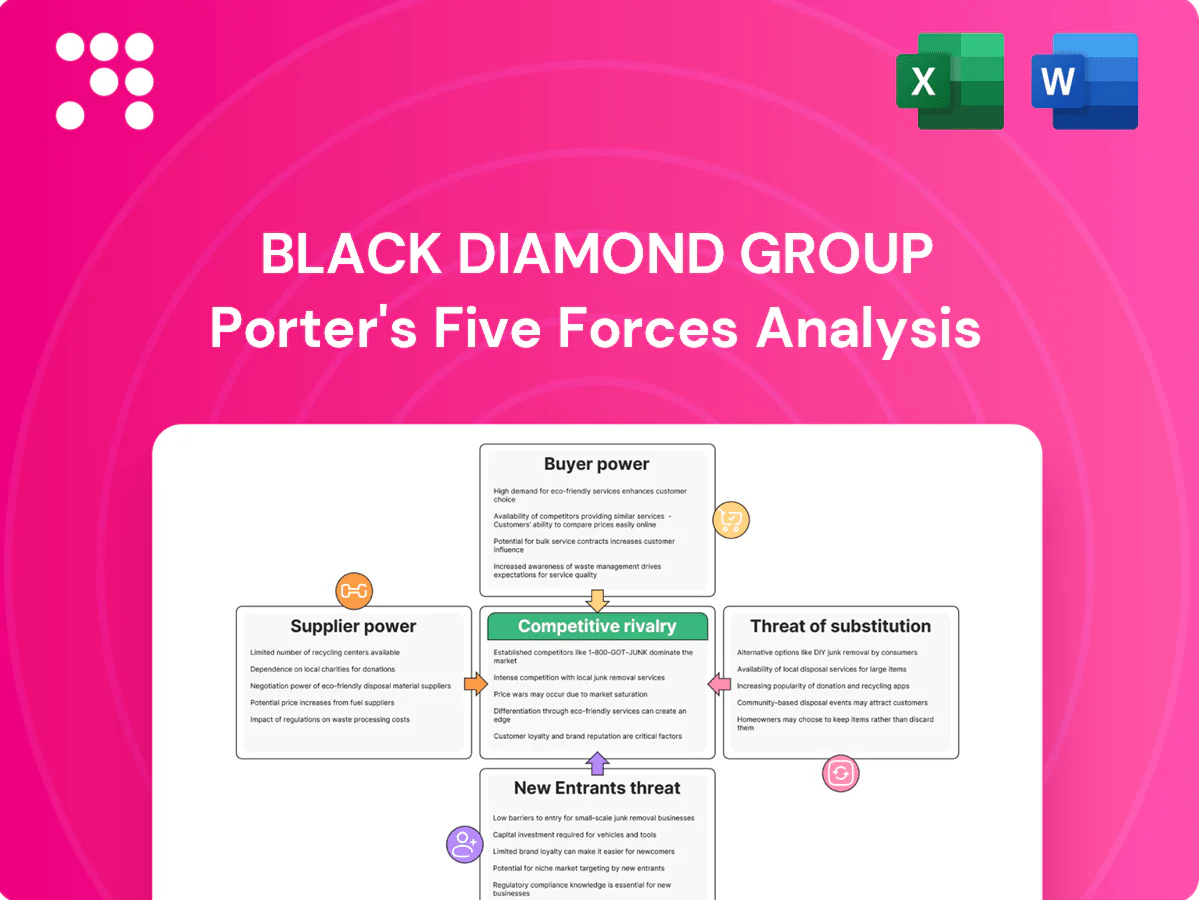
Black Diamond Group Porter's Five Forces Analysis

Elevate Your Analysis with the Complete Porter's Five Forces Analysis
Black Diamond Group faces moderate buyer power and differentiated service offerings but contends with rising regulatory scrutiny and competition from larger asset managers; supplier influence and substitutes present manageable risks. This brief snapshot only scratches the surface — unlock the full Porter's Five Forces Analysis to explore Black Diamond Group’s competitive dynamics, market pressures, and strategic advantages in detail.
Suppliers Bargaining Power

Steel and materials concentration
Modular units depend on concentrated regional suppliers of steel, lumber, insulation and specialty HVAC, and 2024 saw input-price volatility of roughly 15% year-over-year for core materials, compressing margins on Black Diamond Group's multi-year leases. Multi-sourcing and commodity hedges mitigate but do not eliminate exposure, and supplier leverage strengthens materially during construction upcycles and logistics tightness, raising procurement risk and upward price pressure.
Specialized fabrication capacity
Custom modular fabrication requires certified plants with QA/QC and safety credentials; as of 2024, qualified facilities are concentrated in key hubs, giving fabricators leverage on lead times and pricing in remote regions. Limited local capacity often forces premium scheduling; strategic vendor partnerships and volume commitments can secure slots. Retaining design specs in-house prevents vendor lock-in and preserves negotiation power.

Remote logistics and transport
Heavy-haul carriers, crane operators and last-mile rigging firms are scarce in remote basins, with fewer than a dozen specialized providers dominating many Arctic and frontier corridors in 2024, concentrating bargaining power. Rising fuel costs—Brent averaged about $85/bbl in 2024—and permit fees plus seasonal road bans lifted carrier leverage. Bundling transport across projects and using backhauls reduced spot rates materially, but weather and narrow regulatory windows can still flip power back to logistics providers.

Utilities and camp services inputs
Diesel, power generation, water/waste and catering are essential to Black Diamond Group camps; diesel and genset fuel can represent a material portion of camp Opex and 2024 fuel volatility raised remote-site operating costs. Local monopolies or few vendors near project sites allow suppliers to dictate pricing and service terms. Long-term contracts and captive onsite infrastructure materially reduce exposure, while tighter ESG sourcing and waste standards in 2024 narrowed approved supplier lists, modestly increasing supplier leverage.
- Diesel volatility 2024: higher Opex pressure
- Local vendor concentration: increased bargaining power
- Long-term contracts/onsite assets: reduced supply risk
- ESG requirements 2024: fewer qualified suppliers, modestly lifting power
Technology and modular components
Proprietary connectors, smart meters and fire/life‑safety systems for Black Diamond are typically sourced from fewer than 10 OEMs, creating supplier leverage; certifications and warranty terms often lock specifications to specific brands, raising switching costs. Use of framework agreements and approved alternates has delivered negotiated discounts of roughly 5–15% in 2024, while in‑house assembly/backward integration can cut component dependence and COGS by an estimated 10–20%.
- Concentration: fewer than 10 OEMs
- Discounts via frameworks: 5–15% (2024)
- COGS reduction via backward integration: ~10–20%
- Certification lock increases switching cost
Supply power tight: ~15% volatility; Brent $85/bbl
Suppliers exert moderate-to-high power: 2024 input-price volatility ~15% YoY and Brent ~$85/bbl increased Opex and margin pressure. Fewer than 10 OEMs for key components and scarce heavy-haul carriers concentrate leverage; long-term contracts, backward integration and framework discounts (5–15%) mitigate risk.
| Metric | 2024 |
|---|---|
| Input-price volatility | ~15% YoY |
| Brent | $85/bbl |
| OEMs (key) | <10 |
| Framework discounts | 5–15% |
What is included in the product
 Detailed Word Document
Uncovers key drivers of competition, customer influence, supplier power, entry barriers, and substitutes tailored to Black Diamond Group, identifying disruptive threats and opportunities to protect market share and enhance profitability.

 Customizable Excel Spreadsheet
Clear one-sheet Porter's Five Forces for Black Diamond Group—instantly shows competitive pressure and strategic risks, ready to drop into decks; easily customize force levels with your data to model regulation or new-entrant scenarios.
Customers Bargaining Power

Large enterprise buyers
Large enterprise buyers—oil & gas majors, miners, EPCs and governments—buy at scale and use multi-site, multi-year contracts to extract discounts and strict SLAs. In 2024 the largest oil majors (Saudi Aramco, ExxonMobil, Shell) remained among the world’s top revenue generators, reinforcing procurement leverage. Preferred-vendor lists and tenders intensify competition; value-added services and performance SLAs enable suppliers to command premiums.
Project-based demand volatility
Cyclical capex drives stop-start purchasing and seasonal utilization swings, with the global equipment rental market estimated around US$110 billion in 2024, enabling buyers to time procurements into soft quarters to extract discounts. Flexible lease terms and relocation services mitigate some discount pressure by preserving utilization and yield. Black Diamond’s sector-diversified pipeline reduces dependence on any single buyer and softens bargaining leverage.

Switching costs and standardization
Units are modular and relocatable, enabling buyer switching between providers; in 2024 this portability remained a core driver of procurement flexibility. Site-specific layouts, permitting timelines and HSE documentation create switching frictions and transaction costs. Standardized footprints improve comparability and thus buyer negotiating power. Embedded maintenance contracts and uptime guarantees increase stickiness and reduce churn.

Bid-driven procurement
In bid-driven procurement RFPs with clear specs force apples-to-apples pricing pressure, enabling buyers to unbundle transport, installation and services to seek best-in-class suppliers for each scope; Black Diamond Group must compete on unit price when scopes are separated. Speed-to-site and turnkey execution provide differentiation that offsets pure price focus, while past performance and safety records act as decisive tie-breakers in award decisions.
- Apples-to-apples pricing
- Unbundling lowers margins
- Turnkey offsets price
- Safety/performance tie-breaker
Government and ESG requirements
Public-sector buyers impose strict compliance, local content and sustainability clauses that raise Black Diamond Group’s project costs but narrow competition; in 2024 many APAC tenders placed 10–20% weighting on ESG criteria, enabling firms with certifications to access sole-source or weighted awards. Buyers use compliance as a negotiation lever, softening pure price pressure when ESG credentials are strong.
- 2024: 10–20% ESG weighting in many public tenders
- Compliance raises bid costs but reduces competitor pool
- Strong ESG can secure sole-source/weighted awards
Buyers control supply: US$110bn rentals, 10–20% ESG tilt
Large enterprise buyers (majors, miners, EPCs, governments) exert strong scale leverage via multi-year contracts and tenders; top oil majors remained among world’s highest revenue generators in 2024. A ~US$110bn equipment rental market in 2024 lets buyers time purchases for discounts; modular units and standardized specs increase switching power while ESG compliance (10–20% tender weighting) narrows competitor pools.
| Metric | 2024 |
|---|---|
| Equipment rental market | ~US$110bn |
| ESG tender weighting | 10–20% |
Full Version Awaits
Black Diamond Group Porter's Five Forces Analysis
This Porter’s Five Forces analysis of Black Diamond Group provides a concise, professional assessment of industry rivalry, supplier and buyer power, threat of entry and substitutes, and overall competitive dynamics. The preview is the exact file you’ll receive upon purchase—fully formatted, comprehensive, and ready for immediate download and use.

Elevate Your Analysis with the Complete Porter's Five Forces Analysis
Black Diamond Group faces moderate buyer power and differentiated service offerings but contends with rising regulatory scrutiny and competition from larger asset managers; supplier influence and substitutes present manageable risks. This brief snapshot only scratches the surface — unlock the full Porter's Five Forces Analysis to explore Black Diamond Group’s competitive dynamics, market pressures, and strategic advantages in detail.
Suppliers Bargaining Power
Steel and materials concentration
Modular units depend on concentrated regional suppliers of steel, lumber, insulation and specialty HVAC, and 2024 saw input-price volatility of roughly 15% year-over-year for core materials, compressing margins on Black Diamond Group's multi-year leases. Multi-sourcing and commodity hedges mitigate but do not eliminate exposure, and supplier leverage strengthens materially during construction upcycles and logistics tightness, raising procurement risk and upward price pressure.
Specialized fabrication capacity
Custom modular fabrication requires certified plants with QA/QC and safety credentials; as of 2024, qualified facilities are concentrated in key hubs, giving fabricators leverage on lead times and pricing in remote regions. Limited local capacity often forces premium scheduling; strategic vendor partnerships and volume commitments can secure slots. Retaining design specs in-house prevents vendor lock-in and preserves negotiation power.
Remote logistics and transport
Heavy-haul carriers, crane operators and last-mile rigging firms are scarce in remote basins, with fewer than a dozen specialized providers dominating many Arctic and frontier corridors in 2024, concentrating bargaining power. Rising fuel costs—Brent averaged about $85/bbl in 2024—and permit fees plus seasonal road bans lifted carrier leverage. Bundling transport across projects and using backhauls reduced spot rates materially, but weather and narrow regulatory windows can still flip power back to logistics providers.
Utilities and camp services inputs
Diesel, power generation, water/waste and catering are essential to Black Diamond Group camps; diesel and genset fuel can represent a material portion of camp Opex and 2024 fuel volatility raised remote-site operating costs. Local monopolies or few vendors near project sites allow suppliers to dictate pricing and service terms. Long-term contracts and captive onsite infrastructure materially reduce exposure, while tighter ESG sourcing and waste standards in 2024 narrowed approved supplier lists, modestly increasing supplier leverage.
- Diesel volatility 2024: higher Opex pressure
- Local vendor concentration: increased bargaining power
- Long-term contracts/onsite assets: reduced supply risk
- ESG requirements 2024: fewer qualified suppliers, modestly lifting power
Technology and modular components
Proprietary connectors, smart meters and fire/life‑safety systems for Black Diamond are typically sourced from fewer than 10 OEMs, creating supplier leverage; certifications and warranty terms often lock specifications to specific brands, raising switching costs. Use of framework agreements and approved alternates has delivered negotiated discounts of roughly 5–15% in 2024, while in‑house assembly/backward integration can cut component dependence and COGS by an estimated 10–20%.
- Concentration: fewer than 10 OEMs
- Discounts via frameworks: 5–15% (2024)
- COGS reduction via backward integration: ~10–20%
- Certification lock increases switching cost
Supply power tight: ~15% volatility; Brent $85/bbl
Suppliers exert moderate-to-high power: 2024 input-price volatility ~15% YoY and Brent ~$85/bbl increased Opex and margin pressure. Fewer than 10 OEMs for key components and scarce heavy-haul carriers concentrate leverage; long-term contracts, backward integration and framework discounts (5–15%) mitigate risk.
| Metric | 2024 |
|---|---|
| Input-price volatility | ~15% YoY |
| Brent | $85/bbl |
| OEMs (key) | <10 |
| Framework discounts | 5–15% |
What is included in the product
Detailed Word Document
Uncovers key drivers of competition, customer influence, supplier power, entry barriers, and substitutes tailored to Black Diamond Group, identifying disruptive threats and opportunities to protect market share and enhance profitability.
Customizable Excel Spreadsheet
Clear one-sheet Porter's Five Forces for Black Diamond Group—instantly shows competitive pressure and strategic risks, ready to drop into decks; easily customize force levels with your data to model regulation or new-entrant scenarios.
Customers Bargaining Power
Large enterprise buyers
Large enterprise buyers—oil & gas majors, miners, EPCs and governments—buy at scale and use multi-site, multi-year contracts to extract discounts and strict SLAs. In 2024 the largest oil majors (Saudi Aramco, ExxonMobil, Shell) remained among the world’s top revenue generators, reinforcing procurement leverage. Preferred-vendor lists and tenders intensify competition; value-added services and performance SLAs enable suppliers to command premiums.
Project-based demand volatility
Cyclical capex drives stop-start purchasing and seasonal utilization swings, with the global equipment rental market estimated around US$110 billion in 2024, enabling buyers to time procurements into soft quarters to extract discounts. Flexible lease terms and relocation services mitigate some discount pressure by preserving utilization and yield. Black Diamond’s sector-diversified pipeline reduces dependence on any single buyer and softens bargaining leverage.
Switching costs and standardization
Units are modular and relocatable, enabling buyer switching between providers; in 2024 this portability remained a core driver of procurement flexibility. Site-specific layouts, permitting timelines and HSE documentation create switching frictions and transaction costs. Standardized footprints improve comparability and thus buyer negotiating power. Embedded maintenance contracts and uptime guarantees increase stickiness and reduce churn.
Bid-driven procurement
In bid-driven procurement RFPs with clear specs force apples-to-apples pricing pressure, enabling buyers to unbundle transport, installation and services to seek best-in-class suppliers for each scope; Black Diamond Group must compete on unit price when scopes are separated. Speed-to-site and turnkey execution provide differentiation that offsets pure price focus, while past performance and safety records act as decisive tie-breakers in award decisions.
- Apples-to-apples pricing
- Unbundling lowers margins
- Turnkey offsets price
- Safety/performance tie-breaker
Government and ESG requirements
Public-sector buyers impose strict compliance, local content and sustainability clauses that raise Black Diamond Group’s project costs but narrow competition; in 2024 many APAC tenders placed 10–20% weighting on ESG criteria, enabling firms with certifications to access sole-source or weighted awards. Buyers use compliance as a negotiation lever, softening pure price pressure when ESG credentials are strong.
- 2024: 10–20% ESG weighting in many public tenders
- Compliance raises bid costs but reduces competitor pool
- Strong ESG can secure sole-source/weighted awards
Buyers control supply: US$110bn rentals, 10–20% ESG tilt
Large enterprise buyers (majors, miners, EPCs, governments) exert strong scale leverage via multi-year contracts and tenders; top oil majors remained among world’s highest revenue generators in 2024. A ~US$110bn equipment rental market in 2024 lets buyers time purchases for discounts; modular units and standardized specs increase switching power while ESG compliance (10–20% tender weighting) narrows competitor pools.
| Metric | 2024 |
|---|---|
| Equipment rental market | ~US$110bn |
| ESG tender weighting | 10–20% |
Full Version Awaits
Black Diamond Group Porter's Five Forces Analysis
This Porter’s Five Forces analysis of Black Diamond Group provides a concise, professional assessment of industry rivalry, supplier and buyer power, threat of entry and substitutes, and overall competitive dynamics. The preview is the exact file you’ll receive upon purchase—fully formatted, comprehensive, and ready for immediate download and use.
Original: $10.00
-65%$10.00
$3.50Description
Elevate Your Analysis with the Complete Porter's Five Forces Analysis
Black Diamond Group faces moderate buyer power and differentiated service offerings but contends with rising regulatory scrutiny and competition from larger asset managers; supplier influence and substitutes present manageable risks. This brief snapshot only scratches the surface — unlock the full Porter's Five Forces Analysis to explore Black Diamond Group’s competitive dynamics, market pressures, and strategic advantages in detail.
Suppliers Bargaining Power
Steel and materials concentration
Modular units depend on concentrated regional suppliers of steel, lumber, insulation and specialty HVAC, and 2024 saw input-price volatility of roughly 15% year-over-year for core materials, compressing margins on Black Diamond Group's multi-year leases. Multi-sourcing and commodity hedges mitigate but do not eliminate exposure, and supplier leverage strengthens materially during construction upcycles and logistics tightness, raising procurement risk and upward price pressure.
Specialized fabrication capacity
Custom modular fabrication requires certified plants with QA/QC and safety credentials; as of 2024, qualified facilities are concentrated in key hubs, giving fabricators leverage on lead times and pricing in remote regions. Limited local capacity often forces premium scheduling; strategic vendor partnerships and volume commitments can secure slots. Retaining design specs in-house prevents vendor lock-in and preserves negotiation power.
Remote logistics and transport
Heavy-haul carriers, crane operators and last-mile rigging firms are scarce in remote basins, with fewer than a dozen specialized providers dominating many Arctic and frontier corridors in 2024, concentrating bargaining power. Rising fuel costs—Brent averaged about $85/bbl in 2024—and permit fees plus seasonal road bans lifted carrier leverage. Bundling transport across projects and using backhauls reduced spot rates materially, but weather and narrow regulatory windows can still flip power back to logistics providers.
Utilities and camp services inputs
Diesel, power generation, water/waste and catering are essential to Black Diamond Group camps; diesel and genset fuel can represent a material portion of camp Opex and 2024 fuel volatility raised remote-site operating costs. Local monopolies or few vendors near project sites allow suppliers to dictate pricing and service terms. Long-term contracts and captive onsite infrastructure materially reduce exposure, while tighter ESG sourcing and waste standards in 2024 narrowed approved supplier lists, modestly increasing supplier leverage.
- Diesel volatility 2024: higher Opex pressure
- Local vendor concentration: increased bargaining power
- Long-term contracts/onsite assets: reduced supply risk
- ESG requirements 2024: fewer qualified suppliers, modestly lifting power
Technology and modular components
Proprietary connectors, smart meters and fire/life‑safety systems for Black Diamond are typically sourced from fewer than 10 OEMs, creating supplier leverage; certifications and warranty terms often lock specifications to specific brands, raising switching costs. Use of framework agreements and approved alternates has delivered negotiated discounts of roughly 5–15% in 2024, while in‑house assembly/backward integration can cut component dependence and COGS by an estimated 10–20%.
- Concentration: fewer than 10 OEMs
- Discounts via frameworks: 5–15% (2024)
- COGS reduction via backward integration: ~10–20%
- Certification lock increases switching cost
Supply power tight: ~15% volatility; Brent $85/bbl
Suppliers exert moderate-to-high power: 2024 input-price volatility ~15% YoY and Brent ~$85/bbl increased Opex and margin pressure. Fewer than 10 OEMs for key components and scarce heavy-haul carriers concentrate leverage; long-term contracts, backward integration and framework discounts (5–15%) mitigate risk.
| Metric | 2024 |
|---|---|
| Input-price volatility | ~15% YoY |
| Brent | $85/bbl |
| OEMs (key) | <10 |
| Framework discounts | 5–15% |
What is included in the product
Detailed Word Document
Uncovers key drivers of competition, customer influence, supplier power, entry barriers, and substitutes tailored to Black Diamond Group, identifying disruptive threats and opportunities to protect market share and enhance profitability.
Customizable Excel Spreadsheet
Clear one-sheet Porter's Five Forces for Black Diamond Group—instantly shows competitive pressure and strategic risks, ready to drop into decks; easily customize force levels with your data to model regulation or new-entrant scenarios.
Customers Bargaining Power
Large enterprise buyers
Large enterprise buyers—oil & gas majors, miners, EPCs and governments—buy at scale and use multi-site, multi-year contracts to extract discounts and strict SLAs. In 2024 the largest oil majors (Saudi Aramco, ExxonMobil, Shell) remained among the world’s top revenue generators, reinforcing procurement leverage. Preferred-vendor lists and tenders intensify competition; value-added services and performance SLAs enable suppliers to command premiums.
Project-based demand volatility
Cyclical capex drives stop-start purchasing and seasonal utilization swings, with the global equipment rental market estimated around US$110 billion in 2024, enabling buyers to time procurements into soft quarters to extract discounts. Flexible lease terms and relocation services mitigate some discount pressure by preserving utilization and yield. Black Diamond’s sector-diversified pipeline reduces dependence on any single buyer and softens bargaining leverage.
Switching costs and standardization
Units are modular and relocatable, enabling buyer switching between providers; in 2024 this portability remained a core driver of procurement flexibility. Site-specific layouts, permitting timelines and HSE documentation create switching frictions and transaction costs. Standardized footprints improve comparability and thus buyer negotiating power. Embedded maintenance contracts and uptime guarantees increase stickiness and reduce churn.
Bid-driven procurement
In bid-driven procurement RFPs with clear specs force apples-to-apples pricing pressure, enabling buyers to unbundle transport, installation and services to seek best-in-class suppliers for each scope; Black Diamond Group must compete on unit price when scopes are separated. Speed-to-site and turnkey execution provide differentiation that offsets pure price focus, while past performance and safety records act as decisive tie-breakers in award decisions.
- Apples-to-apples pricing
- Unbundling lowers margins
- Turnkey offsets price
- Safety/performance tie-breaker
Government and ESG requirements
Public-sector buyers impose strict compliance, local content and sustainability clauses that raise Black Diamond Group’s project costs but narrow competition; in 2024 many APAC tenders placed 10–20% weighting on ESG criteria, enabling firms with certifications to access sole-source or weighted awards. Buyers use compliance as a negotiation lever, softening pure price pressure when ESG credentials are strong.
- 2024: 10–20% ESG weighting in many public tenders
- Compliance raises bid costs but reduces competitor pool
- Strong ESG can secure sole-source/weighted awards
Buyers control supply: US$110bn rentals, 10–20% ESG tilt
Large enterprise buyers (majors, miners, EPCs, governments) exert strong scale leverage via multi-year contracts and tenders; top oil majors remained among world’s highest revenue generators in 2024. A ~US$110bn equipment rental market in 2024 lets buyers time purchases for discounts; modular units and standardized specs increase switching power while ESG compliance (10–20% tender weighting) narrows competitor pools.
| Metric | 2024 |
|---|---|
| Equipment rental market | ~US$110bn |
| ESG tender weighting | 10–20% |
Full Version Awaits
Black Diamond Group Porter's Five Forces Analysis
This Porter’s Five Forces analysis of Black Diamond Group provides a concise, professional assessment of industry rivalry, supplier and buyer power, threat of entry and substitutes, and overall competitive dynamics. The preview is the exact file you’ll receive upon purchase—fully formatted, comprehensive, and ready for immediate download and use.











