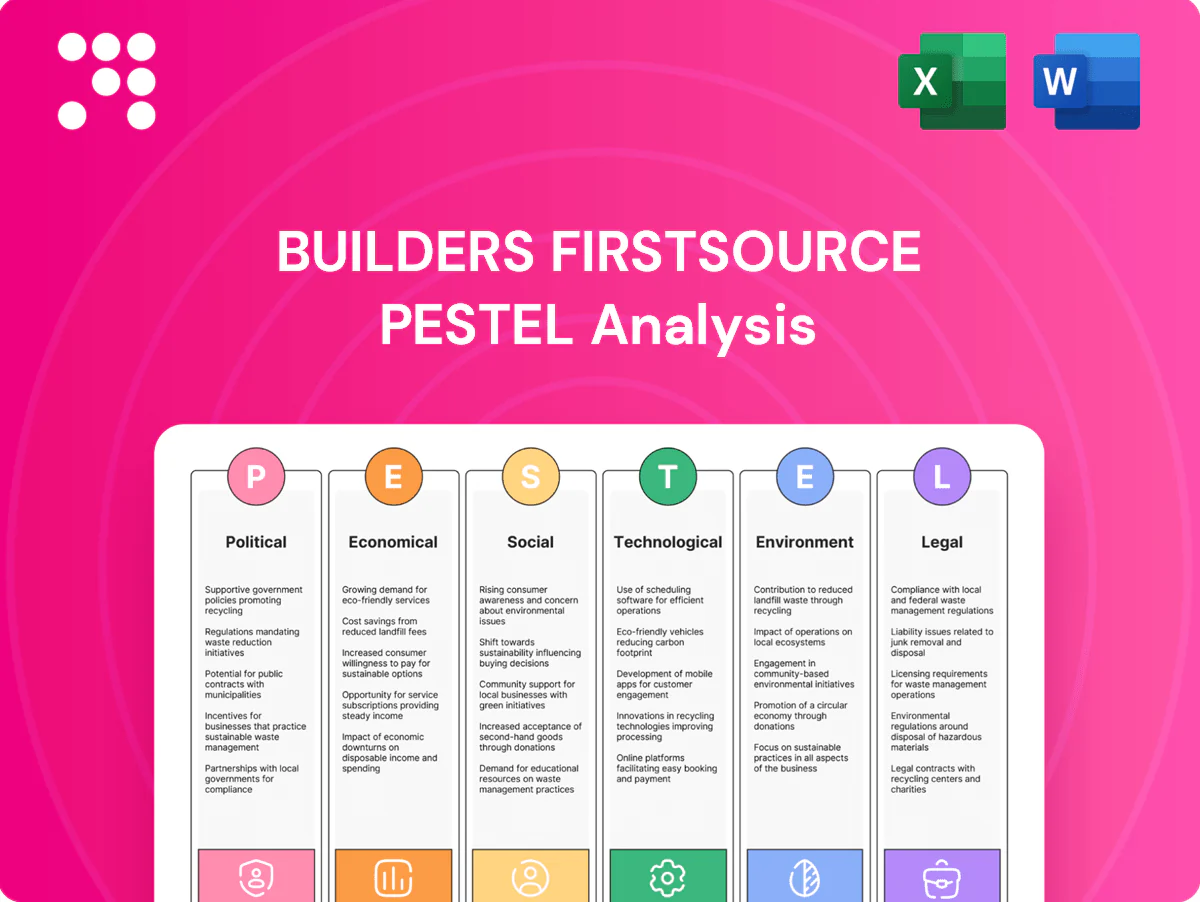
Builders FirstSource PESTLE Analysis

Make Smarter Strategic Decisions with a Complete PESTEL View
Gain a competitive edge with our PESTLE Analysis of Builders FirstSource—concise insights on political, economic, social, technological, legal, and environmental forces shaping its future. Ideal for investors and strategists; purchase the full report to access detailed trends, risks, and actionable recommendations instantly.
Political factors

Housing and infrastructure policy
Federal and state spending on housing and infrastructure, exemplified by the $1.2 trillion Bipartisan Infrastructure Law, can directly stimulate demand for building materials and services for companies like Builders FirstSource. Incentives for affordable housing and disaster-recovery rebuilds often create regional sales spikes and compressed lead times. Shifts in political priorities can rapidly reallocate funding, reducing backlog visibility. Builders FirstSource must align capacity and inventory with these policy-driven demand cycles.
Trade and lumber tariffs
U.S.–Canada softwood lumber duties directly influence Builders FirstSource input costs and pricing strategy, with duty swings historically reaching tens of percentage points and creating material cost shocks for North American sawmills and distributors. Tariff volatility can compress margins or cause pass-through frictions with builders, especially during policy reviews that can change rates on short notice. Hedging and diversified sourcing remain critical mitigants to stabilize procurement and margins.

Local zoning and permitting regimes
Decentralized land-use decisions across over 19,000 U.S. local governments materially shape the pace of new housing starts, with permitting often adding several months to project timelines. Lengthy approvals push demand toward repair and remodel—U.S. home improvement spending topped $400B in 2023—altering Builders FirstSource’s product mix. Political pressure for densification versus single-family expansion varies sharply by market, so network planning must account for municipal variability.

Labor and immigration policy
- Immigrant share: ~25% of construction workforce
- DOL apprenticeship grants: $185 million (2023)
- Impact: authorization rules → longer timelines, higher wages
Buy American and procurement rules
Publicly funded projects governed by Buy American rules and IIJA provisions favor U.S.-sourced components, narrowing supplier choices and often raising input costs; compliance also increases documentation across the supply chain. Compliance can compress margins for suppliers unable to prove provenance, while BLDR’s scale—reported revenue of about 23.0 billion USD in FY2024—improves its ability to meet traceability requirements.
- favors U.S.-sourced components — benefits BLDR scale
- limits supplier pool — can increase procurement costs
- documentation burden rises — traceability advantage for large operators
IIJA $1.2T boosts construction; permitting, duties, labor drive swings
Federal infrastructure spending (IIJA $1.2T) and affordable-housing incentives drive cyclical demand; BLDR revenue ~$23.0B (FY2024) aids compliance with Buy American rules. Softwood duties (swinging tens of ppt) and local permitting (19,000+ jurisdictions) create regional volatility. Immigrant share ~25% of construction workforce; DOL apprenticeship grants $185M (2023) affect labor availability.
| Factor | Metric |
|---|---|
| IIJA | $1.2T |
| BLDR revenue | $23.0B FY2024 |
| Home improvement | $400B (2023) |
| Immigrant workforce | ~25% |
What is included in the product
 Detailed Word Document
Explores how macro-environmental factors uniquely affect Builders FirstSource across Political, Economic, Social, Technological, Environmental, and Legal dimensions, with data-backed insights and forward-looking scenarios. Designed for executives and investors to identify industry-specific threats, opportunities, and strategic actions, ready for inclusion in plans and decks.

 Customizable Excel Spreadsheet
A concise, visually segmented PESTLE summary of Builders FirstSource that can be dropped into presentations, edited for region or product specifics, and easily shared across teams to streamline external risk discussions and planning sessions.
Economic factors

Interest rates and mortgage affordability
Higher mortgage rates—30-year fixed averaged about 6.8% in mid-2025 per Freddie Mac—suppress new-home demand and push buyers to the sidelines. Affordability swings boost smaller-footprint builds and renovation activity. Rate cuts can rapidly revive starts, straining supply chains. BLDR’s volumes closely track this cycle, driving revenue sensitivity to mortgage-driven starts.
Housing starts and remodeling cycle
Single- and multi-family starts set the cadence for structural product demand, with U.S. housing starts near 1.3 million units annualized in 2023 (U.S. Census Bureau). When starts slow, repair and remodel — a >$450 billion market in 2023 (Harvard JCHS) — partially offsets volumes. Regional divergence forces agile inventory and routing, and shifts in single- vs. multi-family mix compress margins and tie up working capital.

Commodity price volatility
Lumber and panel prices are highly cyclical—lumber surged more than 300% in 2020–21 and then collapsed, creating large swings in Builders FirstSource revenue recognition and gross margins. Rapid price drops increase inventory write-down risk while sudden spikes strain pass-through timing to customers. Index-linked pricing and hedging programs damp volatility but do not eliminate margin exposure. Superior forecast accuracy remains a measurable competitive advantage.

Labor availability and wage inflation
Shortages of drivers, plant workers and carpentry trades push Builders FirstSource’s costs up and extend lead times, with industry surveys (NAHB/2024) reporting roughly 80–85% of firms struggling to hire skilled workers. Wage pressure can outpace price realization during demand soft patches, while company automation and productivity programs (ongoing 2023–25 investments) partially offset labor cost growth. Hiring and retention remain critical to service reliability and on-time project delivery.
- Impact: higher direct labor and logistics costs
- Risk: wages rising faster than sell-through in weak markets
- Mitigation: automation/productivity investments
- Key driver: hiring and retention determine service levels
M&A and market consolidation
Industry fragmentation lets Builders FirstSource pursue scale-driven deals—notably the 2021 BMC acquisition valued at about $8.3 billion—expanding footprint and product breadth; successful integration drives procurement, logistics and SG&A synergies while antitrust scrutiny can limit deal scope in specific regions, and consolidation strengthens bargaining power with mills and OEMs.
- Fragmentation enables roll-up growth
- BMC deal ~$8.3B
- Integration determines synergies
- Antitrust may constrain regional deals
- Greater scale improves supplier leverage
IIJA $1.2T boosts construction; permitting, duties, labor drive swings
Higher 30-year mortgage rates ~6.8% mid-2025 (Freddie Mac) curb new-home demand, shifting volume toward renovations and smaller-footprint builds.
U.S. housing starts ~1.3M annualized (2023, Census); remodel market >$450B (2023, Harvard JCHS) cushions revenue when starts fall.
Lumber volatility (300% surge 2020–21) and 80–85% firms reporting skilled labor shortages (NAHB 2024) drive margin and lead-time risk; scale and integration (BMC ~$8.3B) improve sourcing leverage.
| Metric | Value/Year |
|---|---|
| 30-yr mortgage | ~6.8% mid-2025 |
| Housing starts | ~1.3M (2023) |
| Remodel market | >$450B (2023) |
| Labor shortage | 80–85% firms (NAHB 2024) |
| BMC deal | ~$8.3B |
Preview the Actual Deliverable
Builders FirstSource PESTLE Analysis
The preview shown here is the exact document you’ll receive—fully formatted and ready to use. This Builders FirstSource PESTLE Analysis covers political, economic, social, technological, legal, and environmental factors with concise, actionable insights. No placeholders or teasers—what you see is the final file available for immediate download after purchase.

Make Smarter Strategic Decisions with a Complete PESTEL View
Gain a competitive edge with our PESTLE Analysis of Builders FirstSource—concise insights on political, economic, social, technological, legal, and environmental forces shaping its future. Ideal for investors and strategists; purchase the full report to access detailed trends, risks, and actionable recommendations instantly.
Political factors
Housing and infrastructure policy
Federal and state spending on housing and infrastructure, exemplified by the $1.2 trillion Bipartisan Infrastructure Law, can directly stimulate demand for building materials and services for companies like Builders FirstSource. Incentives for affordable housing and disaster-recovery rebuilds often create regional sales spikes and compressed lead times. Shifts in political priorities can rapidly reallocate funding, reducing backlog visibility. Builders FirstSource must align capacity and inventory with these policy-driven demand cycles.
Trade and lumber tariffs
U.S.–Canada softwood lumber duties directly influence Builders FirstSource input costs and pricing strategy, with duty swings historically reaching tens of percentage points and creating material cost shocks for North American sawmills and distributors. Tariff volatility can compress margins or cause pass-through frictions with builders, especially during policy reviews that can change rates on short notice. Hedging and diversified sourcing remain critical mitigants to stabilize procurement and margins.
Local zoning and permitting regimes
Decentralized land-use decisions across over 19,000 U.S. local governments materially shape the pace of new housing starts, with permitting often adding several months to project timelines. Lengthy approvals push demand toward repair and remodel—U.S. home improvement spending topped $400B in 2023—altering Builders FirstSource’s product mix. Political pressure for densification versus single-family expansion varies sharply by market, so network planning must account for municipal variability.
Labor and immigration policy
- Immigrant share: ~25% of construction workforce
- DOL apprenticeship grants: $185 million (2023)
- Impact: authorization rules → longer timelines, higher wages
Buy American and procurement rules
Publicly funded projects governed by Buy American rules and IIJA provisions favor U.S.-sourced components, narrowing supplier choices and often raising input costs; compliance also increases documentation across the supply chain. Compliance can compress margins for suppliers unable to prove provenance, while BLDR’s scale—reported revenue of about 23.0 billion USD in FY2024—improves its ability to meet traceability requirements.
- favors U.S.-sourced components — benefits BLDR scale
- limits supplier pool — can increase procurement costs
- documentation burden rises — traceability advantage for large operators
IIJA $1.2T boosts construction; permitting, duties, labor drive swings
Federal infrastructure spending (IIJA $1.2T) and affordable-housing incentives drive cyclical demand; BLDR revenue ~$23.0B (FY2024) aids compliance with Buy American rules. Softwood duties (swinging tens of ppt) and local permitting (19,000+ jurisdictions) create regional volatility. Immigrant share ~25% of construction workforce; DOL apprenticeship grants $185M (2023) affect labor availability.
| Factor | Metric |
|---|---|
| IIJA | $1.2T |
| BLDR revenue | $23.0B FY2024 |
| Home improvement | $400B (2023) |
| Immigrant workforce | ~25% |
What is included in the product
Detailed Word Document
Explores how macro-environmental factors uniquely affect Builders FirstSource across Political, Economic, Social, Technological, Environmental, and Legal dimensions, with data-backed insights and forward-looking scenarios. Designed for executives and investors to identify industry-specific threats, opportunities, and strategic actions, ready for inclusion in plans and decks.
Customizable Excel Spreadsheet
A concise, visually segmented PESTLE summary of Builders FirstSource that can be dropped into presentations, edited for region or product specifics, and easily shared across teams to streamline external risk discussions and planning sessions.
Economic factors
Interest rates and mortgage affordability
Higher mortgage rates—30-year fixed averaged about 6.8% in mid-2025 per Freddie Mac—suppress new-home demand and push buyers to the sidelines. Affordability swings boost smaller-footprint builds and renovation activity. Rate cuts can rapidly revive starts, straining supply chains. BLDR’s volumes closely track this cycle, driving revenue sensitivity to mortgage-driven starts.
Housing starts and remodeling cycle
Single- and multi-family starts set the cadence for structural product demand, with U.S. housing starts near 1.3 million units annualized in 2023 (U.S. Census Bureau). When starts slow, repair and remodel — a >$450 billion market in 2023 (Harvard JCHS) — partially offsets volumes. Regional divergence forces agile inventory and routing, and shifts in single- vs. multi-family mix compress margins and tie up working capital.
Commodity price volatility
Lumber and panel prices are highly cyclical—lumber surged more than 300% in 2020–21 and then collapsed, creating large swings in Builders FirstSource revenue recognition and gross margins. Rapid price drops increase inventory write-down risk while sudden spikes strain pass-through timing to customers. Index-linked pricing and hedging programs damp volatility but do not eliminate margin exposure. Superior forecast accuracy remains a measurable competitive advantage.
Labor availability and wage inflation
Shortages of drivers, plant workers and carpentry trades push Builders FirstSource’s costs up and extend lead times, with industry surveys (NAHB/2024) reporting roughly 80–85% of firms struggling to hire skilled workers. Wage pressure can outpace price realization during demand soft patches, while company automation and productivity programs (ongoing 2023–25 investments) partially offset labor cost growth. Hiring and retention remain critical to service reliability and on-time project delivery.
- Impact: higher direct labor and logistics costs
- Risk: wages rising faster than sell-through in weak markets
- Mitigation: automation/productivity investments
- Key driver: hiring and retention determine service levels
M&A and market consolidation
Industry fragmentation lets Builders FirstSource pursue scale-driven deals—notably the 2021 BMC acquisition valued at about $8.3 billion—expanding footprint and product breadth; successful integration drives procurement, logistics and SG&A synergies while antitrust scrutiny can limit deal scope in specific regions, and consolidation strengthens bargaining power with mills and OEMs.
- Fragmentation enables roll-up growth
- BMC deal ~$8.3B
- Integration determines synergies
- Antitrust may constrain regional deals
- Greater scale improves supplier leverage
IIJA $1.2T boosts construction; permitting, duties, labor drive swings
Higher 30-year mortgage rates ~6.8% mid-2025 (Freddie Mac) curb new-home demand, shifting volume toward renovations and smaller-footprint builds.
U.S. housing starts ~1.3M annualized (2023, Census); remodel market >$450B (2023, Harvard JCHS) cushions revenue when starts fall.
Lumber volatility (300% surge 2020–21) and 80–85% firms reporting skilled labor shortages (NAHB 2024) drive margin and lead-time risk; scale and integration (BMC ~$8.3B) improve sourcing leverage.
| Metric | Value/Year |
|---|---|
| 30-yr mortgage | ~6.8% mid-2025 |
| Housing starts | ~1.3M (2023) |
| Remodel market | >$450B (2023) |
| Labor shortage | 80–85% firms (NAHB 2024) |
| BMC deal | ~$8.3B |
Preview the Actual Deliverable
Builders FirstSource PESTLE Analysis
The preview shown here is the exact document you’ll receive—fully formatted and ready to use. This Builders FirstSource PESTLE Analysis covers political, economic, social, technological, legal, and environmental factors with concise, actionable insights. No placeholders or teasers—what you see is the final file available for immediate download after purchase.
Original: $10.00
-65%$10.00
$3.50Description
Make Smarter Strategic Decisions with a Complete PESTEL View
Gain a competitive edge with our PESTLE Analysis of Builders FirstSource—concise insights on political, economic, social, technological, legal, and environmental forces shaping its future. Ideal for investors and strategists; purchase the full report to access detailed trends, risks, and actionable recommendations instantly.
Political factors
Housing and infrastructure policy
Federal and state spending on housing and infrastructure, exemplified by the $1.2 trillion Bipartisan Infrastructure Law, can directly stimulate demand for building materials and services for companies like Builders FirstSource. Incentives for affordable housing and disaster-recovery rebuilds often create regional sales spikes and compressed lead times. Shifts in political priorities can rapidly reallocate funding, reducing backlog visibility. Builders FirstSource must align capacity and inventory with these policy-driven demand cycles.
Trade and lumber tariffs
U.S.–Canada softwood lumber duties directly influence Builders FirstSource input costs and pricing strategy, with duty swings historically reaching tens of percentage points and creating material cost shocks for North American sawmills and distributors. Tariff volatility can compress margins or cause pass-through frictions with builders, especially during policy reviews that can change rates on short notice. Hedging and diversified sourcing remain critical mitigants to stabilize procurement and margins.
Local zoning and permitting regimes
Decentralized land-use decisions across over 19,000 U.S. local governments materially shape the pace of new housing starts, with permitting often adding several months to project timelines. Lengthy approvals push demand toward repair and remodel—U.S. home improvement spending topped $400B in 2023—altering Builders FirstSource’s product mix. Political pressure for densification versus single-family expansion varies sharply by market, so network planning must account for municipal variability.
Labor and immigration policy
- Immigrant share: ~25% of construction workforce
- DOL apprenticeship grants: $185 million (2023)
- Impact: authorization rules → longer timelines, higher wages
Buy American and procurement rules
Publicly funded projects governed by Buy American rules and IIJA provisions favor U.S.-sourced components, narrowing supplier choices and often raising input costs; compliance also increases documentation across the supply chain. Compliance can compress margins for suppliers unable to prove provenance, while BLDR’s scale—reported revenue of about 23.0 billion USD in FY2024—improves its ability to meet traceability requirements.
- favors U.S.-sourced components — benefits BLDR scale
- limits supplier pool — can increase procurement costs
- documentation burden rises — traceability advantage for large operators
IIJA $1.2T boosts construction; permitting, duties, labor drive swings
Federal infrastructure spending (IIJA $1.2T) and affordable-housing incentives drive cyclical demand; BLDR revenue ~$23.0B (FY2024) aids compliance with Buy American rules. Softwood duties (swinging tens of ppt) and local permitting (19,000+ jurisdictions) create regional volatility. Immigrant share ~25% of construction workforce; DOL apprenticeship grants $185M (2023) affect labor availability.
| Factor | Metric |
|---|---|
| IIJA | $1.2T |
| BLDR revenue | $23.0B FY2024 |
| Home improvement | $400B (2023) |
| Immigrant workforce | ~25% |
What is included in the product
Detailed Word Document
Explores how macro-environmental factors uniquely affect Builders FirstSource across Political, Economic, Social, Technological, Environmental, and Legal dimensions, with data-backed insights and forward-looking scenarios. Designed for executives and investors to identify industry-specific threats, opportunities, and strategic actions, ready for inclusion in plans and decks.
Customizable Excel Spreadsheet
A concise, visually segmented PESTLE summary of Builders FirstSource that can be dropped into presentations, edited for region or product specifics, and easily shared across teams to streamline external risk discussions and planning sessions.
Economic factors
Interest rates and mortgage affordability
Higher mortgage rates—30-year fixed averaged about 6.8% in mid-2025 per Freddie Mac—suppress new-home demand and push buyers to the sidelines. Affordability swings boost smaller-footprint builds and renovation activity. Rate cuts can rapidly revive starts, straining supply chains. BLDR’s volumes closely track this cycle, driving revenue sensitivity to mortgage-driven starts.
Housing starts and remodeling cycle
Single- and multi-family starts set the cadence for structural product demand, with U.S. housing starts near 1.3 million units annualized in 2023 (U.S. Census Bureau). When starts slow, repair and remodel — a >$450 billion market in 2023 (Harvard JCHS) — partially offsets volumes. Regional divergence forces agile inventory and routing, and shifts in single- vs. multi-family mix compress margins and tie up working capital.
Commodity price volatility
Lumber and panel prices are highly cyclical—lumber surged more than 300% in 2020–21 and then collapsed, creating large swings in Builders FirstSource revenue recognition and gross margins. Rapid price drops increase inventory write-down risk while sudden spikes strain pass-through timing to customers. Index-linked pricing and hedging programs damp volatility but do not eliminate margin exposure. Superior forecast accuracy remains a measurable competitive advantage.
Labor availability and wage inflation
Shortages of drivers, plant workers and carpentry trades push Builders FirstSource’s costs up and extend lead times, with industry surveys (NAHB/2024) reporting roughly 80–85% of firms struggling to hire skilled workers. Wage pressure can outpace price realization during demand soft patches, while company automation and productivity programs (ongoing 2023–25 investments) partially offset labor cost growth. Hiring and retention remain critical to service reliability and on-time project delivery.
- Impact: higher direct labor and logistics costs
- Risk: wages rising faster than sell-through in weak markets
- Mitigation: automation/productivity investments
- Key driver: hiring and retention determine service levels
M&A and market consolidation
Industry fragmentation lets Builders FirstSource pursue scale-driven deals—notably the 2021 BMC acquisition valued at about $8.3 billion—expanding footprint and product breadth; successful integration drives procurement, logistics and SG&A synergies while antitrust scrutiny can limit deal scope in specific regions, and consolidation strengthens bargaining power with mills and OEMs.
- Fragmentation enables roll-up growth
- BMC deal ~$8.3B
- Integration determines synergies
- Antitrust may constrain regional deals
- Greater scale improves supplier leverage
IIJA $1.2T boosts construction; permitting, duties, labor drive swings
Higher 30-year mortgage rates ~6.8% mid-2025 (Freddie Mac) curb new-home demand, shifting volume toward renovations and smaller-footprint builds.
U.S. housing starts ~1.3M annualized (2023, Census); remodel market >$450B (2023, Harvard JCHS) cushions revenue when starts fall.
Lumber volatility (300% surge 2020–21) and 80–85% firms reporting skilled labor shortages (NAHB 2024) drive margin and lead-time risk; scale and integration (BMC ~$8.3B) improve sourcing leverage.
| Metric | Value/Year |
|---|---|
| 30-yr mortgage | ~6.8% mid-2025 |
| Housing starts | ~1.3M (2023) |
| Remodel market | >$450B (2023) |
| Labor shortage | 80–85% firms (NAHB 2024) |
| BMC deal | ~$8.3B |
Preview the Actual Deliverable
Builders FirstSource PESTLE Analysis
The preview shown here is the exact document you’ll receive—fully formatted and ready to use. This Builders FirstSource PESTLE Analysis covers political, economic, social, technological, legal, and environmental factors with concise, actionable insights. No placeholders or teasers—what you see is the final file available for immediate download after purchase.











