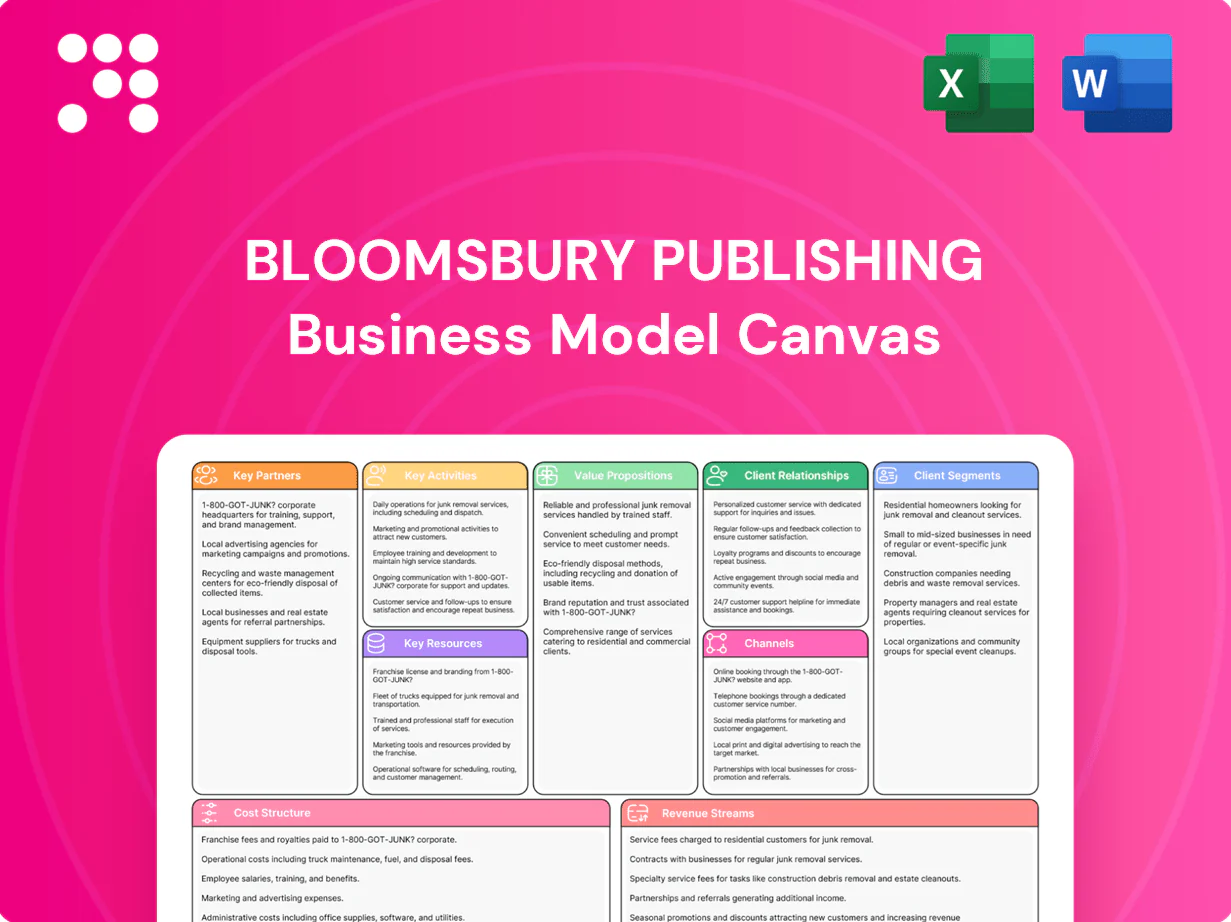
Bloomsbury Publishing Business Model Canvas

Unlock the strategic Business Model Canvas for a leading publisher: benchmark, plan, act
Unlock the full strategic blueprint behind Bloomsbury Publishing’s business model. This in-depth Business Model Canvas reveals how the publisher creates and captures value across customer segments, partnerships, and revenue streams. Download the complete, editable canvas to benchmark, plan, and act on proven industry strategies.
Partnerships

Authors and Literary Agents
Authors and literary agents are core content partners, supplying over 2,000 new Bloomsbury manuscripts annually and feeding a diverse catalog across trade and academic lists. Agents negotiate contracts, rights sales and adaptations, underpinning revenue streams from territorial and format rights. Strong agent relationships secure marquee authors and debut voices, sustaining backlist longevity and recurring sales into 2024.
Printers, Audiobook Studios, and Production Vendors
Printers, audiobook studios and production vendors are essential for Bloomsbury’s physical print runs, special editions and audio formats, driving scale and quality control that reduce unit costs and returns; flexible third‑party capacity supports seasonal peaks and ensures consistent multi‑format release schedules for Bloomsbury’s FY 2024 publishing programme.

Retailers and E-commerce Platforms
Retailers and e-commerce platforms give Bloomsbury global reach via chains, independents, marketplaces and D2C sites, tapping a global book market worth roughly $120bn in 2024. Prominent placement and promotions boost discoverability and short‑term sales, while data‑sharing with partners improves demand forecasting. Co‑op marketing across retail partners amplifies new launches and reduces marketing spend per unit.

Academic Institutions, Libraries, and Consortia
Academic institutions, libraries and consortia are core institutional buyers of Bloomsbury's scholarly and professional content, providing predictable demand and sector-specific licensing needs. Consortia agreements broaden access while improving budget efficiency and procurement scale; long-term licenses deliver multi-year revenue visibility and reduce churn. Library feedback directly shapes platform feature roadmaps and content curation, informing product prioritization in 2024.
- Institutional buyers: stable, mission-driven demand
- Consortia: expanded coverage, pooled budgets
- Long-term licenses: revenue stability
- User feedback: drives platform roadmap (2024)
Rights, Media, and Technology Partners
- Film/TV: +200–400% sales uplift
- Edtech/platforms: global reach
- DRM/analytics/payments: secure ops
- Merch/translation: extended revenue streams
Authors, printers and rights partners unlock $120bn book market and 200–400% sales uplifts
Authors/agents supply 2,000+ manuscripts p.a., underpinning trade and academic lists; printers/audio vendors ensure multi-format scale and lower unit costs; retailers, D2C and libraries access a $120bn global market (2024) and secure placement; rights/media partners drive 200–400% sales uplifts from adaptations and expand licensing revenue.
| Partner | Metric (2024) |
|---|---|
| Authors/Agents | 2,000+ manuscripts p.a. |
| Market | $120bn global book market |
| Adaptations | +200–400% sales uplift |
What is included in the product
 Detailed Word Document
A comprehensive Business Model Canvas for Bloomsbury Publishing organized into the 9 classic blocks, detailing customer segments, channels, value propositions, revenue streams and key activities tied to real-world operations. Includes SWOT and competitive advantage analysis, ideal for presentations, investor discussions and strategic decision-making.

 Customizable Excel Spreadsheet
High-level, editable Business Model Canvas for Bloomsbury Publishing that condenses strategy into a one-page, shareable snapshot—saves hours of structuring, supports rapid comparisons and team collaboration for boardrooms or brainstorming sessions.
Activities

Content Acquisition and Editorial Development
Scouting, evaluating and contracting manuscripts across Bloomsbury’s UK and US lists feeds a pipeline that undergoes structural editing, copyediting and design to ensure quality; portfolio balancing manages risk and trend exposure while typical trade lead times align with market windows of 9–18 months.
Production and Format Management
Production and Format Management converts print into ebook and audio at scale across Bloomsbury’s c.1,000 new titles per year and a catalogue of ~5,000 titles; metadata optimization and cover design boost discovery (industry click-through uplift ~30% in 2024); inventory planning cuts stockouts and returns—reducing returns by up to 20%—while quality assurance maintains consistent brand standards across formats.

Marketing, Publicity, and Community Building
Campaigns across social, email, PR and events drive discoverability for Bloomsbury, leveraging email marketing with an industry-average ROI of about $36 per $1 spent to boost conversions. Author tours and influencer outreach generate pre-publication buzz and lift first-week sales. Audience segmentation personalizes messaging across channels to improve engagement rates, while reviews and awards enhance credibility and long-tail revenue.

Sales and Distribution Execution
Bloomsbury executes global sales across retail, wholesale and institutional channels and drives rights sales for territories, formats and adaptations. Logistics coordination focuses on on-time delivery and returns management, while demand planning and replenishment optimize sell-through. The global publishing market in 2024 was about US$122 billion, supporting cross-border rights demand.
- Global channels: retail, wholesale, institutional
- Rights: territories, formats, adaptations
- Logistics: on-time delivery & returns
- Demand planning: replenishment to boost sell-through; 2024 market ~US$122bn
Digital Platform and Data Operations
Bloomsbury develops and maintains academic and professional platforms, supporting a catalogue of over 4,000 academic and professional titles and expanding digital access in 2024.
Platforms integrate DRM, advanced search and usage analytics to protect rights and optimize discovery, feeding subscription management and access control systems that handle institutional and individual entitlements.
Data-driven pricing and catalogue curation use usage metrics and sales data to increase uptake and renewals, targeting higher ARPU and improved catalogue ROI.
- catalogue: over 4,000 academic/professional titles (2024)
- focus: DRM + search + analytics integration
- operations: subscription management & access control
- strategy: data-driven pricing & curation
Scaling 1,000 new titles/year: print→ebook→audio boosts discovery +30%, trims returns 20%
Scouting, contracting and editorial refine c.1,000 new trade titles annually and a ~5,000-title catalogue, balancing risk with 9–18 month lead times. Production scales print→ebook→audio, boosting discovery (cover/metadata +30% CTR) and cutting returns up to 20%. Sales, rights and platforms drive global distribution and institutional subscriptions (academic/professional catalogue >4,000; 2024 market ~US$122bn).
| Metric | Value (2024) |
|---|---|
| New titles/year | c.1,000 |
| Total catalogue | ~5,000 |
| Academic titles | >4,000 |
| Market size | US$122bn |
| CTR uplift | ~30% |
| Returns reduction | up to 20% |
| Email ROI | $36 per $1 |
What You See Is What You Get
Business Model Canvas
The Bloomsbury Publishing Business Model Canvas you’re previewing is the actual deliverable, not a mockup—what you see is a direct extract from the final file. After purchase you’ll receive the same complete, ready-to-edit document in Word and Excel formats. No hidden pages, no filler—fully formatted for use. You can present, customize, and deploy it immediately upon download.

Unlock the strategic Business Model Canvas for a leading publisher: benchmark, plan, act
Unlock the full strategic blueprint behind Bloomsbury Publishing’s business model. This in-depth Business Model Canvas reveals how the publisher creates and captures value across customer segments, partnerships, and revenue streams. Download the complete, editable canvas to benchmark, plan, and act on proven industry strategies.
Partnerships
Authors and Literary Agents
Authors and literary agents are core content partners, supplying over 2,000 new Bloomsbury manuscripts annually and feeding a diverse catalog across trade and academic lists. Agents negotiate contracts, rights sales and adaptations, underpinning revenue streams from territorial and format rights. Strong agent relationships secure marquee authors and debut voices, sustaining backlist longevity and recurring sales into 2024.
Printers, Audiobook Studios, and Production Vendors
Printers, audiobook studios and production vendors are essential for Bloomsbury’s physical print runs, special editions and audio formats, driving scale and quality control that reduce unit costs and returns; flexible third‑party capacity supports seasonal peaks and ensures consistent multi‑format release schedules for Bloomsbury’s FY 2024 publishing programme.
Retailers and E-commerce Platforms
Retailers and e-commerce platforms give Bloomsbury global reach via chains, independents, marketplaces and D2C sites, tapping a global book market worth roughly $120bn in 2024. Prominent placement and promotions boost discoverability and short‑term sales, while data‑sharing with partners improves demand forecasting. Co‑op marketing across retail partners amplifies new launches and reduces marketing spend per unit.
Academic Institutions, Libraries, and Consortia
Academic institutions, libraries and consortia are core institutional buyers of Bloomsbury's scholarly and professional content, providing predictable demand and sector-specific licensing needs. Consortia agreements broaden access while improving budget efficiency and procurement scale; long-term licenses deliver multi-year revenue visibility and reduce churn. Library feedback directly shapes platform feature roadmaps and content curation, informing product prioritization in 2024.
- Institutional buyers: stable, mission-driven demand
- Consortia: expanded coverage, pooled budgets
- Long-term licenses: revenue stability
- User feedback: drives platform roadmap (2024)
Rights, Media, and Technology Partners
- Film/TV: +200–400% sales uplift
- Edtech/platforms: global reach
- DRM/analytics/payments: secure ops
- Merch/translation: extended revenue streams
Authors, printers and rights partners unlock $120bn book market and 200–400% sales uplifts
Authors/agents supply 2,000+ manuscripts p.a., underpinning trade and academic lists; printers/audio vendors ensure multi-format scale and lower unit costs; retailers, D2C and libraries access a $120bn global market (2024) and secure placement; rights/media partners drive 200–400% sales uplifts from adaptations and expand licensing revenue.
| Partner | Metric (2024) |
|---|---|
| Authors/Agents | 2,000+ manuscripts p.a. |
| Market | $120bn global book market |
| Adaptations | +200–400% sales uplift |
What is included in the product
Detailed Word Document
A comprehensive Business Model Canvas for Bloomsbury Publishing organized into the 9 classic blocks, detailing customer segments, channels, value propositions, revenue streams and key activities tied to real-world operations. Includes SWOT and competitive advantage analysis, ideal for presentations, investor discussions and strategic decision-making.
Customizable Excel Spreadsheet
High-level, editable Business Model Canvas for Bloomsbury Publishing that condenses strategy into a one-page, shareable snapshot—saves hours of structuring, supports rapid comparisons and team collaboration for boardrooms or brainstorming sessions.
Activities
Content Acquisition and Editorial Development
Scouting, evaluating and contracting manuscripts across Bloomsbury’s UK and US lists feeds a pipeline that undergoes structural editing, copyediting and design to ensure quality; portfolio balancing manages risk and trend exposure while typical trade lead times align with market windows of 9–18 months.
Production and Format Management
Production and Format Management converts print into ebook and audio at scale across Bloomsbury’s c.1,000 new titles per year and a catalogue of ~5,000 titles; metadata optimization and cover design boost discovery (industry click-through uplift ~30% in 2024); inventory planning cuts stockouts and returns—reducing returns by up to 20%—while quality assurance maintains consistent brand standards across formats.
Marketing, Publicity, and Community Building
Campaigns across social, email, PR and events drive discoverability for Bloomsbury, leveraging email marketing with an industry-average ROI of about $36 per $1 spent to boost conversions. Author tours and influencer outreach generate pre-publication buzz and lift first-week sales. Audience segmentation personalizes messaging across channels to improve engagement rates, while reviews and awards enhance credibility and long-tail revenue.
Sales and Distribution Execution
Bloomsbury executes global sales across retail, wholesale and institutional channels and drives rights sales for territories, formats and adaptations. Logistics coordination focuses on on-time delivery and returns management, while demand planning and replenishment optimize sell-through. The global publishing market in 2024 was about US$122 billion, supporting cross-border rights demand.
- Global channels: retail, wholesale, institutional
- Rights: territories, formats, adaptations
- Logistics: on-time delivery & returns
- Demand planning: replenishment to boost sell-through; 2024 market ~US$122bn
Digital Platform and Data Operations
Bloomsbury develops and maintains academic and professional platforms, supporting a catalogue of over 4,000 academic and professional titles and expanding digital access in 2024.
Platforms integrate DRM, advanced search and usage analytics to protect rights and optimize discovery, feeding subscription management and access control systems that handle institutional and individual entitlements.
Data-driven pricing and catalogue curation use usage metrics and sales data to increase uptake and renewals, targeting higher ARPU and improved catalogue ROI.
- catalogue: over 4,000 academic/professional titles (2024)
- focus: DRM + search + analytics integration
- operations: subscription management & access control
- strategy: data-driven pricing & curation
Scaling 1,000 new titles/year: print→ebook→audio boosts discovery +30%, trims returns 20%
Scouting, contracting and editorial refine c.1,000 new trade titles annually and a ~5,000-title catalogue, balancing risk with 9–18 month lead times. Production scales print→ebook→audio, boosting discovery (cover/metadata +30% CTR) and cutting returns up to 20%. Sales, rights and platforms drive global distribution and institutional subscriptions (academic/professional catalogue >4,000; 2024 market ~US$122bn).
| Metric | Value (2024) |
|---|---|
| New titles/year | c.1,000 |
| Total catalogue | ~5,000 |
| Academic titles | >4,000 |
| Market size | US$122bn |
| CTR uplift | ~30% |
| Returns reduction | up to 20% |
| Email ROI | $36 per $1 |
What You See Is What You Get
Business Model Canvas
The Bloomsbury Publishing Business Model Canvas you’re previewing is the actual deliverable, not a mockup—what you see is a direct extract from the final file. After purchase you’ll receive the same complete, ready-to-edit document in Word and Excel formats. No hidden pages, no filler—fully formatted for use. You can present, customize, and deploy it immediately upon download.
Original: $10.00
-65%$10.00
$3.50Description
Unlock the strategic Business Model Canvas for a leading publisher: benchmark, plan, act
Unlock the full strategic blueprint behind Bloomsbury Publishing’s business model. This in-depth Business Model Canvas reveals how the publisher creates and captures value across customer segments, partnerships, and revenue streams. Download the complete, editable canvas to benchmark, plan, and act on proven industry strategies.
Partnerships
Authors and Literary Agents
Authors and literary agents are core content partners, supplying over 2,000 new Bloomsbury manuscripts annually and feeding a diverse catalog across trade and academic lists. Agents negotiate contracts, rights sales and adaptations, underpinning revenue streams from territorial and format rights. Strong agent relationships secure marquee authors and debut voices, sustaining backlist longevity and recurring sales into 2024.
Printers, Audiobook Studios, and Production Vendors
Printers, audiobook studios and production vendors are essential for Bloomsbury’s physical print runs, special editions and audio formats, driving scale and quality control that reduce unit costs and returns; flexible third‑party capacity supports seasonal peaks and ensures consistent multi‑format release schedules for Bloomsbury’s FY 2024 publishing programme.
Retailers and E-commerce Platforms
Retailers and e-commerce platforms give Bloomsbury global reach via chains, independents, marketplaces and D2C sites, tapping a global book market worth roughly $120bn in 2024. Prominent placement and promotions boost discoverability and short‑term sales, while data‑sharing with partners improves demand forecasting. Co‑op marketing across retail partners amplifies new launches and reduces marketing spend per unit.
Academic Institutions, Libraries, and Consortia
Academic institutions, libraries and consortia are core institutional buyers of Bloomsbury's scholarly and professional content, providing predictable demand and sector-specific licensing needs. Consortia agreements broaden access while improving budget efficiency and procurement scale; long-term licenses deliver multi-year revenue visibility and reduce churn. Library feedback directly shapes platform feature roadmaps and content curation, informing product prioritization in 2024.
- Institutional buyers: stable, mission-driven demand
- Consortia: expanded coverage, pooled budgets
- Long-term licenses: revenue stability
- User feedback: drives platform roadmap (2024)
Rights, Media, and Technology Partners
- Film/TV: +200–400% sales uplift
- Edtech/platforms: global reach
- DRM/analytics/payments: secure ops
- Merch/translation: extended revenue streams
Authors, printers and rights partners unlock $120bn book market and 200–400% sales uplifts
Authors/agents supply 2,000+ manuscripts p.a., underpinning trade and academic lists; printers/audio vendors ensure multi-format scale and lower unit costs; retailers, D2C and libraries access a $120bn global market (2024) and secure placement; rights/media partners drive 200–400% sales uplifts from adaptations and expand licensing revenue.
| Partner | Metric (2024) |
|---|---|
| Authors/Agents | 2,000+ manuscripts p.a. |
| Market | $120bn global book market |
| Adaptations | +200–400% sales uplift |
What is included in the product
Detailed Word Document
A comprehensive Business Model Canvas for Bloomsbury Publishing organized into the 9 classic blocks, detailing customer segments, channels, value propositions, revenue streams and key activities tied to real-world operations. Includes SWOT and competitive advantage analysis, ideal for presentations, investor discussions and strategic decision-making.
Customizable Excel Spreadsheet
High-level, editable Business Model Canvas for Bloomsbury Publishing that condenses strategy into a one-page, shareable snapshot—saves hours of structuring, supports rapid comparisons and team collaboration for boardrooms or brainstorming sessions.
Activities
Content Acquisition and Editorial Development
Scouting, evaluating and contracting manuscripts across Bloomsbury’s UK and US lists feeds a pipeline that undergoes structural editing, copyediting and design to ensure quality; portfolio balancing manages risk and trend exposure while typical trade lead times align with market windows of 9–18 months.
Production and Format Management
Production and Format Management converts print into ebook and audio at scale across Bloomsbury’s c.1,000 new titles per year and a catalogue of ~5,000 titles; metadata optimization and cover design boost discovery (industry click-through uplift ~30% in 2024); inventory planning cuts stockouts and returns—reducing returns by up to 20%—while quality assurance maintains consistent brand standards across formats.
Marketing, Publicity, and Community Building
Campaigns across social, email, PR and events drive discoverability for Bloomsbury, leveraging email marketing with an industry-average ROI of about $36 per $1 spent to boost conversions. Author tours and influencer outreach generate pre-publication buzz and lift first-week sales. Audience segmentation personalizes messaging across channels to improve engagement rates, while reviews and awards enhance credibility and long-tail revenue.
Sales and Distribution Execution
Bloomsbury executes global sales across retail, wholesale and institutional channels and drives rights sales for territories, formats and adaptations. Logistics coordination focuses on on-time delivery and returns management, while demand planning and replenishment optimize sell-through. The global publishing market in 2024 was about US$122 billion, supporting cross-border rights demand.
- Global channels: retail, wholesale, institutional
- Rights: territories, formats, adaptations
- Logistics: on-time delivery & returns
- Demand planning: replenishment to boost sell-through; 2024 market ~US$122bn
Digital Platform and Data Operations
Bloomsbury develops and maintains academic and professional platforms, supporting a catalogue of over 4,000 academic and professional titles and expanding digital access in 2024.
Platforms integrate DRM, advanced search and usage analytics to protect rights and optimize discovery, feeding subscription management and access control systems that handle institutional and individual entitlements.
Data-driven pricing and catalogue curation use usage metrics and sales data to increase uptake and renewals, targeting higher ARPU and improved catalogue ROI.
- catalogue: over 4,000 academic/professional titles (2024)
- focus: DRM + search + analytics integration
- operations: subscription management & access control
- strategy: data-driven pricing & curation
Scaling 1,000 new titles/year: print→ebook→audio boosts discovery +30%, trims returns 20%
Scouting, contracting and editorial refine c.1,000 new trade titles annually and a ~5,000-title catalogue, balancing risk with 9–18 month lead times. Production scales print→ebook→audio, boosting discovery (cover/metadata +30% CTR) and cutting returns up to 20%. Sales, rights and platforms drive global distribution and institutional subscriptions (academic/professional catalogue >4,000; 2024 market ~US$122bn).
| Metric | Value (2024) |
|---|---|
| New titles/year | c.1,000 |
| Total catalogue | ~5,000 |
| Academic titles | >4,000 |
| Market size | US$122bn |
| CTR uplift | ~30% |
| Returns reduction | up to 20% |
| Email ROI | $36 per $1 |
What You See Is What You Get
Business Model Canvas
The Bloomsbury Publishing Business Model Canvas you’re previewing is the actual deliverable, not a mockup—what you see is a direct extract from the final file. After purchase you’ll receive the same complete, ready-to-edit document in Word and Excel formats. No hidden pages, no filler—fully formatted for use. You can present, customize, and deploy it immediately upon download.











