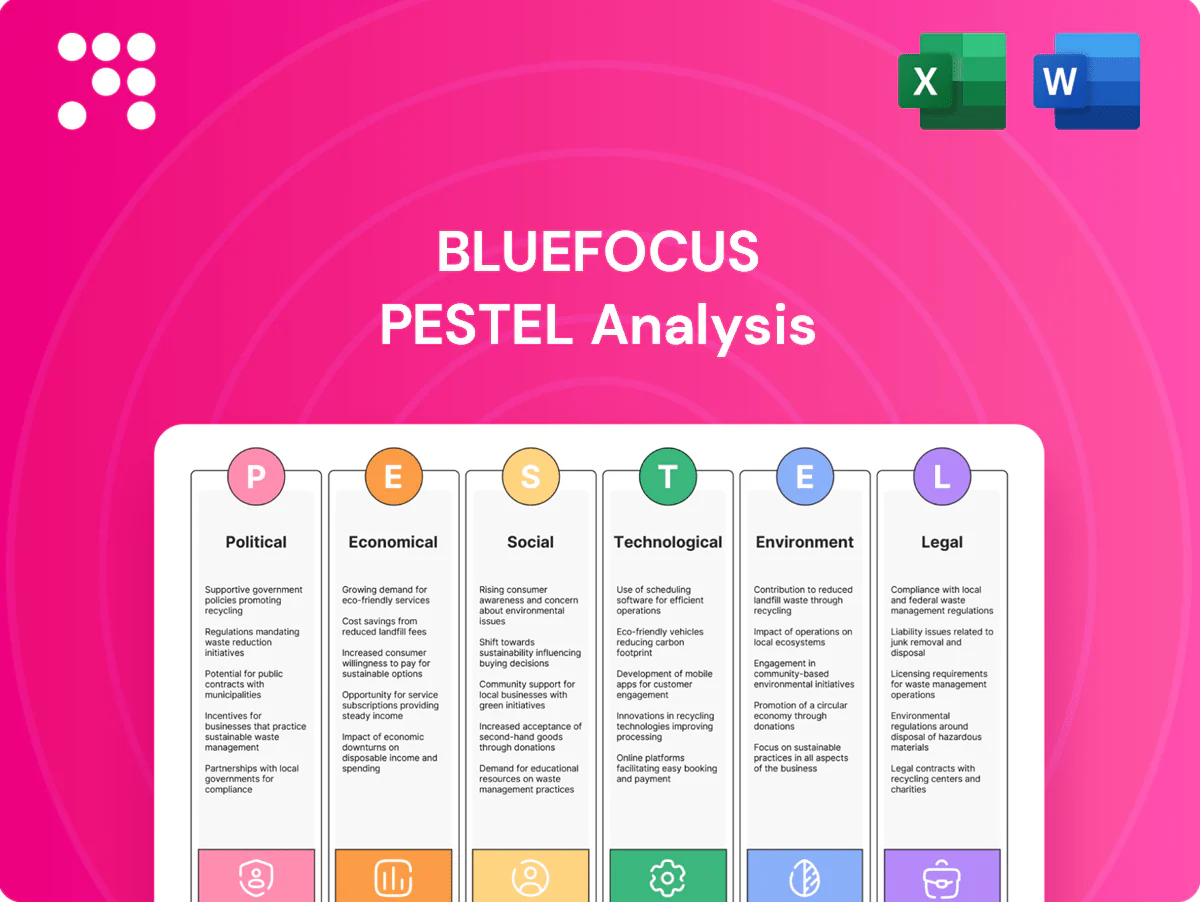
BlueFocus PESTLE Analysis

Your Competitive Advantage Starts with This Report
Get strategic clarity with our focused PESTLE Analysis of BlueFocus—uncover how political, economic, social, technological, legal, and environmental forces shape its outlook. Ideal for investors and strategists, this concise report highlights risks and growth levers. Buy the full analysis now for actionable insights and ready-to-use findings.
Political factors

Geopolitical tensions
US–China frictions, sanctions and export controls (US–China goods and services trade was $737 billion in 2023) can disrupt cross-border campaigns and vendor access, raising compliance costs for agencies. Market access risks in constrained regions may delay client growth plans and media bookings. Scenario plans should diversify supply partners and regional fulfillment, while political risk insurance and local alliances mitigate shocks.
Regulatory oversight of media
State influence via bodies such as the Cyberspace Administration of China (CAC) and local regulators shapes where BlueFocus (SZSE:300058) can run campaigns, with 2024 seeing intensified enforcement of content and platform rules. Approvals and censorship risks commonly elongate timelines for finance, healthcare and education sectors, forcing multi-week clearances. Build market-specific compliance playbooks and pre-clear creative variants; maintain crisis communication protocols for rapid pivots.

Public sector spending
Government advertising and outreach contracts can be sizable but cyclical, with US 2024 election ad spend surpassing $14 billion per Kantar/OpenSecrets estimates, shifting budgets toward public information and political messaging during campaign cycles. Pre-bid intelligence and framework agreements typically improve win rates by enabling faster response to RFPs and securing blanket purchase arrangements. Maintain strict neutrality policies and documented conflict checks to manage reputational and compliance risk.

Trade and data localization
Trade tariffs, cross-border data rules and growing localization mandates (over 100 jurisdictions with transfer restrictions by 2024) force BlueFocus to redesign tech stacks: hosting choice, encryption and vendor SLAs must reflect country-specific requirements such as China’s Cybersecurity Law and Schrems II implications in the EU. Maintain regional cloud presence and data residency assurances and contract mirror architectures and failover to ensure continuity and compliance.
- tariffs affect cloud egress costs
- country-specific cross-border rules
- regional clouds + data residency
- mirror architectures in contracts
Platform policy shifts
- Create a centralized registry of platform rules with automated alerts
- Track country- and channel-specific eligibility/disclosure
- Train account teams on compliant targeting and labeling
Regulatory frictions and data-residency choke cross-border ads as US political spend hits > $14B
US–China frictions (US–China trade $737B in 2023), sanctions and export controls raise compliance costs and disrupt cross-border campaigns. Intensified content enforcement (CAC, EU DSA) and platform ad-rule changes (VLOP threshold 45M users) elongate approvals. Over 100 jurisdictions had cross-border data restrictions by 2024, forcing regional clouds and data residency. Government ad cycles (US 2024 >$14B) shift demand toward political/public messaging.
| Metric | Value |
|---|---|
| US–China trade (2023) | $737B |
| US 2024 election ad spend | >$14B |
| Jurisdictions with transfer limits (2024) | >100 |
What is included in the product
 Detailed Word Document
Explores how external macro-environmental factors uniquely affect BlueFocus across Political, Economic, Social, Technological, Environmental, and Legal dimensions; each section is data-backed with regional market and regulatory context, forward-looking scenario insights, and actionable implications to help executives, consultants, and investors identify threats, opportunities, and strategic priorities.

 Customizable Excel Spreadsheet
Condenses BlueFocus’s external environment into a clean, visually segmented PESTLE summary that relieves the pain of information overload, enabling quick alignment across teams and swift inclusion in presentations or planning sessions.
Economic factors

Ad spend cyclicality
Marketing budgets track GDP, consumer confidence and sector health; IMF projected global growth ~3.0% for 2024 and GroupM estimated global ad spend near $820bn in 2024, tying spend to macro swings. Downturns push clients to performance channels and shorter commitments, raising churn risk. Offer flexible pricing and outcome-based models to retain share. Build countercyclical verticals like essentials and gov/NGO to stabilize revenue.
Currency and inflation
Currency volatility compresses global fee realization and raises media costs as USD strength vs major EM currencies sharpens margins, so BlueFocus uses hedging and multi-currency billing to stabilize revenue. Inflation pressures talent, production and cloud spend — global public cloud spend reached about $613B in 2024 (Gartner). Annual indexation clauses help recover input cost rises.

Client mix and concentration
Dependence on a few large accounts—top five clients representing roughly 35% of revenue in 2024—raises material revenue risk for BlueFocus if any major advertiser cuts spend. Diversifying across sectors such as healthcare, finance and retail smooths shocks from tech or consumer pullbacks that hit ad spend cyclically. Building mid-market and high-growth vertical portfolios and cross-selling integrated services can increase wallet share and stabilize margins.

M&A and consolidation
Agency and martech consolidation can compress fees while expanding capabilities; smart bolt-ons should prioritize data, AI, and commerce strengths to drive higher-margin cross-sell opportunities. Maintain disciplined integration playbooks to protect culture and client retention, and structure earn-outs around retention and cross-sell targets to align incentives.
- Focus: data, AI, commerce
- Integration: playbooks to protect culture
- Earn-outs: retention + cross-sell KPIs
Digital commerce growth
Digital commerce growth shifts budgets: social and live commerce are expanding measurable demand-gen spend as global retail e-commerce exceeded $6.9 trillion in 2024, prompting brands to reallocate trade spend into retail media networks and build retail-media planning and marketplace optimization units to capture ROI.
- Demonstrable ROAS via unified incrementality measurement
- Brands moving spend to retail media
- Teams for marketplace optimization
Regulatory frictions and data-residency choke cross-border ads as US political spend hits > $14B
IMF global growth ~3.0% (2024) with GroupM ad spend ~$820bn ties marketing to macro cycles, raising churn in downturns; offer flexible pricing and outcome models. USD strength and inflation hit fee realization and costs; use hedging, multi-currency billing and indexation. Top-5 clients ≈35% revenue; diversify into healthcare, finance, retail. Retail media and commerce grow as global e‑commerce hit $6.9T and cloud spend $613B (2024).
| Metric | 2024 value / source |
|---|---|
| Global growth | ~3.0% (IMF) |
| Global ad spend | $820bn (GroupM) |
| Global e‑commerce | $6.9T (2024) |
| Public cloud spend | $613B (Gartner) |
| Top‑5 client concentration | ~35% revenue |
Full Version Awaits
BlueFocus PESTLE Analysis
The preview shown here is the exact BlueFocus PESTLE Analysis document you’ll receive after purchase—fully formatted, professionally structured, and ready to use. No placeholders or teasers: the content, layout, and structure visible here are the final file. After payment you’ll be able to download this exact document immediately.

Your Competitive Advantage Starts with This Report
Get strategic clarity with our focused PESTLE Analysis of BlueFocus—uncover how political, economic, social, technological, legal, and environmental forces shape its outlook. Ideal for investors and strategists, this concise report highlights risks and growth levers. Buy the full analysis now for actionable insights and ready-to-use findings.
Political factors
Geopolitical tensions
US–China frictions, sanctions and export controls (US–China goods and services trade was $737 billion in 2023) can disrupt cross-border campaigns and vendor access, raising compliance costs for agencies. Market access risks in constrained regions may delay client growth plans and media bookings. Scenario plans should diversify supply partners and regional fulfillment, while political risk insurance and local alliances mitigate shocks.
Regulatory oversight of media
State influence via bodies such as the Cyberspace Administration of China (CAC) and local regulators shapes where BlueFocus (SZSE:300058) can run campaigns, with 2024 seeing intensified enforcement of content and platform rules. Approvals and censorship risks commonly elongate timelines for finance, healthcare and education sectors, forcing multi-week clearances. Build market-specific compliance playbooks and pre-clear creative variants; maintain crisis communication protocols for rapid pivots.
Public sector spending
Government advertising and outreach contracts can be sizable but cyclical, with US 2024 election ad spend surpassing $14 billion per Kantar/OpenSecrets estimates, shifting budgets toward public information and political messaging during campaign cycles. Pre-bid intelligence and framework agreements typically improve win rates by enabling faster response to RFPs and securing blanket purchase arrangements. Maintain strict neutrality policies and documented conflict checks to manage reputational and compliance risk.
Trade and data localization
Trade tariffs, cross-border data rules and growing localization mandates (over 100 jurisdictions with transfer restrictions by 2024) force BlueFocus to redesign tech stacks: hosting choice, encryption and vendor SLAs must reflect country-specific requirements such as China’s Cybersecurity Law and Schrems II implications in the EU. Maintain regional cloud presence and data residency assurances and contract mirror architectures and failover to ensure continuity and compliance.
- tariffs affect cloud egress costs
- country-specific cross-border rules
- regional clouds + data residency
- mirror architectures in contracts
Platform policy shifts
- Create a centralized registry of platform rules with automated alerts
- Track country- and channel-specific eligibility/disclosure
- Train account teams on compliant targeting and labeling
Regulatory frictions and data-residency choke cross-border ads as US political spend hits > $14B
US–China frictions (US–China trade $737B in 2023), sanctions and export controls raise compliance costs and disrupt cross-border campaigns. Intensified content enforcement (CAC, EU DSA) and platform ad-rule changes (VLOP threshold 45M users) elongate approvals. Over 100 jurisdictions had cross-border data restrictions by 2024, forcing regional clouds and data residency. Government ad cycles (US 2024 >$14B) shift demand toward political/public messaging.
| Metric | Value |
|---|---|
| US–China trade (2023) | $737B |
| US 2024 election ad spend | >$14B |
| Jurisdictions with transfer limits (2024) | >100 |
What is included in the product
Detailed Word Document
Explores how external macro-environmental factors uniquely affect BlueFocus across Political, Economic, Social, Technological, Environmental, and Legal dimensions; each section is data-backed with regional market and regulatory context, forward-looking scenario insights, and actionable implications to help executives, consultants, and investors identify threats, opportunities, and strategic priorities.
Customizable Excel Spreadsheet
Condenses BlueFocus’s external environment into a clean, visually segmented PESTLE summary that relieves the pain of information overload, enabling quick alignment across teams and swift inclusion in presentations or planning sessions.
Economic factors
Ad spend cyclicality
Marketing budgets track GDP, consumer confidence and sector health; IMF projected global growth ~3.0% for 2024 and GroupM estimated global ad spend near $820bn in 2024, tying spend to macro swings. Downturns push clients to performance channels and shorter commitments, raising churn risk. Offer flexible pricing and outcome-based models to retain share. Build countercyclical verticals like essentials and gov/NGO to stabilize revenue.
Currency and inflation
Currency volatility compresses global fee realization and raises media costs as USD strength vs major EM currencies sharpens margins, so BlueFocus uses hedging and multi-currency billing to stabilize revenue. Inflation pressures talent, production and cloud spend — global public cloud spend reached about $613B in 2024 (Gartner). Annual indexation clauses help recover input cost rises.
Client mix and concentration
Dependence on a few large accounts—top five clients representing roughly 35% of revenue in 2024—raises material revenue risk for BlueFocus if any major advertiser cuts spend. Diversifying across sectors such as healthcare, finance and retail smooths shocks from tech or consumer pullbacks that hit ad spend cyclically. Building mid-market and high-growth vertical portfolios and cross-selling integrated services can increase wallet share and stabilize margins.
M&A and consolidation
Agency and martech consolidation can compress fees while expanding capabilities; smart bolt-ons should prioritize data, AI, and commerce strengths to drive higher-margin cross-sell opportunities. Maintain disciplined integration playbooks to protect culture and client retention, and structure earn-outs around retention and cross-sell targets to align incentives.
- Focus: data, AI, commerce
- Integration: playbooks to protect culture
- Earn-outs: retention + cross-sell KPIs
Digital commerce growth
Digital commerce growth shifts budgets: social and live commerce are expanding measurable demand-gen spend as global retail e-commerce exceeded $6.9 trillion in 2024, prompting brands to reallocate trade spend into retail media networks and build retail-media planning and marketplace optimization units to capture ROI.
- Demonstrable ROAS via unified incrementality measurement
- Brands moving spend to retail media
- Teams for marketplace optimization
Regulatory frictions and data-residency choke cross-border ads as US political spend hits > $14B
IMF global growth ~3.0% (2024) with GroupM ad spend ~$820bn ties marketing to macro cycles, raising churn in downturns; offer flexible pricing and outcome models. USD strength and inflation hit fee realization and costs; use hedging, multi-currency billing and indexation. Top-5 clients ≈35% revenue; diversify into healthcare, finance, retail. Retail media and commerce grow as global e‑commerce hit $6.9T and cloud spend $613B (2024).
| Metric | 2024 value / source |
|---|---|
| Global growth | ~3.0% (IMF) |
| Global ad spend | $820bn (GroupM) |
| Global e‑commerce | $6.9T (2024) |
| Public cloud spend | $613B (Gartner) |
| Top‑5 client concentration | ~35% revenue |
Full Version Awaits
BlueFocus PESTLE Analysis
The preview shown here is the exact BlueFocus PESTLE Analysis document you’ll receive after purchase—fully formatted, professionally structured, and ready to use. No placeholders or teasers: the content, layout, and structure visible here are the final file. After payment you’ll be able to download this exact document immediately.
Original: $10.00
-65%$10.00
$3.50Description
Your Competitive Advantage Starts with This Report
Get strategic clarity with our focused PESTLE Analysis of BlueFocus—uncover how political, economic, social, technological, legal, and environmental forces shape its outlook. Ideal for investors and strategists, this concise report highlights risks and growth levers. Buy the full analysis now for actionable insights and ready-to-use findings.
Political factors
Geopolitical tensions
US–China frictions, sanctions and export controls (US–China goods and services trade was $737 billion in 2023) can disrupt cross-border campaigns and vendor access, raising compliance costs for agencies. Market access risks in constrained regions may delay client growth plans and media bookings. Scenario plans should diversify supply partners and regional fulfillment, while political risk insurance and local alliances mitigate shocks.
Regulatory oversight of media
State influence via bodies such as the Cyberspace Administration of China (CAC) and local regulators shapes where BlueFocus (SZSE:300058) can run campaigns, with 2024 seeing intensified enforcement of content and platform rules. Approvals and censorship risks commonly elongate timelines for finance, healthcare and education sectors, forcing multi-week clearances. Build market-specific compliance playbooks and pre-clear creative variants; maintain crisis communication protocols for rapid pivots.
Public sector spending
Government advertising and outreach contracts can be sizable but cyclical, with US 2024 election ad spend surpassing $14 billion per Kantar/OpenSecrets estimates, shifting budgets toward public information and political messaging during campaign cycles. Pre-bid intelligence and framework agreements typically improve win rates by enabling faster response to RFPs and securing blanket purchase arrangements. Maintain strict neutrality policies and documented conflict checks to manage reputational and compliance risk.
Trade and data localization
Trade tariffs, cross-border data rules and growing localization mandates (over 100 jurisdictions with transfer restrictions by 2024) force BlueFocus to redesign tech stacks: hosting choice, encryption and vendor SLAs must reflect country-specific requirements such as China’s Cybersecurity Law and Schrems II implications in the EU. Maintain regional cloud presence and data residency assurances and contract mirror architectures and failover to ensure continuity and compliance.
- tariffs affect cloud egress costs
- country-specific cross-border rules
- regional clouds + data residency
- mirror architectures in contracts
Platform policy shifts
- Create a centralized registry of platform rules with automated alerts
- Track country- and channel-specific eligibility/disclosure
- Train account teams on compliant targeting and labeling
Regulatory frictions and data-residency choke cross-border ads as US political spend hits > $14B
US–China frictions (US–China trade $737B in 2023), sanctions and export controls raise compliance costs and disrupt cross-border campaigns. Intensified content enforcement (CAC, EU DSA) and platform ad-rule changes (VLOP threshold 45M users) elongate approvals. Over 100 jurisdictions had cross-border data restrictions by 2024, forcing regional clouds and data residency. Government ad cycles (US 2024 >$14B) shift demand toward political/public messaging.
| Metric | Value |
|---|---|
| US–China trade (2023) | $737B |
| US 2024 election ad spend | >$14B |
| Jurisdictions with transfer limits (2024) | >100 |
What is included in the product
Detailed Word Document
Explores how external macro-environmental factors uniquely affect BlueFocus across Political, Economic, Social, Technological, Environmental, and Legal dimensions; each section is data-backed with regional market and regulatory context, forward-looking scenario insights, and actionable implications to help executives, consultants, and investors identify threats, opportunities, and strategic priorities.
Customizable Excel Spreadsheet
Condenses BlueFocus’s external environment into a clean, visually segmented PESTLE summary that relieves the pain of information overload, enabling quick alignment across teams and swift inclusion in presentations or planning sessions.
Economic factors
Ad spend cyclicality
Marketing budgets track GDP, consumer confidence and sector health; IMF projected global growth ~3.0% for 2024 and GroupM estimated global ad spend near $820bn in 2024, tying spend to macro swings. Downturns push clients to performance channels and shorter commitments, raising churn risk. Offer flexible pricing and outcome-based models to retain share. Build countercyclical verticals like essentials and gov/NGO to stabilize revenue.
Currency and inflation
Currency volatility compresses global fee realization and raises media costs as USD strength vs major EM currencies sharpens margins, so BlueFocus uses hedging and multi-currency billing to stabilize revenue. Inflation pressures talent, production and cloud spend — global public cloud spend reached about $613B in 2024 (Gartner). Annual indexation clauses help recover input cost rises.
Client mix and concentration
Dependence on a few large accounts—top five clients representing roughly 35% of revenue in 2024—raises material revenue risk for BlueFocus if any major advertiser cuts spend. Diversifying across sectors such as healthcare, finance and retail smooths shocks from tech or consumer pullbacks that hit ad spend cyclically. Building mid-market and high-growth vertical portfolios and cross-selling integrated services can increase wallet share and stabilize margins.
M&A and consolidation
Agency and martech consolidation can compress fees while expanding capabilities; smart bolt-ons should prioritize data, AI, and commerce strengths to drive higher-margin cross-sell opportunities. Maintain disciplined integration playbooks to protect culture and client retention, and structure earn-outs around retention and cross-sell targets to align incentives.
- Focus: data, AI, commerce
- Integration: playbooks to protect culture
- Earn-outs: retention + cross-sell KPIs
Digital commerce growth
Digital commerce growth shifts budgets: social and live commerce are expanding measurable demand-gen spend as global retail e-commerce exceeded $6.9 trillion in 2024, prompting brands to reallocate trade spend into retail media networks and build retail-media planning and marketplace optimization units to capture ROI.
- Demonstrable ROAS via unified incrementality measurement
- Brands moving spend to retail media
- Teams for marketplace optimization
Regulatory frictions and data-residency choke cross-border ads as US political spend hits > $14B
IMF global growth ~3.0% (2024) with GroupM ad spend ~$820bn ties marketing to macro cycles, raising churn in downturns; offer flexible pricing and outcome models. USD strength and inflation hit fee realization and costs; use hedging, multi-currency billing and indexation. Top-5 clients ≈35% revenue; diversify into healthcare, finance, retail. Retail media and commerce grow as global e‑commerce hit $6.9T and cloud spend $613B (2024).
| Metric | 2024 value / source |
|---|---|
| Global growth | ~3.0% (IMF) |
| Global ad spend | $820bn (GroupM) |
| Global e‑commerce | $6.9T (2024) |
| Public cloud spend | $613B (Gartner) |
| Top‑5 client concentration | ~35% revenue |
Full Version Awaits
BlueFocus PESTLE Analysis
The preview shown here is the exact BlueFocus PESTLE Analysis document you’ll receive after purchase—fully formatted, professionally structured, and ready to use. No placeholders or teasers: the content, layout, and structure visible here are the final file. After payment you’ll be able to download this exact document immediately.











