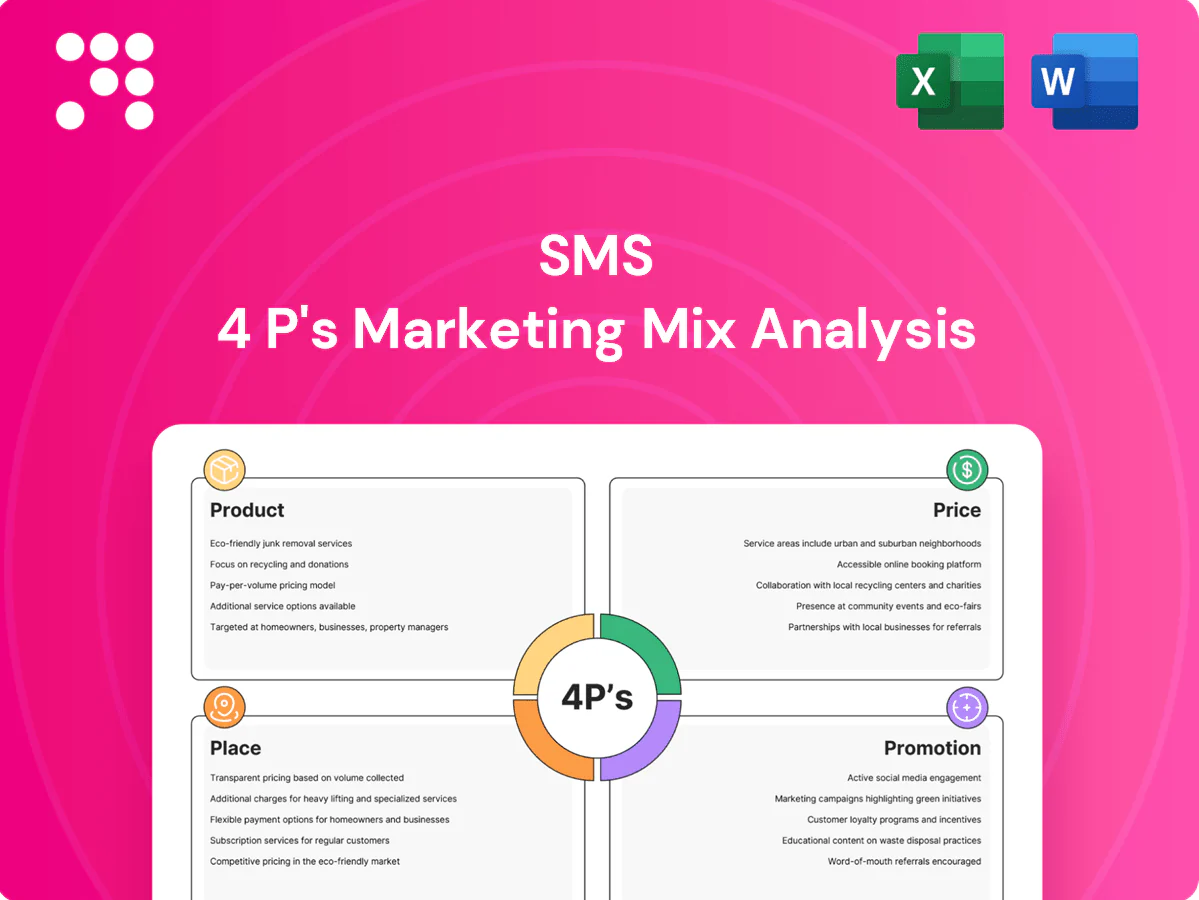
SMS Marketing Mix

Your Shortcut to a Strategic 4Ps Breakdown
Discover how SMS’s Product, Price, Place, and Promotion choices combine to create competitive advantage—this brief highlights key strengths and gaps, and shows practical takeaways. Purchase the full 4Ps Marketing Mix Analysis for a presentation-ready, editable report with data-driven recommendations and ready-to-use templates.
Product

Healthcare career matching
AI-enabled job board and agency services connect nurses, pharmacists, and clinicians with vetted openings nationwide, leveraging profiles, credentials, and preferences to streamline matching and regulatory compliance. Interview scheduling, offer management, and onboarding tools reduce time-to-hire and administrative friction. Focused on healthcare with a deep employer network across Japan, where 29.1% of the population was aged 65+ in 2023, the service addresses rising care demand.
Medical institution SaaS
Cloud tools support staffing, scheduling, procurement, and revenue workflows across Japan's healthcare network of about 8,400 hospitals and roughly 100,000 clinics (MHLW, 2024). Role-based dashboards, audit trails, and integrations streamline operations and cut administrative time across departments. Templates for claims and reporting reduce errors and rework, improving billing accuracy in live deployments. Localized UX and regulatory alignment match Japan's fee schedule and privacy rules for smooth adoption.

Senior life information portal
Senior life information portal guides families through care options, facilities, costs and benefits, addressing a global 65+ population of 761 million (UN DESA 2022). Rich content, reviews and search filters raise decision confidence; 77% of older adults prefer aging in place (AARP 2021). Lead routing connects users to appropriate providers, improving match efficiency, while planning tools, checklists and comparisons provide ongoing value.

Market data and insights
Market data and insights aggregate labor, utilization, and pricing to inform strategic decisions, leveraging trends as health spending reached 18.3% of US GDP in 2023 to pinpoint cost drivers. Benchmarking dashboards enable institutions and recruiters to optimize staffing and policy against peer performance. Custom research serves payers, providers, and policymakers while APIs provide programmatic access for enterprise analytics and integration.
- Aggregated labor, utilization, pricing
- Benchmarking dashboards for optimization
- Custom reports for payers, providers, policymakers
- APIs for enterprise analytics and integration
Trust, security, compliance
End-to-end encryption (AES-256/TLS 1.3), granular consent controls and PII masking protect health and HR data in transit and at rest; workflows enforce Japan APPI requirements and labor/privacy clauses. Enterprise-grade SLA 99.99% uptime, RTO <1 hour and RPO <15 minutes support mission-critical use; ISO 27001 and SOC 2 Type II certifications plus annual audits demonstrate reliability to large customers.
- Encryption: AES-256/TLS 1.3
- Compliance: APPI-aligned workflows
- Uptime SLA: 99.99%
- BC: RTO <1h, RPO <15m
- Certs: ISO 27001, SOC 2 Type II
AI staffing for Japan healthcare: reduces time-to-hire, aids seniors amid 29.1% 65+, AES-256/TLS1.3
AI-enabled job board, agency and cloud staffing tools match nurses, pharmacists and clinicians to vetted roles across Japan, reducing time-to-hire and admin friction. Senior portal and lead routing serve families amid Japan's 29.1% 65+ population (2023) and global 761M 65+ (UN DESA 2022). Enterprise security (AES-256/TLS1.3), 99.99% SLA, ISO27001/SOC2 support mission-critical adoption.
| Metric | Value | Source |
|---|---|---|
| Japan 65+ | 29.1% | 2023 |
| Hospitals/Clinics | ~8,400 / ~100,000 | MHLW 2024 |
| SLA | 99.99% | Product |
| Security | AES-256, TLS1.3, ISO27001, SOC2 | Product |
What is included in the product
 Detailed Word Document
Delivers a concise, company-specific deep dive into Product, Price, Place and Promotion for SMS, ideal for managers, consultants and marketers seeking a practical marketing-positioning breakdown; grounded in real brand practices and competitive context with a clean, editable layout ready for reports, presentations, benchmarking and strategy work.

 Customizable Excel Spreadsheet
Condenses the SMS 4P's into a concise, at-a-glance framework to resolve time-consuming analysis and misalignment, making strategic product, price, place and promotion decisions faster; easily customizable for presentations, side-by-side brand comparisons, or quick team workshops to accelerate consensus and execution.
Place

Online platforms
Web portals host career services, SaaS dashboards, and content libraries with responsive design for desktops in hospitals and mobile devices for clinicians; a 2024 HIMSS survey shows roughly 70% of clinicians use mobiles for clinical apps. Self-service onboarding cuts support tickets about 40% per Zendesk 2024, while 24/7 availability drives regional engagement uplifts near 30%.
Mobile applications
Mobile apps enable job alerts, shift picks, in-app messaging and document uploads on the go, streamlining workforce coordination. Push notifications boost responsiveness for time-sensitive roles, while offline-friendly features support field use and reduce downtime. App store distribution taps ~4.7 million apps and ~5.5 billion smartphone users (2024), extending reach to individual professionals.

Direct enterprise sales
Field sales and customer success teams target hospitals, clinics and care facilities, using solution demos and pilots that in healthcare IT commonly convert at roughly 25–35% into paid deployments; onsite training and integration support measurably increase clinician adoption and reduce churn. Focused account management then expands usage across departments, often driving 15–25% ARR expansion within existing enterprise accounts.

Partner and association channels
Tie-ups with medical associations, nursing schools, and care networks widen access; the American Medical Association has about 240,000 members and US registered nurses number roughly 3.1 million (BLS 2023), creating large referral pools. Co-branded programs build credibility and funnel qualified users. Referral agreements with facility groups accelerate multi-site rollouts. Vendor alliances with EHR leaders like Epic (≈34% US hospital bed share in 2024) support integrations and cross-sell.
- Association reach: AMA ~240,000 members
- Nursing talent pool: ≈3.1M RNs (BLS 2023)
- Vendor leverage: Epic ≈34% bed share (2024)
- Referral deals speed multi-site deployments
API and integrations
Connectors to HRIS, EMR/EHR, payroll, and scheduling systems streamline data flow and reduce manual reconciliation, with marketplace platforms like Salesforce AppExchange hosting 7,000+ apps (Salesforce 2024) to accelerate integrations.
SSO adoption in enterprises surpassed 60% in 2024, lowering login friction and reducing credential-related helpdesk costs; deeper API integration raises switching costs and supports higher retention.
Marketplace listings boost discoverability and partner-driven revenue; tightly integrated systems tend to show better customer lifetime value and lower churn in enterprise deployments.
- Connectors: HRIS, EMR/EHR, payroll, scheduling
- SSO: >60% enterprise adoption (2024)
- Marketplace: 7,000+ apps on AppExchange (Salesforce 2024)
- Impact: higher switching costs → improved retention
Clinician mobile use ≈70%; pilots convert 25-35%, expansion 15-25% ARR
Place channels mix web portals, mobile apps, field sales and partner networks to reach clinicians (≈70% mobile app use, HIMSS 2024), hospitals (Epic ≈34% bed share 2024) and 3.1M nurses (BLS 2023). Self-service cuts tickets ≈40% (Zendesk 2024); pilots convert ~25–35% to paid and account expansion adds 15–25% ARR. SSO >60% (2024) and 7,000+ AppExchange apps accelerate integrations.
| Metric | Value |
|---|---|
| Clinician mobile use | ≈70% (HIMSS 2024) |
| Epic bed share | ≈34% (2024) |
| SSO adoption | >60% (2024) |
| AppExchange apps | 7,000+ (Salesforce 2024) |
Same Document Delivered
SMS 4P's Marketing Mix Analysis
The preview shown here is the exact SMS 4P’s Marketing Mix Analysis you’ll receive instantly after purchase—no sample or mockup. It’s fully complete, editable, and ready for immediate use. Buy with confidence.

Your Shortcut to a Strategic 4Ps Breakdown
Discover how SMS’s Product, Price, Place, and Promotion choices combine to create competitive advantage—this brief highlights key strengths and gaps, and shows practical takeaways. Purchase the full 4Ps Marketing Mix Analysis for a presentation-ready, editable report with data-driven recommendations and ready-to-use templates.
Product
Healthcare career matching
AI-enabled job board and agency services connect nurses, pharmacists, and clinicians with vetted openings nationwide, leveraging profiles, credentials, and preferences to streamline matching and regulatory compliance. Interview scheduling, offer management, and onboarding tools reduce time-to-hire and administrative friction. Focused on healthcare with a deep employer network across Japan, where 29.1% of the population was aged 65+ in 2023, the service addresses rising care demand.
Medical institution SaaS
Cloud tools support staffing, scheduling, procurement, and revenue workflows across Japan's healthcare network of about 8,400 hospitals and roughly 100,000 clinics (MHLW, 2024). Role-based dashboards, audit trails, and integrations streamline operations and cut administrative time across departments. Templates for claims and reporting reduce errors and rework, improving billing accuracy in live deployments. Localized UX and regulatory alignment match Japan's fee schedule and privacy rules for smooth adoption.
Senior life information portal
Senior life information portal guides families through care options, facilities, costs and benefits, addressing a global 65+ population of 761 million (UN DESA 2022). Rich content, reviews and search filters raise decision confidence; 77% of older adults prefer aging in place (AARP 2021). Lead routing connects users to appropriate providers, improving match efficiency, while planning tools, checklists and comparisons provide ongoing value.
Market data and insights
Market data and insights aggregate labor, utilization, and pricing to inform strategic decisions, leveraging trends as health spending reached 18.3% of US GDP in 2023 to pinpoint cost drivers. Benchmarking dashboards enable institutions and recruiters to optimize staffing and policy against peer performance. Custom research serves payers, providers, and policymakers while APIs provide programmatic access for enterprise analytics and integration.
- Aggregated labor, utilization, pricing
- Benchmarking dashboards for optimization
- Custom reports for payers, providers, policymakers
- APIs for enterprise analytics and integration
Trust, security, compliance
End-to-end encryption (AES-256/TLS 1.3), granular consent controls and PII masking protect health and HR data in transit and at rest; workflows enforce Japan APPI requirements and labor/privacy clauses. Enterprise-grade SLA 99.99% uptime, RTO <1 hour and RPO <15 minutes support mission-critical use; ISO 27001 and SOC 2 Type II certifications plus annual audits demonstrate reliability to large customers.
- Encryption: AES-256/TLS 1.3
- Compliance: APPI-aligned workflows
- Uptime SLA: 99.99%
- BC: RTO <1h, RPO <15m
- Certs: ISO 27001, SOC 2 Type II
AI staffing for Japan healthcare: reduces time-to-hire, aids seniors amid 29.1% 65+, AES-256/TLS1.3
AI-enabled job board, agency and cloud staffing tools match nurses, pharmacists and clinicians to vetted roles across Japan, reducing time-to-hire and admin friction. Senior portal and lead routing serve families amid Japan's 29.1% 65+ population (2023) and global 761M 65+ (UN DESA 2022). Enterprise security (AES-256/TLS1.3), 99.99% SLA, ISO27001/SOC2 support mission-critical adoption.
| Metric | Value | Source |
|---|---|---|
| Japan 65+ | 29.1% | 2023 |
| Hospitals/Clinics | ~8,400 / ~100,000 | MHLW 2024 |
| SLA | 99.99% | Product |
| Security | AES-256, TLS1.3, ISO27001, SOC2 | Product |
What is included in the product
Detailed Word Document
Delivers a concise, company-specific deep dive into Product, Price, Place and Promotion for SMS, ideal for managers, consultants and marketers seeking a practical marketing-positioning breakdown; grounded in real brand practices and competitive context with a clean, editable layout ready for reports, presentations, benchmarking and strategy work.
Customizable Excel Spreadsheet
Condenses the SMS 4P's into a concise, at-a-glance framework to resolve time-consuming analysis and misalignment, making strategic product, price, place and promotion decisions faster; easily customizable for presentations, side-by-side brand comparisons, or quick team workshops to accelerate consensus and execution.
Place
Online platforms
Web portals host career services, SaaS dashboards, and content libraries with responsive design for desktops in hospitals and mobile devices for clinicians; a 2024 HIMSS survey shows roughly 70% of clinicians use mobiles for clinical apps. Self-service onboarding cuts support tickets about 40% per Zendesk 2024, while 24/7 availability drives regional engagement uplifts near 30%.
Mobile applications
Mobile apps enable job alerts, shift picks, in-app messaging and document uploads on the go, streamlining workforce coordination. Push notifications boost responsiveness for time-sensitive roles, while offline-friendly features support field use and reduce downtime. App store distribution taps ~4.7 million apps and ~5.5 billion smartphone users (2024), extending reach to individual professionals.
Direct enterprise sales
Field sales and customer success teams target hospitals, clinics and care facilities, using solution demos and pilots that in healthcare IT commonly convert at roughly 25–35% into paid deployments; onsite training and integration support measurably increase clinician adoption and reduce churn. Focused account management then expands usage across departments, often driving 15–25% ARR expansion within existing enterprise accounts.
Partner and association channels
Tie-ups with medical associations, nursing schools, and care networks widen access; the American Medical Association has about 240,000 members and US registered nurses number roughly 3.1 million (BLS 2023), creating large referral pools. Co-branded programs build credibility and funnel qualified users. Referral agreements with facility groups accelerate multi-site rollouts. Vendor alliances with EHR leaders like Epic (≈34% US hospital bed share in 2024) support integrations and cross-sell.
- Association reach: AMA ~240,000 members
- Nursing talent pool: ≈3.1M RNs (BLS 2023)
- Vendor leverage: Epic ≈34% bed share (2024)
- Referral deals speed multi-site deployments
API and integrations
Connectors to HRIS, EMR/EHR, payroll, and scheduling systems streamline data flow and reduce manual reconciliation, with marketplace platforms like Salesforce AppExchange hosting 7,000+ apps (Salesforce 2024) to accelerate integrations.
SSO adoption in enterprises surpassed 60% in 2024, lowering login friction and reducing credential-related helpdesk costs; deeper API integration raises switching costs and supports higher retention.
Marketplace listings boost discoverability and partner-driven revenue; tightly integrated systems tend to show better customer lifetime value and lower churn in enterprise deployments.
- Connectors: HRIS, EMR/EHR, payroll, scheduling
- SSO: >60% enterprise adoption (2024)
- Marketplace: 7,000+ apps on AppExchange (Salesforce 2024)
- Impact: higher switching costs → improved retention
Clinician mobile use ≈70%; pilots convert 25-35%, expansion 15-25% ARR
Place channels mix web portals, mobile apps, field sales and partner networks to reach clinicians (≈70% mobile app use, HIMSS 2024), hospitals (Epic ≈34% bed share 2024) and 3.1M nurses (BLS 2023). Self-service cuts tickets ≈40% (Zendesk 2024); pilots convert ~25–35% to paid and account expansion adds 15–25% ARR. SSO >60% (2024) and 7,000+ AppExchange apps accelerate integrations.
| Metric | Value |
|---|---|
| Clinician mobile use | ≈70% (HIMSS 2024) |
| Epic bed share | ≈34% (2024) |
| SSO adoption | >60% (2024) |
| AppExchange apps | 7,000+ (Salesforce 2024) |
Same Document Delivered
SMS 4P's Marketing Mix Analysis
The preview shown here is the exact SMS 4P’s Marketing Mix Analysis you’ll receive instantly after purchase—no sample or mockup. It’s fully complete, editable, and ready for immediate use. Buy with confidence.
Original: $10.00
-65%$10.00
$3.50Description
Your Shortcut to a Strategic 4Ps Breakdown
Discover how SMS’s Product, Price, Place, and Promotion choices combine to create competitive advantage—this brief highlights key strengths and gaps, and shows practical takeaways. Purchase the full 4Ps Marketing Mix Analysis for a presentation-ready, editable report with data-driven recommendations and ready-to-use templates.
Product
Healthcare career matching
AI-enabled job board and agency services connect nurses, pharmacists, and clinicians with vetted openings nationwide, leveraging profiles, credentials, and preferences to streamline matching and regulatory compliance. Interview scheduling, offer management, and onboarding tools reduce time-to-hire and administrative friction. Focused on healthcare with a deep employer network across Japan, where 29.1% of the population was aged 65+ in 2023, the service addresses rising care demand.
Medical institution SaaS
Cloud tools support staffing, scheduling, procurement, and revenue workflows across Japan's healthcare network of about 8,400 hospitals and roughly 100,000 clinics (MHLW, 2024). Role-based dashboards, audit trails, and integrations streamline operations and cut administrative time across departments. Templates for claims and reporting reduce errors and rework, improving billing accuracy in live deployments. Localized UX and regulatory alignment match Japan's fee schedule and privacy rules for smooth adoption.
Senior life information portal
Senior life information portal guides families through care options, facilities, costs and benefits, addressing a global 65+ population of 761 million (UN DESA 2022). Rich content, reviews and search filters raise decision confidence; 77% of older adults prefer aging in place (AARP 2021). Lead routing connects users to appropriate providers, improving match efficiency, while planning tools, checklists and comparisons provide ongoing value.
Market data and insights
Market data and insights aggregate labor, utilization, and pricing to inform strategic decisions, leveraging trends as health spending reached 18.3% of US GDP in 2023 to pinpoint cost drivers. Benchmarking dashboards enable institutions and recruiters to optimize staffing and policy against peer performance. Custom research serves payers, providers, and policymakers while APIs provide programmatic access for enterprise analytics and integration.
- Aggregated labor, utilization, pricing
- Benchmarking dashboards for optimization
- Custom reports for payers, providers, policymakers
- APIs for enterprise analytics and integration
Trust, security, compliance
End-to-end encryption (AES-256/TLS 1.3), granular consent controls and PII masking protect health and HR data in transit and at rest; workflows enforce Japan APPI requirements and labor/privacy clauses. Enterprise-grade SLA 99.99% uptime, RTO <1 hour and RPO <15 minutes support mission-critical use; ISO 27001 and SOC 2 Type II certifications plus annual audits demonstrate reliability to large customers.
- Encryption: AES-256/TLS 1.3
- Compliance: APPI-aligned workflows
- Uptime SLA: 99.99%
- BC: RTO <1h, RPO <15m
- Certs: ISO 27001, SOC 2 Type II
AI staffing for Japan healthcare: reduces time-to-hire, aids seniors amid 29.1% 65+, AES-256/TLS1.3
AI-enabled job board, agency and cloud staffing tools match nurses, pharmacists and clinicians to vetted roles across Japan, reducing time-to-hire and admin friction. Senior portal and lead routing serve families amid Japan's 29.1% 65+ population (2023) and global 761M 65+ (UN DESA 2022). Enterprise security (AES-256/TLS1.3), 99.99% SLA, ISO27001/SOC2 support mission-critical adoption.
| Metric | Value | Source |
|---|---|---|
| Japan 65+ | 29.1% | 2023 |
| Hospitals/Clinics | ~8,400 / ~100,000 | MHLW 2024 |
| SLA | 99.99% | Product |
| Security | AES-256, TLS1.3, ISO27001, SOC2 | Product |
What is included in the product
Detailed Word Document
Delivers a concise, company-specific deep dive into Product, Price, Place and Promotion for SMS, ideal for managers, consultants and marketers seeking a practical marketing-positioning breakdown; grounded in real brand practices and competitive context with a clean, editable layout ready for reports, presentations, benchmarking and strategy work.
Customizable Excel Spreadsheet
Condenses the SMS 4P's into a concise, at-a-glance framework to resolve time-consuming analysis and misalignment, making strategic product, price, place and promotion decisions faster; easily customizable for presentations, side-by-side brand comparisons, or quick team workshops to accelerate consensus and execution.
Place
Online platforms
Web portals host career services, SaaS dashboards, and content libraries with responsive design for desktops in hospitals and mobile devices for clinicians; a 2024 HIMSS survey shows roughly 70% of clinicians use mobiles for clinical apps. Self-service onboarding cuts support tickets about 40% per Zendesk 2024, while 24/7 availability drives regional engagement uplifts near 30%.
Mobile applications
Mobile apps enable job alerts, shift picks, in-app messaging and document uploads on the go, streamlining workforce coordination. Push notifications boost responsiveness for time-sensitive roles, while offline-friendly features support field use and reduce downtime. App store distribution taps ~4.7 million apps and ~5.5 billion smartphone users (2024), extending reach to individual professionals.
Direct enterprise sales
Field sales and customer success teams target hospitals, clinics and care facilities, using solution demos and pilots that in healthcare IT commonly convert at roughly 25–35% into paid deployments; onsite training and integration support measurably increase clinician adoption and reduce churn. Focused account management then expands usage across departments, often driving 15–25% ARR expansion within existing enterprise accounts.
Partner and association channels
Tie-ups with medical associations, nursing schools, and care networks widen access; the American Medical Association has about 240,000 members and US registered nurses number roughly 3.1 million (BLS 2023), creating large referral pools. Co-branded programs build credibility and funnel qualified users. Referral agreements with facility groups accelerate multi-site rollouts. Vendor alliances with EHR leaders like Epic (≈34% US hospital bed share in 2024) support integrations and cross-sell.
- Association reach: AMA ~240,000 members
- Nursing talent pool: ≈3.1M RNs (BLS 2023)
- Vendor leverage: Epic ≈34% bed share (2024)
- Referral deals speed multi-site deployments
API and integrations
Connectors to HRIS, EMR/EHR, payroll, and scheduling systems streamline data flow and reduce manual reconciliation, with marketplace platforms like Salesforce AppExchange hosting 7,000+ apps (Salesforce 2024) to accelerate integrations.
SSO adoption in enterprises surpassed 60% in 2024, lowering login friction and reducing credential-related helpdesk costs; deeper API integration raises switching costs and supports higher retention.
Marketplace listings boost discoverability and partner-driven revenue; tightly integrated systems tend to show better customer lifetime value and lower churn in enterprise deployments.
- Connectors: HRIS, EMR/EHR, payroll, scheduling
- SSO: >60% enterprise adoption (2024)
- Marketplace: 7,000+ apps on AppExchange (Salesforce 2024)
- Impact: higher switching costs → improved retention
Clinician mobile use ≈70%; pilots convert 25-35%, expansion 15-25% ARR
Place channels mix web portals, mobile apps, field sales and partner networks to reach clinicians (≈70% mobile app use, HIMSS 2024), hospitals (Epic ≈34% bed share 2024) and 3.1M nurses (BLS 2023). Self-service cuts tickets ≈40% (Zendesk 2024); pilots convert ~25–35% to paid and account expansion adds 15–25% ARR. SSO >60% (2024) and 7,000+ AppExchange apps accelerate integrations.
| Metric | Value |
|---|---|
| Clinician mobile use | ≈70% (HIMSS 2024) |
| Epic bed share | ≈34% (2024) |
| SSO adoption | >60% (2024) |
| AppExchange apps | 7,000+ (Salesforce 2024) |
Same Document Delivered
SMS 4P's Marketing Mix Analysis
The preview shown here is the exact SMS 4P’s Marketing Mix Analysis you’ll receive instantly after purchase—no sample or mockup. It’s fully complete, editable, and ready for immediate use. Buy with confidence.











