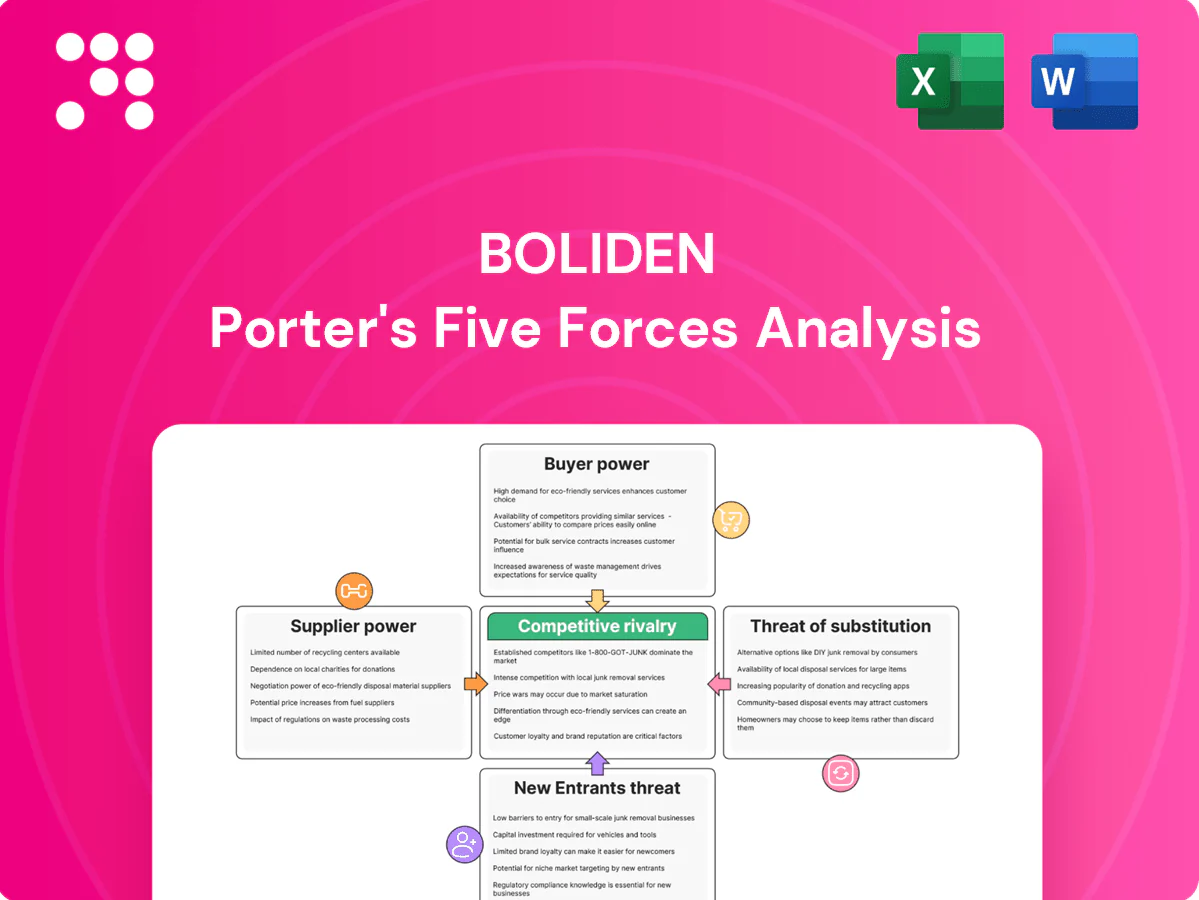
Boliden Porter's Five Forces Analysis

A Must-Have Tool for Decision-Makers
Boliden operates in a capital-intensive, commodity-driven metals market where supplier leverage, commodity price swings, and tight environmental regulations shape margins and strategy. Buyer concentration and substitute materials add pressure, while high entry barriers protect incumbents. This brief snapshot only scratches the surface. Unlock the full Porter's Five Forces Analysis to explore Boliden’s competitive dynamics, market pressures, and strategic advantages in detail.
Suppliers Bargaining Power

Critical equipment OEMs
Mining depends on a concentrated set of OEMs for drills, loaders, mills and automation, giving suppliers outsized leverage in procurement and aftermarket services. As of 2024 switching costs remain high because equipment is embedded in complex integration and maintenance ecosystems tied to production continuity. Boliden reduces exposure through multi-sourcing and long-term service agreements, yet specialized parts shortages or downtime sustain OEM negotiating power.
Power and energy inputs
Smelting and milling are electricity-intensive, making Boliden vulnerable to power-price swings; Nordic baseload averaged about 60 EUR/MWh in 2024, amplifying input-cost exposure. Long-term PPAs and grid access mitigate some risk but tight markets and the EU ETS (~80 EUR/tCO2 in 2024) can lift costs further. Price spikes or supply interruptions can hit margins quickly. Green electricity premiums for ESG-linked contracts increase supplier leverage.

Chemicals and consumables
Reagents, explosives and fluxes are sourced from regional suppliers with some substitution possible, but deliveries to remote Nordic and Iberian sites raise delivered costs and limit switching. Boliden mitigates supplier power by aggregating volumes across mines to negotiate rebates and service terms. Logistics bottlenecks and seasonal demand push price volatility, while global chemical price cycles affect contract duration and availability.

Skilled labor and contractors
- Scarcity: limited regional pool of geologists/engineers
- Union pressure: Nordic union density ~60–70% (2024)
- Cost trend: wage inflation raises input costs
- Mitigants: training pipelines and automation reduce reliance
Ore concentrates and by-products
Smelters like Boliden rely on third-party ore concentrates and by-products when internal feed is insufficient; in 2024 external feeds remained a key supply pillar for smelter throughput.
Supply is fragmented across miners, but trading houses arbitrated spot tightness in 2024, smoothing immediate availability and price spikes.
Treatment charges and penalty terms moved with market balance through 2024; Boliden’s strategic sourcing and blending capabilities reduced supplier leverage.
- Fragmented supply, mitigated by trading houses in 2024
- Spot TC/penalties responsive to market balance
- Sourcing/blending lowers supplier power
Moderate-high supplier power as energy and carbon costs bite; PPAs and multi-sourcing mitigate.
Supplier power is moderate-high: OEMs and specialist contractors hold leverage via high switching costs and unionized labor (60–70% density, 2024). Energy and carbon costs are material (Nordic baseload ~60 EUR/MWh; EU ETS ~80 EUR/tCO2, 2024). Multi-sourcing, PPAs, blending and long-term contracts partly mitigate risks.
| Metric | 2024 |
|---|---|
| Nordic baseload | ~60 EUR/MWh |
| EU ETS price | ~80 EUR/tCO2 |
| Union density | 60–70% |
What is included in the product
 Detailed Word Document
Concise Porter's Five Forces review of Boliden that uncovers competitive drivers, supplier and buyer power, entry barriers, substitutes and disruptive threats, with industry-backed strategic commentary tailored for investor decks, strategy reports or academic use.

 Customizable Excel Spreadsheet
Concise, one-sheet Porter's Five Forces for Boliden—instantly clarifies competitive pressures across mining, smelting, and recycling to guide strategic decisions and relieve analysis bottlenecks.
Customers Bargaining Power

LME-linked pricing
Most of Boliden’s metal sales reference LME-linked pricing, constraining its ability to set independent prices as global spot and futures benchmarks drive contract values.
Premiums for treatment, specification and product quality offer some differentiation, but in down cycles buyers extract more value as base LME prices fall.
Hedging reduces short-term volatility yet does not eliminate the structural bargaining power of large, LME-indexed purchasers.
Concentrated industrial customers
Large galvanizers, wire/rod mills and battery supply chains constitute sizable accounts with multi-year planning horizons that strengthen buyer leverage; in 2024 these industrial customers continued to seek volume certainty and price predictability. Boliden offsets this by promoting reliable delivery and strengthened ESG credentials, securing offtake discussions and long-term contracts that stabilize volumes but typically compress transaction premiums.

Specification and quality demands
Buyers demand tight impurity specs—refined copper typically at 99.99% purity—and consistent formats to fit downstream processes, making quality a primary bargaining lever. Meeting these standards creates customer stickiness and raises switching costs, while failures or variability force price concessions and remediation costs. Offering value-added forms like copper rod shifts margin downstream and modestly weakens buyer power; 2024 LME copper averaged about $9,300/t, amplifying impact of quality-related premiums.

Logistics and location
Proximity to Nordic and European customers in 2024 lowers freight costs and lead times, enabling Boliden to offer faster replenishment compared with intercontinental suppliers.
Nearby buyers retain alternatives among EU smelters, keeping customer bargaining power high despite Boliden embedding just-in-time delivery to strengthen ties.
Export customers can still leverage suppliers across regions to negotiate on price and terms, forcing Boliden to balance service with competitive pricing.
- 2024: regional proximity reduces transit time and logistics cost pressure
- JIT deliveries increase switching costs for local buyers
- EU smelter alternatives sustain buyer negotiation leverage
ESG-driven procurement
Automotive and electronics buyers increasingly require low-carbon, traceable metals, shifting procurement toward ESG credentials; Boliden’s sustainable profile can secure preferred-supplier status and reduce pure price-based bargaining. Audits and certification costs, however, transfer compliance expenses to Boliden, raising operating costs. The 2024 CSRD expansion to ~50,000 EU firms increases buyer scrutiny and reporting demands.
- Preferred-supplier: lowers price pressure
- Audit/certification: raises Boliden’s costs
- CSRD 2024: ~50,000 EU firms, higher buyer scrutiny
LME pricing caps margins; CSRD compliance raises costs but unlocks preferred-supplier upside
Most sales reference LME pricing, limiting Boliden’s pricing power; 2024 LME copper averaged $9,300/t. Large industrial buyers and EU smelter alternatives keep buyer leverage high despite JIT and Nordic proximity. ESG demands (CSRD ~50,000 firms) give Boliden preferred‑supplier upside but raise compliance costs.
| Metric | 2024 |
|---|---|
| LME copper | $9,300/t |
| CSRD scope | ~50,000 firms |
| Buyer leverage | High |
What You See Is What You Get
Boliden Porter's Five Forces Analysis
This preview shows the exact Boliden Porter's Five Forces Analysis you'll receive immediately after purchase—no surprises or placeholders. It provides a complete, professionally formatted evaluation of competitive rivalry, supplier and buyer power, and threats of new entrants and substitutes. You’ll get this same file ready for instant download and use upon payment.

A Must-Have Tool for Decision-Makers
Boliden operates in a capital-intensive, commodity-driven metals market where supplier leverage, commodity price swings, and tight environmental regulations shape margins and strategy. Buyer concentration and substitute materials add pressure, while high entry barriers protect incumbents. This brief snapshot only scratches the surface. Unlock the full Porter's Five Forces Analysis to explore Boliden’s competitive dynamics, market pressures, and strategic advantages in detail.
Suppliers Bargaining Power
Critical equipment OEMs
Mining depends on a concentrated set of OEMs for drills, loaders, mills and automation, giving suppliers outsized leverage in procurement and aftermarket services. As of 2024 switching costs remain high because equipment is embedded in complex integration and maintenance ecosystems tied to production continuity. Boliden reduces exposure through multi-sourcing and long-term service agreements, yet specialized parts shortages or downtime sustain OEM negotiating power.
Power and energy inputs
Smelting and milling are electricity-intensive, making Boliden vulnerable to power-price swings; Nordic baseload averaged about 60 EUR/MWh in 2024, amplifying input-cost exposure. Long-term PPAs and grid access mitigate some risk but tight markets and the EU ETS (~80 EUR/tCO2 in 2024) can lift costs further. Price spikes or supply interruptions can hit margins quickly. Green electricity premiums for ESG-linked contracts increase supplier leverage.
Chemicals and consumables
Reagents, explosives and fluxes are sourced from regional suppliers with some substitution possible, but deliveries to remote Nordic and Iberian sites raise delivered costs and limit switching. Boliden mitigates supplier power by aggregating volumes across mines to negotiate rebates and service terms. Logistics bottlenecks and seasonal demand push price volatility, while global chemical price cycles affect contract duration and availability.
Skilled labor and contractors
- Scarcity: limited regional pool of geologists/engineers
- Union pressure: Nordic union density ~60–70% (2024)
- Cost trend: wage inflation raises input costs
- Mitigants: training pipelines and automation reduce reliance
Ore concentrates and by-products
Smelters like Boliden rely on third-party ore concentrates and by-products when internal feed is insufficient; in 2024 external feeds remained a key supply pillar for smelter throughput.
Supply is fragmented across miners, but trading houses arbitrated spot tightness in 2024, smoothing immediate availability and price spikes.
Treatment charges and penalty terms moved with market balance through 2024; Boliden’s strategic sourcing and blending capabilities reduced supplier leverage.
- Fragmented supply, mitigated by trading houses in 2024
- Spot TC/penalties responsive to market balance
- Sourcing/blending lowers supplier power
Moderate-high supplier power as energy and carbon costs bite; PPAs and multi-sourcing mitigate.
Supplier power is moderate-high: OEMs and specialist contractors hold leverage via high switching costs and unionized labor (60–70% density, 2024). Energy and carbon costs are material (Nordic baseload ~60 EUR/MWh; EU ETS ~80 EUR/tCO2, 2024). Multi-sourcing, PPAs, blending and long-term contracts partly mitigate risks.
| Metric | 2024 |
|---|---|
| Nordic baseload | ~60 EUR/MWh |
| EU ETS price | ~80 EUR/tCO2 |
| Union density | 60–70% |
What is included in the product
Detailed Word Document
Concise Porter's Five Forces review of Boliden that uncovers competitive drivers, supplier and buyer power, entry barriers, substitutes and disruptive threats, with industry-backed strategic commentary tailored for investor decks, strategy reports or academic use.
Customizable Excel Spreadsheet
Concise, one-sheet Porter's Five Forces for Boliden—instantly clarifies competitive pressures across mining, smelting, and recycling to guide strategic decisions and relieve analysis bottlenecks.
Customers Bargaining Power
LME-linked pricing
Most of Boliden’s metal sales reference LME-linked pricing, constraining its ability to set independent prices as global spot and futures benchmarks drive contract values.
Premiums for treatment, specification and product quality offer some differentiation, but in down cycles buyers extract more value as base LME prices fall.
Hedging reduces short-term volatility yet does not eliminate the structural bargaining power of large, LME-indexed purchasers.
Concentrated industrial customers
Large galvanizers, wire/rod mills and battery supply chains constitute sizable accounts with multi-year planning horizons that strengthen buyer leverage; in 2024 these industrial customers continued to seek volume certainty and price predictability. Boliden offsets this by promoting reliable delivery and strengthened ESG credentials, securing offtake discussions and long-term contracts that stabilize volumes but typically compress transaction premiums.
Specification and quality demands
Buyers demand tight impurity specs—refined copper typically at 99.99% purity—and consistent formats to fit downstream processes, making quality a primary bargaining lever. Meeting these standards creates customer stickiness and raises switching costs, while failures or variability force price concessions and remediation costs. Offering value-added forms like copper rod shifts margin downstream and modestly weakens buyer power; 2024 LME copper averaged about $9,300/t, amplifying impact of quality-related premiums.
Logistics and location
Proximity to Nordic and European customers in 2024 lowers freight costs and lead times, enabling Boliden to offer faster replenishment compared with intercontinental suppliers.
Nearby buyers retain alternatives among EU smelters, keeping customer bargaining power high despite Boliden embedding just-in-time delivery to strengthen ties.
Export customers can still leverage suppliers across regions to negotiate on price and terms, forcing Boliden to balance service with competitive pricing.
- 2024: regional proximity reduces transit time and logistics cost pressure
- JIT deliveries increase switching costs for local buyers
- EU smelter alternatives sustain buyer negotiation leverage
ESG-driven procurement
Automotive and electronics buyers increasingly require low-carbon, traceable metals, shifting procurement toward ESG credentials; Boliden’s sustainable profile can secure preferred-supplier status and reduce pure price-based bargaining. Audits and certification costs, however, transfer compliance expenses to Boliden, raising operating costs. The 2024 CSRD expansion to ~50,000 EU firms increases buyer scrutiny and reporting demands.
- Preferred-supplier: lowers price pressure
- Audit/certification: raises Boliden’s costs
- CSRD 2024: ~50,000 EU firms, higher buyer scrutiny
LME pricing caps margins; CSRD compliance raises costs but unlocks preferred-supplier upside
Most sales reference LME pricing, limiting Boliden’s pricing power; 2024 LME copper averaged $9,300/t. Large industrial buyers and EU smelter alternatives keep buyer leverage high despite JIT and Nordic proximity. ESG demands (CSRD ~50,000 firms) give Boliden preferred‑supplier upside but raise compliance costs.
| Metric | 2024 |
|---|---|
| LME copper | $9,300/t |
| CSRD scope | ~50,000 firms |
| Buyer leverage | High |
What You See Is What You Get
Boliden Porter's Five Forces Analysis
This preview shows the exact Boliden Porter's Five Forces Analysis you'll receive immediately after purchase—no surprises or placeholders. It provides a complete, professionally formatted evaluation of competitive rivalry, supplier and buyer power, and threats of new entrants and substitutes. You’ll get this same file ready for instant download and use upon payment.
Description
A Must-Have Tool for Decision-Makers
Boliden operates in a capital-intensive, commodity-driven metals market where supplier leverage, commodity price swings, and tight environmental regulations shape margins and strategy. Buyer concentration and substitute materials add pressure, while high entry barriers protect incumbents. This brief snapshot only scratches the surface. Unlock the full Porter's Five Forces Analysis to explore Boliden’s competitive dynamics, market pressures, and strategic advantages in detail.
Suppliers Bargaining Power
Critical equipment OEMs
Mining depends on a concentrated set of OEMs for drills, loaders, mills and automation, giving suppliers outsized leverage in procurement and aftermarket services. As of 2024 switching costs remain high because equipment is embedded in complex integration and maintenance ecosystems tied to production continuity. Boliden reduces exposure through multi-sourcing and long-term service agreements, yet specialized parts shortages or downtime sustain OEM negotiating power.
Power and energy inputs
Smelting and milling are electricity-intensive, making Boliden vulnerable to power-price swings; Nordic baseload averaged about 60 EUR/MWh in 2024, amplifying input-cost exposure. Long-term PPAs and grid access mitigate some risk but tight markets and the EU ETS (~80 EUR/tCO2 in 2024) can lift costs further. Price spikes or supply interruptions can hit margins quickly. Green electricity premiums for ESG-linked contracts increase supplier leverage.
Chemicals and consumables
Reagents, explosives and fluxes are sourced from regional suppliers with some substitution possible, but deliveries to remote Nordic and Iberian sites raise delivered costs and limit switching. Boliden mitigates supplier power by aggregating volumes across mines to negotiate rebates and service terms. Logistics bottlenecks and seasonal demand push price volatility, while global chemical price cycles affect contract duration and availability.
Skilled labor and contractors
- Scarcity: limited regional pool of geologists/engineers
- Union pressure: Nordic union density ~60–70% (2024)
- Cost trend: wage inflation raises input costs
- Mitigants: training pipelines and automation reduce reliance
Ore concentrates and by-products
Smelters like Boliden rely on third-party ore concentrates and by-products when internal feed is insufficient; in 2024 external feeds remained a key supply pillar for smelter throughput.
Supply is fragmented across miners, but trading houses arbitrated spot tightness in 2024, smoothing immediate availability and price spikes.
Treatment charges and penalty terms moved with market balance through 2024; Boliden’s strategic sourcing and blending capabilities reduced supplier leverage.
- Fragmented supply, mitigated by trading houses in 2024
- Spot TC/penalties responsive to market balance
- Sourcing/blending lowers supplier power
Moderate-high supplier power as energy and carbon costs bite; PPAs and multi-sourcing mitigate.
Supplier power is moderate-high: OEMs and specialist contractors hold leverage via high switching costs and unionized labor (60–70% density, 2024). Energy and carbon costs are material (Nordic baseload ~60 EUR/MWh; EU ETS ~80 EUR/tCO2, 2024). Multi-sourcing, PPAs, blending and long-term contracts partly mitigate risks.
| Metric | 2024 |
|---|---|
| Nordic baseload | ~60 EUR/MWh |
| EU ETS price | ~80 EUR/tCO2 |
| Union density | 60–70% |
What is included in the product
Detailed Word Document
Concise Porter's Five Forces review of Boliden that uncovers competitive drivers, supplier and buyer power, entry barriers, substitutes and disruptive threats, with industry-backed strategic commentary tailored for investor decks, strategy reports or academic use.
Customizable Excel Spreadsheet
Concise, one-sheet Porter's Five Forces for Boliden—instantly clarifies competitive pressures across mining, smelting, and recycling to guide strategic decisions and relieve analysis bottlenecks.
Customers Bargaining Power
LME-linked pricing
Most of Boliden’s metal sales reference LME-linked pricing, constraining its ability to set independent prices as global spot and futures benchmarks drive contract values.
Premiums for treatment, specification and product quality offer some differentiation, but in down cycles buyers extract more value as base LME prices fall.
Hedging reduces short-term volatility yet does not eliminate the structural bargaining power of large, LME-indexed purchasers.
Concentrated industrial customers
Large galvanizers, wire/rod mills and battery supply chains constitute sizable accounts with multi-year planning horizons that strengthen buyer leverage; in 2024 these industrial customers continued to seek volume certainty and price predictability. Boliden offsets this by promoting reliable delivery and strengthened ESG credentials, securing offtake discussions and long-term contracts that stabilize volumes but typically compress transaction premiums.
Specification and quality demands
Buyers demand tight impurity specs—refined copper typically at 99.99% purity—and consistent formats to fit downstream processes, making quality a primary bargaining lever. Meeting these standards creates customer stickiness and raises switching costs, while failures or variability force price concessions and remediation costs. Offering value-added forms like copper rod shifts margin downstream and modestly weakens buyer power; 2024 LME copper averaged about $9,300/t, amplifying impact of quality-related premiums.
Logistics and location
Proximity to Nordic and European customers in 2024 lowers freight costs and lead times, enabling Boliden to offer faster replenishment compared with intercontinental suppliers.
Nearby buyers retain alternatives among EU smelters, keeping customer bargaining power high despite Boliden embedding just-in-time delivery to strengthen ties.
Export customers can still leverage suppliers across regions to negotiate on price and terms, forcing Boliden to balance service with competitive pricing.
- 2024: regional proximity reduces transit time and logistics cost pressure
- JIT deliveries increase switching costs for local buyers
- EU smelter alternatives sustain buyer negotiation leverage
ESG-driven procurement
Automotive and electronics buyers increasingly require low-carbon, traceable metals, shifting procurement toward ESG credentials; Boliden’s sustainable profile can secure preferred-supplier status and reduce pure price-based bargaining. Audits and certification costs, however, transfer compliance expenses to Boliden, raising operating costs. The 2024 CSRD expansion to ~50,000 EU firms increases buyer scrutiny and reporting demands.
- Preferred-supplier: lowers price pressure
- Audit/certification: raises Boliden’s costs
- CSRD 2024: ~50,000 EU firms, higher buyer scrutiny
LME pricing caps margins; CSRD compliance raises costs but unlocks preferred-supplier upside
Most sales reference LME pricing, limiting Boliden’s pricing power; 2024 LME copper averaged $9,300/t. Large industrial buyers and EU smelter alternatives keep buyer leverage high despite JIT and Nordic proximity. ESG demands (CSRD ~50,000 firms) give Boliden preferred‑supplier upside but raise compliance costs.
| Metric | 2024 |
|---|---|
| LME copper | $9,300/t |
| CSRD scope | ~50,000 firms |
| Buyer leverage | High |
What You See Is What You Get
Boliden Porter's Five Forces Analysis
This preview shows the exact Boliden Porter's Five Forces Analysis you'll receive immediately after purchase—no surprises or placeholders. It provides a complete, professionally formatted evaluation of competitive rivalry, supplier and buyer power, and threats of new entrants and substitutes. You’ll get this same file ready for instant download and use upon payment.











