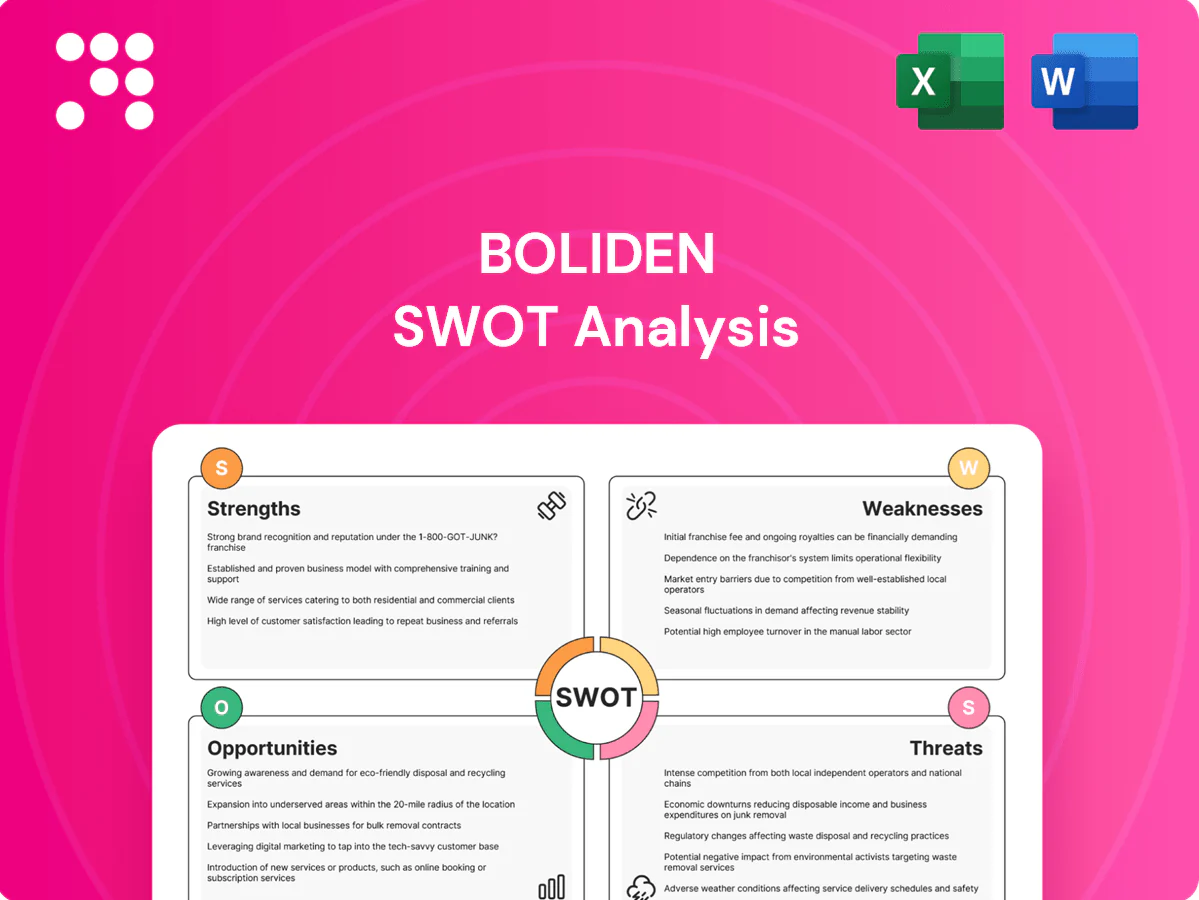
Boliden SWOT Analysis

Your Strategic Toolkit Starts Here
Boliden’s resilient portfolio of base metals and strong ESG focus underpin competitive strengths, while commodity cycles and regulatory shifts present clear risks and strategic levers. Want the full picture—opportunities, threats, and financial context—to inform investment or M&A decisions? Purchase the complete SWOT analysis for a research-backed, editable Word and Excel report to plan and present with confidence.
Strengths

Integrated mines-to-smelters chain
Owning mines (Aitik, Kevitsa, Garpenberg) and smelters (Rönnskär, Kokkola) gives Boliden tighter control over quality, costs and delivery times; matching internal concentrates to smelter feed raises recoveries and margins, reduces reliance on third-party inputs and stabilizes throughput, and lets operations pivot faster to market or technical shifts.
Diversified metal portfolio
Boliden’s exposure to zinc, copper, lead, gold and valuable by‑products smooths revenue as end‑markets vary across construction, electronics and EVs, with copper and zinc demand linked to electrification and infrastructure. Co‑product credits historically cut reported net cash costs (estimates ~10%) and supported margins during metal price swings (LME 2024 avg: copper ≈ $9,500/t, zinc ≈ $3,200/t). This diversification underpins steadier cash flows across cycles.

Nordic operational base
Operations across Sweden, Finland, Norway and Ireland give Boliden access to stable institutions and a skilled workforce, supporting its ~5,500 employees and integrated mining-smelting footprint. Nordic access to low‑carbon power (around 50 gCO2/kWh vs EU ~250 gCO2/kWh) strengthens its sustainability credentials and lower Scope 2 intensity. Proximity to European customers shortens lead times and logistics, while regional clustering enables shared infrastructure and technical expertise.

Sustainability and traceability focus
Sustainability and traceability are central to Boliden’s strategy, with responsible mining and low-emission smelting aligning directly with customers’ ESG procurement requirements and helping secure premium offtake agreements. Robust traceability and compliance lower regulatory and reputational risk while improving access to green financing.
- ESG-aligned supply
- Traceable low‑carbon premium
- Lower regulatory friction
- Enhanced green financing access
Process and technology expertise
Boliden, operating since 1924 with smelters at Rönnskär and Harjavalta, leverages a century of complex ore processing to sustain high recoveries and plant reliability. Ongoing metallurgy R&D and automation projects steadily raise throughput and reduce unit costs. Real-time data analytics optimize maintenance and energy use, and this technical depth creates a strong barrier to entry.
- Legacy since 1924
- Smelters: Rönnskär, Harjavalta
- Continuous metallurgy & automation
- Data-driven maintenance & energy optimization
Integrated mines and smelters control costs, workforce ~5,500, power ~50 gCO2/kWh
Integrated mines and smelters give Boliden control of quality, costs and recovery; workforce ~5,500 and legacy since 1924 support operational depth.
Product mix (Cu, Zn, Pb, Au + by‑products) and co‑product credits historically lower net cash costs; LME 2024 avg: copper ≈ $9,500/t, zinc ≈ $3,200/t.
Nordic low‑carbon power (~50 gCO2/kWh) and strong traceability enhance ESG access and green financing.
| Strength | Metric | Value |
|---|---|---|
| Integrated footprint | Employees / Legacy | ~5,500 / 1924 |
| Low‑carbon power | Grid intensity | ≈50 gCO2/kWh |
| Market context | LME 2024 avg | Cu ≈ $9,500/t; Zn ≈ $3,200/t |
What is included in the product
 Detailed Word Document
Provides a strategic overview of Boliden’s internal strengths and weaknesses and external opportunities and threats, highlighting operational capabilities, resource positions, market opportunities, and risk exposures shaping its competitive position.

 Customizable Excel Spreadsheet
Provides a concise SWOT matrix focused on Boliden for fast, visual strategy alignment and mitigation of mining- and commodity-related pain points. Editable format enables quick updates to reflect commodity cycles, environmental regulations, and operational priorities.
Weaknesses

High commodity price exposure
Earnings remain highly sensitive to zinc and copper price swings—zinc and copper made up the bulk of metal sales in 2024, with LME zinc averaging about $2,900/t and copper about $9,200/t in 2024. Smelter treatment and refining charges also fluctuated, compressing concentrate margins. Hedging programs only partially mitigate volatility, so cash flows can compress rapidly in downcycles.
Capital‑intensive asset base
Boliden’s mining and smelting model requires large, ongoing capex—typically running in the billions of SEK annually (>5bn SEK range)—to sustain reserves and meet environmental and safety compliance. Project overruns or delays can therefore strain the balance sheet, sometimes adding hundreds of millions in extra cost. Heavy depreciation and maintenance create fixed-cost rigidity, making margins sensitive. Returns depend on flawless project execution and commodity cycle timing.

Geographic concentration
Boliden’s assets are concentrated in three countries—Sweden, Finland and Ireland—with major operations at Aitik, Garpenberg, Kevitsa and Tara, increasing regional exposure.
Local regulatory shifts or labor constraints in these jurisdictions can have outsized impacts on production and cash flow.
Adverse weather and Nordic infrastructure bottlenecks (ports, winter transport) further concentrate operational risk and limit flexibility.
Limited presence outside these markets reduces strategic optionality into faster‑growing mining jurisdictions.

Environmental liabilities
Legacy sites and tailings facilities create long-term remediation obligations for Boliden, with stricter EU and national standards raising potential closure and cleanup costs. Any tailings incident would trigger major financial liabilities and reputational damage that could hit operations and stock value. Insurance often excludes catastrophic or contingent tailings risks, leaving residual exposure on Boliden’s balance sheet.
- legacy-liabilities
- regulatory-costs
- incident-reputation-risk
- insurance-gap
Energy cost sensitivity
Smelting is highly power-intensive, leaving Boliden's margins exposed to electricity spikes; Nordic day-ahead prices averaged about 46 EUR/MWh in 2024, illustrating volatility. Hedging and long-term contracts reduce but do not eliminate price risk, and grid disruptions can force throughput cuts. Decarbonization CAPEX (electrification, CO2 abatement) will raise near-term unit costs.
- Exposure: smelters = major electricity consumers
- Price risk: Nordics ~46 EUR/MWh (2024 avg)
- Operational risk: grid disruptions → throughput loss
- CAPEX: decarbonization increases short-term costs
Earnings exposed to zinc and copper swings; heavy CAPEX and concentrated regional risk
Boliden’s earnings are highly exposed to zinc (LME ~2,900 USD/t in 2024) and copper (~9,200 USD/t in 2024) swings, with hedges only partially protecting cash flow. High annual sustaining CAPEX (typically >5bn SEK) plus heavy depreciation tightens margins and raises balance‑sheet risk if projects overrun. Concentrated operations in Sweden, Finland and Ireland amplify regulatory, labor and weather disruption risk, while legacy tailings create sizable remediation and uninsured catastrophe exposure.
| Metric | 2024/Status |
|---|---|
| LME zinc | ~2,900 USD/t (2024) |
| LME copper | ~9,200 USD/t (2024) |
| Nordic power | ~46 EUR/MWh (2024 avg) |
| Sustaining CAPEX | >5bn SEK pa (typical) |
Full Version Awaits
Boliden SWOT Analysis
This is the actual SWOT analysis document you’ll receive upon purchase—no surprises, just professional quality. The preview below is taken directly from the full SWOT report you'll get; purchase unlocks the entire in‑depth version. The content is editable and ready to use for strategic planning or valuation.

Your Strategic Toolkit Starts Here
Boliden’s resilient portfolio of base metals and strong ESG focus underpin competitive strengths, while commodity cycles and regulatory shifts present clear risks and strategic levers. Want the full picture—opportunities, threats, and financial context—to inform investment or M&A decisions? Purchase the complete SWOT analysis for a research-backed, editable Word and Excel report to plan and present with confidence.
Strengths
Integrated mines-to-smelters chain
Owning mines (Aitik, Kevitsa, Garpenberg) and smelters (Rönnskär, Kokkola) gives Boliden tighter control over quality, costs and delivery times; matching internal concentrates to smelter feed raises recoveries and margins, reduces reliance on third-party inputs and stabilizes throughput, and lets operations pivot faster to market or technical shifts.
Diversified metal portfolio
Boliden’s exposure to zinc, copper, lead, gold and valuable by‑products smooths revenue as end‑markets vary across construction, electronics and EVs, with copper and zinc demand linked to electrification and infrastructure. Co‑product credits historically cut reported net cash costs (estimates ~10%) and supported margins during metal price swings (LME 2024 avg: copper ≈ $9,500/t, zinc ≈ $3,200/t). This diversification underpins steadier cash flows across cycles.
Nordic operational base
Operations across Sweden, Finland, Norway and Ireland give Boliden access to stable institutions and a skilled workforce, supporting its ~5,500 employees and integrated mining-smelting footprint. Nordic access to low‑carbon power (around 50 gCO2/kWh vs EU ~250 gCO2/kWh) strengthens its sustainability credentials and lower Scope 2 intensity. Proximity to European customers shortens lead times and logistics, while regional clustering enables shared infrastructure and technical expertise.
Sustainability and traceability focus
Sustainability and traceability are central to Boliden’s strategy, with responsible mining and low-emission smelting aligning directly with customers’ ESG procurement requirements and helping secure premium offtake agreements. Robust traceability and compliance lower regulatory and reputational risk while improving access to green financing.
- ESG-aligned supply
- Traceable low‑carbon premium
- Lower regulatory friction
- Enhanced green financing access
Process and technology expertise
Boliden, operating since 1924 with smelters at Rönnskär and Harjavalta, leverages a century of complex ore processing to sustain high recoveries and plant reliability. Ongoing metallurgy R&D and automation projects steadily raise throughput and reduce unit costs. Real-time data analytics optimize maintenance and energy use, and this technical depth creates a strong barrier to entry.
- Legacy since 1924
- Smelters: Rönnskär, Harjavalta
- Continuous metallurgy & automation
- Data-driven maintenance & energy optimization
Integrated mines and smelters control costs, workforce ~5,500, power ~50 gCO2/kWh
Integrated mines and smelters give Boliden control of quality, costs and recovery; workforce ~5,500 and legacy since 1924 support operational depth.
Product mix (Cu, Zn, Pb, Au + by‑products) and co‑product credits historically lower net cash costs; LME 2024 avg: copper ≈ $9,500/t, zinc ≈ $3,200/t.
Nordic low‑carbon power (~50 gCO2/kWh) and strong traceability enhance ESG access and green financing.
| Strength | Metric | Value |
|---|---|---|
| Integrated footprint | Employees / Legacy | ~5,500 / 1924 |
| Low‑carbon power | Grid intensity | ≈50 gCO2/kWh |
| Market context | LME 2024 avg | Cu ≈ $9,500/t; Zn ≈ $3,200/t |
What is included in the product
Detailed Word Document
Provides a strategic overview of Boliden’s internal strengths and weaknesses and external opportunities and threats, highlighting operational capabilities, resource positions, market opportunities, and risk exposures shaping its competitive position.
Customizable Excel Spreadsheet
Provides a concise SWOT matrix focused on Boliden for fast, visual strategy alignment and mitigation of mining- and commodity-related pain points. Editable format enables quick updates to reflect commodity cycles, environmental regulations, and operational priorities.
Weaknesses
High commodity price exposure
Earnings remain highly sensitive to zinc and copper price swings—zinc and copper made up the bulk of metal sales in 2024, with LME zinc averaging about $2,900/t and copper about $9,200/t in 2024. Smelter treatment and refining charges also fluctuated, compressing concentrate margins. Hedging programs only partially mitigate volatility, so cash flows can compress rapidly in downcycles.
Capital‑intensive asset base
Boliden’s mining and smelting model requires large, ongoing capex—typically running in the billions of SEK annually (>5bn SEK range)—to sustain reserves and meet environmental and safety compliance. Project overruns or delays can therefore strain the balance sheet, sometimes adding hundreds of millions in extra cost. Heavy depreciation and maintenance create fixed-cost rigidity, making margins sensitive. Returns depend on flawless project execution and commodity cycle timing.
Geographic concentration
Boliden’s assets are concentrated in three countries—Sweden, Finland and Ireland—with major operations at Aitik, Garpenberg, Kevitsa and Tara, increasing regional exposure.
Local regulatory shifts or labor constraints in these jurisdictions can have outsized impacts on production and cash flow.
Adverse weather and Nordic infrastructure bottlenecks (ports, winter transport) further concentrate operational risk and limit flexibility.
Limited presence outside these markets reduces strategic optionality into faster‑growing mining jurisdictions.
Environmental liabilities
Legacy sites and tailings facilities create long-term remediation obligations for Boliden, with stricter EU and national standards raising potential closure and cleanup costs. Any tailings incident would trigger major financial liabilities and reputational damage that could hit operations and stock value. Insurance often excludes catastrophic or contingent tailings risks, leaving residual exposure on Boliden’s balance sheet.
- legacy-liabilities
- regulatory-costs
- incident-reputation-risk
- insurance-gap
Energy cost sensitivity
Smelting is highly power-intensive, leaving Boliden's margins exposed to electricity spikes; Nordic day-ahead prices averaged about 46 EUR/MWh in 2024, illustrating volatility. Hedging and long-term contracts reduce but do not eliminate price risk, and grid disruptions can force throughput cuts. Decarbonization CAPEX (electrification, CO2 abatement) will raise near-term unit costs.
- Exposure: smelters = major electricity consumers
- Price risk: Nordics ~46 EUR/MWh (2024 avg)
- Operational risk: grid disruptions → throughput loss
- CAPEX: decarbonization increases short-term costs
Earnings exposed to zinc and copper swings; heavy CAPEX and concentrated regional risk
Boliden’s earnings are highly exposed to zinc (LME ~2,900 USD/t in 2024) and copper (~9,200 USD/t in 2024) swings, with hedges only partially protecting cash flow. High annual sustaining CAPEX (typically >5bn SEK) plus heavy depreciation tightens margins and raises balance‑sheet risk if projects overrun. Concentrated operations in Sweden, Finland and Ireland amplify regulatory, labor and weather disruption risk, while legacy tailings create sizable remediation and uninsured catastrophe exposure.
| Metric | 2024/Status |
|---|---|
| LME zinc | ~2,900 USD/t (2024) |
| LME copper | ~9,200 USD/t (2024) |
| Nordic power | ~46 EUR/MWh (2024 avg) |
| Sustaining CAPEX | >5bn SEK pa (typical) |
Full Version Awaits
Boliden SWOT Analysis
This is the actual SWOT analysis document you’ll receive upon purchase—no surprises, just professional quality. The preview below is taken directly from the full SWOT report you'll get; purchase unlocks the entire in‑depth version. The content is editable and ready to use for strategic planning or valuation.
Original: $10.00
-65%$10.00
$3.50Description
Your Strategic Toolkit Starts Here
Boliden’s resilient portfolio of base metals and strong ESG focus underpin competitive strengths, while commodity cycles and regulatory shifts present clear risks and strategic levers. Want the full picture—opportunities, threats, and financial context—to inform investment or M&A decisions? Purchase the complete SWOT analysis for a research-backed, editable Word and Excel report to plan and present with confidence.
Strengths
Integrated mines-to-smelters chain
Owning mines (Aitik, Kevitsa, Garpenberg) and smelters (Rönnskär, Kokkola) gives Boliden tighter control over quality, costs and delivery times; matching internal concentrates to smelter feed raises recoveries and margins, reduces reliance on third-party inputs and stabilizes throughput, and lets operations pivot faster to market or technical shifts.
Diversified metal portfolio
Boliden’s exposure to zinc, copper, lead, gold and valuable by‑products smooths revenue as end‑markets vary across construction, electronics and EVs, with copper and zinc demand linked to electrification and infrastructure. Co‑product credits historically cut reported net cash costs (estimates ~10%) and supported margins during metal price swings (LME 2024 avg: copper ≈ $9,500/t, zinc ≈ $3,200/t). This diversification underpins steadier cash flows across cycles.
Nordic operational base
Operations across Sweden, Finland, Norway and Ireland give Boliden access to stable institutions and a skilled workforce, supporting its ~5,500 employees and integrated mining-smelting footprint. Nordic access to low‑carbon power (around 50 gCO2/kWh vs EU ~250 gCO2/kWh) strengthens its sustainability credentials and lower Scope 2 intensity. Proximity to European customers shortens lead times and logistics, while regional clustering enables shared infrastructure and technical expertise.
Sustainability and traceability focus
Sustainability and traceability are central to Boliden’s strategy, with responsible mining and low-emission smelting aligning directly with customers’ ESG procurement requirements and helping secure premium offtake agreements. Robust traceability and compliance lower regulatory and reputational risk while improving access to green financing.
- ESG-aligned supply
- Traceable low‑carbon premium
- Lower regulatory friction
- Enhanced green financing access
Process and technology expertise
Boliden, operating since 1924 with smelters at Rönnskär and Harjavalta, leverages a century of complex ore processing to sustain high recoveries and plant reliability. Ongoing metallurgy R&D and automation projects steadily raise throughput and reduce unit costs. Real-time data analytics optimize maintenance and energy use, and this technical depth creates a strong barrier to entry.
- Legacy since 1924
- Smelters: Rönnskär, Harjavalta
- Continuous metallurgy & automation
- Data-driven maintenance & energy optimization
Integrated mines and smelters control costs, workforce ~5,500, power ~50 gCO2/kWh
Integrated mines and smelters give Boliden control of quality, costs and recovery; workforce ~5,500 and legacy since 1924 support operational depth.
Product mix (Cu, Zn, Pb, Au + by‑products) and co‑product credits historically lower net cash costs; LME 2024 avg: copper ≈ $9,500/t, zinc ≈ $3,200/t.
Nordic low‑carbon power (~50 gCO2/kWh) and strong traceability enhance ESG access and green financing.
| Strength | Metric | Value |
|---|---|---|
| Integrated footprint | Employees / Legacy | ~5,500 / 1924 |
| Low‑carbon power | Grid intensity | ≈50 gCO2/kWh |
| Market context | LME 2024 avg | Cu ≈ $9,500/t; Zn ≈ $3,200/t |
What is included in the product
Detailed Word Document
Provides a strategic overview of Boliden’s internal strengths and weaknesses and external opportunities and threats, highlighting operational capabilities, resource positions, market opportunities, and risk exposures shaping its competitive position.
Customizable Excel Spreadsheet
Provides a concise SWOT matrix focused on Boliden for fast, visual strategy alignment and mitigation of mining- and commodity-related pain points. Editable format enables quick updates to reflect commodity cycles, environmental regulations, and operational priorities.
Weaknesses
High commodity price exposure
Earnings remain highly sensitive to zinc and copper price swings—zinc and copper made up the bulk of metal sales in 2024, with LME zinc averaging about $2,900/t and copper about $9,200/t in 2024. Smelter treatment and refining charges also fluctuated, compressing concentrate margins. Hedging programs only partially mitigate volatility, so cash flows can compress rapidly in downcycles.
Capital‑intensive asset base
Boliden’s mining and smelting model requires large, ongoing capex—typically running in the billions of SEK annually (>5bn SEK range)—to sustain reserves and meet environmental and safety compliance. Project overruns or delays can therefore strain the balance sheet, sometimes adding hundreds of millions in extra cost. Heavy depreciation and maintenance create fixed-cost rigidity, making margins sensitive. Returns depend on flawless project execution and commodity cycle timing.
Geographic concentration
Boliden’s assets are concentrated in three countries—Sweden, Finland and Ireland—with major operations at Aitik, Garpenberg, Kevitsa and Tara, increasing regional exposure.
Local regulatory shifts or labor constraints in these jurisdictions can have outsized impacts on production and cash flow.
Adverse weather and Nordic infrastructure bottlenecks (ports, winter transport) further concentrate operational risk and limit flexibility.
Limited presence outside these markets reduces strategic optionality into faster‑growing mining jurisdictions.
Environmental liabilities
Legacy sites and tailings facilities create long-term remediation obligations for Boliden, with stricter EU and national standards raising potential closure and cleanup costs. Any tailings incident would trigger major financial liabilities and reputational damage that could hit operations and stock value. Insurance often excludes catastrophic or contingent tailings risks, leaving residual exposure on Boliden’s balance sheet.
- legacy-liabilities
- regulatory-costs
- incident-reputation-risk
- insurance-gap
Energy cost sensitivity
Smelting is highly power-intensive, leaving Boliden's margins exposed to electricity spikes; Nordic day-ahead prices averaged about 46 EUR/MWh in 2024, illustrating volatility. Hedging and long-term contracts reduce but do not eliminate price risk, and grid disruptions can force throughput cuts. Decarbonization CAPEX (electrification, CO2 abatement) will raise near-term unit costs.
- Exposure: smelters = major electricity consumers
- Price risk: Nordics ~46 EUR/MWh (2024 avg)
- Operational risk: grid disruptions → throughput loss
- CAPEX: decarbonization increases short-term costs
Earnings exposed to zinc and copper swings; heavy CAPEX and concentrated regional risk
Boliden’s earnings are highly exposed to zinc (LME ~2,900 USD/t in 2024) and copper (~9,200 USD/t in 2024) swings, with hedges only partially protecting cash flow. High annual sustaining CAPEX (typically >5bn SEK) plus heavy depreciation tightens margins and raises balance‑sheet risk if projects overrun. Concentrated operations in Sweden, Finland and Ireland amplify regulatory, labor and weather disruption risk, while legacy tailings create sizable remediation and uninsured catastrophe exposure.
| Metric | 2024/Status |
|---|---|
| LME zinc | ~2,900 USD/t (2024) |
| LME copper | ~9,200 USD/t (2024) |
| Nordic power | ~46 EUR/MWh (2024 avg) |
| Sustaining CAPEX | >5bn SEK pa (typical) |
Full Version Awaits
Boliden SWOT Analysis
This is the actual SWOT analysis document you’ll receive upon purchase—no surprises, just professional quality. The preview below is taken directly from the full SWOT report you'll get; purchase unlocks the entire in‑depth version. The content is editable and ready to use for strategic planning or valuation.











