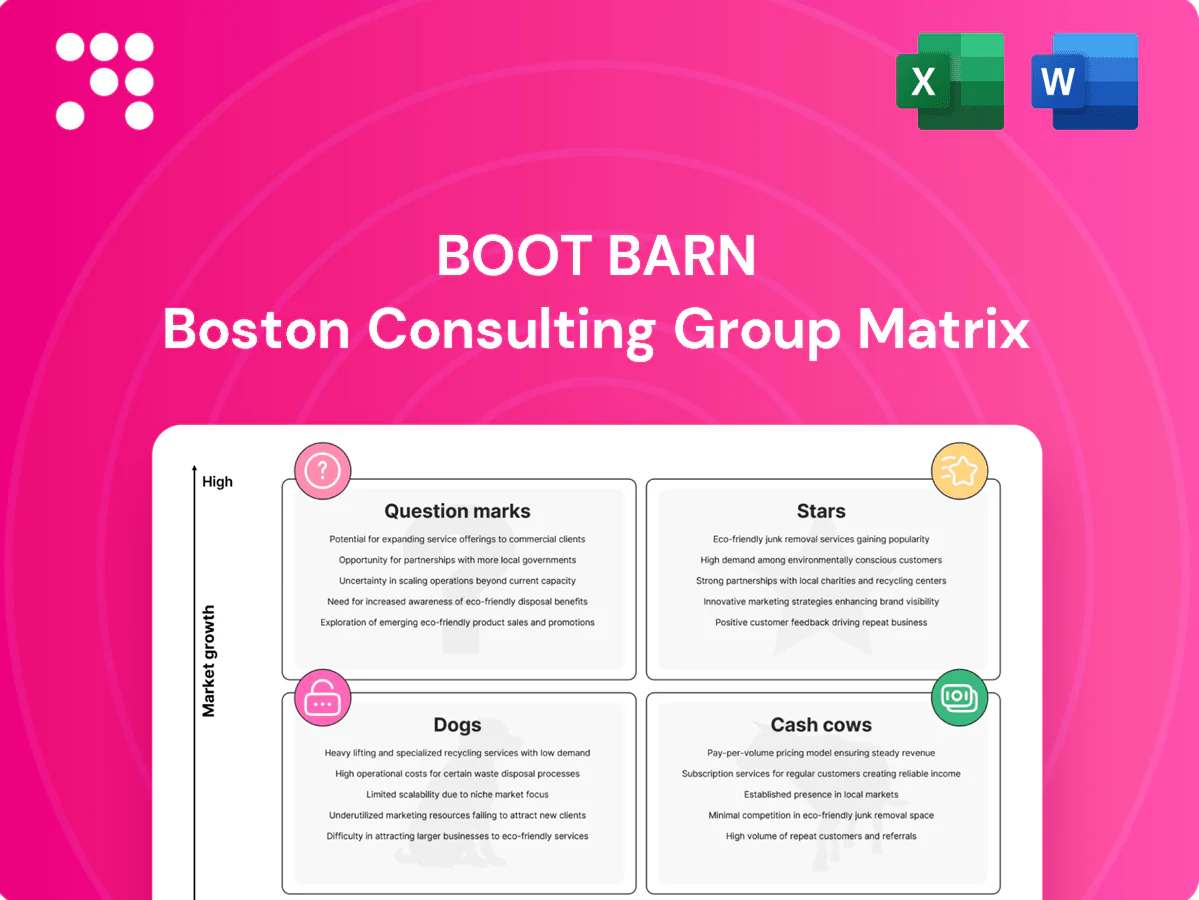
Boot Barn Boston Consulting Group Matrix

See the Bigger Picture
Want a clear read on Boot Barn’s product playbook—what’s a Star, what’s bleeding cash, and what to double down on? This quick preview teases the map; the full Boot Barn BCG Matrix gives you quadrant-by-quadrant placements, crisp strategic moves, and data-backed recommendations you can act on now. Purchase the complete report for Word + Excel deliverables and skip the guesswork—get a ready-to-use roadmap to smarter investment and product decisions. Buy now and make confident, fast choices with clarity.
Stars

Men’s western boots (core leaders)
Boot Barn dominates men’s western boots with deep size runs, constant new drops, and more than 300 stores plus e‑commerce growth, pushing the category from ranch into mainstream fashion. High sell‑through, frequent repeat purchases, and strong vendor partnerships sustain a powerful sales flywheel. The aisle still absorbs working capital for inventory breadth, merchandising and promotion. Maintain share and reinvest to let it mature into long‑term cash generation.
Work boots for construction & energy
Regulatory demand plus the $1.2 trillion Infrastructure Investment and Jobs Act and BLS 5% projected construction employment growth (2022–32) support steady high growth in work boots for construction and energy. Boot Barn is a destination for safety toes and waterproof tech, yielding healthy ticket sizes and accessory attach rates (socks, insoles, care) that lift baskets. The category requires continuous certification assortment, fit expertise, and field marketing with employers; keep investing in selection and in-store expertise to lock leadership.

Private‑label boot brands
Private‑label boot brands are driving margin and loyalty, contributing to Boot Barn’s FY2024 net sales of $1.76B and leveraging the chain’s ~333 stores to ride the broader boot category growth; private label typically earns a ~300 bps gross margin premium versus national brands. They’re taking share with fashion‑forward looks at accessible price points, but need faster design cadence, sharper brand storytelling, and targeted promo to scale. Stay aggressive—this is the engine that can become tomorrow’s cash cow.

Women’s western fashion (boots + apparel)
Western chic demand is surging with festivals and social trends; Boot Barn leverages ≈300 stores (2024) plus e-commerce to sell complete outfits via exclusive assortments, turning boots into multi-item baskets. Higher return rates and faster trend cycles require nimble buys and marketing to protect margins and inventory turnover.
- omnichannel reach ≈300 stores (2024)
- exclusive assortments = higher AOV
- higher returns → agile replenishment
- influencer + newness = leadership moat
Omnichannel exclusives and e‑commerce assortments
Omnichannel exclusives and expanded e‑commerce assortments drove Boot Barn’s 2024 strategy, pulling customers into its owned ecosystem and capturing higher-margin online demand. The deeper online assortment enables long-tail sizes and niche styles that physical stores cannot stock, increasing lifetime value potential. Maintaining conversion requires sustained investment in paid media, original content, and rapid fulfillment. Invest to scale: these initiatives produce first-party data and future loyalty.
Boots category surging — FY24 sales $1.76B, PL +300 bps
Boot Barn’s Stars: core boots category growing fast—FY2024 sales $1.76B, ≈333 stores and e‑commerce scale; private‑label lifts gross margin ~300 bps and drives repeat purchases. Strong tailwinds: $1.2T Infrastructure Act and BLS 5% construction job growth (2022–32). Reinvest in inventory, exclusives, paid media and fulfillment to convert growth into enduring cash flow.
| Metric | 2024 | Implication |
|---|---|---|
| Net sales | $1.76B | Scale |
| Stores | ≈333 | Omnichannel reach |
| PL margin | +300 bps | Higher EBIT |
What is included in the product
 Detailed Word Document
In-depth review of Boot Barn products across BCG quadrants, with strategic recommendations to invest, hold, or divest per unit.

 Customizable Excel Spreadsheet
One-page Boot Barn BCG matrix mapping units by quadrant to relieve decision friction and deliver a clean C-level view.
Cash Cows

Classic cowboy boot staples
Classic cowboy boot staples sell year-round with minimal promo, supporting Boot Barn’s core business that surpassed $1 billion in net sales in 2023 and operates roughly 240 stores as of 2024. High gross margins and low markdown risk for core boot silhouettes drive steady replenishment patterns and predictable turns. Little launch hype or education is needed—keep these SKUs stocked and optimize inventory turns to maximize cash generation.
Core work apparel (FR, heavy-duty shirts, pants)
Core work apparel (FR, heavy-duty shirts, pants) serves pros with compliance-driven, repeat purchase cycles and delivers mature but reliable cash flow; Boot Barn operated about 260 stores in 2024 supporting distribution and consistent demand. Promo needs are light—priority is fit availability and durability claims—and repeat buy frequency for essentials drives predictable sizing inventory. Invest in supply-chain and SKU efficiency to convert steady sales into higher operating cash; tighter turns and margin capture amplify free cash generation.

Belts and buckles
Belts and buckles show high attach to boots and outfits with dependable, non-seasonal sell-through; accessories typically register lower return rates (around 5–10%) versus apparel’s ~20% in 2024, boosting gross margin retention. Broad price ladder and easy merchandising reduce markdown risk, while minimal trend exposure keeps inventory turnover stable. Maintain breadth and prominent endcap presence to sustain steady, predictable cash flow for Boot Barn.

Hats (core felt and straw)
Hats (core felt and straw) are cash cows: staple styles sell every season with high attach-rates for shaping and care services, driving steady in-store profitability; the mature category needs limited promotion once the fit wall is dialed in, so keep the service model efficient and inventory tight to preserve margin.
- In-store focus
- High attach-rate: shaping & care
- Low promo once fit wall set
- Tight inventory & efficient service
Kids’ western basics
Kids’ western basics are cash cows: parents purchase predictably for events and growth spurts, yielding steady volume despite lower ASPs and minimal marketing spend; specialty fit reduces direct competition, supporting margin stability. Maintain core SKUs, avoid over-assorting trendy items that erode inventory turns.
- Predictable demand
- Lower ASP, high velocity
- Low marketing needs
- Limited specialty competition
- Focus on essentials, avoid trend bloat
Prioritize boots and apparel turns to boost predictable, high-margin free cash flow
Boot Barn cash cows (core boots, work apparel, accessories, hats, kids basics) generate steady, high-margin cash: company net sales topped $1B in 2023 and operated ~240 stores in 2024. Core boots show low markdown risk and predictable turns; apparel returns ~20% (2024) vs accessories 5–10% (2024), so optimize turns and inventory to maximize free cash flow.
| Metric | Value |
|---|---|
| 2023 Net Sales | > $1.0B |
| Stores (2024) | ~240 |
| Returns (2024) | Apparel ~20% / Accessories 5–10% |
Delivered as Shown
Boot Barn BCG Matrix
The file you're previewing here is the exact Boot Barn BCG Matrix you'll receive after purchase. No watermarks, no placeholders—just the fully formatted, ready-to-use report built for clarity and action. Buy once and download immediately; it's editable for presentations or planning. Crafted by strategy pros, it slots straight into your workflow with no surprises.

See the Bigger Picture
Want a clear read on Boot Barn’s product playbook—what’s a Star, what’s bleeding cash, and what to double down on? This quick preview teases the map; the full Boot Barn BCG Matrix gives you quadrant-by-quadrant placements, crisp strategic moves, and data-backed recommendations you can act on now. Purchase the complete report for Word + Excel deliverables and skip the guesswork—get a ready-to-use roadmap to smarter investment and product decisions. Buy now and make confident, fast choices with clarity.
Stars
Men’s western boots (core leaders)
Boot Barn dominates men’s western boots with deep size runs, constant new drops, and more than 300 stores plus e‑commerce growth, pushing the category from ranch into mainstream fashion. High sell‑through, frequent repeat purchases, and strong vendor partnerships sustain a powerful sales flywheel. The aisle still absorbs working capital for inventory breadth, merchandising and promotion. Maintain share and reinvest to let it mature into long‑term cash generation.
Work boots for construction & energy
Regulatory demand plus the $1.2 trillion Infrastructure Investment and Jobs Act and BLS 5% projected construction employment growth (2022–32) support steady high growth in work boots for construction and energy. Boot Barn is a destination for safety toes and waterproof tech, yielding healthy ticket sizes and accessory attach rates (socks, insoles, care) that lift baskets. The category requires continuous certification assortment, fit expertise, and field marketing with employers; keep investing in selection and in-store expertise to lock leadership.
Private‑label boot brands
Private‑label boot brands are driving margin and loyalty, contributing to Boot Barn’s FY2024 net sales of $1.76B and leveraging the chain’s ~333 stores to ride the broader boot category growth; private label typically earns a ~300 bps gross margin premium versus national brands. They’re taking share with fashion‑forward looks at accessible price points, but need faster design cadence, sharper brand storytelling, and targeted promo to scale. Stay aggressive—this is the engine that can become tomorrow’s cash cow.
Women’s western fashion (boots + apparel)
Western chic demand is surging with festivals and social trends; Boot Barn leverages ≈300 stores (2024) plus e-commerce to sell complete outfits via exclusive assortments, turning boots into multi-item baskets. Higher return rates and faster trend cycles require nimble buys and marketing to protect margins and inventory turnover.
- omnichannel reach ≈300 stores (2024)
- exclusive assortments = higher AOV
- higher returns → agile replenishment
- influencer + newness = leadership moat
Omnichannel exclusives and e‑commerce assortments
Omnichannel exclusives and expanded e‑commerce assortments drove Boot Barn’s 2024 strategy, pulling customers into its owned ecosystem and capturing higher-margin online demand. The deeper online assortment enables long-tail sizes and niche styles that physical stores cannot stock, increasing lifetime value potential. Maintaining conversion requires sustained investment in paid media, original content, and rapid fulfillment. Invest to scale: these initiatives produce first-party data and future loyalty.
Boots category surging — FY24 sales $1.76B, PL +300 bps
Boot Barn’s Stars: core boots category growing fast—FY2024 sales $1.76B, ≈333 stores and e‑commerce scale; private‑label lifts gross margin ~300 bps and drives repeat purchases. Strong tailwinds: $1.2T Infrastructure Act and BLS 5% construction job growth (2022–32). Reinvest in inventory, exclusives, paid media and fulfillment to convert growth into enduring cash flow.
| Metric | 2024 | Implication |
|---|---|---|
| Net sales | $1.76B | Scale |
| Stores | ≈333 | Omnichannel reach |
| PL margin | +300 bps | Higher EBIT |
What is included in the product
Detailed Word Document
In-depth review of Boot Barn products across BCG quadrants, with strategic recommendations to invest, hold, or divest per unit.
Customizable Excel Spreadsheet
One-page Boot Barn BCG matrix mapping units by quadrant to relieve decision friction and deliver a clean C-level view.
Cash Cows
Classic cowboy boot staples
Classic cowboy boot staples sell year-round with minimal promo, supporting Boot Barn’s core business that surpassed $1 billion in net sales in 2023 and operates roughly 240 stores as of 2024. High gross margins and low markdown risk for core boot silhouettes drive steady replenishment patterns and predictable turns. Little launch hype or education is needed—keep these SKUs stocked and optimize inventory turns to maximize cash generation.
Core work apparel (FR, heavy-duty shirts, pants)
Core work apparel (FR, heavy-duty shirts, pants) serves pros with compliance-driven, repeat purchase cycles and delivers mature but reliable cash flow; Boot Barn operated about 260 stores in 2024 supporting distribution and consistent demand. Promo needs are light—priority is fit availability and durability claims—and repeat buy frequency for essentials drives predictable sizing inventory. Invest in supply-chain and SKU efficiency to convert steady sales into higher operating cash; tighter turns and margin capture amplify free cash generation.
Belts and buckles
Belts and buckles show high attach to boots and outfits with dependable, non-seasonal sell-through; accessories typically register lower return rates (around 5–10%) versus apparel’s ~20% in 2024, boosting gross margin retention. Broad price ladder and easy merchandising reduce markdown risk, while minimal trend exposure keeps inventory turnover stable. Maintain breadth and prominent endcap presence to sustain steady, predictable cash flow for Boot Barn.
Hats (core felt and straw)
Hats (core felt and straw) are cash cows: staple styles sell every season with high attach-rates for shaping and care services, driving steady in-store profitability; the mature category needs limited promotion once the fit wall is dialed in, so keep the service model efficient and inventory tight to preserve margin.
- In-store focus
- High attach-rate: shaping & care
- Low promo once fit wall set
- Tight inventory & efficient service
Kids’ western basics
Kids’ western basics are cash cows: parents purchase predictably for events and growth spurts, yielding steady volume despite lower ASPs and minimal marketing spend; specialty fit reduces direct competition, supporting margin stability. Maintain core SKUs, avoid over-assorting trendy items that erode inventory turns.
- Predictable demand
- Lower ASP, high velocity
- Low marketing needs
- Limited specialty competition
- Focus on essentials, avoid trend bloat
Prioritize boots and apparel turns to boost predictable, high-margin free cash flow
Boot Barn cash cows (core boots, work apparel, accessories, hats, kids basics) generate steady, high-margin cash: company net sales topped $1B in 2023 and operated ~240 stores in 2024. Core boots show low markdown risk and predictable turns; apparel returns ~20% (2024) vs accessories 5–10% (2024), so optimize turns and inventory to maximize free cash flow.
| Metric | Value |
|---|---|
| 2023 Net Sales | > $1.0B |
| Stores (2024) | ~240 |
| Returns (2024) | Apparel ~20% / Accessories 5–10% |
Delivered as Shown
Boot Barn BCG Matrix
The file you're previewing here is the exact Boot Barn BCG Matrix you'll receive after purchase. No watermarks, no placeholders—just the fully formatted, ready-to-use report built for clarity and action. Buy once and download immediately; it's editable for presentations or planning. Crafted by strategy pros, it slots straight into your workflow with no surprises.
Original: $10.00
-65%$10.00
$3.50Description
See the Bigger Picture
Want a clear read on Boot Barn’s product playbook—what’s a Star, what’s bleeding cash, and what to double down on? This quick preview teases the map; the full Boot Barn BCG Matrix gives you quadrant-by-quadrant placements, crisp strategic moves, and data-backed recommendations you can act on now. Purchase the complete report for Word + Excel deliverables and skip the guesswork—get a ready-to-use roadmap to smarter investment and product decisions. Buy now and make confident, fast choices with clarity.
Stars
Men’s western boots (core leaders)
Boot Barn dominates men’s western boots with deep size runs, constant new drops, and more than 300 stores plus e‑commerce growth, pushing the category from ranch into mainstream fashion. High sell‑through, frequent repeat purchases, and strong vendor partnerships sustain a powerful sales flywheel. The aisle still absorbs working capital for inventory breadth, merchandising and promotion. Maintain share and reinvest to let it mature into long‑term cash generation.
Work boots for construction & energy
Regulatory demand plus the $1.2 trillion Infrastructure Investment and Jobs Act and BLS 5% projected construction employment growth (2022–32) support steady high growth in work boots for construction and energy. Boot Barn is a destination for safety toes and waterproof tech, yielding healthy ticket sizes and accessory attach rates (socks, insoles, care) that lift baskets. The category requires continuous certification assortment, fit expertise, and field marketing with employers; keep investing in selection and in-store expertise to lock leadership.
Private‑label boot brands
Private‑label boot brands are driving margin and loyalty, contributing to Boot Barn’s FY2024 net sales of $1.76B and leveraging the chain’s ~333 stores to ride the broader boot category growth; private label typically earns a ~300 bps gross margin premium versus national brands. They’re taking share with fashion‑forward looks at accessible price points, but need faster design cadence, sharper brand storytelling, and targeted promo to scale. Stay aggressive—this is the engine that can become tomorrow’s cash cow.
Women’s western fashion (boots + apparel)
Western chic demand is surging with festivals and social trends; Boot Barn leverages ≈300 stores (2024) plus e-commerce to sell complete outfits via exclusive assortments, turning boots into multi-item baskets. Higher return rates and faster trend cycles require nimble buys and marketing to protect margins and inventory turnover.
- omnichannel reach ≈300 stores (2024)
- exclusive assortments = higher AOV
- higher returns → agile replenishment
- influencer + newness = leadership moat
Omnichannel exclusives and e‑commerce assortments
Omnichannel exclusives and expanded e‑commerce assortments drove Boot Barn’s 2024 strategy, pulling customers into its owned ecosystem and capturing higher-margin online demand. The deeper online assortment enables long-tail sizes and niche styles that physical stores cannot stock, increasing lifetime value potential. Maintaining conversion requires sustained investment in paid media, original content, and rapid fulfillment. Invest to scale: these initiatives produce first-party data and future loyalty.
Boots category surging — FY24 sales $1.76B, PL +300 bps
Boot Barn’s Stars: core boots category growing fast—FY2024 sales $1.76B, ≈333 stores and e‑commerce scale; private‑label lifts gross margin ~300 bps and drives repeat purchases. Strong tailwinds: $1.2T Infrastructure Act and BLS 5% construction job growth (2022–32). Reinvest in inventory, exclusives, paid media and fulfillment to convert growth into enduring cash flow.
| Metric | 2024 | Implication |
|---|---|---|
| Net sales | $1.76B | Scale |
| Stores | ≈333 | Omnichannel reach |
| PL margin | +300 bps | Higher EBIT |
What is included in the product
Detailed Word Document
In-depth review of Boot Barn products across BCG quadrants, with strategic recommendations to invest, hold, or divest per unit.
Customizable Excel Spreadsheet
One-page Boot Barn BCG matrix mapping units by quadrant to relieve decision friction and deliver a clean C-level view.
Cash Cows
Classic cowboy boot staples
Classic cowboy boot staples sell year-round with minimal promo, supporting Boot Barn’s core business that surpassed $1 billion in net sales in 2023 and operates roughly 240 stores as of 2024. High gross margins and low markdown risk for core boot silhouettes drive steady replenishment patterns and predictable turns. Little launch hype or education is needed—keep these SKUs stocked and optimize inventory turns to maximize cash generation.
Core work apparel (FR, heavy-duty shirts, pants)
Core work apparel (FR, heavy-duty shirts, pants) serves pros with compliance-driven, repeat purchase cycles and delivers mature but reliable cash flow; Boot Barn operated about 260 stores in 2024 supporting distribution and consistent demand. Promo needs are light—priority is fit availability and durability claims—and repeat buy frequency for essentials drives predictable sizing inventory. Invest in supply-chain and SKU efficiency to convert steady sales into higher operating cash; tighter turns and margin capture amplify free cash generation.
Belts and buckles
Belts and buckles show high attach to boots and outfits with dependable, non-seasonal sell-through; accessories typically register lower return rates (around 5–10%) versus apparel’s ~20% in 2024, boosting gross margin retention. Broad price ladder and easy merchandising reduce markdown risk, while minimal trend exposure keeps inventory turnover stable. Maintain breadth and prominent endcap presence to sustain steady, predictable cash flow for Boot Barn.
Hats (core felt and straw)
Hats (core felt and straw) are cash cows: staple styles sell every season with high attach-rates for shaping and care services, driving steady in-store profitability; the mature category needs limited promotion once the fit wall is dialed in, so keep the service model efficient and inventory tight to preserve margin.
- In-store focus
- High attach-rate: shaping & care
- Low promo once fit wall set
- Tight inventory & efficient service
Kids’ western basics
Kids’ western basics are cash cows: parents purchase predictably for events and growth spurts, yielding steady volume despite lower ASPs and minimal marketing spend; specialty fit reduces direct competition, supporting margin stability. Maintain core SKUs, avoid over-assorting trendy items that erode inventory turns.
- Predictable demand
- Lower ASP, high velocity
- Low marketing needs
- Limited specialty competition
- Focus on essentials, avoid trend bloat
Prioritize boots and apparel turns to boost predictable, high-margin free cash flow
Boot Barn cash cows (core boots, work apparel, accessories, hats, kids basics) generate steady, high-margin cash: company net sales topped $1B in 2023 and operated ~240 stores in 2024. Core boots show low markdown risk and predictable turns; apparel returns ~20% (2024) vs accessories 5–10% (2024), so optimize turns and inventory to maximize free cash flow.
| Metric | Value |
|---|---|
| 2023 Net Sales | > $1.0B |
| Stores (2024) | ~240 |
| Returns (2024) | Apparel ~20% / Accessories 5–10% |
Delivered as Shown
Boot Barn BCG Matrix
The file you're previewing here is the exact Boot Barn BCG Matrix you'll receive after purchase. No watermarks, no placeholders—just the fully formatted, ready-to-use report built for clarity and action. Buy once and download immediately; it's editable for presentations or planning. Crafted by strategy pros, it slots straight into your workflow with no surprises.











