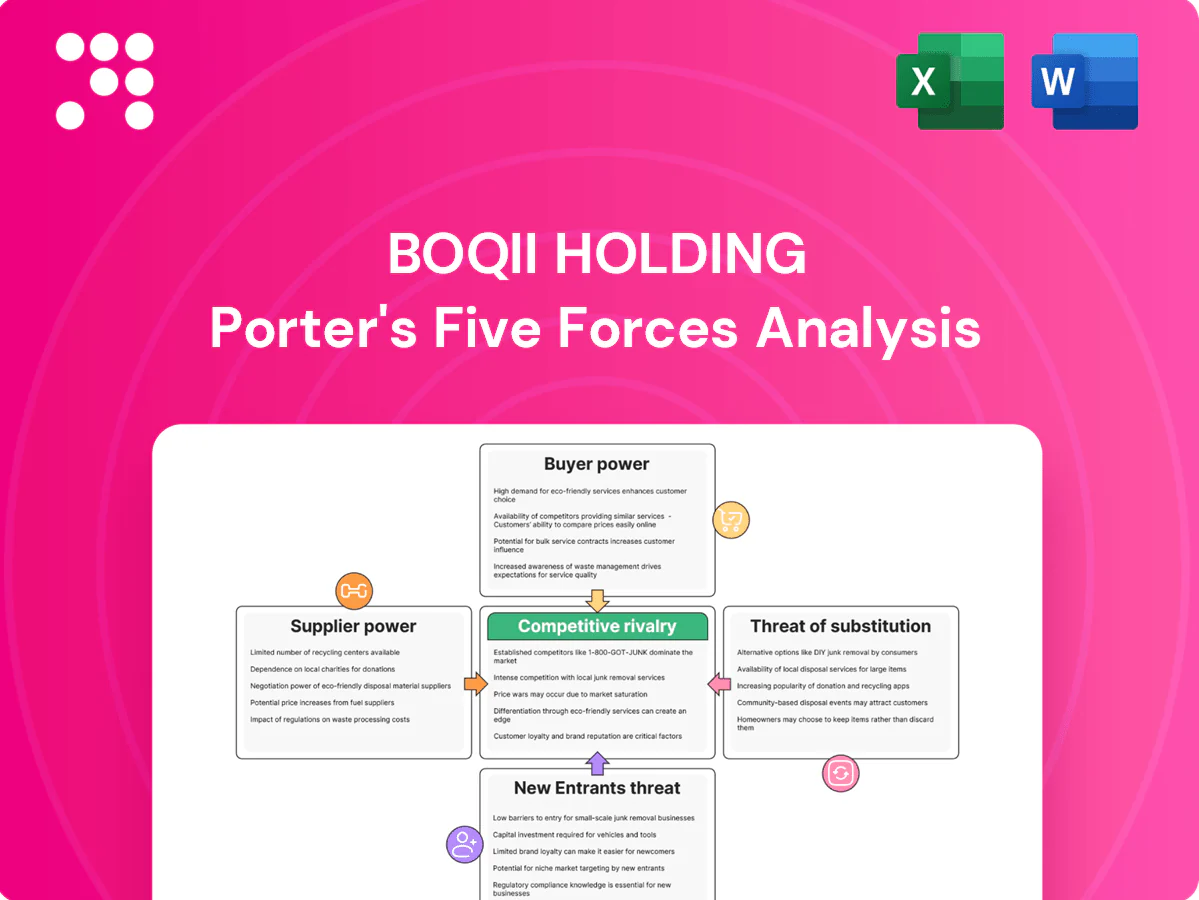
Boqii Holding Porter's Five Forces Analysis

Elevate Your Analysis with the Complete Porter's Five Forces Analysis
Boqii Holding’s Porter's Five Forces snapshot highlights tight competitive intensity, rising buyer expectations, and supplier leverage in pet care e-commerce, with substitutes and new entrants shaping margins and growth prospects. This brief view teases key vulnerabilities and strategic levers but stops short of force-by-force ratings and visuals. Unlock the full Porter's Five Forces Analysis for a data-driven roadmap to inform investment or strategic decisions.
Suppliers Bargaining Power

Brand concentration in premium pet food
Premium pet nutrition is concentrated among a few multinational and leading domestic brands, giving them strong leverage over pricing, shelf placement, and promotional calendars. Heavy reliance on these SKUs exposes Boqii to margin compression and higher supplier negotiating power. Long-term supplier partnerships and co-marketing reduce but do not eliminate supplier leverage, while scaling private-label offerings can gradually rebalance supplier power.
Service providers’ fragmentation
Grooming, training and local healthcare providers are numerous and small—2024 industry estimates show the China pet services market near 400 billion RMB with over 1 million service outlets, diluting individual supplier bargaining power.
Boqii can standardize quality, set platform take rates and rotate visibility to manage terms and margins.
However, top-rated providers in dense cities command premium economics, and reputed vet clinics often negotiate preferential exposure and fee arrangements.

Logistics and fulfillment dependencies
Boqii’s reliance on third-party logistics, last-mile couriers and warehousing partners directly shapes delivery SLAs and cost-to-serve, with industry reports in 2024 noting peak-season last-mile surcharges can exceed 15% and drive service degradation. Peak capacity constraints increase risk unless Boqii expands multi-sourcing or in-house fulfillment nodes, which lower disruption risk but demand capital investment. Negotiated volume tiers and data-driven forecasting—reducing forecast error and enabling tiered pricing—strengthen Boqii’s negotiating leverage.

Cross-border and regulatory compliance
Imported pet foods and supplements face customs, labeling, and quota constraints that tighten supply and elevate supplier power when compliant inventory is scarce; regulatory shifts can abruptly remove SKUs and raise switching costs for Boqii. Boqii’s compliance expertise and bonded-warehouse access improve allocation and lead times, while diversifying into vetted domestic alternatives mitigates cross-border shocks.
- Elevated supplier leverage from customs/quotas
- Regulatory delistings increase switching costs
- Bonded warehouses improve allocation
- Domestic compliance diversification reduces risk
Platform multi-homing by suppliers
Suppliers multi-home across Tmall, JD, Pinduoduo and Douyin, diluting exclusivity and raising supplier leverage as merchants chase fees and visibility; platforms hosted 600M–900M+ active buyers in 2024, enabling suppliers to pit channels for better terms. Boqii must deliver community, data-insights and bundled services to justify preferential placement. Exclusive launches and co-created content can secure better fees and inventory priority.
Imported SKU shortages lift spot premiums 10-25%; leading sellers use exclusives and private labels
Premium imported SKUs and large brands exert high supplier leverage—2024 imported stock shortages raised spot premiums ~10–25%, pressuring margins. Fragmented local services dilute power but top-city vets command premiums. Multi-homing across platforms (600M–900M+ buyers in 2024) lets suppliers pit channels; Boqii counters with private label, bonded warehousing and exclusives.
| Metric | 2024 |
|---|---|
| Platform buyers | 600M–900M+ |
| Peak last-mile surcharge | 15%+ |
| Imported SKU premium | 10–25% |
What is included in the product
 Detailed Word Document
Tailored Porter's Five Forces analysis for Boqii Holding that uncovers key drivers of competition, buyer and supplier influence, substitute threats, and barriers to entry. Includes strategic commentary on disruptive forces and market dynamics to inform investor materials, strategy decks, or academic projects.

 Customizable Excel Spreadsheet
Clear one-sheet Porter's Five Forces for Boqii Holding—instantly highlights competitive pressures and relief strategies for investors and managers, exportable to decks or Excel dashboards.
Customers Bargaining Power

Low switching costs and high price transparency
Low switching costs and high price transparency empower pet owners to compare prices instantly across major marketplaces and social commerce, pressuring Boqii (NASDAQ: BQ) to match competitors; flash sales and coupons condition buyers to wait for deals, increasing promotional intensity. Assortment breadth must be paired with competitive pricing to retain share, and loyalty programs must deliver tangible value to curb churn.
Repeat purchase but promotion sensitivity
Staples like food and litter drive frequent, predictable orders but are highly promotion-driven: a 2024 China pet-ecommerce survey found about 60% of purchases influenced by discounts, anchoring buyers to historical promo prices and compressing margins. Subscription and auto-replenishment programs can trade depth of discount for retention, often improving repeat rates by ~20–30% year-over-year. Personalized offers tied to pet lifecycle (puppy/kitten to adult/senior) can lift ARPU through upsells and higher basket spend.

Demand for authenticity and safety
Counterfeit and quality concerns push over 70% of buyers to demand traceability, raising expectations for Boqii’s curated sourcing and batch-level info that can support modest premiums. Verified sourcing and batch data increase willingness to pay and lower return rates. Reviews and UGC — consulted by over 70% of shoppers — serve as proof points and cut perceived risk. Safety incidents prompt rapid switching to rivals, shrinking market share quickly.

Omnichannel alternatives increase leverage
Buyers can choose offline pet stores, vet clinics, supermarkets, or direct brand sites, and omnichannel access raises their bargaining power by enabling price and convenience comparisons.
Instant pickup options compete directly with delivery convenience; Boqii must lean on deeper selection, community content, and bundled services to retain customers, while faster shipping and easy returns lower churn.
- Omnichannel choice increases price sensitivity
- Pickup vs delivery intensifies convenience competition
- Differentiation: selection depth, content, bundles
- Logistics: fast shipping and easy returns reduce defection
Community influence and KOL-driven choices
Content, forums and KOLs shape pet-owner preferences and brand trust, shifting bargaining power to informed buyers; 2024 influencer marketing spend exceeded $21 billion, amplifying KOL impact on discovery and consideration. If Boqii hosts credible communities it can steer choices and reduce pure price competition, while poor moderation quickly erodes credibility and control.
- Community-driven trust boosts conversion and lowers price sensitivity
- KOL partnerships increase cross-sell and AOV via curated discovery
- Poor moderation risks reputational loss and reduced platform influence
Discount-driven pet ecommerce compresses margins; traceability and subscriptions lift loyalty
Low switching costs and high price transparency push Boqii to match promos; 60% of China pet-ecommerce purchases were discount-influenced in 2024, compressing margins. Traceability and reviews drive premiums—>70% of buyers demand sourcing info in 2024—while subscriptions lift repeat rates ~25% YoY. KOLs matter: global influencer spend hit $21B in 2024, shifting power to informed shoppers.
| Metric | Value | Year |
|---|---|---|
| Discount-influenced purchases | 60% | 2024 |
| Buyers demanding traceability | >70% | 2024 |
| Subscription repeat lift | ~25% YoY | 2024 |
| Influencer marketing spend | $21B | 2024 |
What You See Is What You Get
Boqii Holding Porter's Five Forces Analysis
This preview shows the exact Boqii Holding Porter’s Five Forces analysis you’ll receive immediately after purchase—no surprises, no placeholders. The document is fully formatted, professionally written, and ready for download and use the moment you buy. You’re viewing the final deliverable, identical to the file provided upon payment.

Elevate Your Analysis with the Complete Porter's Five Forces Analysis
Boqii Holding’s Porter's Five Forces snapshot highlights tight competitive intensity, rising buyer expectations, and supplier leverage in pet care e-commerce, with substitutes and new entrants shaping margins and growth prospects. This brief view teases key vulnerabilities and strategic levers but stops short of force-by-force ratings and visuals. Unlock the full Porter's Five Forces Analysis for a data-driven roadmap to inform investment or strategic decisions.
Suppliers Bargaining Power
Brand concentration in premium pet food
Premium pet nutrition is concentrated among a few multinational and leading domestic brands, giving them strong leverage over pricing, shelf placement, and promotional calendars. Heavy reliance on these SKUs exposes Boqii to margin compression and higher supplier negotiating power. Long-term supplier partnerships and co-marketing reduce but do not eliminate supplier leverage, while scaling private-label offerings can gradually rebalance supplier power.
Service providers’ fragmentation
Grooming, training and local healthcare providers are numerous and small—2024 industry estimates show the China pet services market near 400 billion RMB with over 1 million service outlets, diluting individual supplier bargaining power.
Boqii can standardize quality, set platform take rates and rotate visibility to manage terms and margins.
However, top-rated providers in dense cities command premium economics, and reputed vet clinics often negotiate preferential exposure and fee arrangements.
Logistics and fulfillment dependencies
Boqii’s reliance on third-party logistics, last-mile couriers and warehousing partners directly shapes delivery SLAs and cost-to-serve, with industry reports in 2024 noting peak-season last-mile surcharges can exceed 15% and drive service degradation. Peak capacity constraints increase risk unless Boqii expands multi-sourcing or in-house fulfillment nodes, which lower disruption risk but demand capital investment. Negotiated volume tiers and data-driven forecasting—reducing forecast error and enabling tiered pricing—strengthen Boqii’s negotiating leverage.
Cross-border and regulatory compliance
Imported pet foods and supplements face customs, labeling, and quota constraints that tighten supply and elevate supplier power when compliant inventory is scarce; regulatory shifts can abruptly remove SKUs and raise switching costs for Boqii. Boqii’s compliance expertise and bonded-warehouse access improve allocation and lead times, while diversifying into vetted domestic alternatives mitigates cross-border shocks.
- Elevated supplier leverage from customs/quotas
- Regulatory delistings increase switching costs
- Bonded warehouses improve allocation
- Domestic compliance diversification reduces risk
Platform multi-homing by suppliers
Suppliers multi-home across Tmall, JD, Pinduoduo and Douyin, diluting exclusivity and raising supplier leverage as merchants chase fees and visibility; platforms hosted 600M–900M+ active buyers in 2024, enabling suppliers to pit channels for better terms. Boqii must deliver community, data-insights and bundled services to justify preferential placement. Exclusive launches and co-created content can secure better fees and inventory priority.
Imported SKU shortages lift spot premiums 10-25%; leading sellers use exclusives and private labels
Premium imported SKUs and large brands exert high supplier leverage—2024 imported stock shortages raised spot premiums ~10–25%, pressuring margins. Fragmented local services dilute power but top-city vets command premiums. Multi-homing across platforms (600M–900M+ buyers in 2024) lets suppliers pit channels; Boqii counters with private label, bonded warehousing and exclusives.
| Metric | 2024 |
|---|---|
| Platform buyers | 600M–900M+ |
| Peak last-mile surcharge | 15%+ |
| Imported SKU premium | 10–25% |
What is included in the product
Detailed Word Document
Tailored Porter's Five Forces analysis for Boqii Holding that uncovers key drivers of competition, buyer and supplier influence, substitute threats, and barriers to entry. Includes strategic commentary on disruptive forces and market dynamics to inform investor materials, strategy decks, or academic projects.
Customizable Excel Spreadsheet
Clear one-sheet Porter's Five Forces for Boqii Holding—instantly highlights competitive pressures and relief strategies for investors and managers, exportable to decks or Excel dashboards.
Customers Bargaining Power
Low switching costs and high price transparency
Low switching costs and high price transparency empower pet owners to compare prices instantly across major marketplaces and social commerce, pressuring Boqii (NASDAQ: BQ) to match competitors; flash sales and coupons condition buyers to wait for deals, increasing promotional intensity. Assortment breadth must be paired with competitive pricing to retain share, and loyalty programs must deliver tangible value to curb churn.
Repeat purchase but promotion sensitivity
Staples like food and litter drive frequent, predictable orders but are highly promotion-driven: a 2024 China pet-ecommerce survey found about 60% of purchases influenced by discounts, anchoring buyers to historical promo prices and compressing margins. Subscription and auto-replenishment programs can trade depth of discount for retention, often improving repeat rates by ~20–30% year-over-year. Personalized offers tied to pet lifecycle (puppy/kitten to adult/senior) can lift ARPU through upsells and higher basket spend.
Demand for authenticity and safety
Counterfeit and quality concerns push over 70% of buyers to demand traceability, raising expectations for Boqii’s curated sourcing and batch-level info that can support modest premiums. Verified sourcing and batch data increase willingness to pay and lower return rates. Reviews and UGC — consulted by over 70% of shoppers — serve as proof points and cut perceived risk. Safety incidents prompt rapid switching to rivals, shrinking market share quickly.
Omnichannel alternatives increase leverage
Buyers can choose offline pet stores, vet clinics, supermarkets, or direct brand sites, and omnichannel access raises their bargaining power by enabling price and convenience comparisons.
Instant pickup options compete directly with delivery convenience; Boqii must lean on deeper selection, community content, and bundled services to retain customers, while faster shipping and easy returns lower churn.
- Omnichannel choice increases price sensitivity
- Pickup vs delivery intensifies convenience competition
- Differentiation: selection depth, content, bundles
- Logistics: fast shipping and easy returns reduce defection
Community influence and KOL-driven choices
Content, forums and KOLs shape pet-owner preferences and brand trust, shifting bargaining power to informed buyers; 2024 influencer marketing spend exceeded $21 billion, amplifying KOL impact on discovery and consideration. If Boqii hosts credible communities it can steer choices and reduce pure price competition, while poor moderation quickly erodes credibility and control.
- Community-driven trust boosts conversion and lowers price sensitivity
- KOL partnerships increase cross-sell and AOV via curated discovery
- Poor moderation risks reputational loss and reduced platform influence
Discount-driven pet ecommerce compresses margins; traceability and subscriptions lift loyalty
Low switching costs and high price transparency push Boqii to match promos; 60% of China pet-ecommerce purchases were discount-influenced in 2024, compressing margins. Traceability and reviews drive premiums—>70% of buyers demand sourcing info in 2024—while subscriptions lift repeat rates ~25% YoY. KOLs matter: global influencer spend hit $21B in 2024, shifting power to informed shoppers.
| Metric | Value | Year |
|---|---|---|
| Discount-influenced purchases | 60% | 2024 |
| Buyers demanding traceability | >70% | 2024 |
| Subscription repeat lift | ~25% YoY | 2024 |
| Influencer marketing spend | $21B | 2024 |
What You See Is What You Get
Boqii Holding Porter's Five Forces Analysis
This preview shows the exact Boqii Holding Porter’s Five Forces analysis you’ll receive immediately after purchase—no surprises, no placeholders. The document is fully formatted, professionally written, and ready for download and use the moment you buy. You’re viewing the final deliverable, identical to the file provided upon payment.
Description
Elevate Your Analysis with the Complete Porter's Five Forces Analysis
Boqii Holding’s Porter's Five Forces snapshot highlights tight competitive intensity, rising buyer expectations, and supplier leverage in pet care e-commerce, with substitutes and new entrants shaping margins and growth prospects. This brief view teases key vulnerabilities and strategic levers but stops short of force-by-force ratings and visuals. Unlock the full Porter's Five Forces Analysis for a data-driven roadmap to inform investment or strategic decisions.
Suppliers Bargaining Power
Brand concentration in premium pet food
Premium pet nutrition is concentrated among a few multinational and leading domestic brands, giving them strong leverage over pricing, shelf placement, and promotional calendars. Heavy reliance on these SKUs exposes Boqii to margin compression and higher supplier negotiating power. Long-term supplier partnerships and co-marketing reduce but do not eliminate supplier leverage, while scaling private-label offerings can gradually rebalance supplier power.
Service providers’ fragmentation
Grooming, training and local healthcare providers are numerous and small—2024 industry estimates show the China pet services market near 400 billion RMB with over 1 million service outlets, diluting individual supplier bargaining power.
Boqii can standardize quality, set platform take rates and rotate visibility to manage terms and margins.
However, top-rated providers in dense cities command premium economics, and reputed vet clinics often negotiate preferential exposure and fee arrangements.
Logistics and fulfillment dependencies
Boqii’s reliance on third-party logistics, last-mile couriers and warehousing partners directly shapes delivery SLAs and cost-to-serve, with industry reports in 2024 noting peak-season last-mile surcharges can exceed 15% and drive service degradation. Peak capacity constraints increase risk unless Boqii expands multi-sourcing or in-house fulfillment nodes, which lower disruption risk but demand capital investment. Negotiated volume tiers and data-driven forecasting—reducing forecast error and enabling tiered pricing—strengthen Boqii’s negotiating leverage.
Cross-border and regulatory compliance
Imported pet foods and supplements face customs, labeling, and quota constraints that tighten supply and elevate supplier power when compliant inventory is scarce; regulatory shifts can abruptly remove SKUs and raise switching costs for Boqii. Boqii’s compliance expertise and bonded-warehouse access improve allocation and lead times, while diversifying into vetted domestic alternatives mitigates cross-border shocks.
- Elevated supplier leverage from customs/quotas
- Regulatory delistings increase switching costs
- Bonded warehouses improve allocation
- Domestic compliance diversification reduces risk
Platform multi-homing by suppliers
Suppliers multi-home across Tmall, JD, Pinduoduo and Douyin, diluting exclusivity and raising supplier leverage as merchants chase fees and visibility; platforms hosted 600M–900M+ active buyers in 2024, enabling suppliers to pit channels for better terms. Boqii must deliver community, data-insights and bundled services to justify preferential placement. Exclusive launches and co-created content can secure better fees and inventory priority.
Imported SKU shortages lift spot premiums 10-25%; leading sellers use exclusives and private labels
Premium imported SKUs and large brands exert high supplier leverage—2024 imported stock shortages raised spot premiums ~10–25%, pressuring margins. Fragmented local services dilute power but top-city vets command premiums. Multi-homing across platforms (600M–900M+ buyers in 2024) lets suppliers pit channels; Boqii counters with private label, bonded warehousing and exclusives.
| Metric | 2024 |
|---|---|
| Platform buyers | 600M–900M+ |
| Peak last-mile surcharge | 15%+ |
| Imported SKU premium | 10–25% |
What is included in the product
Detailed Word Document
Tailored Porter's Five Forces analysis for Boqii Holding that uncovers key drivers of competition, buyer and supplier influence, substitute threats, and barriers to entry. Includes strategic commentary on disruptive forces and market dynamics to inform investor materials, strategy decks, or academic projects.
Customizable Excel Spreadsheet
Clear one-sheet Porter's Five Forces for Boqii Holding—instantly highlights competitive pressures and relief strategies for investors and managers, exportable to decks or Excel dashboards.
Customers Bargaining Power
Low switching costs and high price transparency
Low switching costs and high price transparency empower pet owners to compare prices instantly across major marketplaces and social commerce, pressuring Boqii (NASDAQ: BQ) to match competitors; flash sales and coupons condition buyers to wait for deals, increasing promotional intensity. Assortment breadth must be paired with competitive pricing to retain share, and loyalty programs must deliver tangible value to curb churn.
Repeat purchase but promotion sensitivity
Staples like food and litter drive frequent, predictable orders but are highly promotion-driven: a 2024 China pet-ecommerce survey found about 60% of purchases influenced by discounts, anchoring buyers to historical promo prices and compressing margins. Subscription and auto-replenishment programs can trade depth of discount for retention, often improving repeat rates by ~20–30% year-over-year. Personalized offers tied to pet lifecycle (puppy/kitten to adult/senior) can lift ARPU through upsells and higher basket spend.
Demand for authenticity and safety
Counterfeit and quality concerns push over 70% of buyers to demand traceability, raising expectations for Boqii’s curated sourcing and batch-level info that can support modest premiums. Verified sourcing and batch data increase willingness to pay and lower return rates. Reviews and UGC — consulted by over 70% of shoppers — serve as proof points and cut perceived risk. Safety incidents prompt rapid switching to rivals, shrinking market share quickly.
Omnichannel alternatives increase leverage
Buyers can choose offline pet stores, vet clinics, supermarkets, or direct brand sites, and omnichannel access raises their bargaining power by enabling price and convenience comparisons.
Instant pickup options compete directly with delivery convenience; Boqii must lean on deeper selection, community content, and bundled services to retain customers, while faster shipping and easy returns lower churn.
- Omnichannel choice increases price sensitivity
- Pickup vs delivery intensifies convenience competition
- Differentiation: selection depth, content, bundles
- Logistics: fast shipping and easy returns reduce defection
Community influence and KOL-driven choices
Content, forums and KOLs shape pet-owner preferences and brand trust, shifting bargaining power to informed buyers; 2024 influencer marketing spend exceeded $21 billion, amplifying KOL impact on discovery and consideration. If Boqii hosts credible communities it can steer choices and reduce pure price competition, while poor moderation quickly erodes credibility and control.
- Community-driven trust boosts conversion and lowers price sensitivity
- KOL partnerships increase cross-sell and AOV via curated discovery
- Poor moderation risks reputational loss and reduced platform influence
Discount-driven pet ecommerce compresses margins; traceability and subscriptions lift loyalty
Low switching costs and high price transparency push Boqii to match promos; 60% of China pet-ecommerce purchases were discount-influenced in 2024, compressing margins. Traceability and reviews drive premiums—>70% of buyers demand sourcing info in 2024—while subscriptions lift repeat rates ~25% YoY. KOLs matter: global influencer spend hit $21B in 2024, shifting power to informed shoppers.
| Metric | Value | Year |
|---|---|---|
| Discount-influenced purchases | 60% | 2024 |
| Buyers demanding traceability | >70% | 2024 |
| Subscription repeat lift | ~25% YoY | 2024 |
| Influencer marketing spend | $21B | 2024 |
What You See Is What You Get
Boqii Holding Porter's Five Forces Analysis
This preview shows the exact Boqii Holding Porter’s Five Forces analysis you’ll receive immediately after purchase—no surprises, no placeholders. The document is fully formatted, professionally written, and ready for download and use the moment you buy. You’re viewing the final deliverable, identical to the file provided upon payment.











