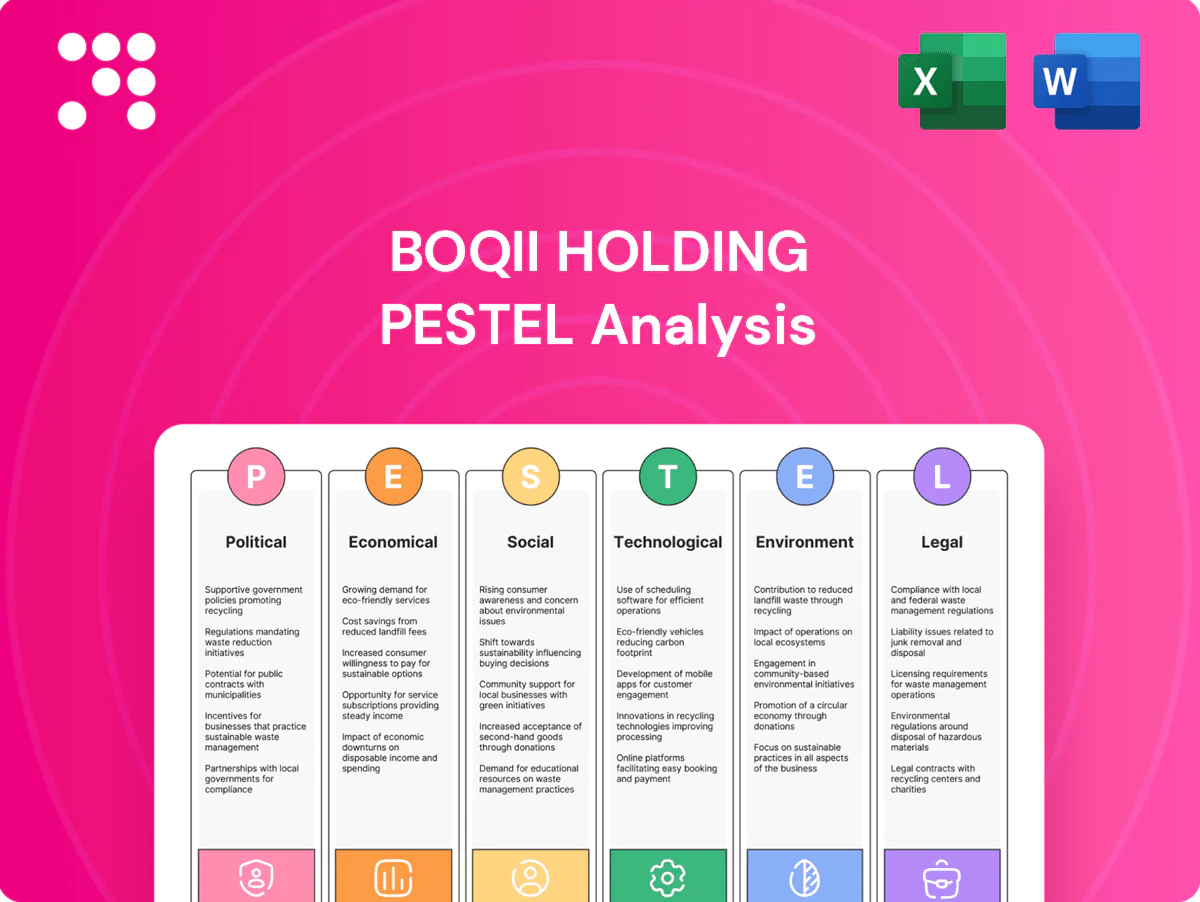
Boqii Holding PESTLE Analysis

Plan Smarter. Present Sharper. Compete Stronger.
Explore how regulatory shifts, consumer trends, and tech innovation are reshaping Boqii Holding’s growth prospects in our concise PESTLE snapshot. This analysis reveals key external risks and opportunities for investors and strategists. Purchase the full PESTLE to access the complete, actionable intelligence now.
Political factors

E-commerce regulatory oversight
China’s evolving rules for online platforms reshape marketplace operations, content and merchant management, forcing Boqii to tighten platform accountability, anti-counterfeit enforcement and fair competition measures. The RMB 18.228 billion antitrust fine against Alibaba in 2021 underscores enforcement intensity. Frequent policy updates demand agile compliance, audit trails and robust seller vetting; non-compliance risks fines, delisting and reputational harm.
Geopolitics and import exposure
Boqii faces geopolitics-driven import exposure as pet food and premium brands—which historically account for a sizable share of China’s market—depend on cross-border supply; China’s pet market was estimated at about USD 39–40 billion in 2023 with continued mid-single-digit growth into 2024. Trade tensions, tariffs, and sanitary barriers can narrow assortments and lift COGS, so Boqii must diversify suppliers and develop local alternatives. Clear substitution policies and proactive customer communication reduce churn when imported SKUs are disrupted.

Local government support for digital economy
City-level incentives for warehousing, logistics and tech pilots can cut Boqii’s operating costs via rent and tax breaks, and China’s digital economy — about 46% of GDP in 2024 — concentrates such subsidies in major e-commerce hubs.
Participation in cross-border e-commerce zones speeds customs clearance and duty processing, improving turnover for pet supplies into ASEAN/EU markets.
Tapping SME merchant subsidies strengthens Boqii’s seller ecosystem and policy ties support community outreach and responsible pet-ownership campaigns.

Public health and veterinary policy
Public health and veterinary policies shape Boqii’s service mix: rules on animal disease control and mandatory vaccination programs drive demand for clinic bookings and in‑app vaccine reminders, in a market valued at over RMB 300 billion in 2023. Boqii’s grooming and healthcare marketplace must align with veterinary practice standards and municipal biosecurity guidance to avoid enforcement actions. Local campaigns for pet registration and vaccines historically spike clinic utilization and platform transactions. Non‑compliance by partners can trigger suspensions or shutdowns under local animal health orders.
Content governance and community
China’s content and cybersecurity regime (PIPL/Data Security Law, effective 2021) forces strict moderation of UGC; regulators can fine platforms up to 50 million CNY or 5% of annual revenue. Pet-care advice, livestreams and forums must avoid prohibited topics and false health claims; CAC enforcement tightened since 2022. Boqii needs automated filters plus human review and transparent reporting to maintain compliance and regulator confidence.
Regulatory crackdown forces pet e-commerce to toughen seller vetting and curb cross-border costs
Regulatory tightening on platforms forces Boqii to strengthen anti‑counterfeit, seller vetting and content controls; non‑compliance risks fines (e.g., Alibaba RMB 18.228bn, 2021) and delistings. Cross‑border trade risk raises COGS for imported pet food amid tariffs and sanitary checks; China pet market ~USD 40bn (2023). City incentives and cross‑border zones lower logistics costs and speed customs, aiding turnover.
| Metric | Value |
|---|---|
| Antitrust precedent | RMB 18.228bn (Alibaba, 2021) |
| China pet market | ≈ USD 40bn (2023) |
| Pet services | RMB 300bn+ (2023) |
| Digital economy | 46% GDP (2024) |
| PIPL/Data Security fines | up to CNY 50M or 5% revenue |
What is included in the product
 Detailed Word Document
Explores how macro-environmental forces uniquely affect Boqii Holding across Political, Economic, Social, Technological, Environmental and Legal dimensions—anchored in China’s pet e‑commerce dynamics and regulatory trends, with data-backed insights, forward-looking scenarios and actionable implications to help executives, investors and strategists identify risks, opportunities and competitive moves.

 Customizable Excel Spreadsheet
Concise, visually segmented PESTLE summary for Boqii Holding that streamlines risk identification and market positioning, easily dropped into presentations or shared across teams to accelerate strategic planning and decision-making.
Economic factors

Consumer spending cycles
Pet products mix staples and discretionary goods; with the global pet care market ~USD 260bn in 2022 and projected to exceed USD 350bn by 2030, macro slowdowns push consumers toward value formats while upcycles drive premiumization. Boqii can hedge by layering tiered SKUs and essential-item subscriptions to lock recurring revenue. Elastic pricing and targeted promotions—proven to reduce demand volatility—smooth sales across cycles.
Logistics and fulfillment costs
Fuel volatility (Brent averaged about 84 USD/bbl in 2024) plus rising labor rates and low urban last-mile densities make delivery unit economics challenging, with last-mile often accounting for ~30–40% of logistics costs. Network optimization and regional fulfillment centers can cut lead times and transport costs materially, often reducing delivery time by 20–30%. Partnering with 3PLs and deploying parcel lockers improves margins via scale and density gains, while continuous SKU rationalization lowers handling complexity and pick-and-pack costs.

RMB exchange and input inflation
RMB traded near 7.2 per USD in H1 2025, roughly 4% weaker year‑on‑year, amplifying import costs for Boqii’s pet food ingredients and accessories.
Commodity‑linked inputs — proteins, grains and packaging — have pushed COGS higher, with China pork price swings and global grain volatility materially affecting margins.
Hedging programs and increased local sourcing have reduced headline volatility, while selective cost pass‑through requires careful price tests to protect retention.

Platform competition and price wars
Platform competition and social commerce have driven customer acquisition costs up an estimated 20%–30% in 2023, pressuring margins for niche players; Boqii defends this through deeper pet assortment and services that support higher gross margins and repeat purchase rates. Private labels and exclusive brand partnerships reduce direct price comparisons, while loyalty programs and data-driven LTV management can raise customer lifetime value by ~15%–25%.
Capital access and scale investments
Boqii benefits from e-commerce scale in tech, data and fulfillment that compress unit costs and improve margins, but tighter financing since 2022 has reduced available growth capex and marketing spend.
Prioritize ROI-positive projects and partnerships to share fixed fulfillment costs; improving CAC payback extends runway when capital markets are weak.
- Scale lowers unit cost
- Financing tighter since 2022
- Prioritize ROI-positive initiatives
- Partnerships to share fixed costs
- Faster CAC payback extends runway
Regulatory crackdown forces pet e-commerce to toughen seller vetting and curb cross-border costs
Global pet market ~USD 260bn (2022) growing to >USD 350bn (2030); Boqii should hedge via tiered SKUs, subscriptions and local sourcing as RMB ~7.2/USD (H1 2025) raises import costs. Last‑mile is ~30–40% of logistics; network densification and 3PLs cut costs. CAC rose 20–30% (2023) while loyalty can lift LTV 15–25%, supporting margin recovery.
| Metric | Value |
|---|---|
| Global market (2022) | USD 260bn |
| RMB/USD (H1 2025) | ~7.2 |
| Last‑mile cost | 30–40% |
| CAC change (2023) | +20–30% |
| LTV uplift | +15–25% |
Full Version Awaits
Boqii Holding PESTLE Analysis
The Boqii Holding PESTLE Analysis preview shown here is the exact document you’ll receive after purchase—fully formatted, professional and ready to use. The content, layout and structure visible are identical to the downloadable file. No placeholders, no surprises—this is the final product.

Plan Smarter. Present Sharper. Compete Stronger.
Explore how regulatory shifts, consumer trends, and tech innovation are reshaping Boqii Holding’s growth prospects in our concise PESTLE snapshot. This analysis reveals key external risks and opportunities for investors and strategists. Purchase the full PESTLE to access the complete, actionable intelligence now.
Political factors
E-commerce regulatory oversight
China’s evolving rules for online platforms reshape marketplace operations, content and merchant management, forcing Boqii to tighten platform accountability, anti-counterfeit enforcement and fair competition measures. The RMB 18.228 billion antitrust fine against Alibaba in 2021 underscores enforcement intensity. Frequent policy updates demand agile compliance, audit trails and robust seller vetting; non-compliance risks fines, delisting and reputational harm.
Geopolitics and import exposure
Boqii faces geopolitics-driven import exposure as pet food and premium brands—which historically account for a sizable share of China’s market—depend on cross-border supply; China’s pet market was estimated at about USD 39–40 billion in 2023 with continued mid-single-digit growth into 2024. Trade tensions, tariffs, and sanitary barriers can narrow assortments and lift COGS, so Boqii must diversify suppliers and develop local alternatives. Clear substitution policies and proactive customer communication reduce churn when imported SKUs are disrupted.
Local government support for digital economy
City-level incentives for warehousing, logistics and tech pilots can cut Boqii’s operating costs via rent and tax breaks, and China’s digital economy — about 46% of GDP in 2024 — concentrates such subsidies in major e-commerce hubs.
Participation in cross-border e-commerce zones speeds customs clearance and duty processing, improving turnover for pet supplies into ASEAN/EU markets.
Tapping SME merchant subsidies strengthens Boqii’s seller ecosystem and policy ties support community outreach and responsible pet-ownership campaigns.
Public health and veterinary policy
Public health and veterinary policies shape Boqii’s service mix: rules on animal disease control and mandatory vaccination programs drive demand for clinic bookings and in‑app vaccine reminders, in a market valued at over RMB 300 billion in 2023. Boqii’s grooming and healthcare marketplace must align with veterinary practice standards and municipal biosecurity guidance to avoid enforcement actions. Local campaigns for pet registration and vaccines historically spike clinic utilization and platform transactions. Non‑compliance by partners can trigger suspensions or shutdowns under local animal health orders.
Content governance and community
China’s content and cybersecurity regime (PIPL/Data Security Law, effective 2021) forces strict moderation of UGC; regulators can fine platforms up to 50 million CNY or 5% of annual revenue. Pet-care advice, livestreams and forums must avoid prohibited topics and false health claims; CAC enforcement tightened since 2022. Boqii needs automated filters plus human review and transparent reporting to maintain compliance and regulator confidence.
Regulatory crackdown forces pet e-commerce to toughen seller vetting and curb cross-border costs
Regulatory tightening on platforms forces Boqii to strengthen anti‑counterfeit, seller vetting and content controls; non‑compliance risks fines (e.g., Alibaba RMB 18.228bn, 2021) and delistings. Cross‑border trade risk raises COGS for imported pet food amid tariffs and sanitary checks; China pet market ~USD 40bn (2023). City incentives and cross‑border zones lower logistics costs and speed customs, aiding turnover.
| Metric | Value |
|---|---|
| Antitrust precedent | RMB 18.228bn (Alibaba, 2021) |
| China pet market | ≈ USD 40bn (2023) |
| Pet services | RMB 300bn+ (2023) |
| Digital economy | 46% GDP (2024) |
| PIPL/Data Security fines | up to CNY 50M or 5% revenue |
What is included in the product
Detailed Word Document
Explores how macro-environmental forces uniquely affect Boqii Holding across Political, Economic, Social, Technological, Environmental and Legal dimensions—anchored in China’s pet e‑commerce dynamics and regulatory trends, with data-backed insights, forward-looking scenarios and actionable implications to help executives, investors and strategists identify risks, opportunities and competitive moves.
Customizable Excel Spreadsheet
Concise, visually segmented PESTLE summary for Boqii Holding that streamlines risk identification and market positioning, easily dropped into presentations or shared across teams to accelerate strategic planning and decision-making.
Economic factors
Consumer spending cycles
Pet products mix staples and discretionary goods; with the global pet care market ~USD 260bn in 2022 and projected to exceed USD 350bn by 2030, macro slowdowns push consumers toward value formats while upcycles drive premiumization. Boqii can hedge by layering tiered SKUs and essential-item subscriptions to lock recurring revenue. Elastic pricing and targeted promotions—proven to reduce demand volatility—smooth sales across cycles.
Logistics and fulfillment costs
Fuel volatility (Brent averaged about 84 USD/bbl in 2024) plus rising labor rates and low urban last-mile densities make delivery unit economics challenging, with last-mile often accounting for ~30–40% of logistics costs. Network optimization and regional fulfillment centers can cut lead times and transport costs materially, often reducing delivery time by 20–30%. Partnering with 3PLs and deploying parcel lockers improves margins via scale and density gains, while continuous SKU rationalization lowers handling complexity and pick-and-pack costs.
RMB exchange and input inflation
RMB traded near 7.2 per USD in H1 2025, roughly 4% weaker year‑on‑year, amplifying import costs for Boqii’s pet food ingredients and accessories.
Commodity‑linked inputs — proteins, grains and packaging — have pushed COGS higher, with China pork price swings and global grain volatility materially affecting margins.
Hedging programs and increased local sourcing have reduced headline volatility, while selective cost pass‑through requires careful price tests to protect retention.
Platform competition and price wars
Platform competition and social commerce have driven customer acquisition costs up an estimated 20%–30% in 2023, pressuring margins for niche players; Boqii defends this through deeper pet assortment and services that support higher gross margins and repeat purchase rates. Private labels and exclusive brand partnerships reduce direct price comparisons, while loyalty programs and data-driven LTV management can raise customer lifetime value by ~15%–25%.
Capital access and scale investments
Boqii benefits from e-commerce scale in tech, data and fulfillment that compress unit costs and improve margins, but tighter financing since 2022 has reduced available growth capex and marketing spend.
Prioritize ROI-positive projects and partnerships to share fixed fulfillment costs; improving CAC payback extends runway when capital markets are weak.
- Scale lowers unit cost
- Financing tighter since 2022
- Prioritize ROI-positive initiatives
- Partnerships to share fixed costs
- Faster CAC payback extends runway
Regulatory crackdown forces pet e-commerce to toughen seller vetting and curb cross-border costs
Global pet market ~USD 260bn (2022) growing to >USD 350bn (2030); Boqii should hedge via tiered SKUs, subscriptions and local sourcing as RMB ~7.2/USD (H1 2025) raises import costs. Last‑mile is ~30–40% of logistics; network densification and 3PLs cut costs. CAC rose 20–30% (2023) while loyalty can lift LTV 15–25%, supporting margin recovery.
| Metric | Value |
|---|---|
| Global market (2022) | USD 260bn |
| RMB/USD (H1 2025) | ~7.2 |
| Last‑mile cost | 30–40% |
| CAC change (2023) | +20–30% |
| LTV uplift | +15–25% |
Full Version Awaits
Boqii Holding PESTLE Analysis
The Boqii Holding PESTLE Analysis preview shown here is the exact document you’ll receive after purchase—fully formatted, professional and ready to use. The content, layout and structure visible are identical to the downloadable file. No placeholders, no surprises—this is the final product.
Original: $10.00
-65%$10.00
$3.50Description
Plan Smarter. Present Sharper. Compete Stronger.
Explore how regulatory shifts, consumer trends, and tech innovation are reshaping Boqii Holding’s growth prospects in our concise PESTLE snapshot. This analysis reveals key external risks and opportunities for investors and strategists. Purchase the full PESTLE to access the complete, actionable intelligence now.
Political factors
E-commerce regulatory oversight
China’s evolving rules for online platforms reshape marketplace operations, content and merchant management, forcing Boqii to tighten platform accountability, anti-counterfeit enforcement and fair competition measures. The RMB 18.228 billion antitrust fine against Alibaba in 2021 underscores enforcement intensity. Frequent policy updates demand agile compliance, audit trails and robust seller vetting; non-compliance risks fines, delisting and reputational harm.
Geopolitics and import exposure
Boqii faces geopolitics-driven import exposure as pet food and premium brands—which historically account for a sizable share of China’s market—depend on cross-border supply; China’s pet market was estimated at about USD 39–40 billion in 2023 with continued mid-single-digit growth into 2024. Trade tensions, tariffs, and sanitary barriers can narrow assortments and lift COGS, so Boqii must diversify suppliers and develop local alternatives. Clear substitution policies and proactive customer communication reduce churn when imported SKUs are disrupted.
Local government support for digital economy
City-level incentives for warehousing, logistics and tech pilots can cut Boqii’s operating costs via rent and tax breaks, and China’s digital economy — about 46% of GDP in 2024 — concentrates such subsidies in major e-commerce hubs.
Participation in cross-border e-commerce zones speeds customs clearance and duty processing, improving turnover for pet supplies into ASEAN/EU markets.
Tapping SME merchant subsidies strengthens Boqii’s seller ecosystem and policy ties support community outreach and responsible pet-ownership campaigns.
Public health and veterinary policy
Public health and veterinary policies shape Boqii’s service mix: rules on animal disease control and mandatory vaccination programs drive demand for clinic bookings and in‑app vaccine reminders, in a market valued at over RMB 300 billion in 2023. Boqii’s grooming and healthcare marketplace must align with veterinary practice standards and municipal biosecurity guidance to avoid enforcement actions. Local campaigns for pet registration and vaccines historically spike clinic utilization and platform transactions. Non‑compliance by partners can trigger suspensions or shutdowns under local animal health orders.
Content governance and community
China’s content and cybersecurity regime (PIPL/Data Security Law, effective 2021) forces strict moderation of UGC; regulators can fine platforms up to 50 million CNY or 5% of annual revenue. Pet-care advice, livestreams and forums must avoid prohibited topics and false health claims; CAC enforcement tightened since 2022. Boqii needs automated filters plus human review and transparent reporting to maintain compliance and regulator confidence.
Regulatory crackdown forces pet e-commerce to toughen seller vetting and curb cross-border costs
Regulatory tightening on platforms forces Boqii to strengthen anti‑counterfeit, seller vetting and content controls; non‑compliance risks fines (e.g., Alibaba RMB 18.228bn, 2021) and delistings. Cross‑border trade risk raises COGS for imported pet food amid tariffs and sanitary checks; China pet market ~USD 40bn (2023). City incentives and cross‑border zones lower logistics costs and speed customs, aiding turnover.
| Metric | Value |
|---|---|
| Antitrust precedent | RMB 18.228bn (Alibaba, 2021) |
| China pet market | ≈ USD 40bn (2023) |
| Pet services | RMB 300bn+ (2023) |
| Digital economy | 46% GDP (2024) |
| PIPL/Data Security fines | up to CNY 50M or 5% revenue |
What is included in the product
Detailed Word Document
Explores how macro-environmental forces uniquely affect Boqii Holding across Political, Economic, Social, Technological, Environmental and Legal dimensions—anchored in China’s pet e‑commerce dynamics and regulatory trends, with data-backed insights, forward-looking scenarios and actionable implications to help executives, investors and strategists identify risks, opportunities and competitive moves.
Customizable Excel Spreadsheet
Concise, visually segmented PESTLE summary for Boqii Holding that streamlines risk identification and market positioning, easily dropped into presentations or shared across teams to accelerate strategic planning and decision-making.
Economic factors
Consumer spending cycles
Pet products mix staples and discretionary goods; with the global pet care market ~USD 260bn in 2022 and projected to exceed USD 350bn by 2030, macro slowdowns push consumers toward value formats while upcycles drive premiumization. Boqii can hedge by layering tiered SKUs and essential-item subscriptions to lock recurring revenue. Elastic pricing and targeted promotions—proven to reduce demand volatility—smooth sales across cycles.
Logistics and fulfillment costs
Fuel volatility (Brent averaged about 84 USD/bbl in 2024) plus rising labor rates and low urban last-mile densities make delivery unit economics challenging, with last-mile often accounting for ~30–40% of logistics costs. Network optimization and regional fulfillment centers can cut lead times and transport costs materially, often reducing delivery time by 20–30%. Partnering with 3PLs and deploying parcel lockers improves margins via scale and density gains, while continuous SKU rationalization lowers handling complexity and pick-and-pack costs.
RMB exchange and input inflation
RMB traded near 7.2 per USD in H1 2025, roughly 4% weaker year‑on‑year, amplifying import costs for Boqii’s pet food ingredients and accessories.
Commodity‑linked inputs — proteins, grains and packaging — have pushed COGS higher, with China pork price swings and global grain volatility materially affecting margins.
Hedging programs and increased local sourcing have reduced headline volatility, while selective cost pass‑through requires careful price tests to protect retention.
Platform competition and price wars
Platform competition and social commerce have driven customer acquisition costs up an estimated 20%–30% in 2023, pressuring margins for niche players; Boqii defends this through deeper pet assortment and services that support higher gross margins and repeat purchase rates. Private labels and exclusive brand partnerships reduce direct price comparisons, while loyalty programs and data-driven LTV management can raise customer lifetime value by ~15%–25%.
Capital access and scale investments
Boqii benefits from e-commerce scale in tech, data and fulfillment that compress unit costs and improve margins, but tighter financing since 2022 has reduced available growth capex and marketing spend.
Prioritize ROI-positive projects and partnerships to share fixed fulfillment costs; improving CAC payback extends runway when capital markets are weak.
- Scale lowers unit cost
- Financing tighter since 2022
- Prioritize ROI-positive initiatives
- Partnerships to share fixed costs
- Faster CAC payback extends runway
Regulatory crackdown forces pet e-commerce to toughen seller vetting and curb cross-border costs
Global pet market ~USD 260bn (2022) growing to >USD 350bn (2030); Boqii should hedge via tiered SKUs, subscriptions and local sourcing as RMB ~7.2/USD (H1 2025) raises import costs. Last‑mile is ~30–40% of logistics; network densification and 3PLs cut costs. CAC rose 20–30% (2023) while loyalty can lift LTV 15–25%, supporting margin recovery.
| Metric | Value |
|---|---|
| Global market (2022) | USD 260bn |
| RMB/USD (H1 2025) | ~7.2 |
| Last‑mile cost | 30–40% |
| CAC change (2023) | +20–30% |
| LTV uplift | +15–25% |
Full Version Awaits
Boqii Holding PESTLE Analysis
The Boqii Holding PESTLE Analysis preview shown here is the exact document you’ll receive after purchase—fully formatted, professional and ready to use. The content, layout and structure visible are identical to the downloadable file. No placeholders, no surprises—this is the final product.











