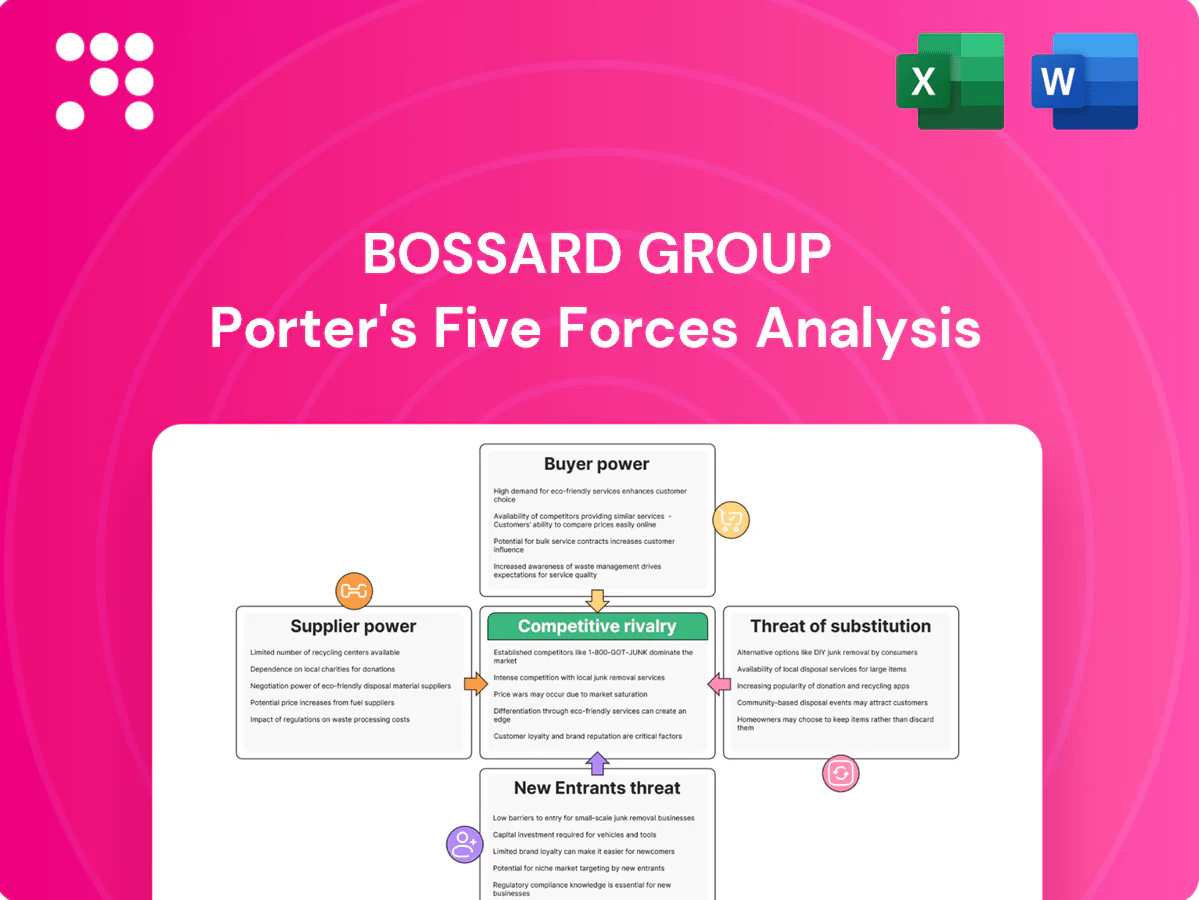
Bossard Group Porter's Five Forces Analysis

A Must-Have Tool for Decision-Makers
Bossard Group faces moderate buyer power and supplier specialization, while scale and distribution networks temper new entrant threats; rivalry is shaped by service differentiation and pricing pressure, with substitutes from alternative fastening technologies. This snapshot only scratches the surface. Unlock the full Porter's Five Forces Analysis to explore Bossard Group’s competitive dynamics, market pressures, and strategic advantages in detail.
Suppliers Bargaining Power

Fragmented global supply base
Fragmented global supply base: fastener and C-parts suppliers are numerous across regions, limiting individual supplier leverage; Bossard, present in 32 countries and reporting CHF 1.15 billion sales in 2023, can multi-source standard items to reduce single-source risk and negotiate better prices. Fragmentation enables competitive bidding and volume aggregation, though it raises coordination costs and requires active quality-consistency management.
Specialized and engineered parts scarcity
For custom or safety-critical fasteners the qualified supplier pool is markedly smaller, raising supplier power; 2024 industry data show lead times commonly 8–16 weeks and MOQs that force batch production. Tooling investments, IP ownership and certification requirements create vendor lock-in and pricing leverage. Bossard mitigates this via early engineering involvement and dual-qualification where feasible to reduce single-supplier risk.

Raw material and energy cost pass-through
Volatility in steel, alloys and energy—about 15–25% price swings in 2024—strengthens suppliers’ pass-through ability; index-linked contracts (common in 2024 industrial procurement) reduce disputes but limit short-term renegotiation. Bossard’s scale and forward purchasing (procurement volumes exceeding CHF 1bn annually) dampen spikes, while inventory strategy and hedging further cushion margin pressure.

Quality and compliance requirements
Automotive, electronics and machinery buyers demand traceability and standards compliance (PPAP, IATF 16949, ISO series), which concentrates power among qualified suppliers and narrows the viable supplier pool. Bossard’s in-house testing, audits and application engineering increase acceptable sources and shift bargaining dynamics toward Bossard in 2024.
- Standards: PPAP, IATF 16949, ISO testing requirements—reduces supplier pool; Bossard labs and audits expand acceptable suppliers
Logistics and lead-time constraints
Global shipping, customs slowdowns, and regional disruptions in 2024 heighten supplier leverage by creating scarcity and price pressure; long lead-times on special parts further increase dependency on key suppliers. Bossard’s distributed warehouses and safety-stock programs reduce exposure and buffer lead-time shocks. Vendor-managed inventory frameworks smooth variability and improve service continuity.
- Supply shocks amplify supplier power
- Specials: long lead-times raise dependence
- Distributed warehouses cut exposure
- VMI reduces variability
Multi-source limits supplier power; specials 8-16w, swings 15-25%
Fragmented global fastener supply limits individual supplier leverage; Bossard (present in 32 countries; CHF 1.15bn sales 2023) uses multi-sourcing to negotiate better terms. For custom/safety-critical parts qualified suppliers are few (lead times 8–16 weeks in 2024), increasing supplier power; tooling, certifications and MOQ elevate lock-in. Steel/alloy price volatility (15–25% in 2024) and logistics shocks amplify pass-through risk mitigated by Bossard’s scale and VMI.
| Metric | 2024 value | Impact |
|---|---|---|
| Lead times (specials) | 8–16 weeks | ↑ supplier power |
| Price volatility | 15–25% | ↑ pass-through risk |
| Bossard scale | procurement >CHF1bn | ↓ price exposure |
What is included in the product
 Detailed Word Document
Concise Porter's Five Forces analysis of Bossard Group highlighting competitive rivalry, buyer and supplier bargaining power, threats from substitutes and new entrants, and strategic levers to safeguard margins and market share.

 Customizable Excel Spreadsheet
A clear, one-sheet Porter's Five Forces summary for Bossard Group—instantly pinpoint supplier/buyer power, competitive rivalry and threats of entry/substitution to streamline sourcing, pricing and strategic decisions.
Customers Bargaining Power

Large OEMs and Tier-1 consolidation
Large OEMs and Tier-1 consolidation lets big industrial buyers aggregate volumes and run competitive tenders and e-auctions, intensifying price pressure. Framework agreements and e-auctions are now standard in procurement cycles. Bossard counters with TCO-focused value propositions beyond unit price and scale-based service SLAs that create stickiness; Bossard reported about CHF 1.11bn sales in 2023, supporting continued investment in services.
High switching costs from requalification
Changing fasteners requires engineering validation, line trials and documentation, often causing weeks of requalification and potential downtime that can cost manufacturers tens to hundreds of thousands of dollars; this raises switching costs. Production risk and quality issues deter rapid changes. Bossard’s application engineering embeds specifications that are hard to replicate quickly. With 2024 sales about CHF 1.11bn, Bossard’s technical lock-in diminishes buyer power over time.

Standardization reduces differentiation
For commodity C-parts buyers can compare across multiple distributors easily, raising bargaining power on standardized items; in 2024 Bossard highlighted growing price transparency as a key market force. Bossard counters by bundling VMI, SmartBin and consulting to shift discussions away from unit price toward total-cost and service value; these services represented over 20% of group revenue in 2024. Mixed baskets further redirect procurement KPIs to delivery reliability and inventory turnover rather than pure price.

TCO and service-value orientation
Customers evaluate TCO by inventory turns, line uptime and defect rates; demonstrated process savings lower price sensitivity and shift buying toward service-oriented suppliers. Bossard’s 2024 annual report highlights expanded data-backed service outcomes and margin resilience, supporting premium positioning and tempering buyer leverage versus low-service alternatives.
- Inventory turns: service reduces safety stock
- Uptime: service-linked uptime gains cut outage costs
- Defects: lower defect rates reduce replacement spend
- 2024: Bossard emphasizes data-backed service growth
Demand cyclicality and budget constraints
Industrial cycles push buyers to renegotiate and pursue cost cuts in downturns, and volume volatility gives procurement leverage on replenishment terms; Bossard’s flexible logistics and consignment models preserve customer relationships while sharing savings. Long-term contracts and VMI stabilize pricing through cycles and reduce spot exposure.
- procurement leverage from volume swings
- consignment/VMI share savings
- long-term contracts stabilize pricing
Consolidation lifts tenders; TCO/engineering sustain margins; services>20%
Consolidation among OEMs raises tender and e-auction pressure, but Bossard offsets this with TCO/value selling and engineering services. High switching costs from requalification and Bossard’s application engineering limit rapid supplier changes; group sales ~CHF 1.11bn in 2024 and services >20% of revenue. Commodity C-parts remain price-sensitive, yet VMI/SmartBin and long-term contracts stabilise margins.
| Metric | 2024 |
|---|---|
| Group sales | CHF 1.11bn |
| Services share | >20% |
Preview Before You Purchase
Bossard Group Porter's Five Forces Analysis
This preview shows the exact Bossard Group Porter's Five Forces analysis you'll receive immediately after purchase—no surprises, no placeholders. The document is fully formatted, professionally written, and ready for download and use the moment you buy. You're viewing the actual deliverable; instant access to this same file follows payment.

A Must-Have Tool for Decision-Makers
Bossard Group faces moderate buyer power and supplier specialization, while scale and distribution networks temper new entrant threats; rivalry is shaped by service differentiation and pricing pressure, with substitutes from alternative fastening technologies. This snapshot only scratches the surface. Unlock the full Porter's Five Forces Analysis to explore Bossard Group’s competitive dynamics, market pressures, and strategic advantages in detail.
Suppliers Bargaining Power
Fragmented global supply base
Fragmented global supply base: fastener and C-parts suppliers are numerous across regions, limiting individual supplier leverage; Bossard, present in 32 countries and reporting CHF 1.15 billion sales in 2023, can multi-source standard items to reduce single-source risk and negotiate better prices. Fragmentation enables competitive bidding and volume aggregation, though it raises coordination costs and requires active quality-consistency management.
Specialized and engineered parts scarcity
For custom or safety-critical fasteners the qualified supplier pool is markedly smaller, raising supplier power; 2024 industry data show lead times commonly 8–16 weeks and MOQs that force batch production. Tooling investments, IP ownership and certification requirements create vendor lock-in and pricing leverage. Bossard mitigates this via early engineering involvement and dual-qualification where feasible to reduce single-supplier risk.
Raw material and energy cost pass-through
Volatility in steel, alloys and energy—about 15–25% price swings in 2024—strengthens suppliers’ pass-through ability; index-linked contracts (common in 2024 industrial procurement) reduce disputes but limit short-term renegotiation. Bossard’s scale and forward purchasing (procurement volumes exceeding CHF 1bn annually) dampen spikes, while inventory strategy and hedging further cushion margin pressure.
Quality and compliance requirements
Automotive, electronics and machinery buyers demand traceability and standards compliance (PPAP, IATF 16949, ISO series), which concentrates power among qualified suppliers and narrows the viable supplier pool. Bossard’s in-house testing, audits and application engineering increase acceptable sources and shift bargaining dynamics toward Bossard in 2024.
- Standards: PPAP, IATF 16949, ISO testing requirements—reduces supplier pool; Bossard labs and audits expand acceptable suppliers
Logistics and lead-time constraints
Global shipping, customs slowdowns, and regional disruptions in 2024 heighten supplier leverage by creating scarcity and price pressure; long lead-times on special parts further increase dependency on key suppliers. Bossard’s distributed warehouses and safety-stock programs reduce exposure and buffer lead-time shocks. Vendor-managed inventory frameworks smooth variability and improve service continuity.
- Supply shocks amplify supplier power
- Specials: long lead-times raise dependence
- Distributed warehouses cut exposure
- VMI reduces variability
Multi-source limits supplier power; specials 8-16w, swings 15-25%
Fragmented global fastener supply limits individual supplier leverage; Bossard (present in 32 countries; CHF 1.15bn sales 2023) uses multi-sourcing to negotiate better terms. For custom/safety-critical parts qualified suppliers are few (lead times 8–16 weeks in 2024), increasing supplier power; tooling, certifications and MOQ elevate lock-in. Steel/alloy price volatility (15–25% in 2024) and logistics shocks amplify pass-through risk mitigated by Bossard’s scale and VMI.
| Metric | 2024 value | Impact |
|---|---|---|
| Lead times (specials) | 8–16 weeks | ↑ supplier power |
| Price volatility | 15–25% | ↑ pass-through risk |
| Bossard scale | procurement >CHF1bn | ↓ price exposure |
What is included in the product
Detailed Word Document
Concise Porter's Five Forces analysis of Bossard Group highlighting competitive rivalry, buyer and supplier bargaining power, threats from substitutes and new entrants, and strategic levers to safeguard margins and market share.
Customizable Excel Spreadsheet
A clear, one-sheet Porter's Five Forces summary for Bossard Group—instantly pinpoint supplier/buyer power, competitive rivalry and threats of entry/substitution to streamline sourcing, pricing and strategic decisions.
Customers Bargaining Power
Large OEMs and Tier-1 consolidation
Large OEMs and Tier-1 consolidation lets big industrial buyers aggregate volumes and run competitive tenders and e-auctions, intensifying price pressure. Framework agreements and e-auctions are now standard in procurement cycles. Bossard counters with TCO-focused value propositions beyond unit price and scale-based service SLAs that create stickiness; Bossard reported about CHF 1.11bn sales in 2023, supporting continued investment in services.
High switching costs from requalification
Changing fasteners requires engineering validation, line trials and documentation, often causing weeks of requalification and potential downtime that can cost manufacturers tens to hundreds of thousands of dollars; this raises switching costs. Production risk and quality issues deter rapid changes. Bossard’s application engineering embeds specifications that are hard to replicate quickly. With 2024 sales about CHF 1.11bn, Bossard’s technical lock-in diminishes buyer power over time.
Standardization reduces differentiation
For commodity C-parts buyers can compare across multiple distributors easily, raising bargaining power on standardized items; in 2024 Bossard highlighted growing price transparency as a key market force. Bossard counters by bundling VMI, SmartBin and consulting to shift discussions away from unit price toward total-cost and service value; these services represented over 20% of group revenue in 2024. Mixed baskets further redirect procurement KPIs to delivery reliability and inventory turnover rather than pure price.
TCO and service-value orientation
Customers evaluate TCO by inventory turns, line uptime and defect rates; demonstrated process savings lower price sensitivity and shift buying toward service-oriented suppliers. Bossard’s 2024 annual report highlights expanded data-backed service outcomes and margin resilience, supporting premium positioning and tempering buyer leverage versus low-service alternatives.
- Inventory turns: service reduces safety stock
- Uptime: service-linked uptime gains cut outage costs
- Defects: lower defect rates reduce replacement spend
- 2024: Bossard emphasizes data-backed service growth
Demand cyclicality and budget constraints
Industrial cycles push buyers to renegotiate and pursue cost cuts in downturns, and volume volatility gives procurement leverage on replenishment terms; Bossard’s flexible logistics and consignment models preserve customer relationships while sharing savings. Long-term contracts and VMI stabilize pricing through cycles and reduce spot exposure.
- procurement leverage from volume swings
- consignment/VMI share savings
- long-term contracts stabilize pricing
Consolidation lifts tenders; TCO/engineering sustain margins; services>20%
Consolidation among OEMs raises tender and e-auction pressure, but Bossard offsets this with TCO/value selling and engineering services. High switching costs from requalification and Bossard’s application engineering limit rapid supplier changes; group sales ~CHF 1.11bn in 2024 and services >20% of revenue. Commodity C-parts remain price-sensitive, yet VMI/SmartBin and long-term contracts stabilise margins.
| Metric | 2024 |
|---|---|
| Group sales | CHF 1.11bn |
| Services share | >20% |
Preview Before You Purchase
Bossard Group Porter's Five Forces Analysis
This preview shows the exact Bossard Group Porter's Five Forces analysis you'll receive immediately after purchase—no surprises, no placeholders. The document is fully formatted, professionally written, and ready for download and use the moment you buy. You're viewing the actual deliverable; instant access to this same file follows payment.
Description
A Must-Have Tool for Decision-Makers
Bossard Group faces moderate buyer power and supplier specialization, while scale and distribution networks temper new entrant threats; rivalry is shaped by service differentiation and pricing pressure, with substitutes from alternative fastening technologies. This snapshot only scratches the surface. Unlock the full Porter's Five Forces Analysis to explore Bossard Group’s competitive dynamics, market pressures, and strategic advantages in detail.
Suppliers Bargaining Power
Fragmented global supply base
Fragmented global supply base: fastener and C-parts suppliers are numerous across regions, limiting individual supplier leverage; Bossard, present in 32 countries and reporting CHF 1.15 billion sales in 2023, can multi-source standard items to reduce single-source risk and negotiate better prices. Fragmentation enables competitive bidding and volume aggregation, though it raises coordination costs and requires active quality-consistency management.
Specialized and engineered parts scarcity
For custom or safety-critical fasteners the qualified supplier pool is markedly smaller, raising supplier power; 2024 industry data show lead times commonly 8–16 weeks and MOQs that force batch production. Tooling investments, IP ownership and certification requirements create vendor lock-in and pricing leverage. Bossard mitigates this via early engineering involvement and dual-qualification where feasible to reduce single-supplier risk.
Raw material and energy cost pass-through
Volatility in steel, alloys and energy—about 15–25% price swings in 2024—strengthens suppliers’ pass-through ability; index-linked contracts (common in 2024 industrial procurement) reduce disputes but limit short-term renegotiation. Bossard’s scale and forward purchasing (procurement volumes exceeding CHF 1bn annually) dampen spikes, while inventory strategy and hedging further cushion margin pressure.
Quality and compliance requirements
Automotive, electronics and machinery buyers demand traceability and standards compliance (PPAP, IATF 16949, ISO series), which concentrates power among qualified suppliers and narrows the viable supplier pool. Bossard’s in-house testing, audits and application engineering increase acceptable sources and shift bargaining dynamics toward Bossard in 2024.
- Standards: PPAP, IATF 16949, ISO testing requirements—reduces supplier pool; Bossard labs and audits expand acceptable suppliers
Logistics and lead-time constraints
Global shipping, customs slowdowns, and regional disruptions in 2024 heighten supplier leverage by creating scarcity and price pressure; long lead-times on special parts further increase dependency on key suppliers. Bossard’s distributed warehouses and safety-stock programs reduce exposure and buffer lead-time shocks. Vendor-managed inventory frameworks smooth variability and improve service continuity.
- Supply shocks amplify supplier power
- Specials: long lead-times raise dependence
- Distributed warehouses cut exposure
- VMI reduces variability
Multi-source limits supplier power; specials 8-16w, swings 15-25%
Fragmented global fastener supply limits individual supplier leverage; Bossard (present in 32 countries; CHF 1.15bn sales 2023) uses multi-sourcing to negotiate better terms. For custom/safety-critical parts qualified suppliers are few (lead times 8–16 weeks in 2024), increasing supplier power; tooling, certifications and MOQ elevate lock-in. Steel/alloy price volatility (15–25% in 2024) and logistics shocks amplify pass-through risk mitigated by Bossard’s scale and VMI.
| Metric | 2024 value | Impact |
|---|---|---|
| Lead times (specials) | 8–16 weeks | ↑ supplier power |
| Price volatility | 15–25% | ↑ pass-through risk |
| Bossard scale | procurement >CHF1bn | ↓ price exposure |
What is included in the product
Detailed Word Document
Concise Porter's Five Forces analysis of Bossard Group highlighting competitive rivalry, buyer and supplier bargaining power, threats from substitutes and new entrants, and strategic levers to safeguard margins and market share.
Customizable Excel Spreadsheet
A clear, one-sheet Porter's Five Forces summary for Bossard Group—instantly pinpoint supplier/buyer power, competitive rivalry and threats of entry/substitution to streamline sourcing, pricing and strategic decisions.
Customers Bargaining Power
Large OEMs and Tier-1 consolidation
Large OEMs and Tier-1 consolidation lets big industrial buyers aggregate volumes and run competitive tenders and e-auctions, intensifying price pressure. Framework agreements and e-auctions are now standard in procurement cycles. Bossard counters with TCO-focused value propositions beyond unit price and scale-based service SLAs that create stickiness; Bossard reported about CHF 1.11bn sales in 2023, supporting continued investment in services.
High switching costs from requalification
Changing fasteners requires engineering validation, line trials and documentation, often causing weeks of requalification and potential downtime that can cost manufacturers tens to hundreds of thousands of dollars; this raises switching costs. Production risk and quality issues deter rapid changes. Bossard’s application engineering embeds specifications that are hard to replicate quickly. With 2024 sales about CHF 1.11bn, Bossard’s technical lock-in diminishes buyer power over time.
Standardization reduces differentiation
For commodity C-parts buyers can compare across multiple distributors easily, raising bargaining power on standardized items; in 2024 Bossard highlighted growing price transparency as a key market force. Bossard counters by bundling VMI, SmartBin and consulting to shift discussions away from unit price toward total-cost and service value; these services represented over 20% of group revenue in 2024. Mixed baskets further redirect procurement KPIs to delivery reliability and inventory turnover rather than pure price.
TCO and service-value orientation
Customers evaluate TCO by inventory turns, line uptime and defect rates; demonstrated process savings lower price sensitivity and shift buying toward service-oriented suppliers. Bossard’s 2024 annual report highlights expanded data-backed service outcomes and margin resilience, supporting premium positioning and tempering buyer leverage versus low-service alternatives.
- Inventory turns: service reduces safety stock
- Uptime: service-linked uptime gains cut outage costs
- Defects: lower defect rates reduce replacement spend
- 2024: Bossard emphasizes data-backed service growth
Demand cyclicality and budget constraints
Industrial cycles push buyers to renegotiate and pursue cost cuts in downturns, and volume volatility gives procurement leverage on replenishment terms; Bossard’s flexible logistics and consignment models preserve customer relationships while sharing savings. Long-term contracts and VMI stabilize pricing through cycles and reduce spot exposure.
- procurement leverage from volume swings
- consignment/VMI share savings
- long-term contracts stabilize pricing
Consolidation lifts tenders; TCO/engineering sustain margins; services>20%
Consolidation among OEMs raises tender and e-auction pressure, but Bossard offsets this with TCO/value selling and engineering services. High switching costs from requalification and Bossard’s application engineering limit rapid supplier changes; group sales ~CHF 1.11bn in 2024 and services >20% of revenue. Commodity C-parts remain price-sensitive, yet VMI/SmartBin and long-term contracts stabilise margins.
| Metric | 2024 |
|---|---|
| Group sales | CHF 1.11bn |
| Services share | >20% |
Preview Before You Purchase
Bossard Group Porter's Five Forces Analysis
This preview shows the exact Bossard Group Porter's Five Forces analysis you'll receive immediately after purchase—no surprises, no placeholders. The document is fully formatted, professionally written, and ready for download and use the moment you buy. You're viewing the actual deliverable; instant access to this same file follows payment.











