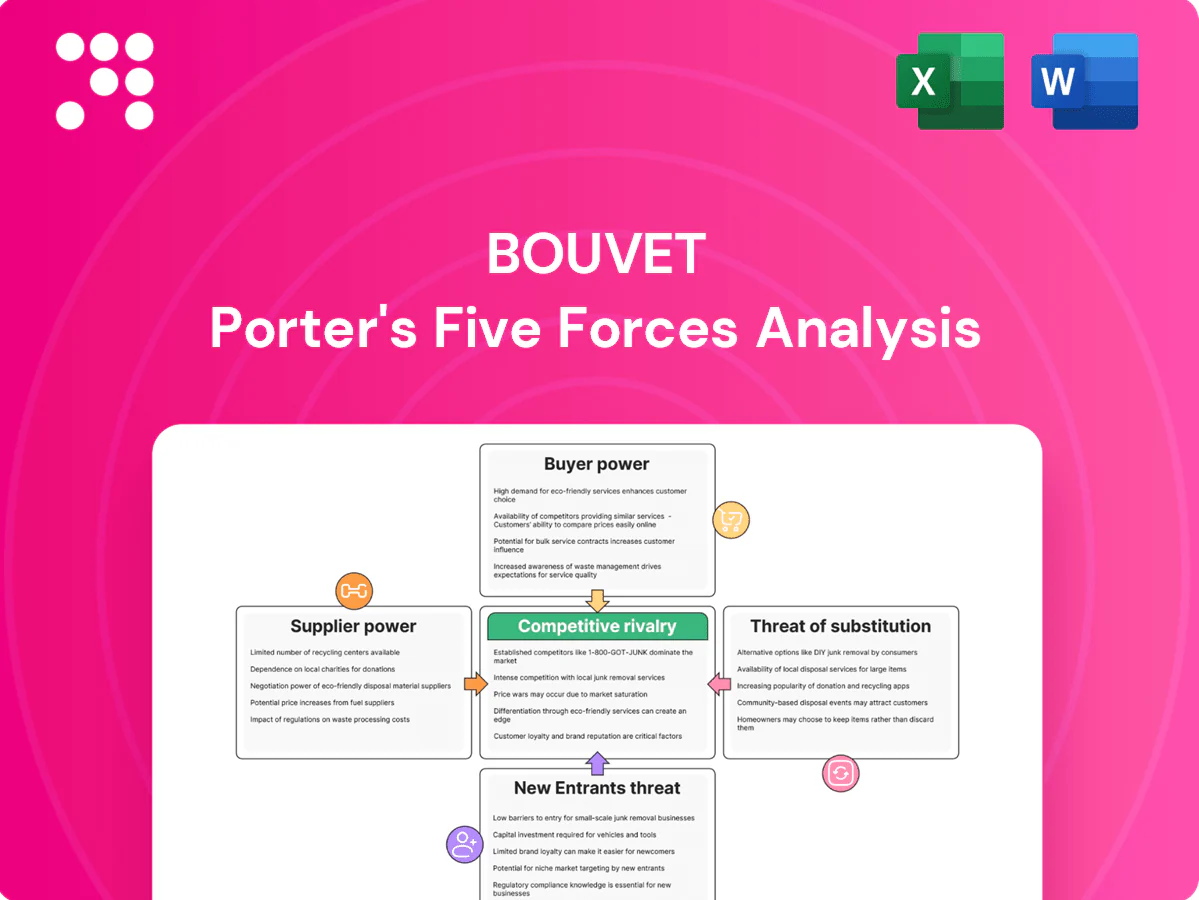
Bouvet Porter's Five Forces Analysis

Don't Miss the Bigger Picture
Bouvet’s Porter's Five Forces snapshot highlights supplier leverage, client bargaining power, threat of substitutes, new entrants, and competitive rivalry to frame its strategic position. Early findings show moderate buyer power, high service differentiation, and niche entry barriers that shape margins. This brief snapshot only scratches the surface. Unlock the full Porter's Five Forces Analysis to explore Bouvet’s competitive dynamics, market pressures, and strategic advantages in detail.
Suppliers Bargaining Power

Scarce senior tech talent
Highly skilled cloud, data and cybersecurity consultants are scarce, giving the labor market strong bargaining power; industry surveys in 2024 reported roughly 68% of firms facing tech-hiring difficulties. Salary inflation and retention bonuses have pushed delivery costs up materially. Bouvet mitigates via a strong employer brand and training pipelines, yet niche expertise remains pricey and fiercely contested.
Dependence on hyperscalers
Partnerships with Microsoft, AWS and Google materially shape Bouvet’s solution roadmaps and pricing, given global 2024 IaaS/PaaS shares of roughly AWS 31%, Azure 24% and GCP 11%. Certification changes or partner tier shifts can tighten access and compress project margins. Bouvet actively diversifies partners and invests in multi‑cloud skills. Switching core stacks remains costly and time‑consuming.

Specialist software vendors
Licensing for analytics, DevOps and design tools is negotiable but vendors retain IP leverage, with vendor price increases of roughly 5–8% reported in 2024. Bouvet offsets impacts via volume deals that can secure up to 25–30% discounts and wider use of open-source stacks. Open-source was used in over 70% of Bouvet client projects in 2024. Large enterprise clients nonetheless frequently mandate specific toolchains, constraining supplier leverage mitigation.

Contracting and subcontractors
Niche subcontractors fill Bouvet’s capacity and skills gaps but commonly command premiums up to 30% in 2024; availability tightens in peak demand periods, further elevating supplier power. Bouvet mitigates this through framework agreements and preferred supplier lists that can cut spot costs by roughly 10–15%. Last-minute needs, however, materially reduce negotiating room and increase margin pressure.
- Premiums: up to 30% (2024)
- Framework savings: ~10–15%
- Peak availability raises bargaining power
- Urgent hires weaken Bouvet’s negotiating leverage
Regulatory and compliance inputs
Security certifications, data residency rules and audit requirements act as supplier constraints for Bouvet: third-party accreditation bodies impose timelines and fees, with ISO 27001 audits commonly costing €5,000–€30,000 and taking 3–6 months. Bouvet invests in compliance readiness to lower friction, but mandated standards reduce flexibility and elevate operating costs.
- Security certifications: recurring audit fees
- Data residency: hosting constraints, potential latency/costs
- Audit timelines: 3–6 months typical
- Compliance investment: reduces friction but raises OPEX
Suppliers squeeze: 68% hiring pain, costs +5–30%, frameworks save 10–15%
Suppliers (specialist talent, cloud partners, tool vendors, subcontractors, cert bodies) exert moderate–high power: 68% of firms report tech hiring difficulty (2024); AWS/Azure/GCP shares ~31/24/11%; vendor price rises 5–8% and subcontractor premiums up to 30% while framework deals save ~10–15%.
| Metric | 2024 |
|---|---|
| Hiring difficulty | 68% |
| IaaS share (AWS/Azure/GCP) | 31/24/11% |
| Cost impacts (vendor/subcontractor/framework) | 5–8% / up to 30% / 10–15% |
What is included in the product
 Detailed Word Document
Tailored Porter's Five Forces analysis for Bouvet that uncovers key drivers of competition, buyer and supplier power, and market entry risks. Identifies disruptive substitutes and strategic barriers protecting incumbents, with commentary for investor reports and strategy decks.

 Customizable Excel Spreadsheet
Bouvet Porter's Five Forces delivers a one-sheet, customizable summary with adjustable pressure levels and an instant spider/radar chart—perfect for quick strategic decisions and slide-ready boardroom visuals. No macros or complex code, so teams can swap data, duplicate scenarios, and embed results into wider reports with minimal setup.
Customers Bargaining Power

Large enterprise procurement
Government and blue-chip clients run competitive tenders that compress prices and margins; in 2024 public tenders remained central to demand. Framework agreements and strict SLAs move delivery risk onto vendors. Bouvet leverages proven delivery, client references and NOK 3.2bn 2024 revenue to defend pricing. Ongoing buyer consolidation, however, raises negotiating clout.
Low switching barriers
Consulting deliverables and skills are highly portable, enabling client-side vendor rotation and making engagements contestable; the global consulting market was about USD 300bn in 2024. Multi-vendor models let clients reallocate scope quickly, increasing price pressure. Bouvet mitigates churn by offering managed services and long-term embedded teams that create operational stickiness. Still, time-and-materials work remains easily contestable across suppliers.

High price transparency
Rate cards and market benchmarks make Bouvet pricing directly comparable; standardized hourly rates and T&M benchmarks drive transparency. Buyers routinely demand volume or tenure discounts of roughly 10–20% on projects. Bouvet offsets pressure by selling outcomes and domain expertise, showing higher client retention and premium pricing power. Still, procurement focuses on total cost in about 70% of RFPs, limiting nuance.

Demand for measurable ROI
Clients demand clear business cases for digital spend; in 2024 about 58% of Nordic buyers set explicit ROI targets, pushing outcome-based contracts that raise accountability and margin risk. Bouvet mitigates this with agile metrics and continuous value tracking, yet delayed benefits still trigger scope creep and fee pressure.
- Clients: explicit ROI expectations (2024: 58%)
- Contracts: outcome-linked fees → higher margin risk
- Bouvet: agile metrics & value tracking
- Risk: delayed benefits → scope or fee compression
Insourcing capability growth
In 2024 many clients build internal product and platform teams, reducing external spend or shifting engagements to niche advisory. Bouvet positions as a capability builder and co-creator, offering upskilling, joint delivery and hybrid operating models. Nevertheless mature clients can repatriate run-rate work in-house, creating margin pressure on commoditised services.
- Insourcing trend: reduces demand for long-term external run-rates
- Bowet role: capability builder and co-creator
- Risk: mature clients replace operational services in-house
Tenders and buyer consolidation squeezed 2024 margins; ~70% RFPs cost-led
Public tenders and buyer consolidation compressed margins in 2024 despite Bouvet's NOK 3.2bn revenue; ~70% of RFPs prioritise total cost. Portable consulting skills and standardised rate cards (10–20% typical discount demands) increase contestability. Insourcing and ROI demands (58% of Nordic buyers set explicit ROI targets) raise pressure on run-rate services and outcome-linked fees.
| Metric | 2024 | Impact |
|---|---|---|
| Revenue | NOK 3.2bn | Pricing defence |
| RFP cost focus | ~70% | Price pressure |
| ROI demands | 58% | Outcome risk |
| Discounts sought | 10–20% | Margin squeeze |
Preview Before You Purchase
Bouvet Porter's Five Forces Analysis
This preview shows the exact Bouvet Porter's Five Forces analysis you'll receive immediately after purchase—no surprises, no placeholders. It includes full assessments of competitive rivalry, supplier and buyer power, threat of substitutes and new entrants, plus strategic implications and actionable recommendations, fully formatted and ready to download. You're viewing the final deliverable; purchase grants instant access to this same file.

Don't Miss the Bigger Picture
Bouvet’s Porter's Five Forces snapshot highlights supplier leverage, client bargaining power, threat of substitutes, new entrants, and competitive rivalry to frame its strategic position. Early findings show moderate buyer power, high service differentiation, and niche entry barriers that shape margins. This brief snapshot only scratches the surface. Unlock the full Porter's Five Forces Analysis to explore Bouvet’s competitive dynamics, market pressures, and strategic advantages in detail.
Suppliers Bargaining Power
Scarce senior tech talent
Highly skilled cloud, data and cybersecurity consultants are scarce, giving the labor market strong bargaining power; industry surveys in 2024 reported roughly 68% of firms facing tech-hiring difficulties. Salary inflation and retention bonuses have pushed delivery costs up materially. Bouvet mitigates via a strong employer brand and training pipelines, yet niche expertise remains pricey and fiercely contested.
Dependence on hyperscalers
Partnerships with Microsoft, AWS and Google materially shape Bouvet’s solution roadmaps and pricing, given global 2024 IaaS/PaaS shares of roughly AWS 31%, Azure 24% and GCP 11%. Certification changes or partner tier shifts can tighten access and compress project margins. Bouvet actively diversifies partners and invests in multi‑cloud skills. Switching core stacks remains costly and time‑consuming.
Specialist software vendors
Licensing for analytics, DevOps and design tools is negotiable but vendors retain IP leverage, with vendor price increases of roughly 5–8% reported in 2024. Bouvet offsets impacts via volume deals that can secure up to 25–30% discounts and wider use of open-source stacks. Open-source was used in over 70% of Bouvet client projects in 2024. Large enterprise clients nonetheless frequently mandate specific toolchains, constraining supplier leverage mitigation.
Contracting and subcontractors
Niche subcontractors fill Bouvet’s capacity and skills gaps but commonly command premiums up to 30% in 2024; availability tightens in peak demand periods, further elevating supplier power. Bouvet mitigates this through framework agreements and preferred supplier lists that can cut spot costs by roughly 10–15%. Last-minute needs, however, materially reduce negotiating room and increase margin pressure.
- Premiums: up to 30% (2024)
- Framework savings: ~10–15%
- Peak availability raises bargaining power
- Urgent hires weaken Bouvet’s negotiating leverage
Regulatory and compliance inputs
Security certifications, data residency rules and audit requirements act as supplier constraints for Bouvet: third-party accreditation bodies impose timelines and fees, with ISO 27001 audits commonly costing €5,000–€30,000 and taking 3–6 months. Bouvet invests in compliance readiness to lower friction, but mandated standards reduce flexibility and elevate operating costs.
- Security certifications: recurring audit fees
- Data residency: hosting constraints, potential latency/costs
- Audit timelines: 3–6 months typical
- Compliance investment: reduces friction but raises OPEX
Suppliers squeeze: 68% hiring pain, costs +5–30%, frameworks save 10–15%
Suppliers (specialist talent, cloud partners, tool vendors, subcontractors, cert bodies) exert moderate–high power: 68% of firms report tech hiring difficulty (2024); AWS/Azure/GCP shares ~31/24/11%; vendor price rises 5–8% and subcontractor premiums up to 30% while framework deals save ~10–15%.
| Metric | 2024 |
|---|---|
| Hiring difficulty | 68% |
| IaaS share (AWS/Azure/GCP) | 31/24/11% |
| Cost impacts (vendor/subcontractor/framework) | 5–8% / up to 30% / 10–15% |
What is included in the product
Detailed Word Document
Tailored Porter's Five Forces analysis for Bouvet that uncovers key drivers of competition, buyer and supplier power, and market entry risks. Identifies disruptive substitutes and strategic barriers protecting incumbents, with commentary for investor reports and strategy decks.
Customizable Excel Spreadsheet
Bouvet Porter's Five Forces delivers a one-sheet, customizable summary with adjustable pressure levels and an instant spider/radar chart—perfect for quick strategic decisions and slide-ready boardroom visuals. No macros or complex code, so teams can swap data, duplicate scenarios, and embed results into wider reports with minimal setup.
Customers Bargaining Power
Large enterprise procurement
Government and blue-chip clients run competitive tenders that compress prices and margins; in 2024 public tenders remained central to demand. Framework agreements and strict SLAs move delivery risk onto vendors. Bouvet leverages proven delivery, client references and NOK 3.2bn 2024 revenue to defend pricing. Ongoing buyer consolidation, however, raises negotiating clout.
Low switching barriers
Consulting deliverables and skills are highly portable, enabling client-side vendor rotation and making engagements contestable; the global consulting market was about USD 300bn in 2024. Multi-vendor models let clients reallocate scope quickly, increasing price pressure. Bouvet mitigates churn by offering managed services and long-term embedded teams that create operational stickiness. Still, time-and-materials work remains easily contestable across suppliers.
High price transparency
Rate cards and market benchmarks make Bouvet pricing directly comparable; standardized hourly rates and T&M benchmarks drive transparency. Buyers routinely demand volume or tenure discounts of roughly 10–20% on projects. Bouvet offsets pressure by selling outcomes and domain expertise, showing higher client retention and premium pricing power. Still, procurement focuses on total cost in about 70% of RFPs, limiting nuance.
Demand for measurable ROI
Clients demand clear business cases for digital spend; in 2024 about 58% of Nordic buyers set explicit ROI targets, pushing outcome-based contracts that raise accountability and margin risk. Bouvet mitigates this with agile metrics and continuous value tracking, yet delayed benefits still trigger scope creep and fee pressure.
- Clients: explicit ROI expectations (2024: 58%)
- Contracts: outcome-linked fees → higher margin risk
- Bouvet: agile metrics & value tracking
- Risk: delayed benefits → scope or fee compression
Insourcing capability growth
In 2024 many clients build internal product and platform teams, reducing external spend or shifting engagements to niche advisory. Bouvet positions as a capability builder and co-creator, offering upskilling, joint delivery and hybrid operating models. Nevertheless mature clients can repatriate run-rate work in-house, creating margin pressure on commoditised services.
- Insourcing trend: reduces demand for long-term external run-rates
- Bowet role: capability builder and co-creator
- Risk: mature clients replace operational services in-house
Tenders and buyer consolidation squeezed 2024 margins; ~70% RFPs cost-led
Public tenders and buyer consolidation compressed margins in 2024 despite Bouvet's NOK 3.2bn revenue; ~70% of RFPs prioritise total cost. Portable consulting skills and standardised rate cards (10–20% typical discount demands) increase contestability. Insourcing and ROI demands (58% of Nordic buyers set explicit ROI targets) raise pressure on run-rate services and outcome-linked fees.
| Metric | 2024 | Impact |
|---|---|---|
| Revenue | NOK 3.2bn | Pricing defence |
| RFP cost focus | ~70% | Price pressure |
| ROI demands | 58% | Outcome risk |
| Discounts sought | 10–20% | Margin squeeze |
Preview Before You Purchase
Bouvet Porter's Five Forces Analysis
This preview shows the exact Bouvet Porter's Five Forces analysis you'll receive immediately after purchase—no surprises, no placeholders. It includes full assessments of competitive rivalry, supplier and buyer power, threat of substitutes and new entrants, plus strategic implications and actionable recommendations, fully formatted and ready to download. You're viewing the final deliverable; purchase grants instant access to this same file.
Original: $10.00
-65%$10.00
$3.50Description
Don't Miss the Bigger Picture
Bouvet’s Porter's Five Forces snapshot highlights supplier leverage, client bargaining power, threat of substitutes, new entrants, and competitive rivalry to frame its strategic position. Early findings show moderate buyer power, high service differentiation, and niche entry barriers that shape margins. This brief snapshot only scratches the surface. Unlock the full Porter's Five Forces Analysis to explore Bouvet’s competitive dynamics, market pressures, and strategic advantages in detail.
Suppliers Bargaining Power
Scarce senior tech talent
Highly skilled cloud, data and cybersecurity consultants are scarce, giving the labor market strong bargaining power; industry surveys in 2024 reported roughly 68% of firms facing tech-hiring difficulties. Salary inflation and retention bonuses have pushed delivery costs up materially. Bouvet mitigates via a strong employer brand and training pipelines, yet niche expertise remains pricey and fiercely contested.
Dependence on hyperscalers
Partnerships with Microsoft, AWS and Google materially shape Bouvet’s solution roadmaps and pricing, given global 2024 IaaS/PaaS shares of roughly AWS 31%, Azure 24% and GCP 11%. Certification changes or partner tier shifts can tighten access and compress project margins. Bouvet actively diversifies partners and invests in multi‑cloud skills. Switching core stacks remains costly and time‑consuming.
Specialist software vendors
Licensing for analytics, DevOps and design tools is negotiable but vendors retain IP leverage, with vendor price increases of roughly 5–8% reported in 2024. Bouvet offsets impacts via volume deals that can secure up to 25–30% discounts and wider use of open-source stacks. Open-source was used in over 70% of Bouvet client projects in 2024. Large enterprise clients nonetheless frequently mandate specific toolchains, constraining supplier leverage mitigation.
Contracting and subcontractors
Niche subcontractors fill Bouvet’s capacity and skills gaps but commonly command premiums up to 30% in 2024; availability tightens in peak demand periods, further elevating supplier power. Bouvet mitigates this through framework agreements and preferred supplier lists that can cut spot costs by roughly 10–15%. Last-minute needs, however, materially reduce negotiating room and increase margin pressure.
- Premiums: up to 30% (2024)
- Framework savings: ~10–15%
- Peak availability raises bargaining power
- Urgent hires weaken Bouvet’s negotiating leverage
Regulatory and compliance inputs
Security certifications, data residency rules and audit requirements act as supplier constraints for Bouvet: third-party accreditation bodies impose timelines and fees, with ISO 27001 audits commonly costing €5,000–€30,000 and taking 3–6 months. Bouvet invests in compliance readiness to lower friction, but mandated standards reduce flexibility and elevate operating costs.
- Security certifications: recurring audit fees
- Data residency: hosting constraints, potential latency/costs
- Audit timelines: 3–6 months typical
- Compliance investment: reduces friction but raises OPEX
Suppliers squeeze: 68% hiring pain, costs +5–30%, frameworks save 10–15%
Suppliers (specialist talent, cloud partners, tool vendors, subcontractors, cert bodies) exert moderate–high power: 68% of firms report tech hiring difficulty (2024); AWS/Azure/GCP shares ~31/24/11%; vendor price rises 5–8% and subcontractor premiums up to 30% while framework deals save ~10–15%.
| Metric | 2024 |
|---|---|
| Hiring difficulty | 68% |
| IaaS share (AWS/Azure/GCP) | 31/24/11% |
| Cost impacts (vendor/subcontractor/framework) | 5–8% / up to 30% / 10–15% |
What is included in the product
Detailed Word Document
Tailored Porter's Five Forces analysis for Bouvet that uncovers key drivers of competition, buyer and supplier power, and market entry risks. Identifies disruptive substitutes and strategic barriers protecting incumbents, with commentary for investor reports and strategy decks.
Customizable Excel Spreadsheet
Bouvet Porter's Five Forces delivers a one-sheet, customizable summary with adjustable pressure levels and an instant spider/radar chart—perfect for quick strategic decisions and slide-ready boardroom visuals. No macros or complex code, so teams can swap data, duplicate scenarios, and embed results into wider reports with minimal setup.
Customers Bargaining Power
Large enterprise procurement
Government and blue-chip clients run competitive tenders that compress prices and margins; in 2024 public tenders remained central to demand. Framework agreements and strict SLAs move delivery risk onto vendors. Bouvet leverages proven delivery, client references and NOK 3.2bn 2024 revenue to defend pricing. Ongoing buyer consolidation, however, raises negotiating clout.
Low switching barriers
Consulting deliverables and skills are highly portable, enabling client-side vendor rotation and making engagements contestable; the global consulting market was about USD 300bn in 2024. Multi-vendor models let clients reallocate scope quickly, increasing price pressure. Bouvet mitigates churn by offering managed services and long-term embedded teams that create operational stickiness. Still, time-and-materials work remains easily contestable across suppliers.
High price transparency
Rate cards and market benchmarks make Bouvet pricing directly comparable; standardized hourly rates and T&M benchmarks drive transparency. Buyers routinely demand volume or tenure discounts of roughly 10–20% on projects. Bouvet offsets pressure by selling outcomes and domain expertise, showing higher client retention and premium pricing power. Still, procurement focuses on total cost in about 70% of RFPs, limiting nuance.
Demand for measurable ROI
Clients demand clear business cases for digital spend; in 2024 about 58% of Nordic buyers set explicit ROI targets, pushing outcome-based contracts that raise accountability and margin risk. Bouvet mitigates this with agile metrics and continuous value tracking, yet delayed benefits still trigger scope creep and fee pressure.
- Clients: explicit ROI expectations (2024: 58%)
- Contracts: outcome-linked fees → higher margin risk
- Bouvet: agile metrics & value tracking
- Risk: delayed benefits → scope or fee compression
Insourcing capability growth
In 2024 many clients build internal product and platform teams, reducing external spend or shifting engagements to niche advisory. Bouvet positions as a capability builder and co-creator, offering upskilling, joint delivery and hybrid operating models. Nevertheless mature clients can repatriate run-rate work in-house, creating margin pressure on commoditised services.
- Insourcing trend: reduces demand for long-term external run-rates
- Bowet role: capability builder and co-creator
- Risk: mature clients replace operational services in-house
Tenders and buyer consolidation squeezed 2024 margins; ~70% RFPs cost-led
Public tenders and buyer consolidation compressed margins in 2024 despite Bouvet's NOK 3.2bn revenue; ~70% of RFPs prioritise total cost. Portable consulting skills and standardised rate cards (10–20% typical discount demands) increase contestability. Insourcing and ROI demands (58% of Nordic buyers set explicit ROI targets) raise pressure on run-rate services and outcome-linked fees.
| Metric | 2024 | Impact |
|---|---|---|
| Revenue | NOK 3.2bn | Pricing defence |
| RFP cost focus | ~70% | Price pressure |
| ROI demands | 58% | Outcome risk |
| Discounts sought | 10–20% | Margin squeeze |
Preview Before You Purchase
Bouvet Porter's Five Forces Analysis
This preview shows the exact Bouvet Porter's Five Forces analysis you'll receive immediately after purchase—no surprises, no placeholders. It includes full assessments of competitive rivalry, supplier and buyer power, threat of substitutes and new entrants, plus strategic implications and actionable recommendations, fully formatted and ready to download. You're viewing the final deliverable; purchase grants instant access to this same file.











