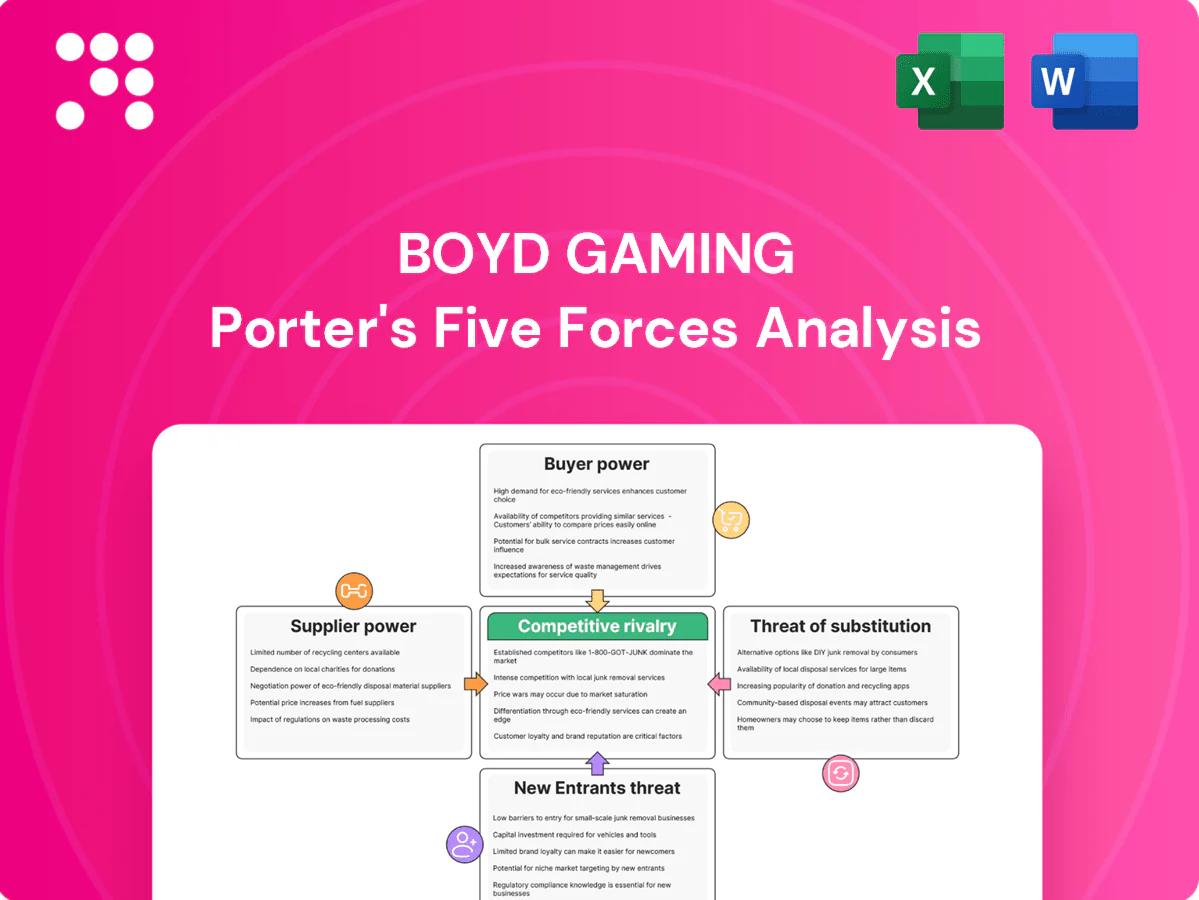
Boyd Gaming Porter's Five Forces Analysis

From Overview to Strategy Blueprint
Boyd Gaming faces intense rivalry among regional casinos, moderate buyer power, constrained supplier influence, rising substitute threats from online gaming, and modest barriers to entry that shape its strategic choices. This brief snapshot only scratches the surface. Unlock the full Porter's Five Forces Analysis to explore Boyd Gaming’s competitive dynamics, market pressures, and strategic advantages in detail.
Suppliers Bargaining Power

Concentrated gaming tech vendors
Slot and table-system supply is concentrated: IGT, Aristocrat and Light & Wonder together account for roughly 70% of the US installed slot base in 2024, giving vendors outsized leverage. Proprietary content and 7–10 year replacement cycles make switching costly and slow. Vendors can set pricing, maintenance and upgrade cadence, while Boyd — with 29 properties in 2024 — offsets pressure through scale purchasing and multi-vendor sourcing.
Sportsbook and iGaming platforms
Odds feeds, risk engines and platform providers remain specialized with key suppliers in 2024 including Sportradar, Kambi and OpenBet, limiting Boyd Gaming’s alternatives. Integration complexity and regulatory certifications (platform, AML, local licences) raise switching costs and timelines. Revenue-share models can shift economics toward suppliers in peak sports seasons. Strategic partnerships diversify exposure but do not fully remove supplier leverage.

Food, beverage, and branded concepts
Premium F&B and branded concepts at Boyd can extract favorable terms and marketing commitments, especially across Boyd’s ~29 domestic properties in 2024. Food-input supply volatility has pressured margins industrywide, affecting availability and driving periodic price spikes. Long-term leases and franchise agreements constrain Boyd’s flexibility, but the company offsets this with a mix of in-house outlets and multiple regional distributors to diversify supply risk.

Labor and union dynamics
Skilled labor in gaming, surveillance, and hospitality is highly specialized, and Boyd’s workforce intensity is affected by union contracts (notably in Nevada) that fix wages, benefits, and scheduling, reducing short-term cost flexibility. Tight U.S. labor markets (annual unemployment ~4.0% in 2024) elevated employee bargaining power and wage pressure. Boyd offsets this via targeted training, retention programs and tech investments to improve productivity across its ~30 properties.
- Specialized roles: gaming, surveillance, hospitality
- Union constraints: set wages/benefits/schedules
- Labor market 2024: U.S. unemployment ~4.0%
- Boyd actions: training, retention, technology
Utilities and facility services
Casinos are energy- and water-intensive and tied to local utility monopolies; Boyd Gaming operated 29 properties in 2024, concentrating exposure to local tariffs and water rates and limiting supplier bargaining. Maintenance, security tech and cleaning vendors are sticky due to regulatory and compliance needs. Long-term utility and service contracts plus efficiency investments (LED, recycling) temper raw cost pressure.
- High dependency: 29 properties (2024) increases local utility exposure
- Low supplier leverage: limited alternative providers for power/water
- Vendor stickiness: compliance-bound maintenance/security/cleaning suppliers
- Mitigants: long-term contracts and efficiency capex reduce downside
Slot vendor dominance (~70% installed) heightens supplier power across 29 properties
Supplier power is moderate-high: top slot vendors (IGT, Aristocrat, Light & Wonder) hold ~70% of the US installed base in 2024, raising switching costs across Boyd’s 29 properties. Specialized platform/odds providers and unionized labor (U.S. unemployment ~4.0% in 2024) limit alternatives, while utility monopolies create local tariff exposure. Boyd mitigates via scale purchasing, multi-vendor sourcing, long-term contracts and efficiency capex.
| Supplier | 2024 metric | Impact | Mitigant |
|---|---|---|---|
| Slot vendors | ~70% installed | High pricing power | Multi-vendor, scale |
| Platform/odds | Sportradar/Kambi dominant | High integration cost | Partnerships |
| Labor | U.S. unemployment ~4.0% | Wage pressure | Training, tech |
| Utilities | 29 properties exposure | Tariff risk | Efficiency capex |
What is included in the product
 Detailed Word Document
Concise Porter's Five Forces analysis tailored to Boyd Gaming, assessing competitive rivalry, buyer and supplier power, substitution risks, and entry barriers to highlight strategic vulnerabilities and growth levers.

 Customizable Excel Spreadsheet
A one-sheet Porter’s Five Forces for Boyd Gaming that highlights competitive pressures, regulatory and casino-market risks, and supplier/buyer bargaining—so executives can quickly pinpoint pain points and prioritize targeted mitigation and strategic actions.
Customers Bargaining Power

Local/regional patrons with easy switching
Local and regional patrons can easily switch among nearby casinos, tribal venues and entertainment options, keeping monetary switching costs low while time and travel are the main frictions; promotions and comps rapidly shift visitation. Boyd’s neighborhood footprint across 29 properties in 2024 and focus on convenience aim to anchor loyalty through B Connected offers and localized marketing.
Loyalty programs moderate price sensitivity
Boyd's tiered B Connected rewards—free play, tiered credits, and room comps across 29+ properties—reduce churn by locking customers into escalating benefits. Data-driven offers based on play patterns personalize value and soften buyer leverage. Players still shop earn rates across rivals, pressuring promotion design. Boyd counters with profitability analytics to calibrate generosity and protect margins.

Group, convention, and event segments
Block bookings and event organizers negotiate aggressively on rates and perks, often securing discounts in the 20–30% range and added concessions to lock inventory for large groups.
Seasonality and calendar gaps shift leverage to buyers on off-peak dates, when hotel occupancy can dip below 60%, increasing pressure to concede on rates.
Packing gaming with rooms and F&B helps defend margins, while venue differentiation and headline entertainment can lift ADRs by roughly 15–25%, shaping buyer choice.

Digital bettors expect value and UX
Digital bettors routinely compare odds, promos and app performance across brands, and by 2024 more than 30 US states offered legal sports betting with mobile channels driving the majority of volume, so low friction to switch elevates buyer power and forces continuous promotions; integrating on-property rewards with digital play materially increases retention.
- Compare: odds, promos, UX
- Switching: low friction, high buyer power
- Retention: continuous promos needed
- Lock-in: link on-property rewards to digital
Price-sensitive mass market
Price-sensitive mass market: economic downturns increase elasticity among mid- to low-tier patrons, who typically cut F&B and room spend before reducing gaming; Boyd, with about 29 properties, sees visit-frequency fall risk but steadier gaming hold per visit.
- Guests trade down on F&B/rooms before gaming
- Transparent fees/parking shift perceived value
- Boyd tailors offers to protect visits and wallet share
Customers wield leverage across 29 properties and 30+ betting states; off-peak <60%, ADR +15–25%
Customers wield elevated bargaining power: low switching costs across 29 Boyd properties and 30+ US sports-betting states force continuous promos and personalized B Connected offers to retain spend. Off-peak hotel occupancy often falls below 60%, increasing concessioning for room/group rates (typical discounts 20–30%) while headline acts can lift ADRs ~15–25%.
| Metric | Value |
|---|---|
| Boyd properties (2024) | 29 |
| Legal sports betting states (2024) | 30+ |
| Off-peak occupancy | <60% |
| Group discount range | 20–30% |
| ADR lift from headline | 15–25% |
Preview Before You Purchase
Boyd Gaming Porter's Five Forces Analysis
This preview shows the exact Boyd Gaming Porter’s Five Forces analysis you'll receive—fully formatted and ready for immediate download after purchase. It delivers a grounded assessment of rivalry, buyer and supplier power, threat of substitutes, and barriers to entry with actionable insights for investors and strategists. No samples or placeholders—this is the complete document you will get.

From Overview to Strategy Blueprint
Boyd Gaming faces intense rivalry among regional casinos, moderate buyer power, constrained supplier influence, rising substitute threats from online gaming, and modest barriers to entry that shape its strategic choices. This brief snapshot only scratches the surface. Unlock the full Porter's Five Forces Analysis to explore Boyd Gaming’s competitive dynamics, market pressures, and strategic advantages in detail.
Suppliers Bargaining Power
Concentrated gaming tech vendors
Slot and table-system supply is concentrated: IGT, Aristocrat and Light & Wonder together account for roughly 70% of the US installed slot base in 2024, giving vendors outsized leverage. Proprietary content and 7–10 year replacement cycles make switching costly and slow. Vendors can set pricing, maintenance and upgrade cadence, while Boyd — with 29 properties in 2024 — offsets pressure through scale purchasing and multi-vendor sourcing.
Sportsbook and iGaming platforms
Odds feeds, risk engines and platform providers remain specialized with key suppliers in 2024 including Sportradar, Kambi and OpenBet, limiting Boyd Gaming’s alternatives. Integration complexity and regulatory certifications (platform, AML, local licences) raise switching costs and timelines. Revenue-share models can shift economics toward suppliers in peak sports seasons. Strategic partnerships diversify exposure but do not fully remove supplier leverage.
Food, beverage, and branded concepts
Premium F&B and branded concepts at Boyd can extract favorable terms and marketing commitments, especially across Boyd’s ~29 domestic properties in 2024. Food-input supply volatility has pressured margins industrywide, affecting availability and driving periodic price spikes. Long-term leases and franchise agreements constrain Boyd’s flexibility, but the company offsets this with a mix of in-house outlets and multiple regional distributors to diversify supply risk.
Labor and union dynamics
Skilled labor in gaming, surveillance, and hospitality is highly specialized, and Boyd’s workforce intensity is affected by union contracts (notably in Nevada) that fix wages, benefits, and scheduling, reducing short-term cost flexibility. Tight U.S. labor markets (annual unemployment ~4.0% in 2024) elevated employee bargaining power and wage pressure. Boyd offsets this via targeted training, retention programs and tech investments to improve productivity across its ~30 properties.
- Specialized roles: gaming, surveillance, hospitality
- Union constraints: set wages/benefits/schedules
- Labor market 2024: U.S. unemployment ~4.0%
- Boyd actions: training, retention, technology
Utilities and facility services
Casinos are energy- and water-intensive and tied to local utility monopolies; Boyd Gaming operated 29 properties in 2024, concentrating exposure to local tariffs and water rates and limiting supplier bargaining. Maintenance, security tech and cleaning vendors are sticky due to regulatory and compliance needs. Long-term utility and service contracts plus efficiency investments (LED, recycling) temper raw cost pressure.
- High dependency: 29 properties (2024) increases local utility exposure
- Low supplier leverage: limited alternative providers for power/water
- Vendor stickiness: compliance-bound maintenance/security/cleaning suppliers
- Mitigants: long-term contracts and efficiency capex reduce downside
Slot vendor dominance (~70% installed) heightens supplier power across 29 properties
Supplier power is moderate-high: top slot vendors (IGT, Aristocrat, Light & Wonder) hold ~70% of the US installed base in 2024, raising switching costs across Boyd’s 29 properties. Specialized platform/odds providers and unionized labor (U.S. unemployment ~4.0% in 2024) limit alternatives, while utility monopolies create local tariff exposure. Boyd mitigates via scale purchasing, multi-vendor sourcing, long-term contracts and efficiency capex.
| Supplier | 2024 metric | Impact | Mitigant |
|---|---|---|---|
| Slot vendors | ~70% installed | High pricing power | Multi-vendor, scale |
| Platform/odds | Sportradar/Kambi dominant | High integration cost | Partnerships |
| Labor | U.S. unemployment ~4.0% | Wage pressure | Training, tech |
| Utilities | 29 properties exposure | Tariff risk | Efficiency capex |
What is included in the product
Detailed Word Document
Concise Porter's Five Forces analysis tailored to Boyd Gaming, assessing competitive rivalry, buyer and supplier power, substitution risks, and entry barriers to highlight strategic vulnerabilities and growth levers.
Customizable Excel Spreadsheet
A one-sheet Porter’s Five Forces for Boyd Gaming that highlights competitive pressures, regulatory and casino-market risks, and supplier/buyer bargaining—so executives can quickly pinpoint pain points and prioritize targeted mitigation and strategic actions.
Customers Bargaining Power
Local/regional patrons with easy switching
Local and regional patrons can easily switch among nearby casinos, tribal venues and entertainment options, keeping monetary switching costs low while time and travel are the main frictions; promotions and comps rapidly shift visitation. Boyd’s neighborhood footprint across 29 properties in 2024 and focus on convenience aim to anchor loyalty through B Connected offers and localized marketing.
Loyalty programs moderate price sensitivity
Boyd's tiered B Connected rewards—free play, tiered credits, and room comps across 29+ properties—reduce churn by locking customers into escalating benefits. Data-driven offers based on play patterns personalize value and soften buyer leverage. Players still shop earn rates across rivals, pressuring promotion design. Boyd counters with profitability analytics to calibrate generosity and protect margins.
Group, convention, and event segments
Block bookings and event organizers negotiate aggressively on rates and perks, often securing discounts in the 20–30% range and added concessions to lock inventory for large groups.
Seasonality and calendar gaps shift leverage to buyers on off-peak dates, when hotel occupancy can dip below 60%, increasing pressure to concede on rates.
Packing gaming with rooms and F&B helps defend margins, while venue differentiation and headline entertainment can lift ADRs by roughly 15–25%, shaping buyer choice.
Digital bettors expect value and UX
Digital bettors routinely compare odds, promos and app performance across brands, and by 2024 more than 30 US states offered legal sports betting with mobile channels driving the majority of volume, so low friction to switch elevates buyer power and forces continuous promotions; integrating on-property rewards with digital play materially increases retention.
- Compare: odds, promos, UX
- Switching: low friction, high buyer power
- Retention: continuous promos needed
- Lock-in: link on-property rewards to digital
Price-sensitive mass market
Price-sensitive mass market: economic downturns increase elasticity among mid- to low-tier patrons, who typically cut F&B and room spend before reducing gaming; Boyd, with about 29 properties, sees visit-frequency fall risk but steadier gaming hold per visit.
- Guests trade down on F&B/rooms before gaming
- Transparent fees/parking shift perceived value
- Boyd tailors offers to protect visits and wallet share
Customers wield leverage across 29 properties and 30+ betting states; off-peak <60%, ADR +15–25%
Customers wield elevated bargaining power: low switching costs across 29 Boyd properties and 30+ US sports-betting states force continuous promos and personalized B Connected offers to retain spend. Off-peak hotel occupancy often falls below 60%, increasing concessioning for room/group rates (typical discounts 20–30%) while headline acts can lift ADRs ~15–25%.
| Metric | Value |
|---|---|
| Boyd properties (2024) | 29 |
| Legal sports betting states (2024) | 30+ |
| Off-peak occupancy | <60% |
| Group discount range | 20–30% |
| ADR lift from headline | 15–25% |
Preview Before You Purchase
Boyd Gaming Porter's Five Forces Analysis
This preview shows the exact Boyd Gaming Porter’s Five Forces analysis you'll receive—fully formatted and ready for immediate download after purchase. It delivers a grounded assessment of rivalry, buyer and supplier power, threat of substitutes, and barriers to entry with actionable insights for investors and strategists. No samples or placeholders—this is the complete document you will get.
Description
From Overview to Strategy Blueprint
Boyd Gaming faces intense rivalry among regional casinos, moderate buyer power, constrained supplier influence, rising substitute threats from online gaming, and modest barriers to entry that shape its strategic choices. This brief snapshot only scratches the surface. Unlock the full Porter's Five Forces Analysis to explore Boyd Gaming’s competitive dynamics, market pressures, and strategic advantages in detail.
Suppliers Bargaining Power
Concentrated gaming tech vendors
Slot and table-system supply is concentrated: IGT, Aristocrat and Light & Wonder together account for roughly 70% of the US installed slot base in 2024, giving vendors outsized leverage. Proprietary content and 7–10 year replacement cycles make switching costly and slow. Vendors can set pricing, maintenance and upgrade cadence, while Boyd — with 29 properties in 2024 — offsets pressure through scale purchasing and multi-vendor sourcing.
Sportsbook and iGaming platforms
Odds feeds, risk engines and platform providers remain specialized with key suppliers in 2024 including Sportradar, Kambi and OpenBet, limiting Boyd Gaming’s alternatives. Integration complexity and regulatory certifications (platform, AML, local licences) raise switching costs and timelines. Revenue-share models can shift economics toward suppliers in peak sports seasons. Strategic partnerships diversify exposure but do not fully remove supplier leverage.
Food, beverage, and branded concepts
Premium F&B and branded concepts at Boyd can extract favorable terms and marketing commitments, especially across Boyd’s ~29 domestic properties in 2024. Food-input supply volatility has pressured margins industrywide, affecting availability and driving periodic price spikes. Long-term leases and franchise agreements constrain Boyd’s flexibility, but the company offsets this with a mix of in-house outlets and multiple regional distributors to diversify supply risk.
Labor and union dynamics
Skilled labor in gaming, surveillance, and hospitality is highly specialized, and Boyd’s workforce intensity is affected by union contracts (notably in Nevada) that fix wages, benefits, and scheduling, reducing short-term cost flexibility. Tight U.S. labor markets (annual unemployment ~4.0% in 2024) elevated employee bargaining power and wage pressure. Boyd offsets this via targeted training, retention programs and tech investments to improve productivity across its ~30 properties.
- Specialized roles: gaming, surveillance, hospitality
- Union constraints: set wages/benefits/schedules
- Labor market 2024: U.S. unemployment ~4.0%
- Boyd actions: training, retention, technology
Utilities and facility services
Casinos are energy- and water-intensive and tied to local utility monopolies; Boyd Gaming operated 29 properties in 2024, concentrating exposure to local tariffs and water rates and limiting supplier bargaining. Maintenance, security tech and cleaning vendors are sticky due to regulatory and compliance needs. Long-term utility and service contracts plus efficiency investments (LED, recycling) temper raw cost pressure.
- High dependency: 29 properties (2024) increases local utility exposure
- Low supplier leverage: limited alternative providers for power/water
- Vendor stickiness: compliance-bound maintenance/security/cleaning suppliers
- Mitigants: long-term contracts and efficiency capex reduce downside
Slot vendor dominance (~70% installed) heightens supplier power across 29 properties
Supplier power is moderate-high: top slot vendors (IGT, Aristocrat, Light & Wonder) hold ~70% of the US installed base in 2024, raising switching costs across Boyd’s 29 properties. Specialized platform/odds providers and unionized labor (U.S. unemployment ~4.0% in 2024) limit alternatives, while utility monopolies create local tariff exposure. Boyd mitigates via scale purchasing, multi-vendor sourcing, long-term contracts and efficiency capex.
| Supplier | 2024 metric | Impact | Mitigant |
|---|---|---|---|
| Slot vendors | ~70% installed | High pricing power | Multi-vendor, scale |
| Platform/odds | Sportradar/Kambi dominant | High integration cost | Partnerships |
| Labor | U.S. unemployment ~4.0% | Wage pressure | Training, tech |
| Utilities | 29 properties exposure | Tariff risk | Efficiency capex |
What is included in the product
Detailed Word Document
Concise Porter's Five Forces analysis tailored to Boyd Gaming, assessing competitive rivalry, buyer and supplier power, substitution risks, and entry barriers to highlight strategic vulnerabilities and growth levers.
Customizable Excel Spreadsheet
A one-sheet Porter’s Five Forces for Boyd Gaming that highlights competitive pressures, regulatory and casino-market risks, and supplier/buyer bargaining—so executives can quickly pinpoint pain points and prioritize targeted mitigation and strategic actions.
Customers Bargaining Power
Local/regional patrons with easy switching
Local and regional patrons can easily switch among nearby casinos, tribal venues and entertainment options, keeping monetary switching costs low while time and travel are the main frictions; promotions and comps rapidly shift visitation. Boyd’s neighborhood footprint across 29 properties in 2024 and focus on convenience aim to anchor loyalty through B Connected offers and localized marketing.
Loyalty programs moderate price sensitivity
Boyd's tiered B Connected rewards—free play, tiered credits, and room comps across 29+ properties—reduce churn by locking customers into escalating benefits. Data-driven offers based on play patterns personalize value and soften buyer leverage. Players still shop earn rates across rivals, pressuring promotion design. Boyd counters with profitability analytics to calibrate generosity and protect margins.
Group, convention, and event segments
Block bookings and event organizers negotiate aggressively on rates and perks, often securing discounts in the 20–30% range and added concessions to lock inventory for large groups.
Seasonality and calendar gaps shift leverage to buyers on off-peak dates, when hotel occupancy can dip below 60%, increasing pressure to concede on rates.
Packing gaming with rooms and F&B helps defend margins, while venue differentiation and headline entertainment can lift ADRs by roughly 15–25%, shaping buyer choice.
Digital bettors expect value and UX
Digital bettors routinely compare odds, promos and app performance across brands, and by 2024 more than 30 US states offered legal sports betting with mobile channels driving the majority of volume, so low friction to switch elevates buyer power and forces continuous promotions; integrating on-property rewards with digital play materially increases retention.
- Compare: odds, promos, UX
- Switching: low friction, high buyer power
- Retention: continuous promos needed
- Lock-in: link on-property rewards to digital
Price-sensitive mass market
Price-sensitive mass market: economic downturns increase elasticity among mid- to low-tier patrons, who typically cut F&B and room spend before reducing gaming; Boyd, with about 29 properties, sees visit-frequency fall risk but steadier gaming hold per visit.
- Guests trade down on F&B/rooms before gaming
- Transparent fees/parking shift perceived value
- Boyd tailors offers to protect visits and wallet share
Customers wield leverage across 29 properties and 30+ betting states; off-peak <60%, ADR +15–25%
Customers wield elevated bargaining power: low switching costs across 29 Boyd properties and 30+ US sports-betting states force continuous promos and personalized B Connected offers to retain spend. Off-peak hotel occupancy often falls below 60%, increasing concessioning for room/group rates (typical discounts 20–30%) while headline acts can lift ADRs ~15–25%.
| Metric | Value |
|---|---|
| Boyd properties (2024) | 29 |
| Legal sports betting states (2024) | 30+ |
| Off-peak occupancy | <60% |
| Group discount range | 20–30% |
| ADR lift from headline | 15–25% |
Preview Before You Purchase
Boyd Gaming Porter's Five Forces Analysis
This preview shows the exact Boyd Gaming Porter’s Five Forces analysis you'll receive—fully formatted and ready for immediate download after purchase. It delivers a grounded assessment of rivalry, buyer and supplier power, threat of substitutes, and barriers to entry with actionable insights for investors and strategists. No samples or placeholders—this is the complete document you will get.











