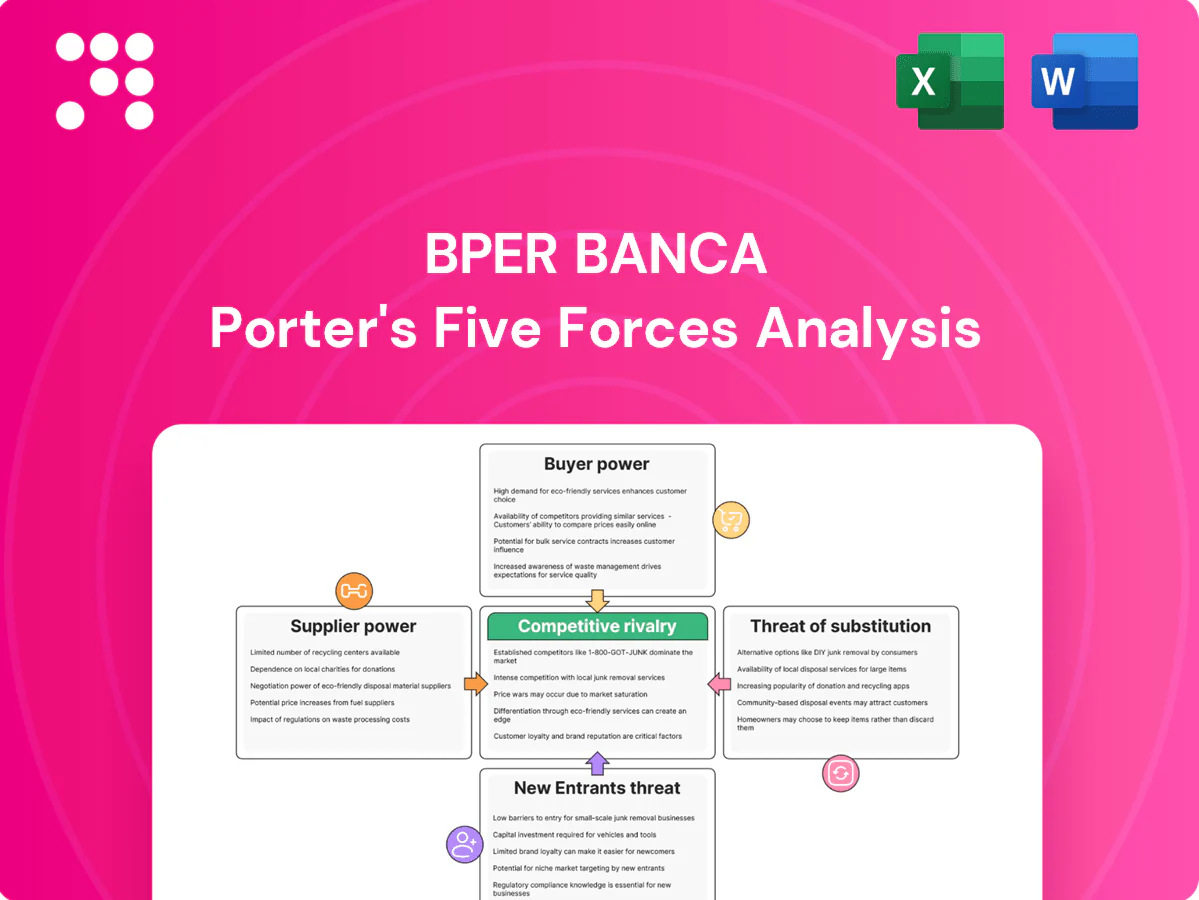
BPER Banca Porter's Five Forces Analysis

From Overview to Strategy Blueprint
BPER Banca faces moderate buyer power, intense local competition, and regulatory pressure that shape margins and growth prospects. Supplier power is limited, while digital entrants and fintechs pose a rising threat to retail banking share. Strategic scale and regional branches are key defenses. This brief snapshot only scratches the surface—unlock the full Porter's Five Forces Analysis to explore BPER Banca’s competitive dynamics and opportunities in detail.
Suppliers Bargaining Power

Concentrated core/IT vendors
Banking cores, cloud, cybersecurity and payment rails are dominated by a concentrated set of global vendors such as Temenos, FIS, Fiserv, Oracle and SAP, creating supplier leverage over pricing and contract terms.
Switching core systems is risky, costly and multi-year, leading to vendor lock-in that can slow innovation and inflate run costs.
BPER mitigates this through multi-vendor sourcing and phased modernization programs to limit migration risk and control TCO.
Wholesale funding and capital markets
Access to interbank lines, covered bonds and senior-debt markets drives BPER Banca’s funding cost; in 2024 wider euro-area funding spreads and investor selectivity during risk-off episodes increase supplier power and raise term-debt pricing. Ratings actions can abruptly lift funding spreads and refinancing costs for mid-sized Italian banks. BPER’s sizeable retail deposit base (around €94bn) and ECB facilities/TLTRO access help buffer short-term market volatility.

Regulatory and infrastructure dependence
Regulators and market infrastructures (ECB, Bank of Italy, TARGET services, clearing houses) set access, rules and fees; TARGET2 processed about €2.4 trillion daily in 2024, highlighting system scale and fee impact. Compliance requirements function as non‑negotiable inputs, and changes to buffers or reporting increase operational cost and complexity, while strong compliance capabilities materially reduce execution friction.

Specialist services providers
Specialist services providers — leasing, factoring platforms, data/analytics and credit bureaus — are critical enablers for BPER Banca, with concentration in some niches giving 2–3 high-quality suppliers outsized bargaining power; data quality and integration constraints raise switching costs materially, while framework agreements and selective in-house builds cap exposure.
Skilled labor and advisory
Skilled tech, risk and wealth-management staff are scarce, driving wage inflation and turnover — industry surveys in 2024 report attrition in financial services near 18% and premium hiring markups of 15–25% for niche roles.
The rise of remote work expanded the talent pool and bidding pressure; consulting and legal advisors command premium fees on regulatory change and M&A, while a strong employer brand and structured training pipelines materially lower external hiring dependence.
- talent-scarcity: attrition ~18% (2024 industry surveys)
- premium-fees: hiring/consulting markups 15–25%
- remote-competition: broader candidate pool increases wage pressure
- mitigation: employer brand + training pipelines reduce supplier power
High supplier power; costly core swaps; funding tight - deposits €94bn, attrition ~18%
Supplier power is high: core banking and payments dominated by Temenos/FIS/Fiserv/Oracle/SAP, creating pricing leverage and vendor lock‑in. Switching cores is multi‑year and costly, raising TCO; BPER uses multi‑vendor and phased modernisation to mitigate. Funding suppliers tightened in 2024 (retail deposits ~€94bn; wider euro spreads; TARGET2 ~€2.4tn/day) increasing term‑debt costs. Talent/consulting scarcity (attrition ~18%; hiring markups 15–25%) adds pressure.
| Metric | 2024 value |
|---|---|
| Retail deposits | €94bn |
| TARGET2 daily volume | €2.4tn |
| Attrition (FS) | ~18% |
| Hiring/consulting markups | 15–25% |
What is included in the product
 Detailed Word Document
Uncovers key drivers of competition, customer influence, and market entry risks specific to BPER Banca, highlighting how fintech disruption and regulatory shifts alter competitive dynamics. Evaluates supplier and buyer power, threat of substitutes, and rivalry intensity to inform strategic positioning and risk mitigation.

 Customizable Excel Spreadsheet
A concise, one-sheet Porter's Five Forces for BPER Banca that clarifies competitive, regulatory and credit pressures for fast decision-making and board-ready presentation.
Customers Bargaining Power

Price-sensitive retail clients
Price-sensitive retail clients shop fees, deposit rates and mortgage spreads across banks and fintechs, with online banking penetration in Italy at about 78% in 2024 boosting transparency and comparison. Digital channels lower search costs and raise bargaining power, compressing margins on commoditized products. Relationship products, branch convenience and moderate switching frictions preserve some loyalty. Loyalty programs and bundled pricing help BPER retain value.
SMEs and corporates negotiate hard
Business clients, especially SMEs that made up 99.8% of EU firms in 2024 per Eurostat, run competitive multi-bank RFPs for credit, cash management and FX; larger-ticket corporates leverage pricing and covenants through cross-sell potential. Shifts in 2024 credit appetite swung bargaining power between banks and clients, while sector expertise and faster execution often offset price pressure.

Wealth clients demand performance
Wealth clients demand performance, scrutinising advisory fees, platform features and net returns and, in 2024, intensified fee transparency has made direct fee comparisons routine. They can reallocate assets rapidly to asset managers, brokers or online platforms, pressuring BPER Banca’s private-banking margins. Strict disclosure rules and differentiated advisory services plus open-architecture products help defend margins by justifying higher net-of-fee outcomes.

Digital expectations and UX
BPER faces strong customer bargaining as 2024 EY data shows about 75% of European retail customers rank seamless digital UX and 24/7 services as critical; expectations for instant payments and frictionless onboarding heighten churn risk to neobanks and payment apps. Service outages materially raise attrition, while meeting high UX standards drives operational and development costs, though continuous app improvement narrows perceived switching gains.
- 75% EY 2024: UX critical
- Instant payments & 24/7 demand
- Higher ops/dev costs vs. lower switching benefit
Low switching costs in commoditized products
Basic accounts, cards and personal loans are highly comparable and PSD2/open-banking-enabled aggregators by 2024 make account portability and price comparison easier, compressing spreads and fee income for BPER; however deeper relationships, bundled mortgages, payroll accounts and advisory services raise effective switching costs for core clients.
- Low product differentiation
- Open-banking facilitation
- Compressed margins/fees
- Embedded services increase retention
78% online, 75% want seamless UX; SMEs reshape margins
Customers exert strong bargaining power: 78% online banking penetration (Italy, 2024), 75% retail demand seamless UX (EY 2024), SMEs 99.8% of EU firms (Eurostat 2024)—open banking compresses fees; relationship products and advisory partially defend margins.
| Metric | 2024 |
|---|---|
| Online banking ITA | 78% |
| UX importance EU | 75% |
| SMEs EU | 99.8% |
Same Document Delivered
BPER Banca Porter's Five Forces Analysis
This preview shows the exact Porter’s Five Forces analysis for BPER Banca you’ll receive after purchase—no placeholders or excerpts. The file is fully formatted, professionally written, and ready for immediate download and use the moment you buy. What you see is the deliverable.

From Overview to Strategy Blueprint
BPER Banca faces moderate buyer power, intense local competition, and regulatory pressure that shape margins and growth prospects. Supplier power is limited, while digital entrants and fintechs pose a rising threat to retail banking share. Strategic scale and regional branches are key defenses. This brief snapshot only scratches the surface—unlock the full Porter's Five Forces Analysis to explore BPER Banca’s competitive dynamics and opportunities in detail.
Suppliers Bargaining Power
Concentrated core/IT vendors
Banking cores, cloud, cybersecurity and payment rails are dominated by a concentrated set of global vendors such as Temenos, FIS, Fiserv, Oracle and SAP, creating supplier leverage over pricing and contract terms.
Switching core systems is risky, costly and multi-year, leading to vendor lock-in that can slow innovation and inflate run costs.
BPER mitigates this through multi-vendor sourcing and phased modernization programs to limit migration risk and control TCO.
Wholesale funding and capital markets
Access to interbank lines, covered bonds and senior-debt markets drives BPER Banca’s funding cost; in 2024 wider euro-area funding spreads and investor selectivity during risk-off episodes increase supplier power and raise term-debt pricing. Ratings actions can abruptly lift funding spreads and refinancing costs for mid-sized Italian banks. BPER’s sizeable retail deposit base (around €94bn) and ECB facilities/TLTRO access help buffer short-term market volatility.
Regulatory and infrastructure dependence
Regulators and market infrastructures (ECB, Bank of Italy, TARGET services, clearing houses) set access, rules and fees; TARGET2 processed about €2.4 trillion daily in 2024, highlighting system scale and fee impact. Compliance requirements function as non‑negotiable inputs, and changes to buffers or reporting increase operational cost and complexity, while strong compliance capabilities materially reduce execution friction.
Specialist services providers
Specialist services providers — leasing, factoring platforms, data/analytics and credit bureaus — are critical enablers for BPER Banca, with concentration in some niches giving 2–3 high-quality suppliers outsized bargaining power; data quality and integration constraints raise switching costs materially, while framework agreements and selective in-house builds cap exposure.
Skilled labor and advisory
Skilled tech, risk and wealth-management staff are scarce, driving wage inflation and turnover — industry surveys in 2024 report attrition in financial services near 18% and premium hiring markups of 15–25% for niche roles.
The rise of remote work expanded the talent pool and bidding pressure; consulting and legal advisors command premium fees on regulatory change and M&A, while a strong employer brand and structured training pipelines materially lower external hiring dependence.
- talent-scarcity: attrition ~18% (2024 industry surveys)
- premium-fees: hiring/consulting markups 15–25%
- remote-competition: broader candidate pool increases wage pressure
- mitigation: employer brand + training pipelines reduce supplier power
High supplier power; costly core swaps; funding tight - deposits €94bn, attrition ~18%
Supplier power is high: core banking and payments dominated by Temenos/FIS/Fiserv/Oracle/SAP, creating pricing leverage and vendor lock‑in. Switching cores is multi‑year and costly, raising TCO; BPER uses multi‑vendor and phased modernisation to mitigate. Funding suppliers tightened in 2024 (retail deposits ~€94bn; wider euro spreads; TARGET2 ~€2.4tn/day) increasing term‑debt costs. Talent/consulting scarcity (attrition ~18%; hiring markups 15–25%) adds pressure.
| Metric | 2024 value |
|---|---|
| Retail deposits | €94bn |
| TARGET2 daily volume | €2.4tn |
| Attrition (FS) | ~18% |
| Hiring/consulting markups | 15–25% |
What is included in the product
Detailed Word Document
Uncovers key drivers of competition, customer influence, and market entry risks specific to BPER Banca, highlighting how fintech disruption and regulatory shifts alter competitive dynamics. Evaluates supplier and buyer power, threat of substitutes, and rivalry intensity to inform strategic positioning and risk mitigation.
Customizable Excel Spreadsheet
A concise, one-sheet Porter's Five Forces for BPER Banca that clarifies competitive, regulatory and credit pressures for fast decision-making and board-ready presentation.
Customers Bargaining Power
Price-sensitive retail clients
Price-sensitive retail clients shop fees, deposit rates and mortgage spreads across banks and fintechs, with online banking penetration in Italy at about 78% in 2024 boosting transparency and comparison. Digital channels lower search costs and raise bargaining power, compressing margins on commoditized products. Relationship products, branch convenience and moderate switching frictions preserve some loyalty. Loyalty programs and bundled pricing help BPER retain value.
SMEs and corporates negotiate hard
Business clients, especially SMEs that made up 99.8% of EU firms in 2024 per Eurostat, run competitive multi-bank RFPs for credit, cash management and FX; larger-ticket corporates leverage pricing and covenants through cross-sell potential. Shifts in 2024 credit appetite swung bargaining power between banks and clients, while sector expertise and faster execution often offset price pressure.
Wealth clients demand performance
Wealth clients demand performance, scrutinising advisory fees, platform features and net returns and, in 2024, intensified fee transparency has made direct fee comparisons routine. They can reallocate assets rapidly to asset managers, brokers or online platforms, pressuring BPER Banca’s private-banking margins. Strict disclosure rules and differentiated advisory services plus open-architecture products help defend margins by justifying higher net-of-fee outcomes.
Digital expectations and UX
BPER faces strong customer bargaining as 2024 EY data shows about 75% of European retail customers rank seamless digital UX and 24/7 services as critical; expectations for instant payments and frictionless onboarding heighten churn risk to neobanks and payment apps. Service outages materially raise attrition, while meeting high UX standards drives operational and development costs, though continuous app improvement narrows perceived switching gains.
- 75% EY 2024: UX critical
- Instant payments & 24/7 demand
- Higher ops/dev costs vs. lower switching benefit
Low switching costs in commoditized products
Basic accounts, cards and personal loans are highly comparable and PSD2/open-banking-enabled aggregators by 2024 make account portability and price comparison easier, compressing spreads and fee income for BPER; however deeper relationships, bundled mortgages, payroll accounts and advisory services raise effective switching costs for core clients.
- Low product differentiation
- Open-banking facilitation
- Compressed margins/fees
- Embedded services increase retention
78% online, 75% want seamless UX; SMEs reshape margins
Customers exert strong bargaining power: 78% online banking penetration (Italy, 2024), 75% retail demand seamless UX (EY 2024), SMEs 99.8% of EU firms (Eurostat 2024)—open banking compresses fees; relationship products and advisory partially defend margins.
| Metric | 2024 |
|---|---|
| Online banking ITA | 78% |
| UX importance EU | 75% |
| SMEs EU | 99.8% |
Same Document Delivered
BPER Banca Porter's Five Forces Analysis
This preview shows the exact Porter’s Five Forces analysis for BPER Banca you’ll receive after purchase—no placeholders or excerpts. The file is fully formatted, professionally written, and ready for immediate download and use the moment you buy. What you see is the deliverable.
Description
From Overview to Strategy Blueprint
BPER Banca faces moderate buyer power, intense local competition, and regulatory pressure that shape margins and growth prospects. Supplier power is limited, while digital entrants and fintechs pose a rising threat to retail banking share. Strategic scale and regional branches are key defenses. This brief snapshot only scratches the surface—unlock the full Porter's Five Forces Analysis to explore BPER Banca’s competitive dynamics and opportunities in detail.
Suppliers Bargaining Power
Concentrated core/IT vendors
Banking cores, cloud, cybersecurity and payment rails are dominated by a concentrated set of global vendors such as Temenos, FIS, Fiserv, Oracle and SAP, creating supplier leverage over pricing and contract terms.
Switching core systems is risky, costly and multi-year, leading to vendor lock-in that can slow innovation and inflate run costs.
BPER mitigates this through multi-vendor sourcing and phased modernization programs to limit migration risk and control TCO.
Wholesale funding and capital markets
Access to interbank lines, covered bonds and senior-debt markets drives BPER Banca’s funding cost; in 2024 wider euro-area funding spreads and investor selectivity during risk-off episodes increase supplier power and raise term-debt pricing. Ratings actions can abruptly lift funding spreads and refinancing costs for mid-sized Italian banks. BPER’s sizeable retail deposit base (around €94bn) and ECB facilities/TLTRO access help buffer short-term market volatility.
Regulatory and infrastructure dependence
Regulators and market infrastructures (ECB, Bank of Italy, TARGET services, clearing houses) set access, rules and fees; TARGET2 processed about €2.4 trillion daily in 2024, highlighting system scale and fee impact. Compliance requirements function as non‑negotiable inputs, and changes to buffers or reporting increase operational cost and complexity, while strong compliance capabilities materially reduce execution friction.
Specialist services providers
Specialist services providers — leasing, factoring platforms, data/analytics and credit bureaus — are critical enablers for BPER Banca, with concentration in some niches giving 2–3 high-quality suppliers outsized bargaining power; data quality and integration constraints raise switching costs materially, while framework agreements and selective in-house builds cap exposure.
Skilled labor and advisory
Skilled tech, risk and wealth-management staff are scarce, driving wage inflation and turnover — industry surveys in 2024 report attrition in financial services near 18% and premium hiring markups of 15–25% for niche roles.
The rise of remote work expanded the talent pool and bidding pressure; consulting and legal advisors command premium fees on regulatory change and M&A, while a strong employer brand and structured training pipelines materially lower external hiring dependence.
- talent-scarcity: attrition ~18% (2024 industry surveys)
- premium-fees: hiring/consulting markups 15–25%
- remote-competition: broader candidate pool increases wage pressure
- mitigation: employer brand + training pipelines reduce supplier power
High supplier power; costly core swaps; funding tight - deposits €94bn, attrition ~18%
Supplier power is high: core banking and payments dominated by Temenos/FIS/Fiserv/Oracle/SAP, creating pricing leverage and vendor lock‑in. Switching cores is multi‑year and costly, raising TCO; BPER uses multi‑vendor and phased modernisation to mitigate. Funding suppliers tightened in 2024 (retail deposits ~€94bn; wider euro spreads; TARGET2 ~€2.4tn/day) increasing term‑debt costs. Talent/consulting scarcity (attrition ~18%; hiring markups 15–25%) adds pressure.
| Metric | 2024 value |
|---|---|
| Retail deposits | €94bn |
| TARGET2 daily volume | €2.4tn |
| Attrition (FS) | ~18% |
| Hiring/consulting markups | 15–25% |
What is included in the product
Detailed Word Document
Uncovers key drivers of competition, customer influence, and market entry risks specific to BPER Banca, highlighting how fintech disruption and regulatory shifts alter competitive dynamics. Evaluates supplier and buyer power, threat of substitutes, and rivalry intensity to inform strategic positioning and risk mitigation.
Customizable Excel Spreadsheet
A concise, one-sheet Porter's Five Forces for BPER Banca that clarifies competitive, regulatory and credit pressures for fast decision-making and board-ready presentation.
Customers Bargaining Power
Price-sensitive retail clients
Price-sensitive retail clients shop fees, deposit rates and mortgage spreads across banks and fintechs, with online banking penetration in Italy at about 78% in 2024 boosting transparency and comparison. Digital channels lower search costs and raise bargaining power, compressing margins on commoditized products. Relationship products, branch convenience and moderate switching frictions preserve some loyalty. Loyalty programs and bundled pricing help BPER retain value.
SMEs and corporates negotiate hard
Business clients, especially SMEs that made up 99.8% of EU firms in 2024 per Eurostat, run competitive multi-bank RFPs for credit, cash management and FX; larger-ticket corporates leverage pricing and covenants through cross-sell potential. Shifts in 2024 credit appetite swung bargaining power between banks and clients, while sector expertise and faster execution often offset price pressure.
Wealth clients demand performance
Wealth clients demand performance, scrutinising advisory fees, platform features and net returns and, in 2024, intensified fee transparency has made direct fee comparisons routine. They can reallocate assets rapidly to asset managers, brokers or online platforms, pressuring BPER Banca’s private-banking margins. Strict disclosure rules and differentiated advisory services plus open-architecture products help defend margins by justifying higher net-of-fee outcomes.
Digital expectations and UX
BPER faces strong customer bargaining as 2024 EY data shows about 75% of European retail customers rank seamless digital UX and 24/7 services as critical; expectations for instant payments and frictionless onboarding heighten churn risk to neobanks and payment apps. Service outages materially raise attrition, while meeting high UX standards drives operational and development costs, though continuous app improvement narrows perceived switching gains.
- 75% EY 2024: UX critical
- Instant payments & 24/7 demand
- Higher ops/dev costs vs. lower switching benefit
Low switching costs in commoditized products
Basic accounts, cards and personal loans are highly comparable and PSD2/open-banking-enabled aggregators by 2024 make account portability and price comparison easier, compressing spreads and fee income for BPER; however deeper relationships, bundled mortgages, payroll accounts and advisory services raise effective switching costs for core clients.
- Low product differentiation
- Open-banking facilitation
- Compressed margins/fees
- Embedded services increase retention
78% online, 75% want seamless UX; SMEs reshape margins
Customers exert strong bargaining power: 78% online banking penetration (Italy, 2024), 75% retail demand seamless UX (EY 2024), SMEs 99.8% of EU firms (Eurostat 2024)—open banking compresses fees; relationship products and advisory partially defend margins.
| Metric | 2024 |
|---|---|
| Online banking ITA | 78% |
| UX importance EU | 75% |
| SMEs EU | 99.8% |
Same Document Delivered
BPER Banca Porter's Five Forces Analysis
This preview shows the exact Porter’s Five Forces analysis for BPER Banca you’ll receive after purchase—no placeholders or excerpts. The file is fully formatted, professionally written, and ready for immediate download and use the moment you buy. What you see is the deliverable.











