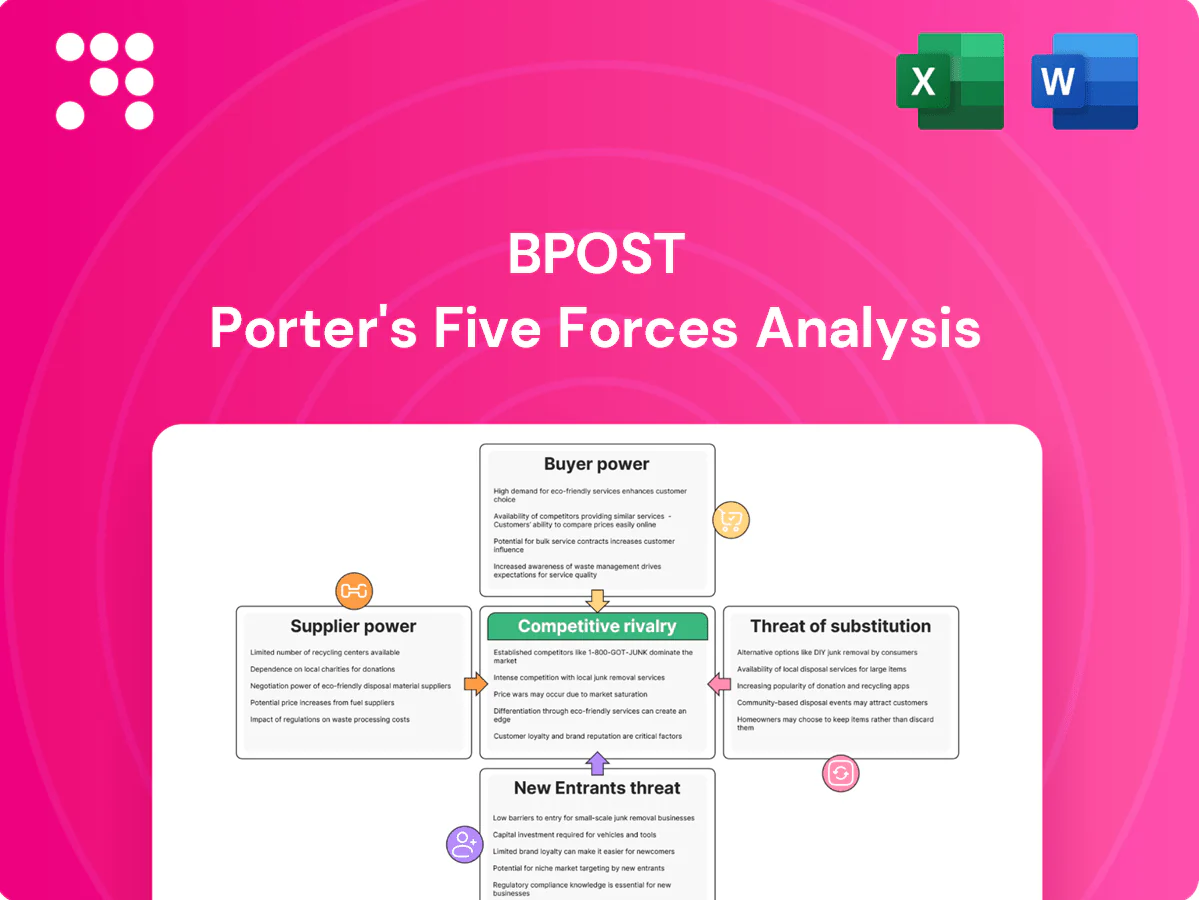
bpost Porter's Five Forces Analysis

A Must-Have Tool for Decision-Makers
bpost operates in a transitioning postal-logistics market where regulatory legacy, digital substitution, and scale-driven competition shape strategic choices. Our snapshot highlights key pressures—buyer sensitivity, supplier contracts, and threat of entrants—but omits force-by-force ratings and visuals. Unlock the full Porter's Five Forces Analysis to see quantified risks and actionable strategies. Purchase the complete report for a consultant-grade breakdown tailored to bpost.
Suppliers Bargaining Power

Unionized labor dependence
Postal operations rely on a large, unionized workforce—bpost employed about 36,000 people in 2024—so collective bargaining raises wage floors, limits flexibility and raises strike risk, giving labor strong leverage over costs and continuity; automation plans must be negotiated and phased to gradually temper that supplier power.
Fuel and transport inputs
Diesel at ~€1.60/L (EU average 2024) and Belgian industrial electricity near €0.21/kWh in 2024 make fuel and power material cost drivers that can swing bpost’s margins. Multi-sourcing of diesel and leased vehicles reduces single-supplier risk but market-wide price spikes compress bargaining leverage. Transitioning to EV fleets and renewable supply contracts cuts exposure to fuel volatility. Long-term supply agreements stabilize costs but reduce short-term flexibility.

Sorting tech and IT vendors
Automation equipment, industrial scanners (Zebra, Honeywell), WMS/TMS (Blue Yonder, Manhattan, SAP) and cloud providers (AWS, Azure, GCP) are specialized with limited alternatives, and the global warehouse automation market surpassed 24 billion USD in 2024. Vendor lock-in and high switching costs from integration and training concentrate power with key suppliers during upgrades and support. Modular architectures and open standards can rebalance negotiating power by lowering integration costs.

Real estate and network access
Strategic depots, urban hubs and retail points for bpost are location-sensitive and scarce, giving landlords in prime zones strong pricing power and restrictive lease terms; zoning and environmental permits further constrain relocations and strengthen supplier leverage. Long leases and owned sites mitigate cost exposure but reduce operational flexibility.
- Location scarcity
- Landlord pricing power
- Zoning constraints
- Long leases limit agility
Airline and cross-border partners
For international flows bpost relies on airlines and cross-border logistics partners for uplift and linehaul, and peak-season capacity tightness can transfer pricing power to carriers via surcharges; bilateral postal agreements provide some relief but e-commerce parcels increasingly fall outside legacy terms. Diversifying partners and booking capacity earlier strengthen bpost’s bargaining position.
- Dependence: airlines/linehaul
- Risk: peak-season surcharges
- Mitigation: bilateral agreements limited for e-commerce
- Leverage: diversified partners + earlier bookings
36,000-strong workforce increases union leverage, raising strike risk
bpost’s 36,000-strong workforce (2024) gives unions high bargaining power, raising wage floors and strike risk.
Fuel (~€1.60/L) and power (~€0.21/kWh) are major cost drivers; EV transition and long-term contracts reduce volatility.
Automation vendors and landlords (warehouse scarcity) create vendor/lease lock-in; global warehouse automation market ~$24bn in 2024.
| Supplier | Metric | 2024 |
|---|---|---|
| Labor | Headcount | 36,000 |
| Fuel/Power | Price | €1.60/L; €0.21/kWh |
| Automation | Market | $24bn |
What is included in the product
 Detailed Word Document
Uncovers key competitive drivers and market entry risks for bpost, evaluating supplier and buyer power, threat of substitutes, rivalry intensity, and barriers protecting incumbents. Identifies disruptive forces and emerging threats that could erode market share, with strategic commentary tailored for investors and strategists.

 Customizable Excel Spreadsheet
Clean one-sheet Porter's Five Forces for bpost—instantly visualizes competitive pressures with a spider chart, customizable inputs for regulatory shifts or new entrants, and plug-and-play formatting ready for decks or dashboards.
Customers Bargaining Power

Mega e-commerce platforms
Large marketplaces and omnichannel retailers drive volume and extract deep discounts; global e‑commerce sales reached about $6.3 trillion in 2024 and Amazon held roughly 37% of US e‑commerce, concentrating buying power. They operate multi‑carrier strategies and reallocate lanes rapidly on price or performance, increasing switching ease through SLAs, penalties and bespoke integrations. For bpost this translates to very high customer bargaining power in parcels and fulfillment.
SMEs and marketplaces
SMEs are highly price sensitive but prioritize nationwide coverage and reliability, with SMEs representing about 99% of EU enterprises (Eurostat). Aggregators and shipping platforms increase price and service transparency, making switching easier. Volume-based tiers give SMEs limited leverage compared with mega-shippers. Value-added services such as returns management and analytics can lower churn and reduce buyer power.

Government and regulated mailers
Government and regulated mailers provide steady letter volumes but press hard on rates; regulatory frameworks around Belgiums universal service limit bpost’s pricing flexibility. As mail volumes fall, in 2024 these buyers increasingly demand cost cuts and digital alternatives, squeezing margins. Their bargaining power is moderate yet persistent, driven by long-term contracts and regulatory protection.

Residential recipients
End recipients rarely pick the carrier, limiting explicit bargaining power, but delivery experience strongly influences retailers and indirectly pressures bpost on price and service levels. Rising consumer expectations for speed, real-time tracking and greener delivery increase operating costs and cap margin flexibility; bpost handled c.400m parcels annually in 2023–24, keeping network load high. Locker and PUDO adoption shifts cost per delivery and last-mile economics.
- Indirect pressure via retailers
- High SLA expectations → higher Opex
- c.400m parcels (2023–24)
- Locker/PUDO change unit costs
International shippers
International shippers exert high bargaining power: cross-border merchants routinely arbitrage carriers by route, duty-paid options and transit times, with industry surveys in 2024 showing over 60% actively comparing landed-cost solutions, increasing price pressure on bpost. Strategic partnerships and customs facilitation (e.g., pre-clearance) create customer stickiness, but without service differentiation buyer power remains elevated. Market volatility in 2024 kept margins tight for national carriers.
- High comparison shopping: >60% merchants compare landed-costs
- Arbitrage levers: route, duties, transit time
- Stickiness from customs/partnerships
- Without differentiation, buyer power stays high
Marketplaces lead: e-commerce $6.3T; >60% sellers shop landed costs
Marketplaces drive high buyer power: global e‑commerce ~$6.3T (2024) and Amazon ~37% US (2024); bpost faces deep discounting and multi‑carrier switching. SMEs (99% EU) are price sensitive; governments exert moderate, regulated pressure. End consumers exert indirect power via delivery expectations; bpost handled c.400m parcels (2023–24); >60% merchants compare landed costs (2024).
| Metric | Value | Year |
|---|---|---|
| Global e‑commerce | $6.3T | 2024 |
| Amazon share (US) | ~37% | 2024 |
| bpost parcels | c.400m | 2023–24 |
| Merchants compare landed cost | >60% | 2024 |
| SMEs (EU) | 99% | Eurostat |
Full Version Awaits
bpost Porter's Five Forces Analysis
This preview displays the exact bpost Porter's Five Forces analysis you'll receive after purchase—no placeholders or samples. It’s the final, professionally formatted document covering competitive rivalry, supplier and buyer power, substitution threats, and barriers to entry. Instant download; ready to use.

A Must-Have Tool for Decision-Makers
bpost operates in a transitioning postal-logistics market where regulatory legacy, digital substitution, and scale-driven competition shape strategic choices. Our snapshot highlights key pressures—buyer sensitivity, supplier contracts, and threat of entrants—but omits force-by-force ratings and visuals. Unlock the full Porter's Five Forces Analysis to see quantified risks and actionable strategies. Purchase the complete report for a consultant-grade breakdown tailored to bpost.
Suppliers Bargaining Power
Unionized labor dependence
Postal operations rely on a large, unionized workforce—bpost employed about 36,000 people in 2024—so collective bargaining raises wage floors, limits flexibility and raises strike risk, giving labor strong leverage over costs and continuity; automation plans must be negotiated and phased to gradually temper that supplier power.
Fuel and transport inputs
Diesel at ~€1.60/L (EU average 2024) and Belgian industrial electricity near €0.21/kWh in 2024 make fuel and power material cost drivers that can swing bpost’s margins. Multi-sourcing of diesel and leased vehicles reduces single-supplier risk but market-wide price spikes compress bargaining leverage. Transitioning to EV fleets and renewable supply contracts cuts exposure to fuel volatility. Long-term supply agreements stabilize costs but reduce short-term flexibility.
Sorting tech and IT vendors
Automation equipment, industrial scanners (Zebra, Honeywell), WMS/TMS (Blue Yonder, Manhattan, SAP) and cloud providers (AWS, Azure, GCP) are specialized with limited alternatives, and the global warehouse automation market surpassed 24 billion USD in 2024. Vendor lock-in and high switching costs from integration and training concentrate power with key suppliers during upgrades and support. Modular architectures and open standards can rebalance negotiating power by lowering integration costs.
Real estate and network access
Strategic depots, urban hubs and retail points for bpost are location-sensitive and scarce, giving landlords in prime zones strong pricing power and restrictive lease terms; zoning and environmental permits further constrain relocations and strengthen supplier leverage. Long leases and owned sites mitigate cost exposure but reduce operational flexibility.
- Location scarcity
- Landlord pricing power
- Zoning constraints
- Long leases limit agility
Airline and cross-border partners
For international flows bpost relies on airlines and cross-border logistics partners for uplift and linehaul, and peak-season capacity tightness can transfer pricing power to carriers via surcharges; bilateral postal agreements provide some relief but e-commerce parcels increasingly fall outside legacy terms. Diversifying partners and booking capacity earlier strengthen bpost’s bargaining position.
- Dependence: airlines/linehaul
- Risk: peak-season surcharges
- Mitigation: bilateral agreements limited for e-commerce
- Leverage: diversified partners + earlier bookings
36,000-strong workforce increases union leverage, raising strike risk
bpost’s 36,000-strong workforce (2024) gives unions high bargaining power, raising wage floors and strike risk.
Fuel (~€1.60/L) and power (~€0.21/kWh) are major cost drivers; EV transition and long-term contracts reduce volatility.
Automation vendors and landlords (warehouse scarcity) create vendor/lease lock-in; global warehouse automation market ~$24bn in 2024.
| Supplier | Metric | 2024 |
|---|---|---|
| Labor | Headcount | 36,000 |
| Fuel/Power | Price | €1.60/L; €0.21/kWh |
| Automation | Market | $24bn |
What is included in the product
Detailed Word Document
Uncovers key competitive drivers and market entry risks for bpost, evaluating supplier and buyer power, threat of substitutes, rivalry intensity, and barriers protecting incumbents. Identifies disruptive forces and emerging threats that could erode market share, with strategic commentary tailored for investors and strategists.
Customizable Excel Spreadsheet
Clean one-sheet Porter's Five Forces for bpost—instantly visualizes competitive pressures with a spider chart, customizable inputs for regulatory shifts or new entrants, and plug-and-play formatting ready for decks or dashboards.
Customers Bargaining Power
Mega e-commerce platforms
Large marketplaces and omnichannel retailers drive volume and extract deep discounts; global e‑commerce sales reached about $6.3 trillion in 2024 and Amazon held roughly 37% of US e‑commerce, concentrating buying power. They operate multi‑carrier strategies and reallocate lanes rapidly on price or performance, increasing switching ease through SLAs, penalties and bespoke integrations. For bpost this translates to very high customer bargaining power in parcels and fulfillment.
SMEs and marketplaces
SMEs are highly price sensitive but prioritize nationwide coverage and reliability, with SMEs representing about 99% of EU enterprises (Eurostat). Aggregators and shipping platforms increase price and service transparency, making switching easier. Volume-based tiers give SMEs limited leverage compared with mega-shippers. Value-added services such as returns management and analytics can lower churn and reduce buyer power.
Government and regulated mailers
Government and regulated mailers provide steady letter volumes but press hard on rates; regulatory frameworks around Belgiums universal service limit bpost’s pricing flexibility. As mail volumes fall, in 2024 these buyers increasingly demand cost cuts and digital alternatives, squeezing margins. Their bargaining power is moderate yet persistent, driven by long-term contracts and regulatory protection.
Residential recipients
End recipients rarely pick the carrier, limiting explicit bargaining power, but delivery experience strongly influences retailers and indirectly pressures bpost on price and service levels. Rising consumer expectations for speed, real-time tracking and greener delivery increase operating costs and cap margin flexibility; bpost handled c.400m parcels annually in 2023–24, keeping network load high. Locker and PUDO adoption shifts cost per delivery and last-mile economics.
- Indirect pressure via retailers
- High SLA expectations → higher Opex
- c.400m parcels (2023–24)
- Locker/PUDO change unit costs
International shippers
International shippers exert high bargaining power: cross-border merchants routinely arbitrage carriers by route, duty-paid options and transit times, with industry surveys in 2024 showing over 60% actively comparing landed-cost solutions, increasing price pressure on bpost. Strategic partnerships and customs facilitation (e.g., pre-clearance) create customer stickiness, but without service differentiation buyer power remains elevated. Market volatility in 2024 kept margins tight for national carriers.
- High comparison shopping: >60% merchants compare landed-costs
- Arbitrage levers: route, duties, transit time
- Stickiness from customs/partnerships
- Without differentiation, buyer power stays high
Marketplaces lead: e-commerce $6.3T; >60% sellers shop landed costs
Marketplaces drive high buyer power: global e‑commerce ~$6.3T (2024) and Amazon ~37% US (2024); bpost faces deep discounting and multi‑carrier switching. SMEs (99% EU) are price sensitive; governments exert moderate, regulated pressure. End consumers exert indirect power via delivery expectations; bpost handled c.400m parcels (2023–24); >60% merchants compare landed costs (2024).
| Metric | Value | Year |
|---|---|---|
| Global e‑commerce | $6.3T | 2024 |
| Amazon share (US) | ~37% | 2024 |
| bpost parcels | c.400m | 2023–24 |
| Merchants compare landed cost | >60% | 2024 |
| SMEs (EU) | 99% | Eurostat |
Full Version Awaits
bpost Porter's Five Forces Analysis
This preview displays the exact bpost Porter's Five Forces analysis you'll receive after purchase—no placeholders or samples. It’s the final, professionally formatted document covering competitive rivalry, supplier and buyer power, substitution threats, and barriers to entry. Instant download; ready to use.
Description
A Must-Have Tool for Decision-Makers
bpost operates in a transitioning postal-logistics market where regulatory legacy, digital substitution, and scale-driven competition shape strategic choices. Our snapshot highlights key pressures—buyer sensitivity, supplier contracts, and threat of entrants—but omits force-by-force ratings and visuals. Unlock the full Porter's Five Forces Analysis to see quantified risks and actionable strategies. Purchase the complete report for a consultant-grade breakdown tailored to bpost.
Suppliers Bargaining Power
Unionized labor dependence
Postal operations rely on a large, unionized workforce—bpost employed about 36,000 people in 2024—so collective bargaining raises wage floors, limits flexibility and raises strike risk, giving labor strong leverage over costs and continuity; automation plans must be negotiated and phased to gradually temper that supplier power.
Fuel and transport inputs
Diesel at ~€1.60/L (EU average 2024) and Belgian industrial electricity near €0.21/kWh in 2024 make fuel and power material cost drivers that can swing bpost’s margins. Multi-sourcing of diesel and leased vehicles reduces single-supplier risk but market-wide price spikes compress bargaining leverage. Transitioning to EV fleets and renewable supply contracts cuts exposure to fuel volatility. Long-term supply agreements stabilize costs but reduce short-term flexibility.
Sorting tech and IT vendors
Automation equipment, industrial scanners (Zebra, Honeywell), WMS/TMS (Blue Yonder, Manhattan, SAP) and cloud providers (AWS, Azure, GCP) are specialized with limited alternatives, and the global warehouse automation market surpassed 24 billion USD in 2024. Vendor lock-in and high switching costs from integration and training concentrate power with key suppliers during upgrades and support. Modular architectures and open standards can rebalance negotiating power by lowering integration costs.
Real estate and network access
Strategic depots, urban hubs and retail points for bpost are location-sensitive and scarce, giving landlords in prime zones strong pricing power and restrictive lease terms; zoning and environmental permits further constrain relocations and strengthen supplier leverage. Long leases and owned sites mitigate cost exposure but reduce operational flexibility.
- Location scarcity
- Landlord pricing power
- Zoning constraints
- Long leases limit agility
Airline and cross-border partners
For international flows bpost relies on airlines and cross-border logistics partners for uplift and linehaul, and peak-season capacity tightness can transfer pricing power to carriers via surcharges; bilateral postal agreements provide some relief but e-commerce parcels increasingly fall outside legacy terms. Diversifying partners and booking capacity earlier strengthen bpost’s bargaining position.
- Dependence: airlines/linehaul
- Risk: peak-season surcharges
- Mitigation: bilateral agreements limited for e-commerce
- Leverage: diversified partners + earlier bookings
36,000-strong workforce increases union leverage, raising strike risk
bpost’s 36,000-strong workforce (2024) gives unions high bargaining power, raising wage floors and strike risk.
Fuel (~€1.60/L) and power (~€0.21/kWh) are major cost drivers; EV transition and long-term contracts reduce volatility.
Automation vendors and landlords (warehouse scarcity) create vendor/lease lock-in; global warehouse automation market ~$24bn in 2024.
| Supplier | Metric | 2024 |
|---|---|---|
| Labor | Headcount | 36,000 |
| Fuel/Power | Price | €1.60/L; €0.21/kWh |
| Automation | Market | $24bn |
What is included in the product
Detailed Word Document
Uncovers key competitive drivers and market entry risks for bpost, evaluating supplier and buyer power, threat of substitutes, rivalry intensity, and barriers protecting incumbents. Identifies disruptive forces and emerging threats that could erode market share, with strategic commentary tailored for investors and strategists.
Customizable Excel Spreadsheet
Clean one-sheet Porter's Five Forces for bpost—instantly visualizes competitive pressures with a spider chart, customizable inputs for regulatory shifts or new entrants, and plug-and-play formatting ready for decks or dashboards.
Customers Bargaining Power
Mega e-commerce platforms
Large marketplaces and omnichannel retailers drive volume and extract deep discounts; global e‑commerce sales reached about $6.3 trillion in 2024 and Amazon held roughly 37% of US e‑commerce, concentrating buying power. They operate multi‑carrier strategies and reallocate lanes rapidly on price or performance, increasing switching ease through SLAs, penalties and bespoke integrations. For bpost this translates to very high customer bargaining power in parcels and fulfillment.
SMEs and marketplaces
SMEs are highly price sensitive but prioritize nationwide coverage and reliability, with SMEs representing about 99% of EU enterprises (Eurostat). Aggregators and shipping platforms increase price and service transparency, making switching easier. Volume-based tiers give SMEs limited leverage compared with mega-shippers. Value-added services such as returns management and analytics can lower churn and reduce buyer power.
Government and regulated mailers
Government and regulated mailers provide steady letter volumes but press hard on rates; regulatory frameworks around Belgiums universal service limit bpost’s pricing flexibility. As mail volumes fall, in 2024 these buyers increasingly demand cost cuts and digital alternatives, squeezing margins. Their bargaining power is moderate yet persistent, driven by long-term contracts and regulatory protection.
Residential recipients
End recipients rarely pick the carrier, limiting explicit bargaining power, but delivery experience strongly influences retailers and indirectly pressures bpost on price and service levels. Rising consumer expectations for speed, real-time tracking and greener delivery increase operating costs and cap margin flexibility; bpost handled c.400m parcels annually in 2023–24, keeping network load high. Locker and PUDO adoption shifts cost per delivery and last-mile economics.
- Indirect pressure via retailers
- High SLA expectations → higher Opex
- c.400m parcels (2023–24)
- Locker/PUDO change unit costs
International shippers
International shippers exert high bargaining power: cross-border merchants routinely arbitrage carriers by route, duty-paid options and transit times, with industry surveys in 2024 showing over 60% actively comparing landed-cost solutions, increasing price pressure on bpost. Strategic partnerships and customs facilitation (e.g., pre-clearance) create customer stickiness, but without service differentiation buyer power remains elevated. Market volatility in 2024 kept margins tight for national carriers.
- High comparison shopping: >60% merchants compare landed-costs
- Arbitrage levers: route, duties, transit time
- Stickiness from customs/partnerships
- Without differentiation, buyer power stays high
Marketplaces lead: e-commerce $6.3T; >60% sellers shop landed costs
Marketplaces drive high buyer power: global e‑commerce ~$6.3T (2024) and Amazon ~37% US (2024); bpost faces deep discounting and multi‑carrier switching. SMEs (99% EU) are price sensitive; governments exert moderate, regulated pressure. End consumers exert indirect power via delivery expectations; bpost handled c.400m parcels (2023–24); >60% merchants compare landed costs (2024).
| Metric | Value | Year |
|---|---|---|
| Global e‑commerce | $6.3T | 2024 |
| Amazon share (US) | ~37% | 2024 |
| bpost parcels | c.400m | 2023–24 |
| Merchants compare landed cost | >60% | 2024 |
| SMEs (EU) | 99% | Eurostat |
Full Version Awaits
bpost Porter's Five Forces Analysis
This preview displays the exact bpost Porter's Five Forces analysis you'll receive after purchase—no placeholders or samples. It’s the final, professionally formatted document covering competitive rivalry, supplier and buyer power, substitution threats, and barriers to entry. Instant download; ready to use.











