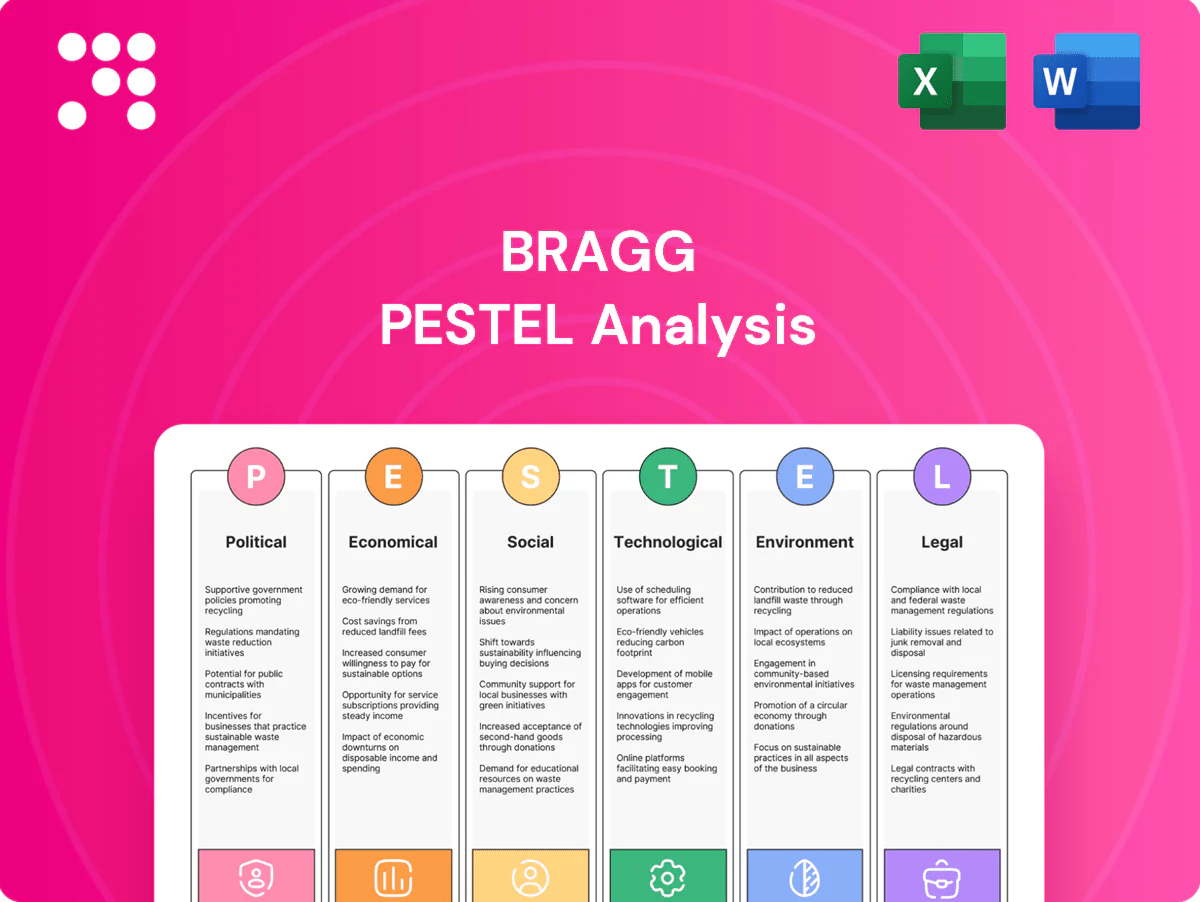
Bragg PESTLE Analysis

Your Shortcut to Market Insight Starts Here
Unlock strategic clarity with our targeted PESTLE Analysis of Bragg — three to five external forces parsed into actionable insights. See how political, economic, social, technological, legal and environmental trends could affect growth and risk. Purchase the full report for a complete, editable breakdown you can use immediately.
Political factors

Regulatory policy shifts in iGaming
Governments periodically revise online gambling frameworks, with more than 80 jurisdictions regulating iGaming by 2024, altering licensing pathways and market access. Bragg must accelerate product certification and reporting to meet evolving oversight, which raises compliance lead times and costs. Policy tightening can delay launches while liberalization (new markets added in 2023–24) creates revenue opportunities; active regulatory intelligence and local partnerships mitigate shocks.
Taxation and channelization agendas
Policymakers increasingly use tax levers to channel play from gray to regulated markets, with H2 Gambling Capital estimating global regulated iGaming GGR near US$73bn in 2024, boosting fiscal visibility. Shifts in GGR and platform taxes directly compress operator budgets and push up vendor pricing; reported effective tax burdens rose in several EU and LATAM markets in 2023–24. Bragg must align its value proposition to operator margin pressure by offering lower TCO and revenue-share options. Flexible commercial models—tiered fees, hybrid SaaS/rev-share—improve resilience across divergent tax regimes.

Cross-border market entry diplomacy
Market access for Bragg often hinges on local stakeholder alignment and government priorities, especially across 20+ regulated markets in 2024. Political goodwill materially affects certification timelines and supplier approvals, sometimes adding months to go-live. Bragg benefits from demonstrating responsible gambling and compliance leadership to speed approvals. Proactive engagement helps navigate protectionism and local content preferences.

Public health and consumer protection focus
- Regulatory focus: UKGC social responsibility code (2023)
- Funding trend: increased mandates for RG tools (2024)
- Bragg fit: analytics and limit-setting align with policy
- Market impact: stronger RG aids approvals in sensitive jurisdictions
Geopolitical tensions and trade frictions
Geopolitical tensions—sanctions, tightening cross‑border data transfer rules (over 100 jurisdictions with some form of restriction by 2024) and episodic currency controls—can disrupt Bragg operations, vendor SLAs and cloud availability regionally. Bragg should maintain multi‑region infrastructure and redundant vendors; scenario planning reduces exposure to abrupt market closures.
- Sanctions/data limits: operational disruption
- Cloud/vendor: regional availability risk
- Action: multi‑region infra + scenario planning
US$73bn regulated GGR, 100+ data limits tighten margins
Regulatory change is rapid: 80+ jurisdictions regulated iGaming by 2024 and global regulated GGR ~US$73bn (2024), forcing faster certification and higher compliance costs. Tax and RG mandates rose in 2023–24, compressing operator margins; Bragg must offer lower TCO and RG-aligned products. Geopolitical/data-transfer limits (100+ jurisdictions by 2024) require multi-region redundancy.
| Metric | 2024 |
|---|---|
| Regulated jurisdictions | 80+ |
| Regulated iGaming GGR | US$73bn |
| Data-transfer limits | 100+ |
What is included in the product
 Detailed Word Document
Explores how external macro-environmental factors uniquely affect Bragg across Political, Economic, Social, Technological, Environmental and Legal dimensions, with data-backed trends and detailed sub-points tailored to its industry and region to reveal threats, opportunities and scenario-ready insights for executives, consultants and investors.

 Customizable Excel Spreadsheet
A concise, visually segmented Bragg PESTLE summary that’s easily editable and shareable—ideal for presentations, team alignment, consultant reports and quick risk discussions to speed decision-making.
Economic factors

Macroeconomic cycles and gaming spend
iGaming discretionary spend tracks employment and consumer confidence; IMF global growth slowed to about 3.1% in 2024, exerting pressure on leisure budgets. Downturns compress operator ARPU and force marketing cuts—industry surveys showed operators reduced marketing spend by roughly 10–15% in weaker quarters of 2023–24. Bragg’s diversified client base across 20+ jurisdictions helps buffer cyclicality, and performance‑linked pricing aligns revenue with operator realities.
Operator consolidation and bargaining power
Operator M&A concentrates procurement, squeezing vendor margins as buyers seek scale; global online gambling market is forecast at about $120bn by 2027, driving consolidation. Preferred vendor lists increasingly favor 5-10 scalable, proven tech providers, raising entry barriers. Bragg’s end-to-end PAM, RGS and managed services position it to win wallet share. Cross-selling exclusive content supports pricing durability and margin retention.

FX volatility and revenue translation
Global contracts expose Bragg to multi-currency cash flows across 20+ currencies, making translation a material P&L driver.
FX swings can compress or inflate reported growth and margins quarter-to-quarter, particularly when USD and EUR move sharply against local currencies.
Natural hedging from a diversified currency mix mitigates risk, while formal hedging policies and contract pricing clauses (indexation or FX pass-through) help stabilize profitability.

Cost of capital and investment pace
Higher interest rates (US federal funds ~5.25–5.50% and 10-year Treasury ~4.2–4.4% mid-2025) push operators to tighten marketing and tech capex and raise hurdle rates for new market entry, so Bragg should favor modular rollouts and prioritize ROI-positive features over full-stack expansion. Capital-light content distribution often out-earns heavy platform builds during tighter financing cycles.
- Prioritize modular MVPs with fast payback
- De-risk launches given 5%+ real cost of capital
- Channel-first content can yield higher ROI vs heavy platform spend
Digital advertising and acquisition costs
Rising UA costs have constrained operator growth and increased demand for retention tools; according to eMarketer global digital ad spend reached about $658 billion in 2024, pushing many operators to prioritize CRM and segmentation to protect margins. Bragg’s CRM, advanced segmentation and personalized content boost LTV/CAC, enabling demonstrable uplift that supports premium pricing for analytics modules. Data-driven retention acts as a hedge when acquisition is expensive.
- UA cost pressure — higher ad spend in 2024
- Improved LTV/CAC — CRM and personalization
- Premium pricing — analytics tied to measurable uplift
- Retention as hedge — reduces dependency on acquisition
US$73bn regulated GGR, 100+ data limits tighten margins
iGaming spend tracks employment and confidence; IMF 2024 growth ~3.1% pressures leisure budgets, operators cut marketing ~10–15% in weak 2023–24 quarters. Global online gambling ~$120bn by 2027; digital ad spend ~$658bn in 2024 raises UA costs. Fed funds ~5.25–5.50% mid‑2025 tightens capex, favoring modular, ROI‑first rollouts.
| Metric | Value |
|---|---|
| IMF global growth 2024 | ~3.1% |
| Online gambling market | $120bn (2027) |
| Digital ad spend 2024 | $658bn |
| US fed funds mid‑2025 | 5.25–5.50% |
| Operator marketing cuts | 10–15% |
What You See Is What You Get
Bragg PESTLE Analysis
The preview shown here is the exact Bragg PESTLE Analysis document you’ll receive after purchase—fully formatted, professionally structured, and ready to use. It delivers political, economic, social, technological, legal, and environmental insights tailored to Bragg. No placeholders or teasers—this is the real file available immediately after checkout.

Your Shortcut to Market Insight Starts Here
Unlock strategic clarity with our targeted PESTLE Analysis of Bragg — three to five external forces parsed into actionable insights. See how political, economic, social, technological, legal and environmental trends could affect growth and risk. Purchase the full report for a complete, editable breakdown you can use immediately.
Political factors
Regulatory policy shifts in iGaming
Governments periodically revise online gambling frameworks, with more than 80 jurisdictions regulating iGaming by 2024, altering licensing pathways and market access. Bragg must accelerate product certification and reporting to meet evolving oversight, which raises compliance lead times and costs. Policy tightening can delay launches while liberalization (new markets added in 2023–24) creates revenue opportunities; active regulatory intelligence and local partnerships mitigate shocks.
Taxation and channelization agendas
Policymakers increasingly use tax levers to channel play from gray to regulated markets, with H2 Gambling Capital estimating global regulated iGaming GGR near US$73bn in 2024, boosting fiscal visibility. Shifts in GGR and platform taxes directly compress operator budgets and push up vendor pricing; reported effective tax burdens rose in several EU and LATAM markets in 2023–24. Bragg must align its value proposition to operator margin pressure by offering lower TCO and revenue-share options. Flexible commercial models—tiered fees, hybrid SaaS/rev-share—improve resilience across divergent tax regimes.
Cross-border market entry diplomacy
Market access for Bragg often hinges on local stakeholder alignment and government priorities, especially across 20+ regulated markets in 2024. Political goodwill materially affects certification timelines and supplier approvals, sometimes adding months to go-live. Bragg benefits from demonstrating responsible gambling and compliance leadership to speed approvals. Proactive engagement helps navigate protectionism and local content preferences.
Public health and consumer protection focus
- Regulatory focus: UKGC social responsibility code (2023)
- Funding trend: increased mandates for RG tools (2024)
- Bragg fit: analytics and limit-setting align with policy
- Market impact: stronger RG aids approvals in sensitive jurisdictions
Geopolitical tensions and trade frictions
Geopolitical tensions—sanctions, tightening cross‑border data transfer rules (over 100 jurisdictions with some form of restriction by 2024) and episodic currency controls—can disrupt Bragg operations, vendor SLAs and cloud availability regionally. Bragg should maintain multi‑region infrastructure and redundant vendors; scenario planning reduces exposure to abrupt market closures.
- Sanctions/data limits: operational disruption
- Cloud/vendor: regional availability risk
- Action: multi‑region infra + scenario planning
US$73bn regulated GGR, 100+ data limits tighten margins
Regulatory change is rapid: 80+ jurisdictions regulated iGaming by 2024 and global regulated GGR ~US$73bn (2024), forcing faster certification and higher compliance costs. Tax and RG mandates rose in 2023–24, compressing operator margins; Bragg must offer lower TCO and RG-aligned products. Geopolitical/data-transfer limits (100+ jurisdictions by 2024) require multi-region redundancy.
| Metric | 2024 |
|---|---|
| Regulated jurisdictions | 80+ |
| Regulated iGaming GGR | US$73bn |
| Data-transfer limits | 100+ |
What is included in the product
Detailed Word Document
Explores how external macro-environmental factors uniquely affect Bragg across Political, Economic, Social, Technological, Environmental and Legal dimensions, with data-backed trends and detailed sub-points tailored to its industry and region to reveal threats, opportunities and scenario-ready insights for executives, consultants and investors.
Customizable Excel Spreadsheet
A concise, visually segmented Bragg PESTLE summary that’s easily editable and shareable—ideal for presentations, team alignment, consultant reports and quick risk discussions to speed decision-making.
Economic factors
Macroeconomic cycles and gaming spend
iGaming discretionary spend tracks employment and consumer confidence; IMF global growth slowed to about 3.1% in 2024, exerting pressure on leisure budgets. Downturns compress operator ARPU and force marketing cuts—industry surveys showed operators reduced marketing spend by roughly 10–15% in weaker quarters of 2023–24. Bragg’s diversified client base across 20+ jurisdictions helps buffer cyclicality, and performance‑linked pricing aligns revenue with operator realities.
Operator consolidation and bargaining power
Operator M&A concentrates procurement, squeezing vendor margins as buyers seek scale; global online gambling market is forecast at about $120bn by 2027, driving consolidation. Preferred vendor lists increasingly favor 5-10 scalable, proven tech providers, raising entry barriers. Bragg’s end-to-end PAM, RGS and managed services position it to win wallet share. Cross-selling exclusive content supports pricing durability and margin retention.
FX volatility and revenue translation
Global contracts expose Bragg to multi-currency cash flows across 20+ currencies, making translation a material P&L driver.
FX swings can compress or inflate reported growth and margins quarter-to-quarter, particularly when USD and EUR move sharply against local currencies.
Natural hedging from a diversified currency mix mitigates risk, while formal hedging policies and contract pricing clauses (indexation or FX pass-through) help stabilize profitability.
Cost of capital and investment pace
Higher interest rates (US federal funds ~5.25–5.50% and 10-year Treasury ~4.2–4.4% mid-2025) push operators to tighten marketing and tech capex and raise hurdle rates for new market entry, so Bragg should favor modular rollouts and prioritize ROI-positive features over full-stack expansion. Capital-light content distribution often out-earns heavy platform builds during tighter financing cycles.
- Prioritize modular MVPs with fast payback
- De-risk launches given 5%+ real cost of capital
- Channel-first content can yield higher ROI vs heavy platform spend
Digital advertising and acquisition costs
Rising UA costs have constrained operator growth and increased demand for retention tools; according to eMarketer global digital ad spend reached about $658 billion in 2024, pushing many operators to prioritize CRM and segmentation to protect margins. Bragg’s CRM, advanced segmentation and personalized content boost LTV/CAC, enabling demonstrable uplift that supports premium pricing for analytics modules. Data-driven retention acts as a hedge when acquisition is expensive.
- UA cost pressure — higher ad spend in 2024
- Improved LTV/CAC — CRM and personalization
- Premium pricing — analytics tied to measurable uplift
- Retention as hedge — reduces dependency on acquisition
US$73bn regulated GGR, 100+ data limits tighten margins
iGaming spend tracks employment and confidence; IMF 2024 growth ~3.1% pressures leisure budgets, operators cut marketing ~10–15% in weak 2023–24 quarters. Global online gambling ~$120bn by 2027; digital ad spend ~$658bn in 2024 raises UA costs. Fed funds ~5.25–5.50% mid‑2025 tightens capex, favoring modular, ROI‑first rollouts.
| Metric | Value |
|---|---|
| IMF global growth 2024 | ~3.1% |
| Online gambling market | $120bn (2027) |
| Digital ad spend 2024 | $658bn |
| US fed funds mid‑2025 | 5.25–5.50% |
| Operator marketing cuts | 10–15% |
What You See Is What You Get
Bragg PESTLE Analysis
The preview shown here is the exact Bragg PESTLE Analysis document you’ll receive after purchase—fully formatted, professionally structured, and ready to use. It delivers political, economic, social, technological, legal, and environmental insights tailored to Bragg. No placeholders or teasers—this is the real file available immediately after checkout.
Original: $10.00
-65%$10.00
$3.50Description
Your Shortcut to Market Insight Starts Here
Unlock strategic clarity with our targeted PESTLE Analysis of Bragg — three to five external forces parsed into actionable insights. See how political, economic, social, technological, legal and environmental trends could affect growth and risk. Purchase the full report for a complete, editable breakdown you can use immediately.
Political factors
Regulatory policy shifts in iGaming
Governments periodically revise online gambling frameworks, with more than 80 jurisdictions regulating iGaming by 2024, altering licensing pathways and market access. Bragg must accelerate product certification and reporting to meet evolving oversight, which raises compliance lead times and costs. Policy tightening can delay launches while liberalization (new markets added in 2023–24) creates revenue opportunities; active regulatory intelligence and local partnerships mitigate shocks.
Taxation and channelization agendas
Policymakers increasingly use tax levers to channel play from gray to regulated markets, with H2 Gambling Capital estimating global regulated iGaming GGR near US$73bn in 2024, boosting fiscal visibility. Shifts in GGR and platform taxes directly compress operator budgets and push up vendor pricing; reported effective tax burdens rose in several EU and LATAM markets in 2023–24. Bragg must align its value proposition to operator margin pressure by offering lower TCO and revenue-share options. Flexible commercial models—tiered fees, hybrid SaaS/rev-share—improve resilience across divergent tax regimes.
Cross-border market entry diplomacy
Market access for Bragg often hinges on local stakeholder alignment and government priorities, especially across 20+ regulated markets in 2024. Political goodwill materially affects certification timelines and supplier approvals, sometimes adding months to go-live. Bragg benefits from demonstrating responsible gambling and compliance leadership to speed approvals. Proactive engagement helps navigate protectionism and local content preferences.
Public health and consumer protection focus
- Regulatory focus: UKGC social responsibility code (2023)
- Funding trend: increased mandates for RG tools (2024)
- Bragg fit: analytics and limit-setting align with policy
- Market impact: stronger RG aids approvals in sensitive jurisdictions
Geopolitical tensions and trade frictions
Geopolitical tensions—sanctions, tightening cross‑border data transfer rules (over 100 jurisdictions with some form of restriction by 2024) and episodic currency controls—can disrupt Bragg operations, vendor SLAs and cloud availability regionally. Bragg should maintain multi‑region infrastructure and redundant vendors; scenario planning reduces exposure to abrupt market closures.
- Sanctions/data limits: operational disruption
- Cloud/vendor: regional availability risk
- Action: multi‑region infra + scenario planning
US$73bn regulated GGR, 100+ data limits tighten margins
Regulatory change is rapid: 80+ jurisdictions regulated iGaming by 2024 and global regulated GGR ~US$73bn (2024), forcing faster certification and higher compliance costs. Tax and RG mandates rose in 2023–24, compressing operator margins; Bragg must offer lower TCO and RG-aligned products. Geopolitical/data-transfer limits (100+ jurisdictions by 2024) require multi-region redundancy.
| Metric | 2024 |
|---|---|
| Regulated jurisdictions | 80+ |
| Regulated iGaming GGR | US$73bn |
| Data-transfer limits | 100+ |
What is included in the product
Detailed Word Document
Explores how external macro-environmental factors uniquely affect Bragg across Political, Economic, Social, Technological, Environmental and Legal dimensions, with data-backed trends and detailed sub-points tailored to its industry and region to reveal threats, opportunities and scenario-ready insights for executives, consultants and investors.
Customizable Excel Spreadsheet
A concise, visually segmented Bragg PESTLE summary that’s easily editable and shareable—ideal for presentations, team alignment, consultant reports and quick risk discussions to speed decision-making.
Economic factors
Macroeconomic cycles and gaming spend
iGaming discretionary spend tracks employment and consumer confidence; IMF global growth slowed to about 3.1% in 2024, exerting pressure on leisure budgets. Downturns compress operator ARPU and force marketing cuts—industry surveys showed operators reduced marketing spend by roughly 10–15% in weaker quarters of 2023–24. Bragg’s diversified client base across 20+ jurisdictions helps buffer cyclicality, and performance‑linked pricing aligns revenue with operator realities.
Operator consolidation and bargaining power
Operator M&A concentrates procurement, squeezing vendor margins as buyers seek scale; global online gambling market is forecast at about $120bn by 2027, driving consolidation. Preferred vendor lists increasingly favor 5-10 scalable, proven tech providers, raising entry barriers. Bragg’s end-to-end PAM, RGS and managed services position it to win wallet share. Cross-selling exclusive content supports pricing durability and margin retention.
FX volatility and revenue translation
Global contracts expose Bragg to multi-currency cash flows across 20+ currencies, making translation a material P&L driver.
FX swings can compress or inflate reported growth and margins quarter-to-quarter, particularly when USD and EUR move sharply against local currencies.
Natural hedging from a diversified currency mix mitigates risk, while formal hedging policies and contract pricing clauses (indexation or FX pass-through) help stabilize profitability.
Cost of capital and investment pace
Higher interest rates (US federal funds ~5.25–5.50% and 10-year Treasury ~4.2–4.4% mid-2025) push operators to tighten marketing and tech capex and raise hurdle rates for new market entry, so Bragg should favor modular rollouts and prioritize ROI-positive features over full-stack expansion. Capital-light content distribution often out-earns heavy platform builds during tighter financing cycles.
- Prioritize modular MVPs with fast payback
- De-risk launches given 5%+ real cost of capital
- Channel-first content can yield higher ROI vs heavy platform spend
Digital advertising and acquisition costs
Rising UA costs have constrained operator growth and increased demand for retention tools; according to eMarketer global digital ad spend reached about $658 billion in 2024, pushing many operators to prioritize CRM and segmentation to protect margins. Bragg’s CRM, advanced segmentation and personalized content boost LTV/CAC, enabling demonstrable uplift that supports premium pricing for analytics modules. Data-driven retention acts as a hedge when acquisition is expensive.
- UA cost pressure — higher ad spend in 2024
- Improved LTV/CAC — CRM and personalization
- Premium pricing — analytics tied to measurable uplift
- Retention as hedge — reduces dependency on acquisition
US$73bn regulated GGR, 100+ data limits tighten margins
iGaming spend tracks employment and confidence; IMF 2024 growth ~3.1% pressures leisure budgets, operators cut marketing ~10–15% in weak 2023–24 quarters. Global online gambling ~$120bn by 2027; digital ad spend ~$658bn in 2024 raises UA costs. Fed funds ~5.25–5.50% mid‑2025 tightens capex, favoring modular, ROI‑first rollouts.
| Metric | Value |
|---|---|
| IMF global growth 2024 | ~3.1% |
| Online gambling market | $120bn (2027) |
| Digital ad spend 2024 | $658bn |
| US fed funds mid‑2025 | 5.25–5.50% |
| Operator marketing cuts | 10–15% |
What You See Is What You Get
Bragg PESTLE Analysis
The preview shown here is the exact Bragg PESTLE Analysis document you’ll receive after purchase—fully formatted, professionally structured, and ready to use. It delivers political, economic, social, technological, legal, and environmental insights tailored to Bragg. No placeholders or teasers—this is the real file available immediately after checkout.











