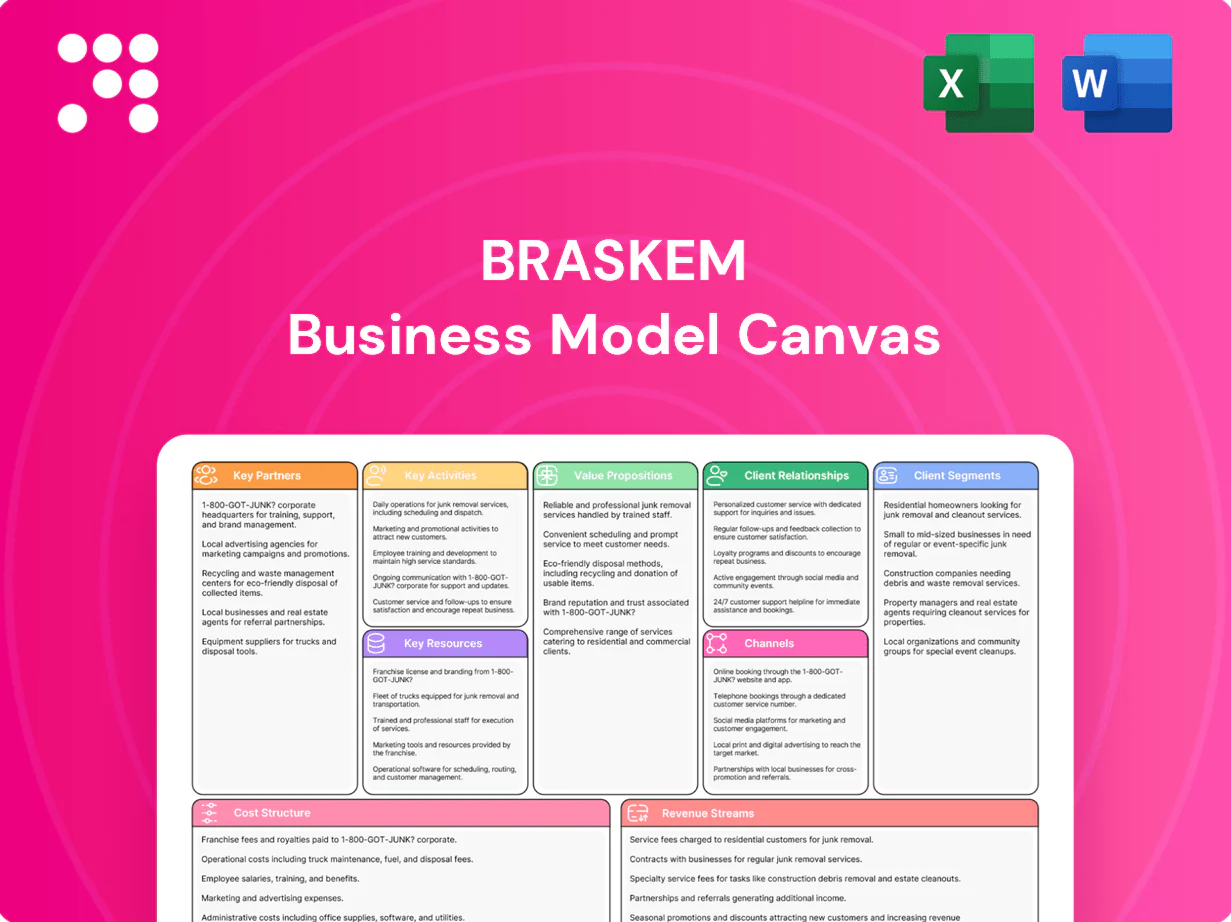
Braskem Business Model Canvas

Business Model Canvas for a leading polymers and chemicals company — investor-ready strategy
Unlock Braskem’s strategic blueprint with our Business Model Canvas: three-to-five concise sections revealing how the company creates value, scales operations, and captures market share across polymers and chemicals. This downloadable, editable canvas is ideal for investors, consultants, and strategists seeking actionable insights and benchmarking tools. Purchase the full file to access detailed, company-specific analysis and templates ready for immediate use.
Partnerships

Feedstock and energy suppliers
Secure, diversified access to naphtha, ethane, propane and power underpins continuous plant operations, with long‑term supply contracts typically spanning 3–10 years to reduce price volatility and supply risk. Strategic ties across Brazil, the U.S., Mexico and Europe align Braskem’s feedstock slate to regional cost curves and fleet needs. Energy partners also advance decarbonization via renewable PPAs and efficiency programs, targeting measurable reductions in Scope 1/2 emissions. These partnerships support operational resilience and cost predictability.
Technology licensors and equipment OEMs
Alliances with licensors for cracking, polymerization and catalyst technologies raise yields and product performance, enabling Braskem to optimize feedstock conversion and quality across polyethylene and polypropylene lines. OEM partnerships ensure reliability and timely upgrades for complex assets, preserving operational continuity. Joint development with licensors and OEMs shortens time-to-market for new resin grades while service agreements improve uptime and lower lifecycle maintenance costs.

Logistics providers and terminals
Integrated partnerships across rail, road, pipeline and ports enable Braskem to distribute over 10 million tonnes p.a. globally, reducing modal costs and transit times. Dedicated terminals and packaging partners with 200+ silo/tank locations safeguard resin quality and traceability. Collaboration with converters optimizes inventory, trimming lead times by ~15%, while contingency networks cover ~95% of export routes to boost resilience.

Brand owners and recyclers
Co-creation with FMCGs and retailers shapes circular solutions and demand signals, aligning packaging specs with recycled-content targets; 2024 global plastic recycling rate remains about 9% (OECD/UNEP estimates), increasing urgency for industrial-scale circular feedstock. Partnerships with mechanical and advanced recyclers secure feedstock and offtake for Braskem circular resins while certification bodies such as ISCC validate mass-balance claims.
- Co-creation: aligns specs to demand signals
- Recyclers: secure feedstock/offtake for circular resins
- Certification: ISCC mass balance validates claims
Universities, startups, and NGOs
Universities, startups, and NGOs accelerate Braskem’s innovation in bio-based materials, catalysts, and waste valorization by enabling applied research and technology transfer through collaborative pilots that de-risk novel processes and scale pathways.
NGO engagement enhances stewardship and transparency on feedstock sourcing and circularity metrics, while joint grants and partnerships expand external funding and talent pipelines.
- ecosystem R&D partnerships
- pilot projects to scale processes
- ngo-driven transparency
- joint grants and talent access
Secure 3–10yr feedstock & energy, >10 Mt p.a. logistics, circular recycling at ~9%
Long‑term feedstock and energy contracts (typically 3–10 years) secure continuous operations and cost predictability. Global logistics and terminals support >10 million tonnes p.a. distribution and ~95% export-route coverage. Circular partnerships with recyclers and ISCC certification respond to a 2024 global plastic recycling rate near 9%.
| Partnership | Scope | 2024 metric |
|---|---|---|
| Feedstock & energy | Long‑term contracts | 3–10 yrs |
| Logistics | Distribution network | >10 Mt p.a.; ~95% routes |
| Circular partners | Recyclers & cert. | Recycling ~9% |
What is included in the product
 Detailed Word Document
A comprehensive Business Model Canvas tailored to Braskem, detailing its nine blocks—customer segments, value propositions, channels, customer relationships, revenue streams, key resources, key activities, key partners, and cost structure—while highlighting competitive advantages, linked SWOT insights, and practical use for presentations, investor discussions, and strategic decision-making.

 Customizable Excel Spreadsheet
High-level view of Braskem’s business model with editable cells to quickly map its petrochemical value chain and regulatory risks, saving hours of formatting while making insights shareable for boardrooms and cross-functional teams.
Activities

Olefins and vinyls production
Cracking and chlor-vinyl operations convert feedstocks into ethylene, propylene and PVC chains, supporting integrated value capture across Braskem’s asset base.
Process optimization targets yield and energy-efficiency gains, aiming for on-stream factors typically above 85% in large-scale olefins complexes.
Strict HSE and reliability practices sustain uptime and lower incident rates, aligning with industry loss-prevention benchmarks.
Active portfolio balancing shifts production toward higher spreads to capture margin differentials in regional markets.
Polymerization and compounding
Polymerization and compounding produce PE and PP grades tailored to end-use requirements, with catalyst selection and strict process control ensuring consistency and performance; Braskem is Latin America’s largest polyolefins producer and operates bio-based PE capacity of about 200 kt/year. Compounding adds targeted functionality for automotive, packaging and construction, while application labs validate properties jointly with customers.

R&D and circular innovation
R&D and circular innovation expand Braskem’s sustainable portfolio through bio-based and mechanically/chemically recycled polymers, building on its position as Latin America’s largest thermoplastic resin producer; I’m green polyethylene can cut cradle-to-gate GHG by about 70% versus fossil PE. Advanced testing and LCAs quantify benefits, collaborations with converters and brand owners speed scale-up and certification, while continuous process improvements drive down material and energy intensity.

Commercial and key account management
Commercial and key account management at Braskem uses structured selling, dynamic pricing, and hedging to capture value across cycles while S&OP forecasts align production to customer demand; technical service drives qualification and conversion, and contracting secures stable volumes and service levels.
Operational excellence and compliance
Operational excellence at Braskem centers on asset integrity, predictive maintenance and digital monitoring that, per 2024 company disclosures, cut unplanned outages by about 20% and boosted plant reliability.
Compliance with environmental and product stewardship standards remains critical, risk management addresses commodity, FX and logistics exposures, and continuous training raises safety culture through recurring programs in 2024.
- Asset integrity: real-time monitoring, 20% fewer unplanned outages (2024)
- Predictive maintenance: reduced downtime, lower OPEX
- Compliance: environmental and product stewardship standards enforced
- Risk management: commodity, FX, logistics hedging
- Training: continuous programs to elevate safety culture
Integrated cracking-to-polymerization platform targets >85% on-stream
Cracking, chlor-vinyl and polymerization integrate feedstocks to PE/PP/PVC, capturing value across Braskem’s asset base.
Process optimization and catalyst control target >85% on-stream and grade consistency for key end-markets.
HSE, predictive maintenance and S&OP cut unplanned outages ~20% (2024) and align supply to demand; circular R&D scales bio-PE (~200 kt/yr).
| Metric | 2024 |
|---|---|
| Bio-PE capacity | 200 kt/yr |
| On-stream factor | >85% |
| Unplanned outages | -20% |
| Market position | Largest LATAM polyolefins producer |
Delivered as Displayed
Business Model Canvas
The document you're previewing is the exact Braskem Business Model Canvas you’ll receive after purchase, not a mockup. It contains the same structured sections—key partners, activities, resources, value propositions, customer segments, channels, revenue streams and cost structure—formatted for editing. Upon purchase, you’ll instantly download this identical, ready-to-use file.

Business Model Canvas for a leading polymers and chemicals company — investor-ready strategy
Unlock Braskem’s strategic blueprint with our Business Model Canvas: three-to-five concise sections revealing how the company creates value, scales operations, and captures market share across polymers and chemicals. This downloadable, editable canvas is ideal for investors, consultants, and strategists seeking actionable insights and benchmarking tools. Purchase the full file to access detailed, company-specific analysis and templates ready for immediate use.
Partnerships
Feedstock and energy suppliers
Secure, diversified access to naphtha, ethane, propane and power underpins continuous plant operations, with long‑term supply contracts typically spanning 3–10 years to reduce price volatility and supply risk. Strategic ties across Brazil, the U.S., Mexico and Europe align Braskem’s feedstock slate to regional cost curves and fleet needs. Energy partners also advance decarbonization via renewable PPAs and efficiency programs, targeting measurable reductions in Scope 1/2 emissions. These partnerships support operational resilience and cost predictability.
Technology licensors and equipment OEMs
Alliances with licensors for cracking, polymerization and catalyst technologies raise yields and product performance, enabling Braskem to optimize feedstock conversion and quality across polyethylene and polypropylene lines. OEM partnerships ensure reliability and timely upgrades for complex assets, preserving operational continuity. Joint development with licensors and OEMs shortens time-to-market for new resin grades while service agreements improve uptime and lower lifecycle maintenance costs.
Logistics providers and terminals
Integrated partnerships across rail, road, pipeline and ports enable Braskem to distribute over 10 million tonnes p.a. globally, reducing modal costs and transit times. Dedicated terminals and packaging partners with 200+ silo/tank locations safeguard resin quality and traceability. Collaboration with converters optimizes inventory, trimming lead times by ~15%, while contingency networks cover ~95% of export routes to boost resilience.
Brand owners and recyclers
Co-creation with FMCGs and retailers shapes circular solutions and demand signals, aligning packaging specs with recycled-content targets; 2024 global plastic recycling rate remains about 9% (OECD/UNEP estimates), increasing urgency for industrial-scale circular feedstock. Partnerships with mechanical and advanced recyclers secure feedstock and offtake for Braskem circular resins while certification bodies such as ISCC validate mass-balance claims.
- Co-creation: aligns specs to demand signals
- Recyclers: secure feedstock/offtake for circular resins
- Certification: ISCC mass balance validates claims
Universities, startups, and NGOs
Universities, startups, and NGOs accelerate Braskem’s innovation in bio-based materials, catalysts, and waste valorization by enabling applied research and technology transfer through collaborative pilots that de-risk novel processes and scale pathways.
NGO engagement enhances stewardship and transparency on feedstock sourcing and circularity metrics, while joint grants and partnerships expand external funding and talent pipelines.
- ecosystem R&D partnerships
- pilot projects to scale processes
- ngo-driven transparency
- joint grants and talent access
Secure 3–10yr feedstock & energy, >10 Mt p.a. logistics, circular recycling at ~9%
Long‑term feedstock and energy contracts (typically 3–10 years) secure continuous operations and cost predictability. Global logistics and terminals support >10 million tonnes p.a. distribution and ~95% export-route coverage. Circular partnerships with recyclers and ISCC certification respond to a 2024 global plastic recycling rate near 9%.
| Partnership | Scope | 2024 metric |
|---|---|---|
| Feedstock & energy | Long‑term contracts | 3–10 yrs |
| Logistics | Distribution network | >10 Mt p.a.; ~95% routes |
| Circular partners | Recyclers & cert. | Recycling ~9% |
What is included in the product
Detailed Word Document
A comprehensive Business Model Canvas tailored to Braskem, detailing its nine blocks—customer segments, value propositions, channels, customer relationships, revenue streams, key resources, key activities, key partners, and cost structure—while highlighting competitive advantages, linked SWOT insights, and practical use for presentations, investor discussions, and strategic decision-making.
Customizable Excel Spreadsheet
High-level view of Braskem’s business model with editable cells to quickly map its petrochemical value chain and regulatory risks, saving hours of formatting while making insights shareable for boardrooms and cross-functional teams.
Activities
Olefins and vinyls production
Cracking and chlor-vinyl operations convert feedstocks into ethylene, propylene and PVC chains, supporting integrated value capture across Braskem’s asset base.
Process optimization targets yield and energy-efficiency gains, aiming for on-stream factors typically above 85% in large-scale olefins complexes.
Strict HSE and reliability practices sustain uptime and lower incident rates, aligning with industry loss-prevention benchmarks.
Active portfolio balancing shifts production toward higher spreads to capture margin differentials in regional markets.
Polymerization and compounding
Polymerization and compounding produce PE and PP grades tailored to end-use requirements, with catalyst selection and strict process control ensuring consistency and performance; Braskem is Latin America’s largest polyolefins producer and operates bio-based PE capacity of about 200 kt/year. Compounding adds targeted functionality for automotive, packaging and construction, while application labs validate properties jointly with customers.
R&D and circular innovation
R&D and circular innovation expand Braskem’s sustainable portfolio through bio-based and mechanically/chemically recycled polymers, building on its position as Latin America’s largest thermoplastic resin producer; I’m green polyethylene can cut cradle-to-gate GHG by about 70% versus fossil PE. Advanced testing and LCAs quantify benefits, collaborations with converters and brand owners speed scale-up and certification, while continuous process improvements drive down material and energy intensity.
Commercial and key account management
Commercial and key account management at Braskem uses structured selling, dynamic pricing, and hedging to capture value across cycles while S&OP forecasts align production to customer demand; technical service drives qualification and conversion, and contracting secures stable volumes and service levels.
Operational excellence and compliance
Operational excellence at Braskem centers on asset integrity, predictive maintenance and digital monitoring that, per 2024 company disclosures, cut unplanned outages by about 20% and boosted plant reliability.
Compliance with environmental and product stewardship standards remains critical, risk management addresses commodity, FX and logistics exposures, and continuous training raises safety culture through recurring programs in 2024.
- Asset integrity: real-time monitoring, 20% fewer unplanned outages (2024)
- Predictive maintenance: reduced downtime, lower OPEX
- Compliance: environmental and product stewardship standards enforced
- Risk management: commodity, FX, logistics hedging
- Training: continuous programs to elevate safety culture
Integrated cracking-to-polymerization platform targets >85% on-stream
Cracking, chlor-vinyl and polymerization integrate feedstocks to PE/PP/PVC, capturing value across Braskem’s asset base.
Process optimization and catalyst control target >85% on-stream and grade consistency for key end-markets.
HSE, predictive maintenance and S&OP cut unplanned outages ~20% (2024) and align supply to demand; circular R&D scales bio-PE (~200 kt/yr).
| Metric | 2024 |
|---|---|
| Bio-PE capacity | 200 kt/yr |
| On-stream factor | >85% |
| Unplanned outages | -20% |
| Market position | Largest LATAM polyolefins producer |
Delivered as Displayed
Business Model Canvas
The document you're previewing is the exact Braskem Business Model Canvas you’ll receive after purchase, not a mockup. It contains the same structured sections—key partners, activities, resources, value propositions, customer segments, channels, revenue streams and cost structure—formatted for editing. Upon purchase, you’ll instantly download this identical, ready-to-use file.
Original: $10.00
-65%$10.00
$3.50Description
Business Model Canvas for a leading polymers and chemicals company — investor-ready strategy
Unlock Braskem’s strategic blueprint with our Business Model Canvas: three-to-five concise sections revealing how the company creates value, scales operations, and captures market share across polymers and chemicals. This downloadable, editable canvas is ideal for investors, consultants, and strategists seeking actionable insights and benchmarking tools. Purchase the full file to access detailed, company-specific analysis and templates ready for immediate use.
Partnerships
Feedstock and energy suppliers
Secure, diversified access to naphtha, ethane, propane and power underpins continuous plant operations, with long‑term supply contracts typically spanning 3–10 years to reduce price volatility and supply risk. Strategic ties across Brazil, the U.S., Mexico and Europe align Braskem’s feedstock slate to regional cost curves and fleet needs. Energy partners also advance decarbonization via renewable PPAs and efficiency programs, targeting measurable reductions in Scope 1/2 emissions. These partnerships support operational resilience and cost predictability.
Technology licensors and equipment OEMs
Alliances with licensors for cracking, polymerization and catalyst technologies raise yields and product performance, enabling Braskem to optimize feedstock conversion and quality across polyethylene and polypropylene lines. OEM partnerships ensure reliability and timely upgrades for complex assets, preserving operational continuity. Joint development with licensors and OEMs shortens time-to-market for new resin grades while service agreements improve uptime and lower lifecycle maintenance costs.
Logistics providers and terminals
Integrated partnerships across rail, road, pipeline and ports enable Braskem to distribute over 10 million tonnes p.a. globally, reducing modal costs and transit times. Dedicated terminals and packaging partners with 200+ silo/tank locations safeguard resin quality and traceability. Collaboration with converters optimizes inventory, trimming lead times by ~15%, while contingency networks cover ~95% of export routes to boost resilience.
Brand owners and recyclers
Co-creation with FMCGs and retailers shapes circular solutions and demand signals, aligning packaging specs with recycled-content targets; 2024 global plastic recycling rate remains about 9% (OECD/UNEP estimates), increasing urgency for industrial-scale circular feedstock. Partnerships with mechanical and advanced recyclers secure feedstock and offtake for Braskem circular resins while certification bodies such as ISCC validate mass-balance claims.
- Co-creation: aligns specs to demand signals
- Recyclers: secure feedstock/offtake for circular resins
- Certification: ISCC mass balance validates claims
Universities, startups, and NGOs
Universities, startups, and NGOs accelerate Braskem’s innovation in bio-based materials, catalysts, and waste valorization by enabling applied research and technology transfer through collaborative pilots that de-risk novel processes and scale pathways.
NGO engagement enhances stewardship and transparency on feedstock sourcing and circularity metrics, while joint grants and partnerships expand external funding and talent pipelines.
- ecosystem R&D partnerships
- pilot projects to scale processes
- ngo-driven transparency
- joint grants and talent access
Secure 3–10yr feedstock & energy, >10 Mt p.a. logistics, circular recycling at ~9%
Long‑term feedstock and energy contracts (typically 3–10 years) secure continuous operations and cost predictability. Global logistics and terminals support >10 million tonnes p.a. distribution and ~95% export-route coverage. Circular partnerships with recyclers and ISCC certification respond to a 2024 global plastic recycling rate near 9%.
| Partnership | Scope | 2024 metric |
|---|---|---|
| Feedstock & energy | Long‑term contracts | 3–10 yrs |
| Logistics | Distribution network | >10 Mt p.a.; ~95% routes |
| Circular partners | Recyclers & cert. | Recycling ~9% |
What is included in the product
Detailed Word Document
A comprehensive Business Model Canvas tailored to Braskem, detailing its nine blocks—customer segments, value propositions, channels, customer relationships, revenue streams, key resources, key activities, key partners, and cost structure—while highlighting competitive advantages, linked SWOT insights, and practical use for presentations, investor discussions, and strategic decision-making.
Customizable Excel Spreadsheet
High-level view of Braskem’s business model with editable cells to quickly map its petrochemical value chain and regulatory risks, saving hours of formatting while making insights shareable for boardrooms and cross-functional teams.
Activities
Olefins and vinyls production
Cracking and chlor-vinyl operations convert feedstocks into ethylene, propylene and PVC chains, supporting integrated value capture across Braskem’s asset base.
Process optimization targets yield and energy-efficiency gains, aiming for on-stream factors typically above 85% in large-scale olefins complexes.
Strict HSE and reliability practices sustain uptime and lower incident rates, aligning with industry loss-prevention benchmarks.
Active portfolio balancing shifts production toward higher spreads to capture margin differentials in regional markets.
Polymerization and compounding
Polymerization and compounding produce PE and PP grades tailored to end-use requirements, with catalyst selection and strict process control ensuring consistency and performance; Braskem is Latin America’s largest polyolefins producer and operates bio-based PE capacity of about 200 kt/year. Compounding adds targeted functionality for automotive, packaging and construction, while application labs validate properties jointly with customers.
R&D and circular innovation
R&D and circular innovation expand Braskem’s sustainable portfolio through bio-based and mechanically/chemically recycled polymers, building on its position as Latin America’s largest thermoplastic resin producer; I’m green polyethylene can cut cradle-to-gate GHG by about 70% versus fossil PE. Advanced testing and LCAs quantify benefits, collaborations with converters and brand owners speed scale-up and certification, while continuous process improvements drive down material and energy intensity.
Commercial and key account management
Commercial and key account management at Braskem uses structured selling, dynamic pricing, and hedging to capture value across cycles while S&OP forecasts align production to customer demand; technical service drives qualification and conversion, and contracting secures stable volumes and service levels.
Operational excellence and compliance
Operational excellence at Braskem centers on asset integrity, predictive maintenance and digital monitoring that, per 2024 company disclosures, cut unplanned outages by about 20% and boosted plant reliability.
Compliance with environmental and product stewardship standards remains critical, risk management addresses commodity, FX and logistics exposures, and continuous training raises safety culture through recurring programs in 2024.
- Asset integrity: real-time monitoring, 20% fewer unplanned outages (2024)
- Predictive maintenance: reduced downtime, lower OPEX
- Compliance: environmental and product stewardship standards enforced
- Risk management: commodity, FX, logistics hedging
- Training: continuous programs to elevate safety culture
Integrated cracking-to-polymerization platform targets >85% on-stream
Cracking, chlor-vinyl and polymerization integrate feedstocks to PE/PP/PVC, capturing value across Braskem’s asset base.
Process optimization and catalyst control target >85% on-stream and grade consistency for key end-markets.
HSE, predictive maintenance and S&OP cut unplanned outages ~20% (2024) and align supply to demand; circular R&D scales bio-PE (~200 kt/yr).
| Metric | 2024 |
|---|---|
| Bio-PE capacity | 200 kt/yr |
| On-stream factor | >85% |
| Unplanned outages | -20% |
| Market position | Largest LATAM polyolefins producer |
Delivered as Displayed
Business Model Canvas
The document you're previewing is the exact Braskem Business Model Canvas you’ll receive after purchase, not a mockup. It contains the same structured sections—key partners, activities, resources, value propositions, customer segments, channels, revenue streams and cost structure—formatted for editing. Upon purchase, you’ll instantly download this identical, ready-to-use file.











