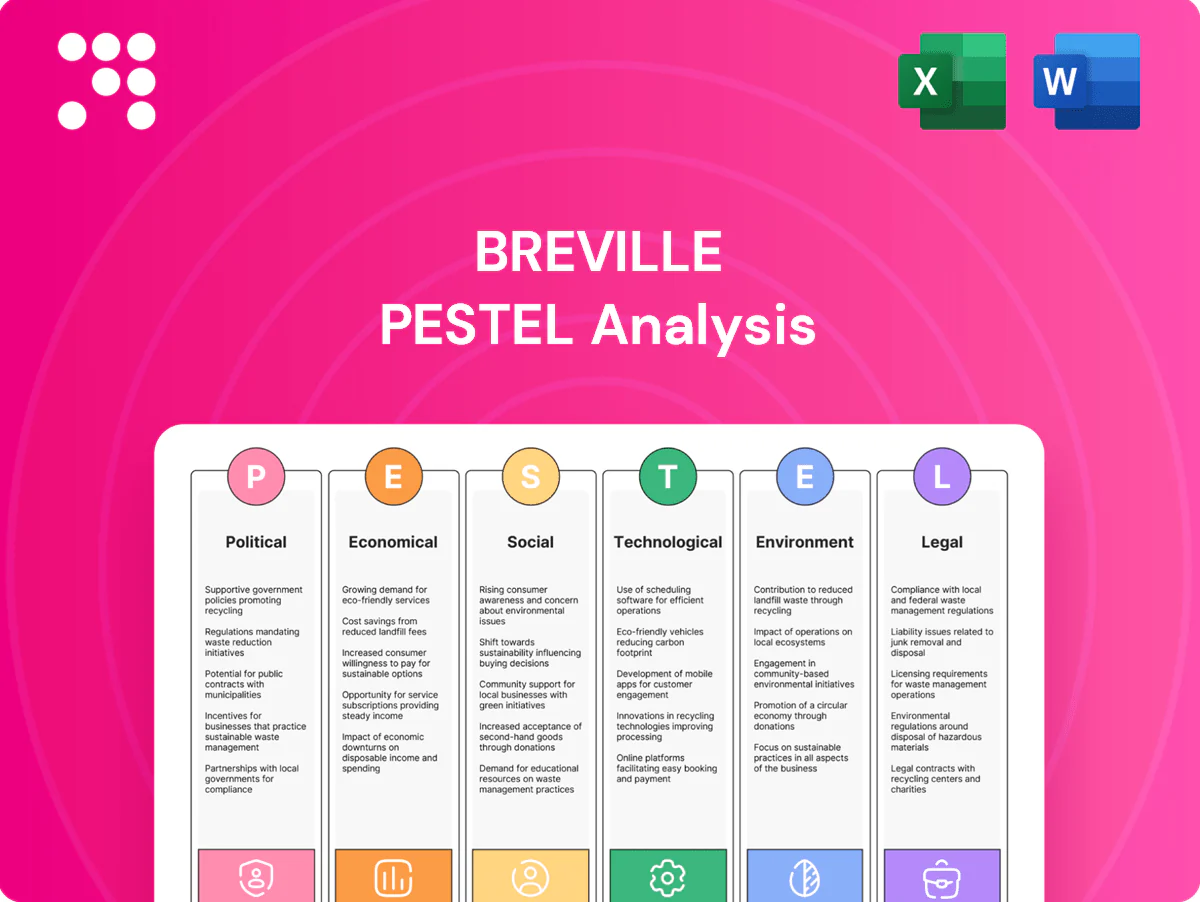
Breville PESTLE Analysis

Skip the Research. Get the Strategy.
Get a strategic advantage with our PESTLE Analysis of Breville—concise, current, and focused on the external forces shaping growth and risk. Ideal for investors, consultants, and planners, it delivers actionable insights you can apply immediately. Purchase the full report to access the complete breakdown, editable files, and data-driven recommendations.
Political factors

Trade policy and tariffs
Breville sources components globally and with FY24 revenue ~AUD 1.76bn is exposed to import tariffs and anti-dumping duties that can compress margins. Shifts in US-China, EU-UK and AUS-Asia trade relations can change landed costs and force retail price moves. Proactive tariff engineering, multi-country sourcing and FTAs (eg CPTPP/FTA use) can mitigate swings. Scenario planning is needed for sudden tariff escalations or relaxations.
Geopolitical supply chain risk
Political instability, port congestion, or sanctions can halt flows of components and finished goods—Ever Given‑style disruptions have been estimated to cost global trade about 9.6 billion USD per day, while LA/Long Beach port backlogs peaked at 109 vessels in early 2022. Concentration in China/Vietnam manufacturing hubs raises country‑risk exposure; dual‑sourcing and nearshoring cut downtime for high‑velocity SKUs, and strategic inventory buffers around peak seasons remain critical.

Government incentives and industrial policy
Subsidies from schemes like Australia’s A$1.3bn Modern Manufacturing Strategy and the A$15bn National Reconstruction Fund, plus global programs such as the US IRA’s ~US$369bn clean‑energy package, can cut Breville’s capex for robotics and energy‑efficient lines. Local content rules in key markets influence plant siting and BOM selection. Active monitoring of policy shifts boosts grant capture and ensures compliant labeling. Engagement with agencies helps shape standards that favor innovation.

Regulatory alignment across markets
Divergent certification regimes (UL, CE, UKCA) increase engineering complexity and lengthen time-to-market; UKCA became mandatory for most goods in Great Britain from 1 Jan 2025, forcing parallel approvals for EU/UK sales. Political moves toward standards harmonization would cut duplicated testing and certification overhead. Investing in pre-compliance labs and agile modular design platforms reduces approval cycles and limits SKU proliferation.
- UKCA mandatory 1 Jan 2025 — parallel EU/UK approvals
- Pre-compliance labs + agile design = faster approvals, fewer SKUs
Public procurement and trade relations for commercial channels
Public procurement rules materially affect commercial coffee and foodservice channels because public purchasing equals roughly 12% of GDP in OECD countries, shaping demand and contract size; political priorities for local suppliers and sustainability criteria now directly influence tender scores. Robust, auditable ESG disclosures improve eligibility for these tenders, while distributor partnerships must comply with sanctioned-country restrictions to avoid disqualification.
- Impact scale: public procurement ~12% of GDP (OECD)
- Tender drivers: local supplier and sustainability mandates
- Action: publish compliant ESG disclosures
- Risk: ensure distributor compliance with sanctions
Tariffs, supply shocks and UKCA changes squeeze margins; pursue subsidies and dual-sourcing
Breville (FY24 revenue ~AUD 1.76bn) is exposed to tariffs/anti‑dumping that can compress margins and alter retail pricing.
Supply shocks (Ever Given ~$9.6bn/day lost trade; LA/Long Beach backlog 109 vessels) plus China/Vietnam concentration raise country‑risk; dual‑sourcing/nearshoring advised.
Grants/subsidies (A$1.3bn Modern Manufacturing, A$15bn National Reconstruction Fund, US IRA ~US$369bn) can offset automation/energy capex; local content rules matter.
Certification divergence (UKCA mandatory 1 Jan 2025) and public procurement (~12% GDP OECD) push pre‑compliance labs and audited ESG disclosures.
| Factor | Key stat | Action |
|---|---|---|
| Tariffs | FY24 rev AUD 1.76bn | Tariff engineering, FTAs |
| Supply risk | 109 vessel backlog | Dual‑sourcing, buffers |
| Subsidies | A$1.3bn/A$15bn/US$369bn | Capture grants |
| Standards & procurement | UKCA 1‑Jan‑2025; 12% GDP | Pre‑compliance labs, ESG |
What is included in the product
 Detailed Word Document
Explores how macro-environmental forces—Political, Economic, Social, Technological, Environmental and Legal—specifically affect Breville, with data-backed trends and regional regulatory context to identify risks and opportunities for executives and investors. Designed as a concise, forward-looking brief ready for business plans, decks and scenario planning.

 Customizable Excel Spreadsheet
Condenses Breville's full PESTLE into a clear, meeting-ready brief that highlights external risks and opportunities, enabling fast alignment and decision-making.
Economic factors

Consumer spending and premiumization
Breville targets premium segments where price elasticity is lower but highly sensitive to consumer confidence; as an ASX-listed company (BRG) this exposure amplifies macro risk. Recessions commonly shift demand toward mid-tier or refurbished units, pressuring unit volumes. Bundles and point-of-sale financing help defend average selling prices and stimulate purchases. Value engineering preserves margins without diluting the brand.
Input costs and inflation
Rising metals (copper ~USD 8,500/t in mid‑2025), plastics (resin down ~10% y/y in 2024) and electronics component volatility, plus logistics (SCFI ~USD 1,200/FEU mid‑2025), drive COGS swings for Breville and pressure retail pricing as global inflation remained elevated (~3–5% range in 2024–25). Hedging and multiyear supplier contracts have been used to stabilize margins, while design‑to‑cost programs reduce material intensity and lower per‑unit cost exposure.

Foreign exchange exposure
Breville earns the bulk of sales in USD, EUR and GBP while manufacturing costs are largely denominated in CNY, creating direct foreign exchange exposure that can erode gross margins when major currencies move against the yuan. FX volatility has previously compressed margins in Breville’s international segments and can cause regional price misalignment. The company employs natural hedging through local sourcing and matching currency flows and uses forward contracts and options as disclosed in its recent annual reports. Regional pricing governance and monitored MSRP bands limit cross-market arbitrage.

Interest rates and channel finance
Higher policy rates (US Fed funds ~5.25–5.50% in 2024–25) raise Breville’s working capital costs and can depress demand for big-ticket appliances; major retailers are likely to tighten trade credit and reduce inventory turns. Using supply-chain finance and dynamic discounting can free cash, while faster direct-to-consumer growth helps offset weaker wholesale orders.
- Higher rates → higher WC cost
- Retailers tighten credit/inventory
- SCF & dynamic discounting optimise cash
- DTC growth partially offsets wholesale
Category growth and competitive intensity
Tariffs, supply shocks and UKCA changes squeeze margins; pursue subsidies and dual-sourcing
Breville faces margin pressure from commodity and logistics swings (copper ~USD 8,500/t mid‑2025; SCFI ~USD 1,200/FEU mid‑2025) while premium positioning buffers price elasticity; inflation ~3–5% in 2024–25 and Fed funds ~5.25–5.50% raise working‑capital costs. FX exposure (USD/EUR/GBP vs CNY) and stronger competition compress pricing power; DTC growth, hedging and design‑to‑cost defend margins.
| Metric | 2024/2025 |
|---|---|
| Market growth (SDA) | ~4–5% (2024) |
| Copper | ~USD 8,500/t (mid‑2025) |
| SCFI | ~USD 1,200/FEU (mid‑2025) |
| Inflation | ~3–5% (2024–25) |
| Fed funds | ~5.25–5.50% (2024–25) |
| Resin prices | ~‑10% y/y (2024) |
Full Version Awaits
Breville PESTLE Analysis
The preview shown here is the exact Breville PESTLE Analysis document you’ll receive after purchase—fully formatted and ready to use. The layout, content, and structure visible are identical to the downloadable file available after payment. No placeholders or teasers—this is the final, professionally structured report. You’ll get this exact file instantly upon checkout.

Skip the Research. Get the Strategy.
Get a strategic advantage with our PESTLE Analysis of Breville—concise, current, and focused on the external forces shaping growth and risk. Ideal for investors, consultants, and planners, it delivers actionable insights you can apply immediately. Purchase the full report to access the complete breakdown, editable files, and data-driven recommendations.
Political factors
Trade policy and tariffs
Breville sources components globally and with FY24 revenue ~AUD 1.76bn is exposed to import tariffs and anti-dumping duties that can compress margins. Shifts in US-China, EU-UK and AUS-Asia trade relations can change landed costs and force retail price moves. Proactive tariff engineering, multi-country sourcing and FTAs (eg CPTPP/FTA use) can mitigate swings. Scenario planning is needed for sudden tariff escalations or relaxations.
Geopolitical supply chain risk
Political instability, port congestion, or sanctions can halt flows of components and finished goods—Ever Given‑style disruptions have been estimated to cost global trade about 9.6 billion USD per day, while LA/Long Beach port backlogs peaked at 109 vessels in early 2022. Concentration in China/Vietnam manufacturing hubs raises country‑risk exposure; dual‑sourcing and nearshoring cut downtime for high‑velocity SKUs, and strategic inventory buffers around peak seasons remain critical.
Government incentives and industrial policy
Subsidies from schemes like Australia’s A$1.3bn Modern Manufacturing Strategy and the A$15bn National Reconstruction Fund, plus global programs such as the US IRA’s ~US$369bn clean‑energy package, can cut Breville’s capex for robotics and energy‑efficient lines. Local content rules in key markets influence plant siting and BOM selection. Active monitoring of policy shifts boosts grant capture and ensures compliant labeling. Engagement with agencies helps shape standards that favor innovation.
Regulatory alignment across markets
Divergent certification regimes (UL, CE, UKCA) increase engineering complexity and lengthen time-to-market; UKCA became mandatory for most goods in Great Britain from 1 Jan 2025, forcing parallel approvals for EU/UK sales. Political moves toward standards harmonization would cut duplicated testing and certification overhead. Investing in pre-compliance labs and agile modular design platforms reduces approval cycles and limits SKU proliferation.
- UKCA mandatory 1 Jan 2025 — parallel EU/UK approvals
- Pre-compliance labs + agile design = faster approvals, fewer SKUs
Public procurement and trade relations for commercial channels
Public procurement rules materially affect commercial coffee and foodservice channels because public purchasing equals roughly 12% of GDP in OECD countries, shaping demand and contract size; political priorities for local suppliers and sustainability criteria now directly influence tender scores. Robust, auditable ESG disclosures improve eligibility for these tenders, while distributor partnerships must comply with sanctioned-country restrictions to avoid disqualification.
- Impact scale: public procurement ~12% of GDP (OECD)
- Tender drivers: local supplier and sustainability mandates
- Action: publish compliant ESG disclosures
- Risk: ensure distributor compliance with sanctions
Tariffs, supply shocks and UKCA changes squeeze margins; pursue subsidies and dual-sourcing
Breville (FY24 revenue ~AUD 1.76bn) is exposed to tariffs/anti‑dumping that can compress margins and alter retail pricing.
Supply shocks (Ever Given ~$9.6bn/day lost trade; LA/Long Beach backlog 109 vessels) plus China/Vietnam concentration raise country‑risk; dual‑sourcing/nearshoring advised.
Grants/subsidies (A$1.3bn Modern Manufacturing, A$15bn National Reconstruction Fund, US IRA ~US$369bn) can offset automation/energy capex; local content rules matter.
Certification divergence (UKCA mandatory 1 Jan 2025) and public procurement (~12% GDP OECD) push pre‑compliance labs and audited ESG disclosures.
| Factor | Key stat | Action |
|---|---|---|
| Tariffs | FY24 rev AUD 1.76bn | Tariff engineering, FTAs |
| Supply risk | 109 vessel backlog | Dual‑sourcing, buffers |
| Subsidies | A$1.3bn/A$15bn/US$369bn | Capture grants |
| Standards & procurement | UKCA 1‑Jan‑2025; 12% GDP | Pre‑compliance labs, ESG |
What is included in the product
Detailed Word Document
Explores how macro-environmental forces—Political, Economic, Social, Technological, Environmental and Legal—specifically affect Breville, with data-backed trends and regional regulatory context to identify risks and opportunities for executives and investors. Designed as a concise, forward-looking brief ready for business plans, decks and scenario planning.
Customizable Excel Spreadsheet
Condenses Breville's full PESTLE into a clear, meeting-ready brief that highlights external risks and opportunities, enabling fast alignment and decision-making.
Economic factors
Consumer spending and premiumization
Breville targets premium segments where price elasticity is lower but highly sensitive to consumer confidence; as an ASX-listed company (BRG) this exposure amplifies macro risk. Recessions commonly shift demand toward mid-tier or refurbished units, pressuring unit volumes. Bundles and point-of-sale financing help defend average selling prices and stimulate purchases. Value engineering preserves margins without diluting the brand.
Input costs and inflation
Rising metals (copper ~USD 8,500/t in mid‑2025), plastics (resin down ~10% y/y in 2024) and electronics component volatility, plus logistics (SCFI ~USD 1,200/FEU mid‑2025), drive COGS swings for Breville and pressure retail pricing as global inflation remained elevated (~3–5% range in 2024–25). Hedging and multiyear supplier contracts have been used to stabilize margins, while design‑to‑cost programs reduce material intensity and lower per‑unit cost exposure.
Foreign exchange exposure
Breville earns the bulk of sales in USD, EUR and GBP while manufacturing costs are largely denominated in CNY, creating direct foreign exchange exposure that can erode gross margins when major currencies move against the yuan. FX volatility has previously compressed margins in Breville’s international segments and can cause regional price misalignment. The company employs natural hedging through local sourcing and matching currency flows and uses forward contracts and options as disclosed in its recent annual reports. Regional pricing governance and monitored MSRP bands limit cross-market arbitrage.
Interest rates and channel finance
Higher policy rates (US Fed funds ~5.25–5.50% in 2024–25) raise Breville’s working capital costs and can depress demand for big-ticket appliances; major retailers are likely to tighten trade credit and reduce inventory turns. Using supply-chain finance and dynamic discounting can free cash, while faster direct-to-consumer growth helps offset weaker wholesale orders.
- Higher rates → higher WC cost
- Retailers tighten credit/inventory
- SCF & dynamic discounting optimise cash
- DTC growth partially offsets wholesale
Category growth and competitive intensity
Tariffs, supply shocks and UKCA changes squeeze margins; pursue subsidies and dual-sourcing
Breville faces margin pressure from commodity and logistics swings (copper ~USD 8,500/t mid‑2025; SCFI ~USD 1,200/FEU mid‑2025) while premium positioning buffers price elasticity; inflation ~3–5% in 2024–25 and Fed funds ~5.25–5.50% raise working‑capital costs. FX exposure (USD/EUR/GBP vs CNY) and stronger competition compress pricing power; DTC growth, hedging and design‑to‑cost defend margins.
| Metric | 2024/2025 |
|---|---|
| Market growth (SDA) | ~4–5% (2024) |
| Copper | ~USD 8,500/t (mid‑2025) |
| SCFI | ~USD 1,200/FEU (mid‑2025) |
| Inflation | ~3–5% (2024–25) |
| Fed funds | ~5.25–5.50% (2024–25) |
| Resin prices | ~‑10% y/y (2024) |
Full Version Awaits
Breville PESTLE Analysis
The preview shown here is the exact Breville PESTLE Analysis document you’ll receive after purchase—fully formatted and ready to use. The layout, content, and structure visible are identical to the downloadable file available after payment. No placeholders or teasers—this is the final, professionally structured report. You’ll get this exact file instantly upon checkout.
Description
Skip the Research. Get the Strategy.
Get a strategic advantage with our PESTLE Analysis of Breville—concise, current, and focused on the external forces shaping growth and risk. Ideal for investors, consultants, and planners, it delivers actionable insights you can apply immediately. Purchase the full report to access the complete breakdown, editable files, and data-driven recommendations.
Political factors
Trade policy and tariffs
Breville sources components globally and with FY24 revenue ~AUD 1.76bn is exposed to import tariffs and anti-dumping duties that can compress margins. Shifts in US-China, EU-UK and AUS-Asia trade relations can change landed costs and force retail price moves. Proactive tariff engineering, multi-country sourcing and FTAs (eg CPTPP/FTA use) can mitigate swings. Scenario planning is needed for sudden tariff escalations or relaxations.
Geopolitical supply chain risk
Political instability, port congestion, or sanctions can halt flows of components and finished goods—Ever Given‑style disruptions have been estimated to cost global trade about 9.6 billion USD per day, while LA/Long Beach port backlogs peaked at 109 vessels in early 2022. Concentration in China/Vietnam manufacturing hubs raises country‑risk exposure; dual‑sourcing and nearshoring cut downtime for high‑velocity SKUs, and strategic inventory buffers around peak seasons remain critical.
Government incentives and industrial policy
Subsidies from schemes like Australia’s A$1.3bn Modern Manufacturing Strategy and the A$15bn National Reconstruction Fund, plus global programs such as the US IRA’s ~US$369bn clean‑energy package, can cut Breville’s capex for robotics and energy‑efficient lines. Local content rules in key markets influence plant siting and BOM selection. Active monitoring of policy shifts boosts grant capture and ensures compliant labeling. Engagement with agencies helps shape standards that favor innovation.
Regulatory alignment across markets
Divergent certification regimes (UL, CE, UKCA) increase engineering complexity and lengthen time-to-market; UKCA became mandatory for most goods in Great Britain from 1 Jan 2025, forcing parallel approvals for EU/UK sales. Political moves toward standards harmonization would cut duplicated testing and certification overhead. Investing in pre-compliance labs and agile modular design platforms reduces approval cycles and limits SKU proliferation.
- UKCA mandatory 1 Jan 2025 — parallel EU/UK approvals
- Pre-compliance labs + agile design = faster approvals, fewer SKUs
Public procurement and trade relations for commercial channels
Public procurement rules materially affect commercial coffee and foodservice channels because public purchasing equals roughly 12% of GDP in OECD countries, shaping demand and contract size; political priorities for local suppliers and sustainability criteria now directly influence tender scores. Robust, auditable ESG disclosures improve eligibility for these tenders, while distributor partnerships must comply with sanctioned-country restrictions to avoid disqualification.
- Impact scale: public procurement ~12% of GDP (OECD)
- Tender drivers: local supplier and sustainability mandates
- Action: publish compliant ESG disclosures
- Risk: ensure distributor compliance with sanctions
Tariffs, supply shocks and UKCA changes squeeze margins; pursue subsidies and dual-sourcing
Breville (FY24 revenue ~AUD 1.76bn) is exposed to tariffs/anti‑dumping that can compress margins and alter retail pricing.
Supply shocks (Ever Given ~$9.6bn/day lost trade; LA/Long Beach backlog 109 vessels) plus China/Vietnam concentration raise country‑risk; dual‑sourcing/nearshoring advised.
Grants/subsidies (A$1.3bn Modern Manufacturing, A$15bn National Reconstruction Fund, US IRA ~US$369bn) can offset automation/energy capex; local content rules matter.
Certification divergence (UKCA mandatory 1 Jan 2025) and public procurement (~12% GDP OECD) push pre‑compliance labs and audited ESG disclosures.
| Factor | Key stat | Action |
|---|---|---|
| Tariffs | FY24 rev AUD 1.76bn | Tariff engineering, FTAs |
| Supply risk | 109 vessel backlog | Dual‑sourcing, buffers |
| Subsidies | A$1.3bn/A$15bn/US$369bn | Capture grants |
| Standards & procurement | UKCA 1‑Jan‑2025; 12% GDP | Pre‑compliance labs, ESG |
What is included in the product
Detailed Word Document
Explores how macro-environmental forces—Political, Economic, Social, Technological, Environmental and Legal—specifically affect Breville, with data-backed trends and regional regulatory context to identify risks and opportunities for executives and investors. Designed as a concise, forward-looking brief ready for business plans, decks and scenario planning.
Customizable Excel Spreadsheet
Condenses Breville's full PESTLE into a clear, meeting-ready brief that highlights external risks and opportunities, enabling fast alignment and decision-making.
Economic factors
Consumer spending and premiumization
Breville targets premium segments where price elasticity is lower but highly sensitive to consumer confidence; as an ASX-listed company (BRG) this exposure amplifies macro risk. Recessions commonly shift demand toward mid-tier or refurbished units, pressuring unit volumes. Bundles and point-of-sale financing help defend average selling prices and stimulate purchases. Value engineering preserves margins without diluting the brand.
Input costs and inflation
Rising metals (copper ~USD 8,500/t in mid‑2025), plastics (resin down ~10% y/y in 2024) and electronics component volatility, plus logistics (SCFI ~USD 1,200/FEU mid‑2025), drive COGS swings for Breville and pressure retail pricing as global inflation remained elevated (~3–5% range in 2024–25). Hedging and multiyear supplier contracts have been used to stabilize margins, while design‑to‑cost programs reduce material intensity and lower per‑unit cost exposure.
Foreign exchange exposure
Breville earns the bulk of sales in USD, EUR and GBP while manufacturing costs are largely denominated in CNY, creating direct foreign exchange exposure that can erode gross margins when major currencies move against the yuan. FX volatility has previously compressed margins in Breville’s international segments and can cause regional price misalignment. The company employs natural hedging through local sourcing and matching currency flows and uses forward contracts and options as disclosed in its recent annual reports. Regional pricing governance and monitored MSRP bands limit cross-market arbitrage.
Interest rates and channel finance
Higher policy rates (US Fed funds ~5.25–5.50% in 2024–25) raise Breville’s working capital costs and can depress demand for big-ticket appliances; major retailers are likely to tighten trade credit and reduce inventory turns. Using supply-chain finance and dynamic discounting can free cash, while faster direct-to-consumer growth helps offset weaker wholesale orders.
- Higher rates → higher WC cost
- Retailers tighten credit/inventory
- SCF & dynamic discounting optimise cash
- DTC growth partially offsets wholesale
Category growth and competitive intensity
Tariffs, supply shocks and UKCA changes squeeze margins; pursue subsidies and dual-sourcing
Breville faces margin pressure from commodity and logistics swings (copper ~USD 8,500/t mid‑2025; SCFI ~USD 1,200/FEU mid‑2025) while premium positioning buffers price elasticity; inflation ~3–5% in 2024–25 and Fed funds ~5.25–5.50% raise working‑capital costs. FX exposure (USD/EUR/GBP vs CNY) and stronger competition compress pricing power; DTC growth, hedging and design‑to‑cost defend margins.
| Metric | 2024/2025 |
|---|---|
| Market growth (SDA) | ~4–5% (2024) |
| Copper | ~USD 8,500/t (mid‑2025) |
| SCFI | ~USD 1,200/FEU (mid‑2025) |
| Inflation | ~3–5% (2024–25) |
| Fed funds | ~5.25–5.50% (2024–25) |
| Resin prices | ~‑10% y/y (2024) |
Full Version Awaits
Breville PESTLE Analysis
The preview shown here is the exact Breville PESTLE Analysis document you’ll receive after purchase—fully formatted and ready to use. The layout, content, and structure visible are identical to the downloadable file available after payment. No placeholders or teasers—this is the final, professionally structured report. You’ll get this exact file instantly upon checkout.











