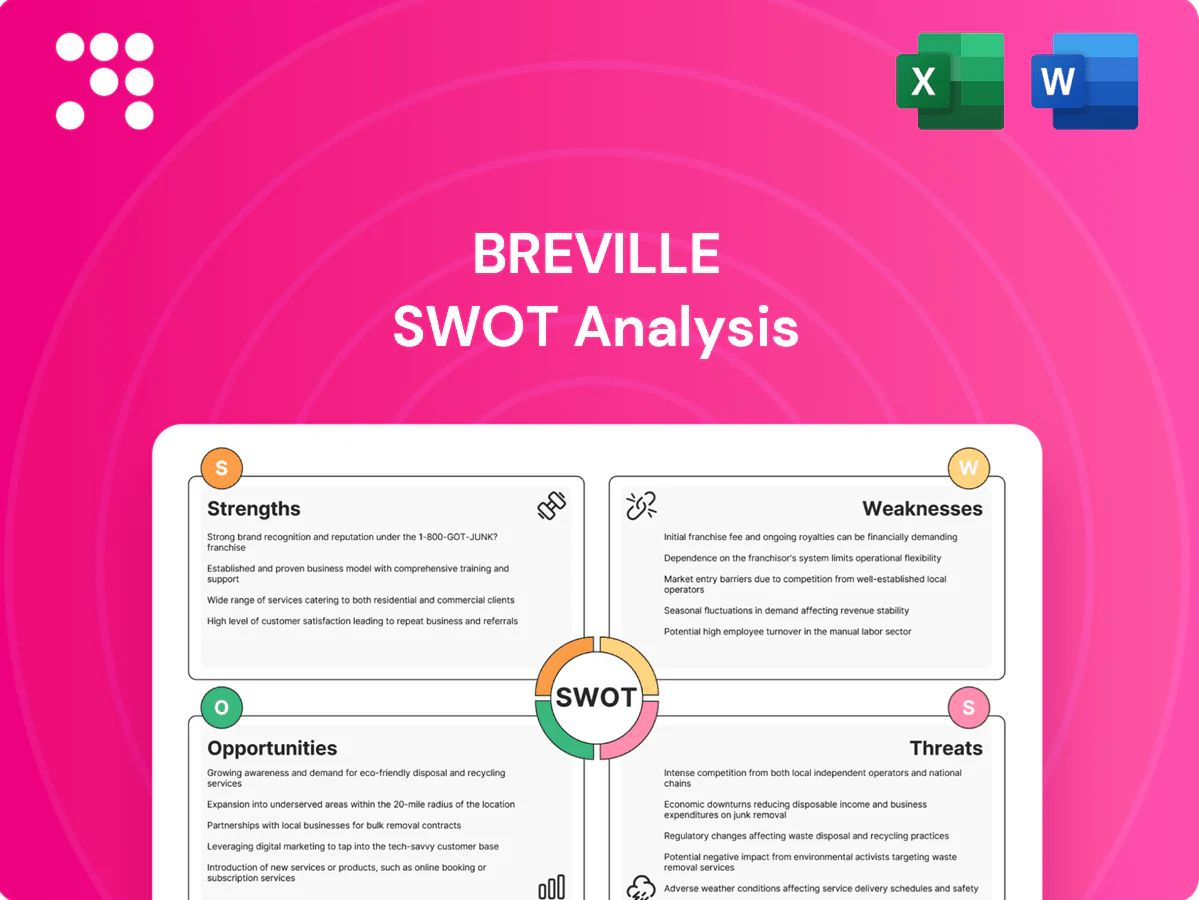
Breville SWOT Analysis

Go Beyond the Preview—Access the Full Strategic Report
Breville’s SWOT highlights strong brand recognition, product innovation, and premium appliance margins alongside supply-chain exposure and intensifying competition; our concise view shows opportunities in smart appliances and international expansion. Purchase the full SWOT analysis for a research-backed, editable Word + Excel package to inform strategy, investment, or pitch materials.
Strengths

Premium brand equity
Breville commands strong recognition for quality and performance in small appliances, enabling consistent premium pricing across its portfolio. Brand trust drives repeat purchases across categories, strengthening lifetime value. Ownership of Sage in Europe and Baratza in specialty coffee extends credibility and channel reach. Premium positioning cushions margins relative to mid-tier competitors, supporting resilience in pricing power.
Design-led innovation
ASX: BRG is defined by user-centric design and patented features in coffee and food-prep categories, driving premium positioning and higher ASPs. The group has over 90 international design awards (Red Dot, iF), reinforcing perceived value and retail appeal. A steady stream of new product launches sustains differentiation, defends shelf space and boosts digital search visibility and conversion rates.

Coffee category leadership
Breville Group (ASX: BRG) and Baratza anchor leadership in prosumer espresso machines and grinders, spanning entry to high-end SKUs that tilt the mix toward higher-margin models. Accessories, replacement parts and ecosystem tie-ins boost repeat sales and lifetime value. Coffee-category authority supports credible expansion into adjacent beverage appliances and channels.

Global multi-brand distribution
Breville’s portfolio sells under Breville, Sage, and Baratza across North America, EMEA and APAC, giving broad geographic diversification and brand segmentation. Omnichannel reach—specialty retail, big-box, e-commerce and DTC—reduces dependency on any single route and supports margin resilience. Strong retail partnerships secure premium shelf placement while global scale delivers marketing efficiency and sourcing leverage.
- Brands: Breville, Sage, Baratza
- Channels: specialty, big-box, e-commerce, DTC
- Benefits: reduced channel risk, premium placement, sourcing & marketing scale
Diversified countertop portfolio
Breville's diversified countertop portfolio spans six core categories — espresso, grinders, blenders, toasters, ovens and food processors — reducing single-product volatility and enabling cross-selling to raise basket size and attachment rates; the group sells into 70+ countries, supporting scale. Platform reuse across categories lowers incremental R&D and tooling costs over time.
- Six core categories: espresso to food processors
- Presence: 70+ countries
- Cross-sell boosts basket size and attachment
- Platform reuse cuts R&D/tooling per SKU over time
Prosumer appliance leader with presence in 70+ countries and 90+ design awards
Breville (ASX: BRG) combines strong global brand recognition, user-centric patented design (90+ international design awards) and prosumer leadership via Breville, Sage and Baratza, supporting premium ASPs and repeat purchases. Omnichannel distribution across specialty, big-box, e-commerce and DTC and presence in 70+ countries diversify risk and improve margins. Platform reuse and accessories drive higher lifetime value.
| Metric | Fact |
|---|---|
| Brands | Breville, Sage, Baratza |
| Design awards | 90+ international awards |
| Geography | 70+ countries |
| Channels | Specialty, big-box, e-commerce, DTC |
What is included in the product
 Detailed Word Document
Provides a concise SWOT analysis of Breville, highlighting core strengths, operational weaknesses, market opportunities, and external threats to assess the company’s strategic positioning and growth prospects.

 Customizable Excel Spreadsheet
Provides a clear Breville SWOT matrix for rapid alignment of strategy and product roadmap, easing cross-team decision-making. Editable format enables quick updates to reflect market shifts and operational priorities.
Weaknesses

Premium price sensitivity
Breville Group (ASX: BRG) premium ASPs limit reach into price‑sensitive segments, constraining volume growth outside higher‑income cohorts. Demand can soften rapidly in downturns as consumers defer discretionary appliance purchases, pressuring FY24 sales momentum. Heavy promotional activity to shift stock erodes margins, and lower‑priced competitors undercut with good‑enough features, capturing value-oriented buyers.
Third-party manufacturing reliance
Heavy reliance on third-party manufacturers in China, Vietnam and Thailand exposes Breville to supplier concentration risk and requires constant oversight of quality control, lead times and IP protection. Past supply-chain disruptions have periodically compressed margins through higher freight and tariff costs. Limited vertical integration reduces bargaining power for key components and amplifies vulnerability to logistics shocks. Continuous supplier monitoring raises operating complexity and costs.

Retail partner concentration
Breville relies on a handful of large retail partners to move most of its product, with FY24 group revenue of about A$2.7bn flowing significantly through major chains. Shelf resets or retailer private-label initiatives can quickly displace Breville SKUs, interrupting sell-through. Retailer-imposed margin structures and promotional calendars compress gross margins and increase markdown risk. Growing DTC sales heighten channel conflict with those key partners.

Narrow focus on small appliances
- Concentration: FY2024 revenue ~A$1.9bn
- Replacement cycles: 5–10 years
- Saturation: limited organic upside in mature markets
- Expansion cost: incremental capex & marketing required
FX and geographic exposure
Breville’s revenues and costs span USD, EUR, GBP and AUD, exposing the group to currency volatility; FY2024 group revenue was about AUD 2.6bn, so translation and transaction FX movements can meaningfully swing reported results. Hedging programs reduce but do not eliminate risk, and aligning pricing across regions is complex, increasing gray market and margin dilution risk.
- FX breadth: USD/EUR/GBP/AUD exposure
- FY2024 revenue ~AUD 2.6bn: sensitivity to rates
- Hedging mitigates but cannot eliminate
- Pricing misalignment fuels gray market activity
Premium-priced appliance leader: concentrated revenue A$2.6bn (A$1.9bn) caps growth
Breville’s premium pricing limits penetration in value segments, making FY2024 revenue concentration (group ~A$2.6bn; small appliances ~A$1.9bn) vulnerable to downturns and margin‑eroding promotions. Reliance on third‑party Asian manufacturing raises supply, quality and IP risk, while concentrated retail partners and long replacement cycles (5–10 yrs) cap near‑term growth.
| Metric | FY2024 / Note |
|---|---|
| Group revenue | A$2.6bn |
| Small appliances | A$1.9bn |
| Replacement cycle | 5–10 yrs |
What You See Is What You Get
Breville SWOT Analysis
This is the actual Breville SWOT analysis document you’ll receive upon purchase—no surprises, just professional quality. The preview below is taken directly from the full report and reflects the complete structure and insights. Once purchased, you’ll receive the full, editable version for immediate download. Buy now to unlock the complete, detailed file.

Go Beyond the Preview—Access the Full Strategic Report
Breville’s SWOT highlights strong brand recognition, product innovation, and premium appliance margins alongside supply-chain exposure and intensifying competition; our concise view shows opportunities in smart appliances and international expansion. Purchase the full SWOT analysis for a research-backed, editable Word + Excel package to inform strategy, investment, or pitch materials.
Strengths
Premium brand equity
Breville commands strong recognition for quality and performance in small appliances, enabling consistent premium pricing across its portfolio. Brand trust drives repeat purchases across categories, strengthening lifetime value. Ownership of Sage in Europe and Baratza in specialty coffee extends credibility and channel reach. Premium positioning cushions margins relative to mid-tier competitors, supporting resilience in pricing power.
Design-led innovation
ASX: BRG is defined by user-centric design and patented features in coffee and food-prep categories, driving premium positioning and higher ASPs. The group has over 90 international design awards (Red Dot, iF), reinforcing perceived value and retail appeal. A steady stream of new product launches sustains differentiation, defends shelf space and boosts digital search visibility and conversion rates.
Coffee category leadership
Breville Group (ASX: BRG) and Baratza anchor leadership in prosumer espresso machines and grinders, spanning entry to high-end SKUs that tilt the mix toward higher-margin models. Accessories, replacement parts and ecosystem tie-ins boost repeat sales and lifetime value. Coffee-category authority supports credible expansion into adjacent beverage appliances and channels.
Global multi-brand distribution
Breville’s portfolio sells under Breville, Sage, and Baratza across North America, EMEA and APAC, giving broad geographic diversification and brand segmentation. Omnichannel reach—specialty retail, big-box, e-commerce and DTC—reduces dependency on any single route and supports margin resilience. Strong retail partnerships secure premium shelf placement while global scale delivers marketing efficiency and sourcing leverage.
- Brands: Breville, Sage, Baratza
- Channels: specialty, big-box, e-commerce, DTC
- Benefits: reduced channel risk, premium placement, sourcing & marketing scale
Diversified countertop portfolio
Breville's diversified countertop portfolio spans six core categories — espresso, grinders, blenders, toasters, ovens and food processors — reducing single-product volatility and enabling cross-selling to raise basket size and attachment rates; the group sells into 70+ countries, supporting scale. Platform reuse across categories lowers incremental R&D and tooling costs over time.
- Six core categories: espresso to food processors
- Presence: 70+ countries
- Cross-sell boosts basket size and attachment
- Platform reuse cuts R&D/tooling per SKU over time
Prosumer appliance leader with presence in 70+ countries and 90+ design awards
Breville (ASX: BRG) combines strong global brand recognition, user-centric patented design (90+ international design awards) and prosumer leadership via Breville, Sage and Baratza, supporting premium ASPs and repeat purchases. Omnichannel distribution across specialty, big-box, e-commerce and DTC and presence in 70+ countries diversify risk and improve margins. Platform reuse and accessories drive higher lifetime value.
| Metric | Fact |
|---|---|
| Brands | Breville, Sage, Baratza |
| Design awards | 90+ international awards |
| Geography | 70+ countries |
| Channels | Specialty, big-box, e-commerce, DTC |
What is included in the product
Detailed Word Document
Provides a concise SWOT analysis of Breville, highlighting core strengths, operational weaknesses, market opportunities, and external threats to assess the company’s strategic positioning and growth prospects.
Customizable Excel Spreadsheet
Provides a clear Breville SWOT matrix for rapid alignment of strategy and product roadmap, easing cross-team decision-making. Editable format enables quick updates to reflect market shifts and operational priorities.
Weaknesses
Premium price sensitivity
Breville Group (ASX: BRG) premium ASPs limit reach into price‑sensitive segments, constraining volume growth outside higher‑income cohorts. Demand can soften rapidly in downturns as consumers defer discretionary appliance purchases, pressuring FY24 sales momentum. Heavy promotional activity to shift stock erodes margins, and lower‑priced competitors undercut with good‑enough features, capturing value-oriented buyers.
Third-party manufacturing reliance
Heavy reliance on third-party manufacturers in China, Vietnam and Thailand exposes Breville to supplier concentration risk and requires constant oversight of quality control, lead times and IP protection. Past supply-chain disruptions have periodically compressed margins through higher freight and tariff costs. Limited vertical integration reduces bargaining power for key components and amplifies vulnerability to logistics shocks. Continuous supplier monitoring raises operating complexity and costs.
Retail partner concentration
Breville relies on a handful of large retail partners to move most of its product, with FY24 group revenue of about A$2.7bn flowing significantly through major chains. Shelf resets or retailer private-label initiatives can quickly displace Breville SKUs, interrupting sell-through. Retailer-imposed margin structures and promotional calendars compress gross margins and increase markdown risk. Growing DTC sales heighten channel conflict with those key partners.
Narrow focus on small appliances
- Concentration: FY2024 revenue ~A$1.9bn
- Replacement cycles: 5–10 years
- Saturation: limited organic upside in mature markets
- Expansion cost: incremental capex & marketing required
FX and geographic exposure
Breville’s revenues and costs span USD, EUR, GBP and AUD, exposing the group to currency volatility; FY2024 group revenue was about AUD 2.6bn, so translation and transaction FX movements can meaningfully swing reported results. Hedging programs reduce but do not eliminate risk, and aligning pricing across regions is complex, increasing gray market and margin dilution risk.
- FX breadth: USD/EUR/GBP/AUD exposure
- FY2024 revenue ~AUD 2.6bn: sensitivity to rates
- Hedging mitigates but cannot eliminate
- Pricing misalignment fuels gray market activity
Premium-priced appliance leader: concentrated revenue A$2.6bn (A$1.9bn) caps growth
Breville’s premium pricing limits penetration in value segments, making FY2024 revenue concentration (group ~A$2.6bn; small appliances ~A$1.9bn) vulnerable to downturns and margin‑eroding promotions. Reliance on third‑party Asian manufacturing raises supply, quality and IP risk, while concentrated retail partners and long replacement cycles (5–10 yrs) cap near‑term growth.
| Metric | FY2024 / Note |
|---|---|
| Group revenue | A$2.6bn |
| Small appliances | A$1.9bn |
| Replacement cycle | 5–10 yrs |
What You See Is What You Get
Breville SWOT Analysis
This is the actual Breville SWOT analysis document you’ll receive upon purchase—no surprises, just professional quality. The preview below is taken directly from the full report and reflects the complete structure and insights. Once purchased, you’ll receive the full, editable version for immediate download. Buy now to unlock the complete, detailed file.
Original: $10.00
-65%$10.00
$3.50Description
Go Beyond the Preview—Access the Full Strategic Report
Breville’s SWOT highlights strong brand recognition, product innovation, and premium appliance margins alongside supply-chain exposure and intensifying competition; our concise view shows opportunities in smart appliances and international expansion. Purchase the full SWOT analysis for a research-backed, editable Word + Excel package to inform strategy, investment, or pitch materials.
Strengths
Premium brand equity
Breville commands strong recognition for quality and performance in small appliances, enabling consistent premium pricing across its portfolio. Brand trust drives repeat purchases across categories, strengthening lifetime value. Ownership of Sage in Europe and Baratza in specialty coffee extends credibility and channel reach. Premium positioning cushions margins relative to mid-tier competitors, supporting resilience in pricing power.
Design-led innovation
ASX: BRG is defined by user-centric design and patented features in coffee and food-prep categories, driving premium positioning and higher ASPs. The group has over 90 international design awards (Red Dot, iF), reinforcing perceived value and retail appeal. A steady stream of new product launches sustains differentiation, defends shelf space and boosts digital search visibility and conversion rates.
Coffee category leadership
Breville Group (ASX: BRG) and Baratza anchor leadership in prosumer espresso machines and grinders, spanning entry to high-end SKUs that tilt the mix toward higher-margin models. Accessories, replacement parts and ecosystem tie-ins boost repeat sales and lifetime value. Coffee-category authority supports credible expansion into adjacent beverage appliances and channels.
Global multi-brand distribution
Breville’s portfolio sells under Breville, Sage, and Baratza across North America, EMEA and APAC, giving broad geographic diversification and brand segmentation. Omnichannel reach—specialty retail, big-box, e-commerce and DTC—reduces dependency on any single route and supports margin resilience. Strong retail partnerships secure premium shelf placement while global scale delivers marketing efficiency and sourcing leverage.
- Brands: Breville, Sage, Baratza
- Channels: specialty, big-box, e-commerce, DTC
- Benefits: reduced channel risk, premium placement, sourcing & marketing scale
Diversified countertop portfolio
Breville's diversified countertop portfolio spans six core categories — espresso, grinders, blenders, toasters, ovens and food processors — reducing single-product volatility and enabling cross-selling to raise basket size and attachment rates; the group sells into 70+ countries, supporting scale. Platform reuse across categories lowers incremental R&D and tooling costs over time.
- Six core categories: espresso to food processors
- Presence: 70+ countries
- Cross-sell boosts basket size and attachment
- Platform reuse cuts R&D/tooling per SKU over time
Prosumer appliance leader with presence in 70+ countries and 90+ design awards
Breville (ASX: BRG) combines strong global brand recognition, user-centric patented design (90+ international design awards) and prosumer leadership via Breville, Sage and Baratza, supporting premium ASPs and repeat purchases. Omnichannel distribution across specialty, big-box, e-commerce and DTC and presence in 70+ countries diversify risk and improve margins. Platform reuse and accessories drive higher lifetime value.
| Metric | Fact |
|---|---|
| Brands | Breville, Sage, Baratza |
| Design awards | 90+ international awards |
| Geography | 70+ countries |
| Channels | Specialty, big-box, e-commerce, DTC |
What is included in the product
Detailed Word Document
Provides a concise SWOT analysis of Breville, highlighting core strengths, operational weaknesses, market opportunities, and external threats to assess the company’s strategic positioning and growth prospects.
Customizable Excel Spreadsheet
Provides a clear Breville SWOT matrix for rapid alignment of strategy and product roadmap, easing cross-team decision-making. Editable format enables quick updates to reflect market shifts and operational priorities.
Weaknesses
Premium price sensitivity
Breville Group (ASX: BRG) premium ASPs limit reach into price‑sensitive segments, constraining volume growth outside higher‑income cohorts. Demand can soften rapidly in downturns as consumers defer discretionary appliance purchases, pressuring FY24 sales momentum. Heavy promotional activity to shift stock erodes margins, and lower‑priced competitors undercut with good‑enough features, capturing value-oriented buyers.
Third-party manufacturing reliance
Heavy reliance on third-party manufacturers in China, Vietnam and Thailand exposes Breville to supplier concentration risk and requires constant oversight of quality control, lead times and IP protection. Past supply-chain disruptions have periodically compressed margins through higher freight and tariff costs. Limited vertical integration reduces bargaining power for key components and amplifies vulnerability to logistics shocks. Continuous supplier monitoring raises operating complexity and costs.
Retail partner concentration
Breville relies on a handful of large retail partners to move most of its product, with FY24 group revenue of about A$2.7bn flowing significantly through major chains. Shelf resets or retailer private-label initiatives can quickly displace Breville SKUs, interrupting sell-through. Retailer-imposed margin structures and promotional calendars compress gross margins and increase markdown risk. Growing DTC sales heighten channel conflict with those key partners.
Narrow focus on small appliances
- Concentration: FY2024 revenue ~A$1.9bn
- Replacement cycles: 5–10 years
- Saturation: limited organic upside in mature markets
- Expansion cost: incremental capex & marketing required
FX and geographic exposure
Breville’s revenues and costs span USD, EUR, GBP and AUD, exposing the group to currency volatility; FY2024 group revenue was about AUD 2.6bn, so translation and transaction FX movements can meaningfully swing reported results. Hedging programs reduce but do not eliminate risk, and aligning pricing across regions is complex, increasing gray market and margin dilution risk.
- FX breadth: USD/EUR/GBP/AUD exposure
- FY2024 revenue ~AUD 2.6bn: sensitivity to rates
- Hedging mitigates but cannot eliminate
- Pricing misalignment fuels gray market activity
Premium-priced appliance leader: concentrated revenue A$2.6bn (A$1.9bn) caps growth
Breville’s premium pricing limits penetration in value segments, making FY2024 revenue concentration (group ~A$2.6bn; small appliances ~A$1.9bn) vulnerable to downturns and margin‑eroding promotions. Reliance on third‑party Asian manufacturing raises supply, quality and IP risk, while concentrated retail partners and long replacement cycles (5–10 yrs) cap near‑term growth.
| Metric | FY2024 / Note |
|---|---|
| Group revenue | A$2.6bn |
| Small appliances | A$1.9bn |
| Replacement cycle | 5–10 yrs |
What You See Is What You Get
Breville SWOT Analysis
This is the actual Breville SWOT analysis document you’ll receive upon purchase—no surprises, just professional quality. The preview below is taken directly from the full report and reflects the complete structure and insights. Once purchased, you’ll receive the full, editable version for immediate download. Buy now to unlock the complete, detailed file.











