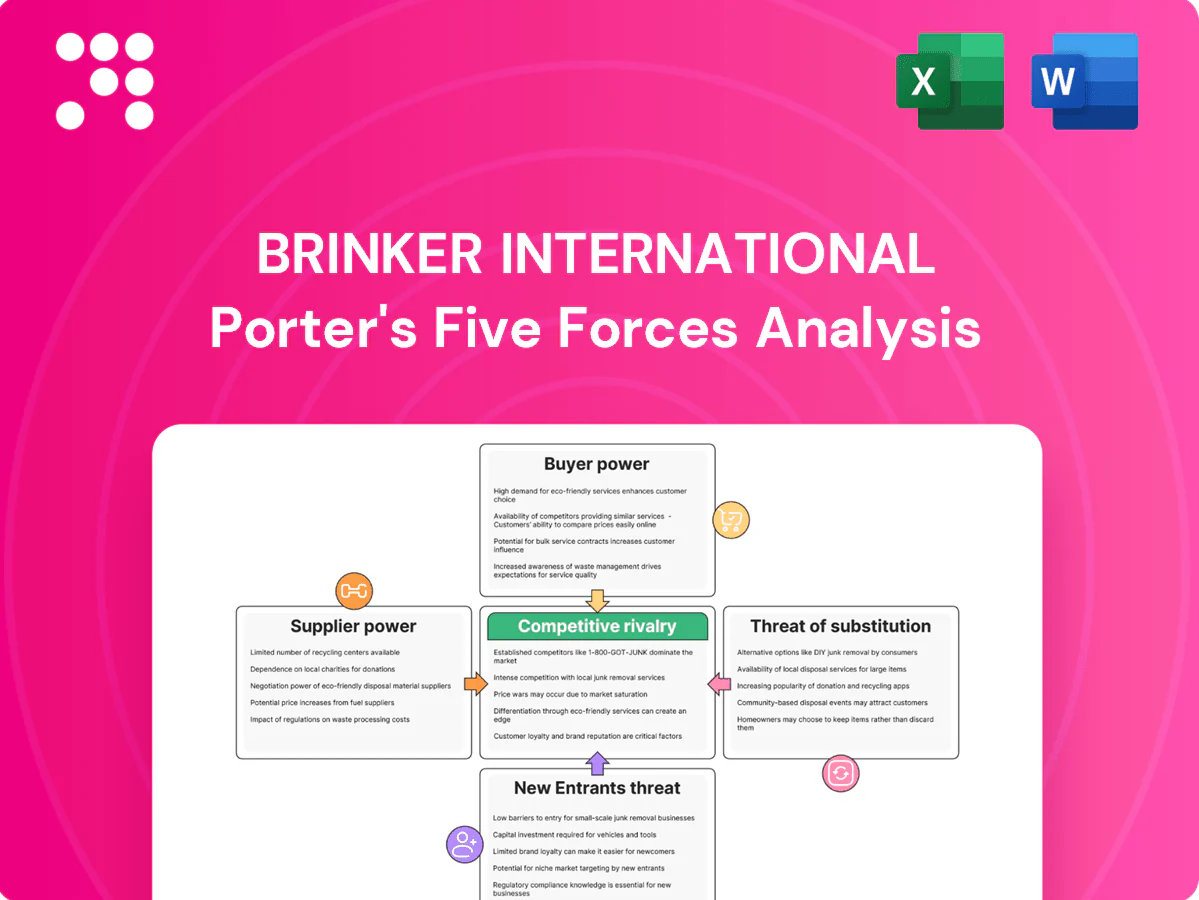
Brinker International Porter's Five Forces Analysis

Don't Miss the Bigger Picture
Brinker International faces intense competitive rivalry, moderate supplier power, and shifting buyer preferences that increase margin pressure. Threats from new fast-casual entrants and growing substitute options raise strategic risks for its casual-dining model. This brief snapshot only scratches the surface—unlock the full Porter's Five Forces Analysis for force-by-force ratings, visuals, and actionable strategy insights.
Suppliers Bargaining Power

Scale vs fragmented suppliers
Brinker’s scale—about 1,600 restaurants and roughly $3.6 billion in FY2024 revenue—gives it negotiating leverage with many commodity and produce suppliers. Fragmented farming and protein markets keep individual supplier power low, but weather or disease-driven shocks can narrow options and raise short-term dependence. Brinker mitigates this via multi-sourcing and longer-term contracts, reducing price volatility and supply disruption risk.
Commodity price volatility
Beef, chicken, dairy, wheat and produce price swings in 2024 pressured margins for Brinker, with food-away-from-home inflation running about 3.7% year-over-year, allowing suppliers to pass cost increases faster than menu repricing; hedging and menu engineering reduced exposure but could not eliminate it, and volatility raised supplier leverage during tight supply markets.

Distribution concentration
Foodservice distribution in the U.S. is concentrated: Sysco and US Foods together control greater than 40% of broadline distribution as of 2024, raising supplier bargaining power over chains like Brinker. Dependence on national distributors increases switching costs and service risk, though contracts and SLAs limit exposure. Outages can ripple quickly across multi-state operations. Brinker mitigates leverage via geographic redundancy and dual-sourcing.

Branded beverage and alcohol partners
Soft drink and alcohol categories are dominated by Coca-Cola and PepsiCo in nonalcoholic drinks and AB InBev among brewers in 2024, giving brand owners strong marketing clout over Brinker. Tied equipment and pouring-rights agreements create moderate switching frictions for Chili’s and Maggiano’s. Rebates and co-marketing reduce net cost but impose compliance constraints; national negotiations help scale leverage yet category captains retain influence.
- Brand concentration: Coca-Cola/PepsiCo, AB InBev (2024)
- Switching frictions: tied equipment/pour rights
- Offsets: rebates + co-marketing with compliance
- Mitigation: national deals but limited supplier displacement
Specialty inputs and equipment
Certain proprietary sauces, seasonings, or kitchen tech used across Brinker’s two brands, Chili’s and Maggiano’s, increase dependency on limited suppliers and extend lead times for menu or operational changes; qualifying alternates requires testing, staff training, and quality control that slow substitutions.
- Brands: Chili’s, Maggiano’s
- Risk: vendor entrenchment
- Cost: testing/training overhead
Scale: ~1,600 units & $3.6B revenue, but supplier power rises
Brinker’s ~1,600 restaurants and $3.6B FY2024 revenue give negotiating leverage, but short-term shocks raise supplier power. Food-away-from-home inflation ~3.7% YoY in 2024 and volatile beef/chicken prices squeezed margins despite hedging. Sysco+US Foods >40% broadline share and Coca-Cola/Pepsi/AB InBev brand concentration create switching frictions mitigated by multi-sourcing and national deals.
| Metric | 2024 value |
|---|---|
| Restaurants | ~1,600 |
| FY2024 revenue | $3.6B |
| FAFH inflation | 3.7% YoY |
| Distributor share (Sysco+US Foods) | >40% |
What is included in the product
 Detailed Word Document
Uncovers key drivers of competition for Brinker International—evaluating buyer and supplier power, threat of new entrants and substitutes, and industry rivalry to identify disruptive forces, pricing pressure, and barriers that protect incumbents.

 Customizable Excel Spreadsheet
A one-sheet Porter’s Five Forces for Brinker International that highlights supplier power, buyer pressure, competitive rivalry, and threats—perfect for quick strategic decisions, deck-ready slides, and easily customized pressure levels to reflect evolving market trends.
Customers Bargaining Power

Low switching costs for diners
Customers can switch easily among casual dining, fast-casual and delivery, pressuring Brinker (around 1,300 restaurants) as off-premise orders reached roughly 24% of sales in 2024; minimal monetary or time penalties raise buyer power. Promotions must be compelling to sustain visits without eroding slim industry operating margins near 6–8% in 2024. Loyalty programs target modestly higher switching costs and incremental spend per visit.
High price sensitivity
Middle-income diners at Brinker are highly price sensitive: US CPI rose 3.4% in 2024, pushing average ticket higher and risking traffic declines as consumers trade down. Value menus and bundles remain critical to defend frequency, while targeted discounts and portion control help preserve margins. Inflation-driven check increases must be balanced to avoid eroding visits, especially in casual-dining segments.

Information transparency and reviews
Online ratings, social media, and aggregator apps amplify customer voice — with reviews influencing an estimated 93% of diners in 2024, negative posts and food-safety incidents can quickly shift demand and traffic. For Brinker, consistency across its roughly 1,600+ locations (2024) is critical to defend Chili’s and Maggiano’s brand equity. Rapid digital responsiveness and community management measurably temper buyer power and mitigate short-term revenue impact.

Delivery aggregators shaping expectations
Delivery aggregators broaden Brinker’s reach but take 15–30% commissions in 2024 and control discovery, letting diners compare price, speed and fees across brands in-app, increasing customer leverage; packaging and in-transit quality drive repeat rates, forcing mix management to protect margins while meeting convenience demand.
- 15–30% aggregator fees
- In-app price/speed/fee comparisons boost switching
- Packaging affects repeat purchase
- Menu mix needed to defend margins
Group and occasion-based demand
Group and occasion-based demand at Brinker is episodic and discerning: large parties and catering drive higher average checks but expect elevated ambiance and service, and Brinker operated about 1,600 restaurants in 2024 to serve these needs.
- Higher-ticket groups: episodic, discerning
- Occasion dining: demands ambiance/service
- Menu/bar breadth: supports groups
- Service failures: rapid defections
Off-premise ~24%, fees 15-30%, margins ~6-8%
Customers wield high bargaining power: off-premise reached ~24% of Brinker sales in 2024, making convenience and aggregator channels crucial; aggregators charged 15–30% commissions. Industry operating margins were ~6–8% in 2024, CPI rose 3.4% (2024) and 93% of diners used reviews to choose restaurants, increasing sensitivity to price, quality and service.
| Metric | 2024 |
|---|---|
| Restaurants | ~1,600 |
| Off-premise share | ~24% |
| Aggregator fees | 15–30% |
| Industry margins | 6–8% |
| US CPI | 3.4% |
| Review influence | 93% |
Preview the Actual Deliverable
Brinker International Porter's Five Forces Analysis
This preview shows the exact Brinker International Porter’s Five Forces analysis you’ll receive—no placeholders or mockups. The full, professionally formatted document is ready for instant download after purchase. What you see is the deliverable, prepared for immediate use.

Don't Miss the Bigger Picture
Brinker International faces intense competitive rivalry, moderate supplier power, and shifting buyer preferences that increase margin pressure. Threats from new fast-casual entrants and growing substitute options raise strategic risks for its casual-dining model. This brief snapshot only scratches the surface—unlock the full Porter's Five Forces Analysis for force-by-force ratings, visuals, and actionable strategy insights.
Suppliers Bargaining Power
Scale vs fragmented suppliers
Brinker’s scale—about 1,600 restaurants and roughly $3.6 billion in FY2024 revenue—gives it negotiating leverage with many commodity and produce suppliers. Fragmented farming and protein markets keep individual supplier power low, but weather or disease-driven shocks can narrow options and raise short-term dependence. Brinker mitigates this via multi-sourcing and longer-term contracts, reducing price volatility and supply disruption risk.
Commodity price volatility
Beef, chicken, dairy, wheat and produce price swings in 2024 pressured margins for Brinker, with food-away-from-home inflation running about 3.7% year-over-year, allowing suppliers to pass cost increases faster than menu repricing; hedging and menu engineering reduced exposure but could not eliminate it, and volatility raised supplier leverage during tight supply markets.
Distribution concentration
Foodservice distribution in the U.S. is concentrated: Sysco and US Foods together control greater than 40% of broadline distribution as of 2024, raising supplier bargaining power over chains like Brinker. Dependence on national distributors increases switching costs and service risk, though contracts and SLAs limit exposure. Outages can ripple quickly across multi-state operations. Brinker mitigates leverage via geographic redundancy and dual-sourcing.
Branded beverage and alcohol partners
Soft drink and alcohol categories are dominated by Coca-Cola and PepsiCo in nonalcoholic drinks and AB InBev among brewers in 2024, giving brand owners strong marketing clout over Brinker. Tied equipment and pouring-rights agreements create moderate switching frictions for Chili’s and Maggiano’s. Rebates and co-marketing reduce net cost but impose compliance constraints; national negotiations help scale leverage yet category captains retain influence.
- Brand concentration: Coca-Cola/PepsiCo, AB InBev (2024)
- Switching frictions: tied equipment/pour rights
- Offsets: rebates + co-marketing with compliance
- Mitigation: national deals but limited supplier displacement
Specialty inputs and equipment
Certain proprietary sauces, seasonings, or kitchen tech used across Brinker’s two brands, Chili’s and Maggiano’s, increase dependency on limited suppliers and extend lead times for menu or operational changes; qualifying alternates requires testing, staff training, and quality control that slow substitutions.
- Brands: Chili’s, Maggiano’s
- Risk: vendor entrenchment
- Cost: testing/training overhead
Scale: ~1,600 units & $3.6B revenue, but supplier power rises
Brinker’s ~1,600 restaurants and $3.6B FY2024 revenue give negotiating leverage, but short-term shocks raise supplier power. Food-away-from-home inflation ~3.7% YoY in 2024 and volatile beef/chicken prices squeezed margins despite hedging. Sysco+US Foods >40% broadline share and Coca-Cola/Pepsi/AB InBev brand concentration create switching frictions mitigated by multi-sourcing and national deals.
| Metric | 2024 value |
|---|---|
| Restaurants | ~1,600 |
| FY2024 revenue | $3.6B |
| FAFH inflation | 3.7% YoY |
| Distributor share (Sysco+US Foods) | >40% |
What is included in the product
Detailed Word Document
Uncovers key drivers of competition for Brinker International—evaluating buyer and supplier power, threat of new entrants and substitutes, and industry rivalry to identify disruptive forces, pricing pressure, and barriers that protect incumbents.
Customizable Excel Spreadsheet
A one-sheet Porter’s Five Forces for Brinker International that highlights supplier power, buyer pressure, competitive rivalry, and threats—perfect for quick strategic decisions, deck-ready slides, and easily customized pressure levels to reflect evolving market trends.
Customers Bargaining Power
Low switching costs for diners
Customers can switch easily among casual dining, fast-casual and delivery, pressuring Brinker (around 1,300 restaurants) as off-premise orders reached roughly 24% of sales in 2024; minimal monetary or time penalties raise buyer power. Promotions must be compelling to sustain visits without eroding slim industry operating margins near 6–8% in 2024. Loyalty programs target modestly higher switching costs and incremental spend per visit.
High price sensitivity
Middle-income diners at Brinker are highly price sensitive: US CPI rose 3.4% in 2024, pushing average ticket higher and risking traffic declines as consumers trade down. Value menus and bundles remain critical to defend frequency, while targeted discounts and portion control help preserve margins. Inflation-driven check increases must be balanced to avoid eroding visits, especially in casual-dining segments.
Information transparency and reviews
Online ratings, social media, and aggregator apps amplify customer voice — with reviews influencing an estimated 93% of diners in 2024, negative posts and food-safety incidents can quickly shift demand and traffic. For Brinker, consistency across its roughly 1,600+ locations (2024) is critical to defend Chili’s and Maggiano’s brand equity. Rapid digital responsiveness and community management measurably temper buyer power and mitigate short-term revenue impact.
Delivery aggregators shaping expectations
Delivery aggregators broaden Brinker’s reach but take 15–30% commissions in 2024 and control discovery, letting diners compare price, speed and fees across brands in-app, increasing customer leverage; packaging and in-transit quality drive repeat rates, forcing mix management to protect margins while meeting convenience demand.
- 15–30% aggregator fees
- In-app price/speed/fee comparisons boost switching
- Packaging affects repeat purchase
- Menu mix needed to defend margins
Group and occasion-based demand
Group and occasion-based demand at Brinker is episodic and discerning: large parties and catering drive higher average checks but expect elevated ambiance and service, and Brinker operated about 1,600 restaurants in 2024 to serve these needs.
- Higher-ticket groups: episodic, discerning
- Occasion dining: demands ambiance/service
- Menu/bar breadth: supports groups
- Service failures: rapid defections
Off-premise ~24%, fees 15-30%, margins ~6-8%
Customers wield high bargaining power: off-premise reached ~24% of Brinker sales in 2024, making convenience and aggregator channels crucial; aggregators charged 15–30% commissions. Industry operating margins were ~6–8% in 2024, CPI rose 3.4% (2024) and 93% of diners used reviews to choose restaurants, increasing sensitivity to price, quality and service.
| Metric | 2024 |
|---|---|
| Restaurants | ~1,600 |
| Off-premise share | ~24% |
| Aggregator fees | 15–30% |
| Industry margins | 6–8% |
| US CPI | 3.4% |
| Review influence | 93% |
Preview the Actual Deliverable
Brinker International Porter's Five Forces Analysis
This preview shows the exact Brinker International Porter’s Five Forces analysis you’ll receive—no placeholders or mockups. The full, professionally formatted document is ready for instant download after purchase. What you see is the deliverable, prepared for immediate use.
Description
Don't Miss the Bigger Picture
Brinker International faces intense competitive rivalry, moderate supplier power, and shifting buyer preferences that increase margin pressure. Threats from new fast-casual entrants and growing substitute options raise strategic risks for its casual-dining model. This brief snapshot only scratches the surface—unlock the full Porter's Five Forces Analysis for force-by-force ratings, visuals, and actionable strategy insights.
Suppliers Bargaining Power
Scale vs fragmented suppliers
Brinker’s scale—about 1,600 restaurants and roughly $3.6 billion in FY2024 revenue—gives it negotiating leverage with many commodity and produce suppliers. Fragmented farming and protein markets keep individual supplier power low, but weather or disease-driven shocks can narrow options and raise short-term dependence. Brinker mitigates this via multi-sourcing and longer-term contracts, reducing price volatility and supply disruption risk.
Commodity price volatility
Beef, chicken, dairy, wheat and produce price swings in 2024 pressured margins for Brinker, with food-away-from-home inflation running about 3.7% year-over-year, allowing suppliers to pass cost increases faster than menu repricing; hedging and menu engineering reduced exposure but could not eliminate it, and volatility raised supplier leverage during tight supply markets.
Distribution concentration
Foodservice distribution in the U.S. is concentrated: Sysco and US Foods together control greater than 40% of broadline distribution as of 2024, raising supplier bargaining power over chains like Brinker. Dependence on national distributors increases switching costs and service risk, though contracts and SLAs limit exposure. Outages can ripple quickly across multi-state operations. Brinker mitigates leverage via geographic redundancy and dual-sourcing.
Branded beverage and alcohol partners
Soft drink and alcohol categories are dominated by Coca-Cola and PepsiCo in nonalcoholic drinks and AB InBev among brewers in 2024, giving brand owners strong marketing clout over Brinker. Tied equipment and pouring-rights agreements create moderate switching frictions for Chili’s and Maggiano’s. Rebates and co-marketing reduce net cost but impose compliance constraints; national negotiations help scale leverage yet category captains retain influence.
- Brand concentration: Coca-Cola/PepsiCo, AB InBev (2024)
- Switching frictions: tied equipment/pour rights
- Offsets: rebates + co-marketing with compliance
- Mitigation: national deals but limited supplier displacement
Specialty inputs and equipment
Certain proprietary sauces, seasonings, or kitchen tech used across Brinker’s two brands, Chili’s and Maggiano’s, increase dependency on limited suppliers and extend lead times for menu or operational changes; qualifying alternates requires testing, staff training, and quality control that slow substitutions.
- Brands: Chili’s, Maggiano’s
- Risk: vendor entrenchment
- Cost: testing/training overhead
Scale: ~1,600 units & $3.6B revenue, but supplier power rises
Brinker’s ~1,600 restaurants and $3.6B FY2024 revenue give negotiating leverage, but short-term shocks raise supplier power. Food-away-from-home inflation ~3.7% YoY in 2024 and volatile beef/chicken prices squeezed margins despite hedging. Sysco+US Foods >40% broadline share and Coca-Cola/Pepsi/AB InBev brand concentration create switching frictions mitigated by multi-sourcing and national deals.
| Metric | 2024 value |
|---|---|
| Restaurants | ~1,600 |
| FY2024 revenue | $3.6B |
| FAFH inflation | 3.7% YoY |
| Distributor share (Sysco+US Foods) | >40% |
What is included in the product
Detailed Word Document
Uncovers key drivers of competition for Brinker International—evaluating buyer and supplier power, threat of new entrants and substitutes, and industry rivalry to identify disruptive forces, pricing pressure, and barriers that protect incumbents.
Customizable Excel Spreadsheet
A one-sheet Porter’s Five Forces for Brinker International that highlights supplier power, buyer pressure, competitive rivalry, and threats—perfect for quick strategic decisions, deck-ready slides, and easily customized pressure levels to reflect evolving market trends.
Customers Bargaining Power
Low switching costs for diners
Customers can switch easily among casual dining, fast-casual and delivery, pressuring Brinker (around 1,300 restaurants) as off-premise orders reached roughly 24% of sales in 2024; minimal monetary or time penalties raise buyer power. Promotions must be compelling to sustain visits without eroding slim industry operating margins near 6–8% in 2024. Loyalty programs target modestly higher switching costs and incremental spend per visit.
High price sensitivity
Middle-income diners at Brinker are highly price sensitive: US CPI rose 3.4% in 2024, pushing average ticket higher and risking traffic declines as consumers trade down. Value menus and bundles remain critical to defend frequency, while targeted discounts and portion control help preserve margins. Inflation-driven check increases must be balanced to avoid eroding visits, especially in casual-dining segments.
Information transparency and reviews
Online ratings, social media, and aggregator apps amplify customer voice — with reviews influencing an estimated 93% of diners in 2024, negative posts and food-safety incidents can quickly shift demand and traffic. For Brinker, consistency across its roughly 1,600+ locations (2024) is critical to defend Chili’s and Maggiano’s brand equity. Rapid digital responsiveness and community management measurably temper buyer power and mitigate short-term revenue impact.
Delivery aggregators shaping expectations
Delivery aggregators broaden Brinker’s reach but take 15–30% commissions in 2024 and control discovery, letting diners compare price, speed and fees across brands in-app, increasing customer leverage; packaging and in-transit quality drive repeat rates, forcing mix management to protect margins while meeting convenience demand.
- 15–30% aggregator fees
- In-app price/speed/fee comparisons boost switching
- Packaging affects repeat purchase
- Menu mix needed to defend margins
Group and occasion-based demand
Group and occasion-based demand at Brinker is episodic and discerning: large parties and catering drive higher average checks but expect elevated ambiance and service, and Brinker operated about 1,600 restaurants in 2024 to serve these needs.
- Higher-ticket groups: episodic, discerning
- Occasion dining: demands ambiance/service
- Menu/bar breadth: supports groups
- Service failures: rapid defections
Off-premise ~24%, fees 15-30%, margins ~6-8%
Customers wield high bargaining power: off-premise reached ~24% of Brinker sales in 2024, making convenience and aggregator channels crucial; aggregators charged 15–30% commissions. Industry operating margins were ~6–8% in 2024, CPI rose 3.4% (2024) and 93% of diners used reviews to choose restaurants, increasing sensitivity to price, quality and service.
| Metric | 2024 |
|---|---|
| Restaurants | ~1,600 |
| Off-premise share | ~24% |
| Aggregator fees | 15–30% |
| Industry margins | 6–8% |
| US CPI | 3.4% |
| Review influence | 93% |
Preview the Actual Deliverable
Brinker International Porter's Five Forces Analysis
This preview shows the exact Brinker International Porter’s Five Forces analysis you’ll receive—no placeholders or mockups. The full, professionally formatted document is ready for instant download after purchase. What you see is the deliverable, prepared for immediate use.











