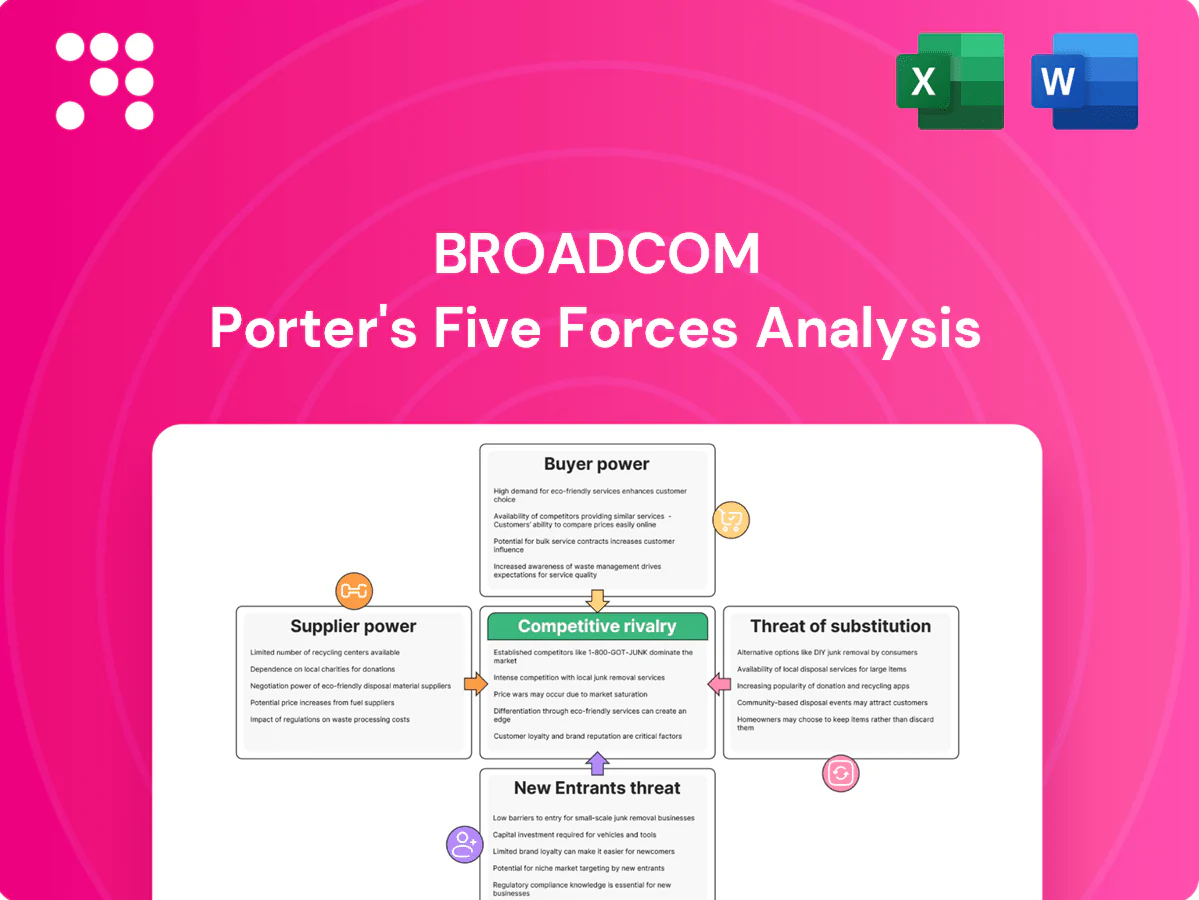
Broadcom Porter's Five Forces Analysis

From Overview to Strategy Blueprint
Broadcom faces intense buyer and competitor pressures, strong supplier leverage in chip ecosystems, and moderate threat from new entrants—this snapshot highlights critical tensions shaping its strategy. Unlock the full Porter's Five Forces Analysis to access force-by-force ratings, visuals, and actionable implications for investment or strategy.
Suppliers Bargaining Power

Concentrated foundry dependence
Broadcom's dependence on leading-edge foundries, primarily TSMC which held roughly 56% of the global foundry market in 2024, gives suppliers leverage over pricing and capacity. Limited alternative sources at 5nm/3nm raise switching costs and risk; utilization often exceeds 90% in tight cycles, and allocation can prioritize strategic customers, pressuring Broadcom's margins. Long-term supply agreements reduce but do not eliminate this exposure.
Advanced packaging and substrates
Advanced packaging and ABF substrate capacity is highly concentrated among a few OSATs and substrate suppliers, with the top providers accounting for the majority of available capacity (industry estimates >60% in 2024), creating tight supply; utilization rates exceeded 85–90% during 2024 peak cycles. Shortages have delayed ramps for networking and custom ASICs, letting suppliers extract premium pricing and favorable lead-time terms. Broadcom diversifies vendors but remains exposed to these bottlenecks.

EDA tools and design IP lock-in
EDA duopoly (Synopsys, Cadence) controls roughly 70% of the market and, together with critical IP like ARM (dominant in >90% of smartphone CPUs) and SerDes PHYs, creates high switching costs; toolchain interoperability and multi‑month to multi‑year certification cycles give suppliers pricing power, while perpetual/subscription licenses can compound costs over time—Broadcom’s scale yields volume discounts but supplier dependence remains.

Memory and HBM supply tightness
High-performance Broadcom products increasingly depend on HBM and premium DRAM supplied mainly by Samsung, SK hynix and Micron; in 2024 these few vendors continued to dominate supply. Cyclical tightness in 2024 pushed component costs higher and extended lead times from weeks to months. Vendor qualification remains time-consuming, limiting rapid re-sourcing, and strategic partnerships secure supply but constrain pricing leverage.
- Concentrated suppliers: Samsung, SK hynix, Micron
- Tightness 2024: higher costs, months-long lead times
- Slow vendor qualification limits flexibility
- Partnerships secure supply but reduce negotiation power
Specialized equipment and materials
Specialized upstream inputs—EUV scanners (~$150m+ per tool), advanced photoresists and specialty gases—create structural supplier leverage; 2024 supply tightness amplified inputs' bargaining power and any disruption cascades from foundries (TSMC, Samsung) to fabless customers like Broadcom, squeezing gross margins. Broadcom's 2024 gross margin ~73% faces pressure from cost pass-throughs despite S&OP visibility reducing surprises but not dependence.
- Upstream tool concentration: high
- Disruption impact: propagated to fabless
- Cost pass-throughs: margin compression
- S&OP: lowers surprise, not structural risk
Supplier concentration threatens chipmaker supply chain resilience
Broadcom faces supplier leverage from TSMC (TSMC ~56% foundry share in 2024) and concentrated OSAT/substrate providers (>60% capacity among top firms in 2024), raising switching costs and lead times. EDA duopoly (~70% market) and HBM suppliers (Samsung, SK hynix, Micron) limit re‑sourcing; 2024 gross margin ~73% remains exposed despite long‑term agreements.
| Supplier | Concentration 2024 | Impact |
|---|---|---|
| Foundries | TSMC ~56% | Pricing, capacity |
| OSATs/Substrates | Top >60% | Lead times |
| EDA | ~70% | Switching cost |
| DRAM/HBM | 3 vendors | Supply tightness |
What is included in the product
 Detailed Word Document
Uncovers key drivers of competition, customer influence, and market entry risks tailored to Broadcom, detailing each force—supplier/buyer power, substitutes, new-entrant barriers—and highlighting disruptive threats and strategic implications for investor decks or internal strategy reports.

 Customizable Excel Spreadsheet
Clear one-sheet summary of Broadcom's Porter's Five Forces—reveals supplier/buyer leverage, competitive rivalry, and entry/substitute risks; slide-ready, customizable, and integrates into dashboards for fast, confident strategic decisions.
Customers Bargaining Power

Hyperscaler and OEM concentration
Large hyperscalers and OEMs supplied over 40% of Broadcom’s revenue in 2024, concentrating data center, networking, broadband and wireless demand; their scale enables aggressive price negotiations and bespoke feature requirements. Design-ins yield multi-year engagements, yet annual pricing resets and renewal leverage—amplified by a small number of buyers—raise concentration risk and boost buyer bargaining power.
High switching and integration costs
Once Broadcom silicon is designed into switches, NICs, storage or wireless modules, replacement is costly and risky; firmware, drivers and multi-stage validation create deep stickiness that limits buyer leverage. Customers increasingly seek roadmap commitments rather than immediate price cuts, shifting negotiations to future feature and support guarantees. Aggressive procurement tactics therefore dampen churn despite pushback on pricing.

Multi-year supply and allocation dynamics
Long-term multi-year supply agreements with volume commitments give Broadcom and its customers balance by locking availability and smoothing allocation during tight cycles. When capacity is constrained, buyers typically accept premium pricing to secure continuity, while in downcycles purchasers push for concessions, flexible inventory terms and release rights. These dynamics shift bargaining power across the cycle as demand and capacity rebalance.

Software entrenchment via VMware and security
Software entrenchment via VMware and security raises switching costs as infrastructure subscriptions and multi-year support contracts bind enterprises; VMware’s installed base exceeds 500,000 customers (2024) and Broadcom reports high enterprise renewal dynamics, often ~90%. Cross-sell and suite bundling reduce buyer leverage on individual SKUs, though large customers can extract enterprise-wide discounts up to ~20% and use renewal timing as a key bargaining lever.
Standards and interoperability expectations
Buyers demand compliance with Ethernet, PCIe (PCI-SIG PCIe 5.0 baseline in 2024), Fibre Channel and security standards, constraining Broadcom’s differentiation and enabling easier price comparisons; proprietary ASIC enhancements, however, can create measurable lock-in—Broadcom’s scale after the $61 billion VMware deal (completed 2023) strengthens its ability to trade openness for performance and lower TCO.
- Standards: Ethernet 400G, PCIe 5.0 (2024)
- Effect: limits differentiation, aids price comparison
- Counter: proprietary ASICs drive lock-in and performance
- Buyer trade-off: openness vs performance/TCO
>40% hyperscaler/OEM revenue share; ~90% renewal moat
Large hyperscalers/OEMs drove >40% of Broadcom revenue in 2024, concentrating negotiation power and enabling price/roadmap demands. Design‑ins and firmware/drivers create high switching costs, limiting buyer leverage despite annual price resets. Multi‑year supply deals and capacity cycles shift power—buyers win in downturns, sellers in shortages. VMware entrenchment (500,000 customers; ~90% renewals) reduces SKU-level bargaining.
| Metric | 2024 |
|---|---|
| Hyperscaler/OEM revenue share | >40% |
| VMware customers | 500,000+ |
| Renewal rate | ~90% |
| Max enterprise discount | ~20% |
Same Document Delivered
Broadcom Porter's Five Forces Analysis
This preview shows the exact document you'll receive immediately after purchase—no surprises, no placeholders. The Broadcom Porter’s Five Forces analysis in this file is professionally formatted and ready to use, covering competitive rivalry, supplier and buyer power, and threats of entry and substitutes. Find concise conclusions and actionable recommendations included.

From Overview to Strategy Blueprint
Broadcom faces intense buyer and competitor pressures, strong supplier leverage in chip ecosystems, and moderate threat from new entrants—this snapshot highlights critical tensions shaping its strategy. Unlock the full Porter's Five Forces Analysis to access force-by-force ratings, visuals, and actionable implications for investment or strategy.
Suppliers Bargaining Power
Concentrated foundry dependence
Broadcom's dependence on leading-edge foundries, primarily TSMC which held roughly 56% of the global foundry market in 2024, gives suppliers leverage over pricing and capacity. Limited alternative sources at 5nm/3nm raise switching costs and risk; utilization often exceeds 90% in tight cycles, and allocation can prioritize strategic customers, pressuring Broadcom's margins. Long-term supply agreements reduce but do not eliminate this exposure.
Advanced packaging and substrates
Advanced packaging and ABF substrate capacity is highly concentrated among a few OSATs and substrate suppliers, with the top providers accounting for the majority of available capacity (industry estimates >60% in 2024), creating tight supply; utilization rates exceeded 85–90% during 2024 peak cycles. Shortages have delayed ramps for networking and custom ASICs, letting suppliers extract premium pricing and favorable lead-time terms. Broadcom diversifies vendors but remains exposed to these bottlenecks.
EDA tools and design IP lock-in
EDA duopoly (Synopsys, Cadence) controls roughly 70% of the market and, together with critical IP like ARM (dominant in >90% of smartphone CPUs) and SerDes PHYs, creates high switching costs; toolchain interoperability and multi‑month to multi‑year certification cycles give suppliers pricing power, while perpetual/subscription licenses can compound costs over time—Broadcom’s scale yields volume discounts but supplier dependence remains.
Memory and HBM supply tightness
High-performance Broadcom products increasingly depend on HBM and premium DRAM supplied mainly by Samsung, SK hynix and Micron; in 2024 these few vendors continued to dominate supply. Cyclical tightness in 2024 pushed component costs higher and extended lead times from weeks to months. Vendor qualification remains time-consuming, limiting rapid re-sourcing, and strategic partnerships secure supply but constrain pricing leverage.
- Concentrated suppliers: Samsung, SK hynix, Micron
- Tightness 2024: higher costs, months-long lead times
- Slow vendor qualification limits flexibility
- Partnerships secure supply but reduce negotiation power
Specialized equipment and materials
Specialized upstream inputs—EUV scanners (~$150m+ per tool), advanced photoresists and specialty gases—create structural supplier leverage; 2024 supply tightness amplified inputs' bargaining power and any disruption cascades from foundries (TSMC, Samsung) to fabless customers like Broadcom, squeezing gross margins. Broadcom's 2024 gross margin ~73% faces pressure from cost pass-throughs despite S&OP visibility reducing surprises but not dependence.
- Upstream tool concentration: high
- Disruption impact: propagated to fabless
- Cost pass-throughs: margin compression
- S&OP: lowers surprise, not structural risk
Supplier concentration threatens chipmaker supply chain resilience
Broadcom faces supplier leverage from TSMC (TSMC ~56% foundry share in 2024) and concentrated OSAT/substrate providers (>60% capacity among top firms in 2024), raising switching costs and lead times. EDA duopoly (~70% market) and HBM suppliers (Samsung, SK hynix, Micron) limit re‑sourcing; 2024 gross margin ~73% remains exposed despite long‑term agreements.
| Supplier | Concentration 2024 | Impact |
|---|---|---|
| Foundries | TSMC ~56% | Pricing, capacity |
| OSATs/Substrates | Top >60% | Lead times |
| EDA | ~70% | Switching cost |
| DRAM/HBM | 3 vendors | Supply tightness |
What is included in the product
Detailed Word Document
Uncovers key drivers of competition, customer influence, and market entry risks tailored to Broadcom, detailing each force—supplier/buyer power, substitutes, new-entrant barriers—and highlighting disruptive threats and strategic implications for investor decks or internal strategy reports.
Customizable Excel Spreadsheet
Clear one-sheet summary of Broadcom's Porter's Five Forces—reveals supplier/buyer leverage, competitive rivalry, and entry/substitute risks; slide-ready, customizable, and integrates into dashboards for fast, confident strategic decisions.
Customers Bargaining Power
Hyperscaler and OEM concentration
Large hyperscalers and OEMs supplied over 40% of Broadcom’s revenue in 2024, concentrating data center, networking, broadband and wireless demand; their scale enables aggressive price negotiations and bespoke feature requirements. Design-ins yield multi-year engagements, yet annual pricing resets and renewal leverage—amplified by a small number of buyers—raise concentration risk and boost buyer bargaining power.
High switching and integration costs
Once Broadcom silicon is designed into switches, NICs, storage or wireless modules, replacement is costly and risky; firmware, drivers and multi-stage validation create deep stickiness that limits buyer leverage. Customers increasingly seek roadmap commitments rather than immediate price cuts, shifting negotiations to future feature and support guarantees. Aggressive procurement tactics therefore dampen churn despite pushback on pricing.
Multi-year supply and allocation dynamics
Long-term multi-year supply agreements with volume commitments give Broadcom and its customers balance by locking availability and smoothing allocation during tight cycles. When capacity is constrained, buyers typically accept premium pricing to secure continuity, while in downcycles purchasers push for concessions, flexible inventory terms and release rights. These dynamics shift bargaining power across the cycle as demand and capacity rebalance.
Software entrenchment via VMware and security
Software entrenchment via VMware and security raises switching costs as infrastructure subscriptions and multi-year support contracts bind enterprises; VMware’s installed base exceeds 500,000 customers (2024) and Broadcom reports high enterprise renewal dynamics, often ~90%. Cross-sell and suite bundling reduce buyer leverage on individual SKUs, though large customers can extract enterprise-wide discounts up to ~20% and use renewal timing as a key bargaining lever.
Standards and interoperability expectations
Buyers demand compliance with Ethernet, PCIe (PCI-SIG PCIe 5.0 baseline in 2024), Fibre Channel and security standards, constraining Broadcom’s differentiation and enabling easier price comparisons; proprietary ASIC enhancements, however, can create measurable lock-in—Broadcom’s scale after the $61 billion VMware deal (completed 2023) strengthens its ability to trade openness for performance and lower TCO.
- Standards: Ethernet 400G, PCIe 5.0 (2024)
- Effect: limits differentiation, aids price comparison
- Counter: proprietary ASICs drive lock-in and performance
- Buyer trade-off: openness vs performance/TCO
>40% hyperscaler/OEM revenue share; ~90% renewal moat
Large hyperscalers/OEMs drove >40% of Broadcom revenue in 2024, concentrating negotiation power and enabling price/roadmap demands. Design‑ins and firmware/drivers create high switching costs, limiting buyer leverage despite annual price resets. Multi‑year supply deals and capacity cycles shift power—buyers win in downturns, sellers in shortages. VMware entrenchment (500,000 customers; ~90% renewals) reduces SKU-level bargaining.
| Metric | 2024 |
|---|---|
| Hyperscaler/OEM revenue share | >40% |
| VMware customers | 500,000+ |
| Renewal rate | ~90% |
| Max enterprise discount | ~20% |
Same Document Delivered
Broadcom Porter's Five Forces Analysis
This preview shows the exact document you'll receive immediately after purchase—no surprises, no placeholders. The Broadcom Porter’s Five Forces analysis in this file is professionally formatted and ready to use, covering competitive rivalry, supplier and buyer power, and threats of entry and substitutes. Find concise conclusions and actionable recommendations included.
Original: $10.00
-65%$10.00
$3.50Description
From Overview to Strategy Blueprint
Broadcom faces intense buyer and competitor pressures, strong supplier leverage in chip ecosystems, and moderate threat from new entrants—this snapshot highlights critical tensions shaping its strategy. Unlock the full Porter's Five Forces Analysis to access force-by-force ratings, visuals, and actionable implications for investment or strategy.
Suppliers Bargaining Power
Concentrated foundry dependence
Broadcom's dependence on leading-edge foundries, primarily TSMC which held roughly 56% of the global foundry market in 2024, gives suppliers leverage over pricing and capacity. Limited alternative sources at 5nm/3nm raise switching costs and risk; utilization often exceeds 90% in tight cycles, and allocation can prioritize strategic customers, pressuring Broadcom's margins. Long-term supply agreements reduce but do not eliminate this exposure.
Advanced packaging and substrates
Advanced packaging and ABF substrate capacity is highly concentrated among a few OSATs and substrate suppliers, with the top providers accounting for the majority of available capacity (industry estimates >60% in 2024), creating tight supply; utilization rates exceeded 85–90% during 2024 peak cycles. Shortages have delayed ramps for networking and custom ASICs, letting suppliers extract premium pricing and favorable lead-time terms. Broadcom diversifies vendors but remains exposed to these bottlenecks.
EDA tools and design IP lock-in
EDA duopoly (Synopsys, Cadence) controls roughly 70% of the market and, together with critical IP like ARM (dominant in >90% of smartphone CPUs) and SerDes PHYs, creates high switching costs; toolchain interoperability and multi‑month to multi‑year certification cycles give suppliers pricing power, while perpetual/subscription licenses can compound costs over time—Broadcom’s scale yields volume discounts but supplier dependence remains.
Memory and HBM supply tightness
High-performance Broadcom products increasingly depend on HBM and premium DRAM supplied mainly by Samsung, SK hynix and Micron; in 2024 these few vendors continued to dominate supply. Cyclical tightness in 2024 pushed component costs higher and extended lead times from weeks to months. Vendor qualification remains time-consuming, limiting rapid re-sourcing, and strategic partnerships secure supply but constrain pricing leverage.
- Concentrated suppliers: Samsung, SK hynix, Micron
- Tightness 2024: higher costs, months-long lead times
- Slow vendor qualification limits flexibility
- Partnerships secure supply but reduce negotiation power
Specialized equipment and materials
Specialized upstream inputs—EUV scanners (~$150m+ per tool), advanced photoresists and specialty gases—create structural supplier leverage; 2024 supply tightness amplified inputs' bargaining power and any disruption cascades from foundries (TSMC, Samsung) to fabless customers like Broadcom, squeezing gross margins. Broadcom's 2024 gross margin ~73% faces pressure from cost pass-throughs despite S&OP visibility reducing surprises but not dependence.
- Upstream tool concentration: high
- Disruption impact: propagated to fabless
- Cost pass-throughs: margin compression
- S&OP: lowers surprise, not structural risk
Supplier concentration threatens chipmaker supply chain resilience
Broadcom faces supplier leverage from TSMC (TSMC ~56% foundry share in 2024) and concentrated OSAT/substrate providers (>60% capacity among top firms in 2024), raising switching costs and lead times. EDA duopoly (~70% market) and HBM suppliers (Samsung, SK hynix, Micron) limit re‑sourcing; 2024 gross margin ~73% remains exposed despite long‑term agreements.
| Supplier | Concentration 2024 | Impact |
|---|---|---|
| Foundries | TSMC ~56% | Pricing, capacity |
| OSATs/Substrates | Top >60% | Lead times |
| EDA | ~70% | Switching cost |
| DRAM/HBM | 3 vendors | Supply tightness |
What is included in the product
Detailed Word Document
Uncovers key drivers of competition, customer influence, and market entry risks tailored to Broadcom, detailing each force—supplier/buyer power, substitutes, new-entrant barriers—and highlighting disruptive threats and strategic implications for investor decks or internal strategy reports.
Customizable Excel Spreadsheet
Clear one-sheet summary of Broadcom's Porter's Five Forces—reveals supplier/buyer leverage, competitive rivalry, and entry/substitute risks; slide-ready, customizable, and integrates into dashboards for fast, confident strategic decisions.
Customers Bargaining Power
Hyperscaler and OEM concentration
Large hyperscalers and OEMs supplied over 40% of Broadcom’s revenue in 2024, concentrating data center, networking, broadband and wireless demand; their scale enables aggressive price negotiations and bespoke feature requirements. Design-ins yield multi-year engagements, yet annual pricing resets and renewal leverage—amplified by a small number of buyers—raise concentration risk and boost buyer bargaining power.
High switching and integration costs
Once Broadcom silicon is designed into switches, NICs, storage or wireless modules, replacement is costly and risky; firmware, drivers and multi-stage validation create deep stickiness that limits buyer leverage. Customers increasingly seek roadmap commitments rather than immediate price cuts, shifting negotiations to future feature and support guarantees. Aggressive procurement tactics therefore dampen churn despite pushback on pricing.
Multi-year supply and allocation dynamics
Long-term multi-year supply agreements with volume commitments give Broadcom and its customers balance by locking availability and smoothing allocation during tight cycles. When capacity is constrained, buyers typically accept premium pricing to secure continuity, while in downcycles purchasers push for concessions, flexible inventory terms and release rights. These dynamics shift bargaining power across the cycle as demand and capacity rebalance.
Software entrenchment via VMware and security
Software entrenchment via VMware and security raises switching costs as infrastructure subscriptions and multi-year support contracts bind enterprises; VMware’s installed base exceeds 500,000 customers (2024) and Broadcom reports high enterprise renewal dynamics, often ~90%. Cross-sell and suite bundling reduce buyer leverage on individual SKUs, though large customers can extract enterprise-wide discounts up to ~20% and use renewal timing as a key bargaining lever.
Standards and interoperability expectations
Buyers demand compliance with Ethernet, PCIe (PCI-SIG PCIe 5.0 baseline in 2024), Fibre Channel and security standards, constraining Broadcom’s differentiation and enabling easier price comparisons; proprietary ASIC enhancements, however, can create measurable lock-in—Broadcom’s scale after the $61 billion VMware deal (completed 2023) strengthens its ability to trade openness for performance and lower TCO.
- Standards: Ethernet 400G, PCIe 5.0 (2024)
- Effect: limits differentiation, aids price comparison
- Counter: proprietary ASICs drive lock-in and performance
- Buyer trade-off: openness vs performance/TCO
>40% hyperscaler/OEM revenue share; ~90% renewal moat
Large hyperscalers/OEMs drove >40% of Broadcom revenue in 2024, concentrating negotiation power and enabling price/roadmap demands. Design‑ins and firmware/drivers create high switching costs, limiting buyer leverage despite annual price resets. Multi‑year supply deals and capacity cycles shift power—buyers win in downturns, sellers in shortages. VMware entrenchment (500,000 customers; ~90% renewals) reduces SKU-level bargaining.
| Metric | 2024 |
|---|---|
| Hyperscaler/OEM revenue share | >40% |
| VMware customers | 500,000+ |
| Renewal rate | ~90% |
| Max enterprise discount | ~20% |
Same Document Delivered
Broadcom Porter's Five Forces Analysis
This preview shows the exact document you'll receive immediately after purchase—no surprises, no placeholders. The Broadcom Porter’s Five Forces analysis in this file is professionally formatted and ready to use, covering competitive rivalry, supplier and buyer power, and threats of entry and substitutes. Find concise conclusions and actionable recommendations included.











